
This article will analyze the Best FX Hedging Platforms for Exporting Businesses with a focus on tools and brokers that manage foreign exchange risk efficiently. Currency fluctuations can affect exporters’ profitability and the right platform can help.
- What is An FX hedging Platform?
- Key Points & Best FX Hedging Platforms For Export Businesses
- 10 Best FX Hedging Platforms For Export Businesses
- 1. Interactive Brokers
- 2. Charles Schwab
- 3. E*TRADE
- 4. NinjaTrader
- 5. Optimus Futures
- 6. AMP Futures
- 7. Tastytrade
- 8. TradeStation
- 9. Tradier
- 10. FP Markets
- How We Choose Best FX Hedging Platforms for Export Businesses
- Conclsuion
- FAQ
This article will analyze the best options available, features, benefits and how each can improve the efficiency of FX management in international trade.
What is An FX hedging Platform?
An FX hedging platform is specially-designed tools or brokers which support exporting companies in controlling and reducing foreign exchange risks.
It enables companies to protect their profits from changes in the currency by employing financial tools, such as forwards, futures, options or CFDs.
These platforms offer market data in real time, execution tools and analytics, which allow businesses to use particular hedging strategies.
By fixing exchange rates or controlling their exposures, exporters are able to stabilize their revenue and eliminate financial risks in international trade.
Key Points & Best FX Hedging Platforms For Export Businesses
| Platform | Key Point |
|---|---|
| Interactive Brokers | Global reach with low FX fees |
| Charles Schwab | Trusted US broker with strong compliance |
| E*TRADE | Easy-to-use platform for SMEs |
| NinjaTrader | Advanced futures & FX hedging tools |
| Optimus Futures | Specialized in futures contracts for risk management |
| AMP Futures | Low-cost futures broker with hedging support |
| tastytrade | Strong options trading for currency risk |
| TradeStation | Robust analytics and hedging automation |
| Tradier | API-driven hedging solutions for businesses |
| FP Markets | Best overall ECN |
10 Best FX Hedging Platforms For Export Businesses
1. Interactive Brokers
Interactive Brokers (IBKR) earned the reputation of the top firm for business FX hedging owing to its global multi-currency access, tight spreads and deep liquidity from interbank source flow.
Due to the access to over 100 currency pairs over both major and emerging market currencies, export businesses are able to precisely hedge their receivables or payables.
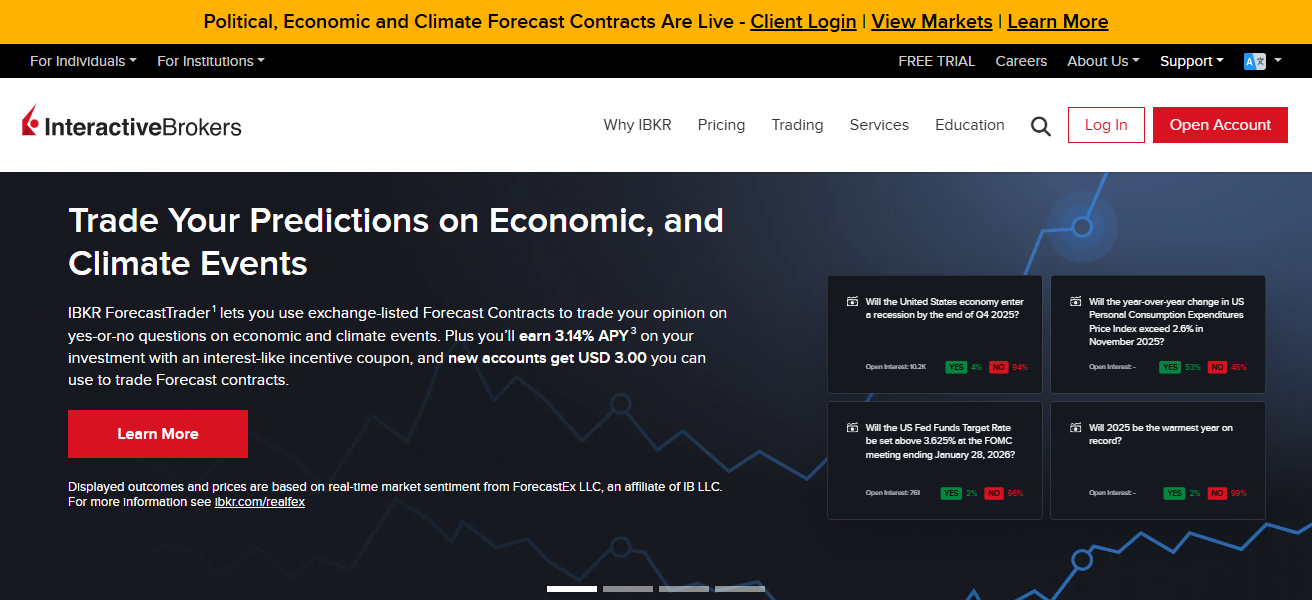
Clients are offered the FXTrader interface which provides the currency risk professional with real time quotes, positions and execution measures.
Furthermore, to more than 36 jurisdictions with considerable regulatory coverage, IBKR’s extensive platform services makes it ideal for international exporters in need of cost-efficient and transparent hedging.
Interactive Brokers Features
- Global Currency Access: Exporters operating on a worldwide scale can access over 135 currencies.
- Low FX Fees: Hedging prices are lowered by tight spreads and low competition.
- Advanced Risk Tools: Use of high-level exposure assessment tools.
- Multi-Asset Integration: Allows for the trading of FX along with equities, debts, and futures.
| Pros | Cons |
|---|---|
| Global reach with 135+ currencies | Complex interface for beginners |
| Low FX fees and tight spreads | High minimum funding requirements |
| Advanced risk management tools | Customer support less personalized |
2. Charles Schwab
Incorporating advanced thinkorswim platform, Charles Schwab is the top contender when it comes to integrating export trading and risk management with hedging.
Schwab has over 65 currency pairs, which include major, minor, and exotic pairs. He has advanced charting and real time data along with adaptive analytical tools which help businesses to monitor and hedge FX exposures.
Schwab’s regulatory status and educational resources help corporate treasurers understand the complexities of hedging and the execution risks involved.
This is why Schwab is an excellent option. FX hedging, portfolio tools and other financial services make Schwab an excellent option for exporters.
Charles Schwab Features
- Trusted US Brand: Reliable and compliant industry leader.
- Integrated Banking: Exporters can easily set up an account with US banks.
- Educational Resources: Support and coaching are provided to SMEs regarding FX hedging for the first time.
- Solid Customer Support: Business clients receive personalized support.
| Pros | Cons |
|---|---|
| Strong regulatory compliance | Limited FX product range |
| Trusted US brand | Not ideal for complex hedging |
| Good customer service | Higher fees compared to ECN brokers |
3. E*TRADE
ETRADE is an established brokerage offering FX along with equities, futures, and options. Businesses can access currency futures and options, hedging foreign exchange risk, via Power ETRADE and Futures Trader platforms.
E*TRADE is not strictly specialized in FX as other brokers, but its multi‑asset approach caters to export market businesses that want to integrate hedging and other financial strategies.
The platform’s easy-to-use interface and advanced trading tools enable corporate risk managers to implement efficient hedging with currency futures and monitor overall financial exposure across assets.
E*TRADE Features
- User-Friendly Platform: Designed for small exporters, the platform is very easy to use.
- Strong US Market Access: Great for exporters with an American currency flow.
- Basic Hedging Tools: Available tools are basic and include spot FX and uncomplicated contracts.
- Mobile Integration: Convenient monitoring on a mobile device.
| Pros | Cons |
|---|---|
| User-friendly platform | Limited global currency access |
| Strong integration with US banking | Not designed for advanced hedging |
| Good for SMEs starting FX hedging | Higher spreads than institutional brokers |
4. NinjaTrader
NinjaTrader primarily serves as a professional trading platform, specializing in trading futures markets, including currency futures which export businesses utilize to hedge FX risk.
Although not a broker, its software integrates with brokerage accounts to execute direct hedging trades in CME currency futures and options markets.
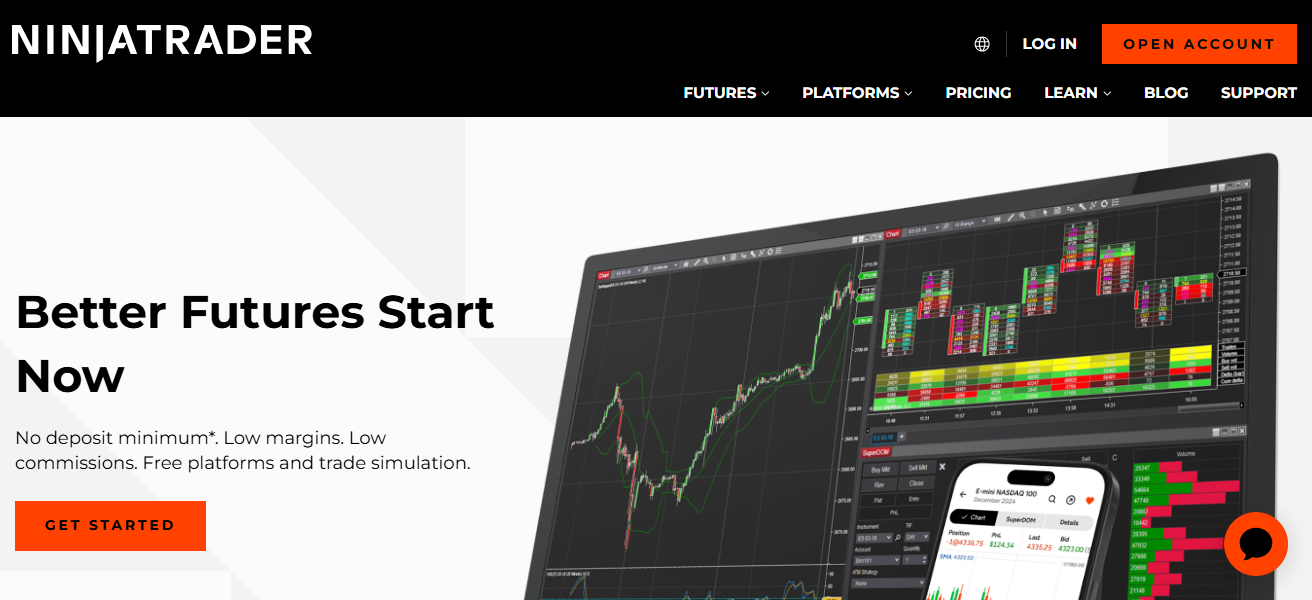
The platform is highly capable in advanced charting and other computing, including automated strategies and real-time analytics which are critical to executing and managing fast-moving currency futures.
For exporters that seek precision and automation protection with NinjaTrader’s software, a highly customizable technical environment is available.
NinjaTrader Features
- Advanced Futures Trading: Strong currency futures trading tools for hedging.
- Customizable Strategies: Risk management can be tailored to the needs of individual businesses.
- Low-Cost Execution: Active hedgers are provided with multiple cost-saving options.
- Analytics & Charts: Utilizes high-level detailed analysis on currency futures.
| Pros | Cons |
|---|---|
| Advanced futures & FX tools | Steep learning curve |
| Customizable strategies | Requires technical expertise |
| Low-cost futures trading | Not beginner-friendly |
5. Optimus Futures
Optimus Futures is a futures broker and provides a gateway to foreign currency futures and foreign currency options contracts that exporters use to hedge their exchange rate risks.
They offer sophisticated trading platforms and APIs that enable companies to automate their hedging logic and/or embed foreign exchange risk management into their existing systems.
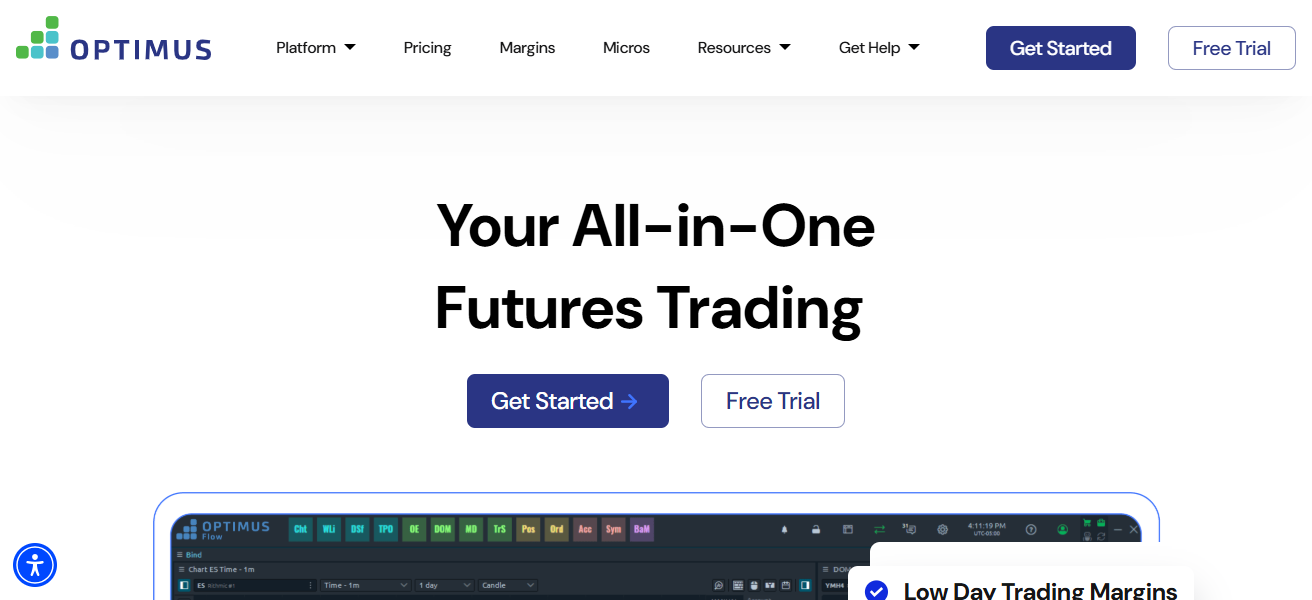
While Optimus might have restrictions on certain traditional FX pairs, they provide access to CME currency futures, an asset hedging instrument corporate treasurers prefer for its exchange- traded transparency and regulated clearing.
The platform also offers execution and research technology that helps companies to optimize their hedging in a cost-efficient manner.
Optimus Futures Features
- Futures Specialists: Perfect for commodity-linked exporters.
- Extensive Range of Contracts: Futures on currencies and commodities.
- Focus on Risk Management: Volatility hedging is what the tools are made for.
- Brokerage Assistance: Support on futures-hedging strategies.
| Pros | Cons |
|---|---|
| Specialized in futures contracts | Limited FX spot trading |
| Strong hedging support | Platform less intuitive |
| Good for commodity-linked exporters | Requires larger trade sizes |
6. AMP Futures
AMP Futures offers a variety of futures markets, including currency futures, which allow businesses to hedge foreign exchange risk.
AMP offers competitive pricing along with access to Quantower, MultiCharts, and TradingView, so businesses can create complex hedging strategies and analyze their currency exposures thoroughly.

AMP’s technology stack offers automation and risk management which are useful when dealing with larger FX exposures, as well as when h hedges are related to other risk factors.
Due to AMP’s strong safety score and low trading costs, it is an appealing option for businesses that need to hedge frequently and/or in larger amounts.
AMP Futures Features
- Brokerage Cost: Very low commissions on futures’ hedging.
- Futures Available Globally: Diverse contracts for exporters.
- Margining Flexibility: Useful for cash flow management in hedging.
- Choice of Platform: Multiple trading platforms are supported.
| Pros | Cons |
|---|---|
| Low-cost futures broker | Limited customer support |
| Wide range of futures contracts | Not ideal for small exporters |
| Strong hedging flexibility | Platform complexity |
7. Tastytrade
Tastytrade provides foreign exchange trading along with other asset classes on its platform. They have competitive pricing and uncomplicated onboarding processes.
The strengths of tastytrade for export businesses and hedging will come from its integration of forex, futures, and options on one platform and its governing regulation that permits sound risk management.
They might not have the largest currency pair options, but their cost structure and the management of tools provided for currency risk make them stand out among other brokers for smaller exporters.
In addition, the businesses’ available hedging plans and market conditions may be analyzed and adjusted with tools geared for trading strategies and research.
Tastytrade Features
- Currency Options: Excellent platform for hedging currencies.
- Exporter Training: Educational material is available.
- Low Cost: Cost-effective strategies for hedging.
- Focus on the US Market: Optimal for exporters selling USD.
| Pros | Cons |
|---|---|
| Strong options trading tools | Limited FX spot access |
| Educational resources for risk management | Better suited for US exporters |
| Low commissions on options | Not ideal for global hedging |
8. TradeStation
TradeStation is versatile for hedging currency futures and multi-asset risk management. It’s programmable environment enables corporate risk managers to design and back-test FX hedging strategies using historical data prior to going live.
For export businesses that require stringent analytical control over their hedging outcomes, strategies, and analytics, and real-time data feeds, and optimizing of strategies do provide that for export businesses.
TradeStation is not an FX broker. However, the integration of futures and strategies does provide systemic currency risk that is accessible.
TradeStation Features
- Outstanding Analytics: Excellent automation of hedging and charting.
- Automated Trading: Used for strategies to manage FX risk.
- Multi-Asset: FX, futures and equities in one platform.
- Tools for Institutions: Designed for bigger exporters.
| Pros | Cons |
|---|---|
| Robust analytics & automation | Platform complexity |
| Strong for algorithmic hedging | Higher fees than discount brokers |
| Wide range of instruments | Requires technical knowledge |
9. Tradier
Tradier is famous for its flexible API, Facilitating connections to 3rd party trading platforms and offering access to several markets, including currency futures and derivatives.
For exporting businesses, Tradier’s developer friendly set of APIs can assist customizations of applications for hedging, and risk systems designed for specific currency exposures.
Tradier is not specifically focused on FX; however, due to its regulated environment and access to derivatives markets, it can be an option for automating hedging logic
Integrating risk dashboards or connecting hedging execution to enterprise systems. Flexibility and competitive Pricing make Tradier stand out.
Tradier Features
- API Focused: Integrates hedging to ERP systems.
- Strategy Customization: Adjusted to the business’s workflows.
- Brokerage Cost: Very low, friendly to SMEs.
- Tech Intensive: High coding knowledge is needed.
| Pros | Cons |
|---|---|
| API-driven hedging solutions | Not beginner-friendly |
| Customizable for ERP integration | Limited FX market access |
| Low-cost brokerage | Requires coding knowledge |
10. FP Markets
FP Markets is a global broker with forex trading on competitive spreads and a wide range of currency pairs, which export businesses can use for spot hedging and short-term risk mitigation.
While FP Markets is a Retail FX player, because of its strict multi-instrument industry regulation, it can also fit some corporates hedging strategy.
FP Markets has platforms with advanced charting, and provides tools for real time execution and risk management so that businesses can efficiently conduct foreign exchange exposure monitoring and hedging in the currency markets.
Exporters needing simple, straightforward access to the FX markets along with execution and analytical tools can find FP Markets a practical options. (Note: FP Markets corporate hedging specific scores are less publicly visible).
FP Markets Features
- Pricing: ECN, tight spreads and ideal for exporters.
- Platforms: Support and widely used for FX hedging is MT4/MT5.
- Global Reach: Has numerous cross-currency pairs.
- Execution Speed: Less slippage on hedging orders.
| Pros | Cons |
|---|---|
| Best ECN pricing with tight spreads | Customer support varies by region |
| MT4/MT5 support for exporters | Requires FX trading knowledge |
| Strong global reach | Not as strong in futures/options |
How We Choose Best FX Hedging Platforms for Export Businesses
Range of currency pairs The platform must have a diverse selection of major, minor and exotic currency pairs to match those of your export business.
Hedging Instruments Choose platforms that offer a variety of hedging instruments that include FX forwards, FX options, and CFDs.
Execution Speed and Liquidity The best platforms have lower costs and minimal slippage because they have tight spreads and a great amount of liquidity.
Automation and API Access The best platforms allow for the automation of hedges and the ability to integrate with your business’s treasury and ERP systems.
Regulation and Safety Look for platforms with applicable regulations to ensure the protection of your funds and the transparency of the platform.
Cost Structure Evaluate hedge affordability by examining the platforms costs including, commissions, margins and spreads.
Analytics and Risk Tools The value of the platform is increased with the ability for scenario analysis and other advanced reporting tools, to improved decision making.
Ease of Use Platforms that are user friendly allow for easier monitoring of your business’s currency pairs and minimize the chance for errors to be made.
Conclsuion
In summary, for export firms, selecting the appropriate FX hedging platform is essential for controlling and safeguarding against loss due to currency fluctuations.
Exporters can hedge effectively using automation and analytical tools available on Interactive Brokers, Charles Schwab, and TradeStation.
Choosing the right platform will help exporters enhance the predictability of their financial outcomes, support revenue stream consistency, and help refine their strategies for overseas trade.
FAQ
To reduce profit volatility caused by currency fluctuations when dealing in currencies different from their home currency.
FX forwards, currency futures, options, and swaps — depending on risk tolerance and strategy.
Yes, many multi‑asset brokers offer FX and futures access suitable for corporate hedging, but professional needs vary.
Wide currency access, low costs, deep liquidity, automation/APIs, risk analytics, and reliable execution.
Yes — spreads, commissions, and fees directly affect hedging profitability.