
This article will focus on the top software used for Global Debt Collection that optimizes collection processes, augments the flow of cash, and guarantees regulatory compliance.
- Key Points & Best Global Collections Management Software
- 10 Best Global Collections Management Software
- 1. HighRadius Collections
- HighRadius Collections – Key Features
- 2. Kolleno
- Kolleno – Key Features
- 3. DebtCol
- DebtCol — Functions and Features
- 4. Experian Debt Collection
- 5. Lexop
- Lexop — Functions and Features
- 6. Katabat
- 7. Collect!
- 8. Case Master Pro
- Case Master Pro — Key Features
- 9. FICO Debt Manager
- 10. TLOxp by TransUnion
- How To Choose The Best Collections Management Software
- Cocnlsuion
- FAQ
This software incorporates automation, data analysis, and multi-channel communication, thereby improving collection efficiency
Decreasing the amount of collection work that has to be done manually, and assisting organizations in the effective management of receivables in numerous countries and different industries.
Key Points & Best Global Collections Management Software
| Software | Key Point |
|---|---|
| HighRadius Collections | AI-driven automation for accounts receivable and debt recovery |
| Kolleno | Unified AR management with smart reminders and cash flow optimization |
| DebtCol | Cloud-based debt recovery with compliance and workflow automation |
| Experian Debt Collection | Data-rich insights leveraging credit bureau analytics for collections |
| Lexop | Customer-friendly payment negotiation platform with digital communication tools |
| Katabat | Omnichannel collections with strong compliance and customer engagement features |
| Collect! | Flexible debt collection system for agencies and enterprises |
| Case Master Pro | Legal-focused collections software with case tracking and document automation |
| FICO Debt Manager | Advanced analytics for debt recovery strategies and portfolio management |
| TLOxp by TransUnion | Skip tracing and debtor insights powered by large-scale data sets |
10 Best Global Collections Management Software
1. HighRadius Collections
HighRadius Collections is a frontrunner in accounts receivable automation software for collectors that is powered by collections automation and artificial intelligence.
This software has been developed for firms that want to automate overdue receivables collections and decrease days sales outstanding.
Cash flow is improved and manual work is reduced due to worklist automation that prioritizes accounts based on predicted risk and accounts that are overdue.
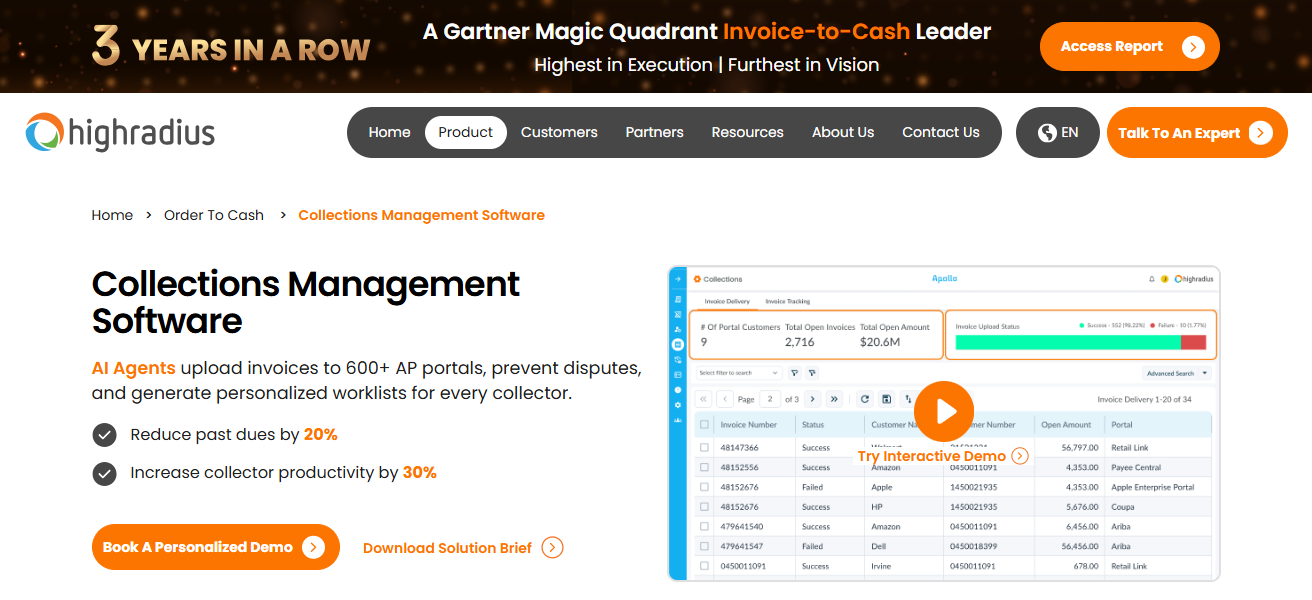
Integrated dashboards display accounts in real time, and the software has been widely adopted by large Du Pont automation has improved finance team productivity reduced overdue accounts and improved decision making.
HighRadius Collections – Key Features
AI-powered Account Risk Assessment: HighRadius uses machine learning to identify and order account risks and payment possibilities so that collectors can prioritize more challenging and overdue receivables.
Automated Payment Reminders and Dunning Letters: HighRadius systems automatically create and dispatch individualized payment email and SMS reminders and dunning letters to improve efficiency in cash recovery.
Integrated Communication and Dialing: HighRadius streams call and email tasks via a single dashboard, giving users the convenience of in-app dialing and automatic call log recording.
Automated Invoice and Payment Status Updating: HighRadius automatically records invoice and payment status by AP portals and ERPs in real time, thereby eliminating time-consuming reconciliations.
| Pros | Cons |
|---|---|
| Uses advanced AI and automation to intelligently prioritize collections and reduce manual effort. | Pricing is usually high and may be prohibitive for small businesses. |
| Integrates well with major ERPs like SAP and Oracle for end-to-end receivables management. | Setup and onboarding can be time-consuming and complex. |
| Strong reporting and real-time dashboards provide actionable insights. | Customization may require additional professional services. |
| Helps reduce Days Sales Outstanding (DSO) and improve cash flow with predictive risk scoring. | Some advanced features might be overwhelming for smaller finance teams. |
2. Kolleno
Kolleno is an innovative platform that automates debt collection and client interactions in an effort to streamline and improve efficiency in the collections process.
specializes in cash flow improvement by automating tailored communications across various channels such as SMS, email, or WhatsApp, depending on the preferred method of contact.
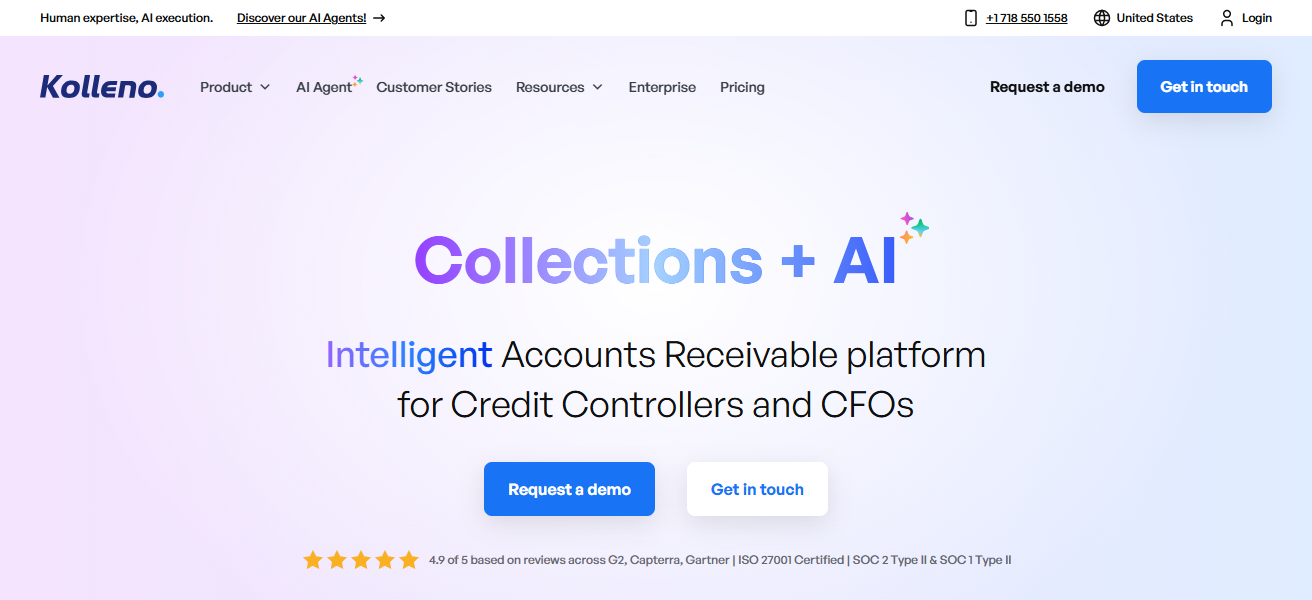
The platform features artificial intelligence, which helps to lower costs and improve collection rates by aligning accounts with the most capable agents and determining the most effective collection strategies.
The software also optimizes compliance with the FDCPA and TCPA and contains features which help regulatory requirements to be met.
Kolleno – Key Features
AI Collection Technology: Kolleno is equipped with AI that improves customer payment behavior prediction for collection recommendations.
All-in-one Accounts Receivable and Collection Software: Kolleno unifies customer payment and communication functions in a single interface for maximum operational efficiency.
Customer Payment Portal: Kolleno provides a payment portal with accessible invoices and payment history that streamlines customer payment.
Real Ontime Data Flow: Kolleno seamlessly integrates with active accounting software such as NetSuite, QuickBooks, or SAP and provides real-time data for payment processors.
| Pros | Cons |
|---|---|
| Modern and easy-to-use interface with intuitive workflows. | A newer platform — may have fewer advanced features than legacy systems. |
| Multi-channel communication (SMS, email, WhatsApp) boosts engagement. | Enterprise-level integrations may not be as mature. |
| AI-driven account matching improves collector productivity. | Rapidly evolving toolset — frequent updates may affect stability. |
| Strong compliance features for regulated environments (e.g., FDCPA). | Smaller user community for peer support/resources. |
3. DebtCol
DebtCol is a complete debt collection and field service management solution that is used by collection agencies, law firms, and field agents to simplify and enhance the collections process.
Features include, but are not limited to: contingent and purchased debt management, secure client and debtor portals, and workflow automation from first contact to payment.
The solution is flexible and can manage the operations of small boutique agencies and larger firms, and is able to connect with MYOB and Xero, popular accounting packages.
With strong security features such as multi-factor authentication and data encryption, DebtCol enables agencies to work more efficiently, monitor manual workload in debt recovery operations, and shift to high-level tasks.
DebtCol — Functions and Features
Complete End-to-End Debt & Field Services Management: This allows for debtor intake and intelligent work queue automation and activity tracking with reporting.
Client & Agent Portals: Secure portals for debtors, clients and field agents to access account information and make payments.
Online Payments & Electronic Filing: Integrated systems for online payment processing and electronic court document filing.
Custom Reports and Compliance Tools: Tailor made reporting;s compliance features assists in following a set of rules.
| Pros | Cons |
|---|---|
| Designed specifically for professional collection agencies and law firms. | Interface may feel outdated compared to modern SaaS tools. |
| Supports contingent and purchased debt portfolios. | Less focus on AI automation or predictive analytics. |
| Integrates with accounting systems like Xero and MYOB. | Best suited for agencies — not ideal for corporate AR teams. |
| Good security with encryption and multi-factor authentication. | Customization may require technical support. |
4. Experian Debt Collection
Experian uses credit bureau info to help companies manage their debt collections by finding debtors, determining their ability to repay, and deciding how to focus their collection efforts.
The platform uses accurate, updated consumer and credit data to assist with skip tracing, right party contact identification, and debtor segmentation.
Experian offers various options within their collection system (from simple access to data to full collection cycle management) making it cost efficient and eliminating unnecessary systems.
Companies can enhance their debtor records, prioritize their outreach and map their contact efforts to targets using a central portal for debt recovery.
Experian has high quality data which is especially useful for creditors, lenders and utilities who want to enhance their recovery.
Experian Debt Collection — Functions and Features
Access to Quality Data: Data on consumers can be contacted, and credit history and information can be utilized.
Skip Tracing & Contact Verification: Known for name and address verification, and related phone number verification to improve reach rates.
Tools for Prioritizing Portfolios: Use of exclusive scoring models to categorize and prioritize accounts based on the probability to collect.
Legal & Compliance Risks: Detection of protected accounts (bankrupt, deceased) to minimize risk.
| Pros | Cons |
|---|---|
| Access to extensive credit bureau data helps locate debtors faster. | Data access costs can be significant. |
| Strong skip tracing and debtor verification tools. | Not a full end-to-end collection workflow by itself. |
| Excellent for segmenting accounts by risk and contact likelihood. | Requires integration with collections software to be fully effective. |
| Widely trusted and established provider of credit intelligence. | Analytics might require training to maximize value. |
5. Lexop
Lexop is a technology provider centered digitally around streamlining collections efficiently and creating a workflow that best optimizes the borrower’s experience and recovery rates for the lending institution.
Lexop provides a platform that automates payment reminders and facilitates payments and balance resolution through digital wallets.
In 2025, Lexop was mergered with Eltropy, where Lexop’s technology and Eltropy’s AI communication technology further enhanced and streamlined loan repayment through credit unions and community banks.
Due to Lexop’s values and culture, the collections process is deeply automated, thus lowering delinquency and allowing the lending institution to collect without damaging the borrower’s experience.
Lexop — Functions and Features
Automated Intelligent Loan Repayment: Loan repayment reminders are automated for prior to and after loan due dates using AI workflows.
Engagement through Multiple Channels: Text, email, and voice communications available to borrowers.
Self-Service Payment: Borrowers make payments with branded portals and digital wallets at any time.
| Pros | Cons |
|---|---|
| Improves debtor experience with self-service payment options. | Focuses mostly on communication — not a complete AR system. |
| Automates reminders via text, email, and voice. | Requires integration with core systems to unlock full value. |
| Increases engagement and payment conversions. | Not built for complex enterprise workflows. |
| Easy implementation and intuitive interfaces. | Fewer advanced analytics features relative to bigger platforms. |
6. Katabat
Katabat offers large lenders, agencies, and financial institutions a comprehensive, cloud-based solution for debt collection and credit management.
With omni-channel orchestration, customizable communication strategies can be employed via email, SMS, and voice, and borrowers can be engaged more effectively through web portal campaigns.

The platform offers configurable workflows that are easily integrated via APIs into existing systems, installed quickly, and customized to fit unique business demands.
Focused on compliance, automation, and customer experience, Katabat helps organizations reduce and manage delinquencies more effectively, automate processes, and scale collections.
Katabat — Key Features
Omni-Channel Communication: Users can engage debtors via email, SMS, web portal, and voice, depending on their preferred and dominated communication channel.
Machine-Learning Strategy Engine: Utilizes pre-trained machine learning models to customize messages and treatment paths to each individual account.
Customizable Workflows: Lets lenders establish rules and workflows to reflect their organization and operational requirements.
Enterprise-Level Compliance: Features as built compliance, regulatory, and security provisions designed to support enterprise lenders.
| Pros | Cons |
|---|---|
| Omni-channel engagement across email, SMS, web, and voice. | Higher cost compared to many alternatives. |
| Highly configurable workflows and compliance tracking. | Learning curve for advanced setup. |
| API support for seamless integration with existing systems. | May require consulting to optimize configurations. |
| Designed to scale for enterprise portfolios. | Some UI elements may feel complex for beginners. |
7. Collect!
Collect! by Comtech Systems Inc. is a flexible and scalable debt collection and accounts receivable management solution suitable for agencies of all sizes.
It automates the entire debt recovery process from initial contact through final payment, offering configurable workflows, automated correspondence, detailed reporting, and robust compliance controls.
Collect! supports cloud and on-premise deployment, making it adaptable to different business needs and IT infrastructures. Its customization options and integrations enable businesses to tailor work queues
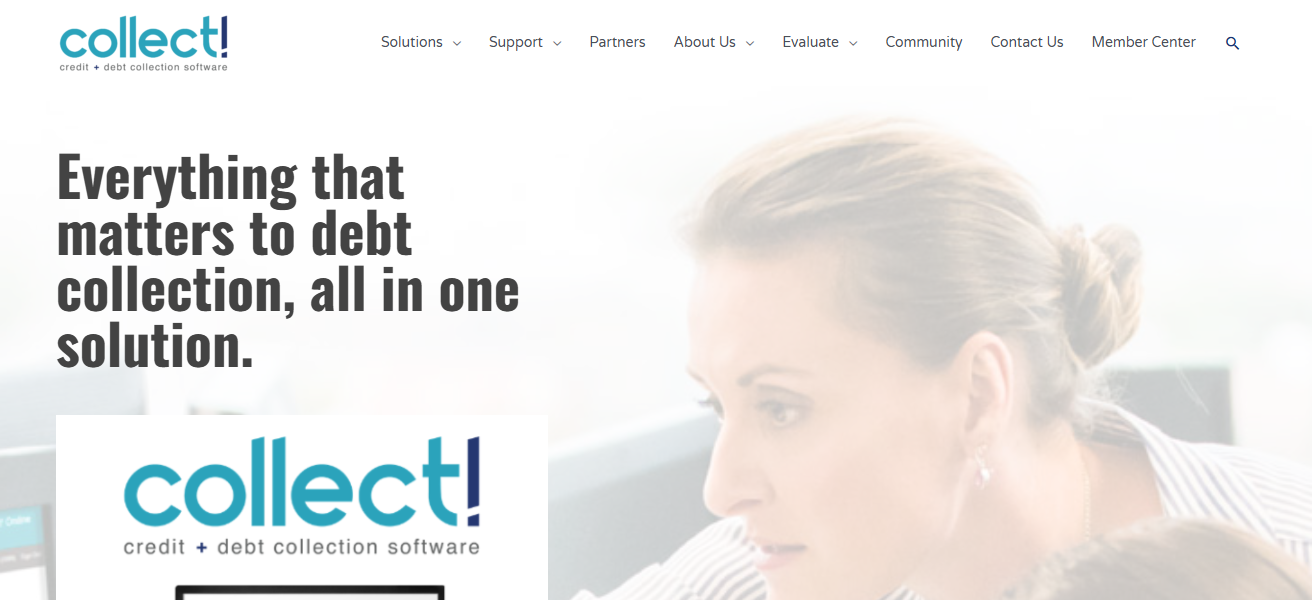
letter templates, and collected data management to their unique operations. Organizations benefit from improved efficiency, reduced manual tasks, and enhanced scalability as their portfolios grow.
Collect — Key Features
Comprehensive Collections Management: Unified dashboard to supervise accounts, tasks, communication, and payment.
Automated Workflow Generation: Assigns tasks and reminders automatically for accounts that are due or overdue.
Segmented Borrower Classification: Sorts borrowers into defined risk buckets to encourage and support more targeted outreach efforts.
Integrated System Sync: Bridges with CRM and financial systems to ensure a cohesive and unified data set.
| Pros | Cons |
|---|---|
| Flexible deployment options: cloud or on-premise. | User interface can be complex for new users. |
| Deep customization of workflows and templates. | Lacks built-in AI prioritization features. |
| Good integration support with accounting/ERP systems. | Analytics tools are less advanced than AI-first platforms. |
| Works well for agencies of many sizes. | Customization may require technical expertise. |
8. Case Master Pro
Case Master Pro is a conflict management and debt collection software designed specifically for attorneys and collection businesses, as well as judgment recovery firms.
The software integrates case management, billing, accounting, and document storage to provide legal businesses a means to streamline operational processes and workflow.
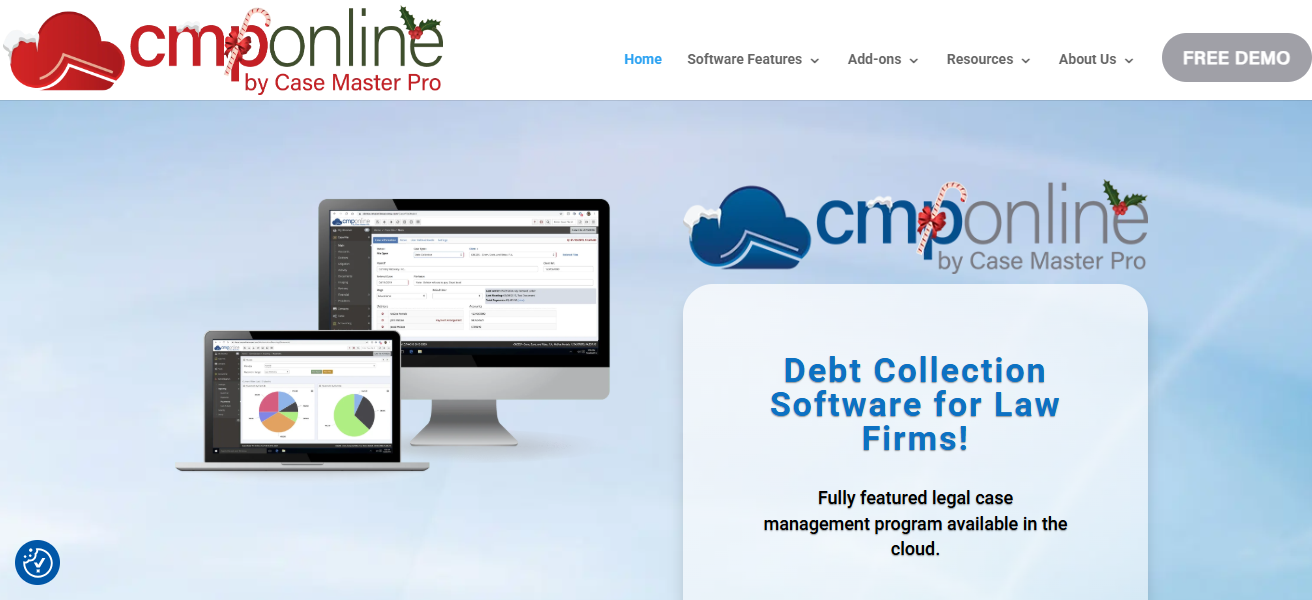
The software provides legal businesses secure cloud functionality, customizable reporting, and automatic notification management features to help businesses manage debtors, court documents, and monetary filings.
Understanding legal staff operational burdens, Case Master Pro enhances efficiency, productivity, and compliance on collection and legal tasks so that firms improve recovery rates.
Case Master Pro — Key Features
Legal Case & Collections Integration: Merges case management with debt recovery for legal teams.
Document & Billing Management: Consolidates client document, billing, and communication management into a single interface.
Custom Reporting: Users can create reports based on the status of the cases, payments made, and legal progress on the cases.
Secure Cloud Access: Users of the system can access the data remotely and securely. There are audit logs of access to all case and collections data.
| Pros | Cons |
|---|---|
| Excellent for legal case tracking + debt recovery. | Not a full accounts receivable automation system. |
| Centralized case files, documents, billing, and reporting. | Limited automation for debtor outreach. |
| Cloud access with secure storage. | Better suited for law firms than corporate finance teams. |
| Helps manage legal workflows and judgments in one place. | Less scalable for high-volume enterprise collections. |
9. FICO Debt Manager
Fico Debt Manager offers organizational debt management support tools and surplus analytical capabilities.
The platform combines analytics and machine learning to assist in determining optimal collection and recovery strategies.
The software supports tailored and automated interactions with debtors and drives smart segmentation of debtors and automated prioritization of workflows.
There is high configurability and scalability and so Fico Debt Manager fits the needs of enterprises across the globe.
The trust and standards of the global technology provider improves collection strategies. The software Advanced analytics and collected data assist in operational cost and debt recovery improvements.
FICO Debt Manager – Key Features
Advanced Analytics & AI: Enhancement of smart decision making through the use of machine learning, predictive models, and analytics.
Integrated Collections Ecosystem: Consolidation of early warning, recovery, and communications into a single system.
Decision Automation: Automation of actions based on configurable business rules, debtor behavior, and real time data.
Customer Centric Engagement Tools: Optimization of outreach to recover debts through various mechanisms.
| Pros | Cons |
|---|---|
| Enterprise-grade analytics and machine learning. | Very expensive — aimed at large organizations. |
| Highly configurable decision logic and strategy optimization. | Implementation requires specialized expertise. |
| Deep integration with existing enterprise systems. | Setup and training can be lengthy. |
| Improves recovery with data-driven segmentation and automation. | May be overkill for smaller operations. |
10. TLOxp by TransUnion
Trans Union offers TLOxp, an advanced analytics and skip-tracing platform to assist organizations in improving their collections and recoveries using data driven intelligence and insights.
TLOxp helps organizations find people, validate their identities, and gain intel about their complex relationships and liens, as well as their contact details and debts.
TLOxp skips risk management as an entire collections workflow system, but offers intelligence that allows collections teams to contact right-parties more quickly, validate and authenticate data correct and make more informed decisions.
By using TLOxp, collections and recoveries teams will become more investigative and efficient to enhance their debt recovery strategies.
TLOxp by TransUnion – Key Features
Deep Skip Tracing Intelligence: Ability to provide data that makes it easier to locate debtors who are difficult to find.
Identity & Asset Discovery: Identify additional contact information, and other assets and relational networks.
Rich Public & Proprietary Records: Public records are enhanced by TransUnion data to provide more accurate profiles.
Enhanced Decision Support: Support in account segmentation and prioritization for those that are contactable and less risky.
| Pros | Cons |
|---|---|
| Exceptional skip tracing and debtor intelligence data. | Not a full collections execution platform. |
| Access to rich datasets for contact and asset discovery. | Must be paired with workflow software. |
| Industry-leading data quality from TransUnion sources. | Data access fees may apply. |
| Helps improve right-party contact rates significantly. | Requires technical skills to interpret advanced data. |
How To Choose The Best Collections Management Software
Define Requirements – Assess need for software based on collection volumes, industry focus, and automation needed first.
Level of Automation – Less collection work is needed if software has automated tasks, reminders, and prioritization.
Communication channels – Broader debtor engagement is possible if all collection channels are covered and available.
Predictive Analytics – High and low risk accounts can be targeted if collection software uses predictive scoring.
Integration with Other Tools – Seamless data flow is ensured if collection software integrates with your other business software.
Compliance – Software must support secure regulatory communication with audit and global compliance capabilities.
Dashboards and Reporting – Good collection software has real time customizable dashboards, and reports to measure activities.
Cocnlsuion
In conclusion Selecting the best collection account management software depends on the size of your business, your compliance requirements, and your goals for automation.
The best option improves cash flow, lowers delinquency, improves debtor engagement, and achieves compliance.
Intelligent automation, analytics, and modern collection platforms’ seamless integration help organizations worldwide optimize recovery efforts while maintaining healthy customer relationships.
FAQ
A tool that automates debt recovery, reminders, and reporting for overdue accounts.
To improve cash flow, reduce manual work, and prioritize high-risk accounts.
Banks, lenders, collection agencies, and businesses with accounts receivable.
Automation, multi-channel communication, analytics, and ERP integration.
Top tools support regulatory rules like GDPR, FDCPA, and audit trails.