This article outlines headless commerce platforms reshaping how companies design and operate online stores.
- Key Points & Best Headless Commerce Platforms
- 10 Best Headless Commerce Platforms
- 1. Shopify Plus
- 2. BigCommerce
- 3. Salesforce Commerce Cloud
- Salesforce Commerce Cloud
- 4. Magento (Adobe Commerce)
- 5. Commercetools
- 6. Elastic Path
- 7. OroCommerce
- 8. Spryker
- 9. Fabric
- 10. Vue Storefront
- How To Choose Best Headless Commerce Platforms
- Conclusion
- FAQ
With headless commerce, the front end and back end are decoupled, providing users with unparalleled flexibility, scalability, and performance.
Choosing the appropriate platform will be critical for both B2B and B2C brands to provide customers with smooth, contemporary, and interactive shopping experiences.
Key Points & Best Headless Commerce Platforms
| Platform | Key Point |
|---|---|
| Shopify Plus | Robust API ecosystem enabling seamless integrations with custom storefronts |
| BigCommerce | Multi-channel selling across marketplaces like Amazon, eBay, and social platforms |
| Salesforce Commerce Cloud | AI-driven personalization for customer journeys and product recommendations |
| Magento (Adobe Commerce) | Extensive customization with open-source flexibility and enterprise scalability |
| Commercetools | API-first microservices architecture designed for modular commerce solutions |
| Elastic Path | Composable commerce approach allowing businesses to build tailored experiences |
| OroCommerce | B2B-focused features like corporate accounts, buyer-specific pricing, and workflows |
| Spryker | Marketplace enablement tools for building multi-vendor commerce ecosystems |
| Fabric | Headless-first design with fast deployment and modular commerce APIs |
| Vue Storefront | Frontend-focused solution offering lightning-fast Progressive Web Apps (PWAs) |
10 Best Headless Commerce Platforms
1. Shopify Plus
Shopify Plus is an enterprise-grade headless commerce platform, integrating Shopify’s powerful backend with frontend frameworks like React (Hydrogen) and global hosting (Oxygen) for highly flexible and performant storefronts.
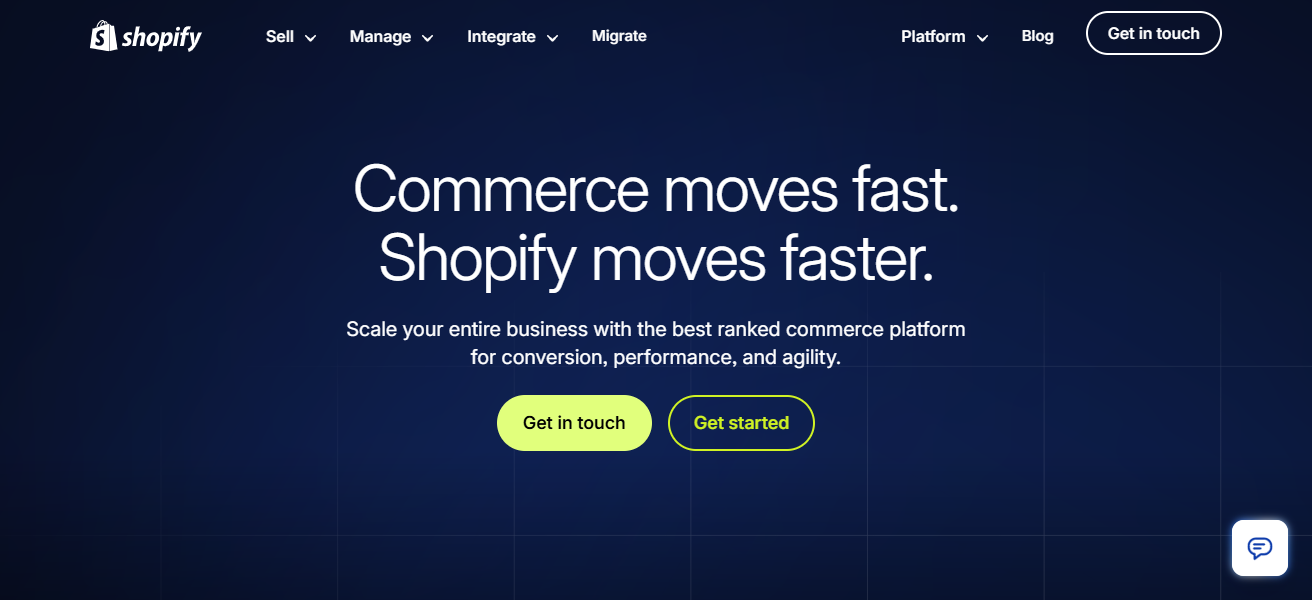
Optimized for rapidly scaling D2C brands, Shopify Plus also enables omnichannel selling to web, mobile, social, and new devices through APIs.
With its global infrastructure, wide-reaching app ecosystem, and scalability, Shopify Plus has become synonymous with speed and flexibility for brands needing more backend commerce capabilities.
Shopify Plus Features
API-First Architecture – Storefront, Admin, and Checkout APIs for custom headless experiences.
Hydrogen & Oxygen – Headless storefront solutions supported by hosted React framework and Hydrogen.
Omnichannel – Integrated seamless commerce across web, POS, mobile and social.
Enterprise-grade – Additional features include flow automation, multi-store admin, and SLA uptime.
| Pros | Cons |
|---|---|
| Enterprise‑grade SaaS with reliable performance and global infrastructure. | Less backend customization compared to open‑source platforms. |
| Strong app ecosystem and integrations for marketing, analytics, and fulfillment. | Cost can be high for large catalogs or sales volume. |
| API‑first support with Hydrogen & Oxygen for modern headless storefronts. | Truly custom headless setups require experienced developers. |
| Great omnichannel support (web, mobile, POS, social). | Some advanced features need third‑party apps. |
2. BigCommerce
BigCommerce helps mid-market and enterprise brands build headless storefronts using API-first SaaS platforms. It has REST and GraphQL
APIs that integrate with modern front-end frameworks like Next.js, Gatsby, and Vue Storefront, while managing catalogs, checkouts, and orders on the backend.

BigCommerce also has great uptime reliability and integrations with popular CMS and marketing tools. Its flexible pricing and no transaction fees help manage costs as businesses scale.
Big Commerce Features
REST & GraphQL APIs – Ideal integration into up-to-date frontend frameworks (Next.js, Gatsby).
Open SaaS Platform – No transaction fees and scalable infrastructure.
Headless Flexibility – Custom storefronts plus optimized PWA via API.
Integrated Commerce Services – Unified catalog, pricing, inventory, and checkout that offers extensibility.
| Pros | Cons |
|---|---|
| Robust API support (REST & GraphQL) for headless builds. | Native CMS is limited; requires plugins for content‑heavy sites. |
| No transaction fees and flexible pricing tiers. | Extensive customizations might need workarounds. |
| Works smoothly with frontend frameworks (React, Vue, Next). | Less enterprise functionality than some competitors. |
| Good scalability and reliability for medium to large brands. | Larger implementation may need experienced developers. |
3. Salesforce Commerce Cloud
Salesforce Commerce Cloud is designed for large enterprises. It is an advanced, cloud‑native, headless commerce solution designed for industry leaders with complex CRM and personalization needs.
It is deeply rooted in the Salesforce Ecosystem, which provides advanced order management, real-time customer data integrations, AI personalization to optimize experiences globally.
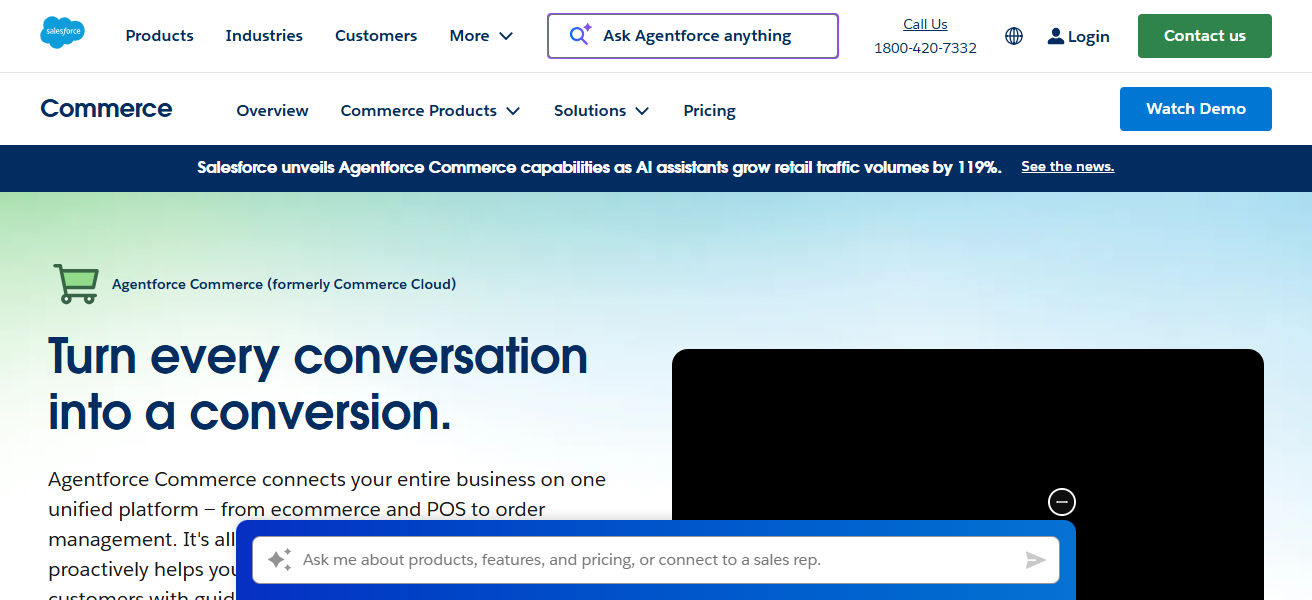
It advanced API suite provides extensive omnichannel customer experiences across the web, mobile, and in-store. Service and Marketing Cloud integrations are especially beneficial.
Salesforce Commerce Cloud
Unified Customer Data – Strong clouds integration with deep CRM for customer personalization.
AI & Personalization – Product recommendations, segmentation, and predictive insights via Einstein.
API-First Composable – Headless APIs for web, mobile, and IoT.
Global Scale & Localization — Available for Global Operating Model (GOM) Enterprises. Global Multi- Currency & Locale Flexibility.
| Pros | Cons |
|---|---|
| Deep CRM & personalization from Salesforce ecosystem. | Very high total cost of ownership. |
| AI‑driven recommendations and advanced marketing automation. | Complex setup and long implementation timelines. |
| Strong omnichannel and global selling capabilities. | Heavy reliance on Salesforce tools can lock you in. |
| Enterprise‑level security and uptime. | Not ideal for small or simple commerce needs. |
4. Magento (Adobe Commerce)
Now known as Adobe Commerce or Magento, is an open-source platform. Brands with more advanced and intricate commerce needs, acquire more customization with stronger headless APIs.
Adobe Commerce provides deep custom headless API integration through its REST and GraphQL API support, allowing more complex business logic such as advanced inventory, SEO, multi-store management, and more through its matured extension marketplace.
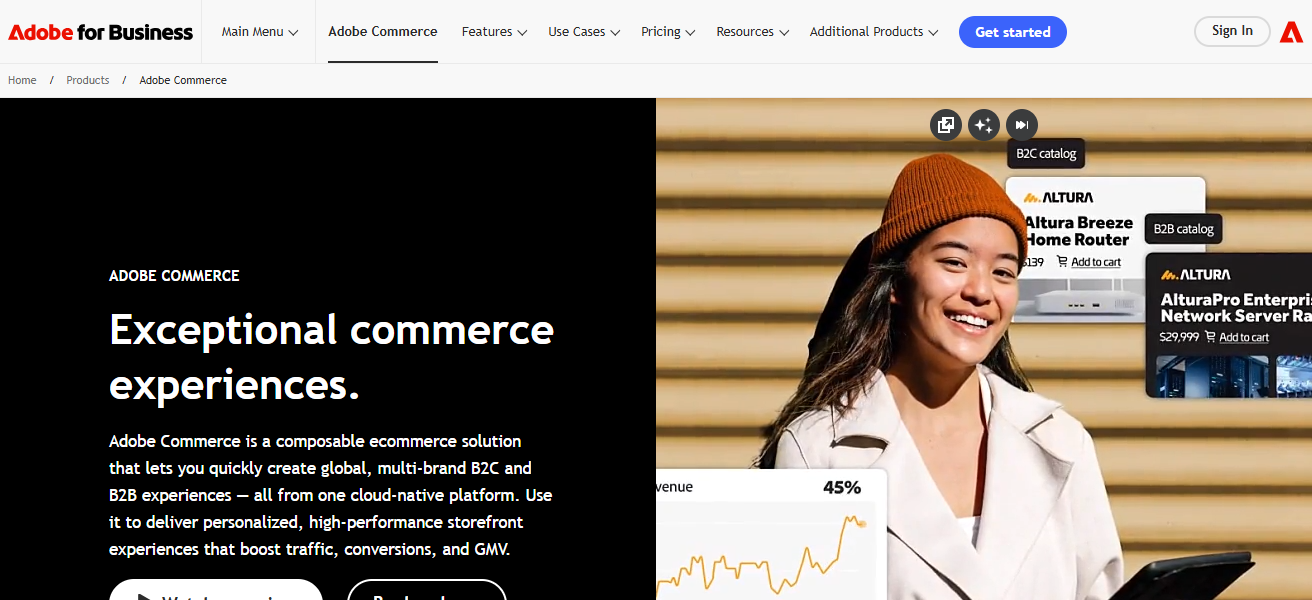
Adobe also provides additional integrations with Adobe Experience Cloud for more advanced analytics and content, making Adobe Commerce suitable for enterprises with more technical capabilities.
Magento (Adobe Commerce) Features
Rich API Support — Availability of REST & GraphQL APIs for headless commerce implementation.
Powerful Backend Engine — Advanced features for Backend Inventory Management, Promotions, SEO, & Catalog.
Adobe Experience Cloud Integration — Integration with Adobe Analytics + Adobe Target for content-driven commerce.
Multi-Store & Multi-Locale — The ability to manage multiple stores in different countries from one backend.
| Pros | Cons |
|---|---|
| Highly customizable with full control over commerce logic. | Requires significant development resources. |
| Mature marketplace of extensions and plugins. | Hosting & maintenance costs can be high. |
| Strong multi‑store, international, and multi‑currency support. | Complex for beginners or small teams. |
| Excellent B2B capabilities. | Upgrades sometimes require developer involvement. |
5. Commercetools
Commercetools designs microservices-based solutions that have API integrations and a MACH architecture (microservices-based, API, Cloud and Headless) for e-commerce. Its headquarters are located in Munich and has operated in the market since 2006.
Through the use of flexible APIs and a composable commerce architecture, the company is able to provide customer seamless shopping experiences through multiple channels (website, applications and other channels that may arise in the future).
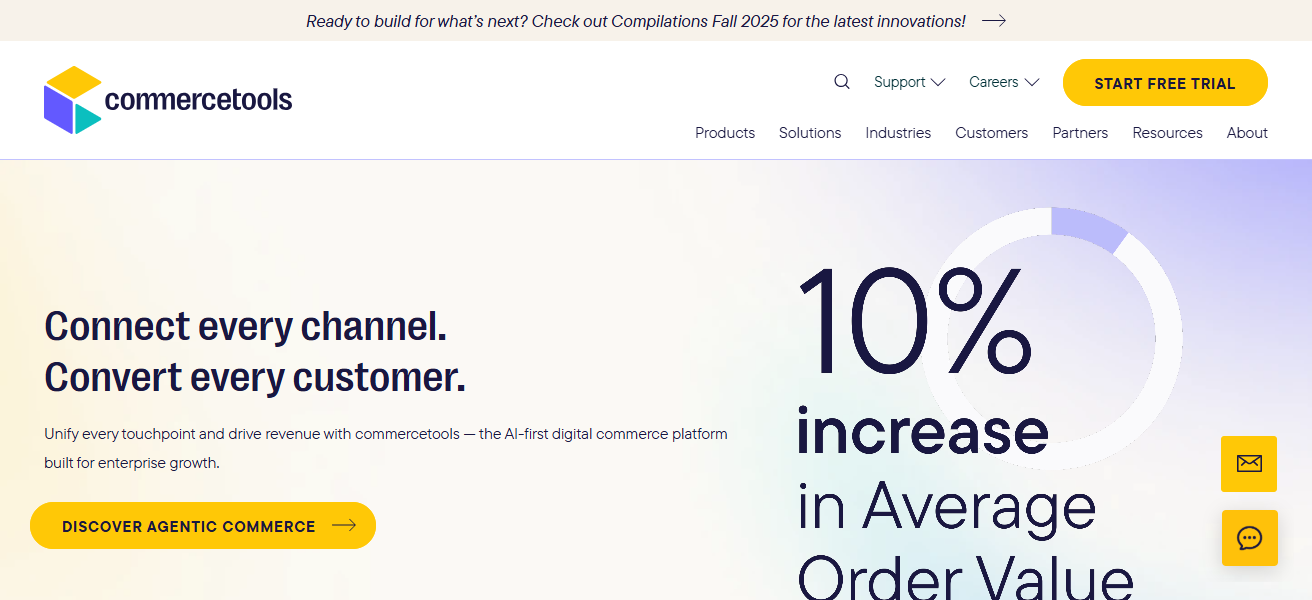
The microservices architecture provides brands the ability to choose the specific features they need, as well as manage inventory and implement complex business strategies at any scale (including B2B, B2C, and hybrid models).
Commercetools Features
MACH Architecture — Microservices, API-First, Cloud-Native, Headless for Ultimate Flexibility.
Modular Commerce components — Select & integrate only the needed services (e.g. cart, catalog, pricing)
Enterprise Scale — High Traffic, Complex Catalogs & Multi-Channel Commerce.
Headless Developer Tools — Fast Builds & Deployments via SDKs & CLI.
| Pros | Cons |
|---|---|
| True API‑first, microservices (MACH) architecture. | Higher licensing costs for enterprise use. |
| Highly modular & composable for tailored stacks. | Requires strong developer expertise. |
| Excellent scalability and flexibility. | Smaller community than older platforms. |
| Ideal for multiple storefronts and advanced use cases. | May need multiple third‑party integrations. |
6. Elastic Path
Elastic Path has an emphasis on composable, API-fast headless commerce for enterprises with complex B2B or subscription requirements.
Elastic Path’s microservices architecture allows for flexible product bundling, tiered pricing, and advanced catalog management resulting in deeply customized commerce experiences.
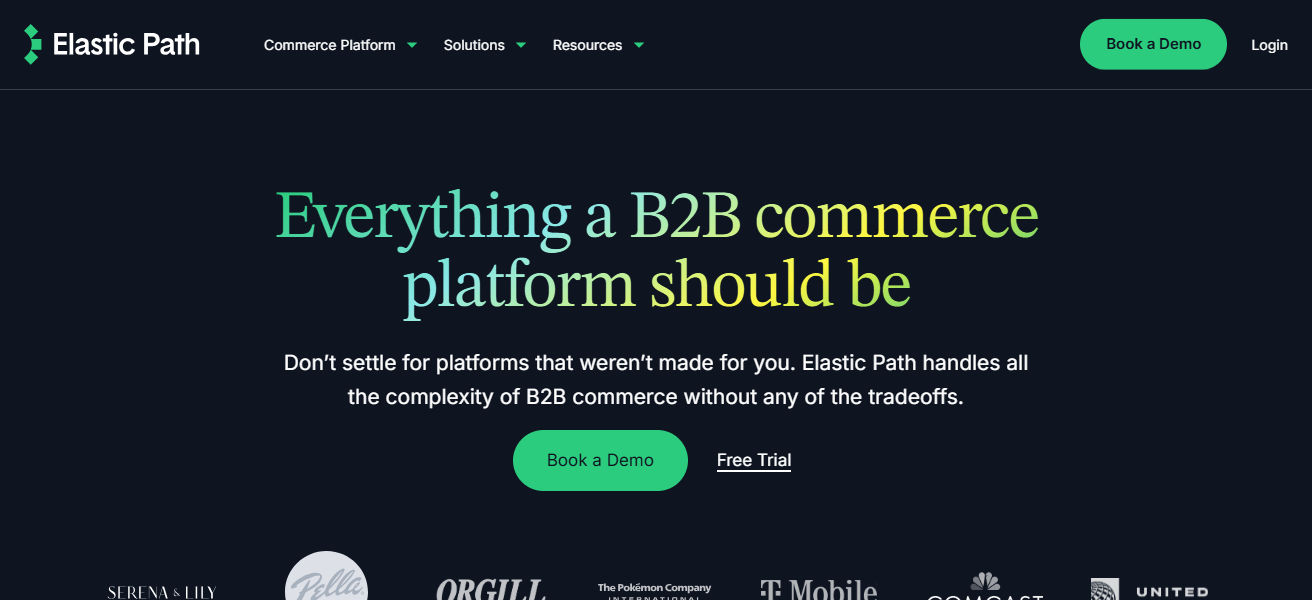
Elastic Path integrates with POS, ERP, and CRM systems for operational flexibility and omnichannel.
Elastic Path’s composable architecture is best suited for businesses that need adaptive and future-proof commerce stacks as opposed to monolithic platforms.
Elastic Path Features
Composable Commerce — Ability to Create Customized Commerce Workflows with Headless Microservices.
Rich Pricing & Catalog Logic — Supports Complex Pricing Models, Bundles, & Subscription Offerings.
API-First Backbone — All commerce functions exposed via APIs for Seamless Integration with Separate Frontend.
ERP/CRM/POS Integration — Seamless Connection with Existing Systems for Unified Operations.
| Pros | Cons |
|---|---|
| Composable commerce with microservices and APIs. | Smaller ecosystem of plugins and partners. |
| Flexible pricing rules, bundles, and subscriptions support. | Custom builds require advanced technical skills. |
| Easy integration with best‑of‑breed systems (ERP/CRM/POS). | Less off‑the‑shelf functionality than monolithic platforms. |
| Excellent for B2B or complex commerce models. | Implementation timelines can be long. |
7. OroCommerce
OroCommerce is an open-source and headless commerce platform for B2B businesses that need complex workflows, advanced pricing rules, and corporate account management.
It comes with built-in CRM systems, and intricate buyer-seller workflows such as quote management, bulk ordering, and segmented pricing. It is a product of the Magento founders.
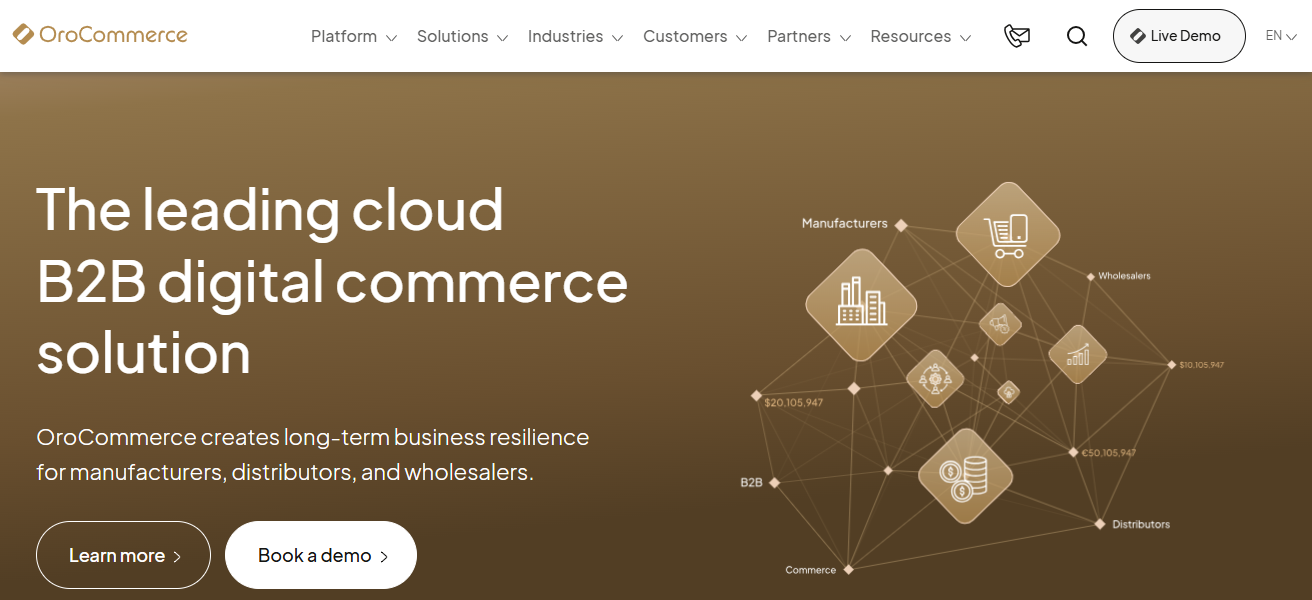
Businesses can exercise more control over their commerce operations as OroCommerce offers both on-premise and cloud-hosted deployment options.
OroCommerce Features
B2B Workflow Focus – Quotes, approvals, custom pricing, and company roles.
CRM Included – Integrated customer management on buyer accounts.
Headless APIs – Commerce APIs for custom front-end solutions.
Flexible Deployment – Cloud or on-premise.
| Pros | Cons |
|---|---|
| Built specifically for B2B commerce workflows. | Limited adoption compared to mainstream platforms. |
| Integrated CRM and account management out of the box. | Not ideal for pure B2C stores. |
| Flexible deployment (cloud or on‑premise). | Smaller third‑party extension ecosystem. |
| Strong support for quotes, custom pricing, and bulk orders. | Implementation may require specialists. |
8. Spryker
Spryker is an enterprise-grade headless commerce solution that is fully customizable and scalable. It’s cloud-enabled and has over 900 API modules which helps brands tailor commerce.
Spryker helps brands with marketplace functionality, pricing, and customer segmentation and avoids monolithic system lock.
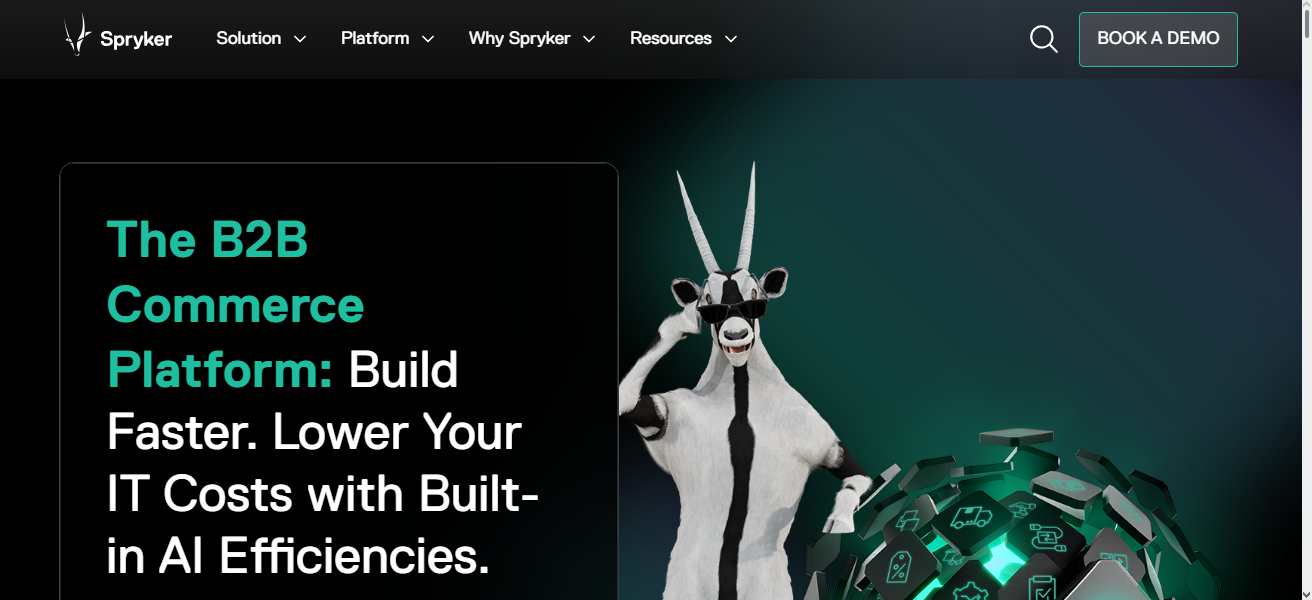
Its composable approach makes it easy to launch platforms, whether B2B, B2C, or hybrid. Its rapid deployment capabilities cater to innovation driven organizations needing digital transformation at scale.
Spryker Features
Modular & Reusable Components – 900 modules for custom commerce systems.
Marketplace & Platform Models – Support for B2C, B2B, and marketplace.
Headless API Layer – Unrestricted frontend access for commerce logic.
Scalable Cloud Infrastructure – High availability and performance for all scales.
| Pros | Cons |
|---|---|
| Modular architecture with 900+ reusable commerce components. | Enterprise price point and complexity. |
| Supports B2B, B2C, marketplace, and hybrid models. | Heavy development resources required. |
| Great for digital transformation and innovation. | Smaller community than older platforms. |
| Scales well for high‑traffic and custom logic. | Longer setup times for full headless builds. |
9. Fabric
Fabric is a contemporary, API headless commerce platform focused on fast-growing digital-first brands and retailers.
It provides flexible commerce solutions such as product information management (PIM), order management, pricing, and promotion management, which can be integrated on a use-case basis.
Fabric’s APIs allow for low latency and optimized fast performance which facilitates rapid deployments and management of global storefronts.
With an emphasis on composability, brands can secure their commerce stack investments to adapt to ever-changing market conditions.
Fabric Features
API-First Commerce Services – Modular services for carts, products, pricing, orders, etc.
PIM & OMS Integration – Integrated APIs for product info and order management.
Composable Stack Friendly – Easy integration with best-of-breed systems.
Fast Global APIs – Low latency and optimized for multi-region.
| Pros | Cons |
|---|---|
| API‑first platform designed for composable commerce. | Newer platform with fewer integrations than legacy players. |
| Modular components (PIM, OMS, pricing, promotions). | Some functionality still relies on partners. |
| Fast performance and multi‑region support. | Smaller developer community than others. |
| Incremental adoption of services is possible. | Requires frontend and backend integration expertise. |
10. Vue Storefront
Vue Storefront is compatible with any headless commerce backend. It provides fast, app-like shopping experiences. Because it’s built using Vue.js it has great performance and excellent offline capabilities.
This allows brands to create captivating front ends without being tied to any specific backend commerce engine. Vue Storefront is compatible with Magento, Shopify, and BigCommerce.
It also has a dedicated and active developer community focused on headless performance and user experience.
Vue Storefront Features
Agnostic Frontend PWA – Any headless backend for app-like performance.
Progressive Web App Features – Works offline, push notifications, and fast loading.
API Middleware Layer – Unified logic for multiple commerce backend systems.
Open‑Source Community – Extensive collaborative ecosystem and extensions.
| Pros | Cons |
|---|---|
| Frontend‑agnostic PWA that works with any commerce backend. | Not a full commerce engine — must connect to a backend. |
| Fast, app‑like user experiences with offline support. | Backend setup and API integration needed. |
| Strong open‑source community and flexibility. | Some advanced features require custom development. |
| Can significantly improve mobile performance. | Learning curve for developers new to PWAs. |
How To Choose Best Headless Commerce Platforms
Type and Scale of Business. Identify if your needs are B2B, B2C, or a combination. Think about traffic, catalog size, and projected growth.
API and Headless Support. Look for robust REST, GraphQL, and other APIs for adaptable front end incorporations.
Customization vs. SaaS. Make a choice between totally customizable open-source (Magento, Commercetools) or managed SaaS (Shopify Plus, BigCommerce) options.
Ecosystem Fit and Integrations. Assess the availability of applications, compatibility of 3rd party tools with your CMS, ERP, and CRM.
Development and Maintenance. Support your team’s technical skills with the tools necessary for implementation and ongoing support.
Expected Returns. Assess the expenses related to licensing, hosting, and developers against the projected growth and cost of scaling.
Performance and Scalability. Check the speed and geographic scalability of the solution to meet the requirements of your end-users.
Omnichannel and Future-Proofing. Platform selection should provide the capability for all commerce types to include mobile, web, and social commerce, and adapt to new innovations.
Conclusion
To wrap things up, selecting the top headless commerce solutions is vital for creating adaptable, scalable, and effective digital storefronts.
While some may prefer simplicity, others may appreciate extensive customization or features suited for larger enterprises. Shopify Plus, Magento, and Commercetools have unique benefits.
By integrating your business requirements, tech capabilities, and future aspirations, you can provide seamless omnichannel solutions and remain competitive in the eCommerce business.
FAQ
A headless commerce platform separates the frontend (storefront) from the backend, allowing flexible, API-driven digital experiences.
It offers faster performance, custom frontends, omnichannel support, and scalability.
Shopify Plus, BigCommerce, Salesforce Commerce Cloud, Magento (Adobe Commerce), Commercetools, Elastic Path, OroCommerce, Spryker, Fabric, and Vue Storefront.
Yes, but SaaS options like Shopify Plus or BigCommerce are easier to implement for smaller teams.
Yes, most top platforms support both models with advanced workflows and integrations.