
This article will focus on the Best Technology Solutions for Insider Threat Detection that assist businesses in protecting sensitive information and avoiding breaches in security.
- Key Points & Best Technology Solutions for Insider Threat Detection
- 10 Best Technology Solutions for Insider Threat Detection
- 1. Exabeam
- 2. Varonis
- 3. Proofpoint ITM
- 4. ObserveIT
- 5. Ekran System
- 6. DTEX InTERCEPT
- 7. Forcepoint Insider Threat
- 8. Teramind
- 9. Microsoft Insider Risk Management
- 10. Splunk UBA
- How We Choose Best Technology Solutions For Insider Threat Detection
- Conclusion
- FAQ
Insider threats, whether intentional or unintentional, present a dangerous challenge for companies. With the appropriate technology, such as behavior analytics, monitoring, and automated alerts, businesses can detect, handle, and limit threats from insiders.
Key Points & Best Technology Solutions for Insider Threat Detection
| Technology Solution | Key Point |
|---|---|
| Exabeam | Behavior analytics to detect unusual insider activity |
| Varonis | Data-centric monitoring for sensitive files and permissions |
| Proofpoint ITM | User activity monitoring with alerts on risky behavior |
| ObserveIT | Session recording for visibility into insider actions |
| Ekran System | Privileged user monitoring with strong access controls |
| DTEX InTERCEPT | Continuous endpoint visibility powered by machine learning |
| Forcepoint Insider Threat | Risk-adaptive protection using contextual analytics |
| Teramind | Employee monitoring with productivity and threat insights |
| Microsoft Insider Risk Management | Integration with Microsoft 365 for compliance and insider detection |
| Splunk UBA | User behavior analytics to detect anomalies across logs |
10 Best Technology Solutions for Insider Threat Detection
1. Exabeam
Exabeam employs sophisticated user and entity behavioral analytics (UEBA) to monitor changes in user behavioral patterns and identify insider risks.
By integrating SIEM with machine learning, Exabeam delivers contextual alerts that help pinpoint potential risks.
Exabeam streamlines investigation processes for quicker incident resolution and minimizes the need for manual labor.

Exabeam’s behavior analytics detection system can identify account takeovers, data theft, and unauthorized access attempts.
Exabeam’s platform also features risk scoring for users and devices, allowing security teams to identify and proactively address threats before they escalate.
Key Features
- User & Entity Behavior Analytics (UEBA): Employs machine learning and behavioral modeling to identify abnormal behaviors.
- SIEM Integration: Consolidates logs and alerts with current SIEM systems.
- Automated Incident Response: Reduces manual efforts and optimizes playbooks for faster investigations.
- Risk Scoring: Prioritizes real threats by assigning risk levels to users and incidents.
| Pros | Cons |
|---|---|
| Strong behavior analytics with UEBA to detect sophisticated threats. | Can be complex to deploy and tune initially. |
| Integrates seamlessly with existing SIEM tools. | Requires significant expertise for effective fine‑tuning. |
| Automated investigation workflows save analyst time. | Pricing may be high for smaller organizations. |
| Risk scoring helps prioritize incidents effectively. | False positives can occur without proper baselining. |
2. Varonis
Varonis specializes in detecting data-centric insider threats and monitoring access to sensitive data including files, emails, and collaboration tools. It identifies data permissions, tracks user activity, and analyzes unusual activity to prevent data loss.
The platform raises alerts for potentially damaging user activities such as large-scale downloads, data-sharing privilege escalations, and unusual access to sensitive datasets.

Additionally, Varonis mitigates risk by constantly auditing, automating policy enforcement, and reporting. Its analytics enable organizations to contextualize risks and threats, facilitating agile threat response and compliance with regulatory frameworks.
Varonis stands out among competitors by its attention to unstructured data, making it a strong choice for large-scale enterprises with significant amounts of file shares and cloud unstructured data.
Key Features
- Data Access Monitoring: Monitors who is making transactions with sensitive files, folders, and data stores.
- Permissions Intelligence: Detects and fixes over entitlements and other dangerous access permissions.
- Behavioral Analytics: Identifies abnormal data access or usage behaviors.
- Audit & Compliance Reporting: Provides reports to meet regulatory obligations.
| Pros | Cons |
|---|---|
| Excellent data‑centric focus — especially for file systems and permissions. | Can be resource‑intensive in complex environments. |
| Strong visualization of access patterns and permissions. | Licensing and storage requirements can be high. |
| Helps enforce least‑privilege policies and reduce risk. | Requires continuous maintenance of policy rules. |
| Good for compliance reporting and audits. | Steep learning curve for new users. |
3. Proofpoint ITM
Proofpoint ITM monitors user activity across email, cloud applications, and endpoints to detect potential insider threats. It monitors user activities like data exfiltration, policy violations, and misuse of privileged access.
It uses behavioral analytics and risk scoring to detect and prioritize threats, and to reduce false positives.
The platform provides features to automate and simplify security operations, including alerting, incident investigation, and reporting.
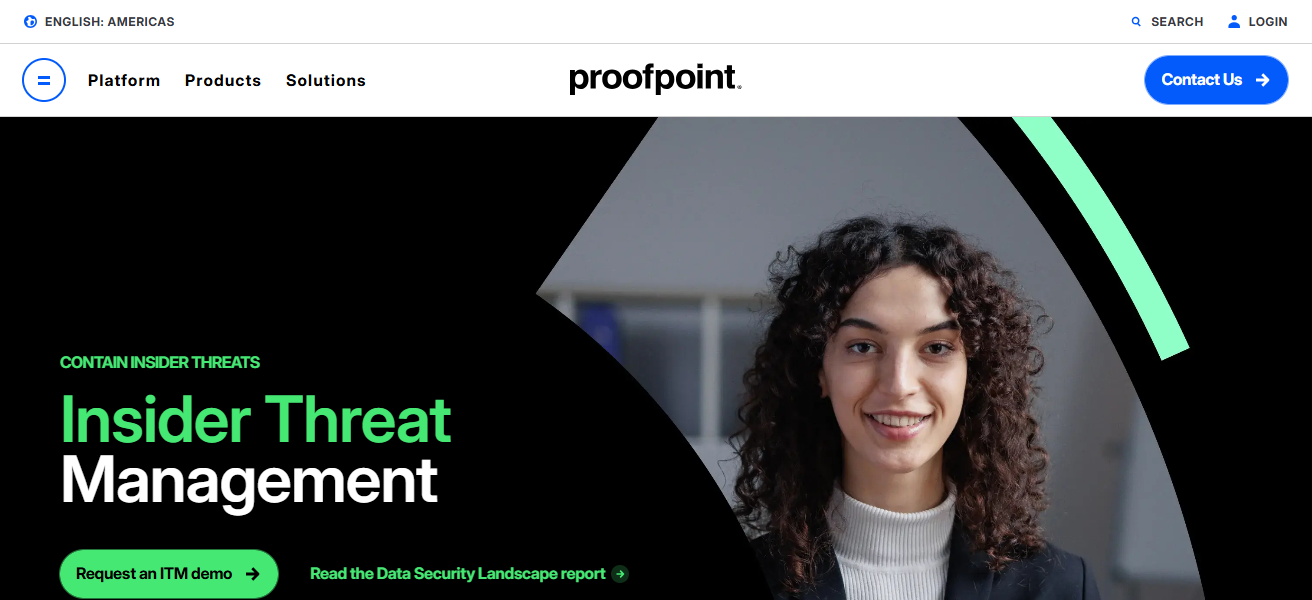
It is designed for compliance in regulated industries because it can integrate with other security products and compliance frameworks.
Proofpoint ITM provides presence and visibility of proactive risk management on the rational and irrational insufficiency of employees to organizations.
Key Features
- User Activity Monitoring: Observes actions taken on email, endpoints, and cloud apps.
- Behavior Analytics: Identifies unusual actions that could be precursors to insider threats.
- Risk Scoring and Alerts: Reduces alert fatigue by balancing high risk actions with other considerations.
- Integration with Security Tools: Enhances other Proofpoint security offerings with more contextual information.
| Pros | Cons |
|---|---|
| Integrates well with broader Proofpoint security stack. | Best value achieved when used as part of wider Proofpoint suite. |
| Detects risky behavior across email, endpoints, and cloud apps. | May generate false positives without proper configuration. |
| Risk scoring and prioritization help reduce alert fatigue. | Advanced features can be costly. |
| Useful for compliance in regulated industries. | Not as strong standalone as some UEBA specialists. |
4. ObserveIT
Proofpoint’s ObserveIT offers detailed detection of insider threats, analyzing user activity and monitoring sessions. It records activities such as keystrokes, app interactions, and file access, providing detailed insights into possible threats.
The system detects irregular patterns and uses machine-learning to identify possible insider threats. ObserveIT offers real-time policy enforcement, automatic reporting, and investigative processes.
The streamlined dashboard aids security personnel in risk evaluation, incident response, and compliance. The activity visibility coupled with proactive monitoring ensures that organizations will detect and address careless and malicious insider threats.
Key Features
- Session Recording: Detailed recorded sessions including screen content and keystroke activity.
- Behavior Analytics: Uses ML to differentiate between normal and anomalous behavior.
- Alerts: Security teams are notified in real time when risk thresholds are crossed.
- Tools for Investigation: Tools for reviewing incidents, including searchable log records and replay.
| Pros | Cons |
|---|---|
| Deep session monitoring with contextual activity logging. | Can raise privacy concerns if not configured carefully. |
| Detailed forensic data supports investigations. | Requires proper policy governance to avoid overload. |
| Machine learning assists with anomaly detection. | Upfront implementation complexity. |
| Alerts based on real‑risk behaviors. | Licensing can be expensive for large deployments. |
5. Ekran System
Ekran System has tools to monitor insider threats focusing on endpoints, access controls, and session recording. It records user actions like app usage, website visits, command entries, and file manipulations.
It provides forensic evidence for all actions taken and can provide real-time alerts for any suspicious activities. Data breaches and misuse of privileges can be mitigated with the services of the Ekran System.

Policies can be enforced at an organizational level with the help of Ekran’s risk scoring and role-based access control features. With the ability to play back sessions, Ekran allows for the evidence-backed investigation of incidents.
Ekran System provides the necessary tools for security and compliance with monitoring the privileged users, remote employees, and contract workers.
Key Features
- Real Time Monitoring: Suspicious behavior tracking live actions on endpoints.
- Session Playback: Forensic analysis of recorded user activity revision.
- Access Control: Control measures and rules enforcement for sensitive systems’ access.
- Alerting & Reporting: Compliance reports and alerting on rule violations.
| Pros | Cons |
|---|---|
| Real‑time monitoring with session recording. | May require high storage for video logs. |
| Good access control + monitoring for privileged users. | UI can feel dated compared to competitors. |
| Risk scoring and automated alerts improve response times. | Tuning needed to reduce false alerts. |
| Useful for insider risk compliance and auditing. | Not optimal for complex enterprise scale without tuning. |
6. DTEX InTERCEPT
DTEX InTERCEPT tracks insider threats via remote endpoint anomaly detection. It keeps monitoring user activity, file movements, apps, and websites in a non-invasive manner.
Rather than predictive heuristic algorithms, intercepts employs machine learning and AI tuned to risky behaviors, data outflow, and insider threats.
It enables security teams to focus on more high-priority events with alerting, reporting, and risk score generation.
Its actionable recommendations and lightweight enterprise deployment focus make it ideal to meet user productivity monitoring and insider threat defense needs.
Key Features
- Behavior Monitoring: Detection of anomalous user activity on endpoints are monitored continuously.
- AI-Driven Detection: Machine learning, with no intrusive agents, for the identification of subtle threats.
- Risk Profiling: Behavior deviations lead to risk score assignments for users.
- Lightweight Deployment: Efficient data collection with minimal impact on endpoints.
| Pros | Cons |
|---|---|
| Strong behavior monitoring without intrusive agents. | May not have all advanced SIEM integrations out of the box. |
| Lightweight and visibility across endpoints. | Learning curve for data interpretation. |
| AI‑driven detection highlights subtle anomalies. | Smaller community/ecosystem vs legacy players. |
| Good balance of visibility and performance. | Some advanced features are add‑ons. |
7. Forcepoint Insider Threat
The Forcepoint Insider Threat uses behavioral analytics, content inspection, and policy enforcement to identify and manage insider threats.
It examines user behavior across endpoints, cloud applications, and networks to detect unusual activities, policy breaches, and possible data exfiltration.

It helps security teams mitigate user threats with risk scoring and real-time alerts and automated response actions. With detailed logging and reporting, Forcepoint facilitates compliance and supports investigations.
Its comprehensive strategy serves both negligent and purposeful insiders, giving organizations protective data loss measures and keeping employee and organizational productivity intact.
Key Features
- Comprehensive Monitoring: Endpoints, cloud, and networks user actions tracking.
- Content Inspection: Inspection of data movement and content for threats.
- Policy Enforcement: Automatic actions to risky behaviors based on the rules.
- Risk Scoring \& Alerts: Orders events based on probable insider threats.
| Pros | Cons |
|---|---|
| Integrated risk scoring with content inspection. | Can be complex to manage and tune. |
| Good visibility across networks, cloud, and endpoints. | Licensing can be costly. |
| Automated response and policy enforcement. | Initial deployment resource‑intensive. |
| Strong compliance and forensic capabilities. | False positives if thresholds aren’t tuned. |
8. Teramind
Teramind’s insider threat detection is enhanced by user behavior analytics, session recording, and anomaly detection. It tracks endpoints and identifies suspicious behavior like unauthorized access, file transfer, and violation of policies.
The platform offers real-time alerting, automated blocking, and incident response forensic evidence.
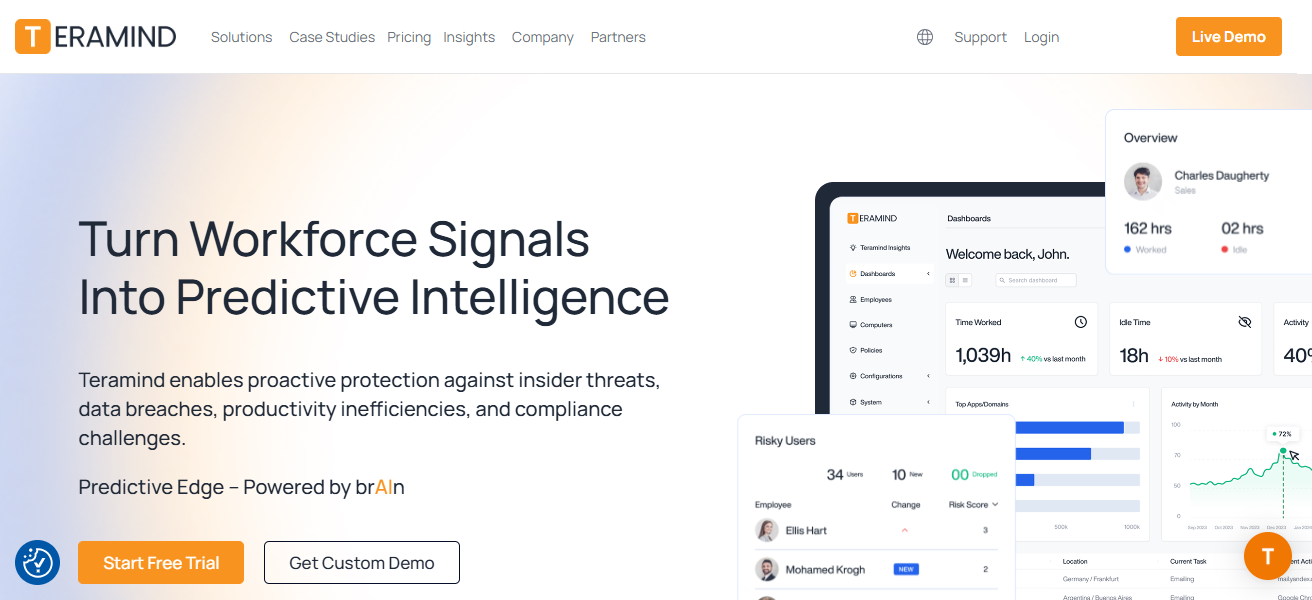
It also provides Productivity Measurement & Reporting, Risk Scoring, and Compliance Reporting, making it useful for industries with strict regulations.
The Monitoring, Analytics, and Control suite allows businesses to identify unintentional and deliberate insider threats while keeping operational oversight and security governance across all user devices.
Key Features
- Detailed Activity Logging: Records what apps are accessed, which files are accessed, and what websites are visited.
- Anomaly Detection: Behavioral profiling is used to identify threats such as data diversion.
- Automated Blocking: System rules can be set to block risky behaviors on the spot.
- Compliance Reporting: Track and report logs for audits.
| Pros | Cons |
|---|---|
| Real‑time monitoring with session recording and blocking. | Can raise privacy concerns if policies aren’t clear. |
| Good rule‑based and behavior‑based detection. | Large deployments need careful tuning and storage planning. |
| Automated alerting and prevention controls. | Reporting can be overwhelming if not filtered. |
| Strong endpoint oversight. | Not ideal for companies without clear usage policies. |
9. Microsoft Insider Risk Management
Microsoft Insider Risk Management is included within the Microsoft 365 Compliance suite and utilizes artificial intelligence and analytics to identify insider risk within an organization.
Microsoft Insider Risk Management analyzes communications, file activities, and collaboration tools to detect risky behaviors, including, data loss, policy violations, and unauthorized access to sensitive information.
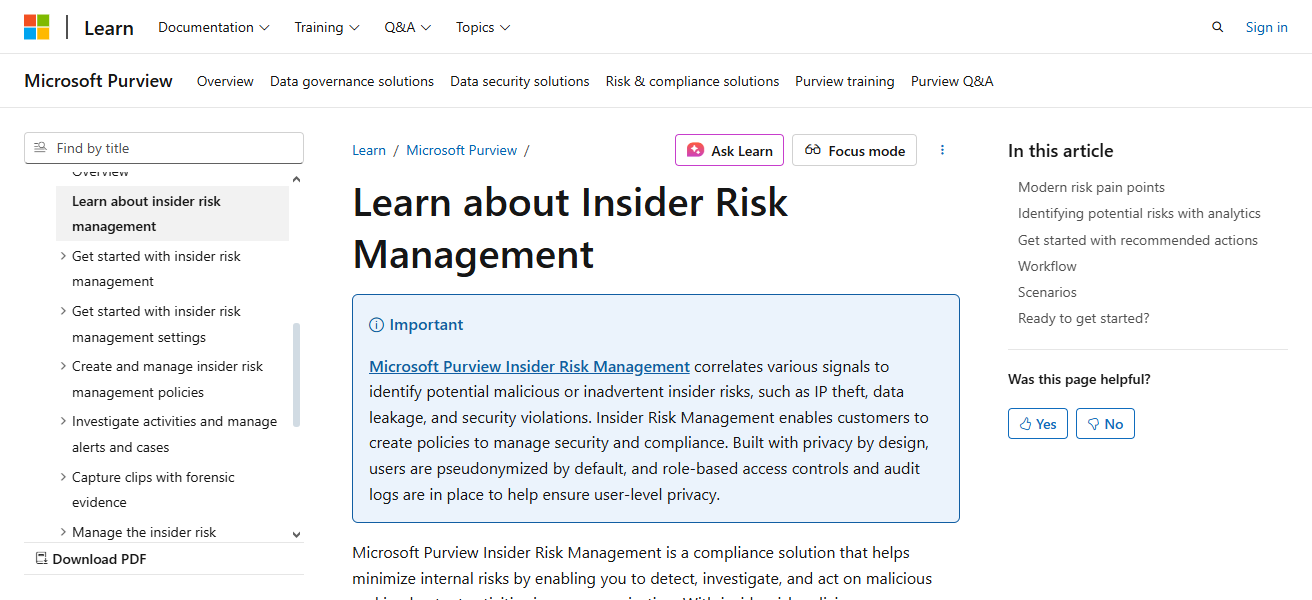
Microsoft Insider Risk Management integrates with Microsoft security platforms to provide threat alerts, case management, and investigation tools.
Microsoft Insider Risk Management automates the application of risk scores and contextual information, empowering organizations to focus their efforts where they are most needed.
Microsoft solutions offer organizations the most value within the Microsoft ecosystem, as they provide monitoring and support without risking compliance.
Key Features
- Microsoft Ecosystem Integration: Works within the Microsoft 365 environment.
- AI-Driven Detection: Machine learning is used to identify risky behaviors in collaboration tools.
- Case Management: Workflow tools are used to manage the investigations and resolution of the incidents.
- Policy Templates: Pre-formed policies for compliance and insider risk related use cases.
| Pros | Cons |
|---|---|
| Native integration with Microsoft 365 environment. | Limited if environment isn’t Microsoft‑centric. |
| AI‑driven detection using existing Microsoft signals. | Less granular than specialized UEBA tools. |
| Case management and investigation workflows built‑in. | Requires Microsoft 365 E5 or similar licensing. |
| Scales easily for organizations on Microsoft stack. | Limited deep endpoint visibility outside Microsoft ecosystem. |
10. Splunk UBA
Splunk UBA improves the detection of insider threats by studying user activities and finding abnormal patterns that could be harmful or represent user negligence.
It works with Splunk’s SIEM to identify and correlate information across endpoints, applications, and networks to give the most complete view of risks.
Machine learning algorithms help pinpoint deviations from standard behavior, while risk scoring and alerts assist security practitioners in managing the order of priority for activities.
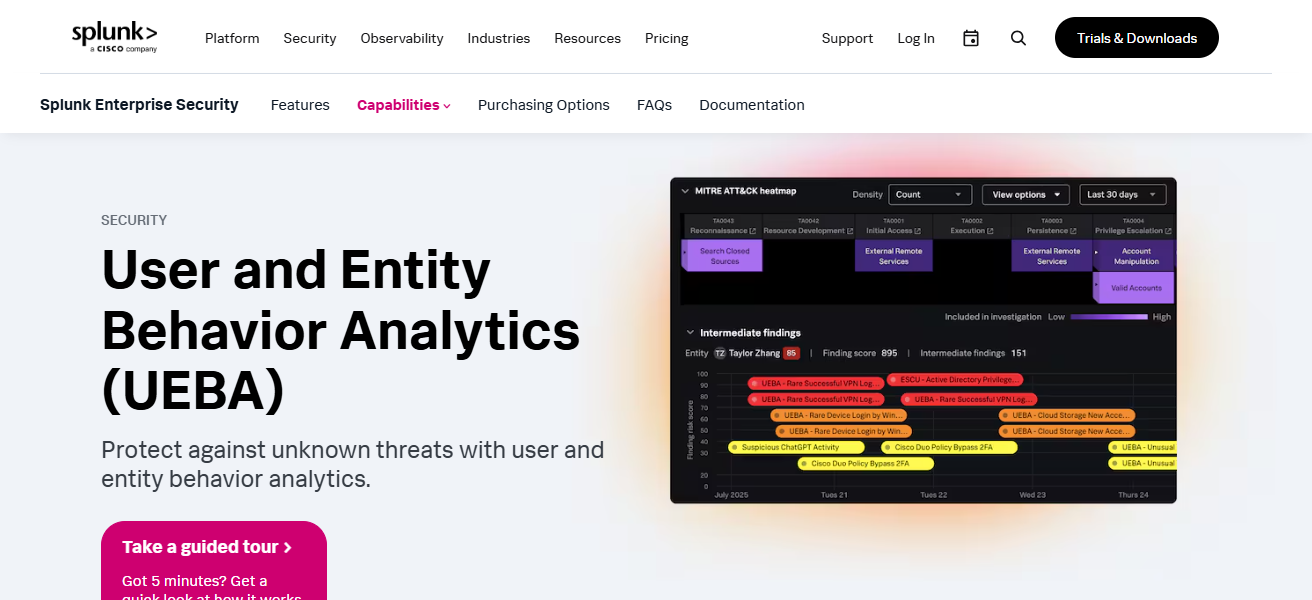
Forensic investigations, reporting, and compliance support are other features of Splunk UBA. Its adaptable and scalable nature
allows for large and complex enterprise environments to be most effective and enables the most proactive detection and response to threats while reducing the occurrence of false positives.
Key Features
- Behavior Analytics: Machine learning is used to identify anomalies in the activities of users and entities.
- SIEM Correlation: Correlates to Splunk to enhance analysis with additional security data.
- Risk Scoring \& Aggregation: Prioritizes risk based on various sources of data.
- Custom Detection Models: Analytics can be tailored to the organization’s needs by security personnel.
| Pros | Cons |
|---|---|
| Powerful analytics with Splunk SIEM correlation. | Requires Splunk infrastructure and expertise. |
| Identifies rare and complex anomalous behaviors. | Total cost of ownership can be high. |
| Customizable detection models. | Requires skilled admins for tuning. |
| Excellent for large enterprise environments. | Not ideal as a standalone product without SIEM. |
How We Choose Best Technology Solutions For Insider Threat Detection
- User Behavior Monitoring: Technologies that use Artificial Intelligence (AI)/User and Entity Behavior Analysis (UEBA) to assess and report negative user behaviors are best to utilize.
- Thoroughness: Full coverage of all endpoints, all cloud applications, email, and all networks should be provided.
- Risk Alerting: The ability to alert users and score based on risk should be available to enhance threat prioritization.
- Integration: Should be able to work with all current Security Information and Event Management (SIEM), security, and compliance solutions.
- Reporting and Forensics: Solutions should be able to provide detailed reporting, including audit trails, logs, and records of user sessions.
- Expandable: The capacity to manage and store large amounts of data while being able to expand with the organization is critical.
- Regulatory Compliance: The ability to comply with regulations without excessive employee surveillance should be available.
Conclusion
In closing, selecting appropriate technological applications for detecting insider threats is critical for safeguarding delicate information and reducing the risk for the organization.
The features of behavior analytics, monitoring in real-time, risk scoring, and automated alerts equip security personnel to recognize intentional and unintentional threats.
With the appropriate solutions, an organization can improve security, maintain compliance, and proactively address insider threats.
FAQ
Insider threat detection identifies risks from employees, contractors, or partners who may intentionally or accidentally compromise data or systems.
Insider threats can cause data breaches, financial loss, and reputational damage, making proactive detection essential for organizations.
Key features include behavior analytics, real-time alerts, risk scoring, session monitoring, forensic reporting, and integration with existing security tools.
Yes, most solutions detect both malicious and unintentional actions, such as careless data handling or policy violations.