
In this article, I examine the most viable investment options within the developing Asian countries, particularly in the booming sectors propelled by fast economic growth, increasing consumer appetites, advancements in technology, and favorable government interventions.
- Key Points & Best Investment Opportunities In Emerging Asian Economies
- 10 Best Investment Opportunities in Emerging Asian Economies
- 1. Technology & Digital Infrastructure
- 2. Renewable Energy
- 3. Healthcare & Biotech
- 4. Real Estate & Smart Cities
- 5. Agritech & Food Security
- 6. Manufacturing & Supply Chains
- 7, Tourism & Hospitality
- 8. Financial Services & Fintech
- 9. Education & EdTech
- 10. Logistics & Transportation
- How To Choose The Best Investment Opportunities In Emerging Asian Economies
- Conclsuion
- FAQ
Considering the likely enduring profits, these countries are drawing the attention of worldwide investors aiming for diversification and enduring growth.
Key Points & Best Investment Opportunities In Emerging Asian Economies
| Investment Opportunity | Key Point |
|---|---|
| Technology & Digital Infrastructure | Rapid growth in e-commerce, fintech, and AI-driven services |
| Renewable Energy | Strong government push for solar, wind, and green hydrogen projects |
| Healthcare & Biotech | Rising demand for affordable healthcare and medical innovation |
| Real Estate & Smart Cities | Urbanization driving housing, commercial spaces, and smart infrastructure |
| Agritech & Food Security | Investment in sustainable farming and food supply chains |
| Manufacturing & Supply Chains | Shift from China to countries like Vietnam, India, and Indonesia |
| Tourism & Hospitality | Booming middle class fueling domestic and international travel |
| Financial Services & Fintech | Mobile banking and digital payments expanding rapidly |
| Education & EdTech | High demand for online learning and skill development platforms |
| Logistics & Transportation | Infrastructure upgrades supporting trade and e-commerce delivery |
10 Best Investment Opportunities in Emerging Asian Economies
1. Technology & Digital Infrastructure
In emerging Asian economies, investments in technology and digital infrastructures represent new frontiers due to exceptional internet connectivity, smartphone utilization, and government-related digital investment initiatives.
Emerging nations such as India, Vietnam, Indonesia, and the Philippines put in substantial capital into 5G, computing clouds, data centers and AI-related services.

A young, technologically inclined population increases the demand for various services such as digital payments, e-commerce, SaaS, and cybersecurity.
Digital public services and digital business models provide investors with the digital recurring revenues. The rapid digital transformation of e-services creates fast sustained growth for the investors.
Features
High-Speed Connectivity: Further expansion of broadband and fiber 5G networks with range of services and application coupling smart services.
Cloud & Data Centers: Secure data storage and cloud computing serving currently and growing across a multitude of new and old businesses and governments.
Digital Platforms: E-commerce with more SaaS and mobile-first applications rapidly deployed with increasing availability of the internet.
Cybersecurity & AI: Protecting data, automation, solutions focus, and further interest in artificial intelligence.
| Pros | Cons |
|---|---|
| Rapid internet and smartphone penetration drives massive user growth | High competition and fast technology obsolescence |
| Strong government support for digitization and smart governance | Regulatory uncertainty around data privacy and cybersecurity |
| Scalable business models with high margins | Heavy upfront capital required for infrastructure |
| Growing demand for cloud, AI, and data centers | Dependence on skilled talent availability |
2. Renewable Energy
Nations in Asia are attempting to cut their reliance on fossil fuels and are switching to clean energy sources to meet their climate targets.
Investing in renewables such as solar, wind, and green hydrogen, where there are positive expected returns, is therefore an increasing opportunity.

Projects are being developed across Asia in countries such as India, China, Vietnam, and Thailand. Government initiatives offer subsidies, technology is cheaper than before, and there is increasing demand for power.
Developing countries also need energy storage and smart grids, to which there are for profitable returns. Developing countries offer bottom-line cash returns and creating energy from renewables are assisting in meeting global climate and ESG targets
Features
Solar & Wind Projects: Sustainable energy systems demand large-scale solar parks and wind farms.
Energy Storage Systems: Reliability and improvement in battery and grid-scale storage solutions.
Government Incentives: Attracting investors using Subsidies, tax benefits, and long-term power purchase agreements.
Green Technologies: Expanding more in hydrogen, bioenergy, and smart grid technologies.
| Pros | Cons |
|---|---|
| Strong government incentives and long-term policy support | High initial capital investment |
| Falling solar and wind technology costs | Grid infrastructure limitations in some regions |
| Long-term power purchase agreements ensure stable revenue | Policy changes can impact returns |
| ESG-friendly and globally attractive sector | Weather and climate dependency risks |
3. Healthcare & Biotech
Rising awareness about healthcare, health systems, and health underpinned by increased incomes and aging populations especially in developing Asia has sustained and propelled investment in healthcare and biotech.
The demand for pharmaceuticals, biotech research, hospitals, diagnostics and telemedicine is growing rapidly.
Generic drugs, biosimilars and clinical research are becoming the focus of hubs in countries such as India, South Korea and Singapore.

Digital health and low-cost healthcare systems are especially appealing in unserved rural economies. Defensively driven demand, innovation, and sustained government investment in broadening healthcare access and the domestic production of pharmaceuticals are the primary enablers of investors’ benefits.
Features
Advanced Medical Infrastructure: Expansion of hospitals as well as diagnostic and specialized care centers is underway.
Pharmaceutical Manufacturing: There is a solid position in generic drugs, vaccines, and biosimilars.
Digital Health Solutions: Remote patient monitoring, health apps, and telemedicine improve access to medical services.
Biotech Research & Innovation: Investment in research, development in clinical trials, and Medicine Precision.
| Pros | Cons |
|---|---|
| Rising healthcare demand due to aging populations | Long regulatory approval timelines |
| Growth in generics, biosimilars, and medical tourism | High R&D and compliance costs |
| Defensive sector with consistent demand | Pricing pressure from government controls |
| Expansion of telemedicine and digital health | Talent and infrastructure gaps in rural areas |
4. Real Estate & Smart Cities
Investments in smart cities and real estate are likely to pay off as population and urbanization levels increase. There is rapid urban migration in developing economies in Asia, and there is a great need for real estate in the form of commercial, residential, and mixed-use developments.
Authorities are pushing the development of smart cities that include digital governance, energy-efficient buildings, and integrated transportation.

There is a potential for smart infrastructure development and the construction of logistics parks, and the buildings to be used for affordable housing in countries such as India, Malaysia, and Indonesia.
Planned cities that leverage technology bring in a higher asset value and rental return, and are more economically viable. This makes the sector appealing to longtime and institutional investors.
Features
Urban Infrastructure Development: Integrated Residential, commercial, and public utilities.
Smart Technologies: Using IoT, AI, and data analytics for effective management of cities.
Sustainable Buildings: Energy-efficient and green-certified construction practices.
Transport Connectivity: Metro, road, and transit-oriented development.
| Pros | Cons |
|---|---|
| Rapid urbanization increases housing and commercial demand | High exposure to economic cycles |
| Government-backed smart city initiatives | Regulatory delays and land acquisition issues |
| Strong rental yields in high-growth cities | Capital-intensive with long payback periods |
| Technology-driven asset value appreciation | Interest rate sensitivity |
5. Agritech & Food Security
The investments concentrating on Agritech in conjunction with food security are indispensable because Asia is facing climate change, a growing population, and little usable land.
Agritech is revolutionizing traditional farming with technologies like sustainable irrigation, vertical farming, and AI crop monitoring. Innovations like these are also streamlining farming.
Countries like India, Bangladesh, and Vietnam, are adopting these innovative technologies and are also targeting Agri-Tech Startups to enhance productivity, as well as reduce supply chain inefficiencies.

There is also a considerable market potential for investments in food processing, cold storage, and alternative proteins.
This sector continues to have enduring relevance, and is a perfect combination of commercial viability and social impact.
Features
Precision Farming: AI, sensors, and drones for enhanced productivity.
Supply Chain Digitization: Cold chain tracking and tech-enabled logistics.
Sustainable Practices: Water-efficient irrigation and environmentally friendly practices.
Food Processing Innovation: Value-added and alternative proteins.
| Pros | Cons |
|---|---|
| Essential sector with long-term demand stability | Climate change and weather-related risks |
| Government focus on food security and sustainability | Fragmented farmer adoption in rural markets |
| High impact innovations in precision and smart farming | Lower margins compared to tech sectors |
| Growing demand for food processing and storage | Infrastructure limitations in remote areas |
6. Manufacturing & Supply Chains
Investments in manufacturing and supply chains are growing, driven by a shift from single-country sourcing. Emerging Asian economies, including Vietnam, India, and Thailand, are profiting from the “China + 1” strategy .
There are investments in electronics, automotive parts, clothing, drugs, and industry automation. Governments are providing incentives and are complemented by improving infrastructure and a skilled workforce, boosting foreign direct investment.
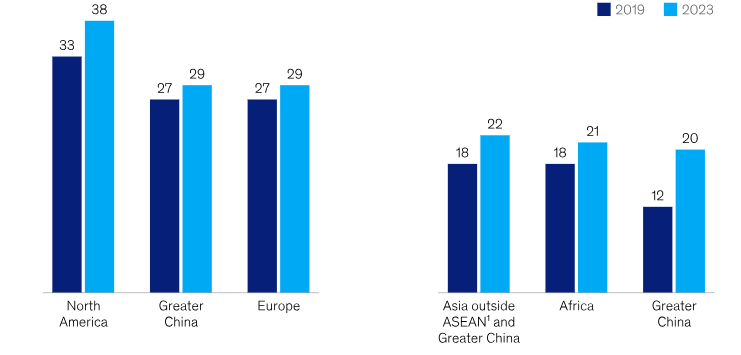
Furthermore, the automation of manufacturing, the use of robotics, and localized supply chains improve efficiency and resilience.
Investors are gaining exposure to multiple industries with strong export growth and rising domestic demand.
Features
Diversified Production Hubs: Geographical expansion of production to reduce single-country dependence.
Automation & Robotics: Smart Factory for improved efficiencies and reduced costs.
Skilled Workforce: Cost-effective and well-trained.
Export-Oriented Infrastructure: Industrial parks, SEZs, and connectivity to ports.
| Pros | Cons |
|---|---|
| Benefiting from “China+1” global diversification strategy | High dependency on global demand cycles |
| Government incentives and export support | Infrastructure gaps in some countries |
| Large labor force with competitive costs | Rising wages in fast-growing economies |
| Growth in automation and smart manufacturing | Environmental compliance costs |
7, Tourism & Hospitality
As international and domestic travel increases, tourism and hospitality are rebounding strongly in emerging Asia.
Thailand, Indonesia, Sri Lanka and Vietnam offer potential in hotel, resorts, eco-tourism, medical tourism and travel-tech. Increased middle-class income and connectivity improve and sustain demand.

There are noteworthy investments in sustainable tourism, experiential travel and premium hospitality. The growth potential is enhanced by government promotion of tourism infrastructure and visa reforms.
There is primary income tourism potential, and is recession resistant with the diverse Asia culture and geography.
Features
Diverse Travel Experiences: Expansion leisure, eco, medical, and cultural tourism.
Hospitality Infrastructure: More hotels, resorts, and serviced apartments.
Digital Booking Platforms: Travel management and customer engagement technology.
Government Promotion: Visa reforms and tourism-friendly policies increase arrivals.
| Pros | Cons |
|---|---|
| Strong rebound in domestic and international tourism | Highly sensitive to economic and geopolitical events |
| Growing middle-class travel demand | Seasonal revenue fluctuations |
| High potential returns in premium and eco-tourism | High operating and maintenance costs |
| Government investment in tourism infrastructure | Vulnerability to pandemics and natural disasters |
8. Financial Services & Fintech
The availability of Financial Services and The Fintech industry continues to reshape and redefine the provision of banking and credit in Emerging Economies in Asia.
The Financial Sector with large unbanked groups of the population is looking on digital wallets, micro-lending, insurtech, and neobanks.
There is rapid adoption in countries like India, Indonesia, and the Philippines on UPI style payment systems and other mobile first financial products.

There is rapid growth from the mix of Regulatory support and smartphone availability in large numbers. The Financial Sector and Fintech industry partnerships are able to provide scalability, and lower customer acquisition costs through innovative use of data.
There are strong network effects, active participation, and long term use from customers and investors from the mainstreaming of digital finance.
Features
Digital Payments: Adoption of mobile wallets and real-time payment systems on a larger scale.
Financial Inclusion: Micro lending and digital banking and insurance products for underserved segments.
Data Driven Services: AI powered credit scoring and custom tailored financial offerings.
Regulatory Support: Government sponsored fintech policies and innovation sandboxes.
| Pros | Cons |
|---|---|
| Large unbanked population drives rapid adoption | Regulatory and compliance challenges |
| Low-cost digital platforms with scalable growth | Cybersecurity and fraud risks |
| Strong network effects in digital payments | Intense competition from global players |
| Government push for financial inclusion | Thin margins in early growth stages |
9. Education & EdTech
Increased accessibility and affordability of quality education, skill shortages, and young population demographics have led to increased investments in Education and EdTech.
Online education, vocational training, corporate upskilling and test preparation are growing and developing in Asia. Digital accessibility and competitive examinations make India and Indonesia the largest EdTech markets.

The value of the offerings in the sector is increased with Government interest in Digital Education. Investors gain exposure to scalable platforms with recurring revenues, and improving human capital for future.
Features
Online Learning Platforms: Digital classrooms and courses that can scale with demand.
Skill-Based Training: Focus on skills needed for employment, vocational, and tech skills.
AI Powered Personalization: Tailored adaptive learning paths and performance analytics.
Hybrid Education Models: Blended learning with online and offline education.
| Pros | Cons |
|---|---|
| Young population ensures sustained demand | Customer acquisition costs can be high |
| Scalable online and hybrid learning models | Regulatory oversight on pricing and content |
| High demand for skill-based and exam prep courses | Low retention rates in some segments |
| Growing corporate upskilling market | Monetization challenges in price-sensitive markets |
10. Logistics & Transportation
Investing will continue to be strong in logistics and transportation, as e-commerce, manufacturing, and trade grow in emerging Asia. Warehouses, cold storage, ports, railways, and last-mile delivery services will be in even higher demand.
Infrastructure modernization is currently a focus for India, Vietnam, and Malaysia. Logistics made easier through technology help improve cost and transparency.

The sector is backed on the demand from trade growth and diversification of the supply chain. This makes the long-term infrastructure very appealing to private equity and institutional investors.
Features
Modern Warehousing: Automated facilities m including for cold chain.
Last Mile Delivery: Tech enabled logistics for fast and efficient delivery.
Infrastructure Expansion: Investment in roads, rail, ports, airports.
Smart Logistics Systems: Real-time tracking and route optimization for supply chain.
| Pros | Cons |
|---|---|
| Growth driven by e-commerce and manufacturing | Capital-intensive infrastructure investments |
| Government focus on transport and trade corridors | Regulatory and land acquisition delays |
| High demand for warehousing and last-mile delivery | Fuel price volatility impacts margins |
| Technology improves efficiency and transparency | Operational complexity across regions |
How To Choose The Best Investment Opportunities In Emerging Asian Economies
Economic Growth & Stability: Focus on countries with strong economic growth, low inflation, and politically stable.
Government Policies: Look for regulations that are supportive of investors, tax friendly, and demonstrate policy continuity.
Market Demand: Focus on sectors that are supported by growth in population, urbanization, and a higher middle-class spending.
Demographic Advantage: Country’s young, educated, and digitally literate population that augers well for future growth.
Infrastructure Development: Quality and availability of transport, digital, and power infrastructure.
Sector Growth Potential: Investment should be in sectors like tech, renewable energy, and healthcare which we future.
Regulatory & Legal Framework: Ease of doing business, foreign investments, and contract enforcement.
Risk Diversification: Decrease volatility by spreading investments across countries and sectors.
Conclsuion
To Summarize the Above Information Investing in the fast-growing, digitally transforming, and policy supportive emerging Asian economies is promising especially in the technology, renewable energy, health, manufacturing, and fintech sectors.
Impactful and sustainable returns are obtainable by evaluating the risks including policy predictability and stability against the market demand.
FAQ
Technology, renewable energy, healthcare, fintech, and manufacturing show the strongest growth.
Strong economic growth, young populations, and rising middle-class demand drive sustained returns.
They carry higher risk but offer higher return potential with proper diversification and research.
India, Vietnam, Indonesia, Thailand, and the Philippines are key investment destinations.
Very important, as incentives, tax benefits, and regulations directly affect profitability.