
In this article, I will talk about the Best Managed Cloud Service Providers that assist companies in simplifying cloud operations, ensuring security, and increasing scalability.
- Key Points & Best Managed Cloud Service Providers
- 10 Best Managed Cloud Service Providers
- 1. CoreWeave
- 2. Capgemini Cloud Services
- 3. Accenture Cloud Services
- 4. OVHcloud
- 5. Rackspace Technology
- 6. Infosys Cloud Services
- 7. Tata Consultancy Services (TCS)
- 8. Wipro Cloud Services
- 9. HCLTech Cloud Services
- 10. Cognizant Cloud Services
- Cognizant Cloud Services – Key Features
- How We Choose Best Managed Cloud Service Providers
- Conclusion
- FAQ
Managed cloud providers are essential in the enhancement of performance, decreased operational complexities, and adequate assurance of infrastructure management.
With the right provider, companies can concentrate on innovation while the professionals monitor the cloud, maintain systems, and optimize costs.
Key Points & Best Managed Cloud Service Providers
| Managed Cloud Provider | Key Point |
|---|---|
| CoreWeave | GPU cloud computing specialization for AI, ML, and rendering workloads |
| Capgemini Cloud Services | Digital transformation expertise with strong consulting and migration support |
| Accenture Cloud Services | Global enterprise focus with industry-specific cloud strategies |
| OVHcloud | Scalable European cloud solutions with competitive pricing |
| Rackspace Technology | Hybrid cloud management across AWS, Azure, and Google Cloud |
| Infosys Cloud Services | Automation-driven operations for efficiency and reduced costs |
| Tata Consultancy Services (TCS) | Multi-cloud governance with strong compliance frameworks |
| Wipro Cloud Services | AI-powered monitoring for performance optimization |
| HCLTech Cloud Services | Application modernization with cloud-native development |
| Cognizant Cloud Services | Customer-centric cloud innovation with tailored solutions |
10 Best Managed Cloud Service Providers
1. CoreWeave
CoreWeave provides tailored managed cloud services with their high-performance GPUs, serving tailored AI, machine learning, visual effects, and other compute intensive cloud workloads.
Running on a Kubernetes-native architecture, customers of CoreWeave get superior and more affordable access to GPUs than their major competitors, while also gaining high scalability, low-latency, and cost-effective access to their services.
CoreWeave-managed services provide professional monitoring, workload optimization, and security management.
CoreWeave has the flexibility, deep cloud performance services expertise, and transparent multifactor to help businesses get the computing power they require.
CoreWeave Features
High-Performance GPU Infrastructure – A cluster solution ideal for AI, machine learning, rendering, and other HPC workloads due to their ever-increasing versatility and low latency.
Kubernetes-Native Platform – A Kubernetes solution, specialized for container orchestration, automated scaling, and task management.
Transparent Pricing – Predictable and usage based pricing, and often the cheaper pricing solution for GPU workloads than any Hyperscalers.
Managed Cloud Operations – Includes cloud infrastructure management, security and cloud maintenance.
CoreWeave – Pros & Cons
| Pros | Cons |
|---|---|
| Excellent GPU performance for AI, ML, and high-compute workloads | Limited general-purpose enterprise cloud services |
| Cost-effective GPU pricing compared to hyperscalers | Smaller global footprint |
| Kubernetes-native and highly scalable | Not ideal for traditional business applications |
| Fast deployment and low-latency infrastructure | Fewer managed compliance certifications |
2. Capgemini Cloud Services
Focusing on digital transformation and governance and industry-specific requirements, Capgemini Cloud Services offers enterprise-grade managed cloud solutions, and with a multi-cloud and hybrid environment, it supports AWS, Azure, and Google Cloud.
Capgemini provides a full range of services, such as the cloud migration and modernization, DevOps, security, and constant optimization.
Capgemini has the best consulting experience and compliance frameworks, and helps large organizations execute cloud strategies while improving agility, decreasing operational risk, and ensuring a better alignment of their managed cloud services with their business goals.
Capgemini Cloud Services Features
Cloud Strategy & Consulting – Cloud consultancy and strategy from a high level down to a detailed roadmap & implementation, designed to match to the business objectives.
Multi-Cloud Management – Management of hybrid, public and multi-cloud spanning from AWS, to Azure and Google Cloud.
Governance & Compliance Frameworks – Comprehensive Regulatory Risk management with special focus on data compliance.
Industry-Focused Solutions – Specialized Cloud products for industries such as Finance, Healthcare, Retail, and Manufacturing.
Capgemini Cloud Services – Pros & Cons
| Pros | Cons |
|---|---|
| Strong consulting-led cloud transformation approach | Higher cost for small and mid-sized businesses |
| Supports multi-cloud and hybrid environments | Complex engagement models |
| Industry-specific cloud solutions | Slower execution for smaller projects |
| Strong governance and compliance frameworks | Less focus on startup-scale needs |
3. Accenture Cloud Services
Accenture Cloud Services is internationally recognized as the highest-selling company in the sector of managed cloud transformation. The company assists its customers in creating, migrating, and operating scalable cloud environments.
They work with every one of the leading cloud providers and can integrate the most modern technologies, including AI, advanced analytics, and automation. Accenture provides operational cloud services as part of its managed services.
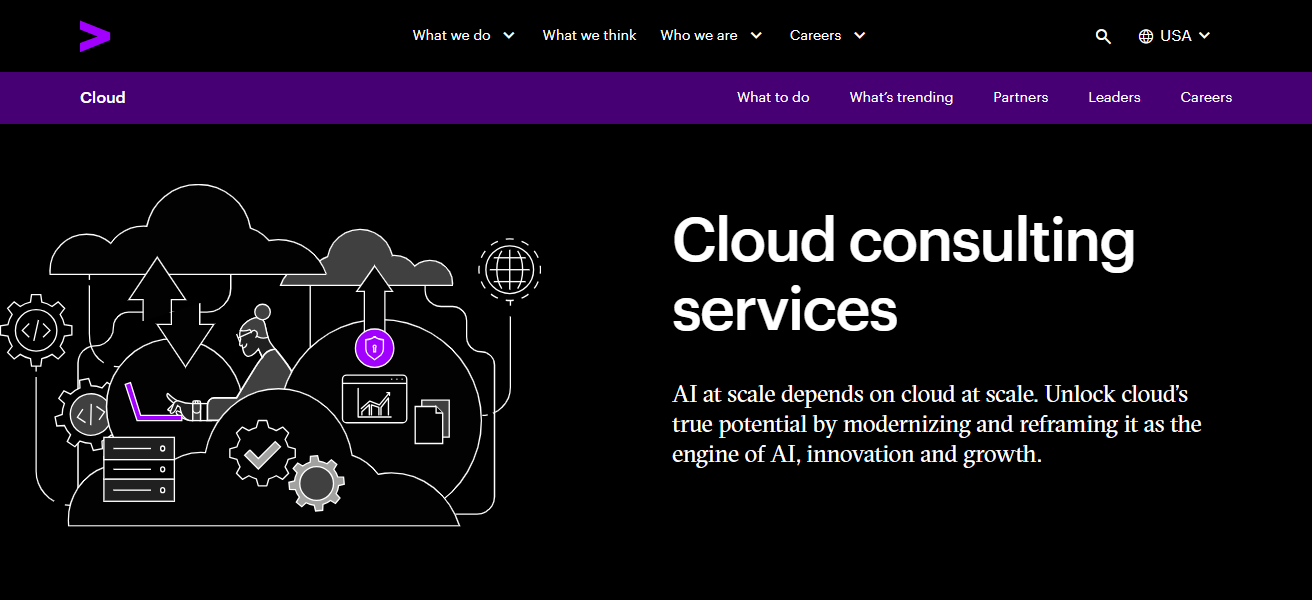
These services go along with cloud security and compliance as well as cost optimization services. Accenture managed services cloud security.
With custom solutions for varying industries and with consulting teams, the company helps customers modernize their core applications, enhances their operational stability, and fosters innovative transformation based on cloud-first principles.
Accenture Cloud Services Features
Comprehensive Cloud Transformation – Complete strategy, as well as migration, modernization, and operational activities, including transformations, aligned with the business digitalization objectives.
AI & Automation Integration: Using AI, analytics, and automation for improved intelligence and insights regarding cloud operational management and cloud managed services.
Multi-Platform Support: Extensive experience across AWS, Azure, Google Cloud, and hybrid cloud environments.
Security & Risk Management: Integrated security operations and threat monitoring, as well as compliance management.
Accenture Cloud Services – Pros & Cons
| Pros | Cons |
|---|---|
| Global leader with deep enterprise expertise | Premium pricing structure |
| Advanced AI, automation, and analytics integration | Can be overwhelming for SMBs |
| Strong security and compliance management | Long onboarding timelines |
| Supports all major cloud platforms | Less flexibility in customized pricing |
4. OVHcloud
OVHcloud is a European cloud provider that is known for its data sovereignity, transparent pricing, and open-source-friendly infrastructure.
OVHcloud has strong compliance with European GDPR laws and offers public and private managed cloud services.
OVH cloud provides managed services such as monitoring, backup, security, and optimization. Businesses are able to predict their cloud costs
While OVHcloud provides data control and privacy. OVHcloud cloud offers businesses sustainable and cost-effective cloud services.
OVHcloud – Key Features
Data Sovereignty-Focused Cloud: Strong commitment to privacy and regional compliance, relevant to EU customers.
Predictable Pricing Model: Pricing is fully transparent, simple, and affordable without unexpected charges.
Public, Private & Hybrid Cloud Options: Different deployment models that align to specific performance, control, and budget requirements.
Developer & Open-Source Friendly: Open frameworks and tools are supported across infrastructure and orchestration.
OVHcloud – Pros & Cons
| Pros | Cons |
|---|---|
| Strong data sovereignty and GDPR compliance | Limited advanced managed services |
| Transparent and predictable pricing | Smaller ecosystem than hyperscalers |
| Open-source friendly infrastructure | Fewer enterprise-grade AI tools |
| European-focused data centers | Limited presence in some regions |
5. Rackspace Technology
Rackspace Technology is an advanced provider in managed technology and cloud services. They specialize in cloud services using multi and hybrid manage systems. They assist with cloud operations such as AWS, Google cloud, Azure, and private cloud.
Rackspace provides cloud operations and migration, security cloud management, and cloud cost optimization 24/7. They help business and companies mitigate and lessen the complexity and enhance the performance and accessibility.
They help businesses and companies manage and streamline cloud participation and performance. Rackspace is suited for businesses needing strong operational assistance but do not want to create big in-house systems with multi cloud technology.
Rackspace Technology – Key Features
Fanatical Support Model: 24/7 monitoring and expert intervention for proactive support and issue resolution.
Multi-Cloud Expertise: Managed services for AWS and Azure, Google Cloud, and private cloud solutions are also offered.
Cloud Migration & Modernization: Transition planning is handled to minimize downtime.
Cost & Performance Optimization: Ongoing optimization to decrease spend and enhance performance.
Rackspace Technology – Pros & Cons
| Pros | Cons |
|---|---|
| Excellent 24/7 managed support (“Fanatical Experience”) | Higher managed service fees |
| Strong multi-cloud and hybrid expertise | Dependent on third-party cloud providers |
| Simplifies complex cloud operations | Limited proprietary cloud innovation |
| Good for organizations lacking in-house expertise | Less suitable for budget-focused users |
6. Infosys Cloud Services
Infosys Cloud Services offers enterprise-level managed cloud solutions designed to fasttrack digital transformation.
It caters to multi-cloud strategies and offers services such as cloud migration, application modernization and automation, and managed operations.
Infosys employs AI tools to enhance performance tracking, security, and cost efficiency. With great understanding of the industry and cloud delivery capabilities
Infosys assists large businesses in modernizing legacy systems, bolstering scalability, and achieving operational excellence in managed cloud environments.
Infosys Cloud Services – Key Features
Cloud Assessment & Roadmapping: IT capabilities and maturity is assessed and outcomes planned strategically, and aligned with business goals.
Application Modernization – Upgrading and re-designing legacy programs for execution in the cloud.
AI Driven Managed Operations – Intelligent supervision, automatisation, and efficient use of resources.
Security & Compliance Governance – Proactive partnerships in risk and compliance frameworks.
Infosys Cloud Services – Pros & Cons
| Pros | Cons |
|---|---|
| Strong enterprise and legacy system modernization | Slower decision-making process |
| AI-driven automation for cloud operations | Less flexible for small businesses |
| Supports multi-cloud strategies | Customization may increase costs |
| Global delivery and industry expertise | Requires long-term engagement |
7. Tata Consultancy Services (TCS)
TCS Cloud Services provides fully managed cloud solutions designed for scale and security, and with a customized approach to enterprise dependability.
TCS offers cloud consulting, migration, DevOps, and managed operations across all major cloud platforms. TCS custom cloud frameworks integrate governance and compliance with cost-efficient cloud solutions.

TCS helps large enterprises in highly regulated industries modernize their IT infrastructure and sustain business operations, accelerate digital growth, protect data, and develop strategies for data-driven digital transformation.
Tata Consultancy Services (TCS) – Key Features
Enterprise-Grade Cloud Consulting – Customized cloud solutions and strategies aligned with sector.
Hybrid & Multi-Cloud Enablement – Smooth transition and integration across varying cloud environments.
Governance & Risk Controls – Established compliance, security, and performance frameworks.
DevOps & Automation Capabilities – Enhanced CI/CD flows and operational automatisation.
Tata Consultancy Services (TCS) – Pros & Cons
| Pros | Cons |
|---|---|
| Highly reliable for large-scale enterprises | Not ideal for startups or SMBs |
| Strong focus on governance and security | Longer implementation cycles |
| Excellent support for regulated industries | Higher initial setup costs |
| Global presence and delivery capability | Less innovation-focused compared to hyperscalers |
8. Wipro Cloud Services
Wipro Cloud Services is designed to nurture business agility and innovation with comprehensive managed cloud solutions.
It provides cloud consulting and migration, as well as modernization and operational management, including on AWS, Azure, and Google Cloud.
Wipro incorporates AI and automation, as well as security, to its cloud services to streamline and improve downtimes.
By having industry-centric solutions and robust global delivery, Wipro helps enterprises to better their cloud cost management and performance, as well as speed up their digital transformation efforts.
Wipro Cloud Services – Key Features
Cloud Advisory & Strategy – Comprehensive and systemic planning from business case to operationalization.
Automation & AI Enhanced Operations – Intelligent technology designed to supervise, prevent faults and save on costs.
Multi-Cloud Implementation – Comprehensive implementation across major cloud providers with interoperability.
Industry Specific Solutions – Tailored cloud solutions in telecommunications, finance and healthcare.
Wipro Cloud Services – Pros & Cons
| Pros | Cons |
|---|---|
| End-to-end managed cloud services | Pricing can be complex |
| Strong automation and AI integration | Moderate speed of execution |
| Industry-specific cloud solutions | Limited focus on small-scale deployments |
| Good multi-cloud support | Custom solutions may raise costs |
9. HCLTech Cloud Services
HCLTech Cloud Services caters to enterprises’ cloud-native transformation and managed cloud operations with a focus on supporting hybrid and multi-cloud environments.
Services offered include migration, application modernization, DevSecOps, and infrastructure management. HCLTech employs automation to achieve engineering-led solutions that enhance reliability and scalability.
HCLTech’s legacy system modernization expertise allows efficient cloud migration while maintaining performance and security, and operational stability within the complex IT environment.
HCLTech Cloud Services – Key Features
Cloud Native Engineering – Updating legacy applications for improved portability and scalability.
DevSecOps & Automation – Fuses development, security and operations for continuous value delivery.
Hybrid & Multi-Cloud Expertise – Unlocks seamless control across diverse environments.
HCLTech Cloud Services – Pros & Cons
| Pros | Cons |
|---|---|
| Strong engineering-led cloud transformation | Less consulting-oriented |
| Excellent legacy application modernization | Smaller AI ecosystem |
| Focus on DevSecOps and automation | Not ideal for very small businesses |
| Reliable hybrid and multi-cloud support | Branding less visible than competitors |
10. Cognizant Cloud Services
Cognizant Cloud Services offers managed cloud solutions to help customers gain greater agility, resilience, and digital innovation.
It works with many cloud providers and offers cloud services, such as; strategy, migration, modernization, and cloud management.
By leveraging industry knowledge along with automation and analytics to improve cloud efficiency and costs, Cognizant optimizes cloud solutions.
With Cognizant’s managed services, enterprises undergoing major cloud transformations can improve customer experiences, scale securely, and modernize application.
Cognizant Cloud Services – Key Features
Cloud Strategy & Advisory – Guidance on transformation and planning in alignment with business goals.
Migration & Modernization Services – Moving to new systems, refactoring, and rearchitecting.
Managed Cloud Operations – Ongoing support, optimization, and monitoring.
Analytics & Automation Integration – Automation of processes and insights derived from the data.
Cognizant Cloud Services – Pros & Cons
| Pros | Cons |
|---|---|
| Strong digital transformation expertise | Pricing may be high for SMBs |
| Good balance of consulting and managed services | Longer project timelines |
| Industry-focused cloud solutions | Less emphasis on infrastructure innovation |
| Effective cost and performance optimization | Requires structured engagement models |
How We Choose Best Managed Cloud Service Providers
Identifying Business Needs – Determine the type of workloads, industry requirements, specific expectations on performance, and how the workloads will need to scale over time.
Multi-cloud & Platform Strategy – Based on your long-term strategy, ensure the provider can help you with and will support the specific cloud services (e.g. AWS, Azure, Google Cloud) or hybrid cloud services.
Industry Security & Compliance – Security practices and protection of your data should comply with your industry regulations and data protection laws.
Quality of Service & Support – Look for the provider who will monitor your systems and data on a 24/7 basis and offer you proactive support. Good SLAs will define the time to solve issues when they arise and ensure the uptime of your systems.
Scalability & Flexibility – You should be able to easily scale the systems up or down to match your busness growth or the changing demand.
Cost Transparency – Hidden costs can be a problem, thus, compare other pricing models, and management costs with other cloud services providers, and check what management services they give, like for example optimization.
Experience with the Industry – Hiring industry-specific providers will be of great help to your business, other you will have to help them with other projects of the same size.
Conclusion
To sum up, the right managed cloud service providers are critical for businesses seeking to improve performance, security, and scalability.
These companies ensure ease of cloud management, cost-effective cloud optimization, reliable cloud operations, and let organizations focus on growth and innovation.
Choosing a provider that matches the uniqueness of your industry will ensure that you have efficient, secure, and future-ready cloud infrastructure.
FAQ
Managed cloud service providers deliver cloud infrastructure support, operations, security, and optimization so businesses can focus on core goals.
To reduce complexity, improve reliability, enhance security, and optimize cloud costs with expert support.
Managed providers add ongoing maintenance, monitoring, and support — beyond basic infrastructure.
Finance, healthcare, retail, manufacturing, and technology sectors often see the greatest value.
Cloud migration, monitoring, security, compliance, cost management, and performance tuning.