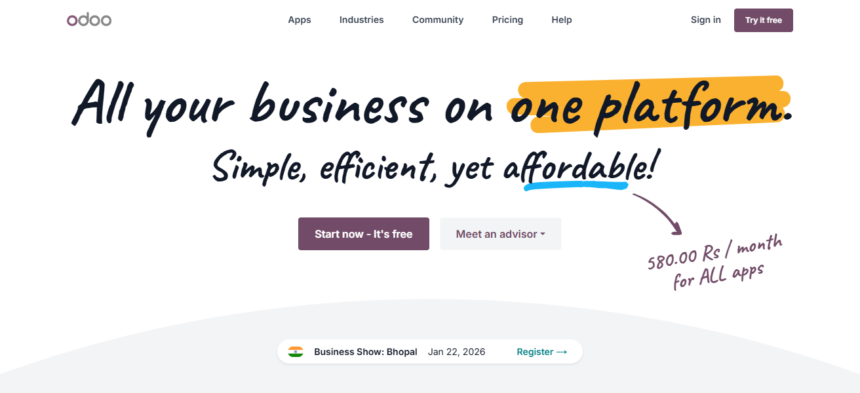
In this article, I will review Odoo’s current competitors in Accounting & Finance which provide powerful functionalities, better user experience, and flexible price offerings.
- Key Points & Best Odoo Alternatives for Accounting & Finance
- 10 Best Odoo Alternatives for Accounting & Finance
- 1. QuickBooks Online
- 2. Xero
- 3. Zoho Books
- 4. FreshBooks
- 5. Wave Accounting
- 6. Sage Intacct
- 7. Kashoo
- 8. ZipBooks
- ZipBooks
- 9. Microsoft Dynamics 365 Finance
- 10. Wave Financial
- How To Choose Best Odoo Alternatives for Accounting & Finance
- Conclusion
- FAQ
These alternatives are designed for businesses that need simplified and automated accounting with real-time financial visibility in an ERP-lite solution.
Key Points & Best Odoo Alternatives for Accounting & Finance
| Software | Key Point |
|---|---|
| QuickBooks Online | User-friendly cloud accounting with strong integrations |
| Xero | Excellent multi-currency support and collaboration tools |
| Zoho Books | Affordable option with automation and tax compliance |
| FreshBooks | Best for freelancers with invoicing and expense tracking |
| Wave Accounting | Free accounting software with core finance features |
| Sage Intacct | Enterprise-grade financial management with scalability |
| Kashoo | Simple accounting for small businesses with automation |
| ZipBooks | Smart insights and modern interface for startups |
| Microsoft Dynamics 365 Finance | Robust enterprise finance solution with AI-driven insights |
| Wave Financial | Easy-to-use platform with free invoicing and payroll add-ons |
10 Best Odoo Alternatives for Accounting & Finance
1. QuickBooks Online
One of the most reputed Easy Odoo alternatives for Accounting and Finances is QuickBooks Online. It prides itself in simplicity, speed, and providing real-time visibility to finances.
Unlike Odoo, where modular complexity is the case, QuickBooks Online allows its users to manage invoicing, expenses, taxes, and cash flow from one dashboard with no technical set up.
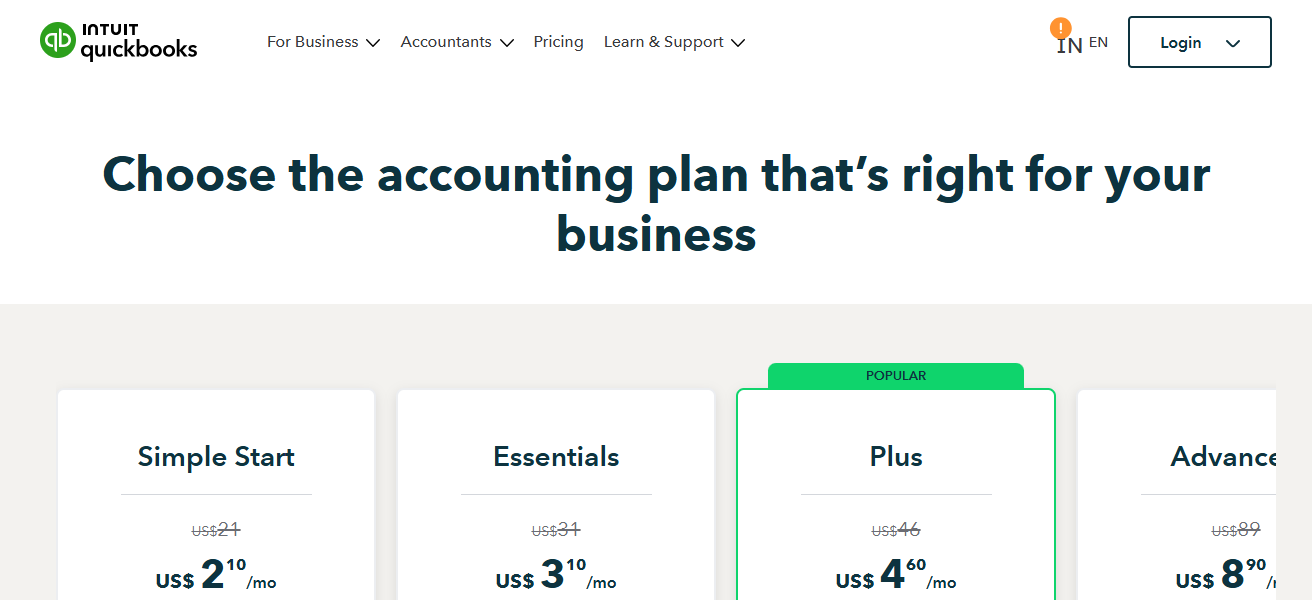
It is also accurate and effortless in financial tracking since it has automated bank feeds, smart reporting, and cloud access.
QuickBooks Online is perfect for small and growing businesses that want robust accounting without the ERP complexity.
QuickBooks Online Features
- Automated Bank Feeds: Links with your bank and credit accounts to automatically download and categorize transactions.
- Invoicing: Draft and distribute invoices, send follow-up reminders, and monitor the status of invoices.
- Cash Flow Dashboard: Displays the most recent information on your revenue, costs, and cash flow.
- Tax Reports: Organizes your tax reports to assist in managing your tax obligations and prepare for tax filing.
| Pros | Cons |
|---|---|
| Easy-to-use interface for non-accountants | Pricing increases with advanced features |
| Strong automation for invoicing and bank feeds | Limited customization for complex workflows |
| Real-time financial reporting | Customer support can be inconsistent |
2. Xero
When looking for alternatives to Odoo, Xero is one of the best options for accounting and finances. While Xero provides advanced financial control, it lacks the complicated full ERP systems.
Because of Xero’s real-time collaboration, accountants and business owners can work together with updated information. Xero’s strong automation reduces the manual work that goes into bank reconciliation, recurring billing, and expense tracking.
Additionally, the interface is easy to use, the cloud access is reliable, and the financial reporting is powerful.
Xero is especially suitable for businesses that require specific accounting functionality instead of Odoo’s multi-module and broad offerings.
Xero Features
- Accounting in Real Time: your accounting data is in the cloud and available to multiple users and advisors simultaneously.
- Time Saving Statement Reconciliation: Automatically pairs transactions to bank statements.
- No Cost Charge for Additional Users: Provide access to your employees or your accountant for free.
- Tailored Financial Reports: Reports can easily be built to suit the specific requirements of the business.
| Pros | Cons |
|---|---|
| Excellent real-time collaboration | Payroll not available in all regions |
| Powerful bank reconciliation | Add-ons required for advanced features |
| Clean and modern dashboard | Slight learning curve for beginners |
3. Zoho Books
Zoho Books is one of the best alternatives to Odoo for finance and accounting because it provides ERP-level control within a lightweight, accounting-centric package.
The deep automation of its invoicing, tax calculation, payment reminders, and workflow approvals modules are its strongest attributes, as these features minimize manual work.
It also offers integration with other Zoho applications for a frictionless connected finance ecosystem, as opposed to the added technical layer of other integration options.
With features that support compliance, real-time reporting, and ease of use, Zoho Books is perfect for businesses that desire solid financial management but don’t want to take on Odoo’s complete ERP system.
Zoho Books Features
- Automated Workflows: Automatically send invoices, reminders, and approval workflows.
- Transaction Handling: Transactions in other currencies are handled by Zoho Books, and then converted.
- Orders on Sales and Purchases: Synchronizes pipeline and supplier orders within one system.
- Integrated Tax Rules: Automatically calculates GST, VAT, and other taxes.
| Pros | Cons |
|---|---|
| Deep automation and workflow rules | Best features tied to Zoho ecosystem |
| Strong tax and compliance tools | Limited advanced inventory features |
| Affordable pricing for small businesses | Not ideal for very large enterprises |
4. FreshBooks
Odoo alternatives like FreshBooks offer accounting and finance solutions specifically catered to service-based businesses. They focus on simplicity and efficiency.
One of their most notable features is invoicing coupled with time tracking, expense monitoring, and automated payment reminders.
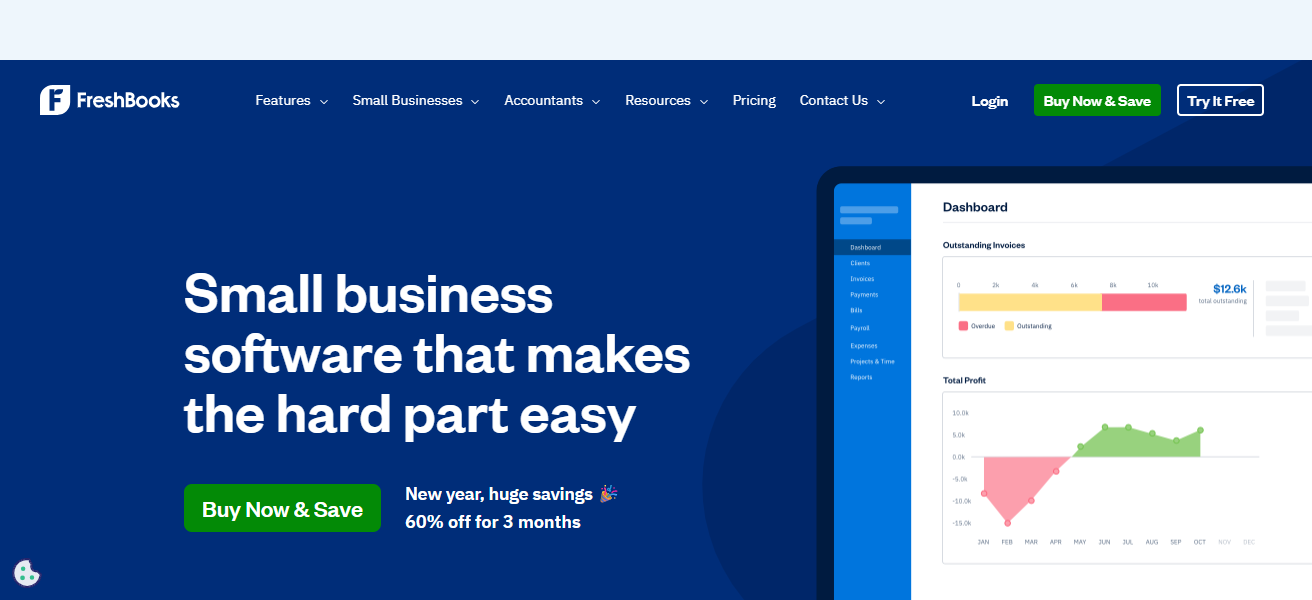
Unlike Odoo, FreshBooks approaches finance and customer-focused simplicity. Users can manage tasks, billing, project profitability, and financial tracking within the same platform.
Its flexible interface is mobile friendly, offers real-time financial tracking, and is easy to learn, making it a great option for freelancers and small teams.
FreshBooks Features
- Built-in Time Tracking: Billable time can be tracked and linked to clients and projects.
- Business Expense Management: Smart expense saves, snap receipts, and categorize business expenses.
- Invoices Profitable to Clients: Online payment acceptance options via easy templates invoices.
- Views profitability per project: See income vs. time spent per project.
| Pros | Cons |
|---|---|
| Excellent for service-based businesses | Limited inventory management |
| Built-in time tracking and invoicing | Not suitable for complex accounting |
| Simple and intuitive design | Reporting depth is basic |
5. Wave Accounting
Wave Accounting has been recognized as one of the finest alternatives for Odoo in the finance and accounting area since it offers simplified financial tools without the need for a full blown ERP system.
Furthermore, it provides invoicing, expense tracking, and financial reporting tools in a clean platform where the other full ERP systems provide more complex tools because Wave values simplicity.
Because Wave focuses more on accessibility and simplicity more than Odoo, Wave is more appropriate for small businesses and freelancers.
Users of Wave do not need to put in much manual work for accurate finances as the platform automates a lot of functions including the categorization of income and expenses, as well as providing financial summaries.
Wave Accounting Features
- Free Primary Accounting: Invoicing, expense tracking, and reports remain free.
- Receipt Uploading: Photos of receipts can be uploaded and details captured automatically.
- Gain Financial Health Insights: Easily visualize summaries show your income and expenses.
- Simple Configuration: Minimal setup lets you hit the ground running.
| Pros | Cons |
|---|---|
| Free core accounting features | Limited scalability |
| Very easy to use | Fewer advanced reports |
| Ideal for freelancers and micro-businesses | No complex accounting support |
6. Sage Intacct
Sage Intacct is one of the best Odoo alternatives for accounting and finance because it offers enterprise-level financial management without the transactional complexity of a full ERP suite.
Its most notable strength is advanced multi-entity and multi-dimensional accounting, giving businesses the ability to monitor and evaluate performance across specific units, locations, and initiatives.
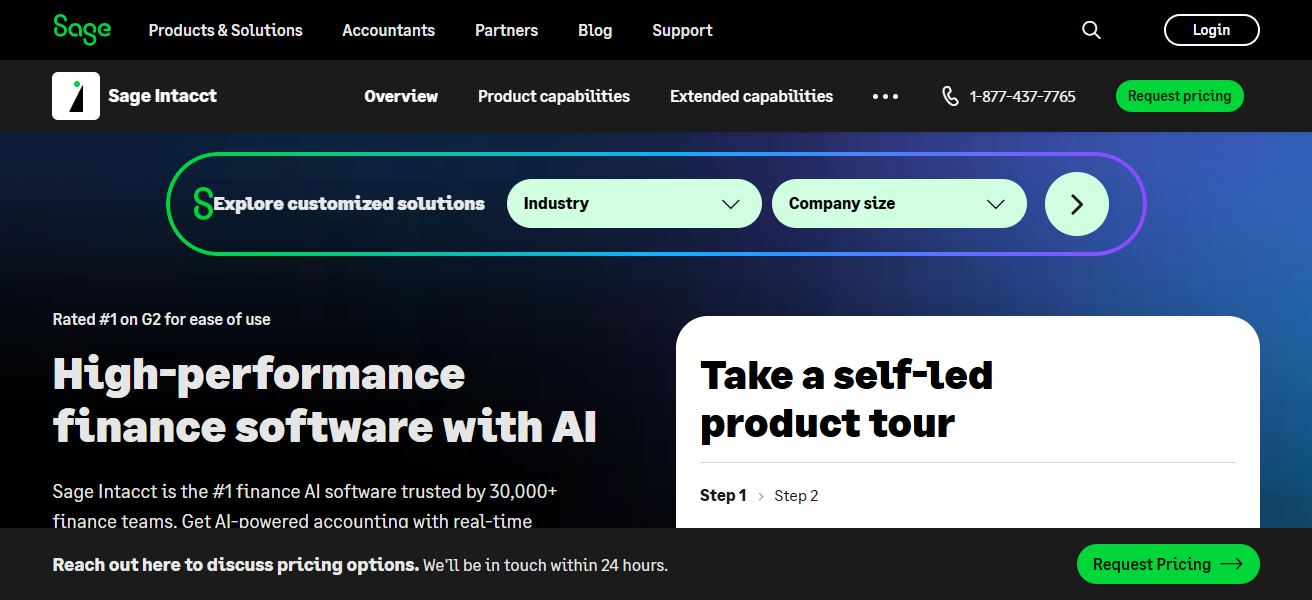
Sage Intacct automates critical financial operations like revenue recognition, budgeting, and close management.
It offers advanced financial reporting and scalable cloud architecture, making it a good fit for growing companies who need sophisticated accounting without Odoo’s extended ERP system.
Sage Intacct Features
- Advanced Consolidation: Seamlessly manage multi-entity finances across locations and subsidiaries.
- Revenue Recognition: Automates complex schedules with advanced recognition of earned income.
- Comprehensive Financial Analysis: Reporting deep with multi-dimensional dashboards.
- Workflow Automation: Journal entries and expense approvals automate entry.
| Pros | Cons |
|---|---|
| Advanced multi-entity accounting | High cost compared to SMB tools |
| Strong financial reporting | Requires training to use effectively |
| Scales well for growing organizations | Overkill for small businesses |
7. Kashoo
Kashoo is an accounting and finance solution that prioritizes straightforwardness and accuracy, making it a good alternative to Odoo, particularly in accounting and finance.
Its smart automation systems analyze and classify complicated transactions, simplifying the financial decision-making process for small businesses.
Instead of a multi-module platform like Odoo’s, Kashoo prioritizes basic accounting functions like income, expenses, and reporting.
Its simple interface, real-time analytics, and easy set-up make it a good platform for entrepreneurs who want dependable accounting controls without any technical or operational difficulties.
Kashoo Features
- Assured Bookkeeping: tasks core computing finances with a clean interface.
- Smart Transactions: Bank transactions are auto categorized.
- Invoices Tracking Payments: Send invoices professionally and.
- Real Summaries Financial: Snapchats clear loss/profit and balance sheets.
| Pros | Cons |
|---|---|
| Clean and simple interface | Limited integrations |
| Smart transaction categorization | Not suitable for complex needs |
| Easy setup for small businesses | Fewer advanced features |
8. ZipBooks
ZipBooks is highly regarded as an Odoo alternative for accounting and finance solutions because of its blend of smart automation and easy-to-use design.
Its standout feature is smart bookkeeping, which provides an analysis of your business performance, cash flow, and payment behavior.
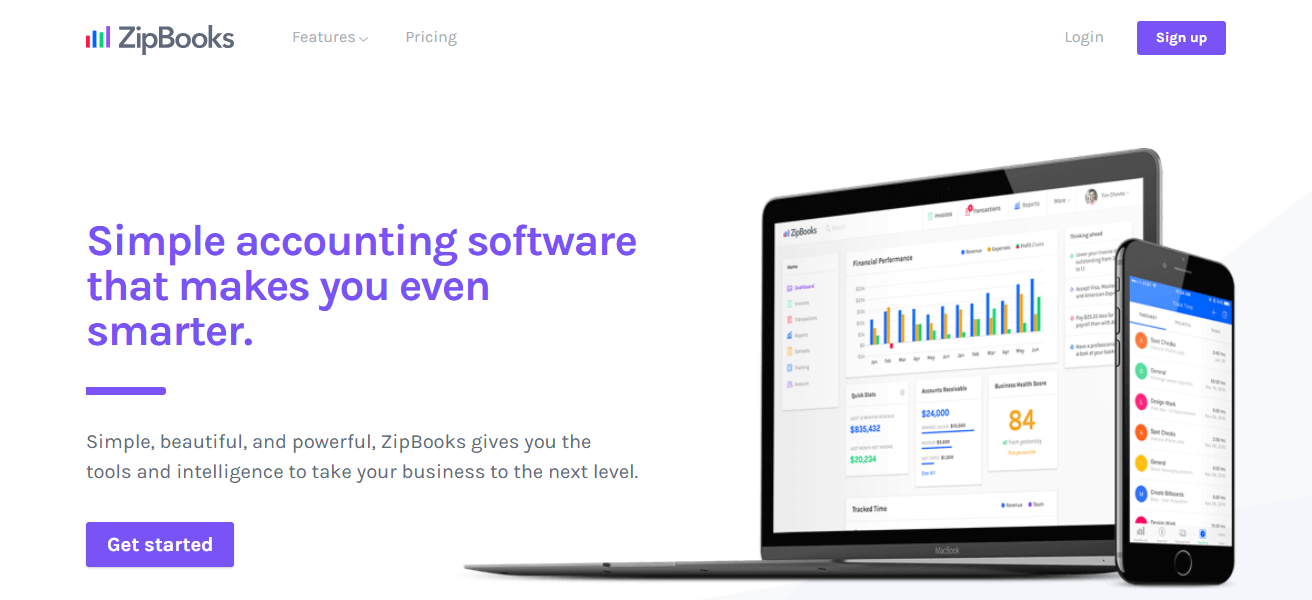
While Odoo provides an extensive ERP system, ZipBooks focuses on core accounting, invoicing, and reporting, without the added complexity.
Automated expense categorization, invoicing, and financial insights allow ZipBooks to provide a smarter accounting solution to small business who wish to avoid the complexity of a full ERP solution.
ZipBooks
- Smart Insights: Highlights important metrics such as payment history and net income.
- Invoicing Made Easy: Personalize your invoices and include options for payments.
- Automated Categorization: Assigns expenses for easier bookkeeping.
- Dashboards: Clearly see how your finances are performing.
| Pros | Cons |
|---|---|
| Smart insights into financial health | Advanced features behind paid plans |
| Simple invoicing and bookkeeping | Limited enterprise capabilities |
| Good for small businesses | Not ideal for complex accounting |
9. Microsoft Dynamics 365 Finance
Microsoft Dynamics 365 Finance is a top Odoo alternative, owing to its deep financial intelligence and high adaptability as an enterprise scale solution.
Its standout features include advanced financial planning, real time analytics, and AI powered cash flow optimization and operational risk analytics.
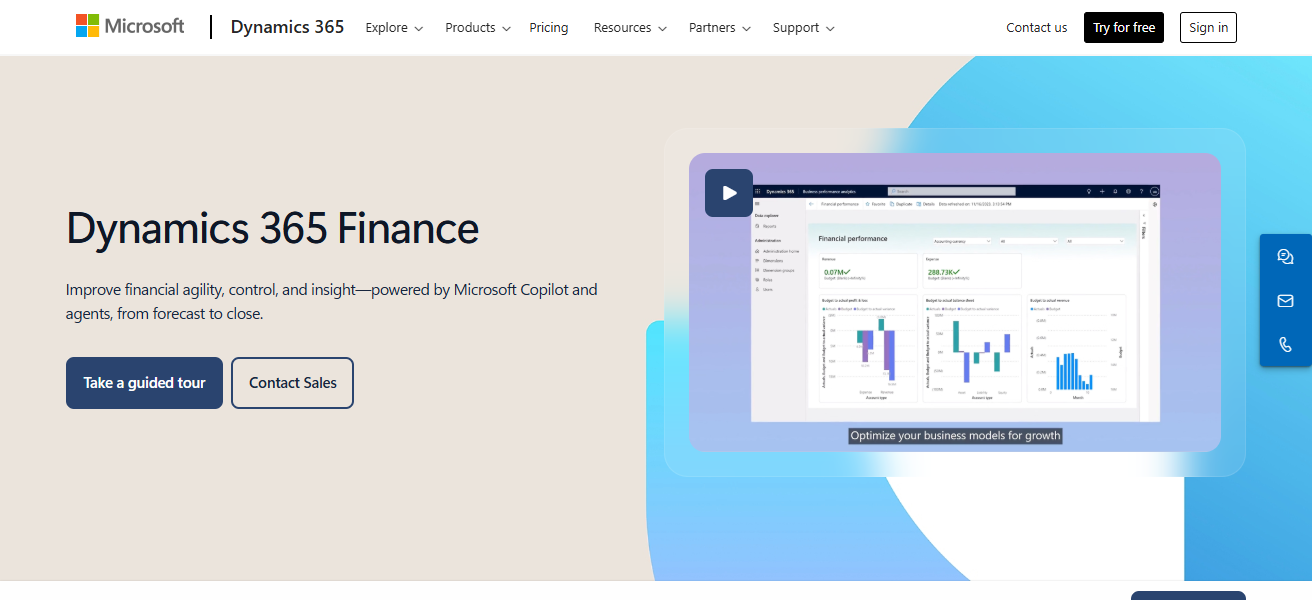
On top of this, Odoo’s modular ERP approach is outclassed as Dynamics 365 Finance integrates fully with the Microsoft ecosystem, resulting in unified data across finance, operations and reporting.
This solution is therefore best suited to large and expanding companies with complex needs around financial control and global compliances.’
Microsoft Dynamics 365 Finance Features
- Analytic AI: Machine learning to analyze and predict trends and cash flow.
- International Finance Management: Manages different currencies, laws, and standards.
- Planning & Budget Control: Tools to control and manage budgets within and across departments.
- Microsoft Integration: Easy connection to Excel, Power BI, and Teams.
| Pros | Cons |
|---|---|
| Enterprise-grade financial management | High implementation cost |
| Deep analytics and AI-driven insights | Requires technical expertise |
| Strong global compliance support | Too complex for small businesses |
10. Wave Financial
Wave Financial stands as a credible alternative to Odoo for accounting and finance functions due to its cost effective and simple solution for essential financial management tools.
The primary benefit of Wave Financial for small businesses and freelancers is the ability to manage invoicing, expense reporting, expense tracking, and financial reporting without the hassle of ERP complexity.
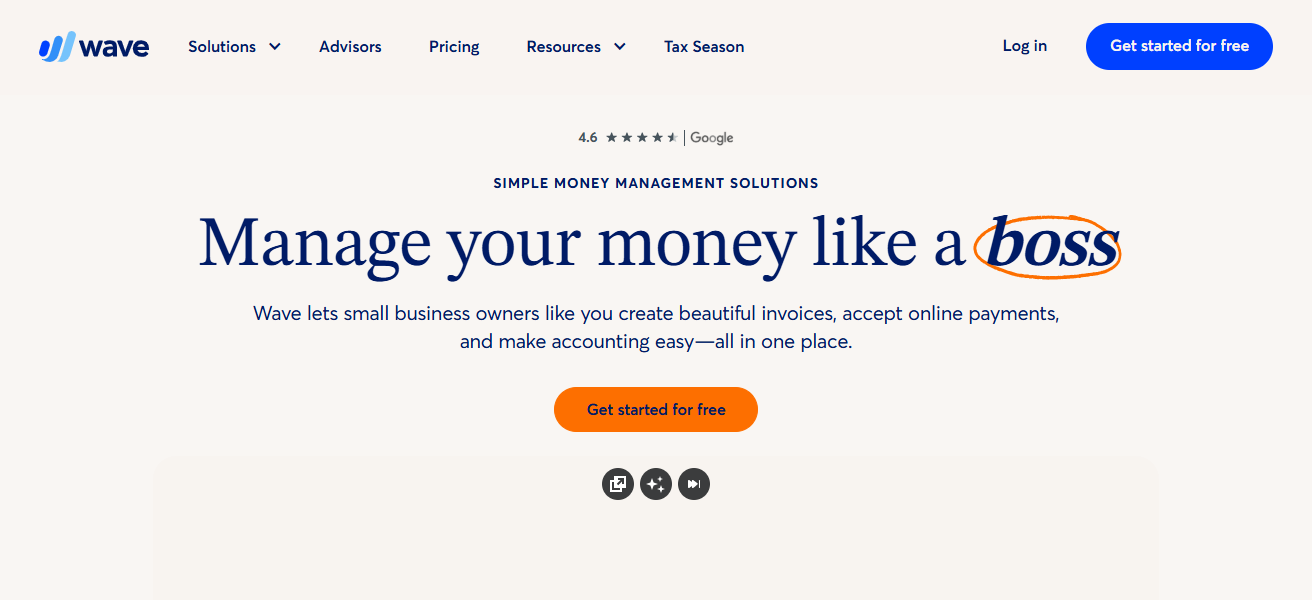
Where Odoo may contain too many features, Wave Financial focuses on keeping accounting simple and available.
Automated transaction organization, summary of income and expenses, and a user friendly dashboard helps the customer save time and money, and stay on top of finances.
Wave Financial Features
- Affordable Accounting: Basic accounting features for no cost.
- Track Expenses Easily: Simple tracking and categorization of business expenses.
- Invoicing: Professional invoices can be generated and sent, with tracking for payments.
- Overview in Real-Time: A dashboard with summary of important financial metrics.
| Pros | Cons |
|---|---|
| Cost-effective for small businesses | Limited advanced accounting tools |
| Simple invoicing and expense tracking | Not designed for scalability |
| Easy learning curve | Basic reporting features |
How To Choose Best Odoo Alternatives for Accounting & Finance
Business Size: Assess the software to avoid paying too little or too much.
Ease of Use: Interfaces should be simple, so all employees can be trained.
Feature Depth: Select accounting software with invoicing, reconciliation, reporting, and tax features.
Scalability: Check the software’s capacity to avoid expensive revisions or cumbersome upgrades.
Integration Options: Look for software compatible with your banking, payroll, CRM, and essential systems.
Automated Reporting: Look for simple and customizable reporting dashboards for quicker decision-making.
Cloud Accessibility: Web-based software is more convenient and gets updated automatically.
Support Quality: Operational downtime can be diminished with quality support and educational materials.
Automation Level: Tax, billing, and banking software should be integrated to save time.
Pricing Transparency: Look for software with predictable pricing and avoid unnecessary tiered pricing.
Conclusion
To sum up, the right Odoo alternative for accounting and finance for you depends on the size, requirements, and budget of your company.
QuickBooks Online, Xero, Zoho Books, and Sage Intacct are all Odoo accounting alternatives that provide powerful, user-friendly, and automated financial management tools with real-time insight features.
For businesses that want efficient accounting, and do not want the additional complexity of a full ERP system, these alternatives offer a simpler and less costly solution.
FAQ
They are accounting-focused software tools offering financial management without Odoo’s full ERP complexity.
Some businesses need simpler accounting, lower costs, or faster setup than Odoo provides.
QuickBooks Online, Zoho Books, and Wave are popular for small business accounting needs.
Yes, solutions like Microsoft Dynamics 365 Finance and Sage Intacct support enterprise-scale finance.