I will highlight the Best Odoo Alternatives for Manufacturing Companies that simplify the management of production, inventory, and overall operations.
- Key Points & Best Odoo Alternatives for Manufacturing Companies
- 10 Best Odoo Alternatives for Manufacturing Companies
- 1. NetSuite
- 2. Microsoft Dynamics 365
- 3. SAP Business One
- 4. Zoho CRM Plus
- 5. Acumatica
- 6. Infor
- 7. Plex
- 8. Epicor
- 9. Sage Intacct
- 10. Monday.com
- HowTo Choose Best Odoo Alternatives for Manufacturing Companies
- Cocnsluion
- FAQ
Odoo is an excellent ERP tool, however, manufacturing businesses require more specific and tailored solutions.
In this sector, having strong ERP tools is essential in order to manage workflows effectively across the board.
In this piece we will examine the other platforms that provide specialization, scalability, and real-time insights for optimal efficiency, minimal downtime, and sustained growth.
Key Points & Best Odoo Alternatives for Manufacturing Companies
| Alternative | Key Point |
|---|---|
| NetSuite | Enterprise powerhouse with robust ERP features for large-scale manufacturing. |
| Microsoft Dynamics 365 | Integration and scalability across supply chain, finance, and operations. |
| SAP Business One | Designed for SMEs offering strong inventory and production management. |
| Zoho CRM Plus | Affordable customization with modular apps for smaller manufacturers. |
| Acumatica | Cloud-based ERP with flexible deployment and manufacturing modules. |
| Infor | Industry-specific solutions tailored for manufacturing verticals. |
| Plex | Manufacturing-focused ERP with shop-floor and production tracking. |
| Epicor | Comprehensive suite covering supply chain, production, and financials. |
| Sage Intacct | Cloud finance powerhouse with strong accounting and reporting tools. |
| Monday.com | Visually driven work management for project and production workflows. |
10 Best Odoo Alternatives for Manufacturing Companies
1. NetSuite
NetSuite’s comprehensive cloud-based ERP solutions tailored for production efficiency make it one of the best Odoo alternatives for manufacturing companies.
Unlike Odoo, NetSuite provides real-time visibility and efficiency in the management of inventory, supply chain, and production workflows, helping manufacturers optimize operations and reduce downtime.
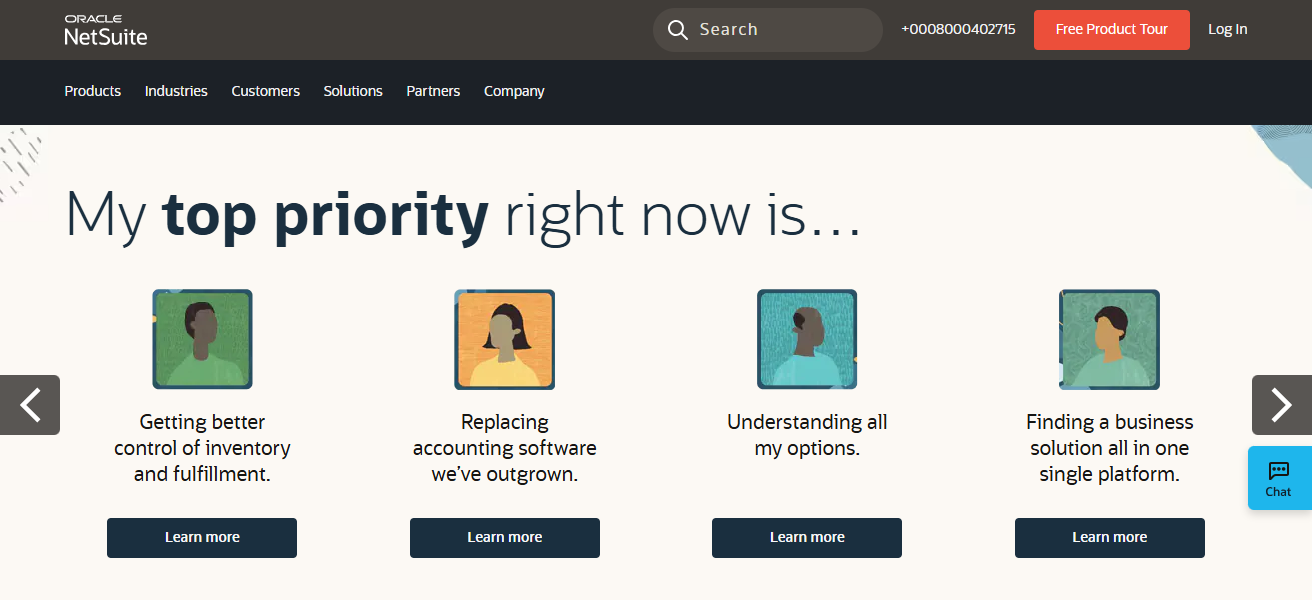
Enhanced demand planning, order management automation, and integrated analytics empower companies to accelerate data-driven decision-making.
Furthermore, NetSuite’s scalability enables growth without complicated upgrades, making it suitable for manufacturers needing a dependable, seamless all-in-one solution to improve profitability and operational control.
NetSuite Features
- Cloud ERP Integration. All of the services (financials, inventory, and production) are integrated and can be used in one product.
- Real-Time Reporting & Analytics. Live insights are provided for each supply chain, inventory, and financial activities.
- Advanced Supply Chain Management. Guides the optimization of supply, production, and demand on the workflows.
- Scalability. Flexible applicable modules and support of global operations assists growing manufacturers.
| Pros | Cons |
|---|---|
| Cloud-based ERP with real-time inventory and production visibility | Can be expensive for small manufacturers |
| Scalable for growing businesses | Customization can be complex and time-consuming |
| Advanced analytics for data-driven decisions | Requires training for full utilization |
| Streamlines supply chain, finance, and operations | Limited offline capabilities |
2. Microsoft Dynamics 365
One of the best alternatives to Odoo for manufacturing businesses is Microsoft Dynamics 365. Its cloud-based solution possesses both CRM and ERP functionalities.
It offers smooth integration with Microsoft products such as Teams and Azure, providing real-time collaboration and insights on data related to production, inventory, and sales.
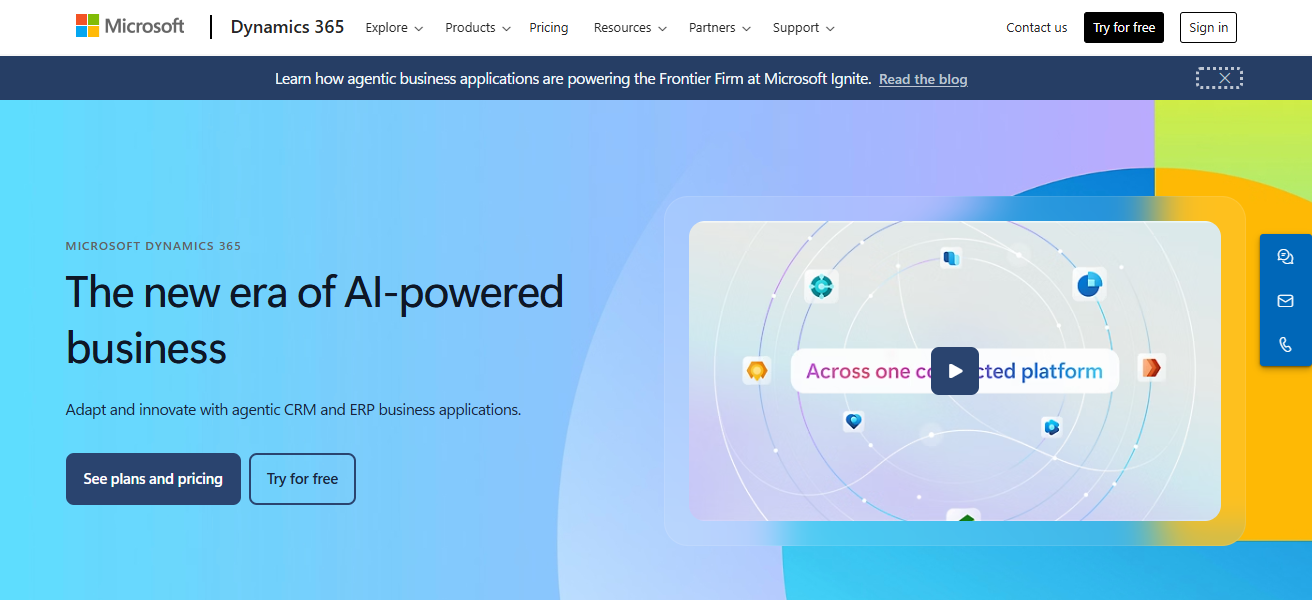
It also offers Power BI for analytics. Furthermore, it offers advanced features for manufacturing, such as production scheduling, optimization of resources, and predictive maintenance.
This helps manufacturers to reduce their costs and increase their operational efficiency and scalability, making it a more flexible and robust solution than Odoo.
Microsoft Dynamics 365 Features
- Unified ERP & CRM. Merges customer relationship management with the manufacturing operations.
- Advanced Production Scheduling. Streamlines the optimization of resources, lessens the downtime, and increases the throughput.
- Microsoft Ecosystem Integrations. Collaboration and insight are obtained easily with Microsoft Teams, Power BI, and Azure.
- Predictive Analytics & AI. Data supported production, inventory, and demand forecasting of Microsoft systems helps to streamline the processes.
| Pros | Cons |
|---|---|
| Combines ERP and CRM in a single platform | Integration setup can be complex |
| Deep integration with Microsoft tools (Teams, Power BI, Azure) | High licensing costs for full features |
| Advanced manufacturing scheduling and resource optimization | Requires technical expertise for customization |
| Scalable for businesses of all sizes | May need third-party add-ons for niche manufacturing needs |
3. SAP Business One
SAP Business One serves as a great Odoo alternative since it is fully integrated with real-time analytics into production, inventory, and finance.
This end-to-end ERP solution is tailored to small and mid-sized manufacturers. The ERP helps manufacturers improve operational efficiency, reduce waste, and minimize downtime with features such as demand planning, shop floor control, and quality management.
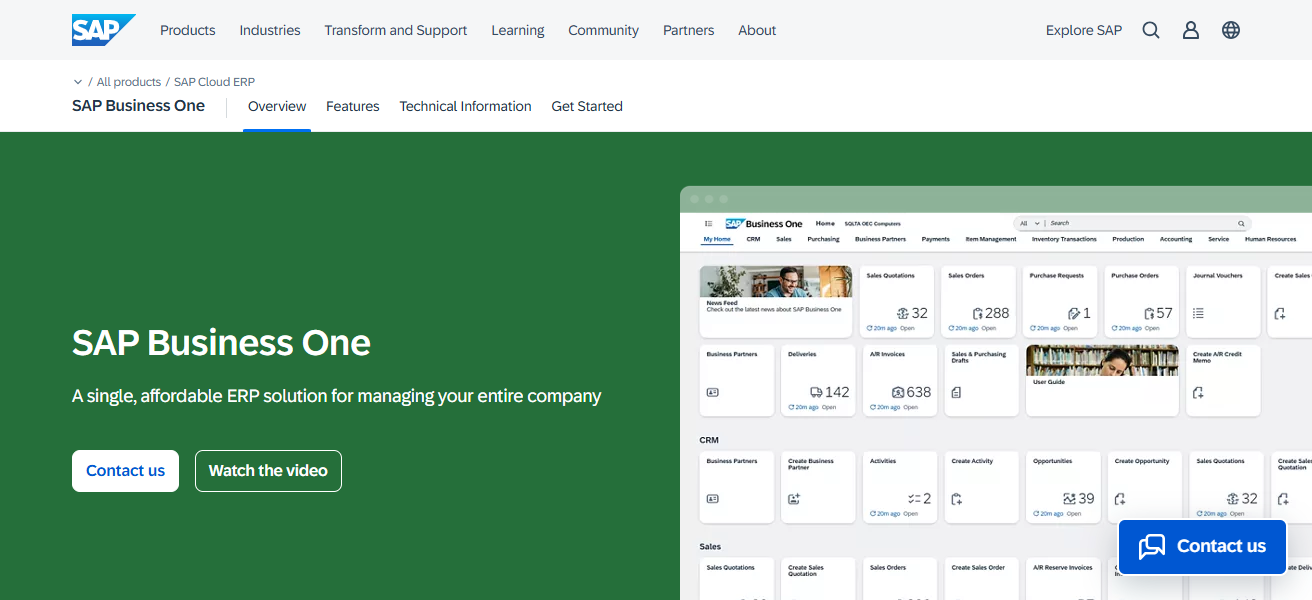
Companies that want to expand without the operational burden of growing to a larger ERP system will find Business One’s scalability and strong reporting capabilities a great asset.
SAP Business One Features
- End-to-End ERP. One entire system is composed of inventory, production, sales, and finance modules.
- Real-Time Visibility. Enables the user to monitor the inventory levels and production lines in all instances.
- Quality & Demand Management. Provides visibility to the product quality and to the accurate forecast of demand.
- Scalable for SMEs: Small to mid-sized manufacturers looking to grow seamlessly are well served.
| Pros | Cons |
|---|---|
| Real-time insights into production, inventory, and finances | Best suited for small to mid-sized manufacturers |
| Streamlines operations and reduces downtime | Can be expensive to scale beyond initial implementation |
| Advanced features like demand forecasting and quality management | Customization may require external consultants |
| Strong reporting and analytics | User interface may feel outdated to some |
4. Zoho CRM Plus
Manufacturing firms can rely on Zoho CRM Plus as a viable alternative to Odoo. Alongside sales, marketing, and customer support, Zoho CRM Plus offers a complete view of customer interactions on a single cloud service.
Its main differentiating factor is order automation and demand forecasting, helping manufacturers track orders, manage leads, and streamline demand forecasting.
By providing automation in customer service, coupled with seamless integration in production and inventory, Zoho CRM Plus improves inter-departmental coordination and workflow, thereby improving customer experience.
Its cost-effective and flexible options provide manufacturers with uninterrupted processes, avoiding the high complexity of traditional ERP systems.
Zoho CRM Plus Features
- Unified Customer Management: Sales, marketing and support are integrated.
- Order & Demand Tracking: Tracks customer orders and predicts demand in real-time.
- Automation & Workflow Management: Minimizes manual work and enhances communication across divisions.
- Customizable & Affordable: Small manufacturers can benefit from its modularity and flexible pricing.
| Pros | Cons |
|---|---|
| Unified platform for sales, marketing, and support | Limited full-scale ERP manufacturing features |
| Tracks orders, leads, and predicts demand efficiently | Advanced customization may be tricky |
| Affordable and flexible | May require integrations for inventory and production |
| Enhances departmental coordination and customer satisfaction | Reporting options are less robust than ERP-focused systems |
5. Acumatica
Manufacturing companies consider Acumatica an ideal Odoo alternative because it provides a fully integrated, cloud-based ERP system specifically designed for optimizing production and operations.
Acumatica’s greatest strength is real-time visibility into inventory, supply chain, and financials, paired with adaptable deployment options as the business grows.
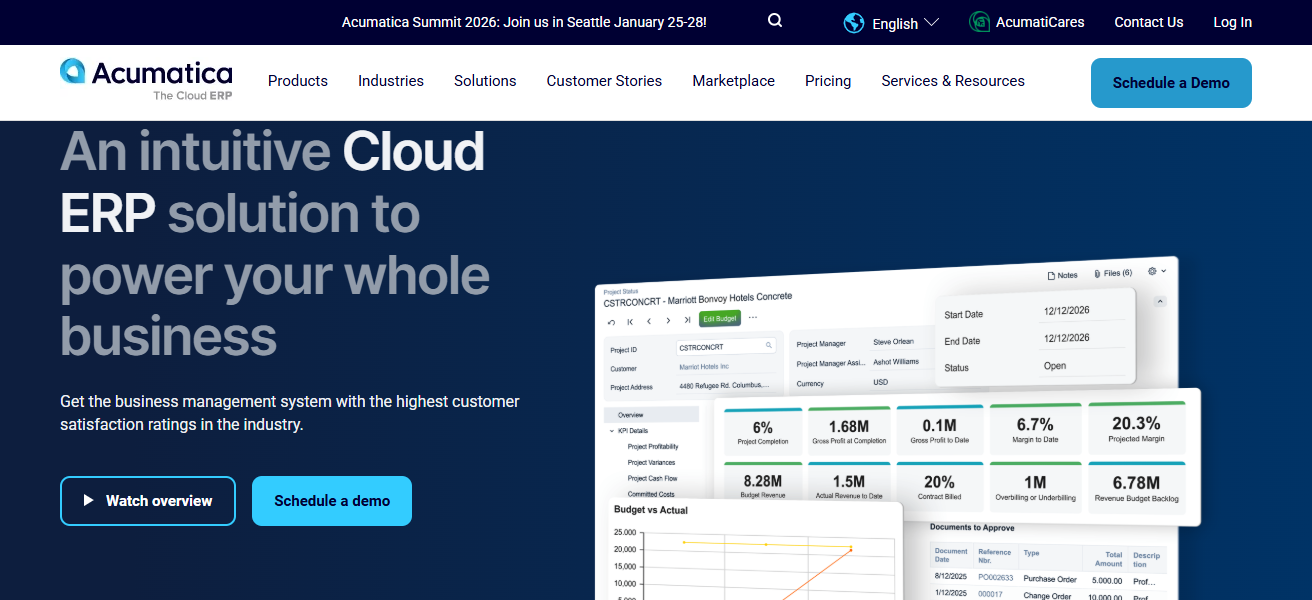
Features such as advanced manufacturing planning, multi-site management, and automated workflow solutions empower manufacturers to minimize downtime, enhance operational efficiency, and rapidly pivot with data-based insights.
Coupled with powerful reporting, Acumatica’s flexibility, advanced scalability, and customizable solutions make it equipped for the future of modern manufacturing.
Acumatica Features
- Cloud ERP Flexibility: Provides cloud, on-premise, or hybrid deployment options.
- Real-Time Operational Insights: Provides real-time updates on inventory, production, and finance.
- Advanced Manufacturing Planning: Provides support for cross-location production, resource mobilization, and workflow automation.
- Scalable Architecture: Accommodates business growth, obviating the need for extensive system updates.
| Pros | Cons |
|---|---|
| Cloud-based ERP with real-time visibility across operations | Smaller user community compared to Odoo or SAP |
| Flexible deployment and scalable architecture | Some advanced modules can be costly |
| Advanced manufacturing planning and automated workflows | Implementation can take time for complex setups |
| Strong reporting for data-driven decisions | Limited marketplace of third-party integrations |
6. Infor
Manufacturing companies consider Infor to be the best Odoo alternative since it is the only ERP cloud solution provider that offers industry specific tech for complicated production workflows.
Infor has the most deep-rooted expertise in manufacturing among its competitors. Its manufacturing software features include smart scheduling, quality management, and supply chain visibility.
Infor features other differentiators including built in analytics and AI for operational waste reduction and decision improvement.
Lastly, Infor’s scaled cloud technology allows manufacturers to swiftly accommodate to demands and is an uncommon ERP solution for manufacturers looking for increased efficiency and growth without traditional ERP restrictions.
Infor Features
- Industry-Specific ERP: Manufacturing specific with production, quality and supply chain modules.
- Smart Scheduling & Resource Planning: Assists in the optimization of the utilization of people and machines.
- AI & Analytics: Identifies efficiency and cost saving opportunities through advanced prediction.
- Cloud-Based Scalability: Works well with the variable and evolving needs of manufacturing.
| Pros | Cons |
|---|---|
| Industry-specific ERP tailored for manufacturing | Can be complex to implement |
| Smart scheduling and quality management | Higher costs for smaller manufacturers |
| AI-driven insights for operational efficiency | User interface may require training |
| Scalable cloud platform for growing businesses | Customization may need technical expertise |
7. Plex
Plex stands out as a great Odoo alternative for the manufacturing sector as it is a cloud-native ERP tailored to the industry.
Its key distinct advantage is real-time visibility into the shop floor production, inventory, and quality control.
Its features such as automated production tracking, supply chain management, and compliance tracking, help manufacturers improve efficiency and reduce downtime while maintaining the quality of the products.

Plex’s industry-focused tools and scalability empower manufacturers to optimize operational efficiency, adapt to market changes, and make quick and informed operational decisions.
Plex Features
- Manufacturing-Centric ERP: Tailored for production, inventory, and quality management.
- Real-Time Shop Floor Visibility: Tracks production progress, inventory, and compliance in real time.
- Automated Workflows: Reduces errors and downtime while streamlining operations.
- Scalable & Industry-Focused Tools: Helps manufacturers with growing and increasingly complex operations.
| Pros | Cons |
|---|---|
| Cloud-native ERP built specifically for manufacturing | Focused mainly on production-heavy industries |
| Real-time production, inventory, and quality tracking | May be expensive for smaller manufacturers |
| Automated workflows reduce downtime and improve efficiency | Limited global presence for support in some regions |
| Scalable and industry-focused tools | Fewer integrations compared to broader ERP platforms |
8. Epicor
Manufacturing firms cite Epicor as a leading alternative to Odoo because, unlike its competitors, Epicor has a fully developed, industry-specific ERP solution that optimizes manufacturing and operational processes.
Epicor’s competitive edge is its manufacturing-related features, such as advanced planning and scheduling, and real-time visibility and management of shop floor quality.
Epicor assists manufacturers with workflow streamlining, waste reduction, and rapid response to demand changes.
Epicor provides flexible deployments, strong analytics, and integrated supply chain management, all of which, combined with Epicor’s considerable operational management and analytics
Capabilities, assist firms in scaling their processes while exercising complete control over their production, inventory, and business results.
Epicor Features
- Deep Manufacturing Capabilities: Comprehensive capabilities, including production scheduling, planning, and execution.
- Shop Floor Management: Tracks and manages production, resources, and inventory in real time.
- Quality Management: Consistency and compliance assurance with industry standards.
- Flexible Deployment: Cloud and on-premise solutions according to company needs.
| Pros | Cons |
|---|---|
| Deep manufacturing capabilities for production and scheduling | Can be complex for first-time users |
| Real-time shop floor visibility | Higher implementation cost for small businesses |
| Quality management and workflow optimization | Advanced analytics may require additional setup |
| Flexible deployment options | User interface may feel less modern than competitors |
9. Sage Intacct
Odoo is a suitable alternative for manufacturing businesses, especially Sage Intacct, as they both specialize in the cloud. Sage Intacct also cloud integrates with manufacturing operations.
Sage incorporates the ability to show in real-time the costs, current inventory, and production expenses. This allows for better financial management and insight recognition.
Sage Intacct also offers automated multi-entity workflows, error reduction, and the optimization of resource allocation.
It is also flexible and scalable for manufacturing entities who strive for ERP that is integrated with operational, financial, and strategic growth, insight.
Sage Intacct Features
- Cloud Financial Management: Offers real-time visibility on costs, inventory, and production-related spending.
- Multi-Entity Management: Enables manufacturers with multiple sites or subsidiaries.
- Automated Workflows: Minimizes manual accounting and operational touchpoints.
- Integration Capabilities: Links financials with ERP for enhanced operational decision-making.
| Pros | Cons |
|---|---|
| Strong cloud-based financial management | Limited full-scale manufacturing ERP features |
| Real-time visibility into costs, inventory, and production expenses | Advanced manufacturing modules may require third-party add-ons |
| Multi-entity management and automated workflows | Less suitable for highly complex production environments |
| Scalable and integrates financials with operations | Requires familiarity with financial workflows for best results |
10. Monday.com
Monday.com serves as an increasingly popular alternative to Odoo for manufacturers due to its combination of project management and workflow automation.
As a visual and intuitive platform for overseeing production, it offers flexibility in customizable boards to track processes, real-time inventory, and team collaboration.
Combined with its automation, reporting dashboards, and integrations, Monday.com helps manufacturers minimize delays, enhance interdepartmental coordination, and optimize utilization of resources.
Its ease of use and flexible features strengthen the platform as an effective choice for companies looking for an uncomplicated, streamlined, and adaptable solution for production management.
Monday.com Features
- Visual Workflow Management: Tracks production, inventory, and tasks using boards.
- Customizable Automation: Removes redundancies to increase operational efficiency.
- Reporting & Dashboards: Provides visual insights on performance across projects and manufacturing.
- Team Collaboration: Improves inter-departmental communication and reduces operational lag.
| Pros | Cons |
|---|---|
| Visual, intuitive project and workflow management | Not a full-featured ERP for complex manufacturing |
| Customizable boards track production, inventory, and teams | Limited built-in accounting or supply chain features |
| Automation and reporting dashboards improve efficiency | Advanced manufacturing features require integrations |
| Flexible and easy to use for team collaboration | May not handle multi-site or highly complex manufacturing operations |
HowTo Choose Best Odoo Alternatives for Manufacturing Companies
- Recognize the Company’s Manufacturing Requirement: Determine whether you require production planning, control of supply chain, quality control, management of inventory, or control of the supply chain.
- Scalability & Flexibility: Select software that aligns with the growth of your business and accommodates new flexible processes.
- Integration Capabilities: Confirm the ability of the software to integrate with your current tools such as CRM, accounting, or BI systems.
- Simplicity: Consider the software that has simple, user-friendly system, fast for teams to learn.
- Cost vs ROI: Weigh the software‘s licensing, implementation, and maintenance costs against the cost savings and gain in operational efficiencies.
- Real-time Transparency: Look for services that give you up-to-date information about your production, inventory, and orders.
- Industry Focus: Choose tools designed specifically for the manufacturing industry instead of generic ERP or CRM systems.
Cocnsluion
In summary, selecting the most appropriate Odoo alternatives for manufacturing companies relies on the specifics of your organization, such as size, operational requirements, and future growth strategies.
Systems such as NetSuite, Microsoft Dynamics 365, SAP Business One, and Plex provide strong ERP functionalities, real-time visibility, and the ability to scale.
By choosing the most appropriate option, manufacturers are able to improve the flow of production, optimize the levels of stock, minimize downtimes, and enhance overall efficiency to drive success in the long-run.
FAQ
Alternatives may provide industry-specific features, better scalability, advanced analytics, or easier integration with existing systems.
NetSuite, Acumatica, and Plex are strong cloud-based ERP solutions for manufacturers.
Yes, Zoho CRM Plus and Monday.com offer cost-effective, flexible options for small to mid-sized manufacturing companies.
Yes, platforms like Microsoft Dynamics 365, NetSuite, and Zoho CRM Plus offer seamless integration with accounting, BI, and CRM tools.