This article is about the Best Regulatory Technology (RegTech) Platforms that are changing the way companies handle compliance and risk.
- Key Points & Best Regulatory Technology (RegTech) Platforms
- 10 Best Regulatory Technology (RegTech) Platforms
- 1. ComplyAdvantage
- 2. Trulioo
- 3. Fenergo
- 4. Ascent RegTech
- 5. Clausematch
- 6. Riskified
- 7. IdentityMind
- 8. Ayasdi
- 9. Quantexa
- 10. RegTech Insight by BearingPoint
- How We Choose Best Regulatory Technology (RegTech) Platforms
- Cocnlsuion
- FAQ
These platforms optimize the processes of KYC, AML, fraud mitigation, and regulatory reporting through the use of Artificial Intelligence, automation, and data analytics.
With the right RegTech solutions, companies can achieve efficiency, lessen manual effort, and remain compliant with the changes in regulations.
Key Points & Best Regulatory Technology (RegTech) Platforms
| Platform | Key Point |
|---|---|
| ComplyAdvantage | AI-driven AML and fraud detection |
| Trulioo | Global identity verification |
| Fenergo | Client lifecycle management |
| Ascent RegTech | Automated regulatory knowledge |
| Clausematch | Policy and compliance management |
| Riskified | E-commerce fraud prevention |
| IdentityMind | Digital identity and KYC |
| Ayasdi | AI-powered financial crime detection |
| Quantexa | Contextual data analytics for compliance |
| RegTech Insight by BearingPoint | Regulatory reporting solutions |
10 Best Regulatory Technology (RegTech) Platforms
1. ComplyAdvantage
ComplyAdvantage uses machine learning technologies to assist companies in identifying and avoiding financial crimes.
Automatic KYC and AML checks, transaction monitoring, and sanction scanning are offered to mitigate compliance risks.
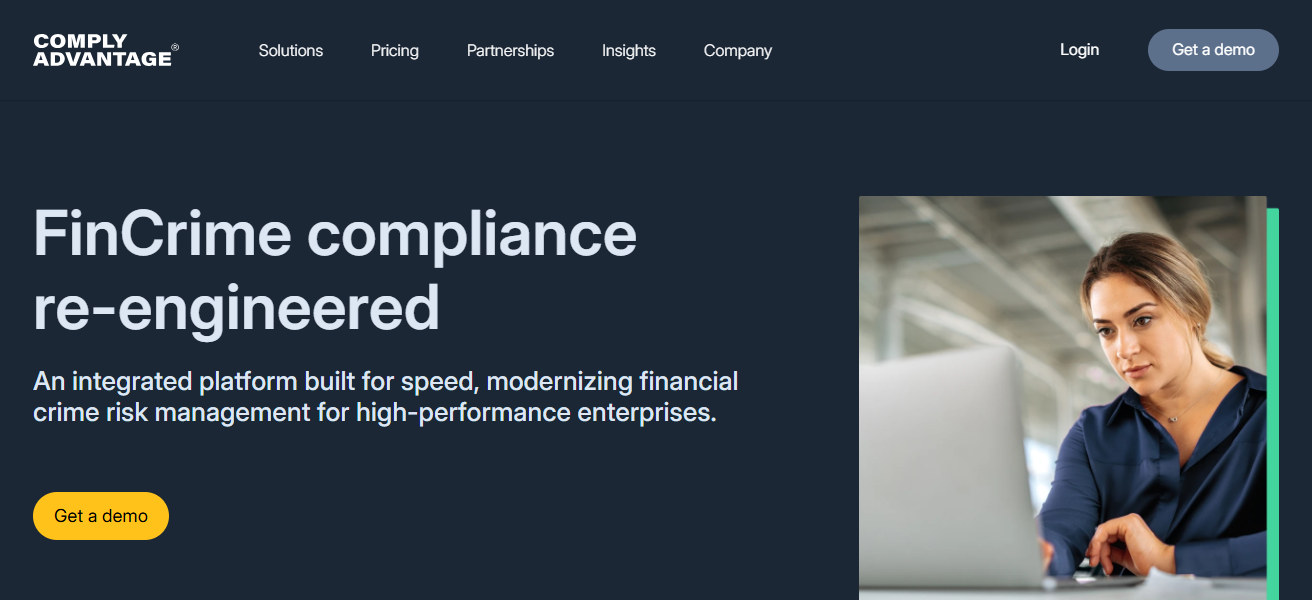
The platform employs Natural Language Processing to identify high-risk individuals and organizations, continuously training an internal model to keep up with relevant regulations.
This helps financial companies with KYC and compliance processes, increasing automation and decreasing manual labor for international operations.
Features ComplyAdvantage
Real‑Time AML Screening – The company utilizes artificial intelligence and machine learning that screens and compares customers and their transactions with global sanctions and watch lists in real time.
Continuous Risk Data Updates – The firm updates its data base regularly and in real time with new threats and updates pertaining to regulatory changes.
Transaction Monitoring – This firm analyzes customers accounts and identifies abnormal patterns that are indicative of financial crime to prevent fraudulent transactions.
Alerts & Case Management – The platforms equipped compliance customers with tools for case and alert prioritization, and streamlining and centralizing their workflow.
| Pros | Cons |
|---|---|
| Uses real‑time AI/ML to detect AML risks and sanctions hits. | Can be expensive for smaller businesses. |
| Continuously updates its risk database to improve accuracy. | Requires configuration and tuning for best results. |
| Reduces false positives and manual screening workload. | Integration with legacy systems may need technical effort. |
| Strong global coverage of watchlists and risk data. | Some advanced features may require premium plans. |
2. Trulioo
Trulioo offers a KYC and AML-enabled global identity verification solution. The service offered helps customers verify their customers in a timely and safe manner.
The solution is able to access in excess of five billion records in 195 countries. Trulioo combines multiple sources of information, including, government databases, credit bureaus, mobile carrier information, and other, to validate in a real time.

The service is able to decrease fraud and streamline the onboarding, helping customers follow different guidelines around the world. The value is especially high for banks, online stores, and online services.
Features Trulioo
Global Identity Verification – The firm is able to authenticate the identities of its clients across over 195 countries, using a variety of data.
Multi‑Source Data Integration – The company merges data from mobile devices, government, and credit bureaus to achieve precision in KYC acquisition.
Digital Onboarding – The company improves the efficiency of client onboarding using prompt and secure identity verification.
Fraud Prevention Tools – The company marks fraudulent activities and high-risk identities, and malfunctions to minimize vulnerability.
| Pros | Cons |
|---|---|
| Offers identity verification across 195+ countries. | Some regional data sources may be less comprehensive. |
| Improves customer onboarding speed and reduces fraud risk. | Pricing may rise with scale and transaction volume. |
| Integrates multiple sources (government, credit bureaus, mobile). | Initial setup can be complex for non‑tech users. |
| Reduces compliance risk with KYC/AML coverage. | Some data may be unavailable in specific regions. |
3. Fenergo
Fenergo is a firm that specializes in providing financial institutions with client lifecycle management solutions that accompany regulatory compliance with operational functionality.
The Fenergo platform helps automate onboarding, KYC, AML, and client data management, thereby reducing manual processing and errors.
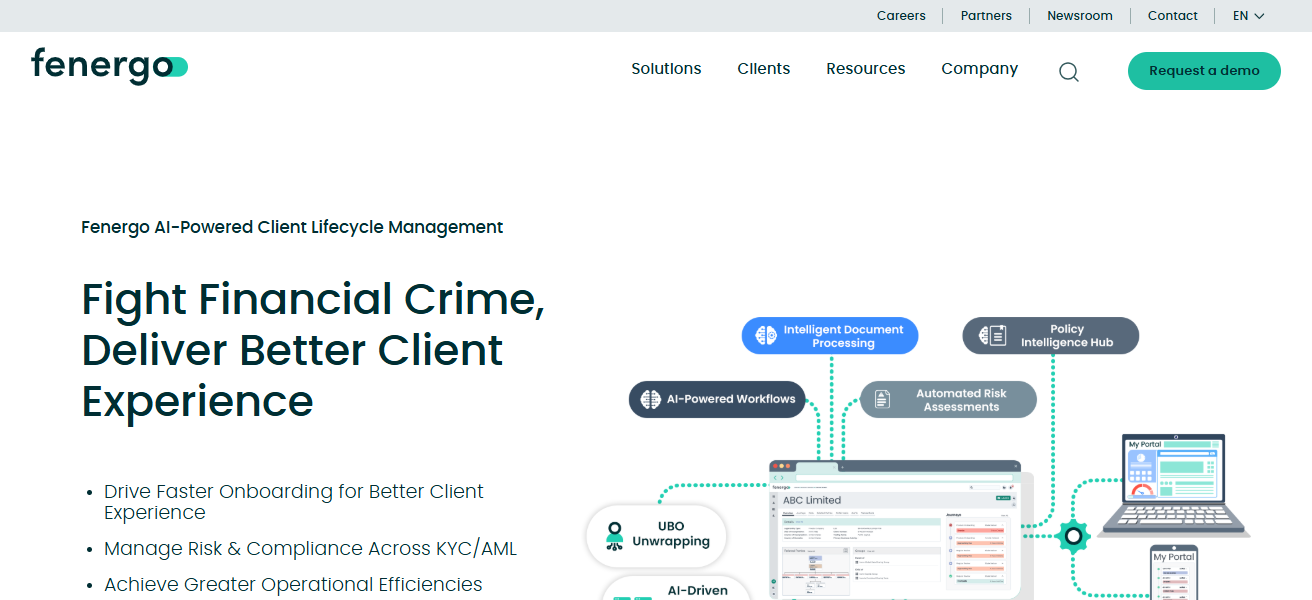
The platform helps with compliance on a global scale with regulations such as FATCA, CRS, and GDPR, and also provides client reporting that is audit-ready.
With the combination of automation and workflow management, Fenergo empowers banks and investment firms to achieve compliance, enhance client service, and fast track their growth with digital transformation.
Features Fenergo
Client Lifecycle Management – The firm automates the KYC procedures, along with onboarding and compliance at each stage of the client relationship.
Regulatory Rule Engine – This tool guarantees that regulatory workflows, such as FATCA & GDPR, are followed across the world.
Data Cleansing & Duplication Reduction – The company improves data integrity by removing duplicate data sets.
Audit & Reporting Tools – Gives regulators audit trail and compliance reports.
| Pros | Cons |
|---|---|
| End‑to‑end client lifecycle and compliance automation. | Higher implementation cost and time. |
| Strong support for complex regulatory requirements. | Best suited for medium/large financial institutions. |
| Reduces manual data entry and duplication. | Requires dedicated training for teams. |
| Improves audit readiness and data quality. | Customization can increase costs. |
4. Ascent RegTech
Ascent RegTech provides an AI-powered regulatory knowledge which captures and turns sophisticated compliance requirements into executable steps.
The AI-powered regulatory knowledge platform streamlines and automates the association of specific business actions to compliance obligations.
RegTech Ascent tracks and analyzes evolving regulations to ensure compliance programs remain effective and legally defensible.
This significantly decreases the level of legal exposure, mitigates the requirement for tedious manual searches, improves the quality of determinations and enhances overall efficiency of compliance programs.
This is especially true for the financial sector, presenting the ability to proactive and accurately manage regulatory compliance.
Features Ascent RegTech
AI‑Driven Regulatory Mapping – Analyzes complex regulations and translates them into business requirements.
Change Monitoring – Keeps track of changes in regulations and adjusts compliance requirements.
Task & Obligation Management – Assists teams in task assignment and compliance workload management.
Automated Compliance Insights – Offers automated guidance to alleviate the need for manual research.
| Pros | Cons |
|---|---|
| AI maps regulations to specific business obligations. | May need ongoing fine‑tuning for some use cases. |
| Continuously monitors regulatory changes. | Smaller firms may find the platform complex. |
| Reduces manual research and improves compliance accuracy. | Feature learning curve for new users. |
| Helps teams stay proactively compliant. | Integrations with internal systems require setup. |
5. Clausematch
Clausematch allows users to work together to manage their policies and regulatory documents. It enables clients to draft, review, approve, and publish documents pertaining to compliance.
Coincident to policies and regulations, policies are updated in real-time. With Clausematch’s workflow automation, operational risk is mitigated, accountability is established, and audit trails are preserved.
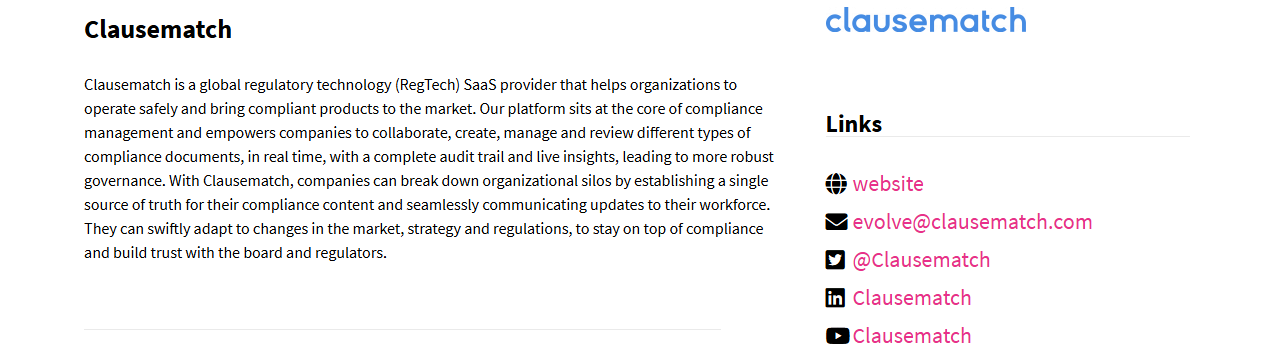
Enhanced internal governance and functionality in the management of intricate compliance documents is especially valuable to large businesses and financial institutions.
Features Clausematch
Policy & Procedure Management – Single point of contact to create and modify compliance documents.
Collaborative Workflow – Includes review and approval processes, versioning for policies.
Audit Trail Tracking – Logs changes and maintains governance archival history.
Regulatory Mapping – Associates internal policies for applicable regulations.
| Pros | Cons |
|---|---|
| Centralizes policy & compliance document workflows. | Focused on documentation—limited risk analytics. |
| Tracks audit history and approval process. | Best value for larger teams with many policies. |
| Reduces operational risk with governance controls. | Initial onboarding and setup effort needed. |
| Enhances collaboration and version control. | Can be expensive for small organizations. |
6. Riskified
Riskified is one of the pioneers in assisting clients with the safe control of risk, fraud and chargeback of e-commerce transactions while reducing their finaincila and regulatory risks.
Riskified is an e-commerce fraud prevention and chargeback protection firm whose platform employs machine learning to evaluate transactions in order to detect and stop fraud while also approving legitimate orders.
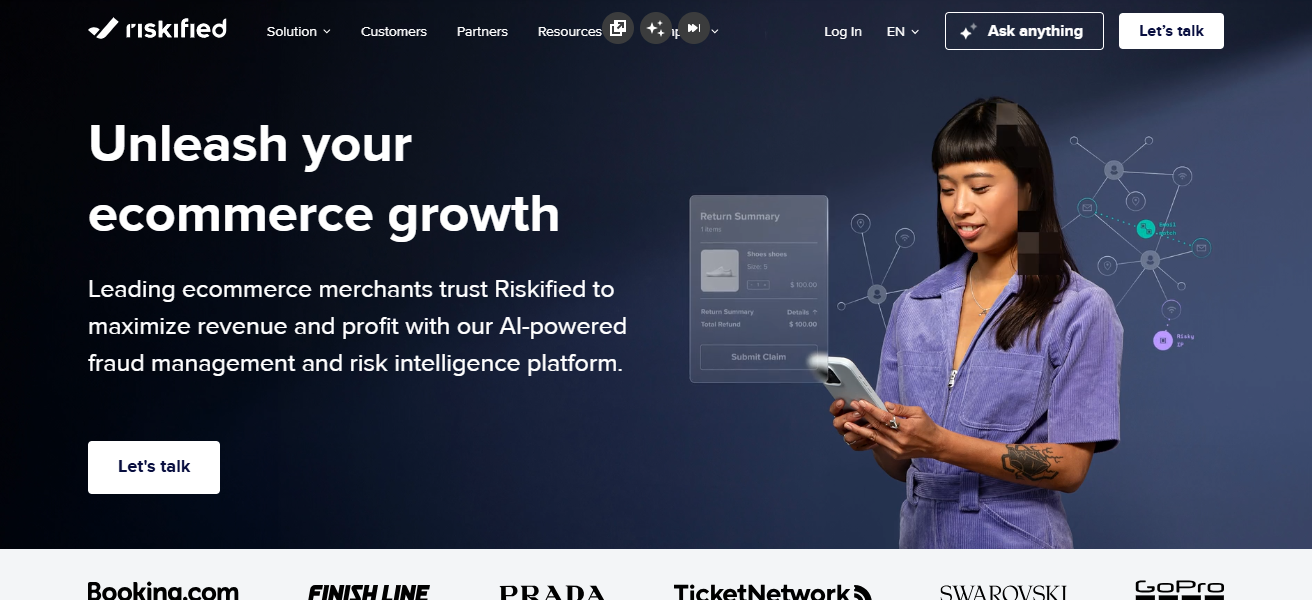
Riskified’s solution eliminates false positives which enhances the customer experience. Providing real time insights and decisions assist merchants in revenue growth while enhancing trust in their ability to comply.
Features Riskified
Machine Learning Fraud Detection – Differentiates legitimate orders from fraudulent ones using AI.
Chargeback Guarantee – Assumes liability for losses due to approved fraud, protecting merchants.
Real‑Time Risk Scoring – Instant transaction scoring to approve or decline.
Customer Experience Optimization – Improved conversion rates due to reduced false declines.
| Pros | Cons |
|---|---|
| Reduces e‑commerce fraud with ML and chargeback coverage. | Primarily designed for online merchants. |
| Improves customer experience by reducing false declines. | May not serve non‑commerce compliance needs. |
| Provides data insights for transaction risk. | Transaction costs can grow with volume. |
| Boosts revenue by approving more valid orders. | Integration complexity for some platforms. |
7. IdentityMind
IdentityMind provides its customer base with solutions for digital identity verification and risk management.
The integration of IdentityMind’s KYC, AML, and transaction monitoring with behavioral analytics allows IdentityMind to enable its customers to identify and avert the consequences of fraud and other financial crimes.
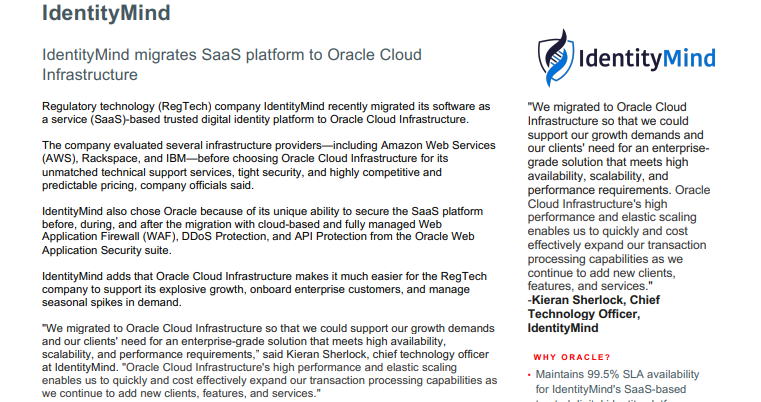
The use of biometric identification and digital footprint verification allows IdentityMind to meet its global compliance and risk management needs.
IdentityMind’s solutions effectively automate the customer onboarding process and improve operational efficiency. Businesses are able to conduct identity verification while blocking fraud across different digital channels.
Features IdentityMind
Digital Identity Verification – Uses online and behavioral data to verify identities.
KYC & AML Compliance – Useful for screening and monitoring within heuristic boundaries.
Risk Scoring Engine – Mix of attributes that helps analyze identity and behaviors.
Fraud Detection & Prevention – Identifies fraudulent activities and behaviors that deviate from norms on a few accounts.
| Pros | Cons |
|---|---|
| Combines KYC/AML with behavioral analytics. | Legacy product branding; now part of Acuant. |
| Detects fraud and risk across digital channels. | Transition to new platforms may cause confusion. |
| Automates identity verification and risk scoring. | Global coverage varies by region. |
| Helps with regulatory reporting and compliance. | Some advanced features need customization. |
8. Ayasdi
Ayasdi uses analytics for risk and regulatory compliance and financial crime detection. At Ayasdi we help companies rely more on AI and analytics for risk and compliance
Regulatory more on AI and analytics for risk and compliance regulatory more on AI and analytics for risk and compliance regulatory crime detection.
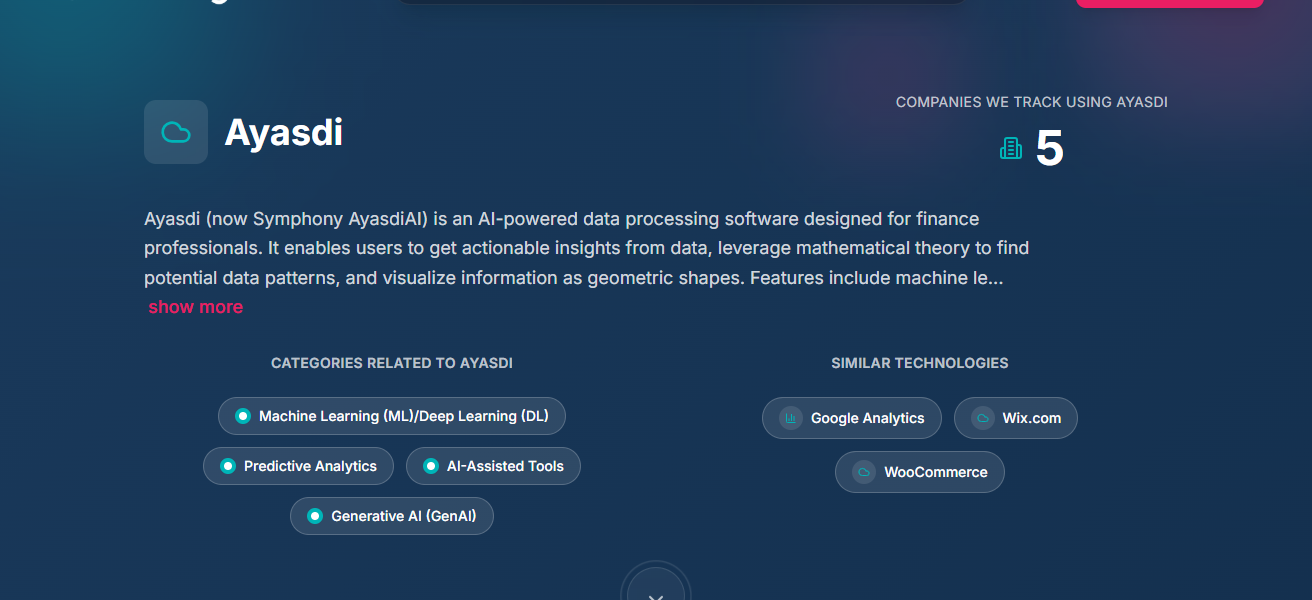
This allows organizations to better and more efficiently assess and respond to risk and regulatory obligations in the fields of risk and compliance, regulatory, and financial crime detection, in a manner which is more effective and efficient
Than what is possible through existing, conventional frameworks, processes, and methods. Ayasdi uses analytics to help enterprises and banks manage compliance risk and financial crime.
Features Ayasdi
AI & Topological Data Analysis (TDA) – Complimented with complex data compliance, advanced AI analyses data for concealed patterns.
AML and Fraud Detection – Predicting clusters that are low-enough risk, and non-obvious, proposing a model for financial crime.
Network Analytics – Spotting and/or detECT unusual links in units and people with analogized relations.
Scalable Big Data Processing – Data processing to suit enterprise requirements efficiency.
| Pros | Cons |
|---|---|
| Uses AI and data analytics for AML and fraud detection. | Requires quality data to perform well. |
| Finds hidden connections and patterns in complex data. | May be cost‑prohibitive for smaller firms. |
| Reduces false positives in alerts. | Deployment demands technical expertise. |
| Generates actionable insights from large datasets. | Training and adoption overhead. |
9. Quantexa
Integrating AI, network analytics, and entity resolution, Quantexa offers a context-driven platform for financial crime detection and regulatory compliance.
Quantexa helps organizations detect fraud, money laundering, and sanctions violations by uncovering hidden relationships within the data.
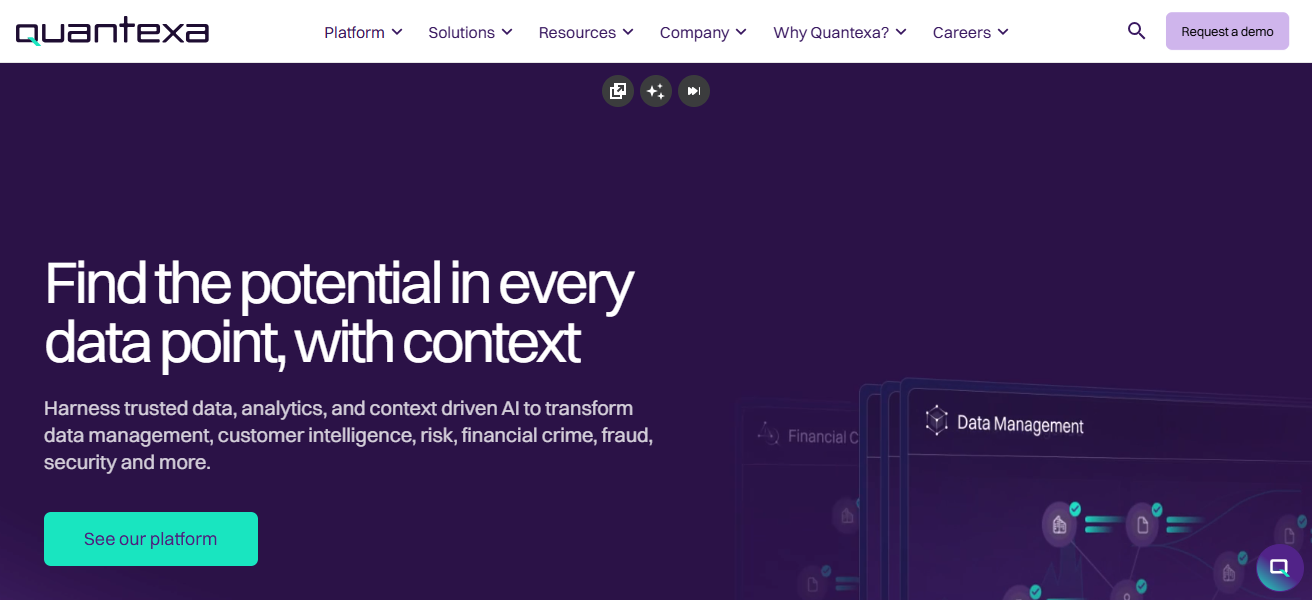
The platform provides support for regulatory reporting, risk scoring, and AML compliance. Quantexa improves accuracy, reduces false positives, enhances global compliance, and improves decision-making for institutions.
Features Quantexa
Contextual Entity Resolution – Establishing detailed portraits of clustered data points.
Network Analytics – Discovering unapparent linkages among clients, accounts, and activities.
Risk & Fraud Scoring – Scoring risks from encountered data in relation to unusual patterns, conduct, and sociable links.
| Pros | Cons |
|---|---|
| Contextual analytics with entity resolution and AI. | Complex setup for first deployment. |
| Detects fraud, money laundering, and network risk. | Requires strong internal data governance. |
| Improves compliance reporting & risk scoring. | Higher cost for advanced modules. |
| Reduces false positives with network intelligence. | May need expert resources to maximize value. |
10. RegTech Insight by BearingPoint
BearingPoint informs and assists with regulatory compliance, risk management, and governance through its’ regulatory training ‘RegTech from BearingPoint’ offering.
Their product offering allows customers to monitor regulatory changes, workflow compliance gaps, and fine-tune internal process automation.
They help organizations operate more efficiently and reduced operational risk through intelligent compliance recommendations.

To help move to a proactive compliance management, bearing point solutions supports several industries, (however is focused on banking and finance). They Continuous with information transparency and audit readiness at all times.
Features RegTech Insight by BearingPoint
Regulatory Change Monitoring – Surveillance of world recruitment specification regulations.
Compliance Gap Analysis Piece of document detailing the regulatory requirements with respect to unfulfilled process.
Process Optimization Tools Advancing efficiency and effectiveness of process managing of control to provide additional instruments.
Reporting & Dashboards – Provides screenshots and interactive reports for compliance teams.
| Pros | Cons |
|---|---|
| Provides insights and tools for compliance & risk. | Less specialized compared to niche RegTech tools. |
| Monitors regulatory changes proactively. | May require integration with other systems. |
| Supports gap analysis and internal process optimization. | Some features suited for consultants rather than operators. |
| Helps improve governance and audit transparency. | Learn‑to‑use curve for new teams. |
How We Choose Best Regulatory Technology (RegTech) Platforms
Regulatory Coverage – Check what regulatory requirements are covered by the platform. Do they cover your industry-specific regulation such as AML, KYC, GDPR, etc.?
Automation Capabilities – See if the platform has the capability for AI/ML automation that can reduce the need for manual compliance work.
Integration Flexibility – Check if the platform can be integrated seamlessly into your existing systems and workflows.
Data Accuracy & Sources – Verify that the platform provides reliable proven datasets in real-time and from reputable sources.
Scalability – Determine if the system has the capability to support an increase in transaction volumes and other potential future business requirements.
User-friendly interface – Assess if the compliance teams will find the platform easy to manage as they will be using the system frequently.
Reporting & Audit Trails – Check if the platform can provide you with a complete set of customizable reports. Are the audit trails clear?
Global Reach – Ensure that the system you are purchasing will support your business with the desired global presence.
Cost vs. ROI – Calculate the ROI based on the cost of the subscription to determine value using improved business efficiency and reduced risk as the key factors.
Cocnlsuion
In conclusion, to meet compliance, risk management, and fraud prevention needs, being able to utilize a RegTech platform, such as ComplyAdvantage and Trulioo, becomes more important than ever. Depending on which of these platforms, certain AI and data analytic services automate KYC and AML processes, as well as regulatory reporting.
Operational efficiency is a consideration, but so too is a platform’s coverage for individual cost, compliance requirements, and reporting.
Ultimately, the correct platform for a business is one which enables the organization to meet compliance requirements while enhancing operational efficiency.
FAQ
A RegTech platform uses technology, often AI and automation, to help businesses comply with regulations efficiently, reduce risk, and streamline compliance processes.
RegTech reduces manual compliance work, minimizes errors, detects fraud, ensures AML/KYC compliance, and keeps companies updated with evolving regulations.
Primarily financial services, banking, insurance, fintech, e-commerce, and any sector needing regulatory compliance and risk management.
Key features include AML/KYC compliance, fraud detection, risk scoring, automated workflows, audit trails, reporting, and regulatory change monitoring.
Costs vary by platform size, features, and usage. While some are expensive for small firms, the ROI often outweighs costs by reducing compliance risks and operational inefficiencies.