
In this article, I will discuss the Best Revenue-Based Financing Platforms that help startups and growing businesses access capital without giving up equity.
- Key Poinst & Best Revenue-Based Financing Platforms
- 10 Best Revenue-Based Financing Platforms
- 1. Capchase
- 2. Pipe
- 3. Clearco
- 4. Uncapped
- 5. Founderpath
- 6. Wayflyer
- 7. Lighter Capital
- 8. Earnest Capital
- 9. Braavo Capital
- 10. Efficient Capital Labs
- How To Choose Best Revenue-Based Financing Platforms
- Cocnsluion
- FAQ
Revenue-based financing allows repayment to scale with your monthly income, making it flexible for SaaS, e-commerce, and digital-first companies. I will cover top platforms, their features, pros, and cons to help you choose the right funding solution.
Key Poinst & Best Revenue-Based Financing Platforms
| Platform | Key Point |
|---|---|
| Capchase | Provides upfront capital for SaaS companies with recurring revenue |
| Pipe | Turns recurring revenue streams into tradable assets for instant liquidity |
| Clearco | Focuses on e-commerce and digital brands with fast funding decisions |
| Uncapped | Offers flexible financing without equity dilution for startups |
| Founderpath | Tailored for bootstrapped SaaS founders to access growth capital |
| Wayflyer | Specializes in marketing and inventory funding for e-commerce businesses |
| Lighter Capital | Provides tech startups with non-dilutive growth funding |
| Earnest Capital | Supports early-stage founders with revenue-share investment |
| Braavo Capital | Focuses on app developers with analytics-driven funding |
| Efficient Capital Labs | Global reach with flexible repayment tied to revenue performance |
10 Best Revenue-Based Financing Platforms
1. Capchase
Capchase offers quick financing options without dilution for SaaS companies. Startups can get financing against predicted future cash flows. Unlike most loans, repayment is based on revenue, which relieves pressure during downturns.
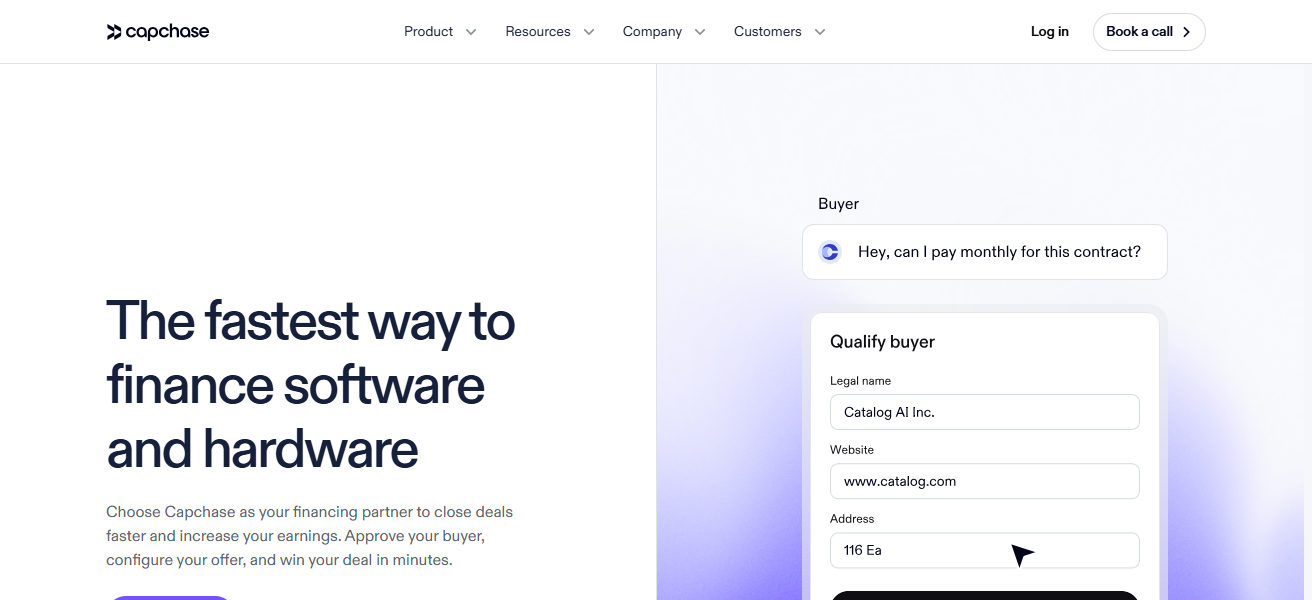
Capchase integrates with accounting and CRM systems to provide cash flow visibility. Its proprietary structure allows for business scaling without dilution.
Capchase great for subscription companies wanting to grow, control, and fund marketing initiatives.
Capchase
- Provides future cash flow equity financing that is non-dilutive.
- Integrates funding eligibility with financial data at maximum automation.
- Repayments that are flexible and adjustable at the higher or lower revenue performance tiers.
- Supplements cash flow forecasting with tools for optimum management of growth capital.
| Pros | Cons |
|---|---|
| Fast access to capital without giving up equity | Fees can be higher compared to traditional loans |
| Repayments scale with revenue performance | Best suited for recurring revenue businesses |
| Integrates with financial tools for forecasting | Requires consistent revenue history |
2. Pipe
Pipe is a trading platform where businesses can immediately trade recurring revenue streams. Monthly subscriptions can be converted by businesses into upfront cash without incurring debt or giving away equity.
Pipe caters to SaaS and subscription-based businesses as well as fintech, enabling them to obtain liquidity and grow their businesses.
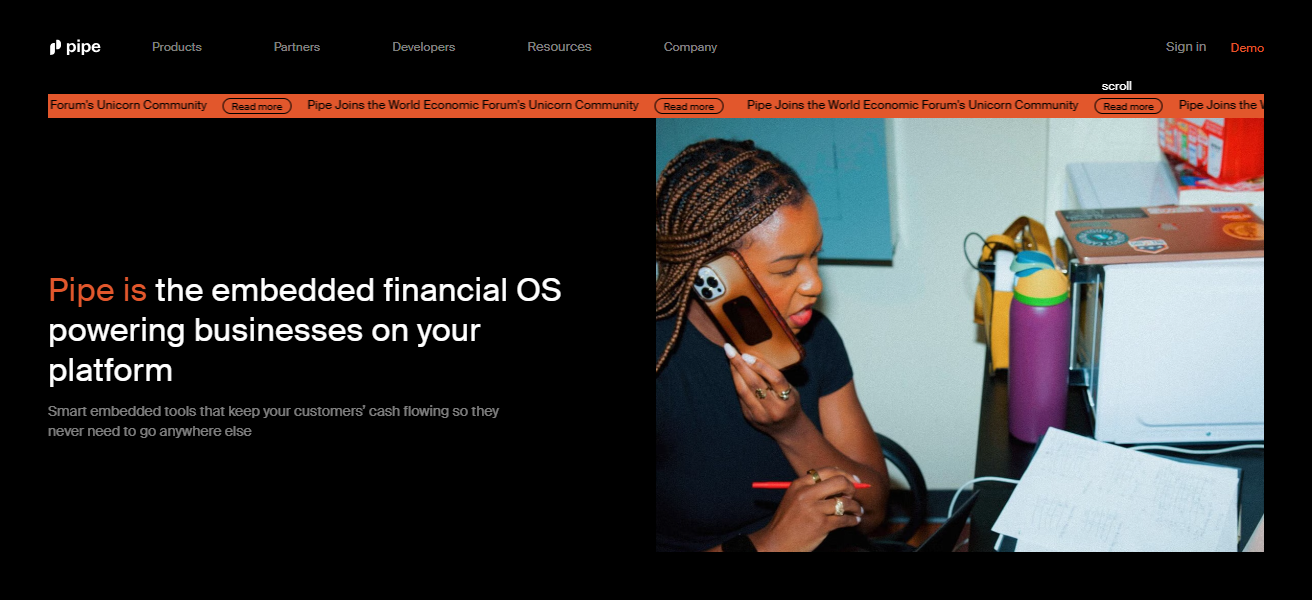
Investors revenue streams get matched on Pipe, allowing them to get fast funding and providing them with flexible funding options.
Pipe makes ownership retention easy for founders, and cash flow forecasting simple with automated systems and a clear platform.
Pipe
- Converts future subscribed revenue to an advance without any interest.
- Employs revenue streams marketplaces where investors sell streams for liquidity.
- No fixed monthly repayments: the revenue inflows determine repayment.
- Suitable for SaaS and subscription businesses with consistent recurring revenue.
| Pros | Cons |
|---|---|
| Converts future recurring revenue into upfront cash | Only supports businesses with recurring revenue |
| No interest or fixed monthly payments | Not ideal for early pre‑revenue startups |
| Competitive pricing through marketplace | Funding tied to quality of recurring revenue |
3. Clearco
Clearco specializes in revenue-based financing, with fast funding and no equity dilution for e commerce and SaaS companies.
Using AI, Clearco assesses the performance of a business and provides flexible funding based on revenue patterns.
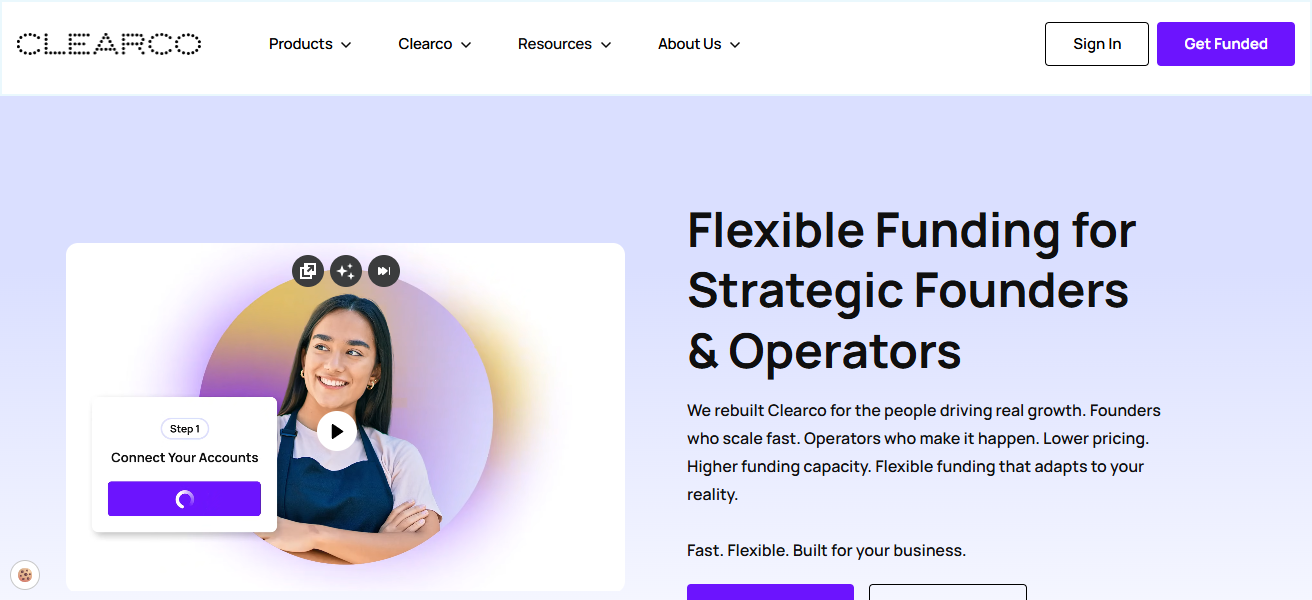
Since funding is based on revenue, slower periods for startups are less stressful because repayments are in sync with revenue.
Aside from financing, Clearco provides analytics and growth optimization tools. For funding, Clearco is more appealing to founders to obtain money for marketing, inventory, and growth other than venture capital.
Clearco
- Employs predictive analytics to assess risk and performance of the business.
- Predictive funding and rapid approval based on the revenue trend.
- Revenue dependent repayments.
- Ideal for growing SaaS and e-commerce companies capitalized on revenue.
| Pros | Cons |
|---|---|
| Quick approvals and data‑driven decisions | Fees may be higher for early or volatile businesses |
| Flexible repayments linked to revenue trends | Repayment cost can increase during slow months |
| Works well for e‑commerce and SaaS companies | Requires reliable analytics and data integration |
4. Uncapped
Uncapped offers e-commerce and SaaS companies the opportunity to grow without the loss of equity through revenue-based funding.
This includes quick funding decisions and clear repayment terms tied to their revenue. Uncapped helps founders improve their cash flow and financial fitness tools.
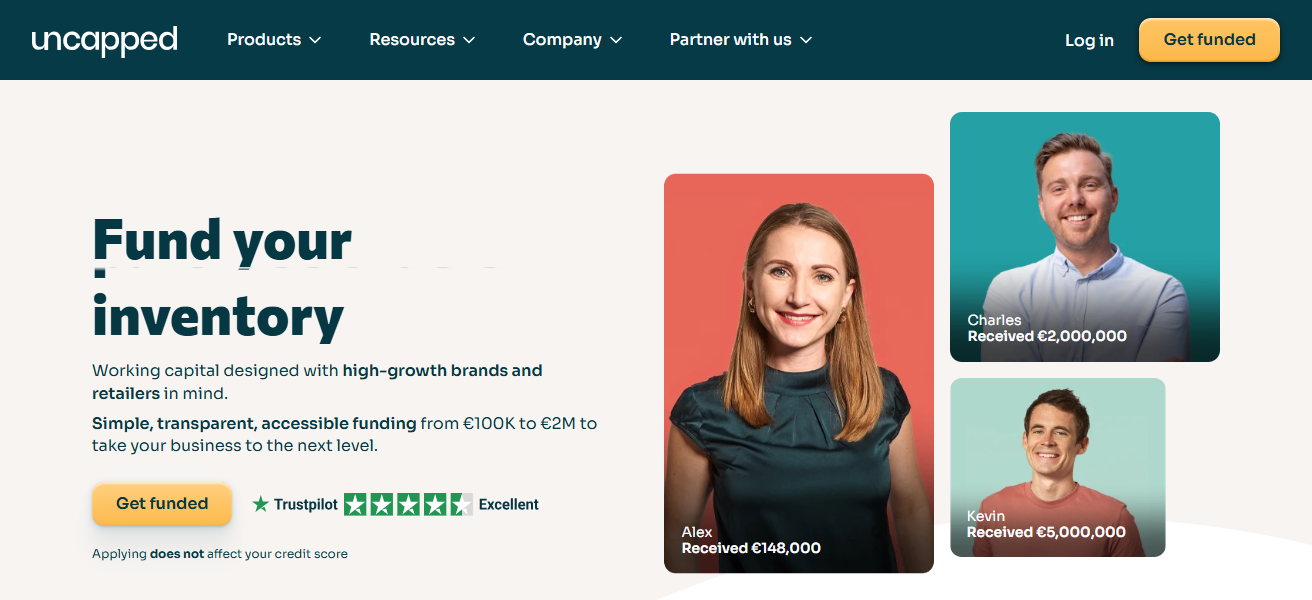
Their platform caters to digitally-driven companies that wish to obtain funding to enhance their marketing, inventory, or workforce.
By eliminating personal guarantees, it lessens the risk for entrepreneurs and offers them funding that is both scalable and predictable.
Uncapped
- Offers revenue-based financing with no equity dilution.
- No personal recourse or collateral on the investment.
- Monthly repayments that are variable based on revenue.
- Ideal for subscription, e-commerce, and digital businesses.
| Pros | Cons |
|---|---|
| Flexible and non‑dilutive financing | Limited to digital/SaaS/e‑commerce businesses |
| No personal guarantees required | Funding amounts may be lower than VC rounds |
| Revenue‑based payments reduce fixed risk | Needs consistent revenue history |
5. Founderpath
Founderpath focuses on SaaS startups and provides non-dilutive financing with reliance on recurring revenue. The platform streamlines revenue confirmation for quick funding decisions.
Financing payments are adjustable based on monthly revenue, and slow months won’t create a cash flow burden.
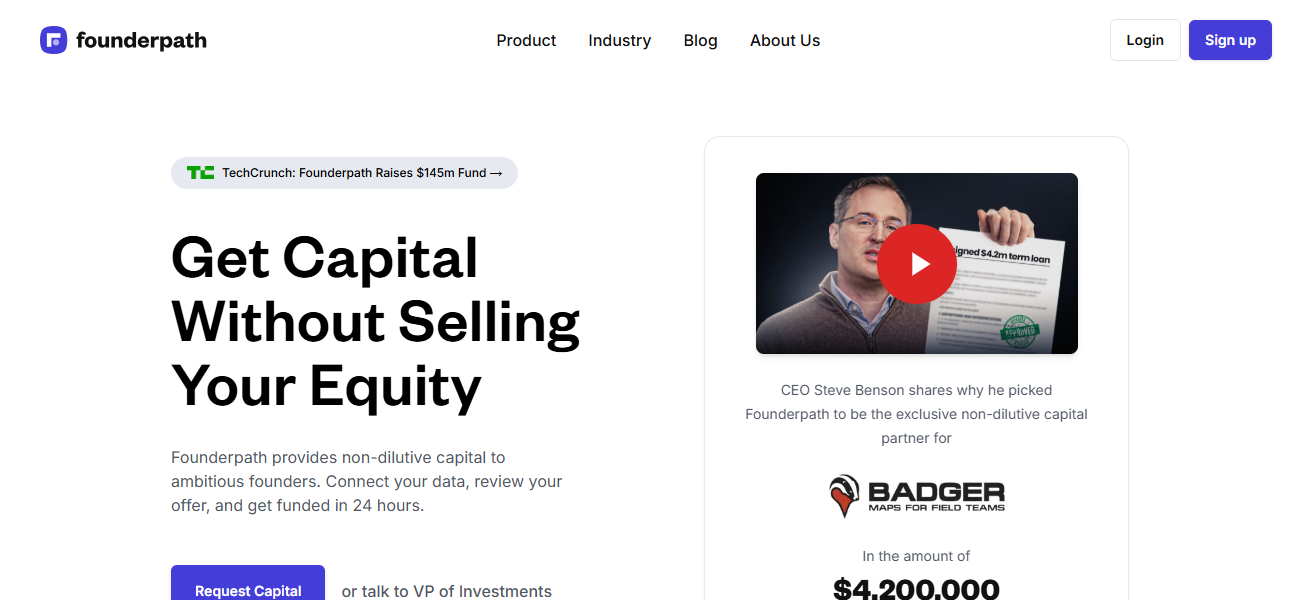
In addition to financing, it offers growth analytics and funding agility to assist founders in optimizing revenue center operational strategies.
Its straightforward founder-centric model becomes a go for cash-strapped early-stage SaaS startups seeking operational equity to develop products and acquire customers.
Founderpath
- Financing is prejudged and intertwined with automated revenue verification.
- Exclusively tailored capital access for SaaS startups.
- Payments are linked to revenue, which lessens tension.
- Founders are able to keep full ownership with no dilution.
| Pros | Cons |
|---|---|
| Automated revenue verification speeds approvals | Focused mainly on SaaS companies |
| Founders retain full ownership | Funding caps can be smaller |
| Repayments scale with revenue | Not ideal for non‑recurring models |
6. Wayflyer
Wayflyer focuses on revenue-based financing in e-commerce. This involves giving merchants up-front payments that can be used on either inventory, advertising, or growth.
Since repayments are bound to sales, businesses can grow without fixed monthly payments. Wayflyer employs AI to assess performance in order to set funding terms, and also provide guides that track marketing efficiency and revenue over time.
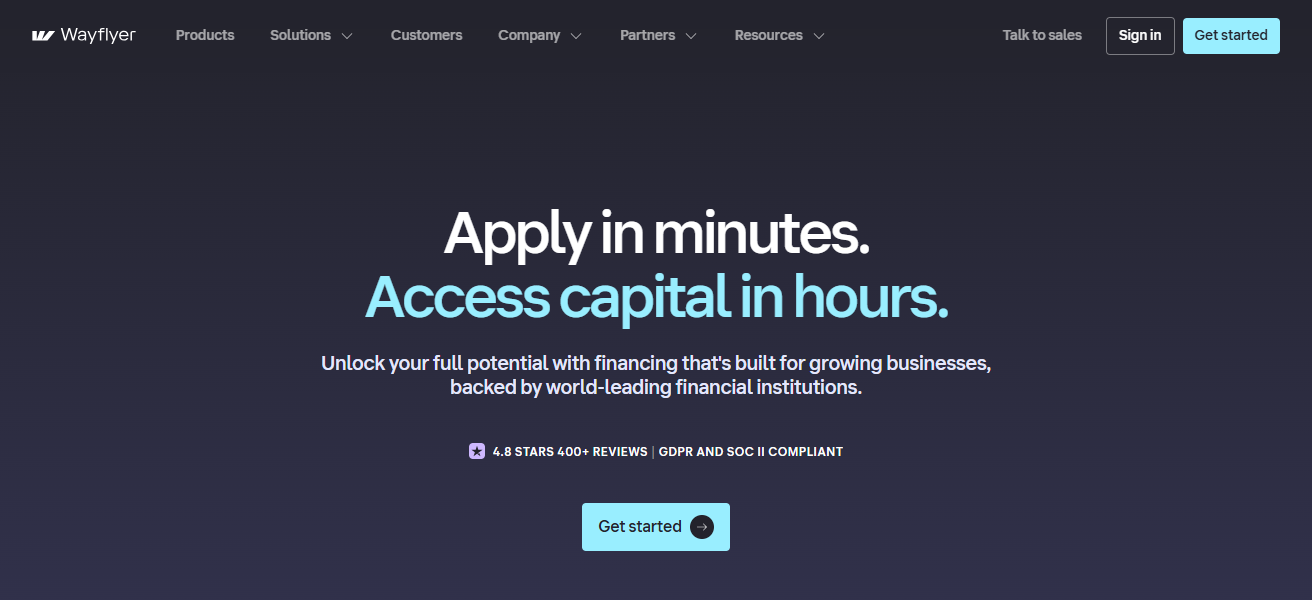
By eliminating equity hurdles and streamlining funding processes, Wayflyer is best suited for online retail and D2C brands.
Wayflyer
- Funds are allocated only for inventory purchases and marketing.
- Payments adapt to actual sales.
- Finances based on performance metrics.
- Ideal for e-commerce and direct-to-consumer brands.
| Pros | Cons |
|---|---|
| Built specifically for e‑commerce needs | Not suitable for non‑e‑commerce companies |
| Repayments tied to actual sales | Costs can increase if revenue fluctuates |
| Provides capital for inventory and ads | Requires predictable sales history |
7. Lighter Capital
Lighter Capital finances B2B SaaS and tech startups and offers revenue-based financing. Since funding decisions happen quickly and repayment is tied to revenue, founders can access growth financing without losing ownership.
Lighter finances startups in different stages, offering flexible financing from small to large growth rounds to help with payroll, marketing, or product expansion.
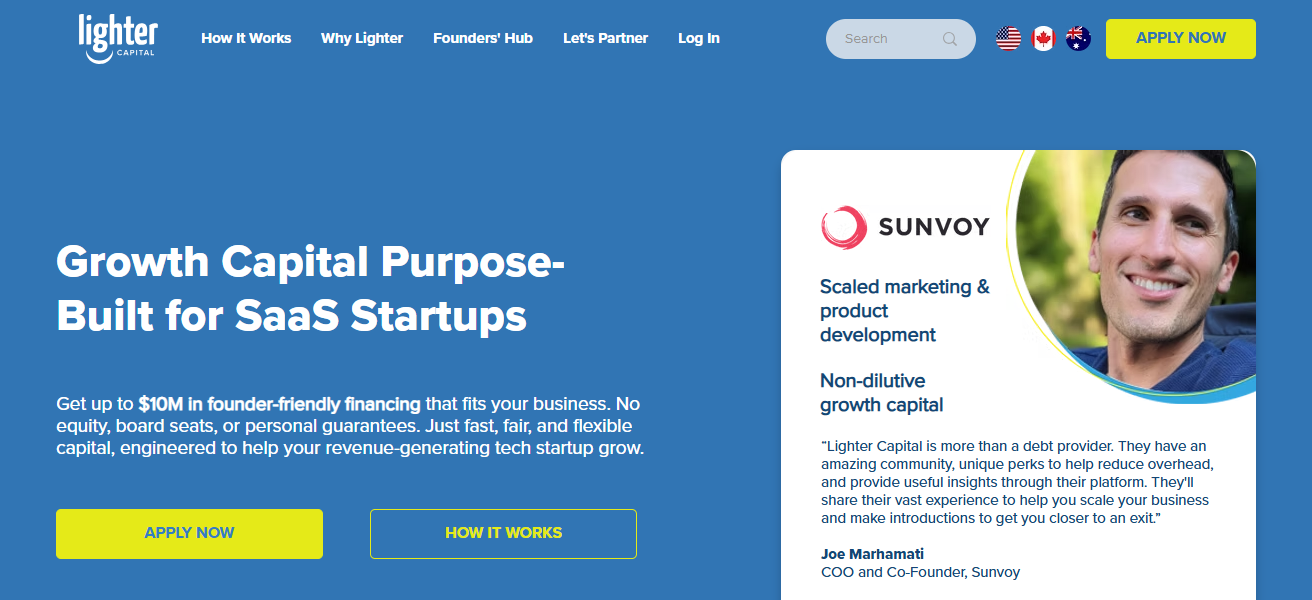
With supportive financing agreements and predictable financing that aligns with the company’s revenue, Lighter Capital is a reliable partner for startups that want flexible financing.
Lighter Capital
- Provides revenue-based financing for tech and SaaS.
- Payments adjust based on revenue, not on a fixed schedule.
- Flexible funding based on the needs of the business.
- No dilution, unlike traditional VC.
| Pros | Cons |
|---|---|
| Scalable financing with no equity loss | Requires solid revenue history |
| Repayments linked to actual performance | Not suitable for early pre‑revenue startups |
| Flexible for tech and SaaS growth | Payments can extend if revenue dips |
8. Earnest Capital
Earnest Capital takes an innovative approach in investing in early-stage founders through revenue-based agreements and profit-sharing.
It steers clear from the conventional equity dilution model and focuses on sustainable growth and founder-friendly terms.

Apart from financing, Earnest provides mentorship and operational support to help businesses scale effectively.
Businesses facing a slow period, need not worry as the repayments are tied to the revenues. Earnest’s unique approach combines both financial and strategic support and is primarily focused on bootstrapped founders and solopreneurs.
Earnest Capital
- Provides mentoring and business growth assistance.
- Blends profit share with revenue- aligned funding, and goes with more founder-friendly terms.
- Repayment terms are tied to business outcomes.
| Pros | Cons |
|---|---|
| Founder‑friendly profit‑share structure | Not purely revenue‑based repayment |
| Offers mentorship and strategic support | Terms vary widely by business |
| Avoids traditional equity dilution | Repayment timelines can be long |
9. Braavo Capital
Financing mobile-first businesses and app developers is what Braavo Capital is focused on. It uses app store analytics to provide performance-based funding via revenue-based advances.
With appraisements flexible and shifting to a founder’s monthly revenue, risk is lowered. Analytics and insights on user acquisition and revenue monetization are provided by Braavo’s platform to adjust growth.
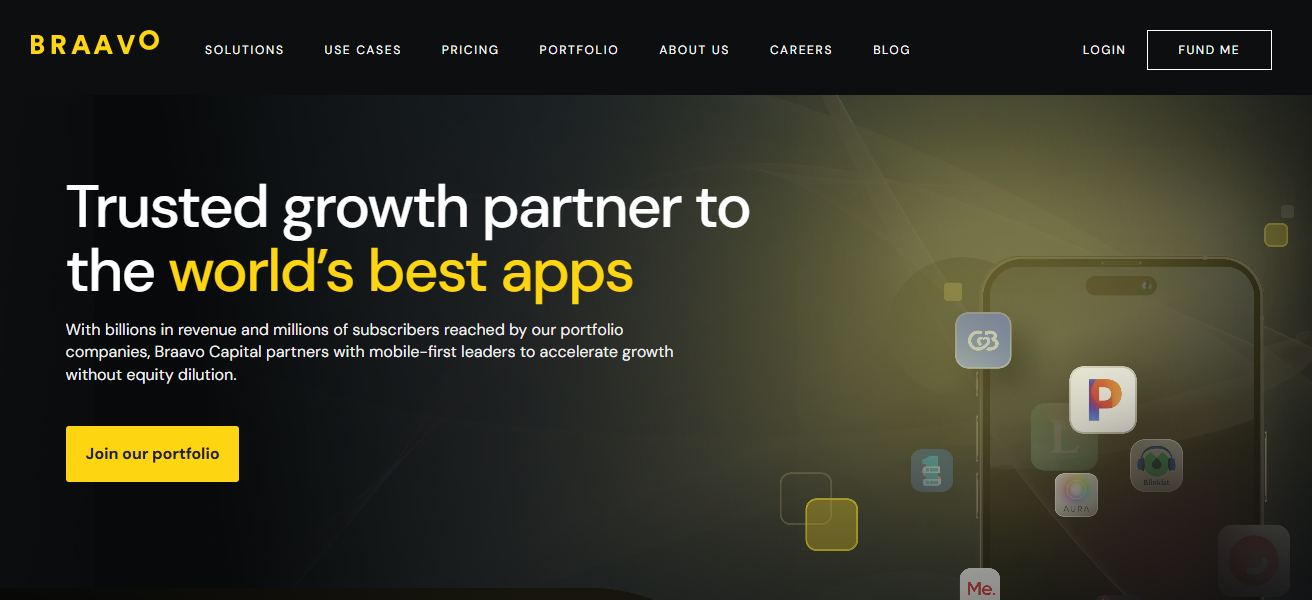
For rapidly growing mobile applications, funding marketing, product development, or growth is unencumbered by equity via a model that prioritizes access to finances for startups.
Braavo Capital
- For mobile and app-based businesses with real revenue.
- Funds and terms are based on app store performance.
- Payments are adaptive to revenue.
- Supports user acquisition and monetization growth.
| Pros | Cons |
|---|---|
| Tailored financing for mobile and app businesses | Only suited for app revenue models |
| Uses app store data for funding decisions | Costs can be relatively high |
| Non‑dilutive funding model | Needs reliable recurring app revenue |
10. Efficient Capital Labs
Efficient Capital Labs specializes in revenue-based financing and claims to be flexible and quick to fund startups without dilution. Its financing terms are tailored to be most founder friendly and the repayment schedule is based on revenue.
Its client base is SaaS, e-commerce and digital companies and funds marketing, inventory, or operational scale.
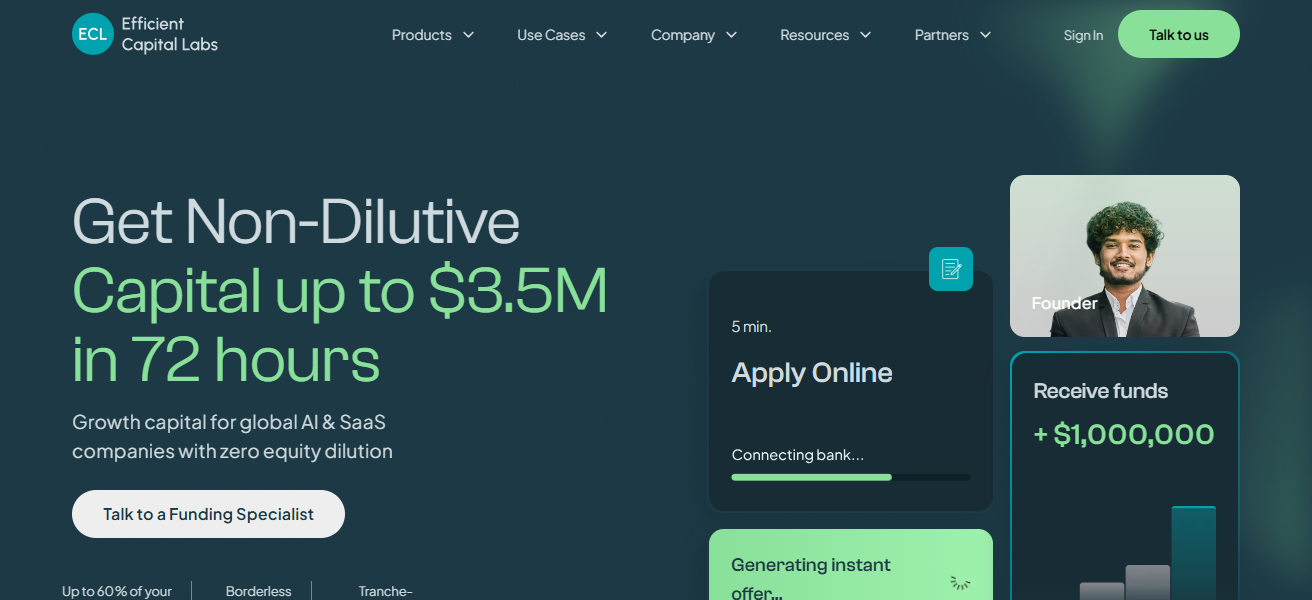
Using data analytics, Efficient Capital Labs predicts and analyzes cash flow and helps to allocate capital. Companies looking for cash flow based financing without the burdens of traditional loans or equity rounds will find peace in Efficient Capital Labs tailored financing solutions.
Efficient Capital Labs
- Financing options that evolve with your growth stages.
- Provides revenue-based financing with fixed terms and transparent pricing.
- Payments are based on monthly revenue.
- Supports SaaS and digital businesses.
| Pros | Cons |
|---|---|
| Transparent revenue‑aligned repayment terms | Newer platform with less market history |
| Flexible and scalable funding options | May have stricter eligibility criteria |
| Supports SaaS and digital businesses | Funding limits may be lower than larger competitors |
How To Choose Best Revenue-Based Financing Platforms
- Revenue Model Fit: Pick platforms that suit your business, eg. SaaS, e-commerce, or app.
- Funding Flexibility: Seek terms that scale with your revenues, easing the burden in slower months.
- Costs & Fees: Analyze the options based on interest, costs, fees, and revenue share.
- Approval Speed: Choose platforms with automated approvals to get to the growth capital faster.
- Integration Tools: Choose platforms that integrate with accounting and/or CRM and/or analytics to optimize cash flow.
- Non-Dilutive Option: Check that they do not take equity if that is important to you.
- Funding Limit: Ensure the amount of capital you can get matches your operational growth needs.
- Support & Insights: Think about platforms that bundle funding with support, growth coaching, and analytics.
Cocnsluion
In summary, SaaS, e-commerce, and digital companies benefit from adjustable and non-dilutive funding through revenue-based financing.
Founders are able to obtain growth capital, control cash flow, and scale without equity dilution. For optimal sustainable growth, assessing features, repayment terms, and business alignment to revenue-based financing platforms is critical.
FAQ
It’s a funding model where repayment scales with your monthly revenue instead of fixed amounts.
SaaS, e-commerce, and digital-first businesses with consistent recurring revenue can benefit most.
No, most revenue-based financing platforms provide non-dilutive funding.
Many platforms offer approvals within days using automated revenue verification.