In this article, I will talk about the best ones for fraud protection and discuss the best tools for helping companies prevent fraud, minimize chargebacks, and safeguard accounts.
Risk scoring and AI, behavioral biometrics, and global identity verification help in the improvement and real-time protection against fraud. If you are in eCommerce, fintech, or online services, these alternatives are reliable and scalable.
Key Points & Best Sardine Alternatives for Fraud Protection
| Platform | Key Strength |
|---|---|
| Sift | AI-driven fraud detection with strong e-commerce protection |
| SEON | AML compliance, 900+ first-party data signals, flexible risk rules |
| Signifyd | Chargeback protection and guaranteed fraud prevention for merchants |
| Fraud Fighters | Real-time monitoring and customizable fraud rules |
| LastPass | Password management with strong identity protection |
| 1Password | Secure authentication and credential protection |
| Kount | AI-powered fraud prevention for payments and account takeovers |
| Forter | Identity-based fraud detection with instant decisioning |
| Trulioo | Global identity verification across 195+ countries |
| Ekata | Identity risk scoring using phone, email, and IP intelligence |
10 Best Sardine Alternatives for Fraud Protection
1. Sift
Sardine’s direct competitors will always be Sift due to their automated fraud detection, their real-time fraud detection, and the ability to be integrated instantly to a business’s processes.
Sift’s vision fraud detection surpasses the traditional fraud systems by a large margin. Sift systems learn from standing networks, not siloed systems which allow Sift to mitigate the effects from complicated fraud in a seamless manner.
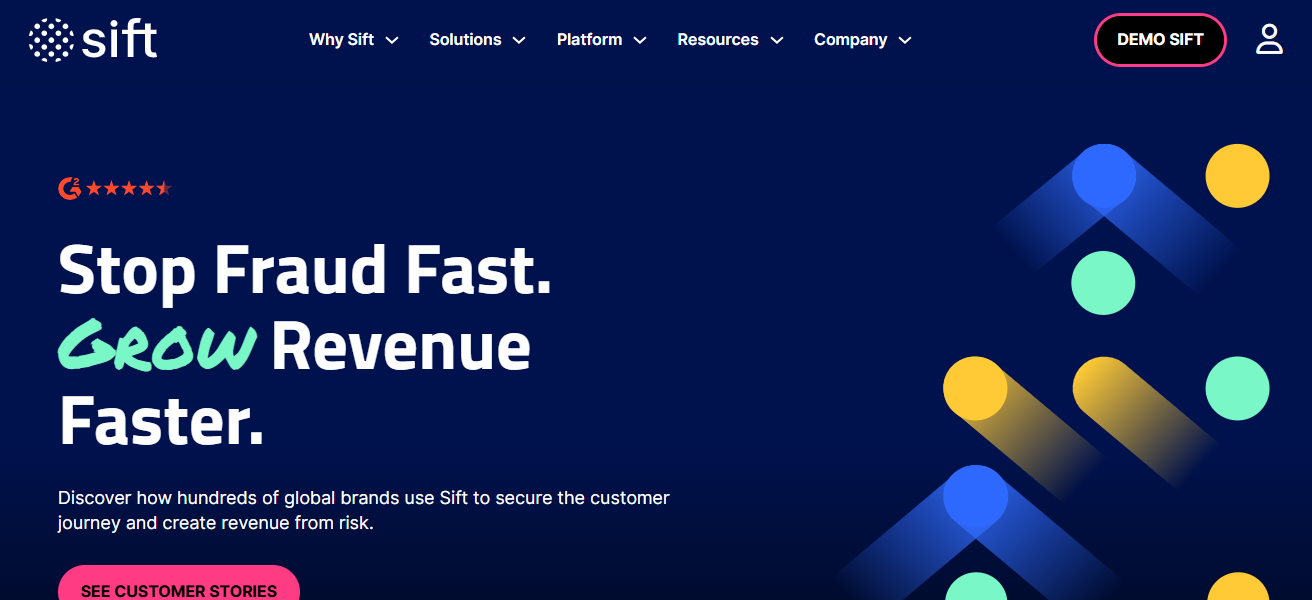
Sift is able to use the balance between company growth and customer satisfaction through automated fraud detection and seamless integration with tailored risk scores to help everyone.
| Feature | Description |
|---|---|
| Machine Learning Fraud Detection | Uses advanced AI to identify fraud patterns across industries. |
| Network-Based Analysis | Detects fraudsters by analyzing behaviors across multiple accounts globally. |
| Custom Risk Scoring | Allows businesses to tailor risk scores to their requirements. |
| Automated Decisioning | Reduces manual reviews with instant approval or decline of transactions. |
| Scalable Platform | Supports businesses of all sizes and industries. |
Pros And Cons Sift
Pros
- Ability to spot and analyze very sophisticated and complex frauds breaches using advanced machine learning.
- Network-based fraudsters analysis and identification across numerous global accounts.
- Risk score automation and customized fraud decision automation helps in eliminating the need for manual reviews and analysis.
- Ability to cater and scale to multiple different businesses and industries.
Cons
- Expensiveness for small businesses; start-up plans can be costly for fledgling firms.
- Some basic rule optimization and configuration might be worth the effort for the more advanced firms.
- There is a sizeable learning curve when it comes to more advanced analytical interface dashboards and various data input output automations.
- Less overall business fraud data can be effectively processed and analyzed using the older historical data systems.
2. SEON
SEON provides fraud prevention and digital footprint analysis and is a strong alternative to Sardine.
Fraud before it happens is detected through the combination of device fingerprinting, IP intelligence, and other unique factors, eventualizing to a risk score.
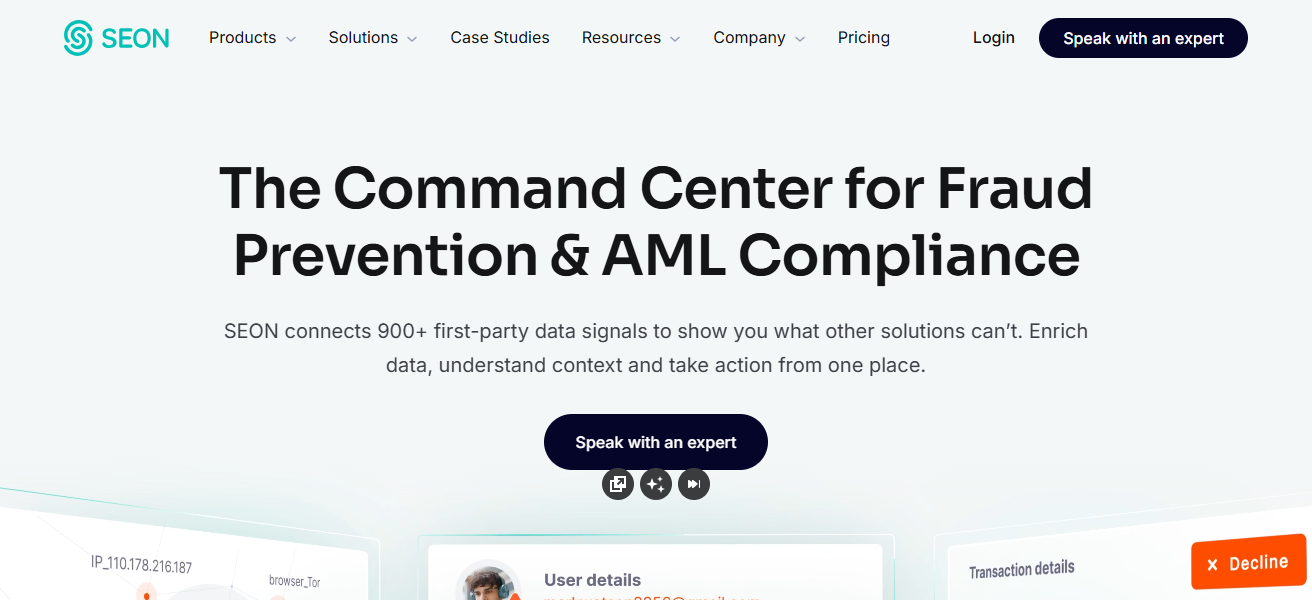
This unique combination eliminates the chance of synthetic identity, account takeover, and payment fraud.
SEON gives the opportunity to growing businesses to be flexible and scalable instantly, and without excessive complexity.
| Feature | Description |
|---|---|
| Device Fingerprinting | Identifies unique device attributes to detect suspicious activity. |
| IP & Email Intelligence | Evaluates IP addresses and emails for risk. |
| Behavioral Analysis | Monitors user actions for abnormal patterns. |
| Customizable Rules Engine | Lets businesses create tailored fraud prevention rules. |
| Real-Time Risk Scoring | Provides instant fraud assessments for transactions. |
Pros And Cons SEON
Pros
- Excellent precision and fraud breaches identification using fingerprinting and i.p device and email intelligence.
- Excellent for the detection and identification of synthetic accounts and account takeovers.
- There are some requirements for the more sophisticated systems but overall the rules engine is highly configurable.
- There is no operational lag in fraud detection with the real-time system and its fast deployment.
Cons
- Complex systems do pose some requirements, but overall less effort required.
- Complicated operational systems are also advanced in functionality.
- There is a small amount of integration potential with more niche and also some average platforms.
- There is less overall observed and reported market activity when it comes automation and merchants in a network.
3. Signifyd
When it comes to fraud protection, Signifyd is a better alternative to Sardine, as it merges sophisticated fraud protection and financial backing on accepted orders.
Its primary unique strength is its decisional model stemming from commerce, which analyses buyer behavior, the context of orders and cross border spending trends to detect the dichotomy of fraudsters and real consumers.
Because Signifyd assumes the liability of fraudulent chargebacks, companies get the leeway to accept more ‘good’ orders without the risks.

It eliminates the need for manual reviews, safeguards the revenue and enhances the overall customer satisfaction.
This makes Signifyd very helpful for eCommerce enterprises in need of scalable, improved fraud prevention that goes beyond traditional risk instruments.
| Feature | Description |
|---|---|
| Commerce-Focused Fraud Detection | Tailored for eCommerce transactions and order risk. |
| Financial Guarantee | Protects merchants against fraudulent chargebacks. |
| Buyer Behavior Analysis | Evaluates patterns to differentiate legitimate customers from fraudsters. |
| Automated Approval & Decline | Reduces manual order review time. |
| Seamless Integrations | Easily connects with popular eCommerce platforms. |
Pros And Cons Signifyd
Pros
- Sophisticated Thomson reuters focus commercial fraud protection and mitigation systems with advanced behavioral analysis systems.2. Chargebacks don’t affect the merchant because of the financial guarantee.
- Decreases the need for manual review and increases the percentage of orders approved.
- Excellent customer support and eCommerce support.
Cons:
- Smaller merchants might find the service expensive.
- Less appropriate for situations involving fraud outside of eCommerce.
- Some merchants report declining genuine purchase orders from the best merchants.
- Some merchants find the customization of risk scoring on specific cases inadequate for minimal fraud.
4. Fraud Fighters
Fighting Fraud offers a great alternative to Sardine due to how they combine augmented intelligence technology with expert human intervention to make the best risk decisions.
They combine their proprietary fraud detection algorithms with ongoing human fraud review to ensure that complex transactions don’t get missed.

Fraud Fighters proprietary algorithms and expert-driven review help declines get reduced and fraudulent transactions, that automated systems, fail to catch, get detected.
Fraud Fighters has the ideal solution for companies that don’t want to build an internal team and need full expert fraud control including real time customizable workflows and seamless monitoring.
| Feature | Description |
|---|---|
| Hybrid Fraud Detection | Combines automated tools with human analysts. |
| Manual Review Support | Provides context-driven verification for complex cases. |
| Custom Workflows | Allows businesses to match fraud controls to their risk profile. |
| 24/7 Monitoring | Continuous fraud surveillance to prevent losses. |
| Real-Time Decisions | Immediate risk assessment with human oversight. |
Pros And Cons Fraud Fighters
Pros:
- Utilize automation and manual analyst review for advanced fraud detection.
- Less false positive results because of added manual review with context of the transaction.
- Modifiable workflows adapt to each individual’s business risk.
- Continuous 24/7 support and system monitoring.
Cons:
- Increased operational expenses due to manual review.
- Less automation leads to faster decisions on a per transaction basis.
- Implementation may require additional development resources to ensure success.
- Less global merchants means limited fraud intelligence sharing.
5. LastPass
In a way, LastPass is also a possible alternative to Sardine fraud protection but only from the access and identity fraud viewpoint.
LastPass’s strongest differentiated capability is the protection of credentials with encrypted password vaults and zero-knowledge architecture, along with a more robust, multi-factor authentication.
Loss of weak or reused passwords aids businesses in cutting account takeovers and insider threats and unauthorized access that are often channels to fraud loss.
Businesses have visibility of user actions through centralized access control and audit logs making user suspicious activity visibility more straightforward.
This identity-first approach is why companies needing LastPass to protect fraud are focused on authentication and controlled digital access.
| Feature | Description |
|---|---|
| Encrypted Password Vaults | Secures credentials with strong encryption. |
| Multi-Factor Authentication | Adds an extra layer of security for account access. |
| Centralized Access Management | Provides control over all user credentials in an organization. |
| Audit Logs | Tracks user activity for suspicious access. |
| Zero-Knowledge Security | Ensures LastPass cannot access user passwords. |
Pros And Cons LastPass
Pros:
- Multi-factor authentication and complex passwords protect compromised accounts.
- Centralizing control of credentials increases overall security.
- Suspicious access is visible because of detailed audit logs.
- Sensitive information is guarded by zero-knowledge encryption.
Cons:
- There is no transaction fraud solution because it is primarily focused on identity.
- User adoption challenges can limit effectiveness.
- User behaviors limit overall security.
- Limited sophistication can be detected for fraud beyond compromised credentials.—
6. 1Password
1Password accounts are also a significant competitor to Sardine for fraud protection, since it improves safeguarding at the primary, location where many fraud cases occur: user entry.
Its sole distinguishing strength is its start-to-finish encrypted, end-knowledge design paired with sophisticated access management, along with secure-locked vault shares.

By implementing strong, distinct passwords and being a proponent of multi-step verification, 1Password safeguards against account takeovers as well as illegitimate access to the system.
Activity logs, device trust, and automatic security protocols provide more insights and management to companies over sensitive information. This access-first protection blueprint offers a significant fraud risk reduction.
| Feature | Description |
|---|---|
| End-to-End Encryption | Secures all stored credentials with zero-knowledge encryption. |
| Secure Vault Sharing | Enables safe sharing of passwords within teams. |
| Activity Logs & Device Trust | Monitors access patterns and trusted devices. |
| Strong Credential Enforcement | Encourages unique and complex passwords. |
| Multi-Factor Authentication | Protects accounts from unauthorized access. |
Pros And Cons 1Password
Pros:
- No account takeover due to end-to-end encryption.
- Advanced access controls secure vault sharing.
- Activity logs device trust increase oversight.
- Weak or reused passwords are reduced.
Cons:
- Room for improvement in complete transaction fraud.
- Must comply for it to be effective.
- Scalability becomes costly with higher number of subscriptions.
- Participates in other fraud access analytic but isn’t a fraud analyst.
7. Kount
Kount’s identity-based approach to risk evaluation makes it a formidable competitor to Sardine for fraud protection solutions.
The company’s key asset is its enormous global identity network that connects devices, geo locations, and behavioral signals through millions of transactions to identify legitimate users and identify fraudsters.
Unlike other companies that analyze transactions in a silo, Kount focuses on creating a digital identity over a continuum in time, adding transactions to value it.
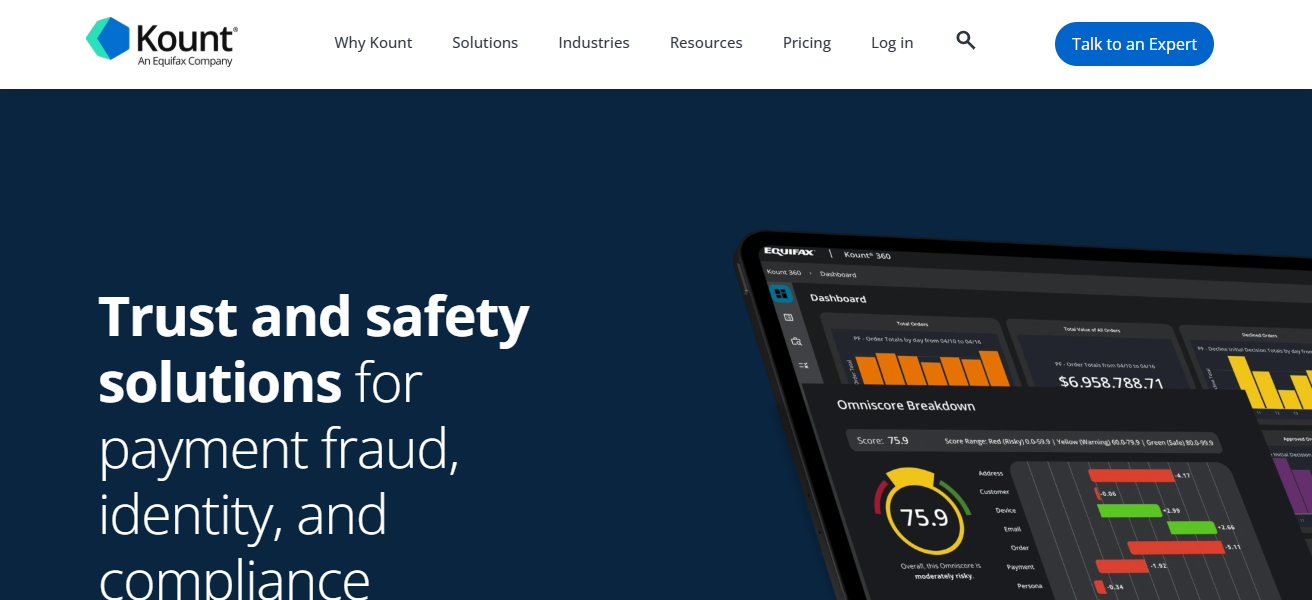
This enriches the risk matrix, allowing Kount to identify high risk account takeovers and payment abuses that other solutions fail to identify, while decreasing the risk of false positive.
Kount’s ability to make risk decisions in real time combined with automated workflows grants businesses a secure ability to scale while offering customers rapid and seamless service.
| Feature | Description |
|---|---|
| Digital Identity Network | Builds identity profiles from global transaction data. |
| Real-Time Decisioning | Instantly approves or declines transactions. |
| Adaptive Risk Scoring | Customizable risk evaluation based on business needs. |
| Fraud Prevention Across Channels | Monitors web, mobile, and in-store transactions. |
| Reduced False Declines | Improves approval rates for legitimate customers. |
Pros And Cons Kount
Pros:
- Identity-centric risk evaluation using global digital identities.
- Better approval rates at lower level of fraud risk.
- Account takeover and payment abuse detections.
- Adaptive workflows for instant decision making.
Cons:
- Pricing may be super high for now.
- Implementation is likely to be a technical process.
- Reports for false positives in edge are some.
- On recent businesses, heavy historical data reliance can be a problem.
8. Forter
In terms of real-time identity decisioning and fraud liability coverage, Forter is a strong alternative to Sardine as a fraud protection provider.
Forter’s main distinguishing feature is that, unlike many competitors, it will assume liability for chargebacks made on orders that it approves.
Forter uses a global network of merchants to determine how customers act, what devices they use, and what context case scenario they purchase for, to determine which customers are trustworthy.
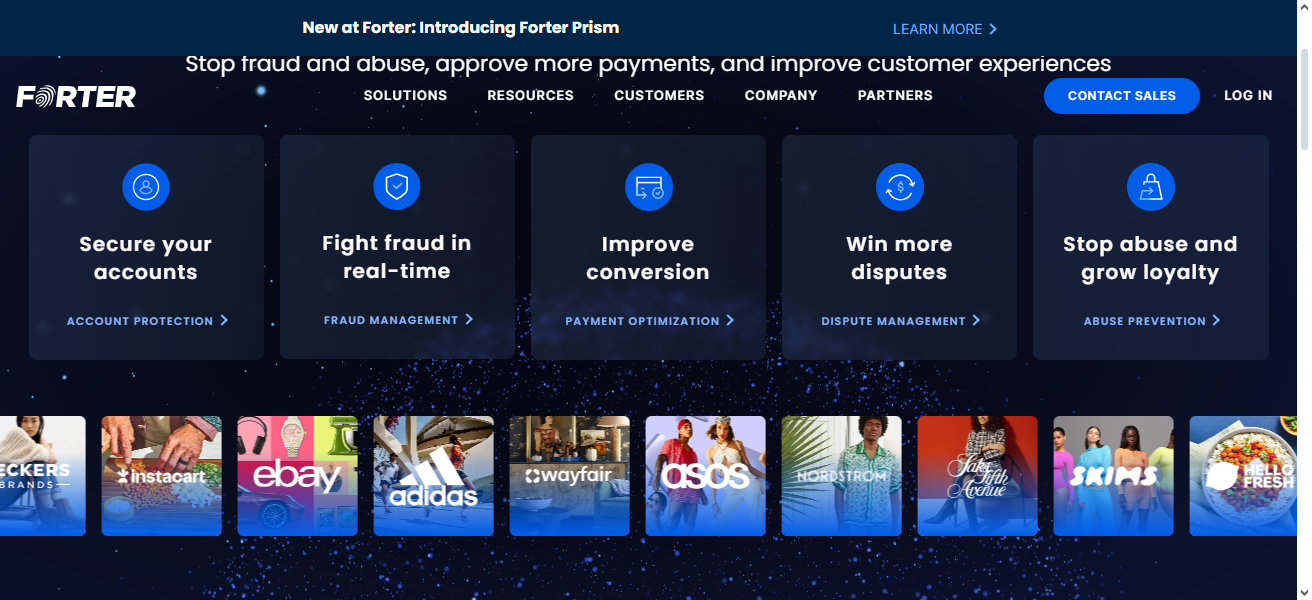
This helps remove friction from the checkout process and allows businesses to boost approval rates.
Forter automates the reviews and shifts the fraud risk from the merchants to Forter, which helps e-commerce companies reduce the fraud scar while giving them confidence.
| Feature | Description |
|---|---|
| Real-Time Identity Decisioning | Approves or declines transactions instantly. |
| Fraud Liability Coverage | Assumes financial risk for fraudulent chargebacks. |
| Global Merchant Data | Uses patterns from other merchants to detect fraud. |
| Automated Transaction Approvals | Reduces manual reviews for eCommerce businesses. |
| Seamless Integration | Works across popular platforms and payment systems. |
Pros And Cons Forter
Pros:
- Instant approval of transactions.
- Active global data helps pattern recognition for merchants.
- Fraud liability in decision is us’s.
- No manual review, cutting costs.
Cons:
- Somewhat high price for smaller businesses.
- Weak-complex risk case customizations.
- Global network data reliance can initially stall onboarding.
- Geared more towards online commerce.
9. Trulioo
Because of real-time access to billions of identity records across 100 countries, Trulioo is a great alternative to Sardine for global identity verification and compliance fraud protection.
With the ability to instantly validate a customer’s identity, businesses can stop fraud before a transaction is completed.
Trulioo can identify high-risk users and detect fake accounts with its document verification, digital identity checks, and AML/KYC compliance.

Trulioo’s advanced global compliance and adaptability fraud protection is valuable for companies that conduct business worldwide in order to safely scale their customer boarding, reduce fraud, and satisfy compliance requirements.
| Feature | Description |
|---|---|
| Global Identity Verification | Validates identities across 100+ countries. |
| Document Verification | Confirms authenticity of government-issued IDs. |
| Digital Identity Checks | Detects synthetic or fake accounts. |
| AML & KYC Compliance | Helps businesses meet regulatory requirements. |
| Real-Time Verification | Instant verification for faster onboarding. |
Pros And Cons Trulioo
Pros:
- Worldwide ID authentication in over 100 nations.
- Instant checks on documents as well as digital identity.
- Merges fraud mitigation with compliance requirements (KYC/AML).
- Aids in the recognition of synthetic identities as well as fraudulent accounts.
Cons:
- Better suited for identity verification than for transactional fraud.
- More intricate for smaller businesses to integrate.
- Expenses can climb for frequent identity verifications.
- Some areas suffer from weak data coverage.
10. Ekata
Ekata is a top alternative to Sardine for fraud protection because it focuses on precise identity verification using global data intelligence.
Its unique strength lies in analyzing phone numbers, email addresses, IP addresses, and physical addresses to create a comprehensive risk score for each transaction.
This allows businesses to detect fraudulent accounts, prevent payment abuse, and verify legitimate customers in real time.

With flexible APIs and machine learning-driven insights, Ekata enables fast, accurate decision-making while reducing false positives.
Its emphasis on digital identity intelligence makes it particularly effective for companies seeking to stop fraud early without compromising customer experience.
| Feature | Description |
|---|---|
| Phone & Email Risk Analysis | Evaluates communication channels for fraud risk. |
| IP & Address Verification | Confirms identity using location data. |
| Machine Learning Risk Scoring | Improves fraud detection over time. |
| Real-Time API Integration | Provides instant risk assessment for transactions. |
| Digital Identity Intelligence | Combines multiple signals to detect fraudulent accounts. |
Pros And Cons Ekata
Pros:
- Risk scoring utilizes phone, email, IP, address, and their associated intelligence.
- Abusive payment patterns and fake accounts are detected.
- Rapid verification and real-time API integration.
- Over time, refined accuracy is attained through machine learning.
Cons:
- More focused on identity than fraud driven by behaviors.
- On its own, sophisticated multi-layer fraud schemes may go undetected.
- With increased transactional volume, costs can rise.
Conclusion
To sum up, alternatives to Sardine for fraud protection –such as Sift, SEON, Signifyd, Kount, Forter, etc.– give a combination of different products, including behavioral biometrics, AI-driven risk scoring, identity verification, and lock systems, as well as other advanced tools.
This equips companies to combat fraud, streamline their approval processes, boost customer confidence, and implement systems that scale and efficient fraud mitigation.
FAQ
Signifyd and Forter are specifically designed for eCommerce, offering real-time approvals and chargeback protection.
Yes, BioCatch, LastPass, 1Password, and Kount specialize in account security and behavioral monitoring.
Most tools like Sift, Kount, and Feedzai use AI and network intelligence to minimize false declines while stopping fraud.
Trulioo and Ekata provide extensive global identity checks and compliance with KYC/AML regulations.
Yes, tools like Forter, SEON, Sift, and Kount offer instant transaction risk assessment.