
In this article, I will talk about the Best Software for Business Rule Management Systems that assist companies in automating decisions, maintaining compliance, and optimizing processes.
- Key Points & Best Software for Business Rule Management Systems
- 10 Best Software for Business Rule Management Systems
- 1. dMACQ DMS+
- 2. TallyPrime
- 3. OpenText
- 4. Appian
- 5. Bizagi
- 6. IBM Operational Decision Manager (ODM)
- 7. PegaRULES
- 8. FICO Blaze Advisor
- 9. InRule
- 10. DecisionRules.io
- How To Choose Best Software for Business Rule Management Systems
- Cocnlsuion
- FAQ
The best BRMS should improve efficiency, lessen mistakes, and help in managing business processes that can be scaled.
I will go over the best available options and explain their main features and how they can fit various business needs.
Key Points & Best Software for Business Rule Management Systems
| Software | Key Point |
|---|---|
| dMACQ DMS+ | Comprehensive document and rule management with strong compliance features |
| TallyPrime | Affordable subscription model with integrated accounting and rule automation |
| OpenText | Enterprise-grade BRMS offering scalability and advanced decision automation |
| Appian | Low-code platform combining workflow automation with business rules |
| Bizagi | User-friendly interface for modeling and executing business rules |
| IBM Operational Decision Manager (ODM) | Robust decision automation trusted by large enterprises |
| PegaRULES | AI-driven decisioning integrated with customer engagement tools |
| FICO Blaze Advisor | Powerful decision engine widely used in financial services |
| InRule | No-code rule authoring enabling business users to manage logic easily |
| DecisionRules.io | Cloud-native BRMS offering real-time decision automation |
10 Best Software for Business Rule Management Systems
1. dMACQ DMS+
dMACQ DMS+ is complex decision-making document and business rule management system. DMS+ gives businesses consolidated management of business rules for quick change, update, and roll-out across applications.
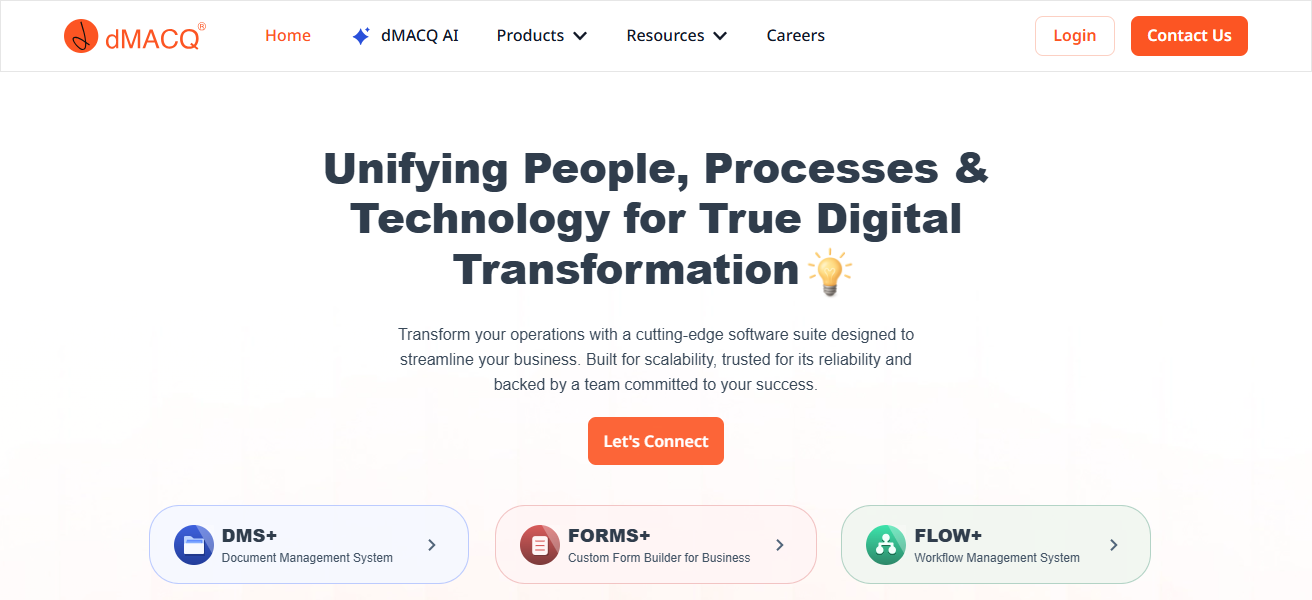
Its user-friendly design allows rule definition, adjustment, and supervision for coding and non-coding users alike. dMACQ integrates with ERPs, CRMs and other enterprise applications for uninterrupted business processes.
DMS+ is great for businesses with high compliance because of the auditing and compliance management capabilities. DMS+ growing with the business allows complex operational adjustments to be managed optimally.
dMACQ DMS+ Features
Central Rule Repository – Business rules are maintained in a central repository, fostering uniformity in applications and across different departments.
Integration with Enterprise Apps – Links with ERP, CRM, and workflow applications to automate and implement business logic across different applications.
Auditing & Compliance Tracking – Documents rule modifications and associated decisions to maintain audit trails and compliance with relevant regulations.
User‑Friendly Rule Editor – Enables the creation and modification of rules by users with and without technical backgrounds.
| Pros | Cons |
|---|---|
| Centralized rule management simplifies governance and reduces inconsistencies across systems. | May require training for users unfamiliar with enterprise BRMS concepts. |
| Integrates with ERP/CRM systems, enabling automated decision workflows. | Not as widely adopted, meaning fewer online community resources. |
| Supports auditing and compliance tracking, helpful for regulated industries. | Feature set may be more than needed for small businesses. |
| Reduces manual decision errors and accelerates updates. | Initial implementation and configuration can take time. |
2. TallyPrime
TallyPrime provides accounting and business management services and handles basic business rule management.
Businesses automate financial workflows and customize tax, invoice and compliance rules and reporting.
Its popularity among small and medium enterprises is due to its banking system integration, ease of use and minimal setup.

While traditional BRMS systems engine is absent, TallyPrime offers more flexible operational, inventory and payroll business rules.
Financial information is used to stream decisions, thus enhancing service and reducing cash errors.
TallyPrime Features
Automation of Financial Rules – Minimizes manual processes by automating rules for tax, invoicing, and accounting in real-time.
Configurable Business Logic – Enables clients to configure rules associated with inventory, pricing, and uniformity in reporting.
Real‑Time Reporting – Provides instant reports on business operations and finance depending on the rules in action.
Integration of Banking and Tax – Automates compliance with rules by linking to tax calculators and banking systems.
| Pros | Cons |
|---|---|
| Highly user‑friendly, especially for accounting and taxation workflows. | Not a full BRMS—limited advanced rule‑engine capabilities. |
| Automates financial rules and reporting, saving manual effort. | Lacks enterprise‑level rule simulation and decision versioning. |
| Strong adoption in SMBs with good support ecosystem. | Rule logic customization is limited compared to dedicated BRMS. |
| Integrates smoothly with banking and taxation. | Less suitable for complex workflow automation beyond finance. |
3. OpenText
OpenText presents a high-level business rule management system within its suite of content management solutions. It allows companies to define, enforce, and monitor rules within various business processes and applications.
Complex rule modeling, decision auditing, and the automation of workflows are all features present within OpenText BRMS and are particularly valuable within compliance-focused industries.
The platform is particularly outstanding in processing scalability, as it efficiently manages large volumes of transactions and decision points.
Its analytics and reporting features provide insights to optimize the performance of rules, while the integration with other OpenText solutions facilitates document and data management integration for operational and strategic decision support.
OpenText Features
Enterprise Rule Engine – Applies intricate business rules across all organizational processes on a large scale.
Content and Rule Integration – Works with the content management system to integrate rules in the decisions and actions taken on documents in workflows.
Governance and Compliance. Provides version control, auditing, and policy enforcement for regulated industries.
Analytics and Monitoring. Tracks execution of rules, and decision outcomes for optimization.
| Pros | Cons |
|---|---|
| Scalable enterprise solution with powerful rule automation. | Can be expensive for smaller teams. |
| Deep integration with content management and compliance workflows. | Steeper learning curve, especially for non‑technical users. |
| Strong auditing, monitoring, and governance features. | Deployment complexity requires skilled IT support. |
| Handles high transaction volumes with consistency. | Customization often needs specialist services. |
4. Appian
Appian combines business rule management with automation, case management, and AI to provide a single unified low-code automation platform.
With the ability to model, execute, and modify business rules, companies are no longer required to have extensive technical experience.
Businesses can deploy rule-based processes across different divisions quickly with the help of Appian’s simple drag-and-drop design.
Businesses can enhance operations and optimize processes using process analytics and real-time decision monitoring. The platform integrates with other enterprise applications to ensure consistent business rule enforcement.
Appian also streamlines development cycles, allowing organizations to maintain compliance, transparency, and efficiency, making it ideal for companies that require agility.
Appian Features
Low-Code Rule Design. Simple drag and drop interface allows for quick rule creation by business users with no coding experience.
Workflow and Rule Automation. Merges business process management with automated decisioning.
Real-Time Decision Insights. Analytics and dashboards captures and displays the impact of the rules in real time.
Integration Capabilities. Provides the ability to integrate with third party systems to offer seamless rule execution in complex enterprise ecosystems.
| Pros | Cons |
|---|---|
| Combines BPM and BRMS with low‑code ease. | Subscription costs can be high for full features. |
| Rapid development with drag‑and‑drop rule modeling. | May be more than needed if pure rule management is the only goal. |
| Real‑time analytics and decision reporting. | Requires training for effective advanced use. |
| Supports integrations, case management, and AI decisioning. | User interface complexity for beginners. |
5. Bizagi
Bizagi is a top-tier BPM and BRMS provider and focuses on sheer agility, ease of adoption, and the digital transformation of enterprises. It allows companies to embed business rules for consistency and compliance on top of process automation and optimization.
Unlike other automation tools, Bizagi’s process automation tools offer advanced functionality to control rules, triggers, and conditions at a detail level without the need to write code.
Their execution engine automates the enforcement of business rules across applications and processes.
Bizagi provides a combination of on-premise and cloud-based systems, as well as advanced analytics and reporting tools, to ensure enterprises can track the performance of business rules, adapt to changing conditions, and optimize operational performance.
Bizagi Features
Visual Rule Modelling. Business users can create, and edit rules through the use of diagrams without the need for coding.
BPM and BRMS Unified. Merges rules with business processes for complete end to end automation.
Cloud and On-Premise Options. Three deployment options help align with varying IT strategies.
Simulation and Testing. Provides the ability to test rules before deployment to validate desired outcomes.
| Pros | Cons |
|---|---|
| Visual rule design that business users can manage. | Cloud version limitations compared to enterprise on‑premise options. |
| Flexible deployment (cloud or on‑prem). | Advanced customization may need technical support. |
| Strong BPM + BRMS combination. | Performance may lag with very large rule sets. |
| Rapid rule iteration and optimization. | Smaller ecosystem compared to bigger vendors. |
6. IBM Operational Decision Manager (ODM)
IBM ODM is an example of a BRMS that incorporates enterprise decision management on an organizational level. It enables businesses to capture, automate, and manage their business rules and operational decisions.
With ODM, businesses can easily maintain and modify their decision logic to improve compliance. It’s sophisticated rules engine is the backbone of decision simulation, testing, and versioning.
The combination of AI and analytics and the simulation and testing capabilities of ODM create powerful predictive decisioning capabilities.
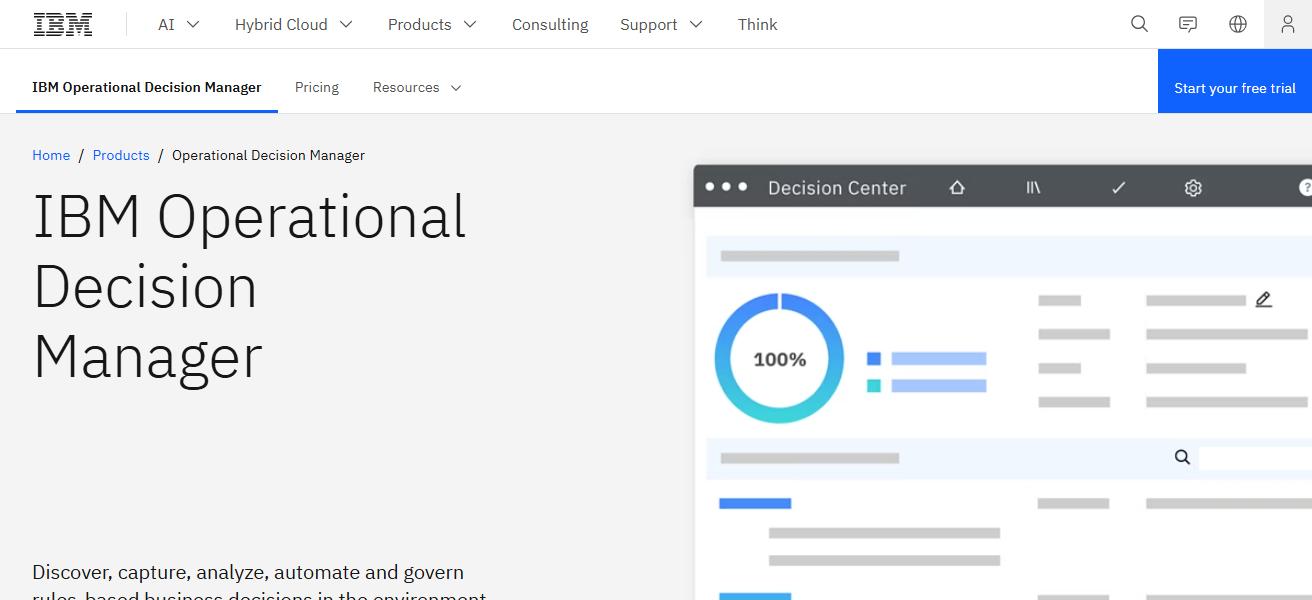
With the use of customizable monitoring, businesses can gain insight and control over the execution of their business rules.
ODM can be used in transaction-intensive verticals like finance, insurance, and healthcare, where operational decisions require precision, agility, and compliance.
IBM Operational Decision Manager (ODM) Features
Advanced Rule Engine. Processes complex decision rules and high volumes of transactions seamlessly and quickly.
Decision Simulation and Testing. Provides the ability to test the impact of rules in controlled environments prior to deployment.
Rule Versioning and Governance. Keeps historical versions of rules for auditing and rollback purposes.
AI & Analytics Integration – Enriches automated decisions with analytics and predictive modeling.
| Pros | Cons |
|---|---|
| Industry‑grade rule engine with scalability for enterprise demands. | High cost and complex licensing model. |
| Decision simulation, testing, and versioning. | Significant technical setup and expertise needed. |
| Strong compliance, monitoring, and governance tools. | Overkill for smaller or mid‑size companies. |
| AI and analytics integration for smarter decisions. | Training and certification often required for users. |
7. PegaRULES
Part of the Pega platform, PegaRULES is a business rule management system (BRMS) that allows companies to automate complex business rules and decisions. PegaRULES employs real-time rule evaluations to ensure consistent rule enforcement across applications.
PegaRULES integrates with case management, process automation and predictive analytics to enable better and faster decisioning.
PegaRULES has a visual interface that allows business users to model rules and decisioning logic without programming, which streamlines deployment and minimizes the likelihood of mistakes.
PegaRULES has built-in auditing, versioning and simulation to help users achieve compliance and optimize performance.
PegaRULES’s scalable architecture and integration options also optimize operational effectiveness while improving regulatory compliance and customer process management.
PegaRULES Features
Real-Time Decision Execution – Executes business rules in real time within operational processes.
Case & Rule Management Integration – Integrates case lifecycle with decision logic.
Adaptive Analytics – Improves predictive accuracy by learning from past results.
Rule Version Control & Auditing – For compliance and accountability, tracks modifications and the history of rules.
| Pros | Cons |
|---|---|
| Powerful real‑time rule evaluation engine. | One of the more expensive BRMS platforms. |
| Combines BRMS with case management and workflows. | Requires skilled developers for scalable solutions. |
| Version control and audit tracking included. | Learning curve can be steep without training. |
| Excellent for complex enterprise process automation. | Platform can feel heavyweight for simple rule logic. |
8. FICO Blaze Advisor
FICO Blaze Advisor is an industry-leading choice for enterprise-grade BRMS. Its sophisticated agile automation and analytics provide decision-making excellence.
Blaze Advisor allows companies to set, implement, and control intricate rules for credit scoring, risk assessment, and operations.
With boundary-pushing achievement in rule execution, compliance, and consistency, and in versioning and simulation, Blaze Advisor continues to be the best in the industry.

Businesses have the ability to manage and control risk with the decision analytics and optimize the outcomes. The predictive capabilities of the integrated AI and machine learning improve decision-making.
Blaze Advisor is a strong contender in the marketplace, especially in finance, telecommunications, and insurance because of its ability to scale, manage high throughput, and provide strict, rule-based decision-making.
FICO Blaze Advisor Features
High-Performance Decision Engine – Optimized for low latency and high-volume decisioning.
Scenario Simulation – Perform “what-if” analysis to fine-tune rules prior to deployment.
Central Rule Repository – Consolidates rules for easy use across multiple applications.
Risk & Compliance Features – Integrated models for risk scoring and compliance.
| Pros | Cons |
|---|---|
| Designed for high‑volume decision automation (e.g., finance). | Licensing and total cost can be high. |
| Advanced decision analytics and scoring capabilities. | Technical expertise needed to unlock full potential. |
| Rule simulation and testing reduce errors before deployment. | Not as user‑friendly for non‑technical users. |
| Scales reliably for enterprise workloads. | Integration may require additional middleware. |
9. InRule
InRule is an adaptable BRMS that helps businesses create, manage, and implement business rules quickly. With a visual design, users without technical skills can set rules and deploy new rules and updates quickly.
InRule integrates with ERP, CRM, and bespoke systems so rules can be enforced across all platforms.
With business rules on simulation, testing, and versioning, the platform lets businesses preview rules before they go live.
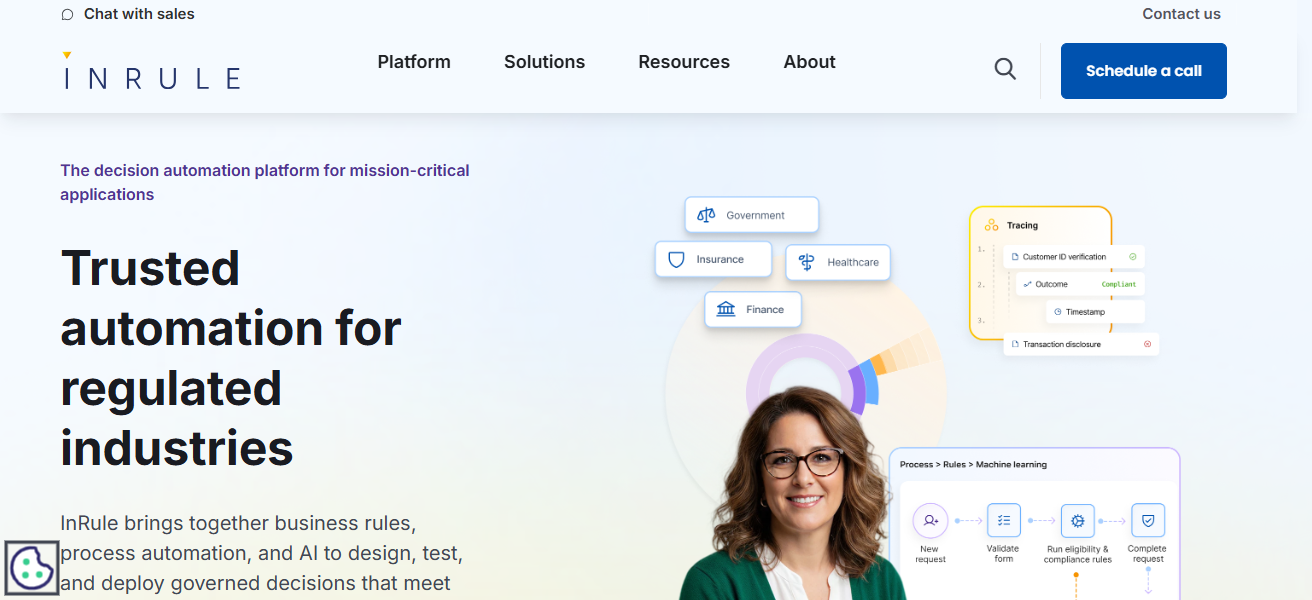
InRule aids compliance and process efficiency with transparency, tracking, and decision reporting. It’s real-time decision monitoring tools.
With the ability to grow, InRule can manage the needs of small startups and support enterprise business models.
It is useful in sectors that need quick, precise decision-making, such as insurance, healthcare, and finance.
InRule Features
Visual Rule Authoring – Graphically, rules can be created and modified by users without a technical background.
Testing & Validation Tools – Validate decisions prior to deployment.
Flexible Integration – Integrates with CRM, ERP, and bespoke applications via APIs.
Versioning & Rule Management – Controls iterations and history of rules for governance.
| Pros | Cons |
|---|---|
| Visual rule design suitable for non‑technical users. | Smaller ecosystem than major enterprise players. |
| Quick deployment and easy rule updates. | Not optimized for extremely high‑throughput decision workloads. |
| Supports integration with various backend systems. | Advanced analytics features are limited. |
| Rule simulation and versioning help governance. | Some advanced features require technical configuration. |
10. DecisionRules.io
DecisionRules.io manages rules and automates decisions for businesses through a simple cloud-based BRMS. Users can create business rules using a point-and-click interface to define, test, and implement rules without coding.
Features for rules auditing, managing versions, and simulating rules support decision-making processes and operational compliance. Through API integration, users can implement rules across multiple business applications.
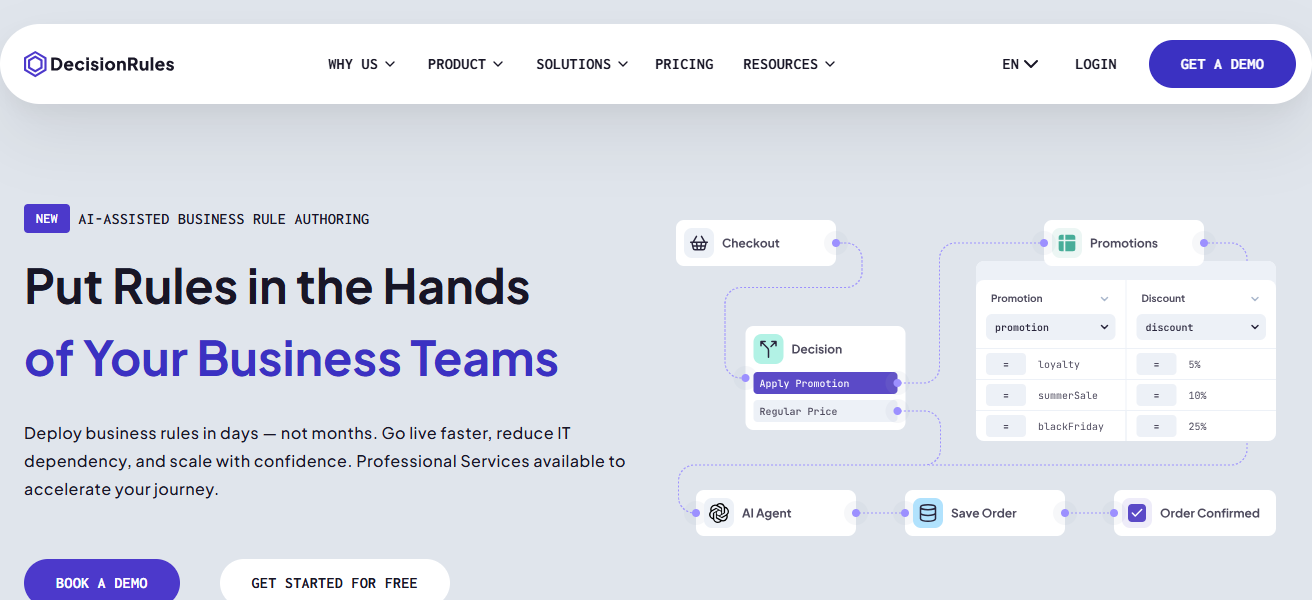
Users can utilize reports and analytics to refine processes and facilitate more timely decisions. Maintenance, scalability, and cost are all positively affected by the SaaS model.
Small and medium businesses can use DecisionRules.io to automate decisions while retaining control and flexibility in their processes.
DecisionRules.io Features
Cloud-Native Rule Platform – Scalable, easy to manage, and available from any location without local infrastructure.
API-First Integration – Executes decisions in real time by integrating with various applications.
Rule Versioning & Audits – Records historical rules and retains modification histories.
User-Friendly Interface – Empowers business users to create and change rules without needing developers.
| Pros | Cons |
|---|---|
| Cloud‑based, accessible anywhere with minimal infrastructure. | Lighter rule engine compared to enterprise solutions. |
| Easy onboarding and rule management UI. | Limited advanced analytics and simulation features. |
| API integrations for seamless automation. | Smaller community and resource base. |
| Cost‑effective for SMEs with straightforward rule requirements. | Less suitable for extremely complex or high‑volume decisioning. |
How To Choose Best Software for Business Rule Management Systems
First Consider Business Needs Systems offer a wide range of services – simple rule automation and complex decisioning. Determine and prioritize the automation pain points you need to address.
User-Friendliness A BRMS product should offer intuitive rule editors. Both business and IT users should be able to self-service rule modifications with little to no training.
Integration Consider the automation of business processes alongside the BRMS. Look for features that integrate with existing business solutions (ERP, CRM, custom DBs, APIs), allowing seamless operational integration.
Scalable Solutions Consider a solution that can evolve with your business and accommodate a growing volume of automated decisions.
What-if Scenarios Proper BRMSs allow for the simulation of rules before they are activated.
Regulatory Compliance Solutions must have thorough versioning of rules, editing, and auditing systems, especially in compliance-heavy industries.
Cocnlsuion
In summary, creating the right impact on automating decisions, compliance, and operational efficiency, choosing the right software for a Business Rule Management System is essential.
A Business rule management software that best fits the needs of the business, optimizes and streamlines processes, correcting the errors and modifying to the changing needs of the business.
By evaluating the features, scalability, and ease of use, as well as the integration capacity, the organization can solve the optimum value problem for sustained growth.
FAQ
To reduce errors, enforce compliance, speed up decision-making, and standardize processes across departments.
Finance, insurance, healthcare, telecommunications, and any industry requiring regulatory compliance and automated decisions.
Rule automation, visual rule design, integration with enterprise systems, auditing, and simulation/testing capabilities.
Yes, modern BRMS platforms offer drag-and-drop interfaces suitable for business users.
Cloud offers scalability and lower maintenance; on-premise gives more control and security.