This article will cover Best Software for Enterprise Data Lineage Tracking. Lineage tracking is important for organizations to manage their data compliantly, transparently, and accurately.
- Key Points & Best Software For Enterprise Data Lineage Tracking
- 10 Best Software For Enterprise Data Lineage Tracking
- 1. Informatica Enterprise Data Catalog
- 2. Collibra Data Lineage
- 3. Alation
- 4. Octopai
- 5. MANTA
- 6. Atlan
- 7. Talend Data Fabric
- 8. IBM Watson Knowledge Catalog
- 9. Azure Purview (Microsoft)
- 10. Erwin Data Intelligence
- How We Choose Best Software for Enterprise Data Lineage Tracking
- Cocnlsuion
- FAQ
Businesses manage large and complicated datasets. It is important to understand the flow of data within the organization.
I will discuss various data flow tracking tools that offer automated discovery, visual lineage mapping, AI insights, and governance to help enterprises improve their data and their data-driven decisions.
Key Points & Best Software For Enterprise Data Lineage Tracking
| Software | Key Point |
|---|---|
| Informatica Enterprise Data Catalog | AI-powered metadata discovery for large-scale enterprises |
| Collibra Data Lineage | Business glossary integration to align technical lineage with business terms |
| Alation | Crowdsourced data stewardship enabling collaborative governance |
| Octopai | Automated cross-platform lineage across BI, ETL, and databases |
| MANTA | Column-level lineage visualization for compliance and impact analysis |
| Atlan | Active metadata management with modern UI for data teams |
| Talend Data Fabric | End-to-end pipeline lineage integrated with data quality tools |
| IBM Watson Knowledge Catalog | Policy-driven governance with lineage tracking for regulated industries |
| Azure Purview (Microsoft) | Cloud-native lineage mapping across hybrid environments |
| erwin Data Intelligence | Impact analysis dashboards for risk management and audits |
10 Best Software For Enterprise Data Lineage Tracking
1. Informatica Enterprise Data Catalog
Informatica Enterprise Data Catalog offers powerful solutions for enterprise data lineage and metadata management.
It provides automatic discovery of data and can classify and catalog data across the enterprise. Users can track data from the initial source to the final destination.
Using its AI, Informatica scans and analyses the data to help build the most accurate lineage it can. It easily tracks data relationships and dependencies.
Businesses can assess and analyze the data with the help of visual impact analysis, ensuring to assess and analyze data quality and compliance. It also helps maintain governance initiatives.
Features Informatica Enterprise Data Catalog
- Enterprise data sources can be cataloged and discovered automatically.
- Relationship and dependency identification through AI-driven metadata analysis.
- Visualization of data lineage for tracking with end to end data mapping.
- Risk analysis to examine the compliance, quality, and impact of issues.
- Data governance in large organizations and analytics is supported.
| Pros | Cons |
|---|---|
| AI-powered metadata scanning automatically discovers and catalogs data. | Can be expensive for small or mid-sized enterprises. |
| Intuitive visualizations for end-to-end data lineage. | Implementation and setup can be complex. |
| Strong support for governance and compliance initiatives. | Requires trained personnel to fully utilize advanced features. |
| Impact analysis helps in risk assessment and decision-making. | May have performance issues with extremely large datasets. |
2. Collibra Data Lineage
Collibra Data Lineage provides detailed enterprise-level data lineage tracking, focusing on governance and compliance.
It retraces the steps data has taken across systems, emphasizing changes and relationships. Users can see data flow from start to finish, evaluate the consequences of modifications, and manage compliance.
Its collaborative framework enables the seamless integration of business and IT, enhancing data accuracy, reliability, and efficiency in extensive enterprise operational environments.
Features Collibra Data Lineage
- Tracking data lineage with enterprise governance and analytics.
- Visualization of data positions, movements, conversions, and relations.
- Integrative platform for technical and business users.
- Analysis of risk and compliance with data and change.
- Operational improvements with data reliability and accuracy.
| Pros | Cons |
|---|---|
| Comprehensive data governance and compliance support. | Can be costly for smaller organizations. |
| Visualizes end-to-end data flow and transformations. | Learning curve can be steep for new users. |
| Collaborative platform for business and technical teams. | Some advanced features may require additional modules. |
| Improves data accuracy, trustworthiness, and operational efficiency. | Initial deployment may be time-consuming. |
3. Alation
Alation integrates data cataloging and sophisticated data lineage to provide a holistic perspective on enterprise data. It automatically records lineage data from various sources like databases, ETL pipelines, and analytics tools.
Users can see how data flows and changes through systems, which enhances understanding and governance.
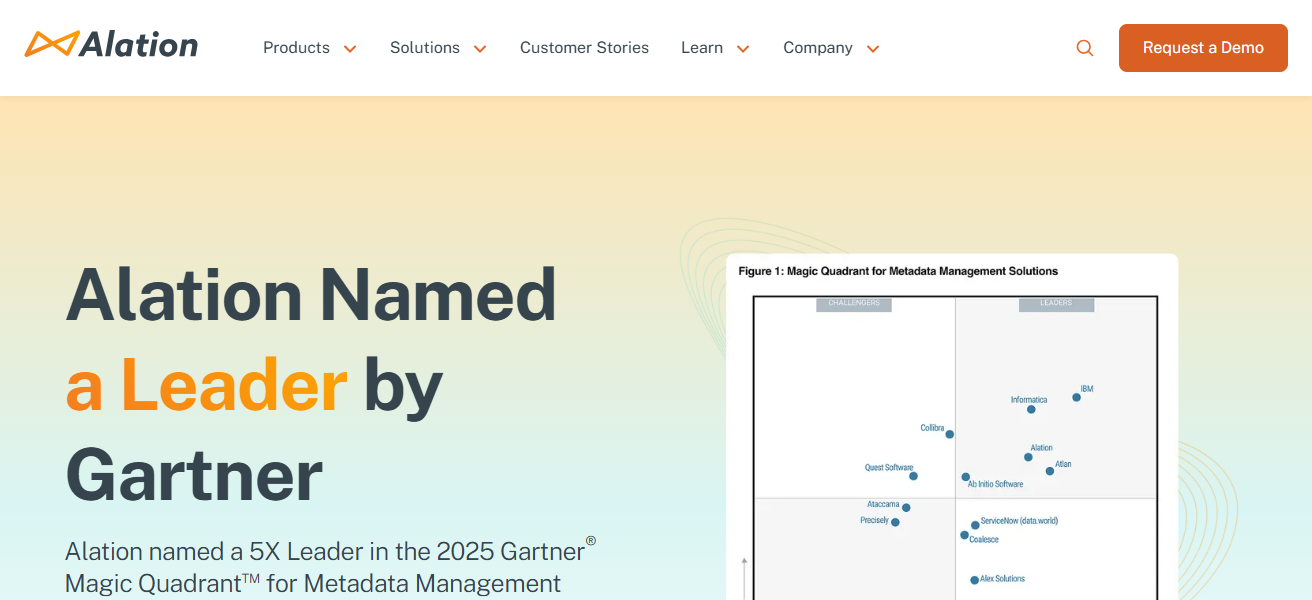
With data lineage pre-validated collaboration, Alation provided a better decision making, regulatory compliance, and data transparency, as teams are enabled to document, share, and validate data lineage.
Features Alation
- Advanced data tracking and single data catalog.
- Automated lineage capture from data base, ETL, and BI tools.
- Clear visualization of data and its transformations with additional tools.
- Excellent collaboration to document, share, and validate lineage.
- Increased compliance, data transparency, and improved decision making.
| Pros | Cons |
|---|---|
| Combines data cataloging with advanced lineage tracking. | High licensing costs for enterprise-scale usage. |
| Automated capture of lineage from databases, ETL, and analytics tools. | May require customization for complex data environments. |
| Collaboration features enhance governance and team workflows. | User interface may be overwhelming for beginners. |
| Supports regulatory compliance and improved data transparency. | Limited offline or on-premise options compared to some competitors. |
4. Octopai
Octopai automates the complicated data lineaging process in large company data ecosystems. It helps users to navigate through data, discover data relationships, and understand its lineage through automapping and scanning across databases, BI tools, and ETL.
Octopai helps users discover dependencies and transforms data to enable quicker error tracing and impact analysis. It is faster and is scalable, making the reporting dashboards easy to understand and use.
This is why customers appreciate Octopai. It also helps data governance, impact analysis, error tracing, and drives compliance through its metadata focused data governance framework.
Features Octopai
- Automation for scanning of BI and ETL tools and databases.
- Compliance and governance with lineage analytics.
- Enhanced analytics for data transformation and relations.
- Improvements in impact analysis and error analytics.
- Adaptive, speedy, and applicable to any enterprise-level data ecosystem.
| Pros | Cons |
|---|---|
| Automated scanning of databases, BI tools, and ETL pipelines. | Smaller ecosystem compared to larger vendors like Informatica. |
| Metadata-driven lineage enhances governance and compliance. | Limited customization for niche enterprise environments. |
| Fast and scalable, suitable for large enterprises. | Some users may find reporting dashboards less flexible. |
| Simplifies troubleshooting and impact analysis. | Learning curve for advanced features exists. |
5. MANTA
MANTA provides sophisticated data lineage for enterprises, focusing on tracking data where it travels and how it changes. It provides lineages for databases and ETL and BI tools, along with data movement visualizations.
With MANTA, organizations can identify data issues, be compliant with regulations, and increase data quality.
It is effective for complicated enterprise environments due to its integration features and supports impact analysis, root-cause analysis, and decision support for business and technical users.
Features MANTA
- Cross structures, ETL and BI frameworks, detailed lineage tracing.
- Error and root cause analysis through detailed visualizations.
- Compliance and regulatory reporting assistance.
- Fits seamlessly into complex enterprise ecosystems.
- Informed decision-making and impact analysis.
| Pros | Cons |
|---|---|
| Deep lineage tracking across databases, ETL, and BI systems. | Focused primarily on technical lineage, less on business glossary. |
| Detailed visualizations help detect errors and compliance risks. | Implementation can be complex for hybrid environments. |
| Integration with existing enterprise tools is strong. | Can be expensive for smaller teams. |
| Supports root-cause analysis and impact assessment efficiently. | Limited collaboration features compared to competitors. |
6. Atlan
Atlan is a contemporary platform for data collaboration and lineage which streamlines enterprise data processes.
It offers automated tracking of data lineage and provides clear visualizations of data movement across data warehouses, pipelines, and BI tools.
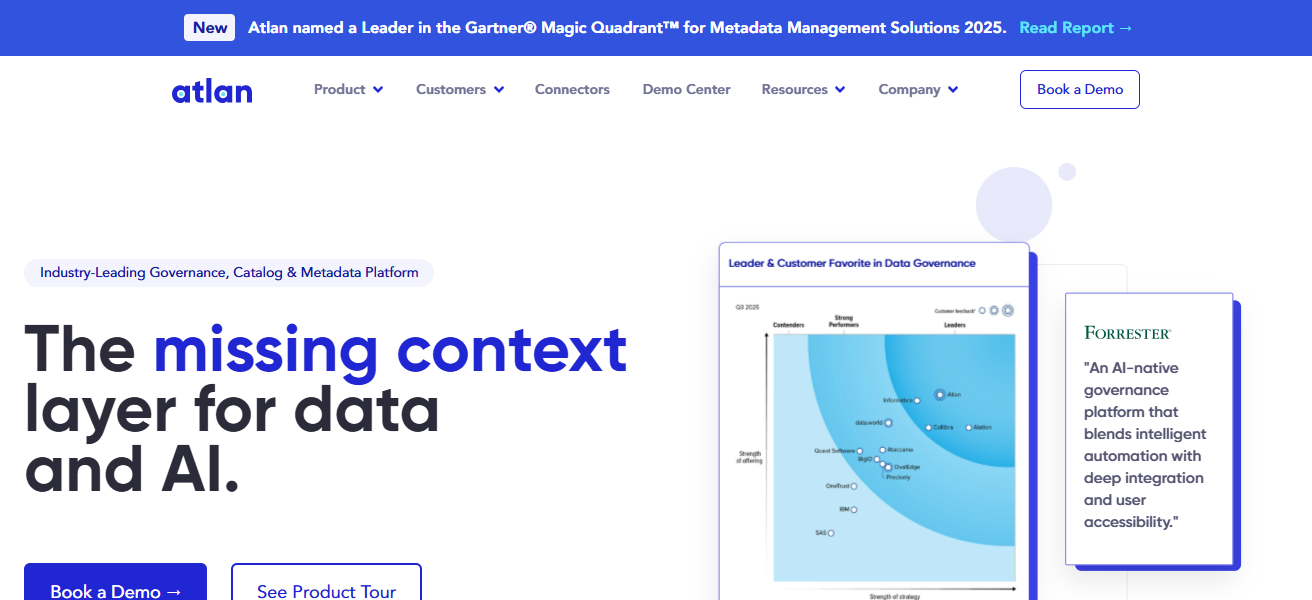
With tools for documentation, teamwork, and governance, Atlan fosters collaboration. The AI-powered insights improve trust, compliance, and operational efficiency with data.
With Atlan, enterprises experience reduced onboarding time, improved collaboration, and increased visibility of their data landscape.
Features Atlan
- Automated lineage tracking for data warehouses, pipelines and BI tools.
- Transparency through data flow visual maps.
- Governance, documentation, annotation and collaboration functionalities.
- Data trust, quality, compliance, and operational efficiency through AI.
- Improves operational efficiency and accelerates team ramp-up.
| Pros | Cons |
|---|---|
| Modern, collaborative platform for data management. | May require training for teams unfamiliar with data governance tools. |
| Automated lineage tracking across warehouses, pipelines, and BI tools. | Some advanced analytics features are limited compared to larger competitors. |
| AI-driven insights improve compliance and data trust. | Relatively new in the market, fewer enterprise adoption case studies. |
| Supports faster onboarding and better team collaboration. | Custom integration may require technical expertise. |
7. Talend Data Fabric
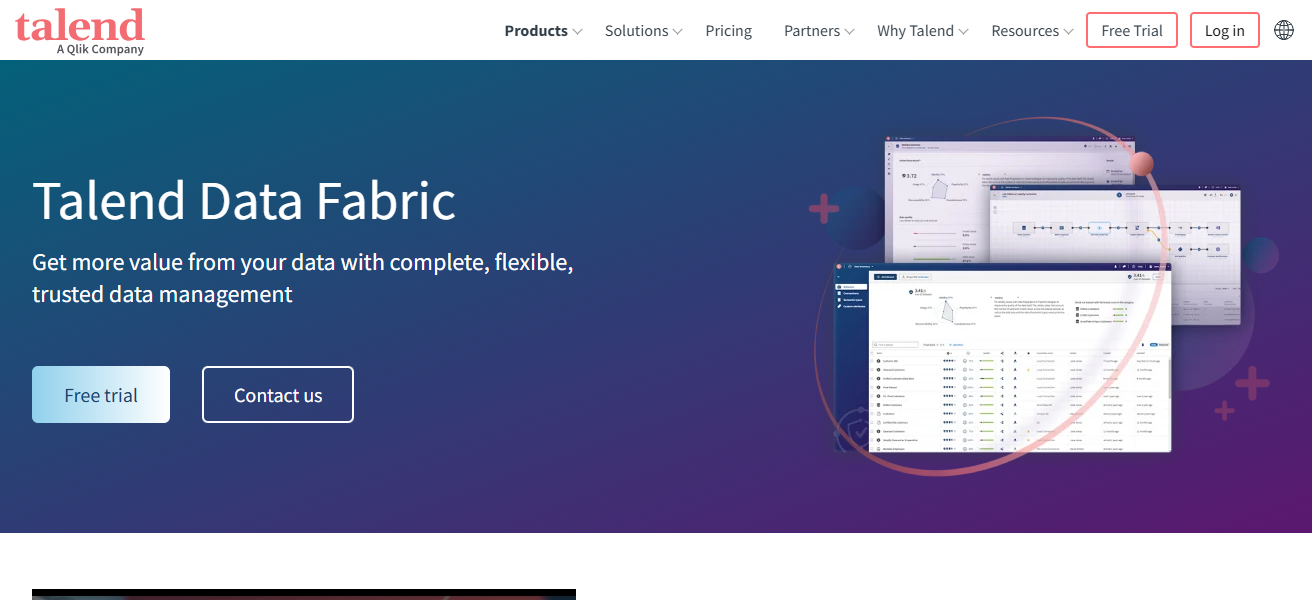
Talend Data Fabric is one integrated platform that unifies data linage, governance, and integration.
Talend captures metadata automatically to create and visualize data flows through various sources, transformations, and end points.
Talend keeps lineage updated in real time, which enhances impact analysis and data quality monitoring.
Talend’s governance framework is strong, ensuring compliance with various models, while enabling organizations to make data driven decisions.
The complexity of data environments in large enterprises is matched with Talend’s cloud-native architecture and scalable services.
Features Talend Data Fabric
- Lineage, governance, and data integration unified within one platform.
- Visualize lineage in real-time and assess impact.
- Metadata capture from sources, transformations, and destinations.
- Assists with regulatory compliance and decision-making through data.
- Heterogeneous environments with scalable and cloud-native architecture.
| Pros | Cons |
|---|---|
| Unified platform for integration, governance, and lineage. | May require more resources to deploy fully in large enterprises. |
| Real-time lineage visualization and impact analysis. | Some users report a steep learning curve for complex workflows. |
| Strong compliance framework for regulatory standards. | Cloud-native architecture may not suit all legacy systems. |
| Scalable for heterogeneous data environments. | UI can feel dated compared to newer platforms. |
8. IBM Watson Knowledge Catalog
IBM Watson Knowledge Catalog serves as an enterprise-level tool for data lineage and cataloging. It has capabilities for automated detection, classification, and lineage tracking for both structured and unstructured data.
Users can see and understand data flows, evaluate data dependencies, and understand the impacts of data transformations. AI-generated recommendations improve data governance, quality, and regulatory compliance.
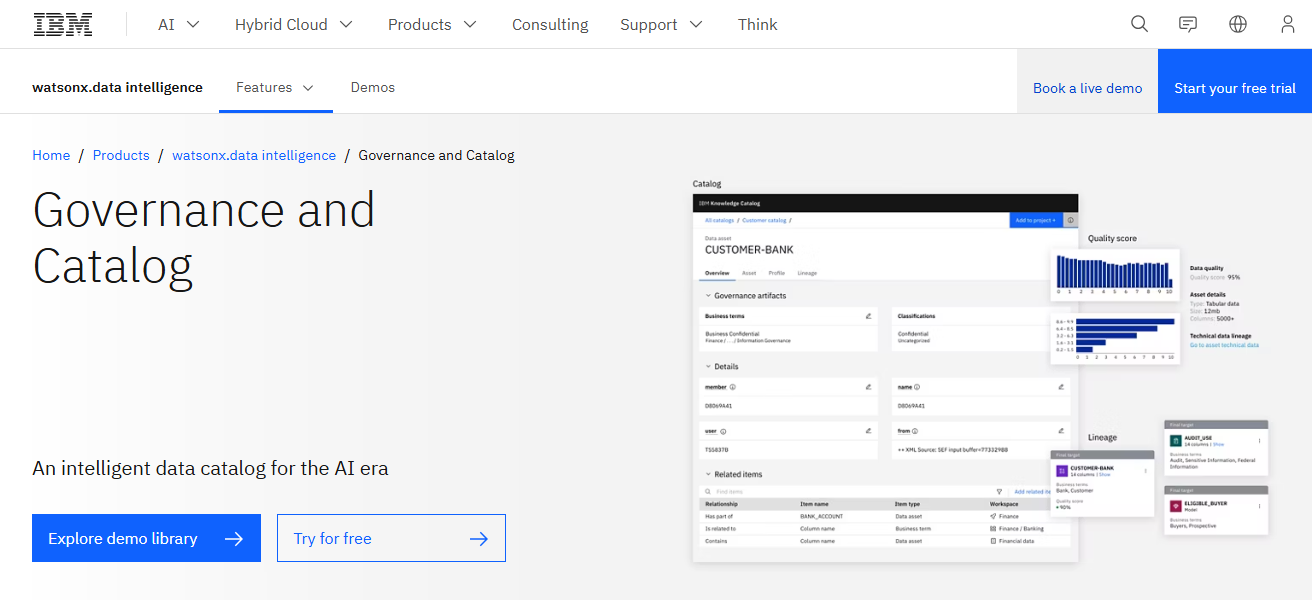
Watson Knowledge Catalog offers a high level of collaboration, allowing both technical and non-technical business users to scale the efficient management of data assets.
Features IBM Watson Knowledge Catalog
- Automated structuring and unstructured data discovery and classification.
- Visualize end-to-end lineage for dependency and impact analysis.
- Governance and data quality improvements through AI-driven recommendations.
- Collaboration for both technical and business teams.
- Enterprise-level compliance and sophisticated data management support.
| Pros | Cons |
|---|---|
| Automated discovery, classification, and lineage tracking. | High cost for enterprise licensing. |
| Supports structured and unstructured data. | Complexity in setting up AI-driven recommendations. |
| Strong collaboration capabilities for business and technical teams. | Initial configuration may require specialized skills. |
| AI-powered insights improve governance and data quality. | Integration with non-IBM tools can require additional work. |
9. Azure Purview (Microsoft)
Azure Purview has now been updated to Microsoft Purview. Microsoft Purview is a cloud-based solution for data governance and data lineage.
It has the ability to automatically scan and catalog data, including on-premises sources, SaaS, and cloud sources.
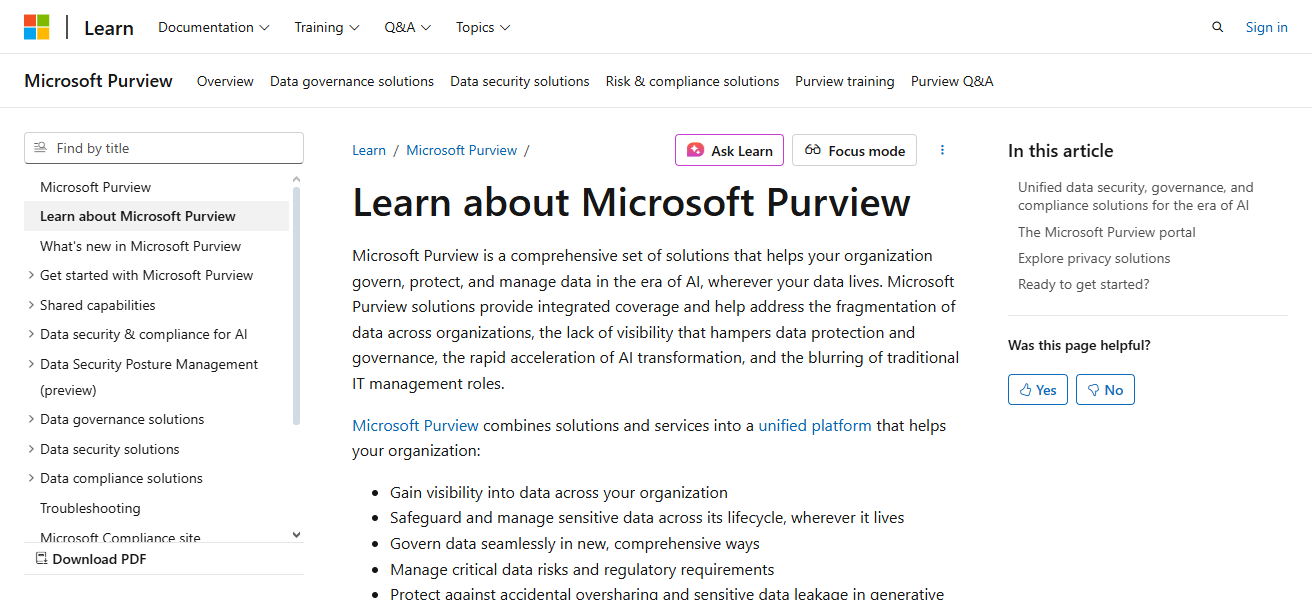
Purview has the ability to visualize data lineage, thereby enabling the user to perform impact analysis and also provides a solution for compliance reporting.
Microsoft’s Integrated Ecosystem, helps with the simplification of governance for analytics, AI, and BI. Enterprises have reported an increase in confidence in their data, simplification of regulatory compliance, and streamlined visibility on complex data.
Features Microsoft Azure Purview
- Data governance and lineage platform that is cloud-based.
- Automated scanning and cataloging for all sources, whether on-premises, cloud, or SaaS.
- End to end lineage for visualization, impact assessment, and compliance.
- Microsoft ecosystem integrations for analytics, AI, and Business Intelligence.
- Enhances data trust, compliance to regulatory standards, and visibility in data landscape.
| Pros | Cons |
|---|---|
| Cloud-native, integrated with Microsoft ecosystem. | Limited functionality outside of Microsoft products. |
| Automatic scanning and cataloging across on-premises, cloud, and SaaS. | Requires Azure subscription and understanding of cloud governance. |
| End-to-end lineage visualization for compliance. | May lack advanced transformation lineage details. |
| Improves data trust and regulatory compliance. | Reporting customization options are limited compared to competitors. |
10. Erwin Data Intelligence
Erwin Data Intelligence offers a unique tracking method for enterprise data lineage, interweaving metadata management with data governance.
It creates automated mappings of data movement across various systems, including ETL tools and BI applications. Additionally, the visual lineage and impact analysis aid organizations to identify and mitigate risks, comply with regulations, and enhance data quality.
Erwin fosters a collaborative environment between business and technical stakeholders, promoting transparency, responsibility, and streamlined decision-making. It is especially beneficial for large organizations needing extensive data governance.
Features Erwin Data Intelligence
- Lineage tracking and metadata management on an enterprise scale.
- For analytics on risk and compliance, impacts and Visual Lineage are used.
- Business and technical user cross collaboration.
- Data governance that is accountable and transparent.
- Data environments for enterprise scale and complexity.
| Pros | Cons |
|---|---|
| Robust lineage tracking and metadata management. | Can be expensive for smaller enterprises. |
| Visual lineage and impact analysis tools for compliance. | Learning curve for complex deployments. |
| Supports collaboration between business and technical users. | Some integrations require additional configuration. |
| Ensures transparency, accountability, and data governance. | May feel less modern compared to newer SaaS-native tools. |
How We Choose Best Software for Enterprise Data Lineage Tracking
- Automation and data discovery: allow users to automatically scan, discover and catalog data from any source.
- Visualization and lineage tracking: provide clear visualizations of data flows end-to-end and for each data field.
- Governance and compliance: support regulatory and audit requirements.
- Collaboration and usability: enable business users and technical users to collaborate efficiently.
- Integration and scalability: handle big data and integrate into your data ecosystem
- Analytics and AI: provide AI insights that help discover data issues, improve data quality, and optimize data lineage tracking.
Cocnlsuion
In cocnlsuion Selecting appropriate solutions for enterprise data lineage tracking software is key to maintaining data accuracy, governance, and compliance.
Automated discovery, AI-powered insights, and end-to-end lineage visualization are features provided by tools such as Informatica, Collibra, and Alation.
Considering your organization’s size, systems integration, cross-team collaboration, and compliance will streamline and clarify your data management efforts.
FAQ
Data lineage tracking is the process of tracing data flow from source to destination, including transformations, movement, and dependencies, to ensure data accuracy, governance, and compliance.
It helps organizations understand data flow, maintain regulatory compliance, detect errors, improve data quality, and make informed business decisions.
Popular tools include Informatica Enterprise Data Catalog, Collibra, Alation, Octopai, MANTA, Atlan, Talend Data Fabric, IBM Watson Knowledge Catalog, Azure Purview, and erwin Data Intelligence.
Key features include automated discovery, end-to-end lineage visualization, compliance support, collaboration, scalability, and AI-driven insights.
Most tools are designed for enterprise-scale environments but some, like Atlan and Talend, also support mid-sized organizations.