
This article focuses on the Best Subscription Commerce Platforms for Businesses that want to sell products/services on a recurring basis.
These platforms streamline the subscription process, automate billing, and enhance customer retention.
From SaaS to subscription boxes to membership sites, the right platform is essential for business growth and operational efficiency.
Key Poinst & Best Subscription Commerce Platforms
| Platform | Key Point |
|---|---|
| Subbly | Best for handling operations without plugins |
| Shopify + Recharge | Seamless integration for Shopify merchants |
| Bold Subscriptions | Flexible recurring billing with upsell options |
| Zuora | Enterprise-grade subscription management |
| Chargebee | Advanced billing automation and analytics |
| WooCommerce Subscriptions | Native WordPress solution for recurring payments |
| Paddle | Global SaaS subscription and tax compliance |
| PayWhirl | Easy setup with customer self-service portal |
| Cratejoy | Marketplace plus subscription box tools |
| SaaSOptics | Financial operations for scaling SaaS businesses |
10 Best Subscription Commerce Platforms
1. Subbly
Subbly focuses on simplicity and functionality, making it easy for businesses to get all the necessary tools for subscription commerce in one place.
From recurring billing and subscription management to customized checkouts and invoicing, everything can be done from one dashboard.

Service-based businesses, membership sites, and SaaS companies are some of the business types that are fond of using Subbly.
It’s easy to set up and manage, and it has flexible pricing, automated payments, and built-in CRM tools for improving customer retention and reducing churn.
Subbly – Key Features
- A fully integrated platform that handles all aspects of subscriptions, billing, and invoicing.
- Flexible pricing and checkout options.
- In-house CRM to help manage and retain customers.
- Workflow tools for operational ease to automate payments and reduce churn.
| Pros | Cons |
|---|---|
| All-in-one solution for subscription management and billing. | Limited advanced enterprise-level features compared to larger platforms. |
| Easy setup with customizable checkout and pricing models. | Smaller app ecosystem than Shopify or WooCommerce. |
| Built-in CRM and automated payments for better customer retention. | May not scale well for very high-volume subscription businesses. |
| Suitable for SaaS, memberships, and service-based businesses. | Some users may find reporting and analytics less advanced. |
2. Shopify + Recharge
Shopify and Recharge together create one of the best subscription-based eCommerce offerings on the market.
Shopify takes care of the design of the storefront, inventory, and checkout, while Recharge takes care of the more complex subscription features—recurring billing, customizable delivery windows, and self-management portals.
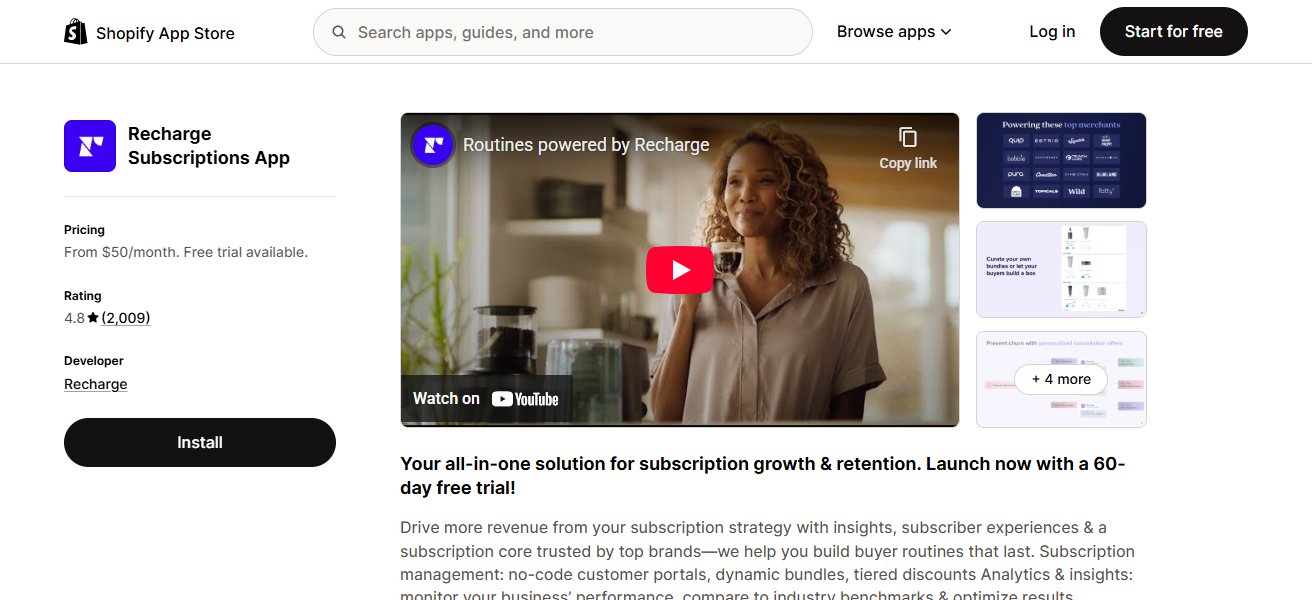
This is the perfect solution for DTC brands that sell consumable products and wellness products. For subscription businesses that are growing quickly, Shopify’s scalability, app ecosystem, and user experience make it the best option.
Shopify + Recharge – Key Features
- Shopify takes care of all aspects of the storefront creation and manages inventory and order fulfillment.
- Recharge offers sophisticated billing options and customers can choose when to receive their orders.
- Portals for customers to manage their subscriptions.
- Perfect for growing businesses for a dominant market position, as it offers endless easy integrations and scalable options.
| Pros | Cons |
|---|---|
| Combines Shopify’s robust eCommerce features with Recharge’s subscription tools. | Higher cost due to combined platform pricing. |
| Scalable and suitable for fast-growing DTC brands. | Requires managing two platforms for full functionality. |
| Flexible recurring billing and customer self-management portals. | Some advanced subscription customizations require coding or apps. |
| Extensive app ecosystem and integrations. | May be overkill for small or simple subscription businesses. |
3. Bold Subscriptions
Bold Subscriptions allows merchants to create flexible recurring payment models. In addition to basic subscriptions, Bold supports prepaid plans and subscription boxes, with lots of customization.
Deep integration with Shopify keeps brand consistency, while Bold’s recurring billing handles the tech.
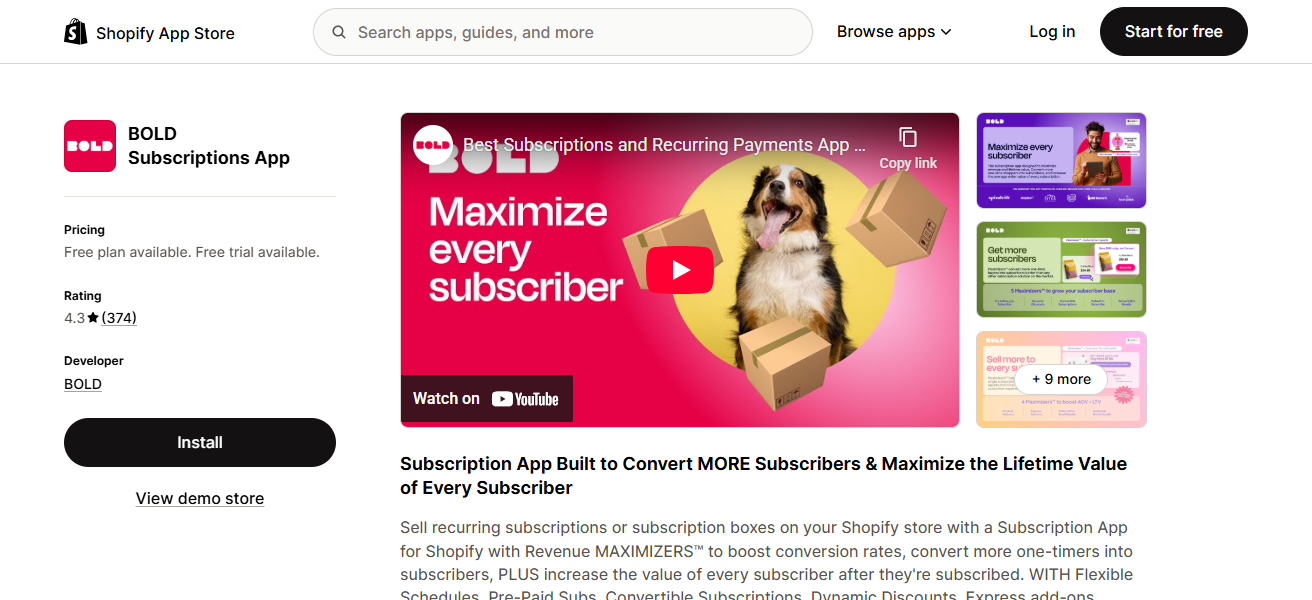
For businesses wanting to personalize customer journeys, AOV, and churn with tailored subscriptions, Bold’s automation and API make it a subscription experience.
Bold Subscriptions – Key Features
- Offers subscriptions, subscription boxes, and prepaid offerings.
- Brand consistency through seamless deep integration with Shopify.
- Tailored experiences using their automation tools and API for customers.
- Flexible billing options that reduce churn and help increasing average order value.
| Pros | Cons |
|---|---|
| Flexible recurring payment models and subscription types. | Limited to Shopify users. |
| Deep Shopify integration for brand consistency. | Pricing can increase with higher sales volume. |
| Robust API and automation for personalized customer experiences. | Learning curve for non-technical users. |
| Helps increase average order value and reduce churn. | Fewer analytics options than enterprise solutions like Zuora. |
4. Zuora
Zuora is a subscription management and billing platform built for enterprise-grade and complex business models.
Most users of the platform are large scale SaaS companies and global enterprises that have advanced business models that require revenue recognition, billing based on usages, and multi-currency processing.

Zuora is great for complex pricing models and compliance. Its learning curve and pricing models are on the steeper side for the processing done
but businesses that need to manage subscription based revenue high in volume see a lot of control and manageability from the processing.
Zuora – Key Features
- Subscription billing and management system of an enterprise grade.
- Outstanding billing with recognition of revenue and billing based on usage.
- Support for international business with multi-currency and global compliance.
- Tailored for growing big with complex and high volume subscription businesses.
| Pros | Cons |
|---|---|
| Enterprise-grade platform for complex subscription models. | Steep learning curve for new users. |
| Advanced revenue recognition and usage-based billing. | High cost, more suitable for large enterprises. |
| Multi-currency and global compliance support. | Overkill for small or mid-sized businesses. |
| Scalable for high-volume subscription revenue streams. | Implementation can be time-consuming. |
5. Chargebee
Chargebee is a billing platform for subscriptions, flexible and aimed at SaaS and digital businesses, supports recurring billing, invoicing, and billing based on metered usage, as well as invoices and compliances for global taxes.
Chargebee integrates with various accounting and payment gateway systems, making it suited for companies in various stages of growth.
Its automation in the management of trials, upgrades, downgrades, and churn is robust. Chargebee’s well-versed analytics and reporting assist companies in managing and optimizing customer revenue.
Chargebee – Key Features
- Support on invoicing, billing, and auditing with metrics on usage for billing.* Users can customize the platform to work with their favorite payment and accounting systems.
- Automate the entire lifecycle of a customer’s subscription with upgrades, downgrades, and churn features.
- Tools for optimizing revenue and the customer lifecycle with analytics and reporting.
| Pros | Cons |
|---|---|
| Supports recurring billing, metered usage, and global tax compliance. | Can be expensive for small startups. |
| Seamless integration with payment gateways and accounting tools. | Customization options may require technical knowledge. |
| Automation features for trials, upgrades, downgrades, and churn management. | Limited marketplace presence compared to Shopify. |
| Strong analytics and reporting for optimizing revenue operations. | Some advanced features may require higher-tier plans. |
6. WooCommerce Subscriptions
WooCommerce Subscriptions works for users already integrated with WooCommerce 2014 it is WordPress-based.
Users can sell any products and services that have recurring payments; these can be physical products, digital content, or even memberships.
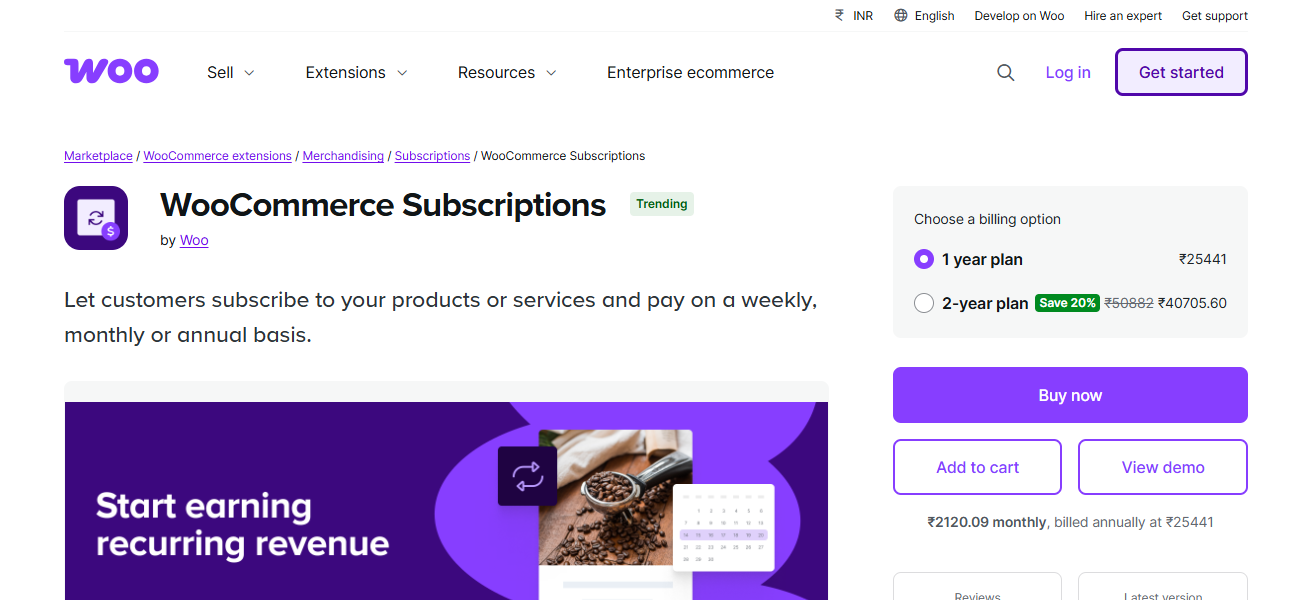
The platform has features like flexible billing cycles, free trials, and sign-up fees for recurring payments. The flexible features offered by WooCommerce Subscriptions make it a great option among competitors.
Its main drawback is that in order to use WooCommerce Subscriptions, users must have low-performance hosting with poorly optimized plugins, and this is a prevalent issue in the WordPress ecosystem.
WooCommerce Subscriptions – Key Features
- Recurring billing for physical products, digital content, and memberships.
- Free trials, and sign-up fee plus adjustable billing intervals.
- Full customization and ownership of the WooCommerce store.
- Performance is dependent on hosting, and plugin optimization.
| Pros | Cons |
|---|---|
| Recurring payments for physical, digital, and membership products. | Performance depends on hosting quality. |
| Flexible billing schedules, free trials, and sign-up fees. | Requires technical knowledge for customization. |
| Full ownership and customization of the store. | Can become resource-intensive with many subscriptions. |
| Ideal for businesses already using WordPress/WooCommerce. | Limited built-in analytics compared to enterprise platforms. |
7. Paddle
Paddle operates as a subscription commerce platform for SaaS and digital product firms. As a merchant of record
Paddle takes care of payments, tax, compliance, and invoicing, thus, operational burdens are alleviated, more so for international sales.
In addition, Paddle offers integrated subscription management, along with analytics and churn mitigation features.

For firms wanting to scale software products and barriers, tax and regulation complexity, Paddle is a viable option.
Paddle – Key Features
- Handles payment, tax, and compliance as a merchant of record.
- Subscription management for SaaS and digital products is built-in.
- Tools for analytics and churn management to optimize recurring revenue.
- Global sales are simplified and operational complexity for businesses is reduced.
| Pros | Cons |
|---|---|
| Acts as merchant of record handling payments, taxes, and compliance. | Limited control over certain payment operations. |
| Simplifies global sales for SaaS and digital products. | Less suitable for physical product subscriptions. |
| Built-in subscription management and analytics. | Some features may be less customizable than Chargebee or Zuora. |
| Reduces operational complexity for startups and software companies. | Higher fees for smaller businesses. |
8. PayWhirl
PayWhirl is an adaptable and easy billing system that is especially designed for small and medium-sized companies.
With the ability to handle billing for memberships, payment plans, and contributions, it is very popular with service providers and content creators.
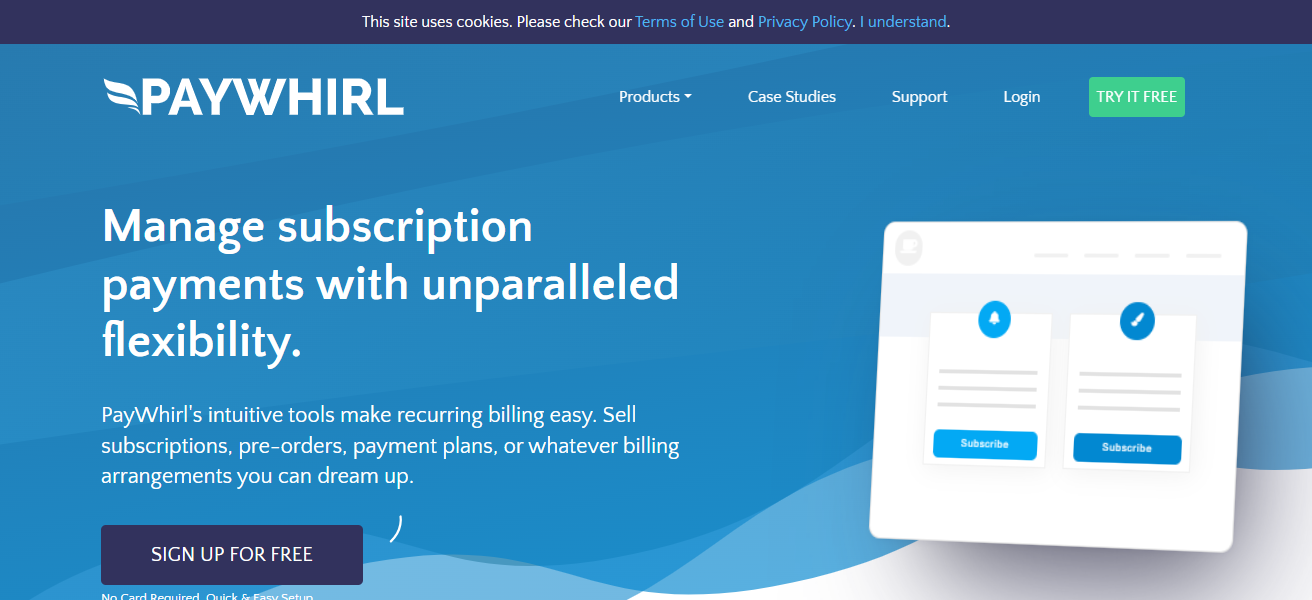
PayWhirl also easily integrates with websites, Shopify, and most payment gateways. As an added bonus, it is no code, and has customizable check out options.
From a business prespective, this means you can quickly launch billing for new subscriptions while controlling the customer experience to most billing aspects.
PayWhirl – Key Features
- Memberships, payment plans, and donations are supported.
- Seamless integration with websites, and payment gateways, and Shopify.
- Customizable checkout with no-code configurations.
- Quick billing control, subscription launch, and transparent pricing.
| Pros | Cons |
|---|---|
| Lightweight and easy-to-use subscription and billing platform. | Limited advanced automation for enterprise needs. |
| No-code setup and customizable checkout options. | Fewer integrations than larger platforms. |
| Supports memberships, payment plans, and donations. | May not scale well for very high-volume businesses. |
| Transparent pricing and quick subscription launch. | Some users may need more advanced analytics. |
9. Cratejoy
Cratejoy is a specialized subscription service that focuses on subscription box businesses. It offers box building tools, billing and billing cycle management, customer management, and marketplace functions.
For entrepreneurs starting out with curated tangible subscription boxes, Cratejoy is a one-stop shop. With regards to billing, logistics, and billing cycle mgmt.

Marketplace functions help enhance a brand’s visibility, although these fees may exceed those from other platforms.
Cratejoy works best for individuals focusing on ease of marketplace functions and quick time to market, sacrificing a more refined deep customization.
Cratejoy – Key Features
- Recurring billing and subscription box business creation tools.
- Built-in analytics and customer subscription management.
- Enhanced brand visibility through access to the Cratejoy marketplace.
- Subscription box business operations and logistics are streamlined.
| Pros | Cons |
|---|---|
| Designed specifically for subscription box businesses. | Higher fees compared to standalone platforms. |
| Tools for box creation, recurring billing, and customer management. | Limited flexibility for non-box businesses. |
| Access to Cratejoy marketplace for visibility. | Marketplace fees may cut into profits. |
| Simplifies logistics and billing for subscription boxes. | Less suitable for SaaS or digital product subscriptions. |
10. SaaSOptics
Maxio, previously SaaSOptics, is a financial operations platform tailored for SaaS subscription companies.
SaaSOptics specializes in subscription analytics, revenue recognition, and financial reporting, intentionally disassociating from storefront management.
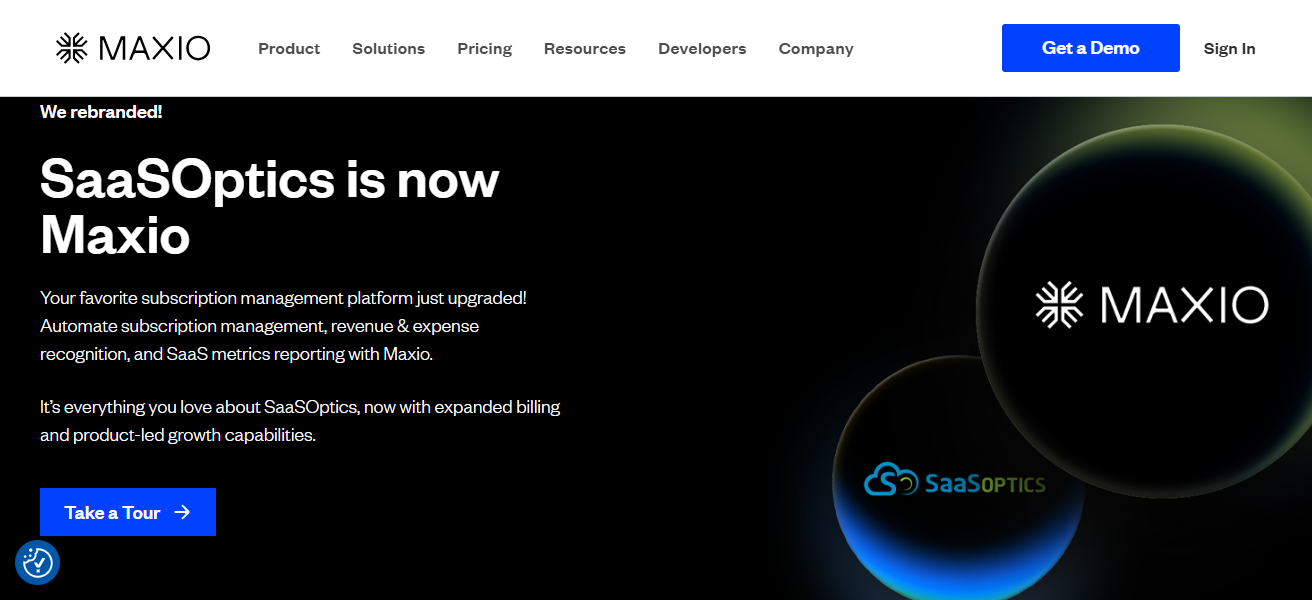
SaaSOptics partners with billing solution providers, Chargebee and Zuora, to track key SaaS metrics (MRR, ARR, and churn).
SaaSOptics is designed for finance teams requiring reports that are GAAP-compliant and providing detailed insights on performance and revenue related to subscriptions.
SaaSOptics – Key Features
- Specializes in subscription support financial analytics and reporting.
- Connects with billing systems such as Chargebee and Zuora.
- Monitors important SaaS indicators including churn, ARR, and MRR.
- Reports under US GAAP with greater detail on the subscription revenue.
| Pros | Cons |
|---|---|
| Focused on subscription analytics, revenue recognition, and reporting. | Not a storefront or billing platform by itself. |
| Integrates with platforms like Chargebee and Zuora. | Requires integration for full functionality. |
| Tracks key SaaS metrics like MRR, ARR, and churn. | More suitable for finance teams than marketing or sales. |
| GAAP-compliant reporting and deep revenue visibility. | May be too specialized for small startups. |
How To Choose Best Subscription Commerce Platforms
Business Size: Consider a subscription commerce platform that matches your company’s size and subscription volume.
Product Type: Evaluate your offerings, including physical products, digital services, and SaaS subscriptions.
Billing Flexibility: Consider if your subscription commerce business needs billing that supports recurring, trial, and usage billing.
Integration Needs: Evaluate if your subscription billing platform integrates with your site, payment processor, CRM, and accounting.
Scalability: Consider a subscription commerce platform that accommodates your growing customer and revenue potential.
Automation Tools: Evaluate automated invoicing, notifications, churn reduction, and other subscription management features.
Analytics & Reporting: Do your subscription commerce business needs detailed revenue reports, churn analytics, MRR, and customer insights?
Ease of Use: Consider a subscription commerce platform with easy setup, management, and customer dashboards.
Cost & Pricing: Evaluate the subscription commerce platform’s fees, transaction charges, and overall cost to your company.
Support & Community: Consider a subscription commerce platform with active community support and documentation.
Cocnlsuion
In cocnlsuion The right subscription commerce platform is critical to business expansion, smooth billing, and retention of customers.
Subbly, Shopify + Recharge, Chargebee, and Cratejoy serve varied needs from small business to enterprise SaaS.
Assess functionality, growth potential, integrations and cost to identify the option that optimizes subscription management and sustains enduring success.
FAQ
A platform that helps businesses manage recurring payments and subscriptions.
SaaS companies, subscription boxes, membership sites, and service-based businesses.
Subbly, PayWhirl, and WooCommerce Subscriptions are ideal for small-scale setups.
Yes, platforms like Paddle, Chargebee, and Zuora support international payments and taxes.