In this article I will go over some of the top Vendor Due Diligence Software on the market today. Finding the right tool to aid in the assessment of vendors, compliance, and management of third party risk is important.
- Key Points & Best Software For Vendor Due Diligence Management
- 10 Best Software For Vendor Due Diligence Management
- 1. Sprinto
- 2. NAVEX RiskRate
- 3. ProcessUnity
- 4. LogicManager
- 5. Resolver
- 6. ComplySci
- 7. Aravo
- 8. Prevalent
- 9. Inventive AI DDQ
- 10. Diligent Compliance
- How To Choose Best Software For Vendor Due Diligence Management
- Cocnlsuion
- FAQ
I will highlight some of the best software solutions and explain how they help automate due diligence, keep track of vendors, and stay in compliance.
Key Points & Best Software For Vendor Due Diligence Management
| Software | Key Point |
|---|---|
| Sprinto | Automates compliance workflows for vendor risk management |
| NAVEX RiskRate | Third-party risk monitoring with continuous updates |
| ProcessUnity | Centralized vendor risk assessments and reporting |
| LogicManager | Integrated governance, risk, and compliance platform |
| Resolver | AI-driven due diligence insights for faster decision-making |
| ComplySci | Regulatory compliance tracking for financial institutions |
| Aravo | Scalable vendor risk management with workflow automation |
| Prevalent | End-to-end third-party risk lifecycle management |
| Inventive AI DDQ | Automated due diligence questionnaires with AI precision |
| Diligent Compliance | Comprehensive audit and compliance oversight |
10 Best Software For Vendor Due Diligence Management
1. Sprinto
Sprinto is a compliance automation platform designed to simplify vendor due diligence and risk management. It streamlines the process of assessing third-party vendors by automating questionnaires, document collection, and compliance tracking.
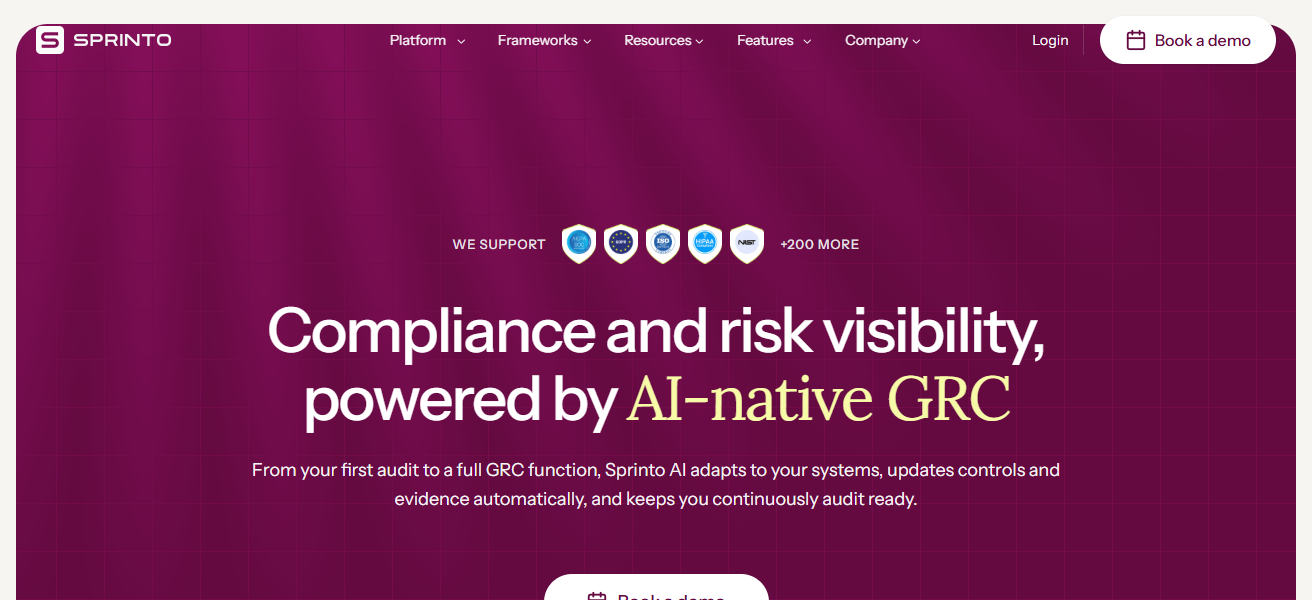
Its intuitive dashboards allow organizations to monitor vendor risk in real time, ensuring that regulatory standards are met efficiently. Sprinto also integrates with existing systems to reduce manual data entry, accelerating audits and risk reporting.
Its AI-driven insights help identify potential vendor risks early, making it suitable for companies seeking proactive compliance management without overloading their teams.
Sprinto Features
- Automated Due Diligence Workflows: Automation reduces the need for manual work in the vendor onboarding process and risk assessments.
- Compliance Tracking & Reporting: Effortless audit reporting and compliance tracking.
- System Integrations: Vendor data is consolidated with other systems and tools to avoid redundancy.
- Real‑Time Risk Dashboards: Vendor compliance and risk levels are displayed in real-time.
| Pros | Cons |
|---|---|
| Automates vendor due diligence workflows and compliance tracking, saving time. | May require onboarding support to leverage advanced automation features. |
| Real‑time dashboards provide visibility into third‑party risk across vendors. | Customization options could be limited for very complex enterprise environments. |
| Integrates well with existing systems, reducing manual data entry. | Reporting features may not be as detailed as other mature GRC platforms. |
| Helps organizations maintain regulatory compliance proactively. | Smaller user community compared to established competitors. |
2. NAVEX RiskRate
NAVEX RiskRate provides complete vendor risk and due diligence management solutions. It helps firms assess and analyze their third-party vendors by using risk assessment, monitoring, and reporting.
RiskRate provides a platform that workflow automates vendor onboarding, surveillance, and review. This reduces manual effort and improves accuracy and efficiency.
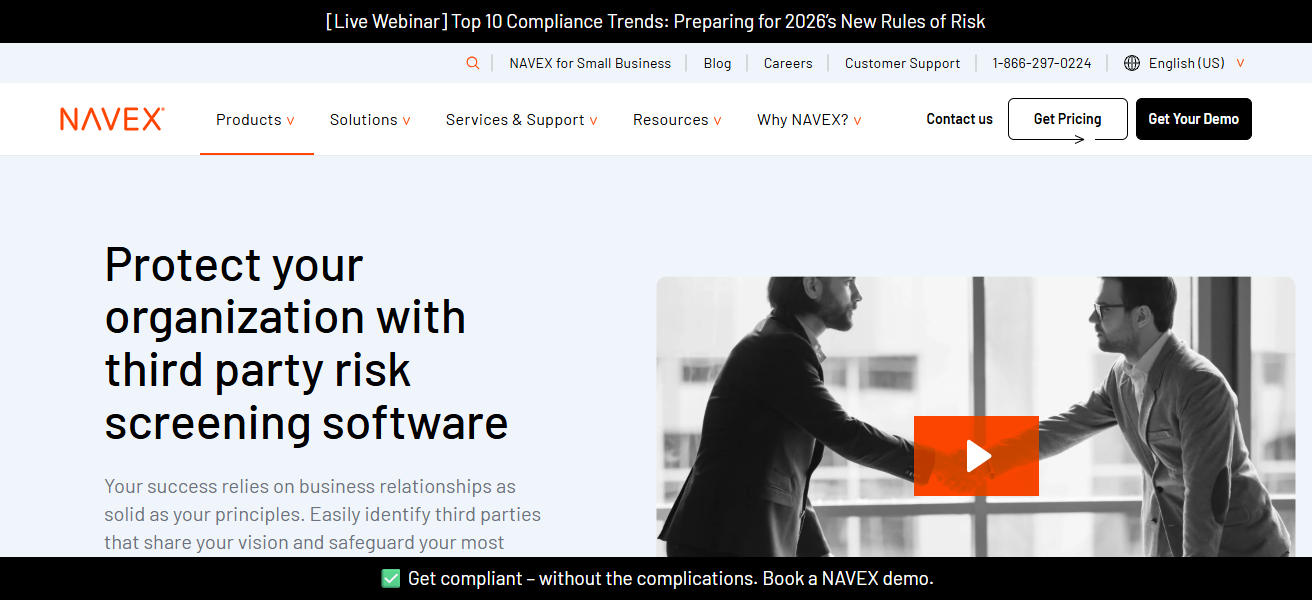
Furthermore, RiskRate monitors financial, compliance, and reputation risks of vendors. NAVEX RiskRate is scalable and suited for big corporations with numerous vendors.
NAVEX RiskRate’s reporting and analytics tools aid organizations in effective risk management decision-making by providing actionable insights.
NAVEX RiskRate Features
- Standardized Risk Assessments: Vendor assessments are done uniformly with standard questionnaires.
- Automated Workflows: Tasks are automatically routed for onboarding, review, and renewal.
- Continuous Monitoring: Vendor risk assessments are updated with issues relating to finances and compliance.
- Analytics & Reporting: Decision-related reports and analyses with risk ratings.
| Pros | Cons |
|---|---|
| Comprehensive risk assessments and continuous monitoring of vendor risk. | Can be expensive for smaller businesses. |
| Automated vendor onboarding and tracking workflows save operational effort. | Setup and configuration can be complex for first‑time users. |
| Scalable for organizations with large vendor portfolios. | Some advanced features may require additional modules. |
| Strong reporting and analytics for decision‑making. | Learning curve for non‑technical users. |
3. ProcessUnity
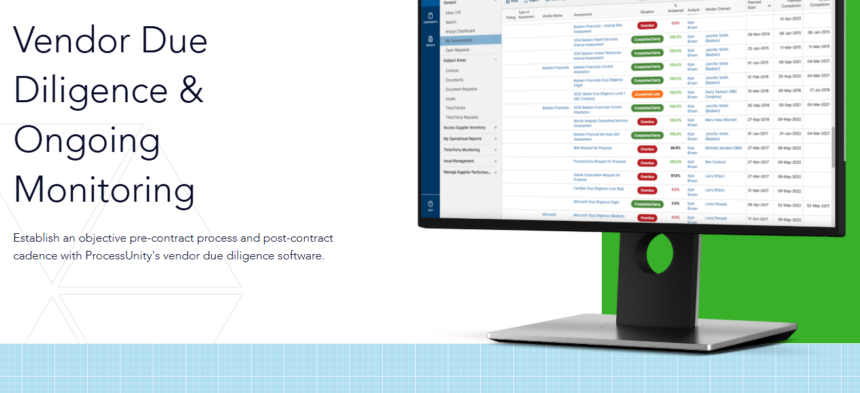
Based in the cloud, ProcessUnity focuses on compliance and automation for vendor risk management. It allows companies to consolidate vendor info, automate risk assessments, and streamline workflows for managing due diligence.
Users can configure questionnaires, scoring systems, and risk frameworks to evaluate and classify vendors as per their organizational standards.
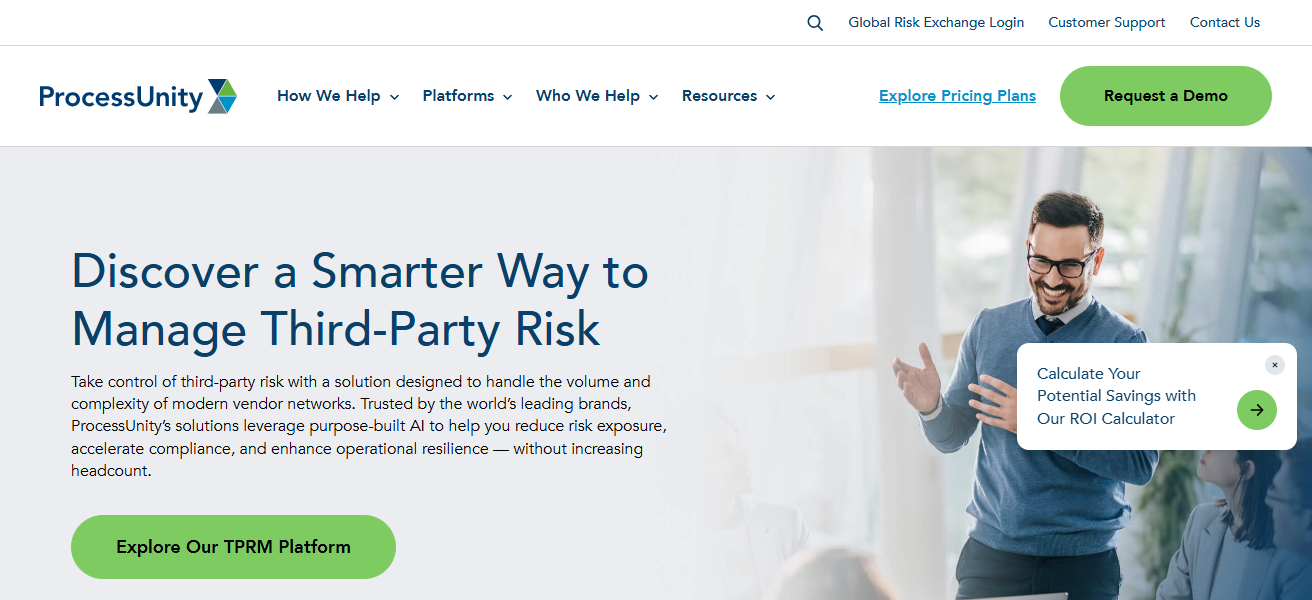
The system’s adaptive monitoring features help users maintain and keep track of vendor risk profile changes while notifying users of potential vendor risk.
ProcessUnity helps streamline enterprise operations with its enhanced integrations. Users can customize and configure dashboards and reports to track and visualize their levels of risk and compliance. Overall, it provides companies with peace of mind vendor management.
ProcessUnity Features
- Automated Alerts & Notifications: Notifications for updates or potential risk from third parties
- Custom Risk Scoring Models: Organizations can design risk scoring systems to their levels of risk tolerance.
- Centralized Vendor Database: Due diligence information and vendor records are kept in a single secure location. Munmiş* Configurable Questionnaires: Enables the issuance of questionnaires tailored to specific industries or internal criteria.
| Pros | Cons |
|---|---|
| Centralizes vendor data and automates risk assessments. | Initial implementation may require dedicated resources. |
| Customizable questionnaires and risk scoring models. | Some users may find UI less intuitive initially. |
| Continuous monitoring alerts on changes in risk profiles. | Integration with niche systems may require custom work. |
| Good scalability for medium to large enterprises. | Pricing may be high for smaller teams. |
4. LogicManager
LogicManager is a GRC (governance, risk, and compliance) platform with fully supported vendor due diligence.
The platform helps organizations with third-party risk cultivation through automated risk assessments and structured workflows.
With adjustable dashboards, organizations can get up-to-date assessments regarding a vendor’s operational risk, compliance with regulations, and performance.
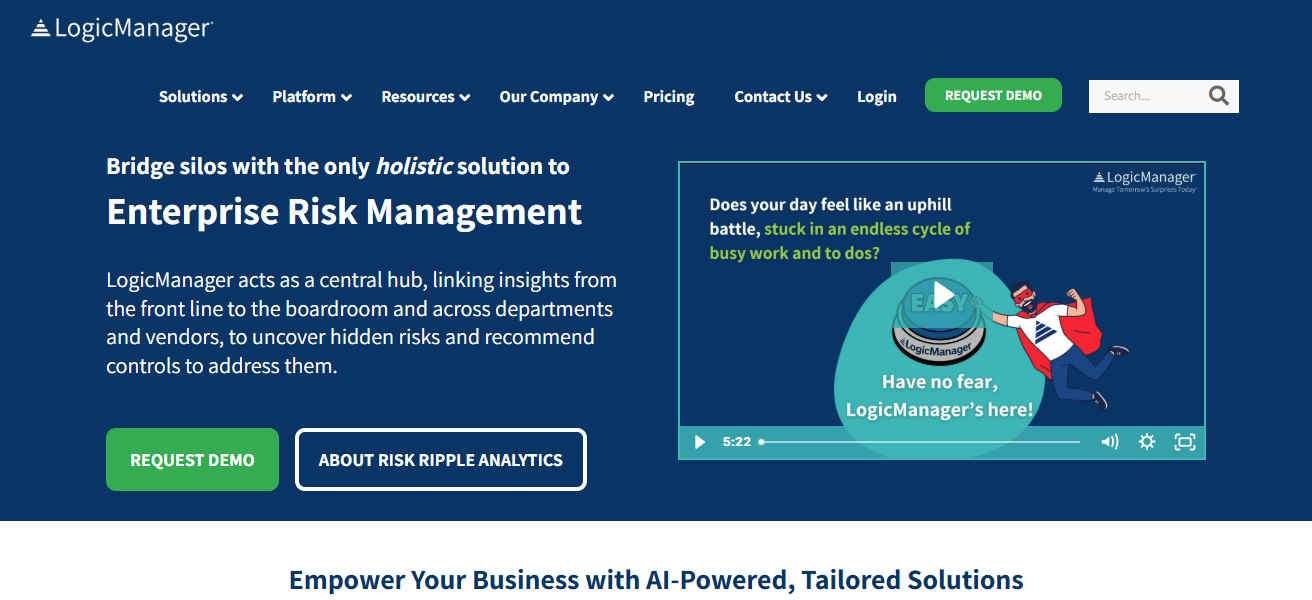
The software includes document management, reporting, and audit-tracking transparency and accountability features. The risk templates and libraries assist organizations in standardizing due diligence across different vendors.
Organizations looking for an integrated GRC solution vendor risk management framework will find LogicManager helpful.
LogicManager Features
- GRC Integration: Merges vendor risk with enterprise governance, risk, and compliance.
- Risk & Performance Dashboards: Tracks and visualizes trends in vendor risk and performance.
- Document Management: Contract, assessment, audit, and compliance document storage.
- Regulatory Mapping: Vendor requirements to internal policies and external regulations mapping.
| Pros | Cons |
|---|---|
| Comprehensive GRC platform with strong vendor oversight. | Some users may find setup and customization time‑intensive. |
| Intuitive dashboards for risk, compliance, and performance. | Advanced features may require training to use fully. |
| Robust audit, reporting, and documentation tools. | Vendor risk features may be too broad for simple needs. |
| Aligns vendor risk management with enterprise risk strategy. | Might be over‑featured for small businesses. |
5. Resolver
Resolver allows companies to manage vendor due diligence and third-party risk more effectively. It helps companies consolidate vendor data, manage due diligence automation, and track compliance.
With Resolver, organizations get access to risk-scoring, issue-tracking, and reporting features to streamline high-risk vendor identification. Monitoring helps to track and immediately report any changes to a vendor’s compliance or financial status.
The platform is built to integrate with other enterprise systems, simplifying the consolidation of risk data. For organizations that want to minimize manual processes and stay active in managing vendor risk, Resolver is a perfect fit.
Resolver Features
- Centralized Risk Repository: Vendor records, risk assessments, and audit notes are consolidated.
- Issue & Incident Tracking: Recording of vendor-specific issues or compliance-related concerns.
- Automated Risk Scoring: Scoring based on preset criteria to facilitate ranking.
- Integration Capabilities: Enhances existing systems for enriched risk data and notifications.
| Pros | Cons |
|---|---|
| Centralizes vendor risk information and compliance status. | Interface complexity may confuse new users. |
| Strong issue tracking, risk scoring, and alerts. | Reporting depth may require configuration for specific use cases. |
| Integrates with external systems for unified risk insights. | Some users report steep learning curve. |
| Proactive risk identification with monitoring tools. | Customization options can be limited for unique workflows. |
6. ComplySci
ComplySci specializes in understanding regulations and managing risks, including due diligence on vendors. With their software, companies can streamline the automation of onboarding vendors, tracking compliance, and assessing risks.
ComplySci assists organizations in evaluating potential third-party vendors concerning regulations, business ethics, and the company’s internal policies.
Their software includes analytics and reporting features that help prevent companies from exposure to vendor risks and identify areas that may be noncompliant.
The software is most beneficial to the financial service industry or any company that needs to keep close tabs on their vendors.
By combining automation of compliance tasks with centralized vendor compliance information, ComplySci minimizes operational risks, improves transparency, and helps organizations easily satisfy rigorous regulations.
ComplySci Features
- Compliance Monitoring Tools: Vendor compliance with internal policies and regulations is monitored.
- Risk Assessment Automation: Automated determination of non-compliance, including review cycles and oversight provisions.
- Analytics & Dashboards: Vendor compliance trend data and dashboards.
- Audit Trail Logging: A complete, time-stamped history of assessments and updates is retained.
| Pros | Cons |
|---|---|
| Automates vendor onboarding and compliance tracking. | Primarily designed for highly regulated industries. |
| Helps enforce regulatory and internal policy adherence. | Smaller focus on broader risk domains beyond compliance. |
| Advanced analytics for compliance gaps. | Pricing may be high for non‑financial sectors. |
| Reduces manual tasks in due diligence assessments. | May require training for complex regulatory frameworks. |
7. Aravo
Aravo has developed a pioneering vendor risk management solution that functions on a cloud platform. It allows companies to optimize their processes involving due diligence and compliance.
Their service has configurable risk assessments and centers automated processes for third-party vendor data. In addition to this, Aravo helps in monitoring and managing the operational and regulatory risks associated with vendor compliance and performance.
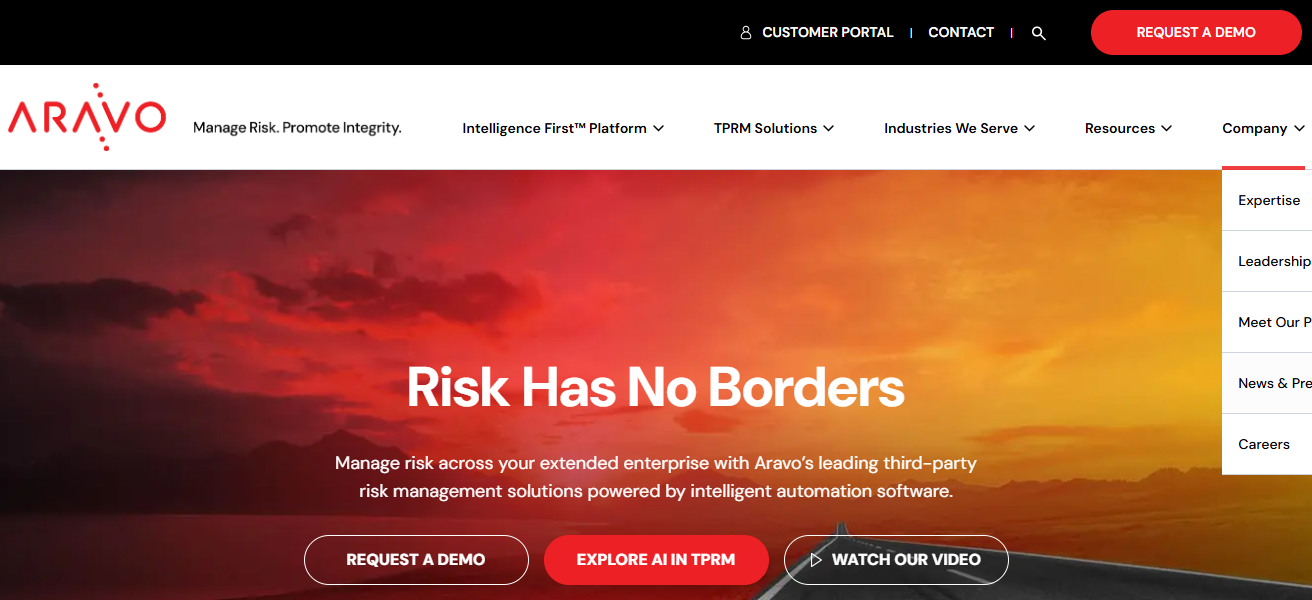
Their platform has the ability to support supplier segmentation, which helps companies in deep diving their assessment to high risk vendors.
Reporting and analytics functions to assess the vendor risk exposure over a period of time, are also features that Aravo possesses.
Their software is the best fit for large companies that need a complete solution to manage their third-party relationships.
Aravo Features
- Configurable Risk Frameworks: Customizes risk thresholds and assessment frameworks by vendor category.
- Risk Categorization: Segments vendors into different risk tiers for targeted due diligence.
- Automated Remediation Workflows: Assigns tasks and monitors progress on corrective actions for high-risk vendors.
- Performance Tracking and Reporting: Displays vendor compliance status and performance metrics.
| Pros | Cons |
|---|---|
| Strong configurable risk assessments and workflows. | Can be costly for smaller organizations. |
| Centralized vendor data with performance tracking. | Complexity in setup for non‑technical teams. |
| Supports segmentation to focus on high‑risk vendors. | Requires training to leverage full capabilities. |
| Good reporting and risk exposure insights. | Some advanced modules may need extra licensing. |
8. Prevalent
Prevalent is a vendor risk management platform that helps automate third-party due diligence. It automates vendor assessments, the completion of vendor questionnaires, and risk scoring, so organizations can manage operational and compliance risk efficiently.
Prevalent also aids in the ongoing, active supervision of vendors to monitor shifting risk profiles. Internal collaboration features help due diligence teams manage vendor communication.
Advanced analytics and reporting features drive actionable insight to the organizations to help manage risk. For organizations that need scalable and automated vendor risk controls without operational or compliance trade-offs, Prevalent is a great fit.
Prevalent Features
- Questionnaire Automation: Automates the creation and distribution of risk questionnaires to vendors.
- Continuous Risk Monitoring: Tracks changes in vendor risk variables and updates accordingly.
- Collaborative Features: Internal teams and vendors can communicate within the application.
- Risk Analytics Dashboard: Provides a high-level summary of risk scores and risk trends for the leadership team.
| Pros | Cons |
|---|---|
| Automates assessments and vendor risk scoring. | Setup may take time for first use. |
| Continuous monitoring alerts to risk changes. | Advanced integration options may be limited. |
| Collaborative tools help team and vendor communication. | UI could be more user‑friendly for beginners. |
| Analytics dashboards provide actionable insights. | Smaller community vs larger GRC brands. |
9. Inventive AI DDQ
Inventive AI DDQ uses cutting-edge technology to aid in the automation of the vendor due diligence process by answering questionnaires and risk assessment automation.
It lessens the manual workload by rapidly assessing and analyzing vendor information to identify possible operational or compliance risks.
This platform uses the most innovative technology to maintain accurate and prompt evaluations of the vendors while preserving all assessor records.
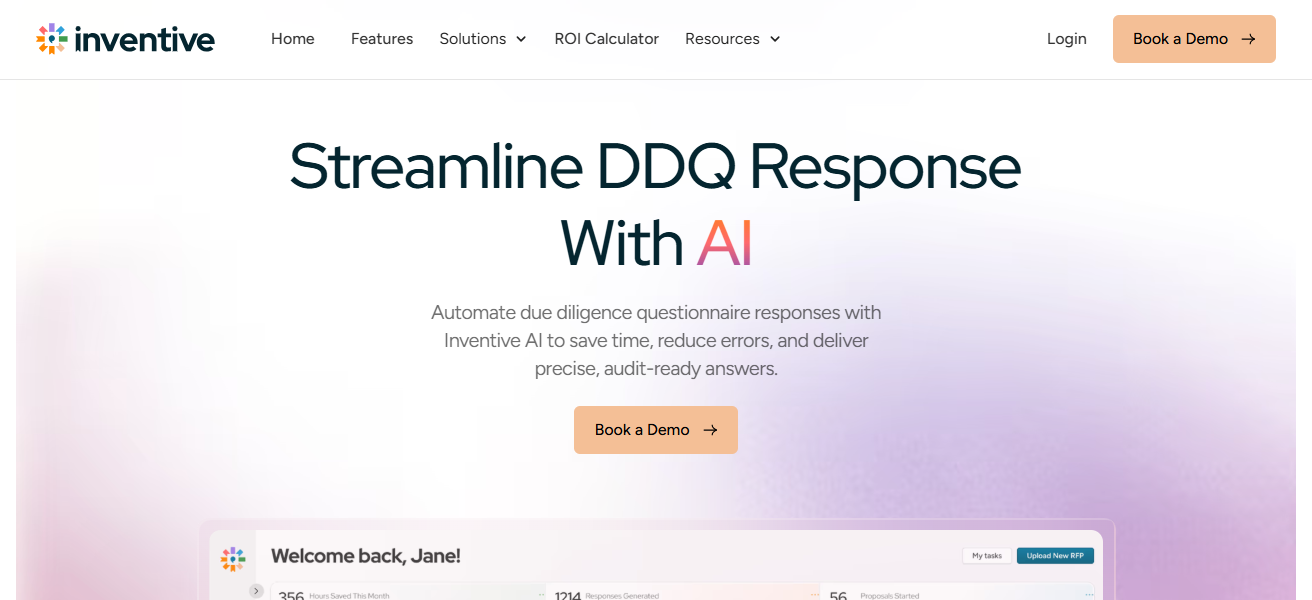
In addition to providing records and analytical dashboards, Inventive AI DDQ helps organizations analyze and track risks and evaluate vendors over time.
This intelligent automation is of the utmost importance for companies with numerous vendors in order to make a quick, accurate, and compliant risk assessment.
Inventive AI DDQ Features
- AI-Driven Questionnaire Processing: Analyzes vendor responses using an artificial intelligence.
- Smart Risk Detection: Identifies possible risk areas using pattern recognition within the data.
- Rapid Response Generation: Assists in the fast drafting and completion of due diligence questionnaires.
- Automated Reporting Insights: Summarizes and highlights key takeaways for less complicated oversight.
| Pros | Cons |
|---|---|
| AI‑powered automation speeds up due diligence workflows. | AI accuracy depends on data quality and training. |
| Reduces manual effort in questionnaire analysis. | May not support deep custom risk frameworks. |
| Intelligent insights highlight potential compliance issues. | Newer platform with evolving features. |
| Great for organizations with large vendor volumes. | Less mature reporting compared to legacy systems. |
10. Diligent Compliance
Diligent Compliance is a vendor management and Governance, Risk, and Compliance (GRC) solution that consolidates corporate due diligence and third-party risk management activities.
It allows businesses to evaluate vendor risk, track compliance, and manage regulatory reporting. The solution streamlines processes and generates risk scores and documents so that businesses can review and evaluate vendors uniformly and accurately.
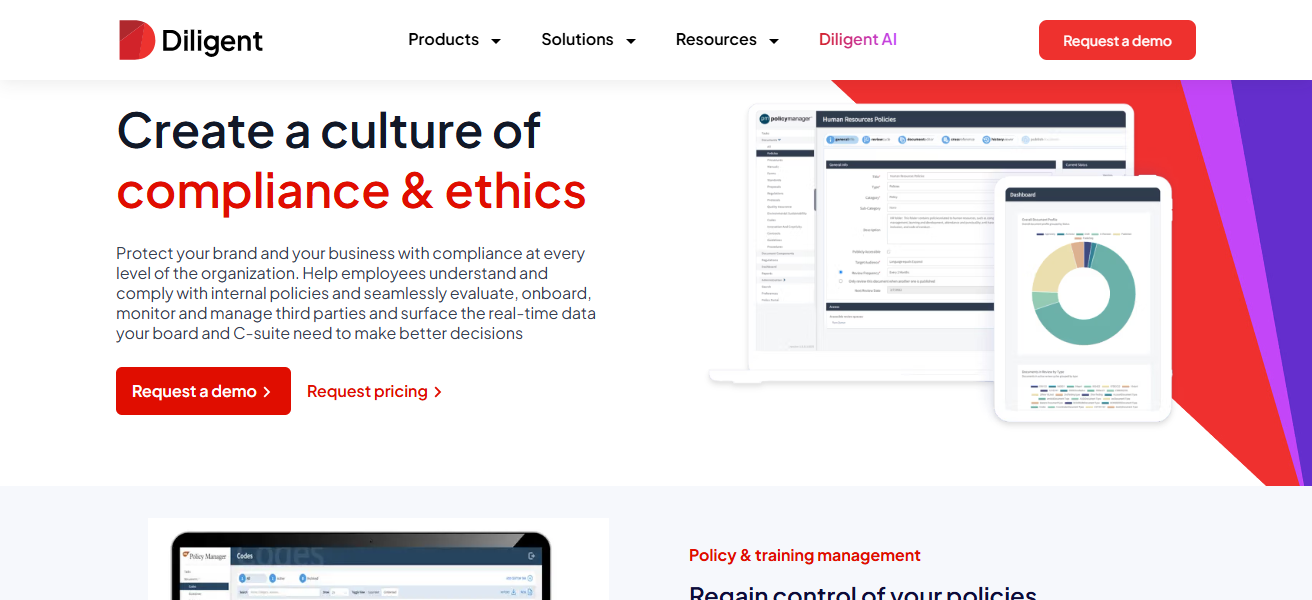
Diligent Compliance also supports proactive risk management with its monitoring and reporting capabilities.
The seamless alignment of vendor management with corporate governance and compliance frameworks is supported by the solution’s user-friendly design and integration features.
Vendor risk management with transparency and accountability is provided by the platform’s comprehensive end-to-end capabilities, making it suitable for large enterprises.
Diligent Compliance Features
- Unified Compliance Platform: Integrates vendor due diligence & other elements of corporate compliance.
- Automated Risk Scoring: Assigns risk scores based on compliance and performance metrics.
- Real-Time Monitoring & Alerts: Alerts teams of vendor status changes and within compliance risks.
- Detailed Reporting Features: Tailored reports assist with audits and updates for executives.
| Pros | Cons |
|---|---|
| Centralizes compliance and vendor risk management. | Can be expensive for teams with limited budgets. |
| Automated workflows and risk scoring. | Configuration required for tailored compliance needs. |
| Real‑time monitoring and reporting tools. | Not as specialized for vendor risk alone; broader GRC focus. |
| Aligns with enterprise compliance goals. | Requires training for full GRC utilization. |
How To Choose Best Software For Vendor Due Diligence Management
Identifying Risk Needs Consider risk factors that are most important to you: compliance, financial, data security, etc. Then choose software that encompasses these specifics.
Automation Software that manages vendor questionnaires, workflows, alerts, and monitoring is ideal to help limit manual tasks.
Vendor Volume If you have a lot of vendors, you will need a scalable system that is able to manage aggregate data and adapt to changing risk profiles.
Systems Integration Check that it integrates smoothly with other tools like Microsoft your ERP, CRM, and compliance systems.
Ease of Use Systems with a simpler layout are preferable as they reduce training and help with software adoption.
Dashboards Look for reporting that is customizable with a real-time dashboard that allows for quick data insights.
Regulatory Guidance The software should allow you to maintain compliance and provide documentation to support an audit.
Cocnlsuion
In cocnlsuion Selecting the appropriate software for managing vendor due diligence is critical to risk mitigation, compliance, and the efficiency of third-party assessments.
The best software streamlines vendor assessments and automates workflows, tracks vendor activities, and offers high-quality insights.
By feature evaluation, scalability, and integration analysis, companies can identify a software solution that streamlines due diligence, improves decision-making, and safeguards the business.
FAQ
It’s a tool that helps businesses assess, monitor, and manage the risks of third-party vendors.
It ensures compliance, reduces operational and financial risks, and protects organizational reputation.
Companies managing multiple vendors, especially in regulated industries, benefit most.
Yes, most top tools automate questionnaires, risk scoring, and monitoring workflows.
Many platforms provide dashboards and alerts to track vendor risk continuously.