In this article, I will review the most effective white-label lending platforms that assist fintech startups, banks, and NBFCs in efficiently deploying fully branded digital lending solutions.
White-label lending platforms help businesses with fully automated loan management, compliance support, and ready infrastructure
Allowing them to accelerate business growth and optimize development expenses while providing integrated lending and borrowing solutions in the competitive ecosystem.
Key Points & Best White-Label Lending Platforms
Antier Solutions: Provides blockchain-powered lending solutions enabling institutions to launch secure, customizable financial platforms.
LenDenClub: India’s leading peer-to-peer lending marketplace offering scalable white-label solutions for digital lenders.
HES FinTech: Offers advanced loan management software with customizable modules for banks, credit unions, and fintechs.
Peerform: Peer-to-peer lending platform enabling institutions to provide personal loans with transparent, investor-driven processes.
Funding Circle: Specializes in SME lending, offering white-label solutions for banks to expand business financing services.
Mintos: Global marketplace for loans, providing institutions with scalable investment and lending infrastructure solutions.
Faircent: India’s largest P2P lending network offering white-label technology for digital lending businesses.
LoanCircle: Provides customizable lending software enabling institutions to manage loan origination, servicing, and compliance efficiently.
Kiva Protocol: Blockchain-based lending infrastructure empowering financial institutions to extend credit access globally.
RupeeCircle: Peer-to-peer lending platform offering white-label solutions for inclusive, affordable credit distribution in India.
10 Best White-Label Lending Platforms
1. Antier Solutions
Antier Solutions provides lend-tech white-label software solutions for a branded end-to-end digital lending platforms.
Their clients can use Antier software for P2P lending, and digital lending marketplace integration, and include automation
features for loan origination, risk scoring, and KYC/AML, smart escrow, customizable repayment and interest plans, and all systems can be tailored.

Antier’s architecture is combined with Artificial Intelligence to optimize and minimize manual interventions and enhance lender/broker interactions, making it easier for institutions to improve their systems.
This is most beneficial for banks, NBFCs, and other lenders who want to construct online lending platforms to better their marketplaces.
Antier Solutions Features
- Automation of Lending Processes: Includes all aspects of the loan life cycle: onboarding of borrowers, KYC, credit evaluation, loan disbursement, servicing, and collections.
- Customizable White-Labeling: Complete brandable solutions enabling lenders to create and market tailored lending products with respect to business objectives, and specific regional compliance.
- Predictive Risk and Fraud Analytics: Tailored AI and data-driven credit analytics and fraud and performance monitoring.
- Flexible and Compliant Architecture: Designed to support growth for banks, NBFCs, and fintechs while ensuring that all security and compliance standards are met.
| Pros | Cons |
|---|---|
| Robust white-label platform with full lending lifecycle support, including origination, scoring, servicing, and compliance automation. | Implementation and customization may require substantial initial setup time and technical collaboration. |
| Highly customizable for banks, NBFCs, and fintechs with scalable architecture that supports global compliance. | Advanced features may lead to higher cost for smaller startups with limited budgets. |
| Integrates risk management, analytics, and AI-driven scoring to improve decision accuracy. | Users may need internal technical expertise to fully utilize advanced modules. |
2. LenDenClub
LenDenClub is one of the largest peer-to-peer (P2P) lending platforms in India, and is regulated by the Reserve Bank of India as an NBFC-P2P.
Unlike traditional banks, LenDenClub facilitates lending by individuals to other individuals looking for unsecured personal or micro-enterprise loans.
Using automated risk assessment, digital onboarding, credit checks, and data analytics, LenDenClub creates borrower-lender matches.
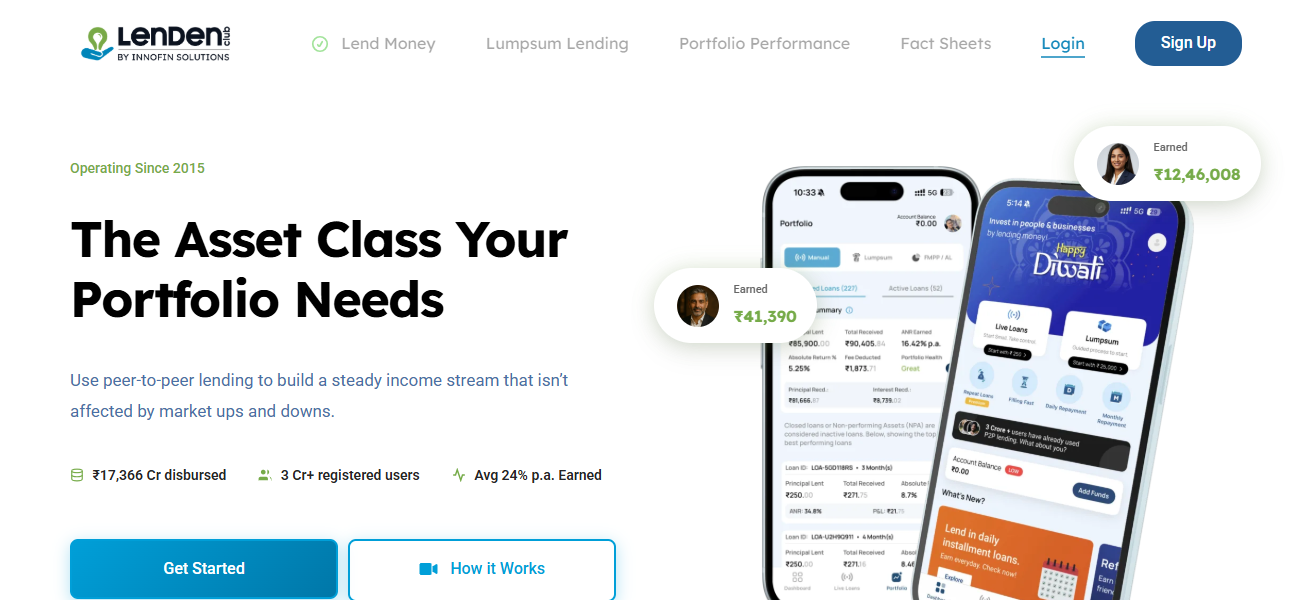
As for the investors, they get to diversify their investments across multiple small loans and receive good returns at potentially high interest.
On the other hand, borrowers get quick financing at reasonable prices. The platform also operates with transparency, compliance, and recovery support, improving trust in one of India’s emerging P2P lending platforms.
LenDenClub Features
- P2P Lending Marketplace: Provides a platform for individual lenders to directly lend money to individual borrowers through a digital lending platform.
- Complete Digital Lending: Fully-virtual processes for registration and loan application which improves turnaround times for loan disbursement.
- Credit Risk Segmentation: Potential borrowers are scored on credit risk so that lending investors can make higher quality investment decisions.
- Loan-by-Loan Investment: Investors have the ability to spread their investment across smaller portions on multiple loans to reduce risk.
| Pros | Cons |
|---|---|
| Regulated P2P lending marketplace connecting lenders and borrowers with transparent matching. | Focused mainly on consumer and small loans, which may limit investor diversification. |
| Quick digital onboarding and automated credit checks improve user experience. | Investors face risk of defaults and liquidity constraints in a secondary market. |
| Enables individual investors to earn returns higher than traditional savings. | As with P2P, returns are not guaranteed and depend on borrower performance. |
3. HES FinTech
HES FinTech has built white-label lending software (LoanBox) that is enterprise-grade and tailored for banks, fintechs, and alternative lenders globally.
Its fully automated platform addresses the entire loan lifecycle, incorporating digital customer onboarding, credit scoring, origination, servicing, and collections.
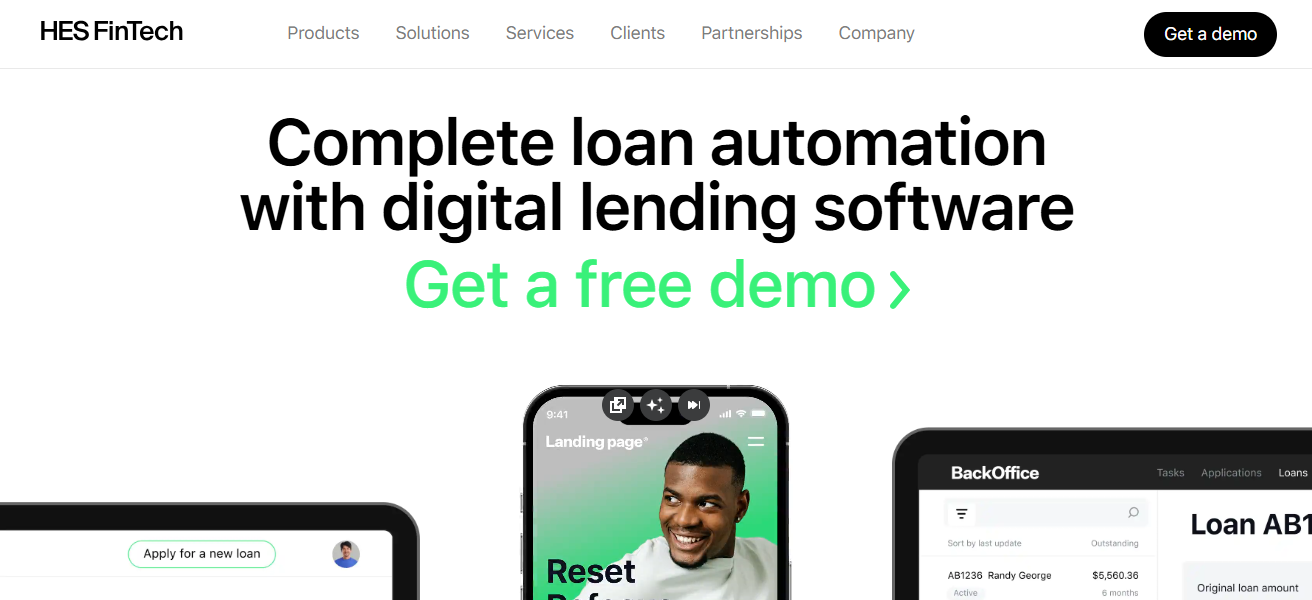
Using AI and machine learning, the platform enhances decision-making and default predictions. HES enables institutions to quickly roll out branded lending products, complete with customizable workflows, compliance, and analytics dashboards.
Its modular architecture is versatile, supporting consumer, SME, POS, and peer-to-peer lending. HES’s solutions improve operational efficiency, accelerate approval processes, and help businesses grow their lending capabilities, all managed within sophisticated automation and risk management.
HES FinTech Features
- Flexible Lending Solutions: Offers multiple lending solutions for consumers, SMEs, and all types of P2P lending.
- Machine Learning Based Credit Scoring: Improves the accuracy of underwriting and the prediction of defaults.
- Regulatory & Compliance Tools: Automated compliance preservation for trouble free functioning in regulated marketplaces.
- Workflow Customization: Offers lenders the ability to arrange loan parameters, approval processes, and repayment options.
| Pros | Cons |
|---|---|
| Modular white-label solution with AI/ML capabilities and end-to-end automation. | Customization depth may require longer deployment cycles. |
| Supports diverse lending models: consumer, SME, POS, and P2P use cases. | Smaller lenders may find it complex relative to simpler tools. |
| Built-in compliance, analytics, and reporting simplify operations. | Premium features can increase overall platform cost. |
4. Peerform
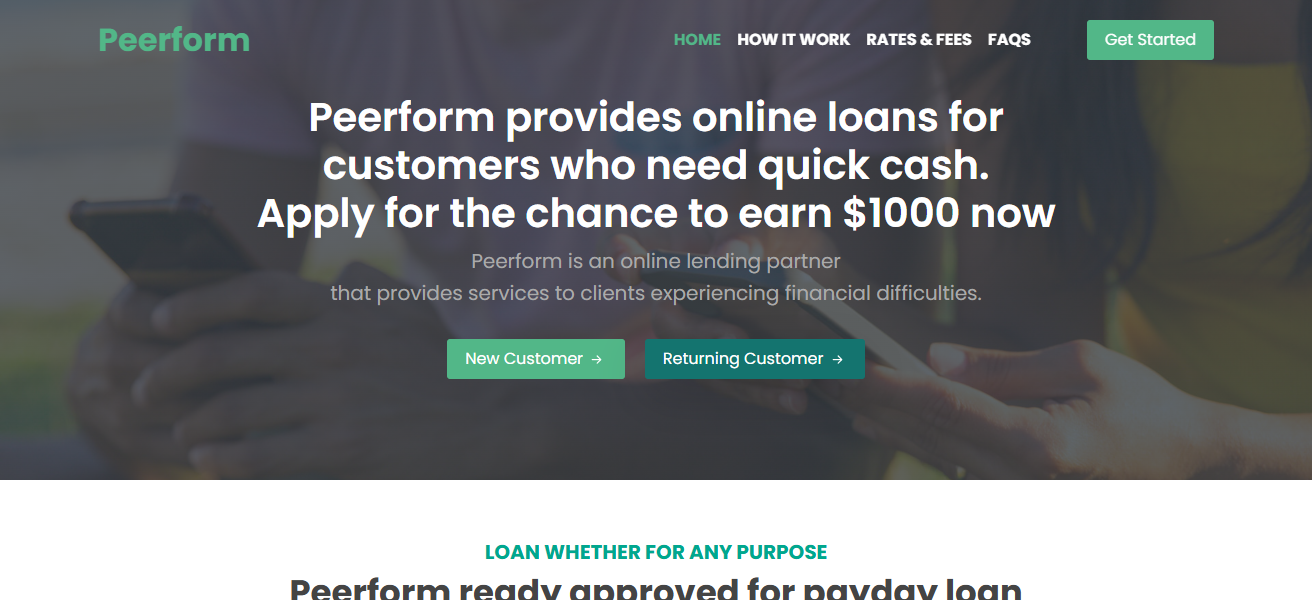
Peerform is a American based company operating in the peer to peer lending marketplace that connects accredited investors (or instituitonal investors) with borrowers.
Peerform specializes in unsecured personal loans. Peerform uses a combination of credit and financial criteria to determine eligible borrowers and assign them a fixed interest rate.
Investors on the platform have the option to fund complete loans or partake in numerous fractional loan investments which provides diversification and a customized investment strategy.
By eliminating the need for traditional banking intermedieries, investors obtain the possibility to earn a return from consumer loans and borrowers get the fasted access to credit.
The marketplace gives investors a choice to consumer loans with transparent terms and a built repayment schedule.
Peerform Features
- Personal Loan Focus: Focuses on unsecured personal loans and offers repayment plans.
- Transparent Risk Assessment: An evaluation system that classifies borrowers on the basis of their credit reports and other economic indicators.
- Fractional Investing: Investors can purchase less than the full amount of a loan.
- Automated Loan Management: Handles repayment, servicing, and investor reporting automatically.
| Pros | Cons |
|---|---|
| Transparent marketplace for unsecured personal loans with clear credit criteria. | Limited primarily to U.S. borrowers and unsecured personal loans. |
| Investors can diversify with fractional loan investments. | Default risk exists and returns depend on borrower creditworthiness. |
| Offers structured repayment and investor choice. | Not ideal for lenders seeking broader asset classes. |
5. Funding Circle
Funding Circle is one of the largest lending platforms in the United Kingdom and is known for its peer-to-peer lending marketplace for small and medium-sized enterprises (SME).
It started as a peer-to-peer lending institutional SME lending marketplace and then began institutional lending when it started focusing on financing for businesses.

It is based in the UK and has also been listed on the London Stock Exchange. It has also provided billions in lending and current products include term lending, flexible credit products such as FlexiPay, and business credit cards.
Although it does not do pure P2P lending anymore, it is marketplace technology and plug and play P2P lending business model that provides alternatives to traditional bank loans
To businesses that need quick and affordable access to financing products. It has also been out of the pure P2P lending business for a very long time.
Funding Circle Features
- SME Lending Platform: Statement of the company’s purpose – providing credit to small and medium enterprises.
- Digital Loan Application: Business loan application and approval processes simplified and made fully digital.
- Flexible Loan Products: Term loans and credit products that adjust to other business cash-flow.
- Data-Driven Decisions: Financial and non-financial business data to make credit assessments.
| Pros | Cons |
|---|---|
| Strong focus on SME lending with structured business loan offerings. | Shifting from retail P2P to institutional funding may reduce individual investor access. |
| Streamlined digital application and loan management. | Business loan performance is tied to macroeconomic conditions. |
| Established track record with large loan volume. | May not suit retail investors with smaller capital. |
6. Mintos
Peer-to-peer lending allows individuals to lend and borrow from one another without going through a bank. Mintos operates a P2P marketplace in Europe so that investors can finance loans from different cross-border lenders.
Mintos does not originate loans. Instead, they purchase loan parts from other lenders and enable investors to fund portions of loans.

Mintos allows individuals to invest in consumer, business, car, and mortgage loans. Mintos offers features such as auto-investments, a secondary market, and custom risk ratings. Mintos has lent billions of euros and offers investors an alternative to fixed income assets.
Mintos Features
- Multi-Originator Marketplace: Loans from multiple originators in a variety of geography and asset class.
- Fractional Investments: Investors can purchase small amounts of a loan and keep their portfolio wide and diversified.
- Auto-Invest Tools: Investors’ funds can be automatically allocated according to personalized parameters.
- Secondary Market Access: Offers a platform where users can buy and sell their loan investment which increases liquidity.
| Pros | Cons |
|---|---|
| Large P2P marketplace with diverse loan types and geographies. | Risk levels vary widely, requiring investor due diligence. |
| Auto-invest and secondary market enhance flexibility. | Loan originators’ performance can impact investor outcomes. |
| Enables fractional investing for broad diversification. | Currency risk may affect returns for cross-border investing. |
7. Faircent
Faircent is India’s first peer-to-peer (P2P) lending company, enabling people to lend to and borrow from one another without relying on banks.
As a company operating with the RBI, Faircent makes it possible for borrowers to meet lenders who want to invest their money in order to earn more interest than they would in a savings account or fixed deposit.
Faircent has various loan products (personal and business loans) and uses credit profiling tools to determine borrowers’ creditworthiness.
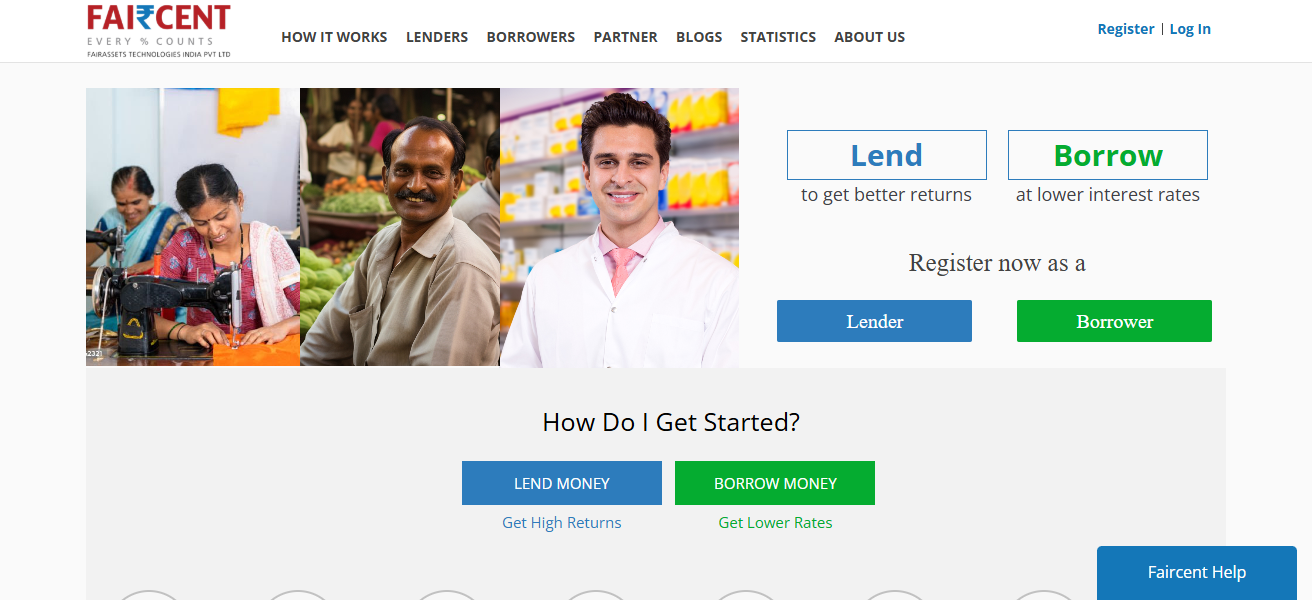
Lenders on the platform have the option to lower the risk of default by dividing their investment into smaller amounts to many different borrowers,
While borrowers have the opportunity to secure good interest rates and a loan application process that is fully online. Faircent was able to shape the Indian peer-to-peer lending industry by being the first player in the market.
Faircent Features
- Regulated P2P Platform: Maintains transparency and compliance by operating within the prescribed boundaries of P2P regulations.
- Direct Borrower-Lender Matching: Bypasses traditional intermediaries, thus cost savings.
- Digital Credit Evaluation: Employs tech-driven scoring systems to evaluate borrower risk.
- Flexible Investment Options: Permits lenders to diversify their investment across a spectrum of borrower categories.
| Pros | Cons |
|---|---|
| Early leader in regulated P2P lending with transparent processes. | Default risk and limited liquidity inherent to P2P. |
| Technology-enabled onboarding and credit assessment. | Primarily focused on Indian market, limiting global expansion. |
| Enables higher yield potential compared to traditional savings. | Investment performance tied to borrower credit behavior. |
8. LoanCircle
LoanCircle has also been mentioned as a private lending startup trying to offer unsecured loans using alternative data and underwriting, focusing on people with non-standard credit histories.
Starting around 2015, it operated using data-centric models that evaluated loan applications using criteria other than traditional credit scores, including job and school information.
Though some previously operating firms using similar names may no longer be in business, the idea shows the period of the fintech disruptions among players trying to broaden the access to credit via digital data and automated decision making.
Such firms exemplify the lending market’s maturation in serving the previously unserved with technology-based credit models.
LoanCircle Features
- Alternative Data Usage: Utilizes non-conventional data for credit assessments.
- Unsecured Loan Model: Emphasizes the delivery of unsecured personal loans to the borrowers.
- Automated Underwriting: Loan processing with a high degree of automation and low human involvement.
- Inclusion-Focused Lending: Prioritizes clientele with little to no credit history.
| Pros | Cons |
|---|---|
| Uses alternative data for credit evaluation, expanding access. | May no longer be actively supported as a standalone product. |
| Focus on underserved borrowers with non-traditional credit. | Limited scale and visibility compared to established platforms. |
| Technology-driven underwriting models. | Investors face typical unsecured loan risk. |
9. Kiva Protocol
Kiva Protocol is not an ordinary lending marketplace. It is an open-source digital infrastructure project that focuses on providing secure digital identity and financial history tracking for individuals.
Kiva built the protocol to help users keep digital wallets with shareable verifiable credentials to lenders, government agencies, and service providers.
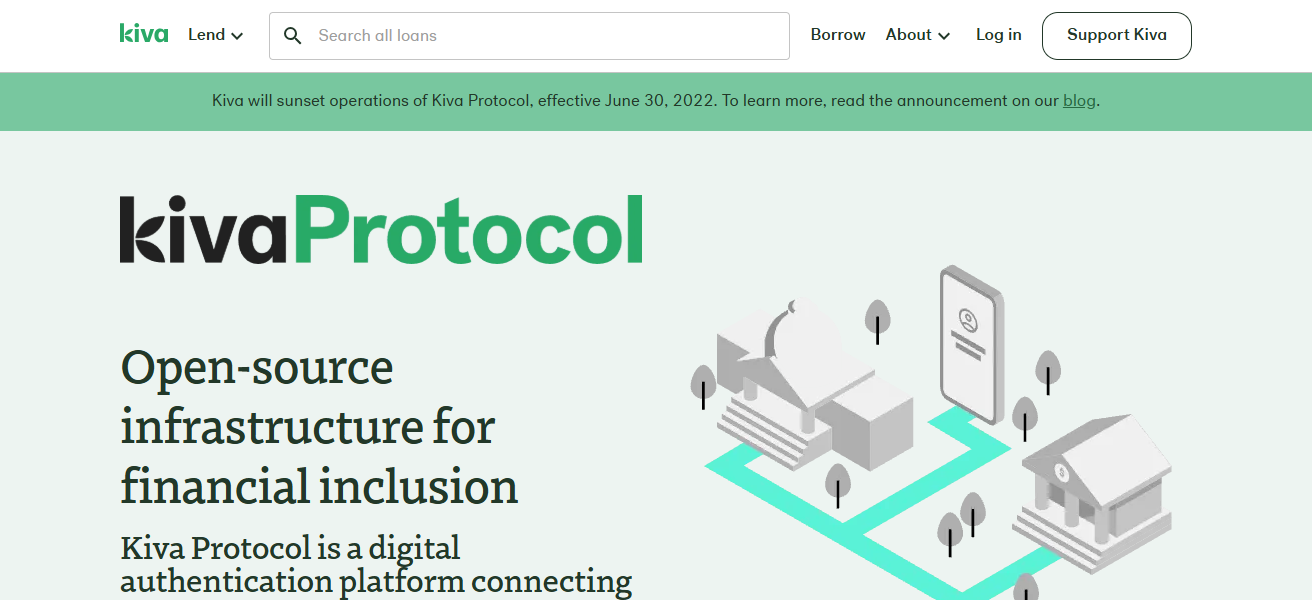
Kiva Protocol, while not a lending platform, provides primary digital infrastructure that facilitates seamless onboarding, credit assessments, and the portability of financial records, particularly in financially excluded areas.
Although the project was closed in 2022, Kiva still exemplifies a strong commitment to the removal of credit access barriers through the use of privacy-compliant digital systems for identity and transaction history.
Kiva Protocol Features
- Digital Identity Infrastructure: Provides customers with safe, customizable, and transportable digital identities for financial services.
- Digital Verified Credentials: Maintains shareable, trustworthy financial history with lenders.
- Open-Source Framework: Built for cross-compatibility within financial systems.
- Financial Inclusion Focus: Aims to lessen the barriers to credit access for the marginalized clientele.
| Pros | Cons |
|---|---|
| Designed to improve financial inclusion through digital identity and verifiable records. | Not a lending marketplace itself — lacks direct loan product access. |
| Helps reduce onboarding friction with portable financial history. | Sunsetting of the initiative impacts long-term viability. |
| Open-source framework for broader financial ecosystem use. | Does not generate direct investment returns. |
10. RupeeCircle
RupeeCircle has established itself as a peer-to-peer lending platform in India, licensed as NBFC-P2P from Reserve Bank of India.
RupeeCircle lends personal and business loans to borrowers while providing what they define as “affordable credit” to borrowers and attractive risk-adjusted returns to lenders.
They use risk assessment algorithms and data science to aid in investor and credit opportunity matching, as well as loan categorization.
Auto-invest, multiple payment modes, and transparent onboarding enhance user experience. RupeeCircle exemplifies India’s alternative lending ecosystem as credit-invisible and underserved borrowers.
RupeeCircle Features
- P2P Lending Marketplace: Provides a digital platform for individual lenders to lend to individual borrowers.
- Risk-Based Loan Categorization: Offers loans that are sorted by levels of risk using in-house models.
- Auto-Invest Feature: Assists lenders in automating the distribution of investments across various loans.
- Operation Transparency: Offers borrowers, returns, and repayment details.
| Pros | Cons |
|---|---|
| RBI-regulated P2P lending with tech-driven risk assessment. | Default and liquidity risk inherent to P2P investments. |
| Auto-invest and transparent loan categorization tools. | Primarily focused on Indian borrowers and lenders. |
| Offers potentially higher returns than traditional fixed income. | Performance depends on borrower repayments. |
How To Choose Best White-Label Lending Platforms
- Customization & Branding: The platform must allow complete branding, UI customization, and unique lending processes.
- End-to-End Automation: Covers onboarding, credit scoring, fund disbursement, servicing, and collection.
- Regulatory Compliance: Adheres to KYC, AML, data privacy, and country-specific lending regulations.
- Scalability: The platform should support an increasing number of users, loan amounts, and various lending products.
- Technology Stack: Preference to be given to AI-based risk analysis and other newer technologies.
- Integration Capabilities: Must integrate seamlessly with other API, payments, CRM, and credit bureaus.
- Security Standards: Must include strong data encryption, fraud defenses, and access control.
- Time to Market: Quicker deployments mean more competitive lending products.
- Cost Structure: Clear pricing that is flexible, especially for startups and enterprise-level lending.
- Support & Maintenance: Efficient long-term operations are guaranteed with dependable tech support and updates.
Conclusion
To sum up, white-label lending platforms provide companies with quick, flexible, and safe means to offer their own branded lending solutions.
They lower cost and operational burdens with automation in areas like loan management, credit scoring, and regulatory compliance.
The right platforms empower fintechs, banks, and NBFCs, giving them the ability to offer seamless lending solutions and retain their competitive advantage in the ever-evolving digital lending landscape.
FAQ
A ready-made lending solution that businesses can brand and launch as their own.
Fintech startups, banks, NBFCs, and financial institutions launching digital lending products.
Loan origination, KYC, credit scoring, disbursement, servicing, and collections.
Yes, most platforms allow full branding and workflow customization.