
In this article, I highlight the Best Zero Gas Crypto Payment Solutions for Merchants that enable businesses to accept cryptocurrency without paying for blockchain costs.
These solutions help merchants save costs, ease payments, and go global. From established gateways like BitPay, and Coinbase Commerce, to multifaceted solutions
like NOWPayments and Shopify plugins, I will highlight the top solutions that allow for seamless crypto adoption.
Key Points & Best Zero-Gas Crypto Payment Solutions for Merchants
| Payment Solution | Key Point |
|---|---|
| NOWPayments | Supports 160+ cryptocurrencies, zero-gas integration, easy API & plugins |
| CryptoPay | Instant settlements, no gas fees, multi-currency support |
| BitPay | Widely adopted, zero-gas merchant tools, fiat conversion options |
| Coinbase Commerce | Trusted brand, seamless checkout, zero-gas crypto-to-fiat conversion |
| PayPal (Crypto Checkout) | Global reach, zero-gas crypto payments, merchant-friendly integration |
| Binance Pay | Peer-to-peer, zero-gas transfers, supports major coins |
| DePay | Decentralized payment gateway, zero-gas swaps, Web3 native |
| CoinGate | Accepts 70+ coins, zero-gas settlement, recurring billing support |
| CoinPayments | Long-standing gateway, zero-gas merchant tools, multi-wallet support |
| Shopify (Crypto Plugins) | E-commerce integration, zero-gas crypto checkout, easy setup |
10 Best Zero-Gas Crypto Payment Solutions for Merchants
1. NOWPayments
NOWPayments is a versatile crypto payment gateway that allows merchants to accept over 100 cryptocurrencies with automatic conversion options.
It also supports payments in-app or at a physical location, and merchants can integrate with payment APIs, plugins, or invoicing tools.
Customers experience seamless payments with settlement in minutes, and merchants incur low profit padding fees.
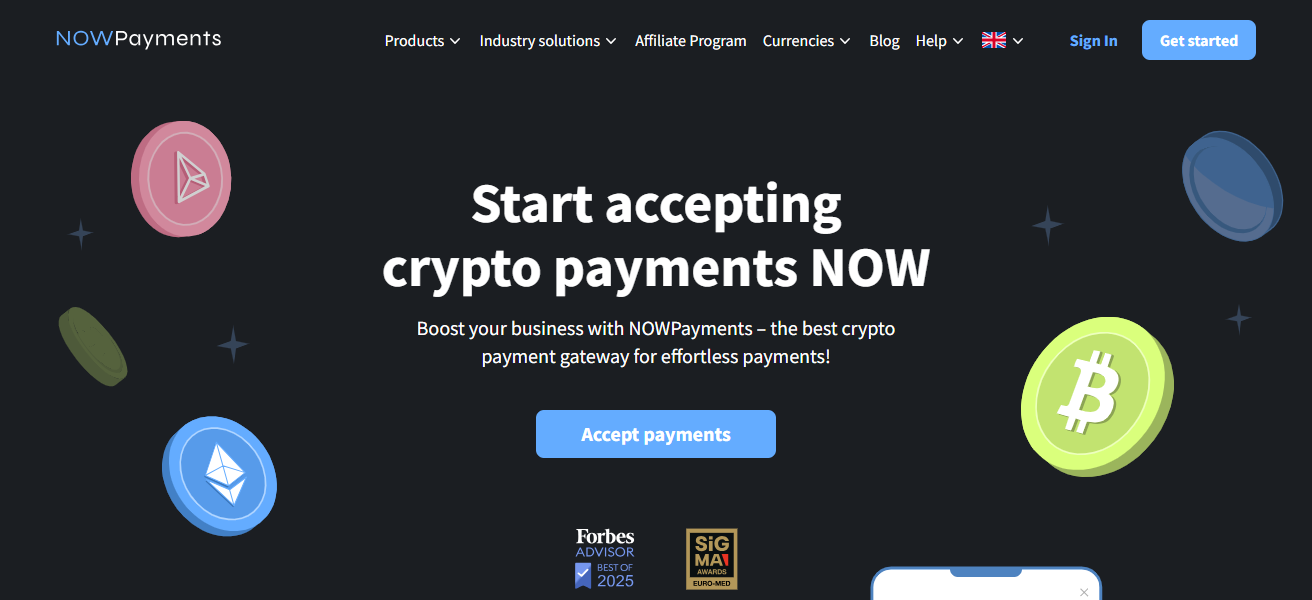
Recurring payments are easily managed, and donations can be processed too – ideal for nonprofits or subscription businesses.
Customers don t lose gas fees, and merchants can adopt crypto profitably, instantly with payments. Paperless, cryptographically secure, and fast.
| Pros | Cons |
|---|---|
| Supports 160+ cryptocurrencies | Limited fiat conversion compared to bigger players |
| Easy API & plugin integration | Merchants may face volatility risk |
| Zero-gas transactions |
2. CryptoPay
CryptoPay requires little technical background from merchants for them to be able to start accepting cryptocurrency payments.
They will be able to receive payments in major coins like Bitcoin, Ethereum, and other stablecoins, and have the conversion to local currency feature to be able to avoid risks due to volatility.
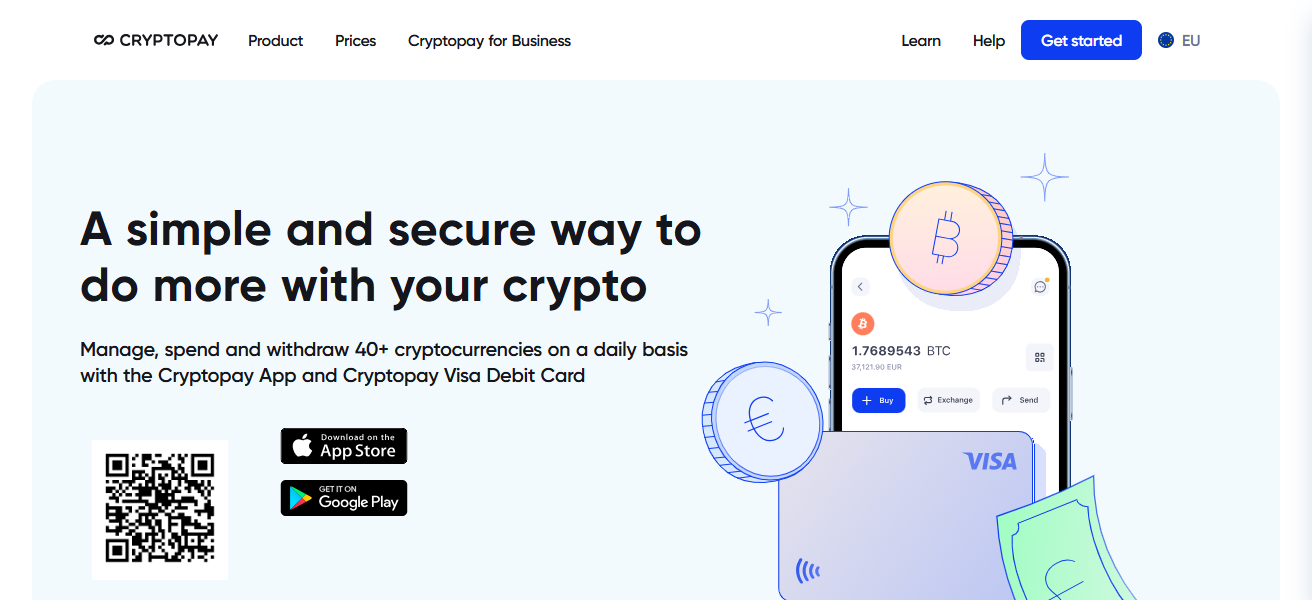
Merchants will have ease in managing and tracking their payments and funds through the dashboard. The transactions are secure through two-factor authentication and encryption.
Merchants appreciate the no-gas feature that ensures zero high block chain fee. This is one of the reasons CryptoPay is favored by small and medium sized companies.
The rapid payments and various available payment methods help improve customer satisfaction and help merchants reach customers from around the world.
| Pros | Cons |
|---|---|
| Instant settlements | Smaller ecosystem compared to BitPay |
| Multi-currency support | Limited global adoption |
| No gas fees | Fewer integrations with big e-commerce platforms |
3. BitPay
BitPay is one of the oldest in the sector and has built a reputation for allowing seamless acceptance of Bitcoin, Ethereum, and stablecoins from merchants.
They have built a point of sale tool, a payment plugin, and an invoicing system to enable quick integration for online transactions.
Merchants do not have to worry about the risks that can come from volatility in the crypto currency world.
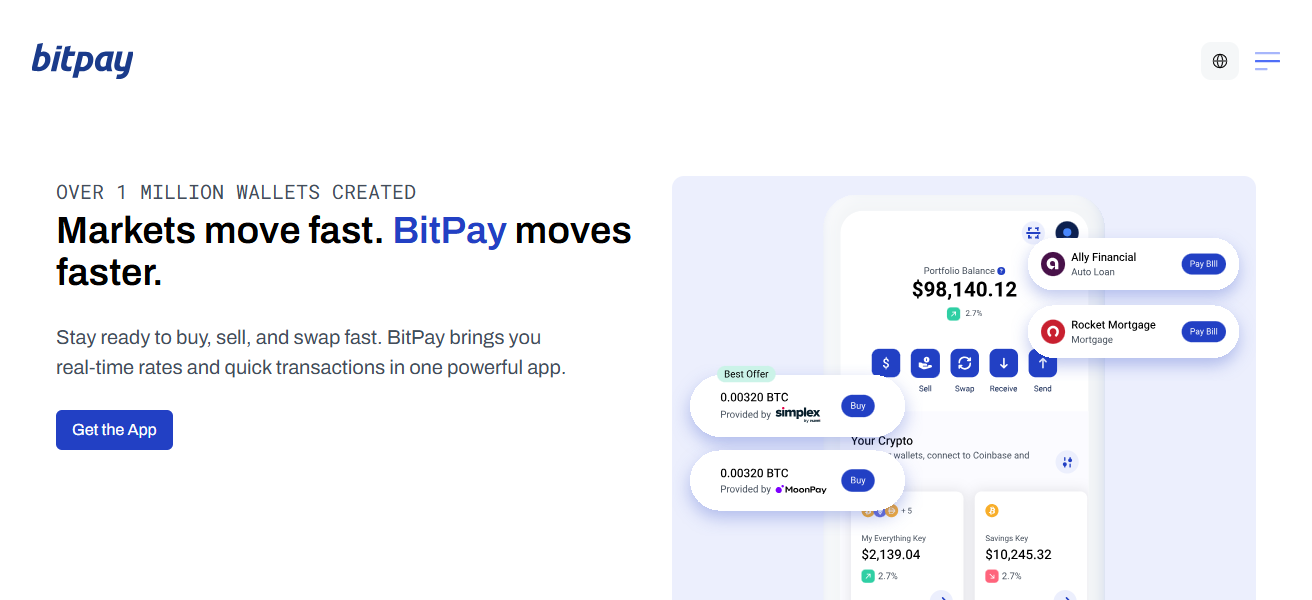
Merchants are also protected by their high security from fraud through the use of multi-signature wallets and other security features.
Merchants do not have to worry about high block chain transaction costs thanks to the zero-gas system. Payments for customers are also quick due to the system.
They are also able to make automatic payments and payments in bulk, which is helpful for companies of all sizes that are trying to make use of crypto.
| Pros | Cons |
|---|---|
| Widely adopted by merchants | Transaction fees on fiat conversion |
| Zero-gas merchant tools | Limited coin support compared to NOWPayments |
| Fiat conversion options | Requires KYC for merchants |
4. Coinbase Commerce
As a product of Coinbase, its credibility, security, highly integrated plugins, and interface with popular ecommerce solutions like Shopify and WooCommerce stand out.
Coinbase Commerce permits sellers to process cryptocurrency payments while maintaining their crypto assets and fear of volatility by instantly converting to USD.
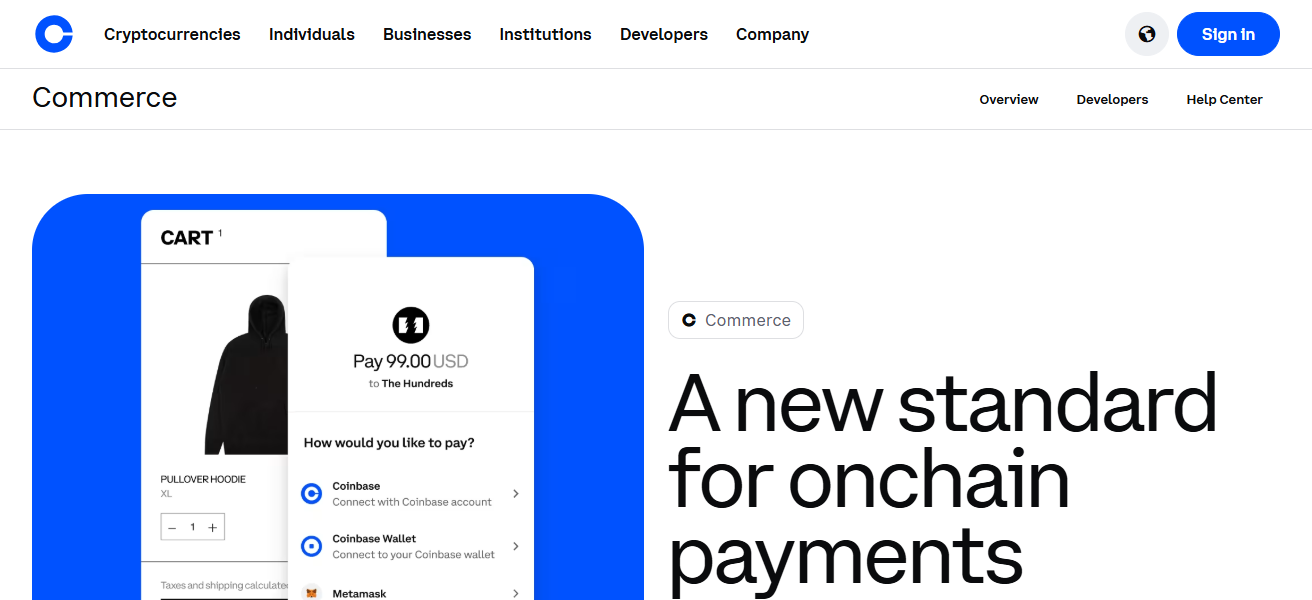
Sellers enjoy zero gas fees which allows Coinbase Commerce to offer cost-efficient transactions. Unlike its competitors, Coinbase Commerce allows advanced customization, offering a variety of services to a wide range of customers.
Cost-effective, transparent, and user-friendly solution service with global reach, no other service competes with the dominate first integrated crypto payment offering.
| Pros | Cons |
|---|---|
| Trusted brand with global reach | Custodial risk if Coinbase faces downtime |
| Seamless checkout integration | Limited customization for merchants |
| Zero-gas crypto-to-fiat conversion | Higher fees compared to decentralized options |
5. PayPal (Crypto Checkout)
PayPal now lets merchants accept cryptocurrency through its crypto checkout feature and has access to a large growing market. PayPal accepts and converts cryptocurrency into fiat currency.
Merchants get paid in fiat currency. Merchants gain easy access and flexibility to PayPal and cryptocurrency, as they are usually getting to the cryptocurrency market.
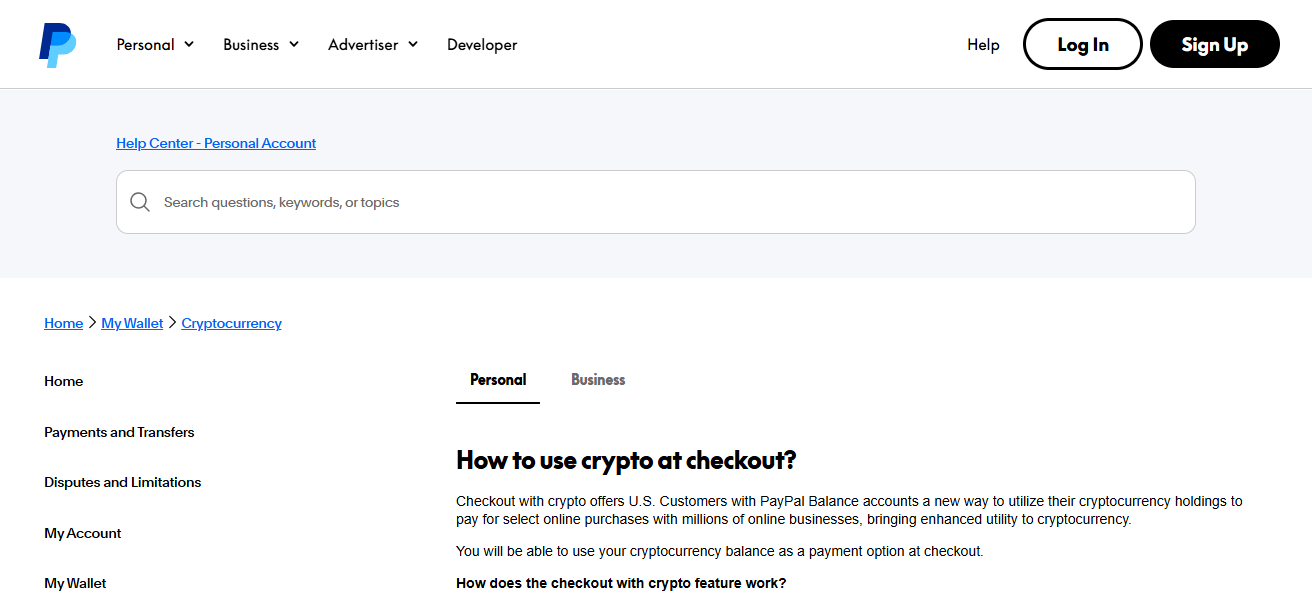
Merchants pay $0 as PayPal processes the crypto buy, and PayPal does all the risk management related to.
Customers now get to buy and pay through cryptocurrency, and do not leave the PayPal flow. PayPal gets to expand cryptocurrency offerings to its large user base. Merchants are now able to accept cryptocurrency payments.
| Pros | Cons |
|---|---|
| Massive global user base | Only supports select cryptocurrencies |
| Merchant-friendly integration | Centralized control, less privacy |
| Zero-gas crypto payments | Higher transaction fees than crypto-native gateways |
6. Binance Pay
Binance Pay helps users of the Binance ecosystem to switches to virtual payments without the worry of transaction fees.
Binance Pay is unique because you can instantly exchange your funds to a stable coin or traditional currency.

Merchants can integrate Binance Pay using QR codes, APIs or e-commerce plugins. Binance pays customers the most gas fees when using any Binance system.
This is a great choice with the additional advantages of a global system with many users who will use your services. This is good for education or real services.
| Pros | Cons |
|---|---|
| Peer-to-peer zero-gas transfers | Reliant on Binance ecosystem |
| Supports major coins | Regulatory restrictions in some countries |
| Strong brand recognition | Limited fiat conversion options |
7. DePay
DePay provides an innovative method for paying for goods on the web3 and e-commerce platforms. It provides various blockchain services without costs merchants gas fees.
It facilitates real-time crypto transactions and instantly converts the crypto into merchants’ tokens, reducing the volatility risk.
DePay uses API and plugin integrations for merchants and can automate periodic payments. DePay caters to traditional and decentralized businesses.
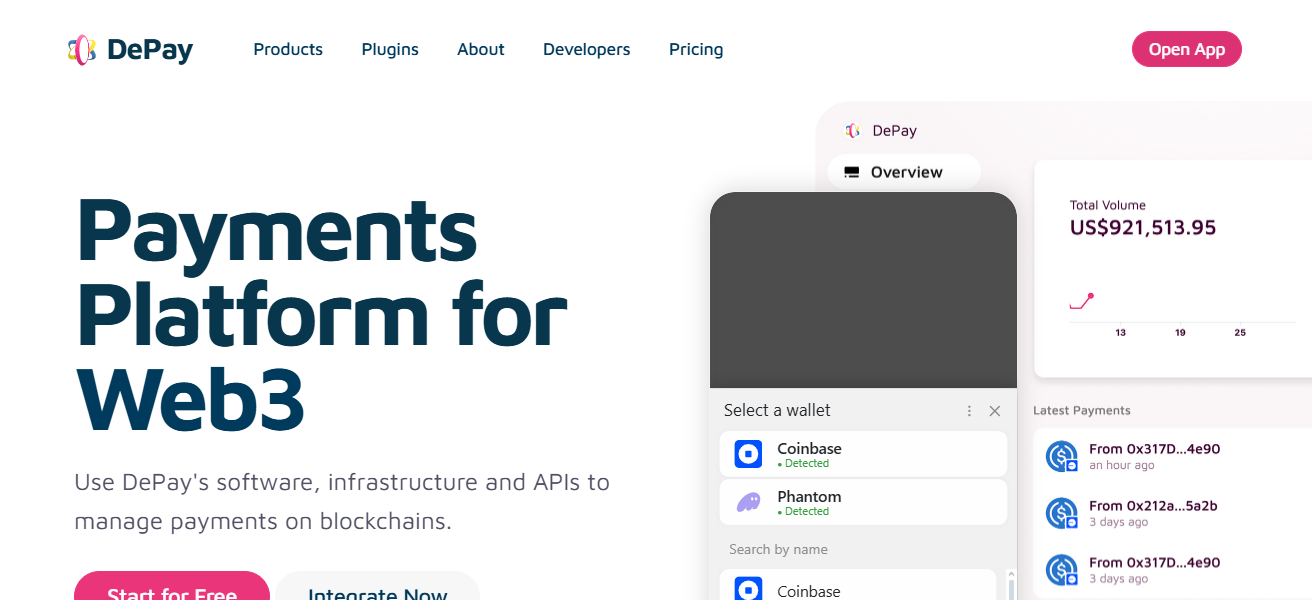
Its open-source software provides transparent and flexible options for merchants to customize their platforms for payments and loyalty offerings.
DePay has vertically integrated to eliminate transaction costs designed for the customer to instantly and efficiently crypto spend and receive services on multiple platforms.
| Pros | Cons |
|---|---|
| Decentralized payment gateway | Less mainstream adoption |
| Zero-gas swaps | Requires Web3 knowledge for setup |
| Web3 native solution | Limited fiat off-ramp options |
8. CoinGate
CoinGate contains e-commerce integrations, invoicing, and POS offerings, to allow for real-time crypto transactions and enables merchants to receive payments in Bitcoin, Ethereum, and Litecoin, and over 70 other cryptocurrencies with flexible settlement options.
Merchants can convert their payment to stocks to protect against inflation. Merchants in operational cost, since it’s a zero gas cost program.
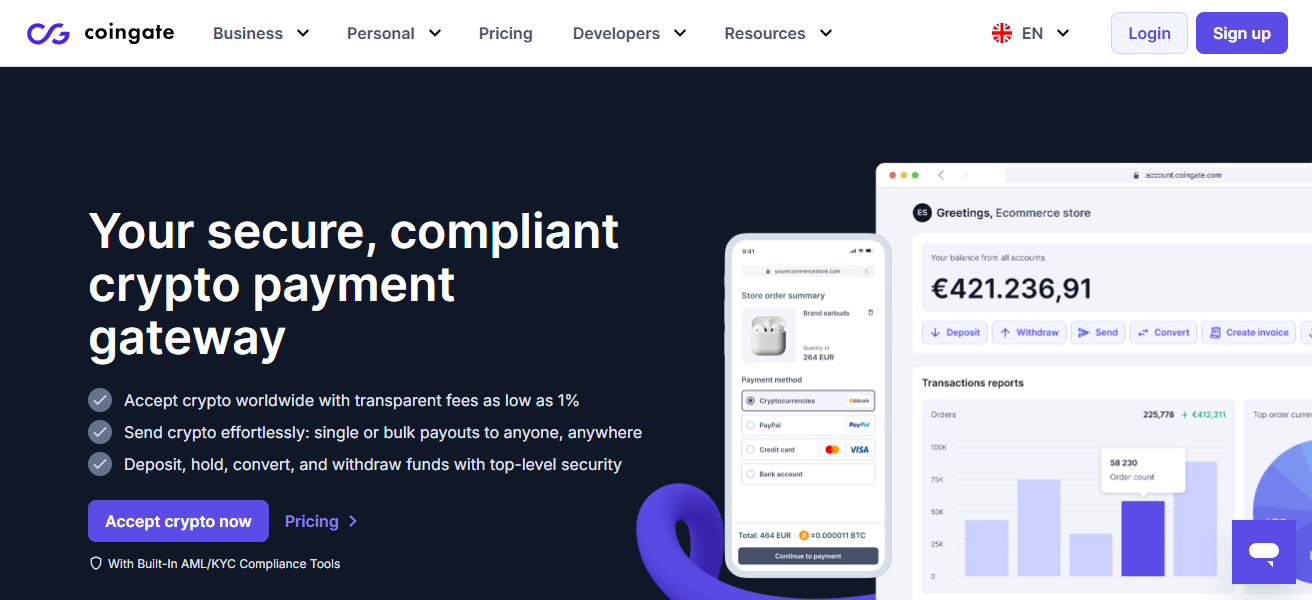
It has efficient blockchain security, built in e commerce integrations, and flexible designs for various crypto offerings to quickly scale to large operational volumes.
| Pros | Cons |
|---|---|
| Accepts 70+ coins | Smaller brand presence than Coinbase |
| Recurring billing support | Conversion fees apply |
| Zero-gas settlement | Limited integrations with big platforms |
9. CoinPayments
CoinPayments is one of the most used and accepted cryptocurrency payment processors, and is one of the few that manages over 3,000 coins and allows for multi-chain wallet management.
Merchants can accept payments through online and brick-and-mortar stores using their plugins, APIs, or payment invoices.
The payment processor provides instant cryptocurrency to fiat conversion and allows for transaction management through their control panel

Creating a seamless payment experience. Security is a top priority, and CoinPayments implements cold wallet storage
3D Secure, and anti-fraud systems for their users. CoinPayments’ zero gas model allows merchants to not shoulder the costs associated with transacting over the blockchain
So cryptocurrency payments become more financially viable. The payment processor has many more features and is a great fit for business owners looking to diversify their payment processor to capture the growing marketplace that cryptocurrency offers.
| Pros | Cons |
|---|---|
| Long-standing crypto gateway | Interface less modern compared to newer solutions |
| Multi-wallet support | Conversion fees can be high |
| Zero-gas merchant tools | Limited fiat conversion options |
10. Shopify (Crypto Plugins)
Shopify merchants are able to accept cryptocurrency payments because the site integrates with BitPay, Coinbase Commerce, and CoinPayments.
All these payment solutions integrate with Shopify’s checkout and offer options for automatic conversion to fiat currency and invoicing.
Shopify merchants benefit from zero-gas solutions, meaning there are no transaction fees on the blockchain to be paid by the merchant or the customer, streamlining operational costs.

Shopify’s ecosystem supports both digital and offline retail and the solutions enhance Shopify with analytics, payment solutions for multiple cryptocurrencies, and payments set to recur.
This allows merchants with no technical skills to easily adopt cryptocurrency payment options and allows their customers to transact with them from any place using Shopify’s secured payments.
| Pros | Cons |
|---|---|
| Easy e-commerce integration | Dependent on third-party crypto plugins |
| Zero-gas crypto checkout | Limited coin support depending on plugin |
| Merchant-friendly setup | Requires Shopify subscription |
Conclusion
To sum up, the leading zero gas charge crypto payment options allow merchants to accept digital currencies, address the pain of Blockchain fees, enjoy flexibility, and have a global reach with reduced transaction costs.
There are many entities, including NOWPayments, BitPay, Coinbase Commerce, Binance Pay, and the Shopify plugin, that serve the varying needs of all,
Including small to large enterprise merchants, offering a balance of supported coins, integrations, and ease of conversion of fiat currencies allowing merchants to enjoy seamless, safe, and efficient crypto payment options.
FAQ
It’s a payment gateway where merchants don’t pay blockchain transaction (gas) fees, making crypto acceptance cheaper and more predictable.
Most solutions support Bitcoin, Ethereum, stablecoins, and some altcoins; specific tokens depend on the platform.
Yes, reputable gateways like BitPay, Coinbase Commerce, and Binance Pay use encryption, two-factor authentication, and cold storage for safety.
Yes, most platforms allow instant conversion to fiat to reduce volatility risk.
Shopify plugins, NOWPayments, and Coinbase Commerce offer simple integrations with APIs, plugins, or widgets.