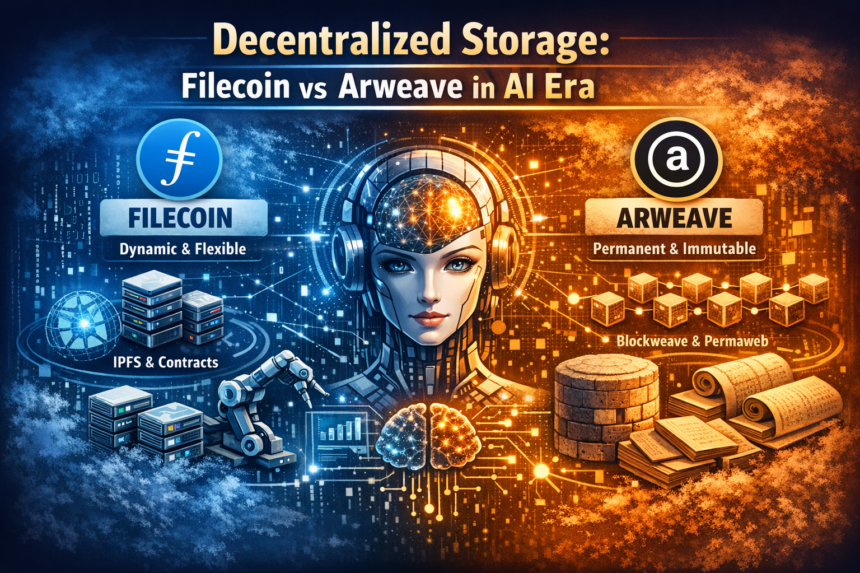
In this article, I will talk about Decentralized Storage: Filecoin vs. Arweave in the AI Era, and examine how the two platforms transform data permanence, accessibility, and scalability.
With AI creating enormous data sets, it is important to analyze the strengths and trade-offs of Filecoin’s flexible contracts and Arweave’s permanent blockweave to understand how we will deal with the future of digital data.
What is Decentralized Storage?
Decentralized storage enables data distribution through a network of independent nodes as opposed to a centralized provider, like AWS or Google Cloud.
With the distributed network approach, the data is stored in multiple places, resulting in a significant reduction of a single point of failure, or increased downtime.
This allows for the information to be accessible at all times, and this method allows for greater user control of their information, as it prevents interference through censorship or unauthorized access.
It also reduces vendor lock-in, providing organizations agility to change providers or control the storage via a different method, all of this while data security, redundancy, and reliability are optimized in a world of growing data.
Why Decentralized Storage Matters in the AI Era
Centralized dangers: Amazon S3, Google Cloud, or Azure dependence results in single failure points, censorship, and vendor lock-in.
Decentralized storage: Filecoin and Arweave create decentralized control with increased resiliency, transparency, and enduring access.
Redundancy and Reliability: Data is divided, stored, and replicated, minimizing potential failure points.
Data Integrity: Storage is protected with authenticity and integrity cryptographic assurances.
Cost Efficiency: P2P stored data markets, based on excess disk space around the world, cut costs.
Decentralized storage is more politically and corporately resistant to censorship.
Filecoin: Decentralized Storage Market Dynamics
Dynamics of the Decentralized Storage Market: Filecoin
Filecoin was developed by Protocol Labs, and it uses an example of a market-based decentralized storage solution. The decentralized storage market functions like a peer-to-peer cloud.
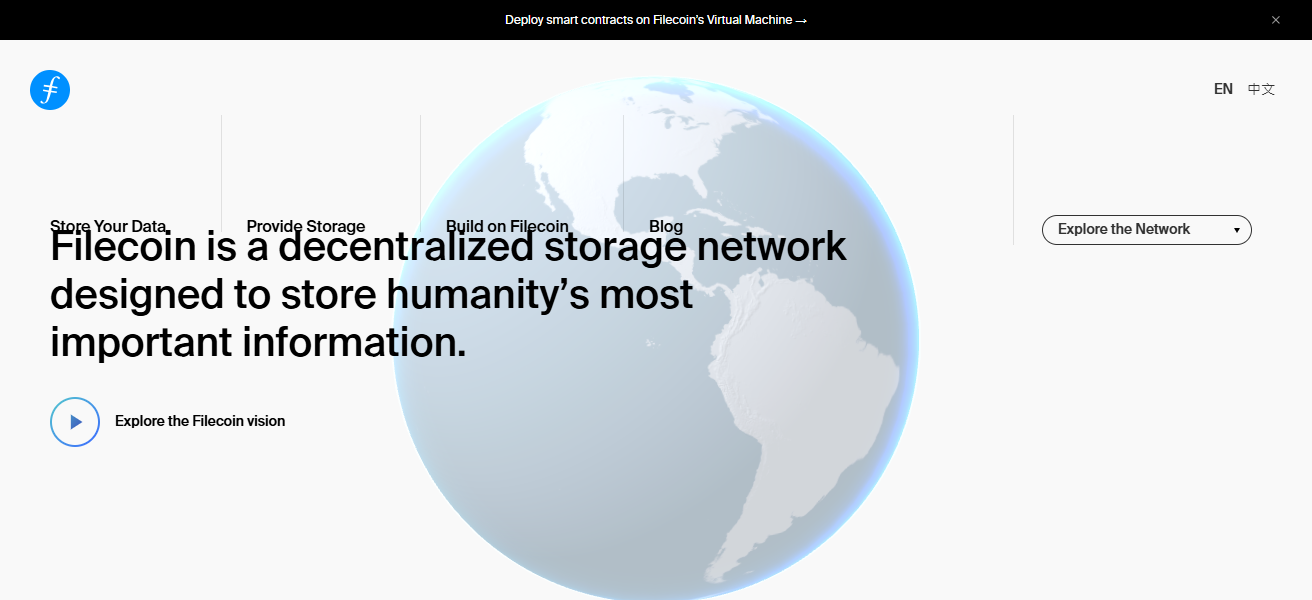
Here, storage providers offer storage solutions based on price and reliability. The Filecoin network uses an incentive-based proof-of-storage mechanism.
- Proof-of-Replication (PoRep) proves that a storage miner stores a client’s data and that this client’s data is not a copy.
- Proof-of-Spacetime (PoSt) proves that the data is still stored at a certain time.
Data-driven enterprises that use AI benefit from Filecoin’s two proof systems, which offer data storage guarantees. Organizations can use Filecoin’s dynamic pricing mechanism to store data and save costs by only paying for storage for the duration of time they require.
Filecoin is also more focused on AI integration. Its decentralized storage solution can store an unlimited amount of data, which is required for AI model training and development. Filecoin also offers an extensive range of tools and integrations, such as IPFS-based content addressing and smart contracts.
Filecoin still faces obstacles, such as a market-based approach that can lead to unpredictability in storage pricing and availability. Delays in real-time AI applications may also be caused by slow transactions and proof-verification within the network that increases the time it takes to complete proof.
Arweave: Permanent Storage in the Age of AI
While Filecoin emphasizes versatility and efficiency in the marketplace, Arweave considers itself a competitor serving the permanent web, or a web of data immutability. With Arweave, you aren’t obligated to make periodic payments like with Filecoin, and instead, Arweave has a one-time, end-all-be-all payment.
Therefore, data is guaranteed to be stored in the long-term, utilizing Arweave’s blockchain-like entities, or blockweaves, in which each node can continue to store more data while cascading references to older blockweave layers.
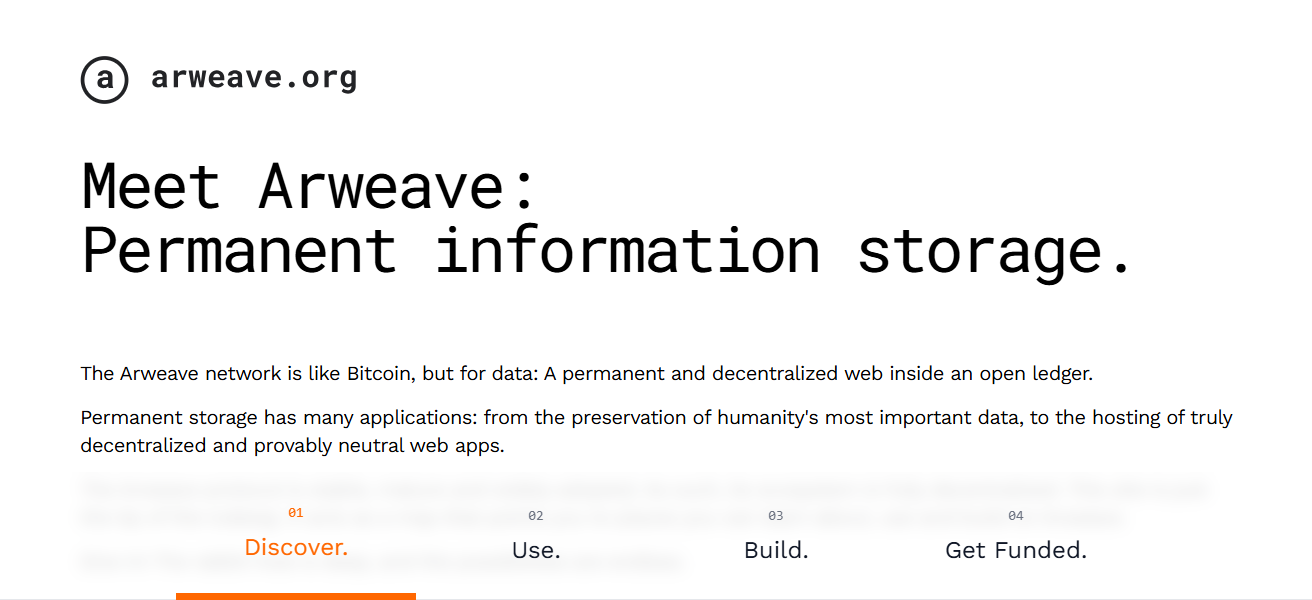
Arweave’s offer of data permanence is especially essential for AI. Arweave will store data for medical research, historic sensor data, and compliance-related legal documents, while guaranteeing the data will NOT be altered and/or deleted. There is a unique assurance of data integrity that is more uncommon in the current age.
Arweave’s permaweb also allows for decentralized applications (dApps) to be built on top of the permaweb, meaning that there can be some AI models that use knowledge graphs
(firm-client relations) with blockchain-based identity verification (permissioned access) and those models that have immutable datasets that can be generatively trained.
Arweave’s permanent data storage option has some unique disadvantages. The one-time payment for permanent data storage can be more costly than aggregative storage solutions.
And finally, the decentralized web services provided by Arweave are less than those provided by Filecoin (meaning less access to AI data pipelines) in a way that can make real-time integrations less viable.
Filecoin vs. Arweave: Core Comparison
| Feature | Filecoin (FIL) | Arweave (AR) |
|---|---|---|
| Architecture | Built on IPFS (InterPlanetary File System) | Uses Blockweave for permanent storage |
| Consensus | Proof-of-Replication + Proof-of-Spacetime | Proof-of-Access |
| Storage Model | Contract-based: pay for duration, renewable | Permanent: one-time fee, data stored forever |
| Fees | Variable, market-driven | Fixed, upfront |
| Market Cap (2026) | ~$1.7 billion | ~$320 million |
| Best Use Cases | Dynamic storage, large datasets, flexible contracts | Archival, immutable records, AI training datasets |
The AI Era: A Hybrid Future?
There may be no need for a strict choice in the hybrid future. Perhaps in the future, a hybrid approach could use Arweave for archiving, and Filecoin for mutable, active datasets.
This type of architecture would give AI models access to the flexibility of the market in storage, and in addition, ensure that important historical data cannot be altered.
Moreover, the AI Decentralization paradigm, particularly with the advent of federated learning and distributed inference, could leverage both networks.
Filecoin can be useful for the storage and the necessary computing flexibility for the training nodes, whereas Arweave can be useful for maintaining integrity of the reference datasets and the model checkpoints.
Risks & Trade-offs
Filecoin: Increased renewal costs are a risk. Depending on market conditions may make certain AI projects too small to fund.
Arweave: Permanence has ethical implications for sensitive AI data. Once stored, data cannot be removed.
Both: These ecosystems are still in their infancy. Adoption will depend on developer trust, regulation, and AI integration in workflows.
Which To Choose?
Filecoin – With rapidly changing data that is changing frequently and in distributed systems environments, For AI workloads that do not require long-term data storage, Filecoin is scalable, cost-effective, and provides verifiable and accessible data.
Arweave – Offering lifelong data storage with cost simplicity, one payment. For data that legally or otherwise must be retained and is inactive, such as archival data or AI reference data, irreversible and unchanging, Arweave is ideal.
Emerging Players – High performance storage networks that are emerging for more than 30 mb/sec and more specifically for AI workloads, such as 0G Storage, provide better throughput for rapid read and write than long term storage Filecoin or Arweave.
Conclsuion
To sum up, Filecoin and Arweave offer two different but equally valid routes for decentralized storage for the upcoming AI age.
While Arweave guarantees permanent and reproducible storage, Filecoin stands out for its dynamic data management and scalability.
Together they offer the AI ecosystem both living data and permanent archives, which are essential for trust, transparency, and innovation in the digital future as they balance the two extremes of data flexibility and data immutability.
FAQ
Costs may fluctuate, and permanence depends on contract renewal.
Filecoin, since contracts can be updated and renewed.
Arweave, due to its one-time fee model.
Filecoin, designed for large and dynamic datasets.
Arweave, since it guarantees immutable datasets for research transparency.