In this article, I will look at Integrating Chainlink Functions for Off-Chain API Triggers and how smart contracts make accessing real-world data possible.
We will look at how these functions retrieve external API data, run computations off the chain, and automate workflows as well as savings in gas fees.
Through this integration, developers will be able to construct decentralized apps that are complex, efficient, responsive, and, above all, interact with external systems.
What are Chainlink Functions?
Chainlink Functions is a decentralized programmable service that lets developers create JavaScript codes to request, process, and analyze data from off-chain API.
It uses Chainlink’s decentralized oracle networks, which give data a secure, tamper-proof, and reliable retrieval process, for it to be integrated to the On-Chain smart contracts.
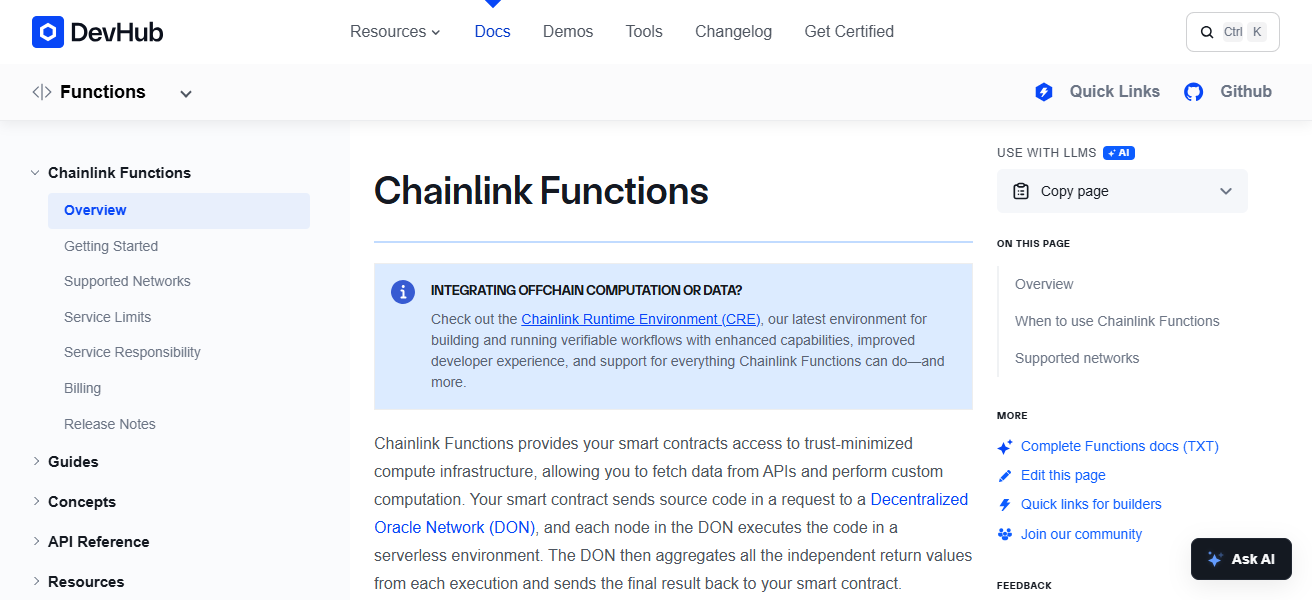
With this, the smart contracts will be able to fetch real-world data like market prices, weather conditions, and IoT readings, while keeping the data decentralized and secure.
Additionally, Chainlink Functions enhances the smart contracts functionality and promotes the creation of more responsive
Event-driven applications in decentralized finance (DeFi), insurance, supply chain, and other blockchain-based systems.
Why Integrate Off-Chain API Triggers?
Smart contracts can only execute logic that has already been programmed into them, and as such do not have access to external APIs. This inflexibility prevents them from referencing and responding to the world outside of the blockchain.
Chainlink Functions solves this problem and allows smart contracts to fetch external data that is securely and reliably sent to the blockchain. Functions can also do off-chain computations which include complex calculations such as risk assessments and data aggregation from multiple sources.
This, in addition to less data needing to be stored on the blockchain, also means that there is less gas used and therefore the execution of smart contracts is more efficient.
Functions do more than just data fetching and computations. They also allow smart contracts to initiate actions based on real-world scenarios.
This could be used to implement a decentralized insurance system that automatically pays out a claim after a confirmed weather event. This example highlights the increased complexity that can be implemented into decentralized applications.
Why Do Smart Contracts Need off-chain API Triggers?

- Smart contracts, by default, can only access on-chain data.
- With off-chain API triggers, smart contracts can pull data from external systems.
- This includes reactions to real world scenarios such as value of assets, the weather, and outputs from IoT sensors.
- This allows for greater dynamism and responsiveness in decentralized applications (dApps).
- Off-chain triggers expand the smarts contracts use cases to beyond blockchain use cases.
- They improve the automation, precision, and overall capacity of applications within DeFi, insurance, supply chain, and IoT.
Key Features of Chainlink Functions
| Feature | Description |
|---|---|
| Decentralized Oracles | Multiple nodes fetch data to avoid single points of failure |
| Data Security | Ensures authenticity and tamper-proof responses |
| Programmable | Functions can interact with APIs or perform computations |
| Real-Time Triggers | Supports event-driven data updates |
| Cross-Chain Compatibility | Integrates with multiple blockchain networks |
Benefits of Off-Chain API Integration

Security: Each deployment of Chainlink Functions utilizes a different set of oracle nodes to verify the accuracy of the data before it is sent to the smart contracts, making sure that the data is authentic and secured.
Flexibility: Chainlink Functions allow developers to incorporate off-chain logic and API calls to customize behaviors of smart contracts to suit the needs of the specific application.
Scalability: Off-chain event triggers do the processing that normally takes a lot of gas to compute on-chain via smart contracts, making it more scalable and efficient to do the work off-chain.
Interoperability: With Chainlink Functions, smart contracts are able to make calls to and utilize services of the traditional Web2 services, APIs, and the IoT, thus integrating non-blockchain technologies with the blockchain.
Automation: Chainlink Functions provide the capability to automatically execute a set of actions to a smart contract that will occur as a result of the analysis of off-chain data.
Trust: The independent nodes that provide information to the oracle are the same ones that verify the information in order to provide a high degree of certainty that the smart contract will not fail.
Common Use Cases of Off-Chain API Triggers
| Use Case | Description |
|---|---|
| DeFi Price Feeds | Update token prices from multiple exchanges |
| Supply Chain Tracking | Monitor shipment status via logistics APIs |
| Sports Betting | Fetch live scores for event outcome verification |
| Insurance | Trigger claims based on external events like weather |
Challenges & Considerations
- API Reliability: Smart contracts depend on external API uptime.
- Secrets Management: API keys must be securely handled.
- Latency: Off-chain calls introduce slight delays compared to purely on-chain logic.
- Complexity: Developers must balance decentralization with external dependencies.
Pros & Cons
| Aspect | Pros | Cons |
|---|---|---|
| Security | – Provides cryptographically verifiable data from off-chain APIs, reducing the risk of tampering. – Trusted oracle network ensures data integrity and authenticity. | – Dependence on external oracle network may introduce a single point of failure if misconfigured or if the network faces issues. |
| Flexibility | – Can access virtually any off-chain API, enabling complex smart contract logic beyond blockchain data. – Supports multiple data sources, reducing reliance on a single API. | – Integration requires careful handling of API keys, authentication, and rate limits. – Complexity increases for multi-source aggregation. |
| Automation | – Enables smart contracts to trigger automatically based on off-chain events (e.g., stock prices, weather conditions). – Reduces manual intervention, improving efficiency. | – Latency may occur due to off-chain query execution and confirmation on-chain. – Not ideal for extremely time-sensitive operations where milliseconds matter. |
| Reliability | – Reduces errors compared to manual data input or centralized intermediaries. – Chainlink’s decentralized design mitigates single-source manipulation. | – Reliability still depends on the oracle nodes’ uptime and performance. – Complex error handling may be required if API responses are inconsistent or fail. |
| Cost | – Only pay for usage when triggering functions; no need to maintain your own off-chain infrastructure. | – Costs can accumulate depending on API frequency and Chainlink oracle usage. – High-volume API calls can become expensive. |
| Developer Experience | – Provides SDKs, documentation, and pre-built templates to simplify integration. – Reduces the need to write custom oracle logic from scratch. | – Steeper learning curve for developers unfamiliar with Chainlink or oracle-based architecture. – Debugging cross-chain or off-chain errors can be challenging. |
| Transparency | – All off-chain triggers are verifiable on-chain, improving accountability and auditability. | – Complex multi-source queries may require careful verification logic to ensure accuracy. |
Conclsuion
In conclusion, using Chainlink Functions for off-chain API triggers provides smart contracts the ability to securely access real-world information and the ability to execute off-chain calculations and automate workflows based on triggered events.
This all results in increased flexibility, scalability, and reliability, as well as a greater reduction in gas fees, allowing smart contracts to access more sophisticated use cases.
Combined with the ability to seamlessly blend blockchains with external systems, the potential real-world use cases for decentralized applications expands significantly.
FAQ
Smart contracts cannot natively access external APIs; Chainlink Functions bridge this gap with secure off-chain data.
Financial prices, weather data, sports scores, IoT sensor outputs, and other real-world information.
Yes, they support off-chain computations like aggregation, risk modeling, or data transformation.
Yes, heavy calculations are performed off-chain, reducing on-chain gas usage.