In this article, I will discuss the leading Smart Contract Payment Tools for Automating B2B Transactions and how they ease the payments workflow and remove the need for human intervention.
- Key Points & Smart Contract Payment Tools For Automating B2B Transactions
- 10 Smart Contract Payment Tools For Automating B2B Transactions
- 1. Superfluid
- 2. Hyperledger Fabric
- 3. Corda
- 4. Chainlink
- 5. Stellar
- 6. Algorand
- 7. Tezos
- 8. RippleNet (XRPL)
- 9. IBM Blockchain Platform
- 10. Polygon (Layer 2 for Ethereum)
- Conclusion
- FAQ
These fintech solutions allow businesses to make payments easily, securely, and transparently in real time.
With features like automated payment settlements and recurring billing, smart contracts are modernizing B2B relationships.
They allow businesses to manage their transactions in a more timely and efficient manner.
Key Points & Smart Contract Payment Tools For Automating B2B Transactions
| Tool | Key Point |
|---|---|
| Ethereum Smart Contracts | Most widely used blockchain for B2B automation; supports customizable payment workflows and decentralized apps. |
| Hyperledger Fabric | Permissioned blockchain ideal for enterprises; enables private, secure smart contract execution for B2B payments. |
| Corda | Focused on financial institutions; supports direct settlement and reduces reconciliation needs in B2B transactions. |
| Chainlink | Provides decentralized oracles to connect smart contracts with real-world data like FX rates or delivery confirmations. |
| Stellar | Designed for fast, low-cost cross-border payments; smart contracts automate settlement between global B2B partners. |
| Algorand | High-speed blockchain with low fees; supports automated escrow and conditional B2B payments. |
| Tezos | Self-amending blockchain; smart contracts automate compliance-heavy B2B transactions with built-in governance. |
| RippleNet (XRPL) | Specializes in cross-border B2B payments; smart contracts streamline liquidity management and settlement. |
| IBM Blockchain Platform | Enterprise-grade solution built on Hyperledger; integrates with ERP systems for automated B2B workflows. |
| Polygon (Layer 2 for Ethereum) | Scales Ethereum smart contracts; reduces transaction costs and speeds up B2B payment automation. |
10 Smart Contract Payment Tools For Automating B2B Transactions
1. Superfluid
Superfluid is a financial protocol that streams money in real-time and allows businesses to create a flexible, automated payment system between each other.
Unlike conventional payment systems that run on pre-scheduled payments, money is programmed to flow in and out through a smart contract every second.

Employees, vendors, subscription payments, and even recurring royalties can be paid out without any manual action.
Superfluid is a “stream” and “super token” that helps fintech businesses manage their financial flows better and offers them a new way to handle automated payments and to manage their finances better.
| Feature | Description |
|---|---|
| Real-time money streaming | Automates continuous payments that flow every second. |
| Smart contract automation | Streams triggered by on-chain programmable logic. |
| Recurring payment support | Ideal for payroll, subscriptions, and vendor settlements. |
| Super Tokens | Upgraded token standard enabling streaming functionality. |
| Zero-latency settlement | Funds are received instantly with no batching. |
| DeFi integration | Compatible with decentralized finance protocols. |
| Reduced reconciliation | Eliminates manual payment tracking and delays. |
2. Hyperledger Fabric
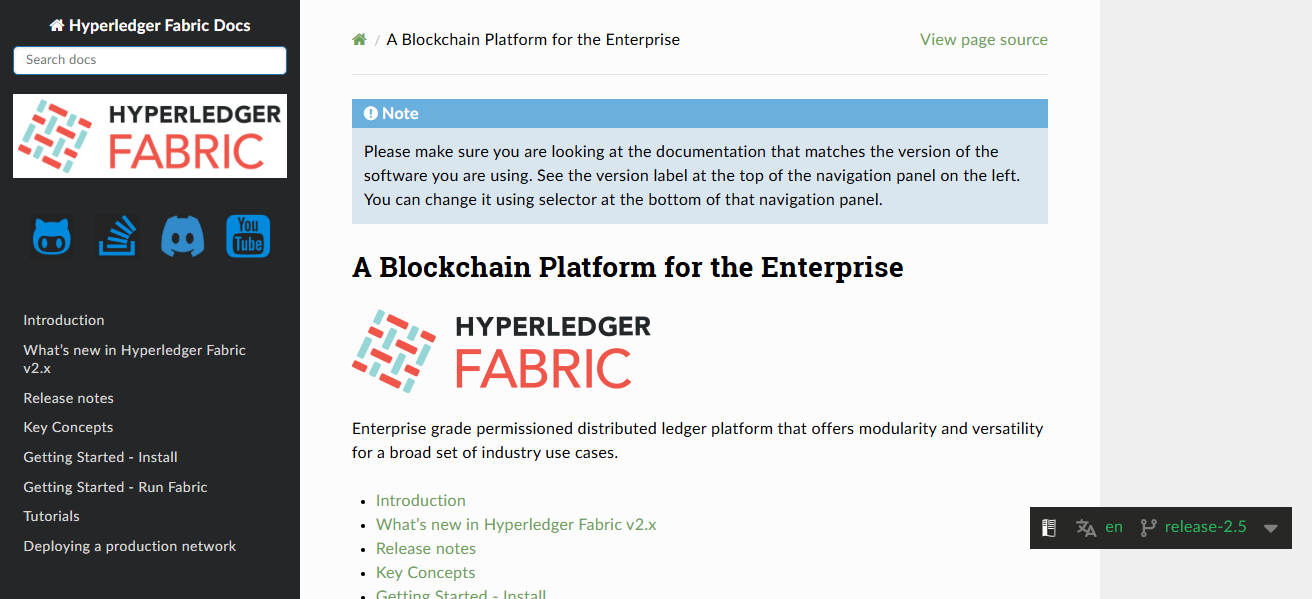
Hyperledger Fabric is an enterprise-grade, permissioned blockchain framework designed for secure and private B2B transactions.
Automating invoicing, settlement, supply chain payment, and compliance workflows through tailored smart contracts (chaincode), companies can seamlessly colloborate.
Fabric’s modular architecture lets organizations define and modify their consensus, membership, and identity management.
As only relevant parties have access to the data, privacy regarding confidential information within the industry, be it finance, logistics, or manufacturing, is guaranteed.
Fabric’s high throughput governance model is ideal for resolving large scale B2B automation networks built with auditability and access to data.
| Feature | Description |
|---|---|
| Permissioned blockchain | Ensures privacy and role-based data access. |
| Modular architecture | Customizable consensus, identity systems, and governance. |
| Chaincode smart contracts | Automates invoicing, settlements, and workflows. |
| Private channels | Allows sensitive data sharing only with relevant parties. |
| High throughput | Supports large-scale enterprise B2B networks. |
| Strong governance controls | Enables auditability and regulatory alignment. |
| Enterprise-focused security | Tailored for finance, logistics, manufacturing. |
3. Corda
Corda is a permissioned, distributed, and confidential intelligence automation framework designed for regulated industries that require privacy.
Unlike other blockchain sec, Corda doesn’t globally broadcast transactions. Rather it efficiently and privately shares documents with respective parties to a deal.
Interbank settlement, trade finance, insurance, supply chain payments, and other industry processes are automated and documented with smart contracts on Corda.

All elements of Corda’s architecture are optimized for legal compliance and interoeprability, which are desirable for enterprises with complex governance requirement
Outcomes of transactions with Corda are predictable, lowing the rate of disputes, and facilitating automated business transactions in a trusted environment.
| Feature | Description |
|---|---|
| Data privacy by design | Shares data only with transaction participants. |
| Permissioned architecture | Designed for regulated industries. |
| Smart contracts (CorDapps) | Automates settlements, trade finance, and insurance. |
| Legal compliance focus | Optimized for enterprise-level governance. |
| Deterministic transactions | Ensures predictable and consistent outcomes. |
| Interoperability | Integrates with existing business systems. |
| High efficiency | No global broadcasting reduces network load. |
4. Chainlink
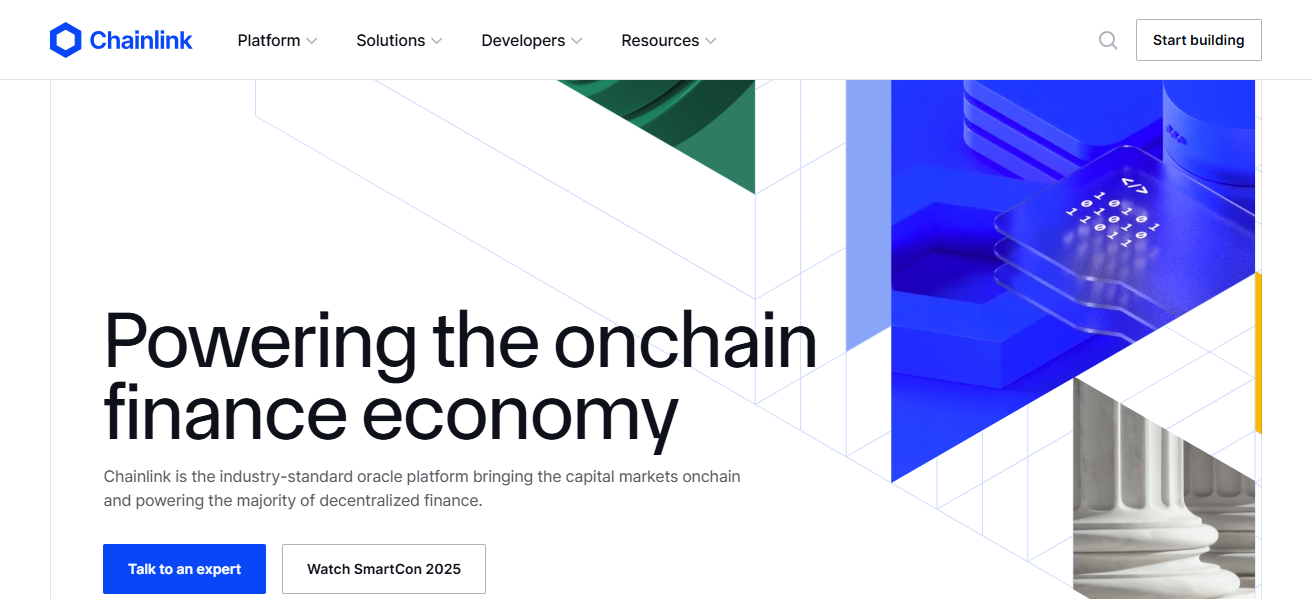
Automated business-to-business payments can be processed with smart contracts that link Chainlink to real-world data.
Events such as gaining access to verified market prices, IOT (internet of things) devices, shipment confirmations, weather data, and APIs can trigger automated payments.
Automated settlements insurance, automated payouts for insurance, and contracts that have their pricing set dynamically can be processed through a secure and tamper-proof system.
Transparent and accurate automated payments can be processed and verified through Chainlink. Businesses can automate reliable and scalable payments
Through the Hybrid Smart Contracts system of Chainlink, which combines on-chain logic with off-chain computation.
| Feature | Description |
|---|---|
| Decentralized oracles | Connects smart contracts to real-world data. |
| External data triggers | Automates payments based on sensors, APIs, or events. |
| Secure data feeds | Tamper-proof market and financial data. |
| Hybrid smart contracts | Combine on-chain logic with off-chain computation. |
| Automation framework | Enables scheduled or conditional payments. |
| Enterprise adapters | Connects ERPs and external systems to blockchain. |
| Cross-chain connectivity | Works across multiple blockchains. |
5. Stellar
Businesses can automate payments, create escrow accounts, and set up milestone-triggered payments with Smart contracts on Stellar.
Steller highly values low-cost and rapid transactions, making it the preferable option for cross-border payments and settling transactions between businesses.
Steller facilitates transactions on a global scale that operates on multiple currencies, assisting businesses in managing international payments efficiently.

Sorobon adds the capability of advanced logic to automate complex financial transactions (programmatically)
As Stellar enables basic automation to its users. Stellar offers transparency, efficiency, and programmable payment automation for businesses.
| Feature | Description |
|---|---|
| Low-cost transactions | Ideal for high-volume B2B settlements. |
| Fast transaction finality | Enables near-instant cross-border payments. |
| Soroban smart contracts | Adds programmability for automated workflows. |
| Multi-currency support | Facilitates global B2B operations. |
| Escrow & multisig | Built-in tools for secure settlements. |
| Global payment rails | Used widely by remittance and fintech companies. |
| Energy-efficient consensus | Fast and environmentally friendly. |
6. Algorand
Algorand is a fast blockchain designed for enterprises needing automation, security, and scalability.
With Algorand, businesses can set up automated payment workflows, recurring payments, and invoice processing, and set condition-based payout agreements, all without the complexity of a Layer 2.
Algorand is suited for B2B Financial operations as its transaction finality is nearly instantaneous, and fees are very low.

Its consensus mechanism, Pure Proof of Stake, decentralizes and strengthens the network’s security, and due to atomic transfers and rekeying, the payment of multiple parties is simplified.
Due to its reliability, performance, and enterprise integrations, Algorand is a preferred choice for large companies for payment automation and for eliminating operational bottlenecks.
| Feature | Description |
|---|---|
| Layer-1 smart contracts | High-speed automated financial workflows. |
| Near-instant finality | Reduces payment delays in B2B operations. |
| Low fees | Cost-effective for large volumes. |
| Pure Proof-of-Stake | Decentralized, secure, and energy efficient. |
| Atomic transfers | Enables coordinated multi-party settlements. |
| Rekeying feature | Enhances enterprise security and wallet management. |
| High scalability | Supports thousands of transactions per second. |
7. Tezos
Tezos boasts a self-amending blockchain, ensuring important enterprise B2B payment systems are secure and stable.
Businesses can create B2B automated payment workflows, and use smart contracts to manage automated payments, escrow, and finance supply chains.
With Tezos payments, Verifiable Formal Proof (VFP), a low-cost, scalable Proof-of-Stake consensus system is able to eliminate risks associated with incorrect payment logic (a.k.a. payment logic bugs)

Which is crucial in high value payments and is a potential gamechanger. With self-governing systems
Tezos can upgrade its protocols and systems without needing to hard fork to guarantee compatibility for a long time, and for enterprise solutions and systems to be adapted to changes. Tezos can be the automated system for payments in enterprises.
| Feature | Description |
|---|---|
| Self-amending blockchain | Upgrades without forks for long-term stability. |
| Formal verification | Mathematically checks smart contract correctness. |
| Low transaction fees | Helps reduce automation costs. |
| Efficient PoS consensus | Energy-efficient and scalable. |
| Enterprise security | Ideal for regulated industries. |
| Smart contract automation | Reliable workflows for finance and supply chains. |
| High-level language (Michelson) | Designed for safety and precision. |
8. RippleNet (XRPL)
RippleNet, which is integrated with the XRP Ledger (XRPL), is designed to make payments over a network of financial institutions in real time and at a lower cost.
Escrow, multi-signing and payment channels allow for seamless, automated payments on the XRPL.
Businesses can quickly settle cross-border transactions using RippleNet to bypass correspondent banking.

RippleNet’s XRP provides liquidity to payment channels, allowing for quick and cost-effective transactions across illiquid corridors.
The XRPL’s network design provides the necessary speed and transparency, which allows for high volume transactions in any industry.
Businesses can automate B2B payments and enhance their treasury management and payment reconciliation with RippleNet.
| Feature | Description |
|---|---|
| Real-time settlement | Near-instant cross-border B2B payments. |
| Built-in escrow | Automates conditional transfers. |
| Payment channels | High-volume recurring transactions. |
| Liquidity via XRP | Efficient in illiquid currency corridors. |
| Low-cost transfers | Fraction-of-a-cent transaction fees. |
| Deterministic ledger | Consistent performance and reliability. |
| Enterprise integrations | Used by banks and financial institutions. |
9. IBM Blockchain Platform
The IBM Blockchain Platform is a distributed system based on Hyperledger Fabric. It provides a range of automated smart contract and multi-party workflow management tools.
Businesses in regulated industries get data privacy, identity protection, and governance features adapted to their needs.
Automated workflows can be designed to manage supply chain payments, invoice matching, trade and banking compliance, and finance automation.

IBM’s platform integrates with existing ERP and cloud systems for complete digitalization of payment flows.
Applications for managing smart contracts can be customized using the platform’s tools to allow large corporations to build safe and scalable B2B automation systems.
| Feature | Description |
|---|---|
| Built on Hyperledger Fabric | Enterprise security and governance. |
| Smart contract lifecycle tools | Easy development, deployment, and monitoring. |
| Identity and access management | Fine-grained enterprise controls. |
| ERP/Cloud integration | Works with SAP, Oracle, AWS, etc. |
| Multi-party networks | Ideal for supply chain and finance ecosystems. |
| Compliance automation | Automates reporting and auditing. |
| Data privacy features | Private channels and encrypted data. |
10. Polygon (Layer 2 for Ethereum)
Polygon is an Ethereum Layer-2 scaling solution that is quicker and considerably less expensive than Ethereum while remaining compatible with Ethereum smart contracts.
Polygon is used by businesses for automation of payment management settlements and their automation on a recurring basis for DeFi billing and for the construction of a tailored B2B payment management system.
Due to Polygon’s low transaction fees, smart contract automation becomes cost-effective for high-volume transaction enterprises.
Polygon is fosters enterprise APC automation and enterprise productivity, and provides a comprehensive system of enterprise tools, bridges, and integrations.
Given EVM compatibility and the ability to scale, for supply chain and payment systems, and for financial applications
Polygon is the right choice for enterprises that require the ability to streamline the deployment of Ethereum smart contract automation on a large scale. Enterprises obtain the full performance of Ethereum for high-volume transaction automation.
| Feature | Description |
|---|---|
| Low-cost transactions | Affordable smart contract automation. |
| High scalability | Handles thousands of transactions per second. |
| EVM compatibility | Supports Ethereum smart contracts seamlessly. |
| Fast confirmation times | Ideal for large daily B2B payment volumes. |
| DeFi ecosystem | Integrates easily with financial protocols. |
| Bridging tools | Moves assets between Ethereum and Polygon. |
| Enterprise-ready | Used for supply chains, fintech, and automation platforms. |
Conclusion
In conclusion, intelligent automated payment solutions enable B2B transaction automation, transparency, and real-time payment across global corporate networks.
These platforms—Superfluid, Hyperledger Fabric, Corda, Chainlink, etc.—alleviate manual processes, reduce their inefficiencies, and improve financial efficiency.
These platforms provide scalable, secure, and cost-efficient corporate payment workflow solutions and are foundational to the future of digital, decentralized corporate operations.
FAQ
They are blockchain-based systems that automate B2B payments using programmable rules.
They reduce manual work, cut costs, and accelerate payment settlement.
Yes, they use cryptographic security and decentralized networks.
Yes, tools like Superfluid and Polygon support recurring and streaming payments.
Platforms like Stellar and RippleNet excel in global payments.