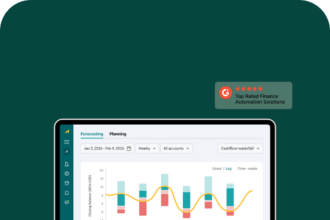
In this post , I will talk about Best Software for Cloud Identity Governance and how it assists businesses in optimizing the management of user identities, access rights, and the associated regulations.
- Key Points & Best Software For Cloud Identity Governance
- 10 Best Software For Cloud Identity Governance
- 1. SailPoint IdentityIQ
- 2. Okta Identity Governance
- 3. Microsoft Entra ID Governance
- 4. IBM Security Verify Governance
- 5. Oracle Identity Governance
- 6. Saviynt Enterprise Identity Cloud
- 7. Ping Identity Governance
- 8. One Identity Manager
- 9. Apono
- 10. CyberArk Identity Governance
- How To Choose Best Software for Cloud Identity Governance
- Cocnsluion
- FAQ
Tools of cloud identity governance streamline the automation of provisioning, access reviews, and policy compliance, while also enhancing security and minimizing risks.
Selecting appropriate software means smooth integration, compliance with regulations, and the safety of sensitive information in cloud and hybrid ecosystems.
Key Points & Best Software For Cloud Identity Governance
| Software | Key Point |
|---|---|
| SailPoint IdentityIQ | Comprehensive identity lifecycle management with strong compliance and certification features |
| Okta Identity Governance | User-friendly cloud-native platform offering automated access requests and reviews |
| Microsoft Entra ID Governance | Deep integration with Microsoft ecosystem and advanced conditional access policies |
| IBM Security Verify Governance | Robust role-based access control with strong audit and reporting capabilities |
| Oracle Identity Governance | Enterprise-grade scalability with automated provisioning and compliance workflows |
| Saviynt Enterprise Identity Cloud | Cloud-first governance solution with strong support for non-human identities |
| Ping Identity Governance | Flexible integration options across hybrid and multi-cloud environments |
| One Identity Manager | Strong role-based governance with customizable workflows and analytics |
| Apono | Granular access control for ephemeral workloads, APIs, and bots |
| CyberArk Identity Governance | Privileged access governance with strong focus on securing high-risk accounts |
10 Best Software For Cloud Identity Governance
1. SailPoint IdentityIQ
SailPoint IdentityIQ is an enterprise-grade identity governance solution that streamlines user access, compliance, and security within complex IT ecosystems.
Automated access certification, policy enforcement, and role management maintain security on critical resources.
AI-powered analytics pinpoint detrimental behaviors and compliance risks, assisting organizations in mitigating security risks.
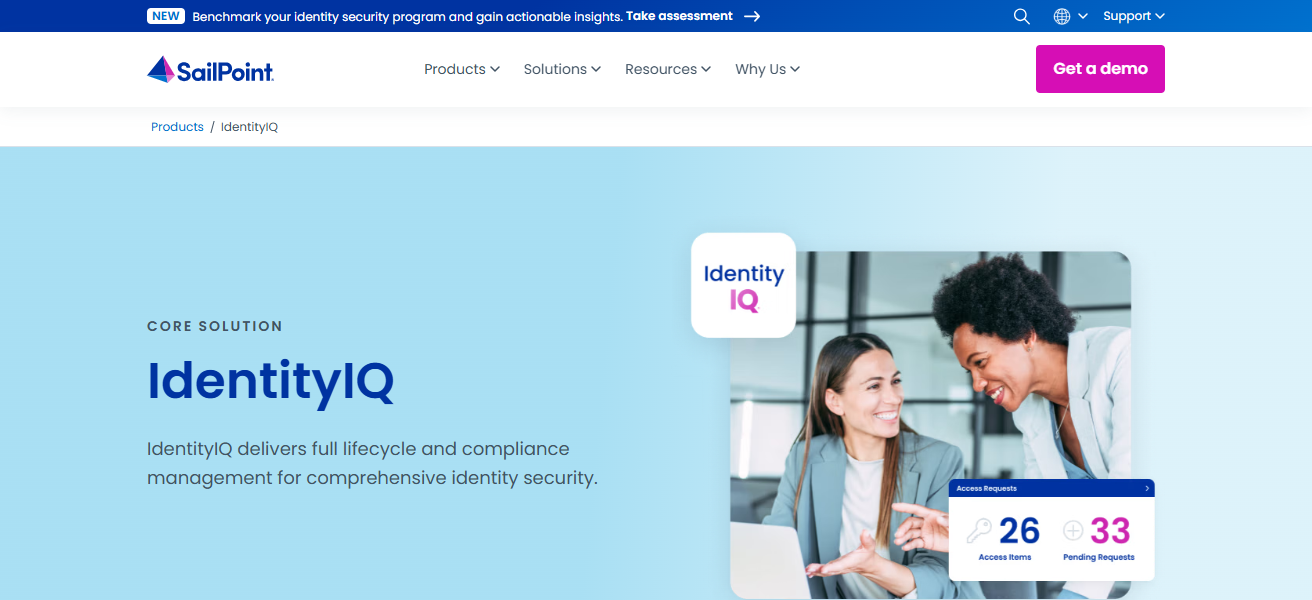
SailPoint can integrate with almost any application, whether on-premises or in the cloud. It can also provision and deprovision user accounts to optimize IT workflows.
IdentityIQ is the best choice for large organizations that need a centralized, scalable identity governance solution that adheres to compliance requirements.
SailPoint IdentityIQ Features
- Automated Access Certifications: Reduces risk and ensures ongoing compliance by streamlining reviews of user rights.
- Role & Policy Management: Defines and enforces policies, roles, and access controls across all systems.
- Access Request & Provisioning: Access workflows for users and automates provisioning and deprovisioning.
- Risk Analytics & Reporting: Automated reporting and analytics tools for assessment of risk and access.
| Pros | Cons |
|---|---|
| Comprehensive identity governance with strong compliance and audit capabilities. | Can be complex and costly for small organizations. |
| Excellent automated access certifications, role management, and analytics. | Requires skilled administrators; steep learning curve. |
| Supports hybrid environments (cloud + on‑prem) with deep integrations. | Implementation timelines can be long for large enterprises. |
| Advanced risk insights help reduce security threats proactively. | UI/UX is not as modern or intuitive as newer cloud‑native platforms. |
2. Okta Identity Governance
Okta Identity Governance provides an innovative solution for identity management that focuses on secure access and compliance automation.
With its cloud-native identity management solution, Okta combines lifecycle management, access requests, and adaptive authentication to help organizations manage and streamline their access control.
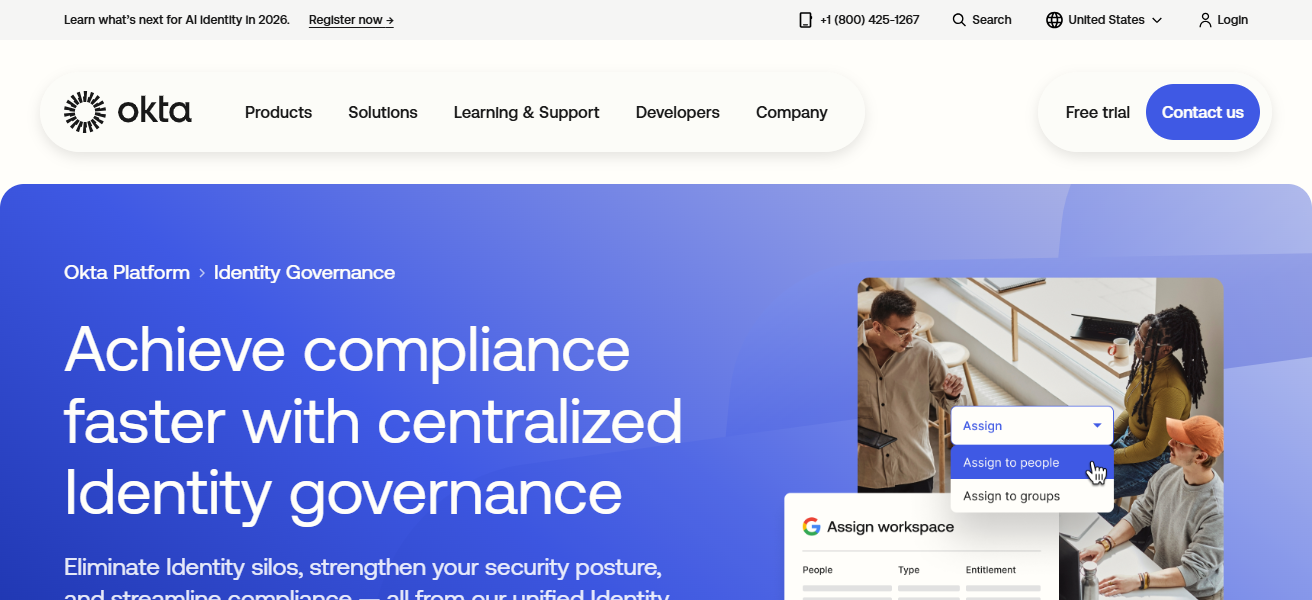
Okta customers also enjoy automated provisioning, access approvals and reviews aligned to policies, and access rights that are adjusted over time.
Okta also provides extensive integration with thousands of cloud and on-premises systems, supports single sign-on (SSO), and multi-factor authentication (MFA) in order to enhance security. Okta provides analytics and reporting features to monitor access and streamline identity governance.
Okta Identity Governance Features
- Lifecycle Management: Modernized user provisioning and de-provisioning across the organizations and their applications.
- Access Request & Approval Workflows: Provides end-users with the ability to request access and workflows with a series of configurable approval steps.
- Adaptive Multi‑Factor Authentication (MFA): Provides authentication mechanisms to user based on the risk of the transaction.
- Integration Catalog: Interoperates with numerous cloud and on-premises applications for holistic management.
| Pros | Cons |
|---|---|
| Cloud‑native platform with seamless integration with thousands of applications. | Premium features may require additional licenses and cost. |
| Strong lifecycle automation and adaptive authentication capabilities. | Governance features are still maturing compared to legacy IGA tools. |
| Easy setup and administration with modern interface. | Some complex access policies may need custom development. |
| Great single sign‑on (SSO) and multi‑factor authentication (MFA) support. | Limited advanced analytics compared to competitors. |
3. Microsoft Entra ID Governance
Microsoft Entra ID Governance (previously Azure AD Identity Governance) supports businesses in controlling user identities, roles, and access within Microsoft and external systems.
These includes identity management, access review, and entitlement management, which provide organizations the ability to control access on a more granular basis.
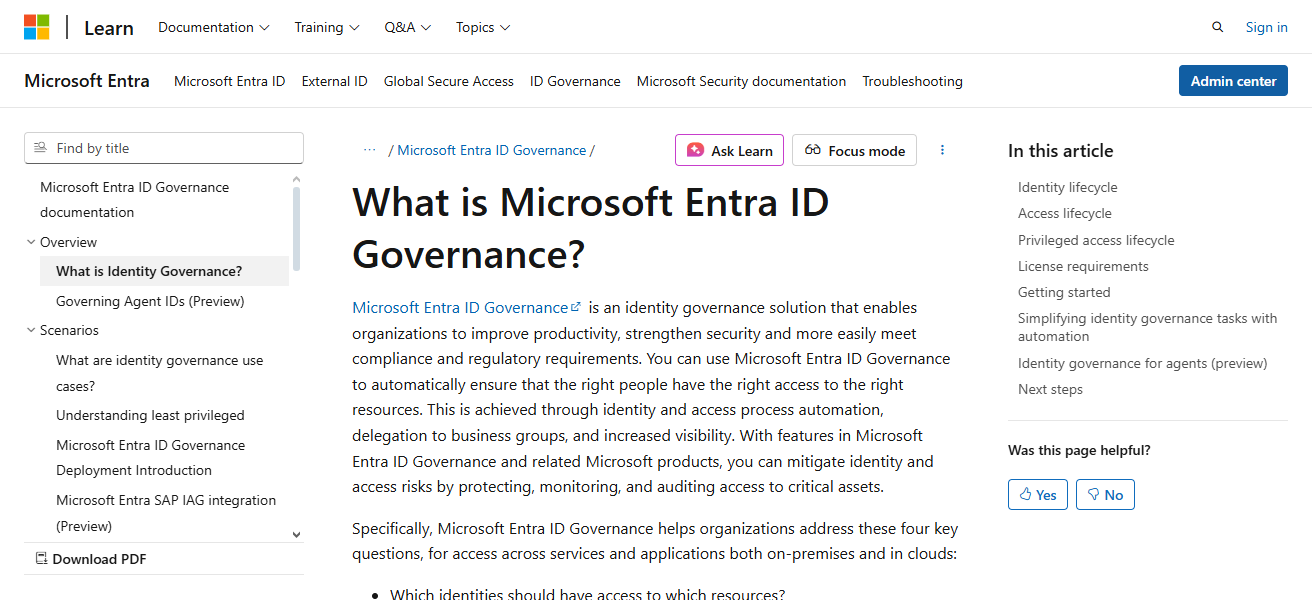
The integration with Microsoft 365 and Azure provides tighter controls to organizations during employee onboarding and offboarding to adhere to compliance regulations, such as the GDPR.
Entra deploys risk-based alerts, automated workflows, and other controls to support conditional access and mitigate the risks of unauthorized access.
Entra’s identity governance is also a great fit for organizations that are cloud-first and looking for a solution that is secure and scalable.
Microsoft Entra ID Governance Features
- Access Reviews: Scheduled and ad hoc reviews to identify and eliminate redundant and misaligned access.
- Entitlement Management: Access packages and policies for external and internal team members are simplified.
- Conditional Access Policies: These are based on rules such as region or device used to log in.
- Privileged Identity Management (PIM): Safeguards and logs elevated access for admin and critical positions.
| Pros | Cons |
|---|---|
| Tight integration with Microsoft 365 and Azure cloud services. | Best suited for Microsoft ecosystems — limited appeal outside Azure environments. |
| Includes access reviews, entitlement management, and privileged identity controls. | Can be expensive if multiple Entra Premium licenses are required. |
| Strong compliance reporting and conditional access policies. | Some features require advanced configuration expertise. |
| Familiar interface for Microsoft administrators. | Limited third‑party integrations compared to standalone IGA solutions. |
4. IBM Security Verify Governance
IBM Security Verify Governance gives a business a complete solution for the management of the identity lifecycle along with access supervision.
It focuses on the automation of the processes of user provisioning, access requests, access certifications, and regulation compliance.
AI within the platform enhances security by detecting anomalies and potential insider threats as well as segregation of duty violations.
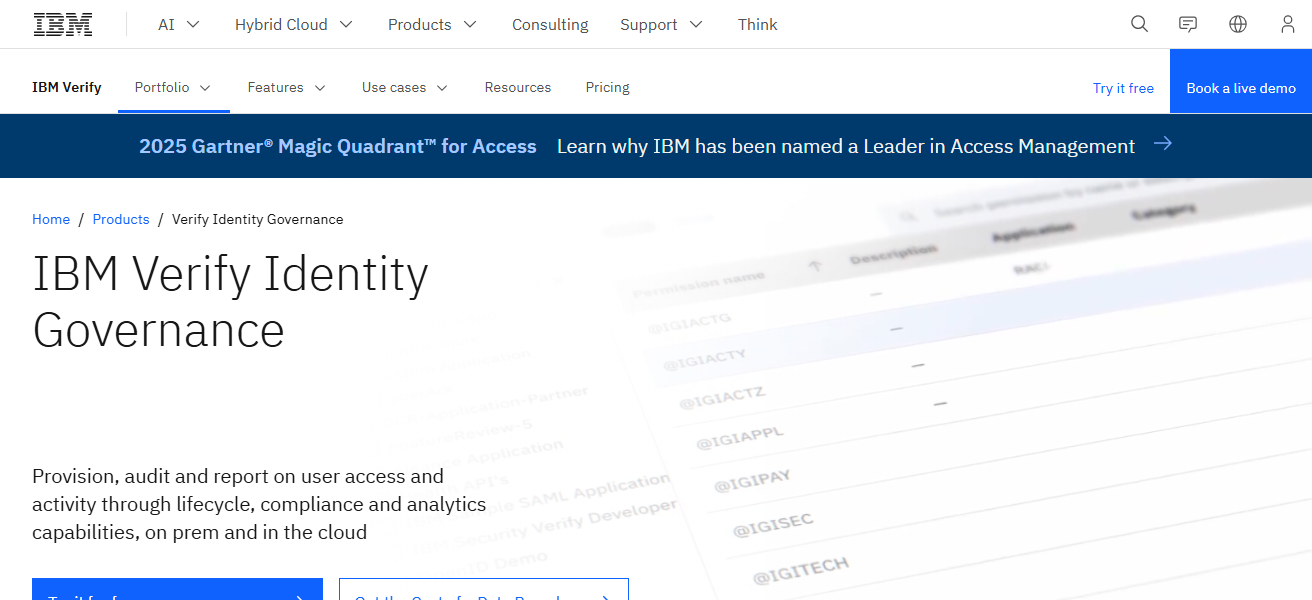
Verify Governance provides support for cloud and on-prem environments and integrates with a variety of enterprise apps. It provides organizations with centralized visibility concerning user access.
Its analytics and reporting capabilities provide organizations the ability to implement more informed decision making with access policies.
This solution is built for large-scale enterprises and is focused on providing solid governance, risk management, and compliance.
IBM Security Verify Governance Features
- Identity Lifecycle Automation: Automates processes related to onboarding and offboarding as well as changes.
- AI‑Driven Risk Insights: Uses analytics to recognize and report abnormal and/or dangerous access patterns.
- Segregation‑of‑Duties (SoD): Helps to avoid overlapping access rights that can result in security risks.
- Comprehensive Compliance Reports: Custom and pre-built audit reports are available.
| Pros | Cons |
|---|---|
| Strong enterprise‑grade governance and compliance capabilities. | Can be complex to deploy for smaller or mid‑market organizations. |
| AI‑driven analytics helps detect risky access and insider threats. | Licensing and pricing structure can be difficult to navigate. |
| Integrates well across hybrid infrastructures (cloud + on‑prem). | UI may feel dated and less intuitive than newer competitors. |
| Flexible policy enforcement and access control features. | Support and consulting services may add to total cost. |
5. Oracle Identity Governance
Oracle Identity Governance provides an enterprise grade solution to automate user access security, identity management, and compliance management.
It provides automation for provisioning, deprovisioning, and user lifecycle processes, which lowers administrative overhead and errors.
It also supports RBAC, policy management, and analytical identities, which identify and mitigate problematic access risks.
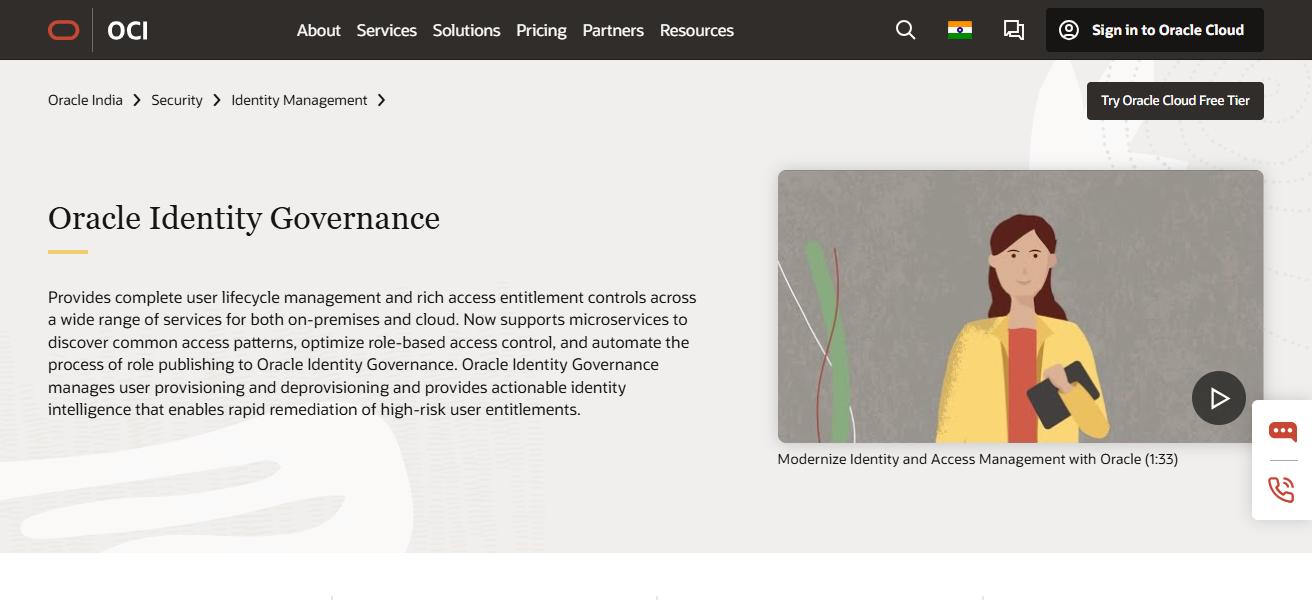
The cloud-native design allows for integration with cloud and on-premises applications. It also provides reporting and auditing functionality.
The solution has advanced scalability, making it ideal for larger organizations with sophisticated identity governance requirements. Its compliance and security focus protects sensitive business information.
Oracle Identity Governance Features
- Role Lifecycle Management: Streamlines the processes involved in adding and managing roles and assigning entitlements.
- Access Requests with Workflow: Users are able to make access requests through automated processes that are governed by policy.
- Policy & Risk Analytics: Access patterns are analyzed to identify and mitigate risks and to monitor policy compliance.
- Hybrid Integration: Provides governance across cloud SaaS and on-premises applications.
| Pros | Cons |
|---|---|
| Highly scalable — built for large enterprises. | High cost and implementation complexity. |
| Advanced role management and compliance enforcement. | Requires experienced consultants for full deployment. |
| Good support for hybrid environments and extensive connectors. | Upgrades and maintenance can be resource‑intensive. |
| Strong automated provisioning and audit reporting. | User interface is not as modern as some cloud‑native competitors. |
6. Saviynt Enterprise Identity Cloud
Saviynt Enterprise Identity Cloud encompasses all the important aspects of modern identity governance and administration (IGA) solutions—security, compliance, and operational efficiency.
It offers automated actions such as Role Lifecycle Management, Policy Management, Access Certification, and Provisioning.
Using AI and advanced analytics, Saviynt identifies access risks, insider threats, and Segregation of Duties (SoD) violations.
The solution supports hybrid cloud ecosystems and integrates with SaaS, cloud, and on-prem applications.
The intuitive cloud UI coupled with flexible process templates enable governance automation. In built analytics and report generation supports compliance for audits.
Saviynt is impressive for firms needing sophisticated, flexible, and scalable identity governance solutions.
Saviynt Enterprise Identity Cloud Features
- Cloud‑Native Architecture: Designed for SaaS, hybrid, and cloud-only technologies incorporating scalable microservices.
- Fine‑Grained Access Controls: Provides the ability to set limits and conditions to privileges based on business requirements.
- Dynamic Risk Scoring: Adjusts risk scoring based on the analysis of user activity and access behavior.
- SoD Enforcement: Automated policies apply to SoD restriction violations.
| Pros | Cons |
|---|---|
| Cloud‑native and highly flexible identity governance platform. | May require significant tuning for complex enterprise policies. |
| Excellent analytics with risk‑based access insights. | Training needed to fully leverage advanced feature sets effectively. |
| Supports SaaS, cloud, and on‑prem integrations with strong visibility. | Pricing can be high for mid‑sized businesses. |
| Effective segregation‑of‑duties (SoD) and compliance automation. | Some customers may find onboarding processes lengthy. |
7. Ping Identity Governance
Ping Identity Governance helps organizations manage identities and secure access in the cloud and on the premises.
Its features include comprehensive lifecycle management, access request and automated provisioning workflows, which ensure access is restricted to authorized users.
With risk-based authentication and policy enforcement, Ping reduces security threats and improves compliance.
Its platform provides integration with applications, directories, and cloud services, providing organizations with central control and visibility over user identities.
Organizations can use advanced reporting and analytics to monitor access, identify behavioral anomalies, and manage and remediate access in a timely manner.
Organizations looking to improve user experience while managing and securing identities will benefit from using Ping Identity Governance.
Ping Identity Governance Features
- Governance and Authentication: Merges governance to identity with powerful SSO and MFA.
- Access Policy: Access is granted based on device, location, and risk.
- Governance Automation: User provisioning and application updates are automated.
- Real Time Monitoring: Access patterns are monitored to discover anomalies and gaps in compliance.
| Pros | Cons |
|---|---|
| Unified identity and access management with governance features. | Governance features are less feature‑rich than IGA‑focused competitors. |
| Strong authentication, federation, and SSO capabilities. | Best value when used with other Ping products; standalone governance limited. |
| Good support for multi‑cloud environments. | Reporting and analytics could be deeper. |
| Flexible access policies based on risk and context. | Implementation may require specialist expertise. |
8. One Identity Manager
Advanced analytics from One Identity Manager assists organizations in identifying issues such as access rights, user identities, and compliance in hybrid IT landscapes.
One Identity Manager also incorporates automated provisioning and policy management, role-based access control, and removal-and-certification-audit access.
One Identity Manager’s sophisticated analytics assists in identifying potential risks, conflicts in the segregation of duties, and abnormal access.
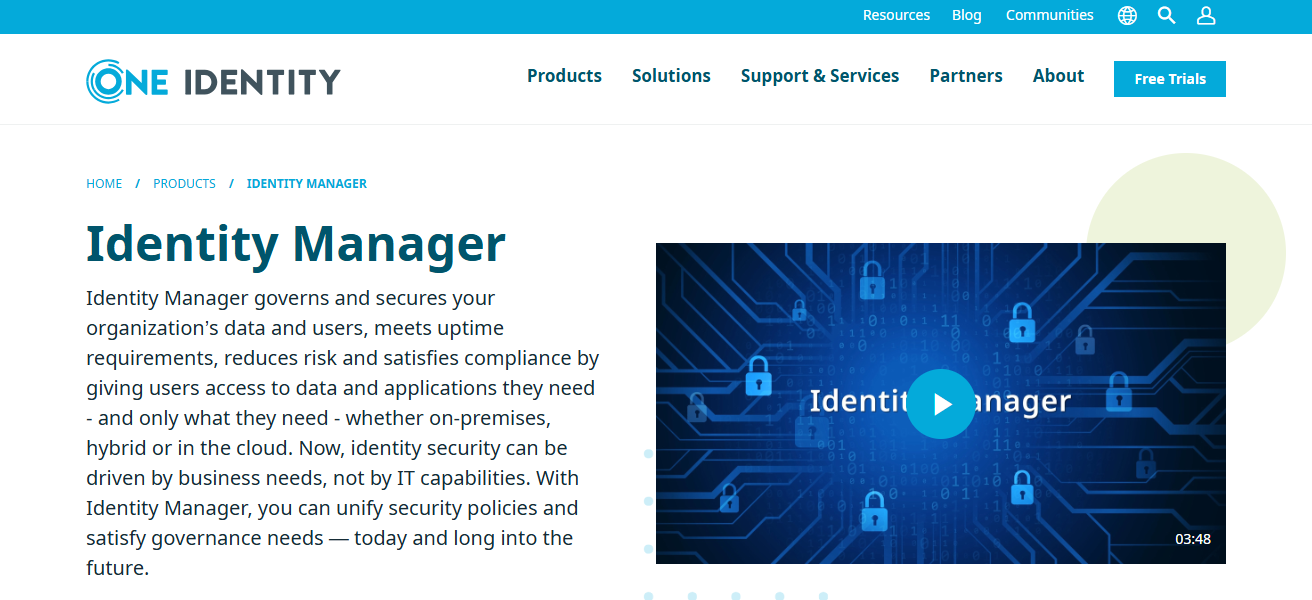
One Identity Manager helps quicken the processes and cut down the costs associated with managing identities in an on-premises and cloud integrated framework.
One Identity Manager’s adaptable design is excellent for large organizations looking for a single system for compliance, security, and identity governance.
One Identity Manager Features
- Automated Provisioning: Automation of permission assignments and account lifecycle management.
- Role and Policy Enforcement: Business roles and access policies are defined and enforced.
- Access Certification Campaigns: Compliance gaps are managed with access reviews.
- Flexible Integration: Cloud, on-prem, and hybrid ecosystems are supported.
| Pros | Cons |
|---|---|
| Powerful identity governance and administration with strong policy control. | Setup can be complex and time‑consuming. |
| Excellent automation in provisioning and access workflows. | Not as cloud‑native; more hybrid focus. |
| Supports fine‑grained access controls and compliance reporting. | Learning curve for non‑technical users. |
| Flexible architecture with broad application support. | UI/interface less modern than newer competitors. |
9. Apono
Apono is a new player in the identity governance realm that is streamlining access management for modern businesses.
Automated provisioning, role-based access control (RBAC), and continuous access monitoring help the closing of security and compliance gaps.
The company’s cloud-native governance design and hybrid environments analytics provide seamless integrations with SaaS applications, and identifies risk access, unauthorized changes, and potential insider threats.
The customer management governance design enables identity management access requests and approvals.
For modern, lightweight, and scalable identity governance, Apono provides the ideal solution, with a focus on security, usability, and operational efficiency.
Apono Features
- Identity Management: Provides an easy to use interface to help teams manage user access.
- Role & Policy Enforcement: Roles and policies can be defined using easy to understand rules.
- Access Monitoring: Access is monitored and so is the usage which determines when recertification is needed.
- Cloud-First: Flexible and responsive design primarily for modern SaaS with hybrid systems.
| Pros | Cons |
|---|---|
| Modern cloud‑native design with simple user experience. | Relatively new entrant with smaller ecosystem. |
| Automated provisioning and access monitoring. | Fewer integrations compared to legacy IGA vendors. |
| Scalable and cost‑efficient for mid‑market organizations. | Limited advanced analytics for large enterprise use cases. |
| Easy role‑based access and policy management. | Smaller community and less documentation than older competitors. |
10. CyberArk Identity Governance
Privileged access management (PAM) combined with identity governance (IG) helps protect sensitive systems and data with CyberArk Identity Governance.
CyberArk automates the management of account lifecycles, access provisioning, and policies, as well as the enforcement of standard and privileged policies.
CyberArk ensures continual monitoring of access actions, detects and respond to potential threats, and automates segregation of duties policies.
CyberArk’s capabilities cover cloud, SaaS, and on-premise applications to provide visibility and centralized control.
With advanced analytics, CyberArk helps organizations comply with regulations like SOX and GDPR.
CyberArk Identity Governance fits enterprises with a need for solid privileged access security, risk management, compliance, and optimized workflows in identity management.
CyberArk Identity Governance Features
- Privileged Access Governance: Securing, monitoring, and auditing of privileged accounts.
- Identity Lifecycle Automation: Includes automation for provisioning, deprovisioning, and access modification.
- Session Monitoring & Recording: For audit and risk tracking, captures details of privileged sessions.
- Risk & Compliance Analytics: Analytics on identity risk, entitlement exposure, and gaps in governance.
| Pros | Cons |
|---|---|
| Combines privileged access management (PAM) with identity governance. | Can be expensive due to PAM + IGA combined licensing. |
| Strong security for privileged and sensitive accounts. | Implementation complexity is high without experienced teams. |
| Real‑time monitoring and risk detection for user access. | Focus is more on privileged access — less suited for general user governance needs. |
| Excellent audit trails and compliance reporting. | Less user‑friendly for basic governance workflows compared to pure IGA tools. |
How To Choose Best Software for Cloud Identity Governance
Identify Business Requirements. Specify the access management, compliance reporting, and privileged account features.
Integration Compatibility. Check how well it connects to cloud, SaaS, and on-prem applications.
Security and Compliance. Check the support of your compliance controls, policies, and regulatory segregation.
Automation and Workflow. Provisioning and deprovisioning, and access request processing, should be fully automated to eliminate manual error.
User Experience. Favor products that have intuitive dashboards and easy admin controls for overall ease of use.
Analytics and Risk Intelligence. Choose software that provides reports on compliance, risks, and other anomalies.
Scalability and Performance. Check the platform’s ability to grow with your users, applications, and enterprise functions.
Deployment Flexibility. Choose software that gives you cloud, hybrid, or on-prem to align your overall IT strategy.
Vendor Support and Reliability. Check the vendor’s reputation in security governance support, documentation, training.
Total Cost of Ownership. Assess your org’s needs vs. licensing, implementation and support costs with your org’s budgets.
Cocnsluion
In cocnsluion Choosing the Best Software for Cloud Identity Governance is a good choice for streamlining access control and user identification management and regulatory compliance.
The best fit streamlines the automation on provisioning, access reviews, risk detection and integrates with both cloud and on-prem systems.
With a provider that fits the dimension, complexity, and security requirements of your organization, you will safeguard your organization’s sensitive information and streamline the management of identities.
FAQ
It’s the process of managing user access, identities, and compliance in cloud environments.
It ensures security, prevents unauthorized access, and helps meet regulatory compliance requirements.
Enterprises, IT teams, and organizations managing multiple cloud and on-prem applications.
Yes, most offer connectors for SaaS apps, cloud services, and on-prem directories.