In this article, I will discuss the concept of Sovereign Cloud Platforms for Guaranteed Enterprise Data Privacy, focusing on how these platforms help organizations keep sensitive data within national boundaries.
- Key Points & Sovereign Cloud Platforms for Guaranteed Enterprise Data Privacy
- 10 Sovereign Cloud Platforms for Guaranteed Enterprise Data Privacy
- 1. Microsoft Cloud
- 2. Google Sovereign Cloud
- 3. Amazon Web Services (AWS) Sovereign Cloud
- 4. IBM Cloud for Sovereignty
- 5. Oracle Sovereign Cloud
- 6. SAP Sovereign Cloud
- 7. Gcore Sovereign Cloud
- 8. Capgemini Sovereign Cloud
- 9. T-Systems Sovereign Cloud (Deutsche Telekom)
- 10. Orange Sovereign Cloud
- Cocnlsuion
- FAQ
I will explore major providers, their features, and how they ensure compliance, security, and control, enabling enterprises to protect critical information while meeting strict regulatory and data sovereignty requirements.
Key Points & Sovereign Cloud Platforms for Guaranteed Enterprise Data Privacy
Microsoft Cloud for Sovereignty Ensures compliance with national regulations, offering localized data residency and advanced enterprise-grade privacy controls.
Google Sovereign Cloud Provides jurisdictional control, strong encryption, and AI-driven compliance monitoring for sensitive enterprise workloads globally.
Amazon Web Services (AWS) Sovereign Cloud Delivers secure infrastructure with region-specific governance, ensuring enterprises meet strict residency and sovereignty requirements.
IBM Cloud for Sovereignty Combines hybrid cloud flexibility with strong compliance frameworks, enabling enterprises to protect regulated industry data.
Oracle Sovereign Cloud Offers enterprise-grade privacy, localized governance, and advanced database security tailored for compliance-critical organizations worldwide.
SAP Sovereign Cloud Integrates enterprise applications with sovereign infrastructure, ensuring GDPR compliance and secure data residency across jurisdictions.
Gcore Sovereign Cloud Focuses on European compliance, offering localized hosting, strong encryption, and guaranteed sovereignty for enterprise-sensitive workloads.
Capgemini Sovereign Cloud Provides consulting-driven sovereign solutions, ensuring enterprises meet evolving regulatory requirements with secure infrastructure management.
T-Systems Sovereign Cloud (Deutsche Telekom) Specializes in German and EU compliance, offering secure hosting and strict jurisdictional control for enterprise data.
Orange Sovereign Cloud Delivers French and EU-compliant infrastructure, ensuring enterprises maintain sovereignty and privacy for sensitive workloads.
10 Sovereign Cloud Platforms for Guaranteed Enterprise Data Privacy
1. Microsoft Cloud
Microsoft provides enforcement of compliance and data privacy legislation with the Dept. of Defense Cloud. It focuses on the Microsoft Cloud Solution of data sovereignty by division of storage into distinct geopolitical zones.
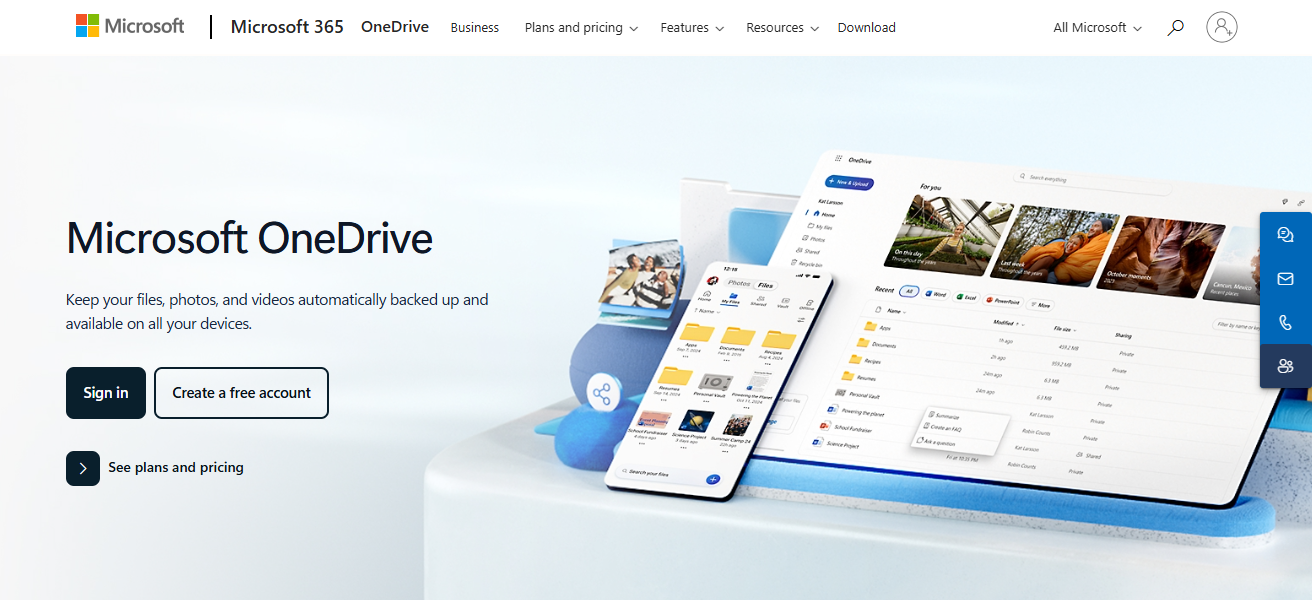
Microsoft reinforces data sovereignty by providing clients with the controls necessary to manage the security and compliance of cloud data.
Highly regulated industries (Health Care, Defense, Financial Services) with the DOD/SOV Cloud are leveled with Microsoft Cloud’s Gov Cloud capabilities and Microsoft Cloud’s Azure services.
| Pros | Cons |
|---|---|
| Strong compliance with global and local regulations | Higher cost for dedicated sovereign regions |
| Deep integration with Azure services and tools | Complexity in setup and governance |
| Advanced security, encryption, and identity management | Limited availability in some countries |
| Suitable for highly regulated industries | Vendor lock-in risk |
2. Google Sovereign Cloud
Google’s Sovereign Cloud solution uses the Google Cloud infrastructure but with additional isolation and sovereignty controls.
Customers maintain complete control and governance on analytics and data. Data privacy, compliance, and regulatory frameworks are reinforced with the additional Geo zone isolation, data residing in specific cloud regions.
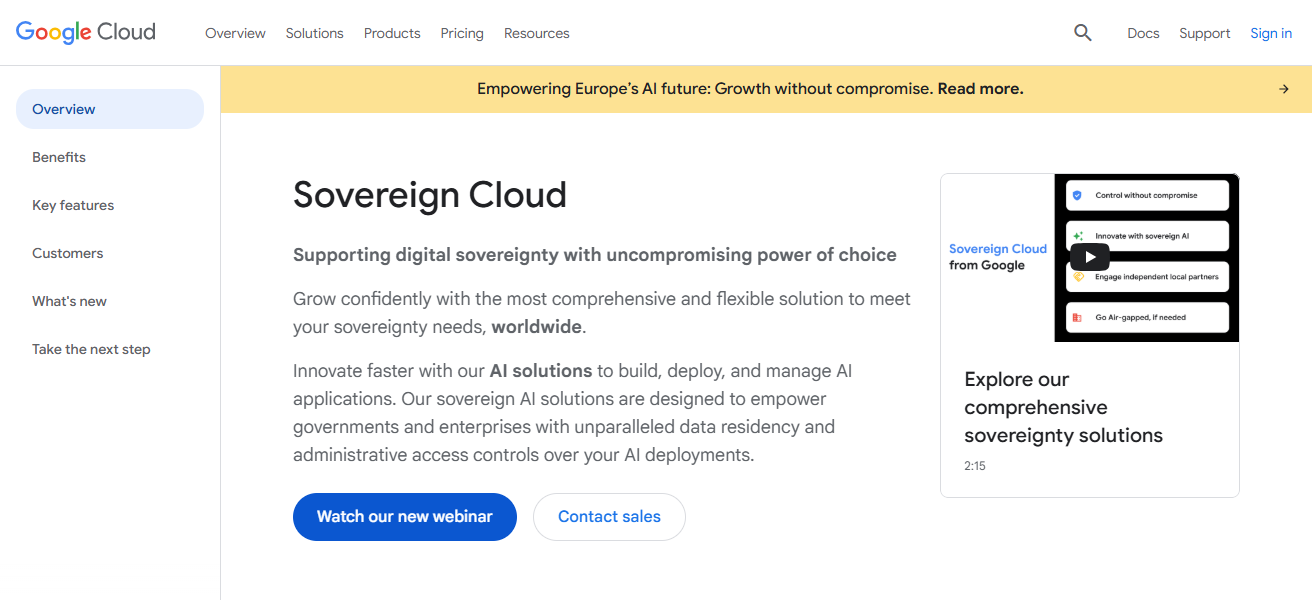
AI, analytics, and security are wrapped in the solution to provide data residency with control, lifecycle management, and processing for Government and Enterprise workloads.
| Pros | Cons |
|---|---|
| Powerful AI, analytics, and data processing tools | Fewer sovereign regions compared to competitors |
| Strong data isolation and residency controls | Dependence on Google ecosystem |
| High-performance infrastructure | Compliance offerings still evolving in some regions |
| Flexible and scalable architecture | Limited enterprise legacy integration |
3. Amazon Web Services (AWS) Sovereign Cloud
AWS Sovereign Cloud caters to enterprise customers that have strict data residency and compliance needs by providing an isolated cloud region.
AWS Sovereign Cloud utilizes its own scalable cloud infrastructure while staying within legal compliance and data residency to allow customers to process and store data in AWS Sovereign Cloud’s region specific data centers.
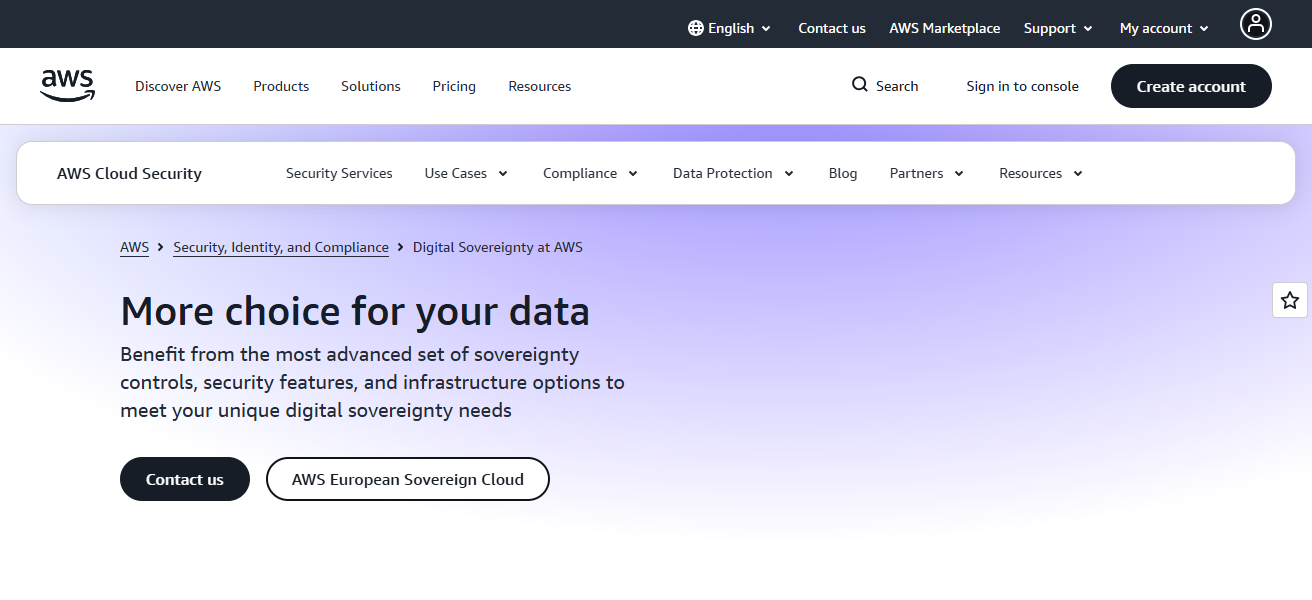
AWS provides customers security, identity and access management, and compliance monitoring services designed to meet enterprise customers’ sovereign cloud needs.
AWS Sovereign Cloud also provides customers the flexibility to utilize AWS global cloud services and regional compliant cloud service ecosystem
While maintaining compliance to specific enterprise industry cloud computing services in healthcare, finance, and government.
| Pros | Cons |
|---|---|
| Highly scalable and reliable infrastructure | Complex pricing structure |
| Wide range of cloud services and tools | Steep learning curve |
| Strong compliance certifications | Data sovereignty offerings still expanding |
| Global presence with regional control | Can be costly for small enterprises |
4. IBM Cloud for Sovereignty
IBM Cloud for Sovereignty is designed for organizations that require the highest level of control over sensitive data and the associated requirements of compliance with national privacy laws.
It achieves this by integrating IBM hybrid cloud with country-specific dedicated cloud regions for the purpose of data isolation.
Enterprises can use this cloud service to perform and manage sensitive workloads with the highest degree of control, data security, and privacy, as well as compliance with government regulations, including those that apply to healthcare and finance.
The cloud service also provides data governance and management tools that allow enterprises to manage cloud-based workloads in a transparent and auditable manner.
| Pros | Cons |
|---|---|
| Strong hybrid cloud capabilities | Smaller ecosystem compared to AWS/Azure |
| High-level security and encryption features | Higher implementation complexity |
| Focus on regulated industries | Slower innovation pace |
| Transparent governance and compliance tools | Limited scalability in some regions |
5. Oracle Sovereign Cloud
Oracle Sovereign Cloud, in compliance with strict data sovereignty requirements, guarantees that data management and storage for enterprise customers is fully compliant with the country of the customer’s choice.
This is achieved by combining Oracle sovereign compliant country-specific infrastructure with Oracle’s autonomous cloud services.
Oracle provides its customers’ enterprises with computing, data management, and analytics services, as well as control over the data access and lifecycle policies,
Which Oracle provides to customers in order to meet the requirements of highly regulated industries. Oracle Cloud services also serve governments and other enterprises that prefer to have the highest degree of control over the data while utilizing high performance cloud services.
| Pros | Cons |
|---|---|
| Excellent database and enterprise application support | Limited third-party integrations |
| High performance and automation features | Smaller global cloud footprint |
| Strong compliance and data residency controls | Less flexibility compared to AWS/Azure |
| Ideal for Oracle-based workloads | Can be expensive |
6. SAP Sovereign Cloud
SAP’s Sovereign Cloud aims to provide enterprise-grade software solutions and full regional data sovereignty privacy and compliance.
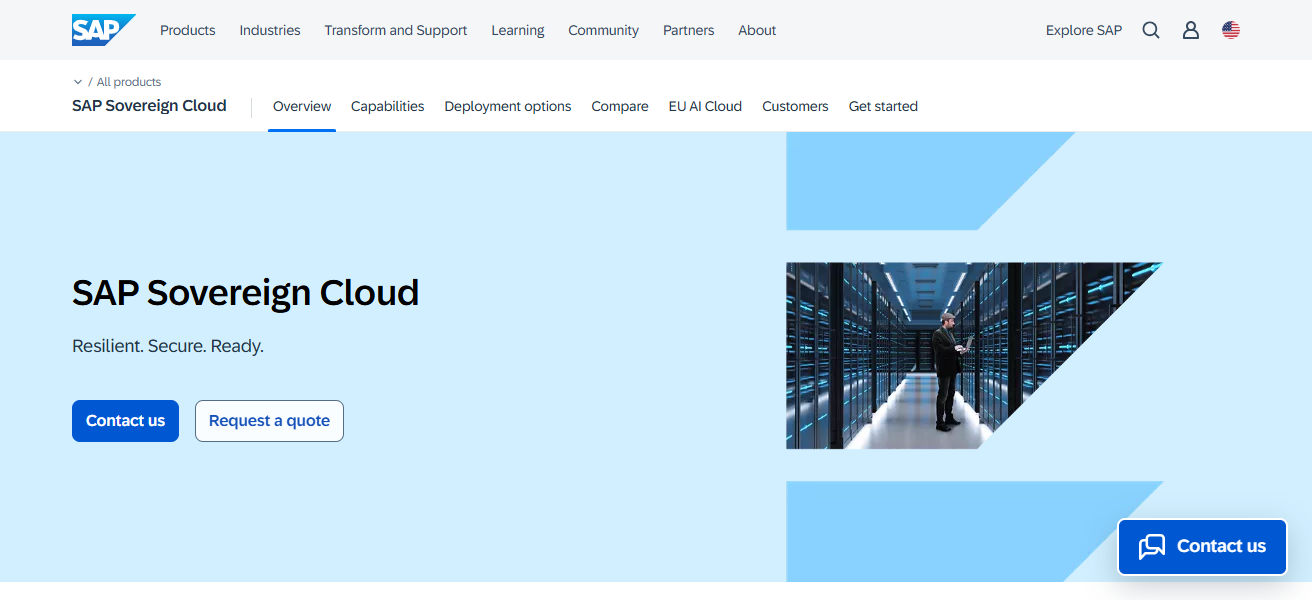
With regionally separated data centers, SAP enables organizations to securely run mission-critical applications like ERP, supply chain, and analytics.
The focus is on control, governance, and protection of enterprise data, allowing organizations to be compliant with data laws without compromising on scalability, operational productivity, and integration with SAP’s advanced cloud technology.
| Pros | Cons |
|---|---|
| Optimized for ERP and enterprise applications | Limited use outside SAP ecosystem |
| Strong compliance and governance features | High cost of implementation |
| Seamless integration with SAP products | Less flexibility for custom workloads |
| Supports mission-critical business processes | Dependency on SAP stack |
7. Gcore Sovereign Cloud
Gcore Sovereign Cloud offers enterprises and government entities self-controlled cloud solutions that meet data residency and privacy requirements.
The cloud platform provides self-governing data storage, secure networking, and enterprise-grade encryption.
Gcore streamlines high-performance computing, CDN, and analytics workloads within self-governing data, ensuring sensitive data is inaccessible.
Its services are dedicated to those self-governing data, cloud computing, regulatory adherence, and flexible solutions.
| Pros | Cons |
|---|---|
| Strong CDN and edge computing capabilities | Smaller market presence |
| Good performance for content delivery workloads | Limited enterprise service portfolio |
| Flexible and scalable infrastructure | Fewer global compliance certifications |
| Cost-effective compared to larger providers | Less brand trust for large enterprises |
8. Capgemini Sovereign Cloud
Capgemini’s Sovereign Cloud solutions provide enterprises end-to-end cloud services with full data residency and compliance guarantees.
It integrates Capgemini’s consulting and managed services with secure, region-specific cloud infrastructure to support sensitive workloads’ digital transformation.
The platform is designed to empower data governance, encryption, and identity management to the controlling country’s regulations.
It is designed for the public sector, finance, and healthcare industries and promotes imaginative, secure cloud data innovative controlling.
| Pros | Cons |
|---|---|
| Strong consulting and managed services support | Relies on partner cloud infrastructure |
| Tailored solutions for enterprises | Not a native cloud provider |
| Focus on compliance and governance | Potential vendor dependency |
| Ideal for digital transformation projects | Higher service costs |
9. T-Systems Sovereign Cloud (Deutsche Telekom)
T-Systems offers sovereign cloud services that focus on data protection and data compliance services in Europe.
In order to meet specific legal and regulatory frameworks, T-Systems provides clients with dedicated infrastructure and regions.
Clients have access to high-security cloud offers, high-security cloud encryption, and compliance cloud monitoring. T-Systems Sovereign Cloud Services are ideal for government and sensitive data cloud storage.
Clients’ data is not transferred outside of the region, which is a requirement for the use of the Cloud Services offered by T-States.
| Pros | Cons |
|---|---|
| Strong European data protection compliance | Limited global reach |
| High-security infrastructure | Less flexibility outside Europe |
| Backed by Deutsche Telekom reliability | Smaller ecosystem compared to hyperscalers |
| Suitable for government and regulated sectors | Limited service variety |
10. Orange Sovereign Cloud
Orange Sovereign Cloud services ensure that Enterprises’ data is stored in a specific territorial or regional storage requirement.
Cloud Services offered by Orange adhere to the strict data privacy protection laws in the country of the client.
Cloud services offered by Orange are focused on cloud storage, cloud networking, and sensitive workloads cloud computing.
In a regulated industry, Orange helps with data management (governance), control and monitoring (auditing compliance), and data protection.
By offering Sovereign Cloud Infrastructure and Cloud Services, Orange provides data protection jurisdictional compliance and an innovation platform to Enterprises.
| Pros | Cons |
|---|---|
| Strong focus on data privacy and sovereignty | Limited global infrastructure |
| Reliable telecom-backed infrastructure | Fewer advanced cloud-native services |
| Good for regulated industries | Smaller ecosystem |
| Emphasis on security and compliance | Less innovation compared to hyperscalers |
Cocnlsuion
Regarding the above, sovereign cloud solutions give enterprises the ability to safeguard sensitive data in accordance with strict compliance and jurisdictional requirements.
These solutions give privacy-conscious organizations the ability to strengthen control, improve transparency, and ensure data residency.
As the digital transformation impetus grows, the correct sovereign cloud approach strikes the right balance between innovation, compliance, and security to privacy conscious organizations.
FAQ
Offers tools for data control, compliance, and transparency across regions.
Provides regionalized infrastructure with strong encryption and policy controls.
Focuses on strict EU data residency and operational independence.
Public cloud services may store data globally, while sovereign clouds strictly limit data to specific jurisdictions and enforce local compliance laws.