
In this article, I will explore how Crypto AI Tools That Automate Complicated Strategies are changing trader’s approach to managing digital assets.
- Key Points & Crypto AI Tools That Automate Complex Strategies
- 10 Crypto AI Tools That Automate Complex Strategies
- 1. Numerai Signals
- 2. Fetch.ai
- 3. Token Metrics
- 4. Autonio
- 5. SingularityDAO
- 6. Kryll.io
- 7. Covesting
- 8. 3Commas
- 9. NapBots
- 10. Hummingbot
- How To Choose Crypto AI Tools That Automate Complex Strategies
- Conclsuion
- FAQ
These tools incorporate artificial intelligence to bypass the need for human involvement in processes such as analyzing the market, generating predictive signals, executing trades, and making real-time decisions.
Advanced algorithms and extensive backtesting, as well as real-time data, help traders, whether novices or experts, in optimizing their strategies, reducing the repetitive tasks, and enhancing their decision-making in the fast moving crypto market.
Key Points & Crypto AI Tools That Automate Complex Strategies
Numerai Signals AI-powered hedge fund platform crowdsources trading signals, optimizing crypto strategies with collective intelligence.
Fetch.ai Decentralized AI agents autonomously execute crypto trades, optimize liquidity, and manage decentralized finance operations.
Token Metrics AI-driven analytics platform provides crypto ratings, price predictions, and portfolio automation for investors worldwide.
Autonio AI trading bot marketplace enables automated crypto strategies, backtesting, and decentralized governance for algorithmic traders.
SingularityDAO AI-powered DeFi platform manages dynamic token baskets, optimizing yield farming and risk-adjusted crypto investment strategies.
Kryll.io Drag-and-drop AI trading strategy builder automates crypto trades, backtests performance, and integrates with major exchanges.
Covesting AI-enhanced copy trading platform allows investors to replicate expert crypto strategies with automated portfolio management.
3Commas Known for SmartTrade terminal, DCA/grid bots, AI optimizes portfolio rebalancing, signals automate trades seamlessly.
NapBots Cloud-based AI trading bots automate crypto strategies, offering portfolio diversification and risk management for investors.
Hummingbot Open-source AI trading framework automates market-making, arbitrage, and liquidity strategies across multiple crypto exchanges.
10 Crypto AI Tools That Automate Complex Strategies
1. Numerai Signals
Numerai Signals is an ecosystem where data scientists construct and submit machine-learning models to forecast financial markets.
In this case, Numerai Signals enables users to utilize AI and model predictions to automatically create trading signals to execute algorithmic trading.

Users are rewarded with NMR for high quality predictions. Signals is not just a simple bot; instead, it incorporates crowd sourced model predictions with a quantitative approach to trading to improve results beyond the standard technical trading indicators.
Signals distinctive approach uses a meta model to adjust predictions to the models that are performing the best.
Numerai Signals Features
- Uses crowdsourced machine learning models to create trade signals.
- Incorporates community model predictions into a meta model for inputs for strategies.
- Contributors are compensated with NMR tokens for more accurate predictions.
- Signals are recalibrated to increase accuracy based on how each model performed.
| Pros | Cons |
|---|---|
| Leverages crowdsourced AI models for diversified insights. | Requires understanding of AI model performance to maximize returns. |
| Rewards contributors with NMR tokens, incentivizing high-quality predictions. | Complexity may overwhelm beginners in quantitative trading. |
| Continuously recalibrates using top-performing models, improving accuracy over time. | Dependent on the quality and participation of the data science community. |
| Enables automated strategy integration with broader Numerai hedge fund ecosystem. | Not suitable for immediate, high-frequency trade execution. |
2. Fetch.ai
Fetch.ai is a blockchain and AI hybrid platform that develops autonomous software agents that can perform various actions such as trading, data retrieval, and smart contract interactions on decentralized networks in an autonomous manner.
These agents utilize AI to learn from the market and make decisions without the need for human involvement and as a result, they can automate trading and orchestrate workflows in the DeFi and digital ecosystems.

In the architecture developed by Fetch.ai the AI engine and the decentralized registry (Almanac) work together to assign tasks to the relevant agents
Which enhances the overall ability to manage complexity and improve the scalability for the automation of the strategies in crypto.
Fetch.ai Features
- Uses autonomous AI software agents for tasks like trading and arbitrage.
- Live data aids agents in optimally automated decision making.
- Agents can use decentralized infrastructure to collaborate on DeFi networks.
- More than simple order placements, agents can execute multi-step automated workflows.
| Pros | Cons |
|---|---|
| Uses autonomous AI agents for independent task execution in DeFi. | Advanced setup can be technical for non-developers. |
| Improves decision-making by learning from market data in real-time. | Reliant on network adoption; smaller ecosystems may limit agent utility. |
| Scalable solution for automated trading and workflow orchestration. | High initial learning curve for agent programming. |
| Supports complex multi-step automated strategies across exchanges. | Requires understanding of both AI and blockchain fundamentals. |
3. Token Metrics
Token Metrics is a research and automation platform for cryptocurrency that leverages AI to research and analyze predictive signals and ratings for traders.
Their platform uses machine learning, sentiment, and on-chain data to evaluate thousands of tokens. Beyond providing research, they recently integrated AI trading capabilities that allows users to trade on the platform to act on insights without having to leave the platform.

The services offered proprietary models that provide users with the ability to receive a technical analysis, buy/sell signals, and risk grade.
Additionally, the API and governance token (TMAI) are designed to create a decentralized approach to strategizing for holders to participate in the evolution of the platform.
Token Metrics Features
- Uses AI and on-chain metrics, sentiment, and price data to analyze and identify top rated tokens.
- Provides predictive buy/sell signals for many tokens.
- Combines research with auto execution feature for a more organized workflow.
- Supplies risk scoring and portfolio insight to help build a better strategy.
| Pros | Cons |
|---|---|
| Provides AI-driven token research, sentiment, and on-chain analysis. | Subscription fees may be high for casual traders. |
| Integrates analytics with automated trading execution. | Models are predictive, not guaranteed profits. |
| Risk grading helps informed investment decisions. | Users must monitor model updates for accuracy. |
| Supports decentralized governance through TMAI token. | Limited support for exotic or low-liquidity tokens. |
4. Autonio
Focusing on algorithm development, strategy implementation, and trade execution, Autonio is a decentralized AI trading ecosystem.
Users have a trading model development and testing graphical interface that includes 25+ trading indicators and analytical workflow.

Once a trading strategy is developed and backtested, the model can run on a linked trading exchange and makes it easy for traders to automate complicated trade decision and order placement processes.
Successful traders can also share or sell strategies through Autonio trading community leaderboards, allowing access to strategies that have traditionally only been available to professionals.
Autonio Features
- Users can create trading algorithms using a no-code graphical interface.
- Users can evaluate and analyze strategies using backtesting tools.
- Users can share strategies and community leaderboards support monetizing strategies.
- Strategy design allows community support for custom indicators and logic flows.
| Pros | Cons |
|---|---|
| No-code graphical interface for creating complex trading strategies. | Smaller user base compared to mainstream platforms. |
| Backtesting allows strategy refinement before live execution. | Limited advanced analytics compared to institutional-grade software. |
| Community features enable sharing or selling strategies. | Performance depends on market volatility; may underperform in extreme conditions. |
| Supports multiple indicators and custom workflows. | Requires API integration knowledge for optimal automation. |
5. SingularityDAO
SingularityDAO is using AI to implement new strategies in decentralized finance (DeFi). They have created Dynamically Managed Token Baskets, or “Dynasets”
Which are updated automatically based on the current market situation and predetermined strategies.
Their AI system constantly evaluates liquidity, volatility, and on-chain metrics to optimize the performance and risks of the Dynamsets by readjusting the weights of the tokens.
This means instead of holding the assets manually, investors can buy into the Dynasets and receive the benefit of a diversified
AI-adjusted portfolio. This strategy hopes to provide the crypto market with a more resilient return, especially in a bear market.
SingularityDAO Features
- Uses AI to manage Dynasets, which are smart baskets of tokens that automatically rebalance.
- AI can analyze signals of liquidity and volatility to change allocations.
- Offers portfolio diversification and exposed risk managed strategies.
- Facilitates investors’ strategic decision-making without requiring them to rebalance their portfolios manually.
| Pros | Cons |
|---|---|
| AI dynamically manages diversified token baskets (Dynasets). | Focused mainly on portfolio allocation, not high-frequency trading. |
| Rebalances automatically to optimize performance and manage risk. | Learning curve for investors new to DeFi. |
| Provides exposure to multiple crypto sectors via AI-managed funds. | Strategy success depends on market conditions; no guaranteed returns. |
| Reduces manual portfolio management effort. | Limited customization compared to building personal bots. |
6. Kryll.io
On Kryll.io, traders can build their own automated trading strategies using a visual drag-and-drop builder, with no coding required.
Users build their own logic with conditional blocks (market sentiment, technical cross overs, etc.) to connect with Exchange APIs for real time trading.
Other traders can use your strategies to trade 24/7 and can automatically adjust trade executions based on your conditions.

Users can also share strategies within the community to rent out and earn money from successful bots.
The template marketplace and analytics provided Kryll.io empowers all traders to build, test, and automate their trading strategies.
Kryll.io Features
- Provides a drag-and-drop strategy builder featuring visual conditional blocks.
- Integrates with exchange APIs for fully automated execution and 24/7 execution.
- Offers a community marketplace for strategy template sharing and renting.
- Allows advanced logic such as sentiment triggers and conditions.
| Pros | Cons |
|---|---|
| Drag-and-drop interface for no-code strategy creation. | Marketplace strategies may vary in reliability. |
| Community features allow strategy sharing and earning potential. | Requires active monitoring for strategy performance optimization. |
| Supports complex conditional logic and multi-exchange connections. | Subscription fees for full features. |
| Enables 24/7 automated execution of strategies. | Can be overwhelming for first-time crypto traders. |
7. Covesting
Covesting’s automation infrastructure includes a copy-trading module that allows followers to automatically copy the trades of successful strategy managers.
Users do not need to create bots to automate portfolio actions; they track professional performance and set allocation parameters.

This combination of human skill and automated technology allows traders to take advantage of sophisticated strategies designed by qualified experts.
Covesting provides access to a broad set of instruments and allows automation of exposure to cryptocurrencies, forex, and commodities, covering a range of instruments.
Covesting provides transparent performance histories and follower management tools for automated strategies.
Covesting Features
- Allows for copy trading as users can replicate professional strategies.
- Shows visible track records of performance of strategy managers.
- Automation is made easy as The execution of the strategy is automated after setting the allocation parameters.
- Automation via execution on multiple asset classes including crypto and forex is possible.
| Pros | Cons |
|---|---|
| Copy-trading module automates following professional traders. | Reliant on the performance of chosen strategy managers. |
| Transparent performance histories help in selecting managers. | Less control over individual trade decisions. |
| Supports multiple instruments including crypto, forex, and commodities. | Fees may reduce net profits for smaller accounts. |
| Reduces time required for personal strategy development. | Limited to available managers on the platform. |
8. 3Commas
3Commas provides a fully automated cryptocurrency trading tool, including DCA bots, grid bots, signal bots, and smart trades automation on all connected exchanges.
Traders link their Binance and Kraken accounts using APIs, and their bots execute trades based on preset criteria, removing emotional trading and providing constant execution of their strategies.
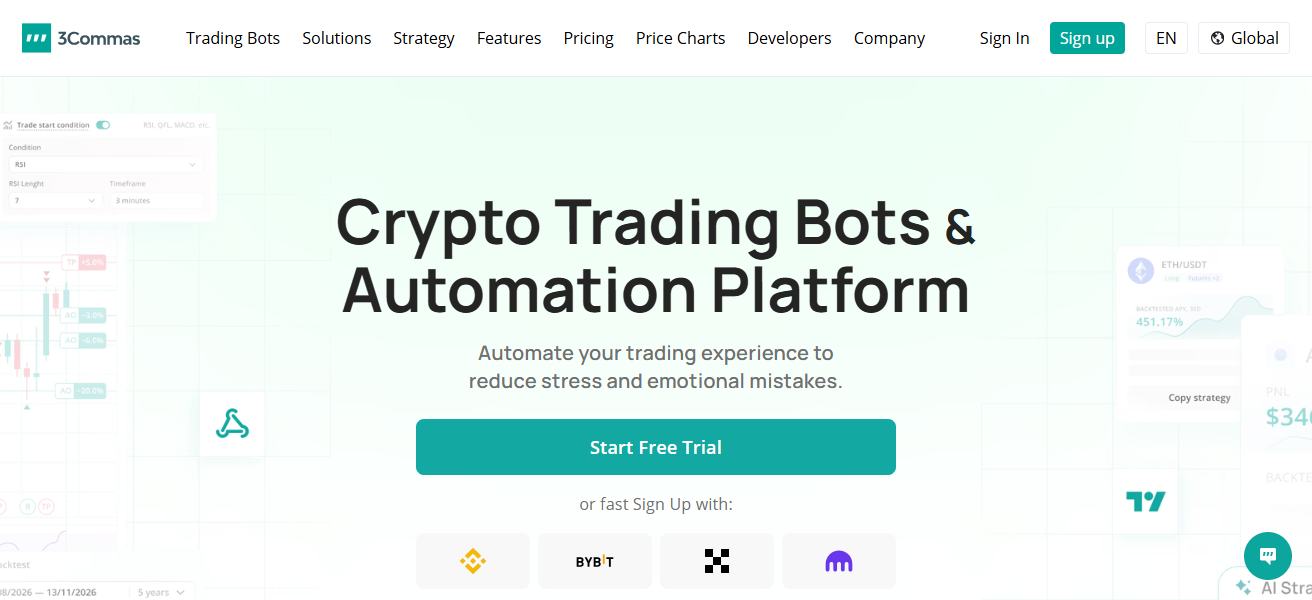
Users can fine-tune their strategies using backtesting, and with custom risk settings, trailing stop losses, and automated orders, both novice and veteran traders can easily automate advanced strategies.
3Commas Features
- Empowers users with a suite of trading bots including DCA, Grid, Signal, and SmartTrade Automation.
- Provides API integrations for constant execution on major exchanges.
- Offers Backtesting for better strategy and risk optimization.
- Users can customize things like trailing stops and risk parameters.
| Pros | Cons |
|---|---|
| Variety of bots including DCA, Grid, and Signal bots. | Advanced bots may require configuration knowledge. |
| Works across multiple exchanges with API integration. | Fees increase with higher-tier subscription plans. |
| Backtesting tools for strategy refinement. | Potential risk if exchange APIs are misconfigured. |
| Configurable risk parameters like trailing stops. | Automated strategies still require monitoring during high volatility. |
9. NapBots
NapBots is an automated crypto trading platform that uses the cloud to implement trading strategies designed by professionals for the average customer.
Users can choose from a library of pre-approved trading strategies and link their accounts to make trades through automated trading bots.

NapBots has partnered with leading crypto exchanges and uses BTC and ETH to minimize the liquidity of manually configured algorithmic trading to a greater degree.
NapBots’ goal is to provide hedge-fund-grade automation strategies for everyone, even though some strategies come with a fee and subscriptions.
NapBots Features
- Provides a selection of quantitative strategies created by professional quants.
- The automated cloud-based trading system runs 24/7 trading without requiring local installations.
- Focuses on connected trading with major exchanges and liquidity-rich assets.
- Plug-and-play deployment of strategies simplifies their use for retail traders.
| Pros | Cons |
|---|---|
| Pre-designed quantitative strategies for easy deployment. | Limited customization compared to fully programmable bots. |
| Cloud-based, no local installation required. | Subscription fees may be a barrier for casual users. |
| Supports major exchanges and high-liquidity assets. | Not ideal for exotic altcoins or very low liquidity markets. |
| Enables 24/7 automated trading for consistent execution. | Strategy performance can fluctuate during volatile markets. |
10. Hummingbot
Hummingbot is an open-source software that allows users to create and implement automated trading bots that use market making, arbitrage, and execution strategies on over 140 centralized and decentralized exchanges.
Users can backtest trading algorithms before putting them live, and the bots autonomously manage orders based on the real-time market conditions.
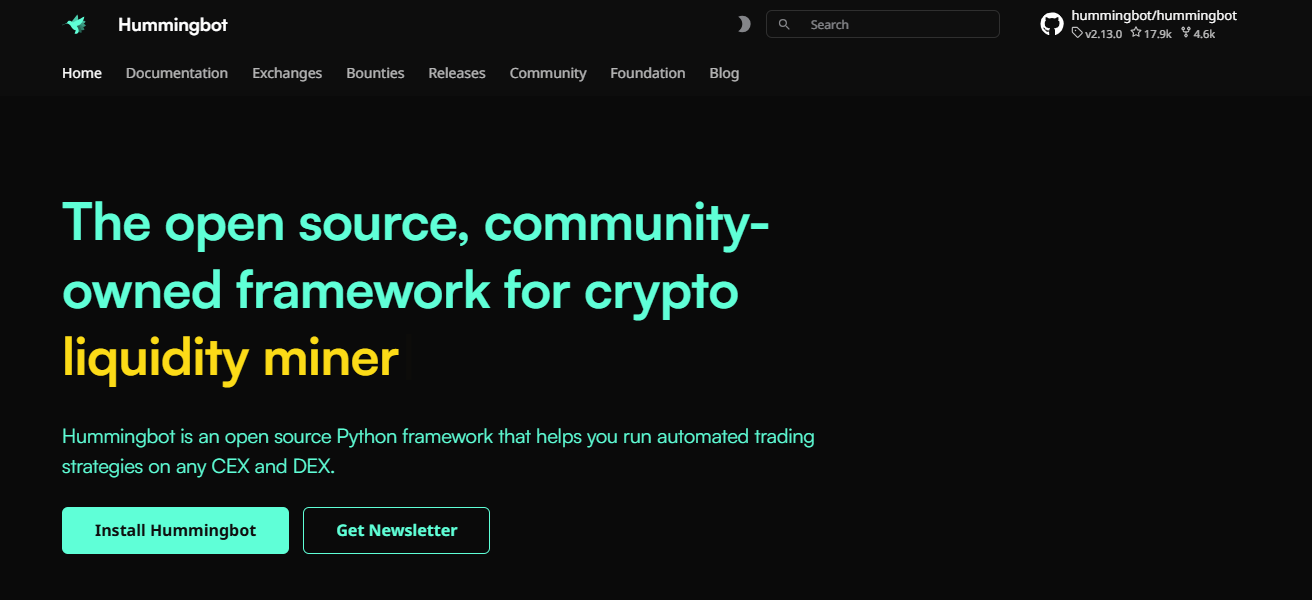
Hummingbot’s community driven ecosystem and modular architecture provide advanced traders and automated liquidity provision traders with the ability to create fully customized trading bots.
The extensive list of strategy templates available on Hummingbot allow traders to simplify the automation of their trading processes.
Hummingbot Features
- Build automated trading bots (market-making, arbitrage, execution) with open-source frameworks.
- Works with more than 140 CEXs and DEXs.
- Strategies can undergo backtesting using historical data.
- The community ecosystem is rich in strategy modules and templates.
| Pros | Cons |
|---|---|
| Open-source, highly customizable for advanced traders. | Technical setup can be challenging for beginners. |
| Supports market-making, arbitrage, and execution strategies. | Requires familiarity with coding and bot maintenance. |
| Works across 140+ centralized and decentralized exchanges. | Continuous monitoring recommended to prevent losses. |
| Community-driven ecosystem with extensive strategy templates. | Strategy success depends heavily on market liquidity. |
How To Choose Crypto AI Tools That Automate Complex Strategies
- Strategy Type Support – Make sure the tool aligns with your trading strategy (eg. grid trading, DCA, market-making, arbitrage, copy-trading).
- Backtesting & Analytics – Tools that offer performance data and historical testing are essential.
- Risk Management Features – Look for features like trailing stops, allocation limits, and automatic rebalancing.
- Cost vs. Benefit – Weigh subscription fees or commissions vs predicted automation gains.
- Community & Support – Tools with strong communities, good documentation, and responsive support are easier to work with.
- Exchange Compatibility – Be sure the tool connects to the same exchanges you trade on via API.
- Ease of Use – If you have no coding expertise, tools that offer no-code interfaces or visual builders are better.
Conclsuion
As a final point, Cryptocurrency Trading Strategies Automated by AI offer vital tools to encourage optimum market trading and valuable market insights.
These tools manage complex trading issues by utilizing AI analysis, automated trading, and risk control. These tools provide valuable insights and tools to even the most seasoned traders, and help to automate
The trading strategy to optimize the portfolio and perform better than the competition in the volatile market.
FAQ
It aggregates AI predictions from data scientists to generate trading signals.
It uses autonomous AI agents to execute trades and tasks in DeFi networks.
AI-driven analysis, token grading, buy/sell signals, and risk scoring.
Yes, it offers a no-code graphical interface for strategy building.