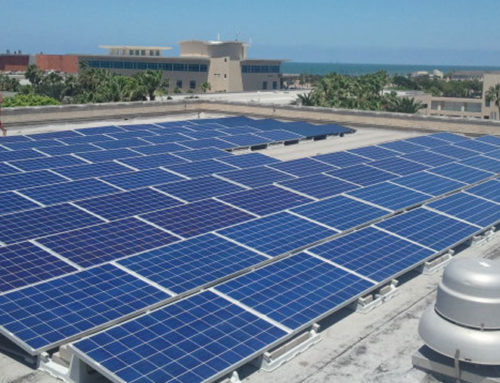
In this article, I will be covering brands of Commercial Grid Industrial Solar Panel Micro-Inverters that I believe are some of the best on the market, and that are changing the way we infuse solar energy into modern systems.
Here, you will find manufacturers that deliver solutions for commercial installations. They will be highly efficient, easy-to-monitor, and scalable. This guide will help you find trustworthy micro-inverters designed for industrial rooftops and those integrated with smart grids and large-scale solar power generation systems.
Key Points & Best Industrial Solar Panel Micro-Inverter Brands for Commercial Grids
| Brand | Explanation |
|---|---|
| Enphase Energy | Global leader providing reliable microinverters for commercial solar grid applications |
| SolarEdge | Known for power optimizers and efficient commercial solar solutions globally |
| Hoymiles | Offers high-efficiency microinverters suitable for large commercial installations projects widely |
| APsystems | Provides scalable dual microinverter systems for commercial solar arrays use |
| Darfon | Delivers compact reliable microinverters for industrial rooftop solar systems applications |
| NEP (Northern Electric Power) | Northern Electric Power offers cost-effective commercial microinverter solutions globally deployed |
| Deye | Manufactures hybrid microinverters supporting commercial and industrial solar grids systems |
| GoodWe | Produces smart microinverters enabling efficient commercial solar energy management platforms |
| Growatt | Offers advanced microinverter technology for scalable commercial solar projects deployments |
| Chilicon Power | Chilicon Power designs intelligent microinverters for commercial solar applications systems |
10 Best Industrial Solar Panel Micro-Inverter Brands for Commercial Grids
1. Enphase Energy
Leading the field of microinverter technology worldwide is Enphase Energy. This is particularly true for commercial and industrial solar grid applications. The latest IQ range of microinverters have been developed to increase module-level performance, assist in safety, and aid in the design of systems for large-scale deployments.

Enphase Energy’s advanced cloud-enabled monitoring, forecasting, and preemptive maintenance is a game-changer. Enphase Energy has directed many of its resources towards software-based energy management systems and grid-forming capability.
These innovations have made Enphase Energy products some of the most effective and reliable smart commercial grid solutions available today. In addition, the company offers some of the highest reliability, longest warranty periods, and best design solutions for hybrid solar with battery storage integration.
Enphase Energy Pros & Cons
| Pros | Cons |
|---|---|
| Highly reliable microinverter technology | Higher upfront installation cost |
| Advanced AI-based monitoring platform | Requires strong internet connectivity |
| Excellent safety with module-level shutdown | Less cost-effective for very large utility plants |
| Strong battery storage integration support | Proprietary ecosystem limits flexibility |
2. SolarEdge Technologies
SolarEdge Technologies is well-known for its power optimizer + inverter architecture. This architecture is one of the most widely adopted systems in commercial solar projects.
While SolarEdge is not a microinverter company, its MLPE (module-level power electronics) does offer substantial advantages and features greater energy harvest and module-level monitoring.
SolarEdge’s commercial offerings utilize advanced grid services, and cutting-edge cybersecurity and AI-based technologies for dynamic performance optimization. This company has gained popularity in large scale, complex commercial solar projects (including solar farms)
Due to the shading-tolerant design of its products. SolarEdge is also expanding its offerings to fully integrate the energy management systems with EV charging and energy storage.
SolarEdge Technologies Pros & Cons
| Pros | Cons |
|---|---|
| High energy yield with power optimizers | More complex system architecture |
| Strong performance in shaded environments | Higher maintenance complexity |
| Advanced cybersecurity and smart grid features | Dependent on optimizers at module level |
| Expanding into EV charging & storage | Initial design requires expert installation |
3. Hoymiles
Hoymiles is a strong competitor in the microinverter space, and particularly for pricing in commercial installations on a global scale. Hoymiles has HMT and HMS series microinverters that are compatible with high-powered PV modules and are suited for large commercial rooftop grids. Hoymiles is focused on efficiency, safety, and installation ease.
This reduces system and labor costs that are associated with sustained downtime. S-Miles is a cloud-based monitoring system. It provides module-based, real-time analysis and performance monitoring. Hoymiles has positioned itself in Europe, Asia, and in growing solar markets.
It has gained preference for large scale, commercial solar projects by having a reliable and problem-free product at a competitive price.
Hoymiles Pros & Cons
| Pros | Cons |
|---|---|
| Cost-effective commercial microinverters | Brand still growing globally |
| Easy installation and maintenance | Limited advanced grid features |
| High compatibility with modern PV panels | The monitoring platform is less advanced than the premium brands |
| Strong performance in rooftop systems | Warranty terms vary by region |
4. APsystems
The APsystems design allows solar installations of a dual module configuration to a single microinverter. This innovative design reduces installation costs for solar arrays at a commercial scale and also provides a high degree of efficiency.
The QT2 and DS3 series are some of the most popular microinverters for commercial rooftop installations and small to medium-sized commercial grid installations. The APsystems EMA platform supports advanced monitoring of energy at the modules.
This allows both performance analysis and the ability to address problems remotely. The company is focused on three-phase microinverters and commercial-scale grids. This focus, along with innovative design, has made APsystems a strong competitor on a global scale.
APsystems Pros & Cons
| Pros | Cons |
|---|---|
| Dual-module microinverter design reduces cost | Slightly lower efficiency in extreme conditions |
| Suitable for scalable commercial systems | Limited utility-scale adoption |
| Strong monitoring platform (EMA) | Communication system may require upgrades |
| Good balance of price and performance | Fewer premium smart-grid features |
5. Darfon Electronics Corporation
Darfon Electronics Corporation focuses on highly reliable, compact microinverter systems aimed at industrial rooftop and commercial PV systems. With a robust background in power electronics, Darfon strives to offer reliable solutions that will perform even under stressful and varying environmental conditions.
Microinverters that are built to last operationally are essential for those larger-scale commercial solar projects, and Darfon’s microinverters fit the bill. Often, Darfon’s microinverter systems are built to integrate with smart monitoring systems, which allow operators to see real-time production data.
In the last few years, Darfon has worked on enhancing conversion efficiencies and thermal performance, so that their microinverters still function at their best in the most difficult and demanding commercial solar applications.
Darfon Electronics Corporation Pros & Cons
| Pros | Cons |
|---|---|
| High durability and long lifespan design | Limited global brand recognition |
| Stable performance in harsh climates | Smaller product ecosystem |
| Strong power electronics expertise | Slower innovation compared to leaders |
| Good for industrial rooftops | Limited advanced software features |
6. Northern Electric Power Technology Inc.
Northern Electric Power Technology Inc. (NEP) is a cost-centric microinverter manufacturer for the commercial and utility-scale solar markets. Reliable and affordable systems that do not sacrifice key performance indicators are the hallmarks of NEP systems.
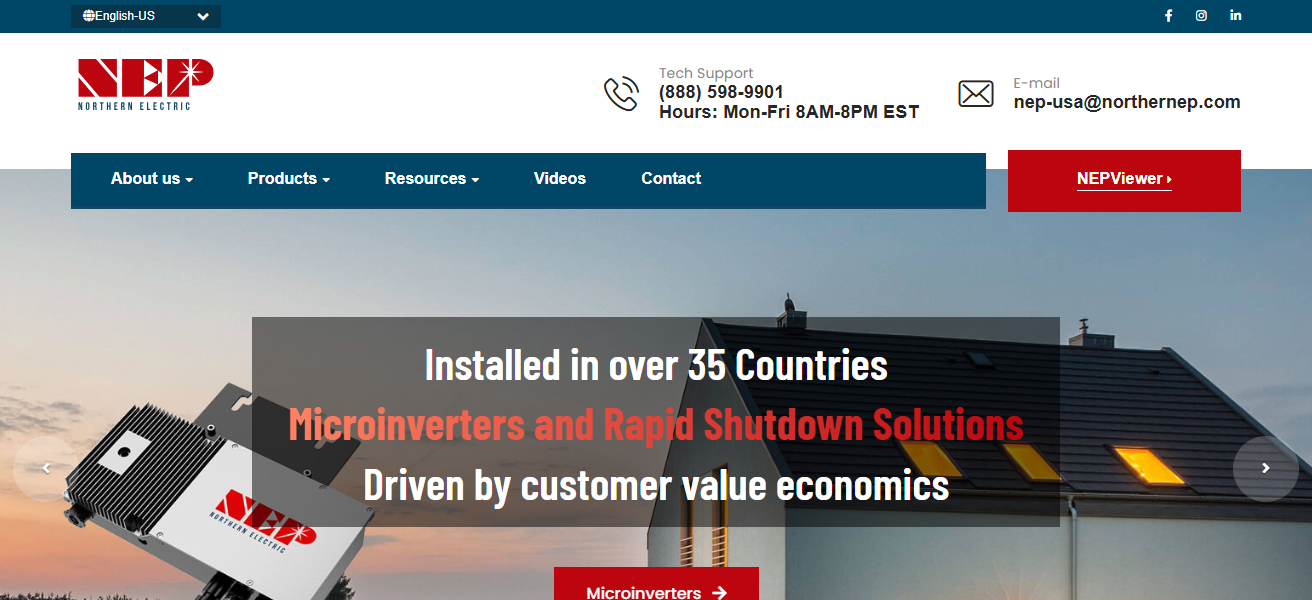
NEP’s most recent microinverter systems are designed for large rooftop installations and support high-efficiency PV modules, while simplifying installation. With smart monitoring, NEP microinverters also allow system operators to analyze energy output and recognize faults.
With aggressive pricing and international grid standard compliance, NEP systems have gained traction in developing countries, especially with cost-sensitive commercial solar developers.
Northern Electric Power Technology Inc. Pros & Cons
| Pros | Cons |
|---|---|
| Very cost-effective commercial solutions | Lower premium feature set |
| Easy installation for large rooftops | Less advanced monitoring tools |
| Compliant with global grid standards | Limited innovation compared to top brands |
| Good for budget solar projects | Smaller presence in developed markets |
7. Deye Inverter Technology
Deye Inverter Technology is quickly becoming an industry leader in hybrid microinverters and commercial solar inverter systems. Deye is well established for its hybrid-ready technology that provides integrated solar and Battery Storage and Grid systems.
Deye microinverters and hybrid inverters are used in many industrial and commercial projects where energy independence and backup power is a requirement. Deye’s newer systems include advanced MPPT, smart tracking, apps, and highly efficient conversion systems.
With its rapid global expansion, Deye provides a competitive, affordable, and feature-rich product in both emerging and established markets in the solar industry.
Deye Inverter Technology Pros & Cons
| Pros | Cons |
|---|---|
| Hybrid-ready solar + storage systems | Brand perception still developing |
| High efficiency MPPT tracking | Software ecosystem still maturing |
| Affordable compared to premium brands | Service network varies globally |
| Strong for energy independence projects | Less established in high-end commercial grids |
8. GoodWe Technologies
GoodWe Technologies is one of the most advanced, commercially produced solar inverter systems that is microinverter-compatible and commercially applicable. GoodWe heavily incorporates smart energy tools that include Artificial Intelligence for systems monitoring and predictive maintenance.
GoodWe’s commercial offering is designed to be highly efficient, safe, and compliant with grid stability. Also, GoodWe has hybrid systems that include integrated energy storage and EV charging systems.
The built-in monitoring and analytical tools of GoodWe’s systems support users in the optimization of energy and lowering cost of energy. With smart energy innovations and advanced technologies, GoodWe is becoming one of the most used commercially solar systems in large-scale industrial applications.
GoodWe Technologies Pros & Cons
| Pros | Cons |
|---|---|
| Strong AI-powered energy management | Premium models can be costly |
| Excellent hybrid inverter ecosystem | Complex product range for beginners |
| Reliable commercial-grade performance | Requires technical setup expertise |
| Expanding EV + storage integration | Not purely microinverter-focused |
9. Growatt New Energy
Growatt New Energy is rapidly expanding as a solar inverter brand that provides flexible and competitively priced commercial solar offerings. They have microinverter-compatible systems that are popular on industrial rooftops and for distributed energy projects.
Their technology focuses primarily on efficiency, smart monitoring, and integration with battery storage. Their software platform provides users with the ability to monitor the project and perform diagnostics, which makes it an excellent option for the smart grid.
Recently, Growatt New Energy has aggressively expanded in Asia, Europe, and Africa with their low-cost options and exceptional support, and as a result, they have become one of the most popular options for commercial solar projects.
Growatt New Energy Pros & Cons
| Pros | Cons |
|---|---|
| Affordable and scalable solutions | Lower-end models have limited features |
| Strong cloud monitoring platform | Support quality varies by region |
| Easy integration with batteries | Not as premium as Enphase/SolarEdge |
| Wide global market presence | Occasional performance inconsistency |
10. Chilicon Power
Chilicon Power designs and manufactures advanced microinverters for commercial solar, with a significant emphasis on power electronics for reliability and yield in dispersed solar systems. All of their microinverters have built-in communication, simplifying the monitoring and control of each module.
Chilicon Power has a unique focus in the commercial solar arena of North America on grid security and safety. System intelligence and automated fault detection with smart grid technology are the focus of their latest innovations and add to the breadth of their specialty in industrial solar.
Chilicon Power Pros & Cons
| Pros | Cons |
|---|---|
| Intelligent module-level monitoring | Limited global availability |
| Strong focus on grid stability | Smaller product portfolio |
| High safety and reliability | Less competitive pricing options |
| Good for smart commercial grids | Lower brand visibility internationally |
Selection Criteria for the Best Industrial Solar Panel Micro-Inverter Brands for Commercial Grids
- Conversion efficiency and the performance of the energy output and the inverter in the field were evaluated.
- Considered reliability in demanding industrial and commercial environments.
- Compared compatibility with new modern high-power solar PV modules.
- Evaluated scalability for large commercial and large rooftop grid applications.
- Reviewed functionality of smart monitoring and real-time data analytics.
- Reviewed safety standards regarding rapid shutdown and grid protection.
- Considered integration with battery storage and hybrid energy systems.
- Evaluated presence in the international market and the extent of service and after-sales support.
- Evaluated the price balance between cost and the most advanced technology.
- Evaluated the technology in terms of the level of innovation, such as AI, MPPT, and smart grids.
Conclusion
To summarize, the top brands producing industrial solar micro-inverters for commercial grids provide solar infrastructure for the commercial solar power systems of the future that incorporate advanced smart energy management and high reliability and high efficiency.
Enphase, SolarEdge, and other brands offer scalable solutions for industrial rooftops and larger commercial solar panel installations.
The right choice of micro-inverters results in improved energy output, reduced safety concerns, and significant savings during the entire life cycle of the system.
FAQ
Which is the best micro-inverter brand for commercial grids?
Enphase Energy is widely considered a top choice due to its high efficiency, reliability, advanced monitoring, and strong integration with battery storage systems for large-scale commercial use.
Is SolarEdge Technologies a micro-inverter company?
Not purely. SolarEdge uses power optimizers with inverters (MLPE technology), which delivers similar benefits to module-level optimization, better energy harvest, and advanced monitoring for commercial solar installations.
Which brands are most cost-effective for large solar projects?
Brands like Hoymiles, Northern Electric Power Technology Inc., and Growatt New Energy are known for affordable and scalable solutions suitable for commercial rooftops and industrial grids.
Which micro-inverter brand is best for hybrid solar systems?
Deye Inverter Technology and GoodWe Technologies are strong choices for hybrid systems, offering integration with battery storage and grid-tied energy management.