
This article will review features of new tools designed for remote teams with multi-currency payment options. Most managers experience a range of issues with global payroll, compliance, and currency management.
These tools seamlessly handle global payment processing, payroll management, and payment currency management. Employee payment and contractor management has been streamlined for remote teams.
Key Points & 10 Tools Built for Remote Workers Paid in Multiple Currencies
Deel – Simplifies global payroll, contracts, and compliance while supporting payments in multiple international currencies.
Remote.com – Manages hiring, payroll, and benefits for distributed teams with seamless multi-currency payment processing worldwide.
Payoneer – Enables freelancers and businesses to receive international payments in diverse currencies with low fees.
Wise (TransferWise) – Offers borderless accounts, real exchange rates, and multi-currency transfers for remote professionals globally.
Papaya Global – Provides workforce management, payroll automation, and compliance with support for multiple currencies across countries.
Rippling – Combines HR, IT, and payroll functions, ensuring employees are paid correctly in their local currencies.
Gusto Global – Expands payroll services internationally, allowing remote workers to receive payments in various supported currencies.
PayPal – Widely used for international payments, supporting multiple currencies and easy transfers for remote workers.
Pilot – Handles payroll, benefits, and contractor payments globally, ensuring smooth multi-currency transactions for distributed teams.
ADP Global Payroll – Enterprise-level payroll solution offering compliance, automation, and multi-currency support for international employees.
10 Tools Built for Remote Workers Paid in Multiple Currencies
1. Deel
Deel is a tool built for remote teams, making global payroll, compliance, and contractor management super easy and streamlined.
It lets businesses hire employees or contractors in 150+ countries, while taking care of local tax and legal obligations. Deel makes working abroad easy because it allows payment in any currency.
This means workers don’t have to worry about currency conversion or payment delays. Deel’s intuitive dashboard makes it easy to onboard employees, manage documents, and contract automation.
This is the perfect tool for businesses that are expanding and need to manage a remote workforce.
| Pros | Cons |
|---|---|
| Supports payments in multiple currencies. | Subscription and transaction fees can be high for small teams. |
| Handles global payroll, taxes, and legal compliance. | Customer support may be slow in some regions. |
| Automates onboarding, contracts, and expense management. | Complex compliance setups may require expert consultation. |
| Dashboard is intuitive and easy to navigate. | Mainly suitable for larger teams or international scaling. |
| Offers benefits administration and workforce management. | Some advanced features may be unnecessary for small businesses. |
2. Remote.com
Remote.com enables businesses to hire employees in other countries without the need to establish international business entities.
The company takes care of international payroll, taxes, employee benefits, and compliance. Remote.com also offers multi-currency payment, allowing employees and contractors to be paid through their currency of choice.
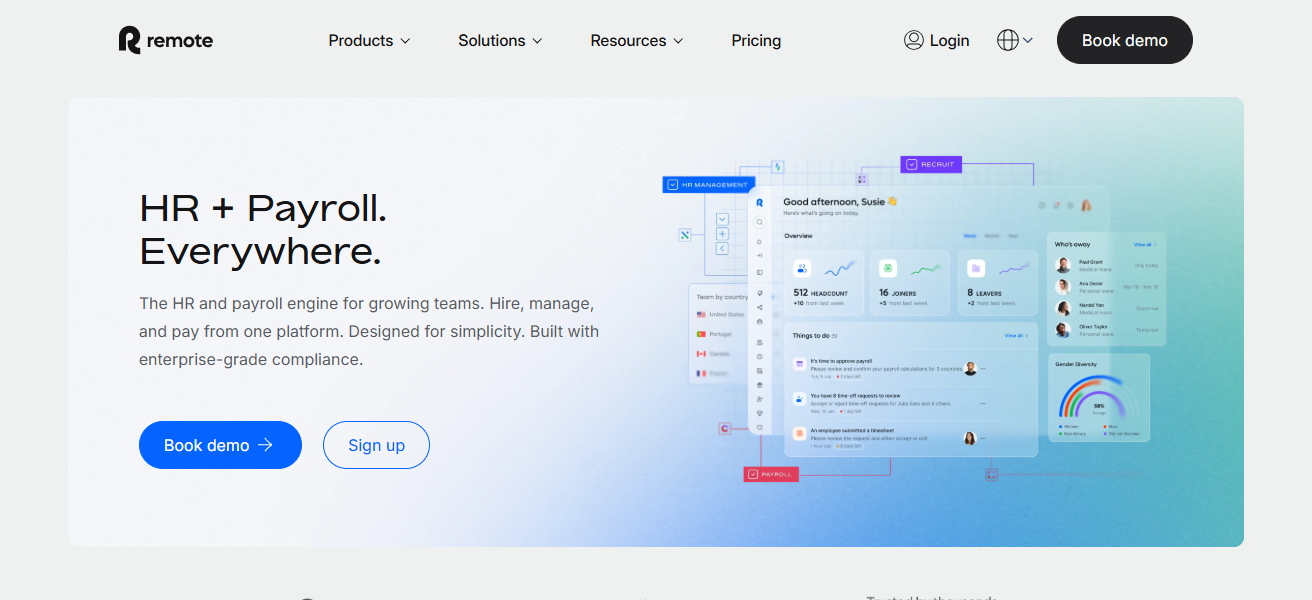
The company also takes care of the employees’ social security, benefits, and other employment agreements that are in compliance with the Country’s labor laws.
The company’s automation solves the administrative burden and regulatory compliance. Remote.com provides trusted and legal ways to support distributed teams for businesses that are going to new destinations to expand their businesses.
| Pros | Cons |
|---|---|
| Simplifies international hiring without foreign entities. | Pricing can be expensive for small businesses. |
| Supports multi-currency payments. | Advanced features may be overkill for simple payroll needs. |
| Manages taxes, benefits, and statutory compliance. | Limited reporting compared to accounting-specific software. |
| Automates payroll processes, reducing administrative workload. | Integration with other HR tools may require technical setup. |
| Reliable for global expansion and compliance. | Best suited for medium to large businesses. |
3. Payoneer
Payoneer is a financial services platform that specializes in cross-border payments. This makes it most appropriate for freelancers, businesses, and remote teams.
Users are able to receive payments from several different clients or marketplaces to their Payoneer account from anywhere in the world and withdraw those funds to local currencies, or hold them in their Payoneer account.
The platform provides a prepaid Mastercard and connects with banks around the world, allowing for easy currency conversions at less market rates.
Payoneer also provides a mass payout service, which is beneficial for companies with a lot of international contractors.
Payoneer’s reporting tools make tracking finances and prepping for taxes easy, and because of these features, Payoneer improves and simplifies cross-border financial services.
| Pros | Cons |
|---|---|
| Supports global payments and multi-currency withdrawals. | Currency conversion and withdrawal fees apply. |
| Mass payout capability for international contractors. | Does not handle HR, compliance, or benefits. |
| Provides a prepaid Mastercard and local bank integrations. | Customer support can be inconsistent in some regions. |
| Simplifies financial tracking and reporting. | Less suitable for full payroll management. |
| Reduces delays compared to traditional banking. | Mainly designed for freelancers and small teams. |
4. Wise (TransferWise)
Payoneer is a financial services platform that specializes in cross-border payments. This makes it most appropriate for freelancers, businesses, and remote teams.
Users are able to receive payments from several different clients or marketplaces to their Payoneer account from anywhere in the world and withdraw those funds to local currencies, or hold them in their Payoneer account.
The platform provides a prepaid Mastercard and connects with banks around the world, allowing for easy currency conversions at less market rates.

Payoneer also provides a mass payout service, which is beneficial for companies with a lot of international contractors.
Payoneer’s reporting tools make tracking finances and prepping for taxes easy, and because of these features, Payoneer improves and simplifies cross-border financial services.
| Pros | Cons |
|---|---|
| Low-cost, transparent international transfers. | Does not provide HR, payroll, or compliance services. |
| Supports multi-currency accounts and batch payments. | Currency conversion fees, though lower than banks, still apply. |
| Enables receiving local bank details in multiple countries. | Lacks advanced payroll features for large teams. |
| Fast, reliable, and affordable for remote teams. | Limited reporting for complex payroll scenarios. |
| Easy for freelancers and recurring payments. | Not a full workforce management platform. |
5. Papaya Global
Papaya Global is a cloud-based software solution for global payroll processing, cost compliance, and contractor payments.
Papaya Global provides businesses the ability to employ contract workers in over 140 countries while remaining compliant with local labor laws, as well as local and national taxation.
Papaya Global enables the contractor to be paid in the currency of the remote worker and also provides integrations to the employer’s HR and payroll and finance systems.
Papaya Global is the best solution for companies needing to expand internationally and have a solution to managing international teams collaboratively. Papaya Global’s solution is compliant, low admin, and low risk.
| Pros | Cons |
|---|---|
| Automates global payroll and contractor payments. | Pricing can be high for small businesses. |
| Supports multi-currency payments. | Setup may be complex for smaller companies. |
| Ensures compliance with local labor laws and taxes. | Customer support response times may vary by region. |
| Integrates HR, payroll, and finance workflows. | Overkill for companies with very small teams. |
| Provides real-time reporting and analytics. | May require onboarding support for complex workflows. |
6. Rippling
Rippling integrates HR, IT, and Payroll, which is ideal for companies with remote or global workers. The platform is an all-in-one solution for managing employee payments, providing benefits and devices, and managing company and employee compliance.
Employees and contractors can be paid globally, in the country and currency of their choice. Automated tax and compliance filings help reduce the risk of tax-related errors.
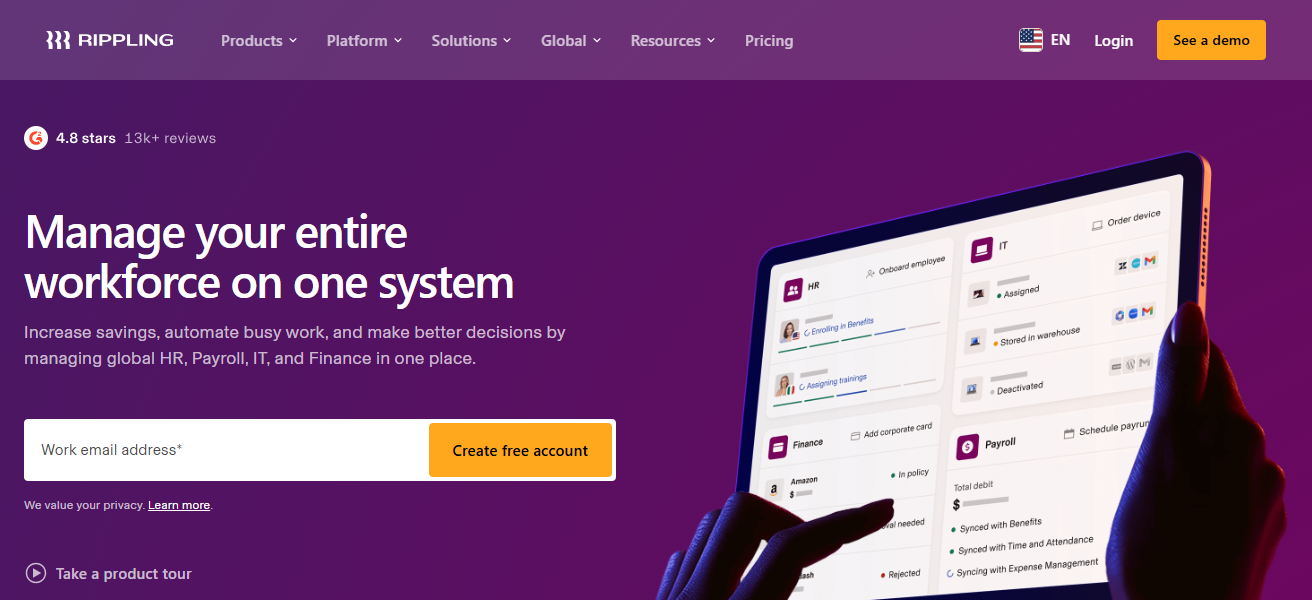
Rippling’s integration capabilities improve the functionality of other software tools used for accounting and productivity, making it especially ideal for businesses wanting to merge HR and IT as they grow internationally.
| Pros | Cons |
|---|---|
| Unifies HR, IT, and payroll management. | Can be expensive for small teams. |
| Supports multi-currency payments. | Steep learning curve due to extensive features. |
| Automates tax filings and regulatory compliance. | Customer support can be slow for complex issues. |
| Integrates with accounting and productivity apps. | Some users may find interface overwhelming. |
| Reduces administrative errors and workload. | More suitable for mid-to-large businesses. |
7. Gusto Global
Gusto Global is an extension of Gusto that provides payroll and HR services for global employees, allowing businesses to pay remote workers in various currencies.
Gusto Global also provides national tax compliance and local labor law compliance, which simplifies things that are often complex cross-border.

Payroll, benefits admin, contractor management, and other components can be integrated for simplified and transparent access across the cross-border workforce.
With integrated HR and Payroll, Gusto Global allows for better control of admin tasks and provides better management of workforce costs. It’s an ideal solution for small to medium-sized businesses that are growing their remote teams globally.
| Pros | Cons |
|---|---|
| Handles payroll, benefits, and compliance internationally. | Better suited for small to mid-sized businesses. |
| Supports multi-currency payments. | Pricing may be restrictive for startups. |
| Transparent payroll calculations and timely payments. | Complex tax situations may need external consultation. |
| Integrates HR functions with payroll. | Limited advanced features for large enterprises. |
| Simplifies onboarding and contractor management. | May not cover all global countries extensively. |
8. PayPal
PayPal is an online payment system that enables users to send and receive money anywhere in the world.
With PayPal remote workers can receive payments in different currencies and then easily convert and withdraw those funds to their local bank accounts.
Also, PayPal offers mass payout services, which is useful to companies that need to pay many contractors.
Paypal offers payment protection, transaction security, marketplace and e-commerce integration, and many other helpful features.
Paypal is especially great for freelancers and remote teams at international companies because they need reliable and quick payment options and need to be able to make international payments, even though PayPal does charge for conversions and cross border payments.
| Pros | Cons |
|---|---|
| Fast, global payments in multiple currencies. | High fees for currency conversion and cross-border transfers. |
| Supports mass payouts for contractors. | Does not provide HR or compliance services. |
| Widely accepted and reliable platform. | Account freezes or restrictions can occur unexpectedly. |
| Easy integration with marketplaces and e-commerce platforms. | Limited reporting and payroll automation. |
| Secure transactions with buyer and seller protection. | Not a full workforce management solution. |
9. Pilot
Pilot is an accounting and payroll service that assists remote teams and start-up companies. Pilot helps pay international employees and contractors while staying compliant for international payroll.
With Pilot, payroll benefits, taxes, and contracts are handled and the administrative tasks and legal risks are decreased. Pilot provides financial and accounting integration for up to date financial reporting.
Pilot combines automation and payroll expert oversight to make international payroll more simple. Pilot is great for growing startups that need to pay remote employees worldwide compliantly and on time.
| Pros | Cons |
|---|---|
| Combines bookkeeping, accounting, and global payroll. | Can be expensive for small teams. |
| Supports multi-currency payments. | Global payroll coverage may not include all countries. |
| Ensures compliance with local tax laws. | Some users may need additional HR management tools. |
| Integrates with accounting tools for real-time insights. | Primarily targeted at startups and fast-growing teams. |
| Reduces administrative overhead and legal risk. | Advanced features may be unnecessary for simple payroll. |
10. ADP Global Payroll
ADP Global Payroll is an all-in-one solutions payroll and human resource management system for large global enterprises.
It manages payroll and workforce compliance with tax and labor laws in various countries. It is also able to manage multi-currency payments and complex payroll scenarios such as; benefits, deductions, and contributions, as well as reporting and analytics.

ADP interfaces with other HR and financial system to give organizations a global management system for their employees.
ADP’s Global Payroll systems automation minimizes errors, administrative work, and provides timely and secure payments to remote employees.
ADP Global Payroll is a system that large multi-national companies manage global payments to their employees.
| Pros | Cons |
|---|---|
| Supports multi-currency payroll for large enterprises. | Expensive and complex for small businesses. |
| Handles complex payroll scenarios, benefits, and deductions. | Implementation can be time-consuming. |
| Ensures compliance across multiple countries. | User interface may feel less modern or intuitive. |
| Integrates with HR and financial systems. | Overkill for small teams or simple payroll needs. |
| Provides detailed reporting and automation. | More suitable for multinational corporations. |
Conclusion
To conclude, solutions designed for remote employees remunerated in various currencies streamline global payroll, compliance, and financial operations.
They facilitate organizations in the quick, precise, and preferred currency payment of employees and independent contractors, while also decreasing administrative load and conversion cost.
With the help of these platforms, companies can effectively handle global workforce and concentrate on expansion without the complications of international payments.
FAQ
They are platforms that help companies pay international employees or contractors in their local currency while handling compliance and taxes.
They reduce conversion fees, speed up payments, and make it easier for workers to receive money in their preferred currency.
Deel, Remote.com, Papaya Global, Rippling, Gusto Global, and ADP Global Payroll.
Yes, platforms like Payoneer, Wise, and PayPal are ideal for freelancers and contractors.