In this article, I will cover the topic USDT vs USDC: Which Is Safer, weighing the pros and cons of the two top stablecoins.
Both attempt to bring some equilibrium to the highly unstable crypto market, but they have different degrees of transparency, regulations, and liquidity.
Knowing the differences will help investors and traders determine which option best suits their safety concerns.
What Is USDT (Tether)?
Tether (USDT) is the very first stablecoin that was created in 2014 by Tether Limited. The stablecoin is tied to the United States Dollar, meaning each USDT token is supposed to be worth $1.
For Tether to maintain liquidity and usability, it uses treasury bills and other assets to back each stablecoin, meaning it can be used as a safe trading tool for Tether.
USDT can be used across multiple blockchain technologies and is used by many centralised and decentralised exchanges.
Tether has faced a lot of backlash when it comes to its transparency which has led to other stablecoins becoming more used and more popular than Tether, however, Tether is still the most used stablecoin with over $100 billion of market capitalisation.
What is USDC (USD Coin)?
USDC (USD Coin) is a stablecoin that is regulated and launched in 2018 by Circle along with Coinbase via the Centre Consortium.
Each USDC token is fully backed by a dollar, with the added value of U.S. Treasury bonds that are short-term and stable, with reserves that provide transparency.
USDC is one of the stablecoins that is most trusted in the crypto ecosystem, because of the independent auditors ‘ attestations that Circle publishes every month.
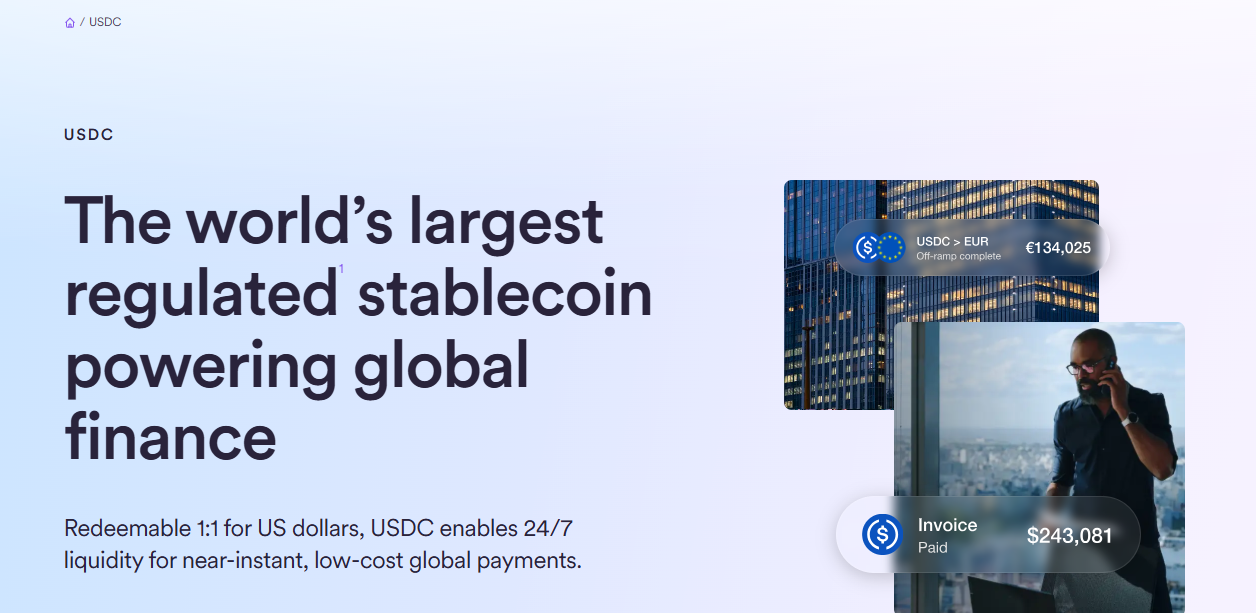
USDC spans several blockchains and is used in decentralized finance (DeFi) alongside trading, and payment.
USDC’s strong focus on regulatory compliance and transparency has garnered it institutional interest and attracted risk-averse investors.
USDT vs. USDC: Comparing key features
USD Coin (USDC), a stablecoin managed by Circle and Coinbase, launched in 2018 under the Centre Consortium, is pegged 1:1 to the USD and is regulated.
USDC’s reserve quality and transparency are strengthened by the fact that each USDC token is collateralized by cash and short-term U.S. Treasury bonds.
USDC is among the most reliable stablecoins in the crypto ecosystem due to Circle’s monthly reserve attestations by a 3rd party auditor.
USDC is a key player in decentralized finance (DeFi), trading, and payments, as it operates on a variety of different blockchains.
USDC’s transparency and focus on compliance have made it popular among institutional and other compliance-oriented investors.
USDT vs. USDC: Key Features Compared
| Feature | USDT (Tether) | USDC (USD Coin) |
|---|---|---|
| Launch Year | 2014 | 2018 |
| Issuer | Tether Limited (offshore) | Circle (U.S.-regulated, partnered with Coinbase) |
| Transparency | Quarterly attestations, criticized for limited clarity | Monthly audits with detailed reserve reports |
| Reserves | Diversified: cash, U.S. Treasuries, corporate debt, other assets | Primarily U.S. Treasuries and cash equivalents |
| Liquidity | Highest global trading volume, dominant in exchanges | Lower volume but strong institutional adoption |
| Regulatory Oversight | Limited, offshore jurisdiction | Strong U.S. compliance and regulatory framework |
| Use Cases | Trading, arbitrage, cross-border transfers | DeFi, institutional finance, regulated platforms |
| Market Share | Largest stablecoin by circulation | Second largest, growing in institutional trust |
| Peg Stability | Historically resilient but questioned during controversies | Maintains peg with high transparency and trust |
What They Are
USDT (Tether) Tether was released in 2014 and is the oldest stablecoin available, and the largest by market capitalization as well.
It is issued by Tether Limited, Inc. and is pegged 1:1 to the US dollar, which gives it liquidity and a far reach, making it favored by traders and exchanges.

USDC (USD Coin) USDC came to market in 2018 as a product of a joint venture between Circle and Coinbase and is pegged to the US dollar, much like USDT. However, it is USDT’s competitor, in that it focuses on compliance, and therefore is seen as a more “trusted” alternative.
Side-by-Side Comparison
| Feature | USDT (Tether) | USDC (USD Coin) |
|---|---|---|
| Launch Year | 2014 | 2018 |
| Issuer | Tether Limited | Circle (regulated in the U.S.) |
| Transparency | Quarterly attestations, criticized for opacity | Monthly audits, high transparency |
| Reserves | Mix of cash, Treasuries, corporate debt, other assets | Primarily U.S. Treasuries and cash |
| Liquidity | Highest trading volume globally | Lower but strong institutional adoption |
| Regulatory Oversight | Limited, offshore | Strong U.S. regulatory compliance |
| Use Cases | Trading, arbitrage, cross-border transfers | DeFi, institutional finance, regulated platforms |
Safety Considerations
Transparency: USDC is more transparent than USDT as USDC shows independent auditors’ reports each month that attest to the cash reserve holdings that USDC has and the U.S.
Treasury securities that the reserve holdings are invested in. USDT has improved its reserve disclosures but has been criticized in the past for being vague and not having its reserves fully backed.
Regulatory Oversight Circle issues USDC, and because Circle is a U.S. regulated entity, it is subject to U.S. regulatory financial laws. Therefore, USDC is more attractive to institutions and DeFi protocols that necessitate the compliance of regulatory oversight controls. USDT, as an offshore entity, has regulatory control not covering it.
Reserve Quality USDC has a more conservative reserve holding than USDT does because USDC’s reserve holdings are mainly short-term U.S. Treasury securities and cash equivalents, while USDT has a diversified reserve holding that includes corporate debt and other diversified assets. While having more diversified assets in reserve holdings can be viewed as a positive, in the event that some of those assets decrease in value, it can also be viewed negatively.
Market Liquidity Although USDT has more market liquidity than USDC as USDT has more market trading volume, for those market traders that need speed and market volume, USDT is considered the best. That, however, does not mean that it is also more safe. More market liquidity than USDC does mean that USDT is more efficient for trading than USDC.
Track Record USDT’s ability to maintain its peg has been proven through many market crashes, including crises, regulatory scrutiny, and market crashes. This gives USDT holders confidence, but USDT naysayers claim luck is USDT’s best asset. USDC, while being a newer stable coin, has been fully transparent and has maintained peg stability.
Which is More Regulated?
Circle issues USDC and is a U.S.-regulated firm. Circle complies with U.S. financial regulations and publishes audits of its reserves every month.
Because of this, USDC is viewed as more transparent and trustworthy, especially by institutions, compared to USDT.
USDT, on the other hand, is managed by Tether Limited, which is located, and operated, offshore, and has a much weaker oversight.
USDT gives incredible liquidity, but the regulatory framework around it is weaker, which raises concerns around safety.
Risks To Keep In Mind
Regulatory Crackdowns: USDT will face scrutiny owing to its offshore nature. USDC is compliant but will have to adapt to new and changing U.S. regulations.
Peg Stability: Under normal market conditions, both coins should remain at $1. Extreme market conditions will be stressful on their reserves.
Counterparty Risk: Trust is a must. Tether and Circle’s potential insolvency and/or legal issues will leave holders exposed.
Conclusion
To summarize, if regulatory oversight, regular audits, and reserve risk conservativeness are considered, USDC is safer than USDT.
On the other hand, USDT has unparalleled liquidity and adoption, but has greater risks stemming from its offshore structure and ambiguous reserve composition.
For institutions and investors averse to risk, USDC is recommended. For trading purposes, USDT’s dominance remains valid.
FAQ
USDC publishes monthly audits, while USDT has faced criticism for limited disclosures.
USDT dominates global trading volume, making it the most liquid stablecoin.
USDC is preferred by institutions due to compliance and transparency.
USDT is favored by traders for speed, liquidity, and global reach.