
Today I want to introduce you the AI agents that autonomously manage your crypto ticks and personal finances.
- Key Poinst & AI Agents That Autonomously Manage Your Crypto Trades and Personal Finances
- 10 AI Agents That Autonomously Manage Your Crypto Trades and Personal Finances
- 1. ASCN.AI
- 2. Virtuals Protocol (OpenClaw)
- 3. Fetch.ai
- 4. ai16z (AI16Z)
- 5. ChainGPT
- 6. Stoic AI
- 7. Pionex
- 8. TokenTrader AI
- 9. WealthOptimizer
- 10. YieldMaximizer
- Cocnlsuion
- FAQ
These intelligent AI-powered tools interpret up-to-the-minute market data, make trades, optimize portfolios and monitor risks—and can operate without human oversight 24 hours a day. Through automation and smart decision-making they assist starters and
Key Poinst & AI Agents That Autonomously Manage Your Crypto Trades and Personal Finances
ASCN.AI – Autonomous AI agent optimizing crypto trades and personal financial decisions with real‑time data insights.
Virtuals Protocol (OpenClaw) – Web3 protocol enabling AI‑driven digital assets and agent interactions across decentralized finance ecosystems.
Fetch.ai – Decentralized AI network powering autonomous economic agents to optimize trade, data, and resource allocation.
ai16z (AI16Z) – Venture initiative focusing on AI innovation including autonomous systems impacting finance and crypto infrastructure.
ChainGPT – AI‑powered chatbot and assistant for blockchain analytics, smart contract queries, and trading decision support.
Stoic AI – Automated AI cryptocurrency portfolio manager that trades passively based on algorithmic market analysis.
Pionex – Crypto exchange with built‑in trading bots that automate strategies like grid and arbitrage trading.
TokenTrader AI – Intelligent trading assistant offering AI‑based token selection and automated execution strategies for traders.
WealthOptimizer – AI financial planner optimizing investments, risk, and asset allocation across crypto and traditional portfolios.
YieldMaximizer – AI system that automatically finds and compounds highest yield opportunities in DeFi liquidity protocols.
10 AI Agents That Autonomously Manage Your Crypto Trades and Personal Finances
1. ASCN.AI
ASCN.AI is a unique advanced artificial intelligence driven crypto assistant and automation platform. It uses Web3 data and helps traders and analysts with real-time on-chain metrics analysis, sentiment signal and market signal processing.
Most conventional AIs use search engines. Ascn.AI connects with blockchain nodes and social sentiment spike and whale activity channels.
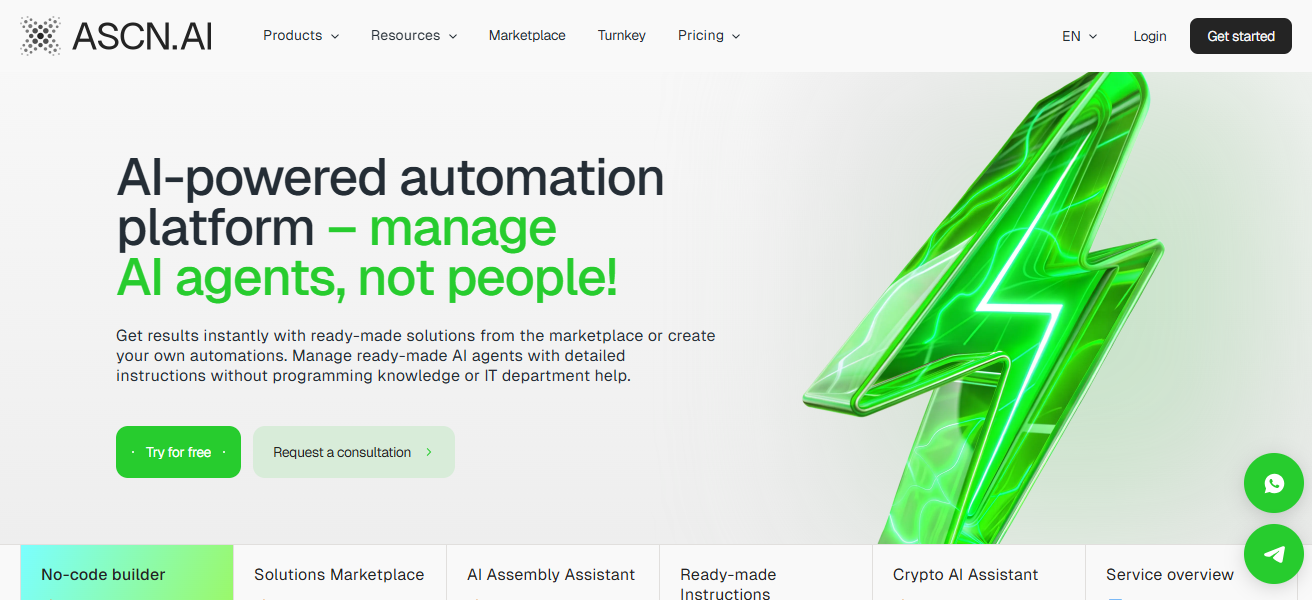
Users can create workflows with no-code automation to analyze, adjust portfolios, create alerts, and generate comprehensive reports.
This saves a tremendous amount of time on manual research, and even more so, it allows users to discover additional trading opportunities.
ASCN.AI Features
- Real-time analysis of market and sentiment through on-chain data integration
- Autonomous alerting and opportunity detection workflows
- Automated reports/Trading signals Create automation with no‑code.
- Whale Tracking, Risk Flags and Smart Contract Insights
| Pros | Cons |
|---|---|
| Uses real‑time on‑chain data for analysis | Requires learning curve for full automation setup |
| Detects whale moves and sentiment spikes | Newer platform with evolving feature set |
| No‑code workflow builder simplifies automation | May produce false signals in volatile markets |
| Alerts and reports reduce research time | Premium features may require subscription fees |
2. Virtuals Protocol (OpenClaw)
Virtuals Protocol on the Coinbase Base chain allows AI agents to be created, co‑owned and tokenized so they can work independently in digital ecosystems.
Native token (VIRTUAL) provides incentive to create and pay inference costs of agents as well as liquidity, so users can think of their agent as a tradeable resource that they can invest in, fund and govern.

Virtuals enable agents to interact, they can engage in actions for which they receive rewards and then share those within the scope of token holders
While the protocol’s ethos around its tokenynamics maximizes buy-backs and burns with expectations on appreciation.
This means the usefulness of AI is no longer simply limited to automation but actual economic actors onchain.
Virtuals Protocol (OpenClaw) Features
- Onchain interactive and profitable agents: Tokenized AI.
- VIRTUAL token governance and revenue sharing
- DeFi ecosystems tradable agent assets.
| Pros | Cons |
|---|---|
| Tokenizes autonomous AI agents as assets | Complex for beginners unfamiliar with tokenomics |
| Agents can generate revenue over time | Revenue is not guaranteed and subject to market risk |
| Governance through tokens supports decentralization | Smart‑contract risk exists in new protocols |
| Enables tradable AI economic entities | Liquidity for some agents may be low |
3. Fetch.ai
Fetch. ai is a decentralized AI and multi‑agent blockchain network that allows users to create intelligent software agents who can perform autonomous tasks such as DeFi trades, data exchanges, smart contracts management without the need for intermediaries.
Its native FET token powers the ecosystem, paying for agent deployment and transaction fees as well as staking.

On the Fetch, AEAs communicate negotiate and optimize solutions. ai network, which adapts to automate complex processes across finance, IoT and logistics.
Combining machine learning with decentralized architecture, this is a permission-less system of economic automation.
Fetch.ai Features
- A decentralized network of Autonomous Economic Agents (AEAs)
- Each agent independently negotiates for tasks and trades.
- FET token is used for staking and accessing the network.
- Machine‑learning integration for predictive optimization.
| Pros | Cons |
|---|---|
| Decentralized network of smart AI agents | May be difficult for non‑technical users |
| Agents negotiate and optimize autonomously | Performance can vary by market or data availability |
| Integrates machine learning for predictions | Dependence on community adoption |
| Uses native token for network access | Rewards subject to token and network performance |
4. ai16z (AI16Z)
ai16z is a new decentralized AI trading and investment DAO on Solana, with governance partly in the hands of token holders but operationally run by an AI agent known as “AI Marc.”
Scorings community recommended crypto investments, the AI studies market trends, autonomously allocating capital in crypto buckets.

With the early signs of huge market cap reach by 2025, ai16z proved that proper investor appetite exists for algorithmically governed funds and was one of the first fully AI‑managed DAO funds.
It fuses a community voice with an automated decision making layer to democratize access to pro investment strategies.
ai16z (AI16Z) Features
- AI‑managed DAO investment structure.
- “AI Marc” assesses and makes market decisions.
- An AI for selecting community funding proposals.
- Self-governing capital distribution across crypto industries
| Pros | Cons |
|---|---|
| Fully automated AI investment decision engine | Community governance can slow decisions |
| AI evaluates and executes proposals consistently | Still experimental, performance not guaranteed |
| Blends community ideas with algorithmic scoring | Performance depends on quality of proposals |
| Autonomous allocation reduces manual bias | Risk of over‑optimization or model error |
5. ChainGPT
ChainGPT is an all-in-one Web3 AI ecosystem with tools catered towards blockchain developers, traders, and enthusiasts.
It provides on‑chain analytics, smart‑contract creation and auditing, AI trading assistants, as well as NFT generation tools through its AI hub and API access.
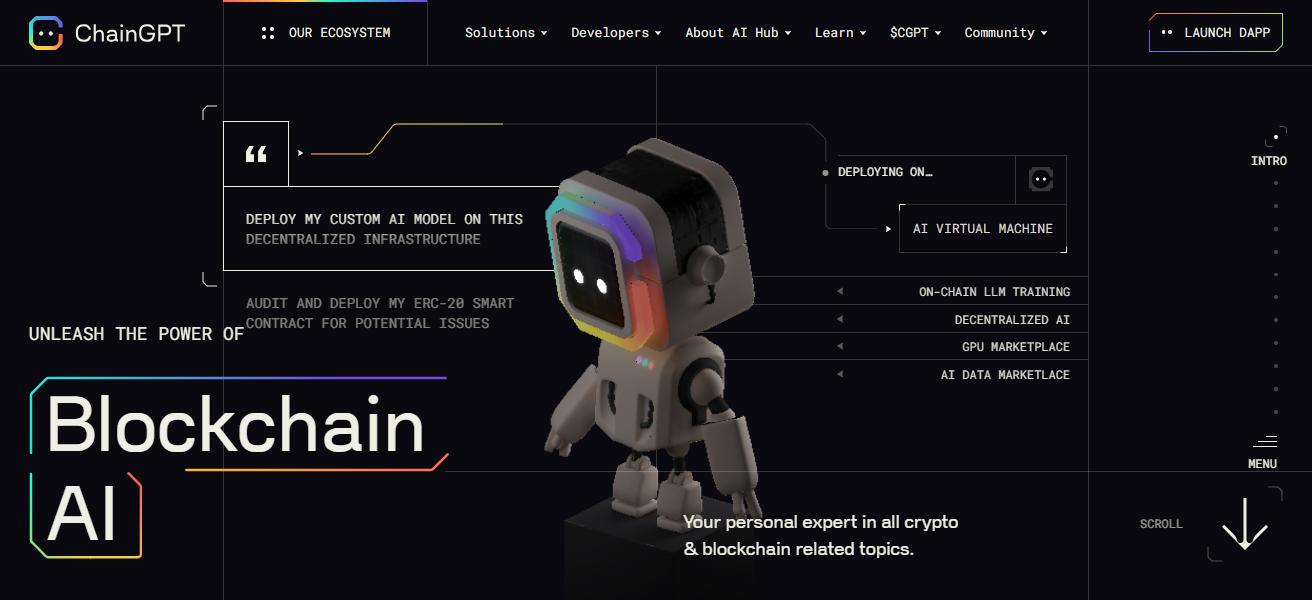
The ChainGPT ecosystem consists of a utility token ($CGPT) paired with a DAO model that facilitates governance layers and staking rewards.
For developers looking to integrate AI into decentralized apps and executives needing automated insights, its uses go beyond providing trading support: it acts as a streamlined trifecta of AI infrastructure for crypto and blockchain development.
ChainGPT Features
- This is AI for smart contract creation and auditing.
- Developers API tools and on‑chain analytics
- Trading insights and signal generation.
- $CGPT governance and ecosystem utilities.
| Pros | Cons |
|---|---|
| Offers developers AI tools beyond just trading | Broad focus may dilute trading‑specific power |
| Smart contract assistance for builders | Complex for users solely seeking trading signals |
| On‑chain analytics help deep research | Utility depends on quality of training data |
| Governance token enables community decision making | Token value may fluctuate with adoption |
6. Stoic AI
Developed by quant researchers and live tested across market cycles, Stoic AI is a fully automated AI crypto trading bot that manages user portfolios using institutional‑grade strategies.
It connects with exchanges through secure API keys — without holding funds — and provides market‑neutral hedged trades, diversified indices, and BTC yield optimizations.
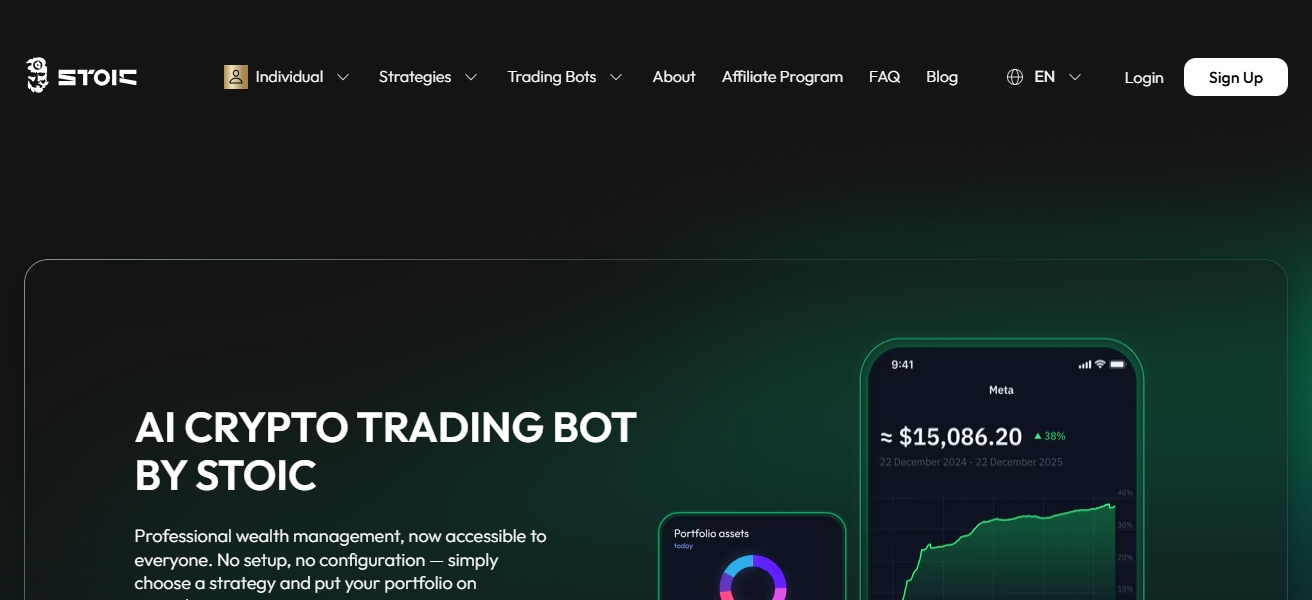
Stoic’s algorithms watch the markets year-round, continuously readjusting positions to generate consistent returns and avoiding emotionally driven decisions, and has already been used by thousands of users with hundreds of millions in managed assets.
Stoic AI Features
- Algorithmic Trading Using Exchange API
- Rules based strategies (e.g., martingale, straddle).
- 24 hora per día, 7 días de riesgo algorítmico y ajuste de posición.
- Users retain control of the asset; no fund custody.
| Pros | Cons |
|---|---|
| Fully automated portfolio management | Limited direct control over individual trades |
| Backtested strategies adapt to market changes | Bot performance can lag sharp market moves |
| Works without custody of users’ funds | Some strategies perform better in specific markets |
| Removes emotional trading from decisions | Fees may impact net returns over time |
7. Pionex
Pionex is a crypto exchange that comes with set of built‑in automated trading bots, allowing users to use grid trading, DCA and trend following strategies without writing any code.
Not all functions are AI‑driven, but its bots automate buying and selling according to market movements, yardımcı remove emotional bias from trades and permitting traders operate 24/7.

Pionex’s low fees and multiple bot options bring algorithmic trading into the reach of retail users (though how effective it is depends on market conditions and configuration).
Pionex Features
- Built-in titans (grid, DCA, arbitrage).
- Automated execution without coding.
- Trading costs and bot optimization tools.
- Bot parameters for controlling their strategy.
| Pros | Cons |
|---|---|
| Built‑in trading bots simplify automation | Not all bots are AI‑driven; some are rule‑based |
| Low fees support frequent trading strategies | Losing trades possible if bot settings are poor |
| Multiple bot options for different styles | Requires careful parameter tuning |
| Accessible to beginners without coding | Less customization than full code bots |
8. TokenTrader AI
TokenTrader AIAcross the spectrum, token trader AI typically refers to an evolving kind of market assistant or platform powered by machine learning to create trade signals, fundamentals analysis, and appropriate strategies to execute.
These tools draw on real‑time market feeds, sentiment indicators and technical factors for users to identify entry/exit points or rebalance their portfolios with minimal manual input.
(Note: right now, there’s not a lot of details on branded product specs available for this item — do check official sites or community sources for accurate features.)
TokenTrader AI Features
- AI‑powered trading signal analysis.
- Entry/exit recommendation generation.
- Fusion of market, sentiment, and technical indicators.
- Dynamic market analytics for automated strategy suggestion
| Pros | Cons |
|---|---|
| Provides AI‑based token trade signals | Accuracy depends on market conditions |
| Combines technical and sentiment analysis | Risk of incorrect or late signals |
| Helps identify entry and exit points | May encourage over‑trading for busy users |
| Assists strategy development | Not a replacement for full due diligence |
9. WealthOptimizer
WealthOptimizer: AI models generate crypto and multi-asset portfolios tailored to user risk tolerance, historical performance and diversification goals.

They combine modern portfolio theory with machine learning to recommend changes in allocation, rebalance holdings, and simulate potential outcomes across various market conditions.
By dynamically adapting to changing market events, these systems try mitigating the risks while producing optimal long-term returns.
WealthOptimizer Features
- AI‑based portfolio allocation and rebalancing.
- Risk profiling and scenario simulation.
- Multi‑asset optimization (crypto + traditional).
- Continuous learning from market conditions.
| Pros | Cons |
|---|---|
| AI optimizes diversified portfolios | Performance depends on model assumptions |
| Tailors risk profiles to user preferences | Risk tolerance may shift in extreme markets |
| Rebalances regularly to target goals | Frequent changes can increase transaction cost |
| Simulates scenarios for planning | Model predictions are not guaranteed outcomes |
10. YieldMaximizer
Tools that maximize yields based on the best opportunities available in DeFi are driven by artificial intelligence and automatically search through them
Automatically deploying and compounding capital across various liquidity sources, stake options, and lending markets.

These systems monitor real-time APYs, smart contract risks and token incentives to adjust allocations of funds accordingly to maintain yield.
Others combine risk scoring and volatility measures to weigh return against safety, in an effort to protect principal while maximizing income as lax conditions dominate decentralized finance venues.
YieldMaximizer Features
- Artifical intelligence has a look at high yields of DeFi protocols.
- Automated allocation across staking/lending.
- To make the most of returns, you can compound and rebalance.
| Pros | Cons |
|---|---|
| Automatically targets highest DeFi yields | High yields often come with high risk |
| Constant monitoring of protocols | Smart‑contract vulnerabilities can expose funds |
| Auto‑compounding can maximize returns | Complex DeFi concepts may confuse beginners |
| Adjusts allocations based on risk scoring | Gas fees may erode yields in low periods |
Cocnlsuion
Overall, There are AI agents who manage your crypto trades and personal finances autonomously.
They save time by eliminating manual effort, minimize emotional trading due to psychological barriers and ultimately they help users in making informed decisions.
Although enhancing efficiency and potential returns, it’s important to comprehend risks, select reputable platforms, and monitor performance regularly for optimal outcomes.
FAQ
AI programs that analyze markets and execute trades automatically.
Yes, some optimize portfolios, budgeting, and risk management.
Generally secure, but risks exist; always use trusted platforms.
Basic understanding helps, but many platforms are user-friendly.