In this article, I cover the Best Crypto Custody Solutions for Small Investors, prioritizing safe, dependable, and simple options. Small investors deserve custody that safeguards their crypto from hacks, theft, or loss while ensuring accessibility.
I analyze the range of options from hardware wallets to quality custodial platforms, and highlight solutions that offer an optimal blend of security, accessibility, and reasonable cost for small crypto holdings.
Key Points & Best Crypto Custody Solutions for Small Investors
| Custody Solution | Key Features & Benefits |
|---|---|
| BitGo | Institutional-grade security, multi-signature wallets, insurance coverage |
| Gemini Custody | Regulated by NYDFS, strong compliance, user-friendly for retail investors |
| Coinbase Custody | Seamless integration with Coinbase exchange, insured cold storage |
| Zodia Custody | Backed by Standard Chartered, combines traditional banking with crypto security |
| ChangeNOW Custody | Ideal for retail users, supports multiple assets, easy-to-use interface |
| Anchorage Digital | Federally chartered crypto bank, advanced security protocols |
| Ledger Nano X | Hardware wallet for self-custody, full control over private keys |
| Fireblocks | Enterprise-grade platform, supports DeFi and staking, secure MPC technology |
| Komainu | Joint venture with Nomura, offers insured custody and regulatory compliance |
| Copper | Offers ClearLoop for instant settlement, strong institutional partnerships |
10 Best Crypto Custody Solutions for Small Investors
1. BitGo
As a regulated qualified custody service provider, BitGo offers multi-signature options and cold storage where clients can hold key-assets with unstitutional grade inftrastructure. (The Digital Asset Infrastructure Company)
They support self-custody cold wallets (user controls keys), hybrid models, and full custodial arrangements. (The Digital Asset Infrastructure Company) BitGo’s security and regulatory standing are important for small clients.
However, the institution-focused fee model may feel unbalanced for retail clients. For small accounts, consider the complexity and cost of the service and determine if the benefits of the advanced functionalities are worth it.
| Feature | Details |
|---|---|
| Security / custody model | Offers qualified custody (through regulated trust entity) with cold‑storage, multi‑sig / TSS (Threshold Signature Scheme) wallets, hardware security modules (HSMs), and insured segregated accounts. |
| Asset support / accessibility | Supports large number of digital assets (700+ claimed) and both hot and cold wallet options. |
| Access & controls | Provides options for self‑custody hot, custodial cold, hybrid models; governance workflows, admin approval, policies. |
| Fees / minimums | Their custodial fee schedule shows tiered basis‑points on Assets Under Custody. |
| Additional services | Enables settlement and trading directly from custody (Go Network), staking, tokenization for institutions. |
2. Gemini Custody
Available through Gemini Trust Company, Gemini Custody integrates with the Gemini exchange and provides segregated cold storage, multi-factor authentication, and offline hardware security modules.
Small investors benefict from Gemini’s well known reputation and accessibility to monitoring the custody balance and the balances and transfers.
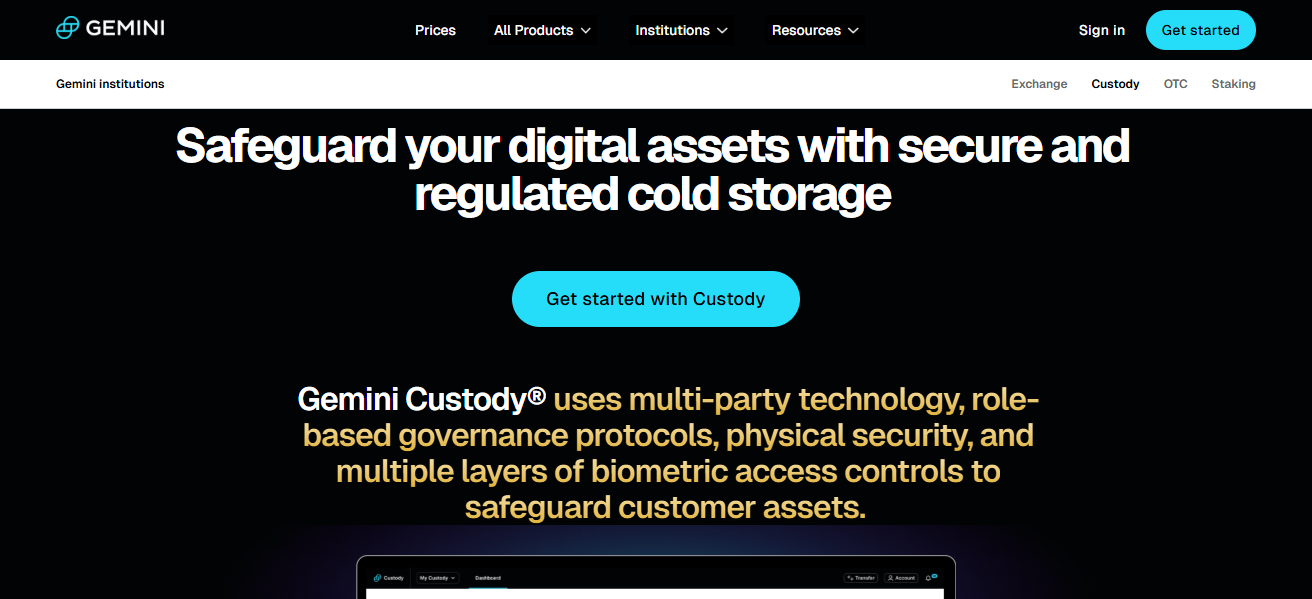
However, since this service is custodial and linked to an exchange, it is important to watch for counterparty risk, the fee structure, and to ascertain whether the assets are segregated and genuinely under independent custody.
| Feature | Details |
|---|---|
| Security / custody model | Institutional‑grade: segregated cold‑storage (offline, air‑gapped), multi‑party tech, role‑based governance, biometrics, SOC2/ISO certification. |
| Asset support / accessibility | Supports over 100 cryptocurrencies for custody. |
| Access & controls | Multi‑user withdrawal workflows, address whitelisting, 2FA/hardware keys, sub‑accounting. |
| Fees / minimums | They state “no set minimum balance”, but there is a minimum monthly fee of ~US$30 per asset in some cases. |
| Additional services | Instant trading from cold storage via Gemini Instant Trade®. |
3. Coinbase Custody
Coinbase Custody operates under Coinbase Prime and is a qualified custodian under New York law. It professes legal custody of more than 400 assets across 38+ blockchains, providing small investors a wide range of assets.
For regulatory compliance and ecosystem range, they’re a regulatory compliant custodian on a legal ecosystem, and the range of assets helps smaller investors.
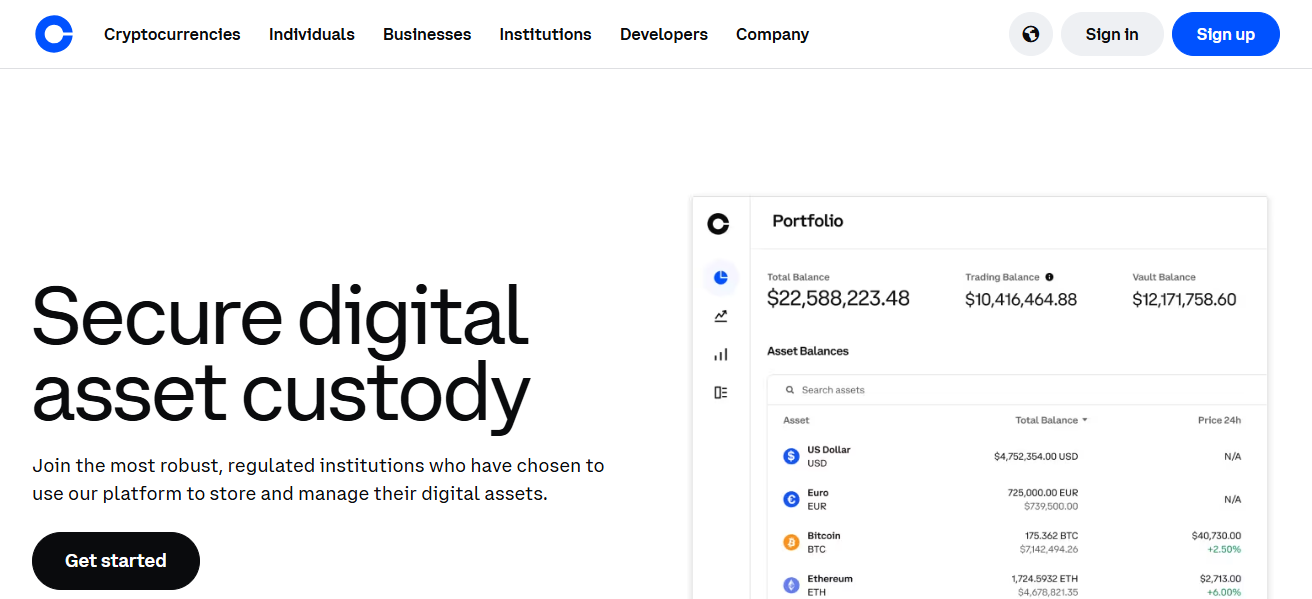
Limitations exist on the lower end, as fees might become disproportionate on smaller amounts, and on the trust of self custody as a 3rd party system is always in place.
| Feature | Details |
|---|---|
| Security / custody model | Qualified custodian under NY law; uses MPC (multi‑party computation), decentralized key shares across regions, offline cold vaults with military‑grade isolation. |
| Asset support / accessibility | Broad support (hundreds of assets) including many blockchains; also offers staking services. |
| Access & controls | Customisable permissions, multi‑user access, audit trails, and 24/7 infrastructure. |
| Fees / minimums | Specific fee schedule not always public for small users; catering more to institutional clients. |
| Additional services | Integration with broader Coinbase ecosystem (trading, staking), audit & insurance coverage. |
4. Zodia Custody
Zodia Custody is backed by banks, including Standard Chartered, and offers custody that includes cold storage, multi-signature governance, and compliance infrastructure.
The focus on institutional clients provides smaller investors with reassurance in the governance and security frameworks in place.
The minimums, pricing, and service levels may not be as suited to smaller balances, as this is more geared towards institutional clients than casual retail.
| Feature | Details |
|---|---|
| Security / custody model | Institutional‑first: integrates regulated custodial framework, uses underlying infrastructure via e.g. Fireblocks network connectivity. |
| Asset support / accessibility | Customisable plug‑and‑play custody solution for financial institutions; global footprint (UK, EU, Singapore, etc). |
| Access & controls | Offers client‑tailored workflows, wallet provisioning, connectivity to trading/loan/liquidity networks. |
| Fees / minimums | Not deeply publicised for small retail holders; more aimed toward institutional accounts. |
| Additional services | Network connectivity (via Fireblocks) for liquidity, rebalancing, trading, and staking. |
5. ChangeNOW Custody
ChangeNOW Pro offers beginner-friendly custody services. Clients can earn through staking and low fees are an added bonus.
The service supports more than 900 coins. From the perspective of a small investor, the wide accessibility of coins and ease of use is a major advantage.
However, do keep in mind that this is a new custody service with less depth in the market compared to other services.
It is highly recommended that you do due diligence on how your assets are held and the custody terms.
| Feature | Details |
|---|---|
| Security / custody model | Hot‑wallet custodial service (on‑platform) – designed more for retail or active users, less heavy cold‑storage institution model. |
| Asset support / accessibility | Supports “several cryptocurrencies”, integrated with ChangeNOW Pro exchange/management. |
| Access & controls | Designed for convenience: users can hold and trade assets easily, lower complexity. |
| Fees / minimums | Lower cost, simpler structure aimed at smaller investors. |
| Additional services | Integrates custody with exchange/trading, staking or passive income may be offered. |
6. Anchorage Digital
As a federally chartered crypto bank in the U.S, Anchorage Digital is a qualified custodian with added staking and custodial crypto and fiat services. It is also added institutional level security.
This service is also great for small investors looking for a top tier solution. The only potential downside is that the larger your account, the easier the services become, small investors may face restrictions in services or account minimums.
| Feature | Details |
|---|---|
| Security / custody model | Charter bank in US (crypto‑native bank) — regulated, segregated client assets, strong controls. |
| Asset support / accessibility | Supports wide range of digital assets (400+ claimed) and fiat + crypto custody. |
| Access & controls | Customisable workflows; strong authentication (e.g., biometric), efficient transactions (90% in <20 minutes claimed) |
| Fees / minimums | Geared toward institutional/high net‑worth; smaller‑investor terms may vary. |
| Additional services | Settlement network, staking, trading capabilities, governance services. |
7. Ledger Nano X
As a hardware (cold-storage) wallet, self-custody is provided with the Ledger Nano X. This includes holding your keys offline, significantly lowering counterparty risk.
The advantage of this service for small investors is total control. In case of loss, counterparty risk can become a liability for third-party custodians.
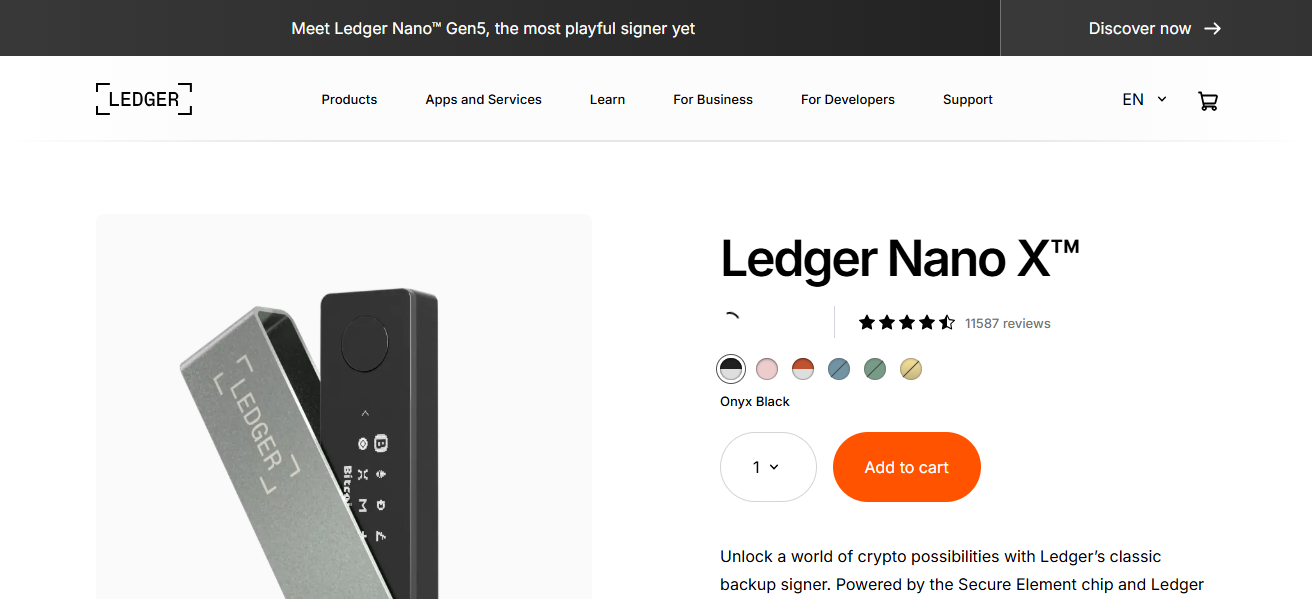
It is suggested to keep the device secured, and to control access to it. This is great for long-term holdings.
| Feature | Details |
|---|---|
| Security / custody model | Fully self‑custody: you control the private keys offline; device uses certified secure element, Bluetooth connectivity, large coin support. |
| Asset support / accessibility | Supports over 1,000 coins/tokens (some sources say 5,000+) across various blockchains. |
| Access & controls | You alone hold/secure the seed phrase; device connects to smartphone or desktop; Ledger Live app. |
| Fees / minimums | One‑time hardware cost; no ongoing custody fees (since you manage). |
| Additional services | Works for long‑term storage (“cold” style), and supports staking via compatible apps. The trade‑off: full responsibility on you. |
8. Fireblocks
Fireblocks builds custody and wallet infrastructure custom around multi-party computation (MPC) and hybrid custody models.
For smaller investors, this might be more complex or designed for institutions, but if you engage with a Fireblocks service, you enjoy strong architecture.
For smaller sums, just ascertain who is running the custody, what your rights are, and ensure you are comfortable with it.
| Feature | Details |
|---|---|
| Security / custody model | “Direct custody” model where you remain owner & controller of assets; infrastructure supports self‑custody + institutional workflows; uses MPC, HSM, multi‑layer security. |
| Asset support / accessibility | Hot, warm, cold MPC wallets; API, roles/quorum‑controls; supports tokenization, DeFi, smart‑contract access. |
| Access & controls | Role‑based access, whitelisting, policy engine, network of participating institutions. |
| Fees / minimums | Geared toward enterprise/institution; complexity may be higher than simple retail wallet. |
| Additional services | Ideal for firms building custody/trading/infrastructure; less “plug‑in retail custody” in simplest form. |
9. Komainu
Komainu provides regulated custody with on-chain segregation, bank-grade governance and institutional oversight.

For smaller investors, this means strong institutional security foundations. However, as in other cases, check required minimums, terms for lock-in (if any), and whether you may need more advanced features that you won’t need.
| Feature | Details |
|---|---|
| Security / custody model | Regulated digital‑asset custodian built by institutions; offers segregated on‑chain custody, MPC & HSM tech, bankruptcy‑remote structure (assets segregated off‑balance‑sheet). |
| Asset support / accessibility | Multi‑asset support, on‑chain segregation, continuity and disaster‑recovery features. |
| Access & controls | Multi‑signature, high security, disaster recovery workflows, business continuity planning. |
| Fees / minimums | Primarily institutional size; terms for smaller investors may need inquiry. |
| Additional services | Supports off‑exchange custody for derivatives/trading collateral as well. |
10. Copper
Copper provides digital asset custody built on MPC technology, collateral management, and institutional infrastructure.
For small investors: while likely over-engineered for modest holdings, choosing a provider that uses or partners with Copper gives you a robust back-end.
The trade-off: typically higher fees or more rigid onboarding than DIY or budget-friendly options.
| Feature | Details |
|---|---|
| Security / custody model | Award‑winning custody platform, multi‑party computation (MPC) shards controlled via three separate entities (client + Copper + third party), segregated vaults. |
| Asset support / accessibility | Supports over 50 blockchains; services include staking, DeFi connectivity, settlement network. |
| Access & controls | Institutional‑grade controls: multi‑sig/MPC, audit trails, 24/7 monitoring, API integration. |
| Fees / minimums | Again, more geared to institutions; smaller retail investors should check onboarding minimums. |
| Additional services | Settlement + trading infrastructure built with custody; whole infrastructure for institutional crypto operations |
Conclsuion
In conclusion For small investors, finding the appropriate crypto custody option weighs security, control, and cost.
For maximum control and minimal recurring costs, hardware wallets like Ledger Nano X are ideal; however, for the convenience of trusted custodial services, BitGo, Gemini, and Coinbase offer institutional-level protection.
ChangeNOW Pro prioritizes retail users, whereas institutional-grade Anchorage or Copper are likely disproportionate for crypto custody with small volumes.
FAQ
Crypto custody is a service or method for securely storing cryptocurrency, either through self-custody (you control private keys) or third-party custodians.
It protects assets from theft, hacking, or loss, while ensuring easier management of holdings.
Hardware wallets like Ledger Nano X provide maximum security by keeping keys offline.
Yes, reputable custodians like BitGo, Gemini, and Coinbase offer institutional-grade security even for small holdings.
Fees vary; some charge flat monthly fees or a percentage of assets under custody, which can be high for small holdings.