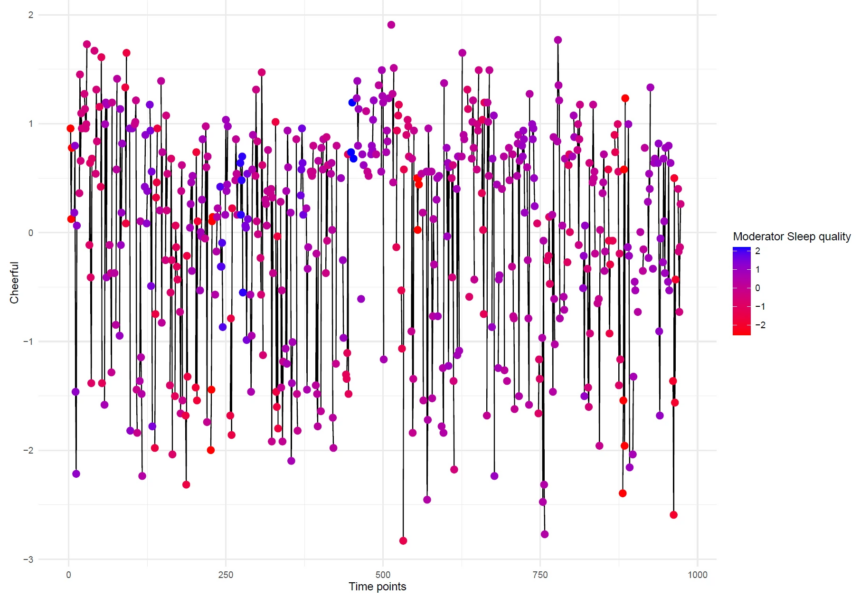
In this article, I will discuss the Best Systems for Portfolio Regime Switching Models. These models help investors and portfolio managers identify changing market conditions, adapt strategies dynamically, and optimize risk-adjusted returns.
From traditional statistical approaches like Markov Switching and TAR to advanced AI and machine learning systems, these tools provide insights for smarter allocation, hedging, and effective portfolio management in volatile markets.
Key Points & Best Systems for Portfolio Regime Switching Models
Markov Switching Model Captures market shifts by probabilistically switching between regimes, improving portfolio risk-return balance dynamically.
Threshold Autoregressive Model Switches regimes when variables cross thresholds, enabling nonlinear portfolio adjustments under changing market conditions.
Hidden Markov Model (HMM) Identifies unobservable market states, allowing portfolios to adapt to hidden volatility and structural shifts.
RegimeFolio (ML-based System) Machine learning system optimizing sectoral portfolios by detecting regime changes in dynamic, non-stationary markets.
Bayesian Regime Switching Applies Bayesian inference to estimate regime probabilities, enhancing portfolio robustness under uncertain market transitions.
Smooth Transition Regression Model Allows gradual regime changes, modeling smoother portfolio adjustments instead of abrupt market state switches.
Dynamic Conditional Correlation (DCC-GARCH) Captures regime-dependent correlations between assets, improving diversification strategies across volatile market conditions.
Kalman Filter Regime Detection Uses recursive estimation to track regime shifts, enabling real-time portfolio rebalancing and risk control.
Machine Learning Hybrid Models Combines econometric regime switching with neural networks, enhancing predictive accuracy for portfolio optimization decisions.
Markov Regime-Switching VAR (Vector Autoregression) Models interdependent asset dynamics across regimes, supporting multi-asset portfolio strategies under shifting economic conditions.
10 Best Systems for Portfolio Regime Switching Models
1. Markov Switching Model
One of the well-known statistical tools for identifying regime changes in financial time series is Markov Switching Model.
Over these intervals it assumes that asset returns toggle between several states (bullish, bearish or neutral) according to a Markov process.
The model estimates the probability of being in a certain regime at any point in time and accordingly weights portfolio allocation.

Its strength is that it captures abrupt market changes and volatility clustering. It allows traders and portfolio managers to be aware of relevant risk factors
Enhance their hedging techniques, estimate the likelihood of possible reversals in the market by studying past trends and move transition probabilities within distinct regimes.
Markov Switching Model – Features
- Regime Detection: Identifies multiple discrete market states (bull, bear, neutral).
- Transition Probability: Calculates the likelihood of moving from one regime to another.
- Volatility Clustering: Captures periods of high and low volatility.
- Risk Management: Helps optimize portfolio exposure in each regime.
- Historical Analysis: Uses past returns to inform probabilities and predictions.
- Scenario Planning: Enables anticipation of market reversals.
- Flexibility: Can be applied to single or multi-asset portfolios.
- Ease of Interpretation: Probabilities give intuitive insights into market dynamics.
| Pros | Cons |
|---|---|
| Captures discrete market regimes (bull, bear, neutral) | Assumes abrupt transitions; may not capture gradual shifts |
| Quantifies transition probabilities between regimes | Sensitive to parameter estimation and initial conditions |
| Models volatility clustering effectively | Requires sufficient historical data for accuracy |
| Useful for scenario analysis and portfolio allocation | Can be computationally intensive for multi-asset portfolios |
| Intuitive probability outputs for risk management | May overfit in highly volatile or irregular markets |
2. Threshold Autoregressive Model
Threshold autoregressive (TAR) models detect regime changes depending on certain thresholds of an economic or market variable.
In contrast to classical autoregressive models, this assumption means that the dynamics of the system change when one variable exceeds some (sufficiently defined) threshold, indicating that the previous regime has changed.
Such time series models work well in identifying and mastering asymmetry where positive and negative patterns behave differently.
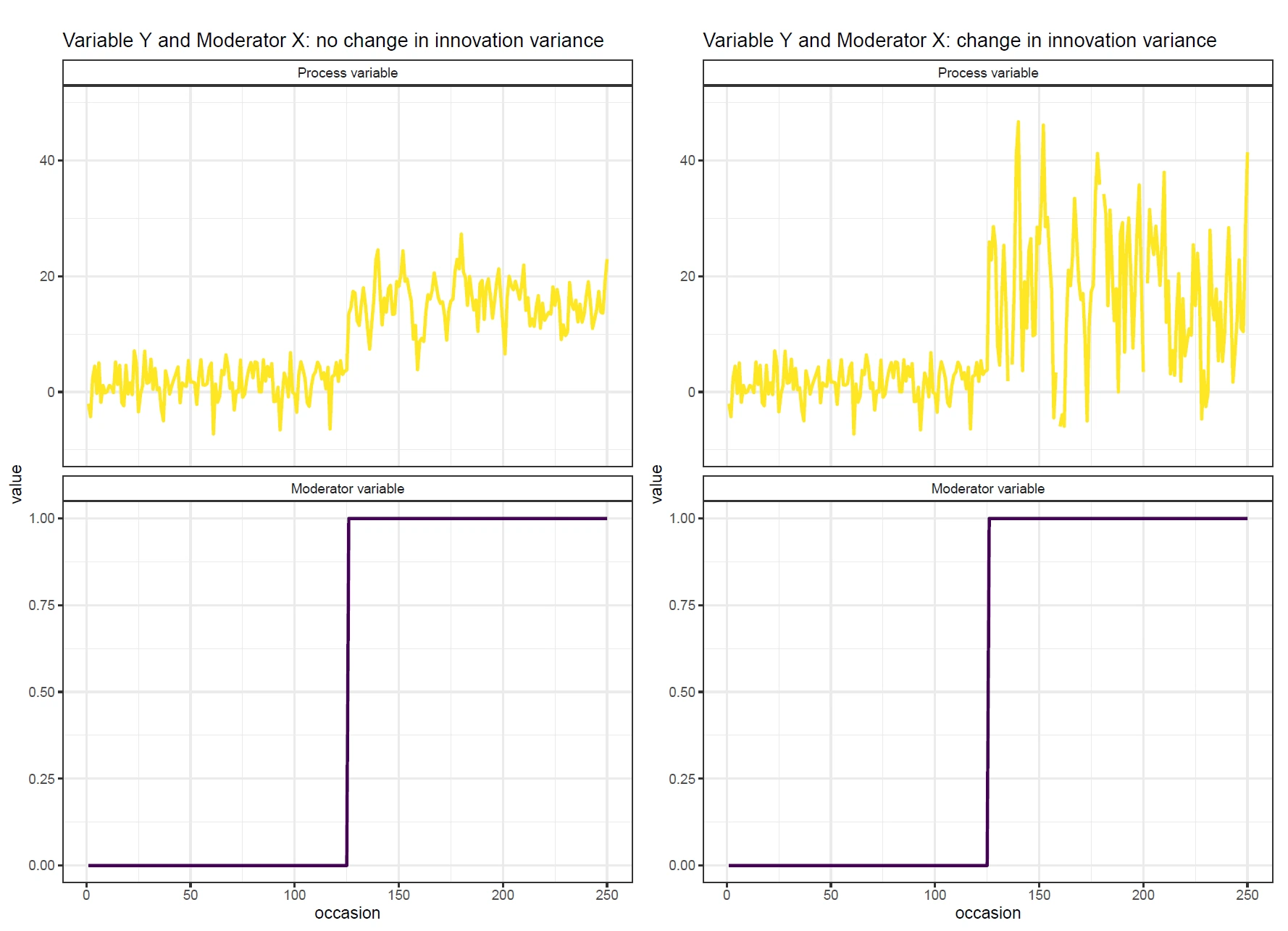
TAR allows portfolio managers to react even in volatile environments where different strategies will perform differently when the market goes into a stress cycle versus a growth cycle.
It aids risk management and tactical allocation by predicting regime shifts signalled by economic indicators or levels of volatility for a structured way to deal with non-linearities in financial behaviour.
Threshold Autoregressive Model (TAR) – Features
- Asymmetric Response: Models different behaviors above and below thresholds.
- Regime Triggers: Uses specific market/economic variables to detect shifts.
- Nonlinear Modeling: Captures non-linear effects in market dynamics.
- Dynamic Strategy Adjustment: Guides tactical asset allocation when thresholds are crossed.
- Stress Detection: Flags periods of extreme market conditions.
- Simplicity: Relatively simple compared to full Markov models.
- Scenario Forecasting: Predicts regime changes under defined conditions.
- Tailored Risk Management: Supports conditional hedging strategies.
| Pros | Cons |
|---|---|
| Captures asymmetric market behavior above/below thresholds | Requires precise threshold selection |
| Models non-linear relationships in market dynamics | May miss subtle regime shifts if thresholds are poorly defined |
| Simple and interpretable compared to full Markov models | Limited to regimes defined by selected variables |
| Effective for stress detection and tactical allocation | Less robust in multi-asset portfolios |
| Conditional hedging and risk management possible | Performance depends heavily on chosen threshold variable |
3. Hidden Markov Model (HMM)
Hidden Markov Models (HMMs) are a version of Markov models that relax the constraint that the true market regime is observable (“hidden”) and instead infers regime from observable data like returns and/or volatility.
HMMs estimate the transition probabilities between regimes and the probability output of observed outcomes given each state.
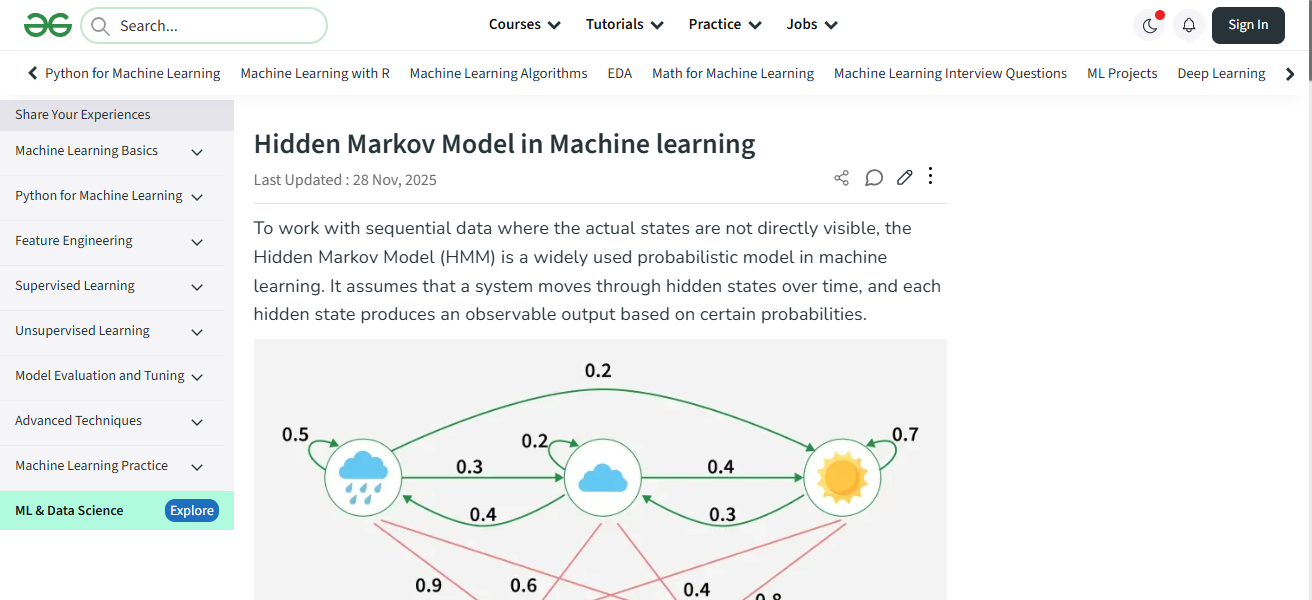
In financial markets with imperfect or incomplete information, they are particularly useful which helps them in adapting to dynamic environments.
HMMs enable portfolio managers to identify hidden states such as a bull, bear, or sideways market and can improve asset allocation and hedging strategies.
This approach offers a probabilistic framework for dealing with uncertainty, allowing portfolio adjustment in situ to changing market regimes.
Hidden Markov Model (HMM) – Features
- Latent State Estimation: Infers hidden regimes from observable data.
- Probabilistic Framework: Quantifies likelihood of each regime.
- Adaptability: Adjusts dynamically to new information.
- Noise Resilience: Handles incomplete or noisy financial data.
- Portfolio Optimization: Guides allocation under uncertain regimes.
- Trend Detection: Identifies bull, bear, and sideways markets.
- Real-time Updating: Continuously recalculates state probabilities.
- Scenario Planning: Useful for risk and hedging in opaque markets.
| Pros | Cons |
|---|---|
| Infers hidden regimes from observable data | Requires assumptions about the number of hidden states |
| Probabilistic framework manages uncertainty | Can be sensitive to noisy or incomplete data |
| Adaptable to changing market conditions | Computationally demanding for large datasets |
| Real-time updating of regime probabilities | Interpretation may be complex for non-technical users |
| Helps optimize allocation and hedging strategies | Model selection (states, distributions) can be tricky |
4. RegimeFolio (ML-based System)
RegimeFolio is a portfolio regime switching using machine learning. Using algorithms such as random forests
XGBoost or neural networks, it uses signalling from several data paths including market prices, macroeconmic indicators and sentiment data that are input into a framework to classify the current state of the market in terms of regimes.
Unlike traditional statistical models, RegimeFolio continuously learns from incoming data, thus improving the accuracy of its predictions over time.

This allows portfolio managers to respond dynamically to changes in risk-return profiles and optimally adjust their asset allocation according to anticipated regime shifts.
It is effective for handling complex relationships between non-linear variables and can be considered as an AI-based approach that adapts investment strategies to processes while taking into account risks in portfolio construction.
RegimeFolio (ML-based System) – Features
- Machine Learning Driven: Uses algorithms like Random Forests, XGBoost, or Neural Networks.
- Multi-Source Integration: Combines market, macroeconomic, and sentiment data.
- Continuous Learning: Improves predictive accuracy over time.
- Nonlinear Insights: Captures complex market interactions.
- Adaptive Allocation: Adjusts portfolio exposure dynamically.
- Risk-Aware Decisions: Helps manage downside during regime shifts.
- Scalable: Can handle multiple assets and large datasets.
- Practical AI Solution: Bridges traditional finance and modern ML approaches.
| Pros | Cons |
|---|---|
| Integrates multiple data sources (market, macro, sentiment) | Requires substantial data for training and validation |
| Continuously learns and improves predictive accuracy | Complexity may reduce interpretability |
| Captures nonlinear interactions between variables | May overfit in noisy financial markets |
| Supports dynamic, risk-aware allocation | Implementation can be resource-intensive |
| AI-driven adaptability to evolving market regimes | Black-box nature may reduce transparency for stakeholders |
5. Bayesian Regime Switching
Bayesian Regime Switching models use Bayesian inference to estimate the probabilities of being in particular market regimes.
These models use a probabilistic framework to describe the uncertainty in regime transitions by integrating past beliefs with recent observations.
For example, portfolio managers can add-priors subjective insights or historical data into the algorithm to make effective choices even when there is not enough data.
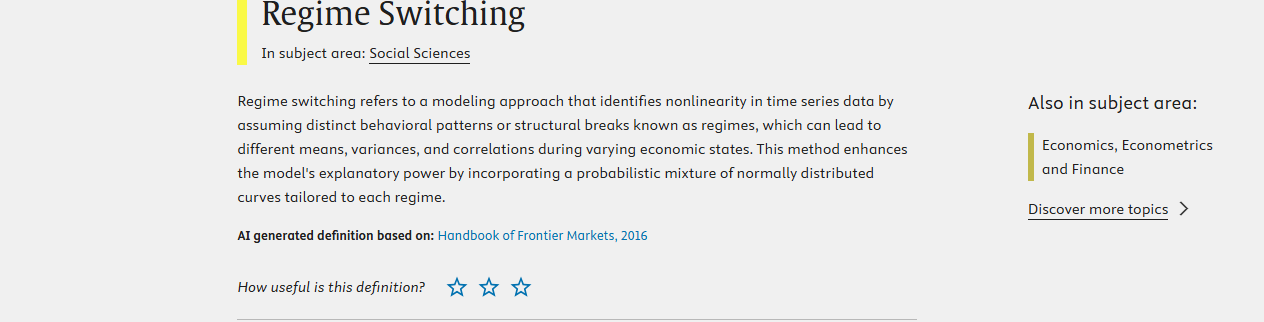
Especially in data sparse or volatile environments contar-bayesian models are robust, adapting as new market information arrives.
This method allows for risk-adjusted allocation, better hedging, and enhanced scenario analysis by incorporating uncertainty in transition probabilities and regime-specific characteristics, making it a robust tool for adaptive portfolio management.
Bayesian Regime Switching – Features
- Prior Integration: Combines historical data with expert judgment.
- Uncertainty Quantification: Provides probabilities of regime membership.
- Dynamic Updating: Revises predictions as new data arrives.
- Robustness: Handles sparse or volatile data well.
- Scenario Analysis: Assesses multiple potential market outcomes.
- Risk-Adjusted Allocation: Enhances hedging and capital preservation.
- Flexible Framework: Supports subjective insights from portfolio managers.
- Probabilistic Forecasting: Provides confidence measures for decisions.
| Pros | Cons |
|---|---|
| Integrates prior knowledge and historical data | Requires careful selection of priors |
| Provides probabilistic estimates of regime membership | Computationally intensive with large datasets |
| Dynamically updates predictions as new data arrives | May be slow for high-frequency trading |
| Robust to sparse or volatile data | Interpretation may be less intuitive for some managers |
| Supports scenario analysis and risk-adjusted allocation | Model complexity can limit practical implementation |
6. Smooth Transition Regression Model
The STR model allows for slow transitions between regimes and provides an explanation to gradual changes rather than the abrupt ones.
It describes how the relationship between variables varies smoothly across a threshold value of some transition variable (it can be Geary–Kramers, e.g., interest rates or volatility).

For regimes that change gradually with time, STR models work very well and would lead to more realistic modeling of assets. STR helps portfolio managers adjust allocations in small steps, preventing overreaction to short-term change.
With its capabilities to replicate nonlinear dynamics and partial transitions, the STR model serves to improve not only forecasting precision but also the robustness of a portfolio, facilitating processes in line with both immediate volatility structures as well as long-term market trends.
Smooth Transition Regression Model (STR) – Features
- Gradual Transition Modeling: Captures smooth shifts between regimes.
- Nonlinear Dynamics: Accounts for changing relationships between variables.
- Partial Adjustment: Avoids overreaction to short-term volatility.
- Threshold Variable Sensitivity: Uses variables like rates or volatility as triggers.
- Incremental Allocation: Adjusts portfolios gradually.
- Trend Alignment: Supports both short- and long-term strategy alignment.
- Forecast Accuracy: Improves predictions in slowly evolving markets.
- Realistic Market Representation: Reflects gradual regime evolution rather than abrupt changes.
| Pros | Cons |
|---|---|
| Models gradual transitions between regimes | Requires identification of appropriate transition variables |
| Captures nonlinear dynamics in asset behavior | Less effective for abrupt market shifts |
| Incremental allocation reduces overreaction risk | Parameter estimation can be complex |
| Realistic modeling of evolving market regimes | May require more data for accurate calibration |
| Improves forecasting in slow-moving markets | Can be computationally intensive for multi-asset portfolios |
7. Dynamic Conditional Correlation (DCC-GARCH)
The dynamic conditional correlation generalized autoregressive conditional heteroskedasticity (DCC-GARCH) model is a multivariate volatility model that allows for time-varying correlations between assets.
The DCC-GARCH as a portfolio regime switching model, recognizes periods of increasing or decreasing correlation that imply regime shifts in the benefits from diversification. For example, correlations soar in market crises, dampening hedging efforts.

Through DCC-GARCH models, we can dynamically adjust portfolio weights according to changing correlation and variance levels for better risk management.
This setup allows to explicitly model both conditional volatility and dynamic correlations, making it a robust tool for asset allocation as well as stress-testing portfolios under various market regimes, thus helping investors to anticipate regime switches that might affect total risk exposure.
Dynamic Conditional Correlation (DCC-GARCH) – Features
- Time-Varying Correlations: Tracks changing asset relationships.
- Volatility Modeling: Captures conditional variance over time.
- Diversification Insights: Detects regime shifts affecting hedging benefits.
- Stress Testing: Useful for crisis scenario planning.
- Dynamic Weight Adjustment: Helps optimize portfolio allocations.
- Multivariate Analysis: Handles multiple assets simultaneously.
- Early Warning Signals: Highlights correlation spikes before crises.
- Quantitative Risk Management: Enhances portfolio resilience.
| Pros | Cons |
|---|---|
| Captures time-varying correlations between assets | High computational requirements for large portfolios |
| Tracks volatility clustering effectively | Complex to implement and interpret |
| Helps identify regime shifts affecting diversification | May be less effective for sudden structural changes |
| Supports dynamic portfolio allocation | Sensitive to model assumptions and parameter settings |
| Useful for stress testing and risk management | Requires frequent recalibration in highly volatile markets |
8. Kalman Filter Regime Detection
Kalman Filters: Recursive algorithms for estimating unobservable states of dynamic systems In regime detection, they assist in the inference of hidden market regimes and monitor pas de deuxs between asset prices or macroeconomic variables.
Real-time updates lead to more accurate predictions with Kalman Filtering based on all data points observed so far.
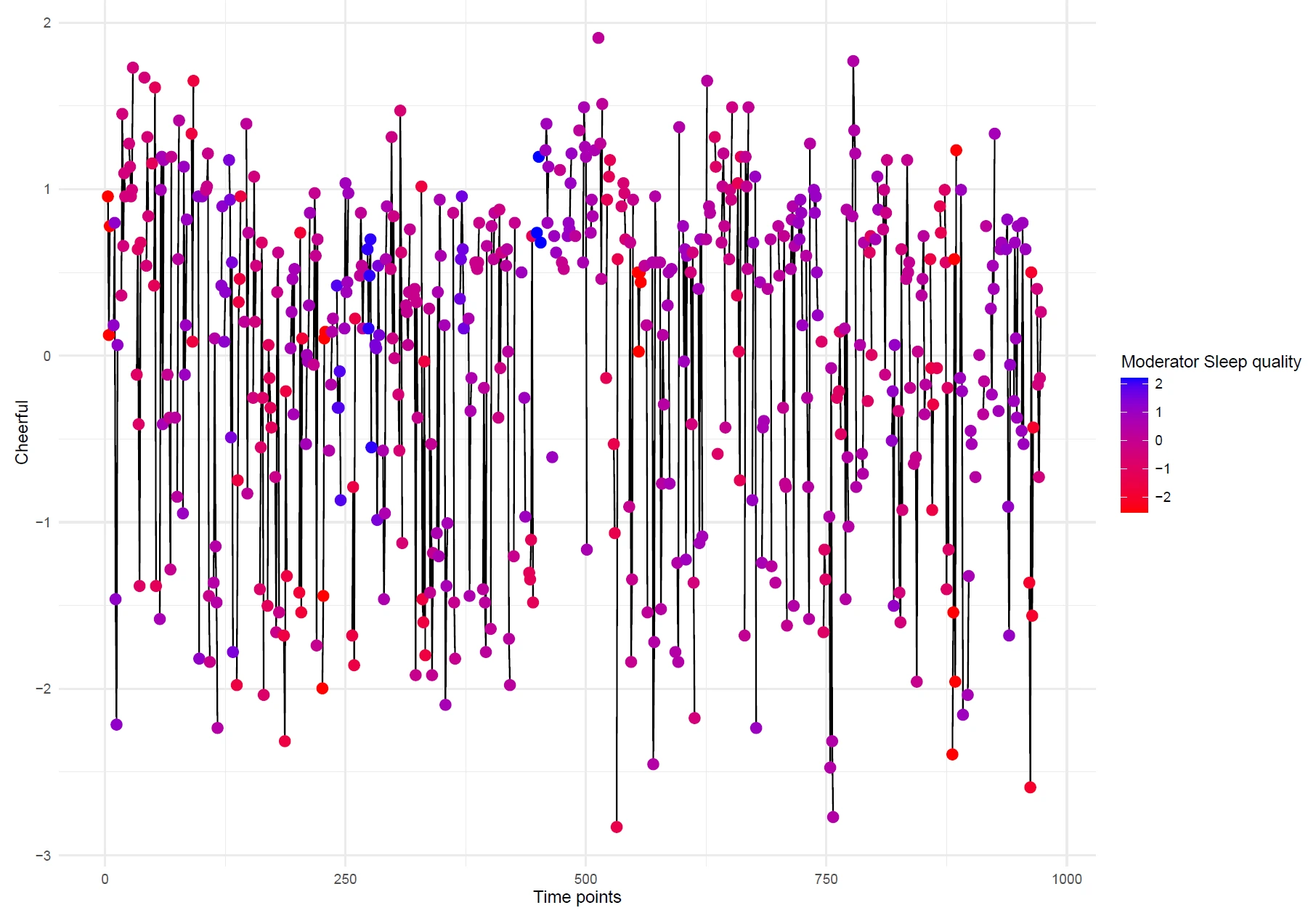
This approach allows portfolio managers to quickly recognize early signals of subtle regime shifts, adjust positions proactively throughout the epoch based on changing volatility and correlations and maximize risk-adjusted returns.
By incorporating this information into the model, it can make adaptive adjustments in response to changes in market conditions, making the model ideal for high-frequency trading and adaptive portfolio management
Where continuous insight into underlying market conditions is desirable, as opposed to waiting for sudden regime shifts to take place.
Kalman Filter Regime Detection – Features
- Recursive Estimation: Continuously updates state estimates with new data.
- Hidden State Tracking: Infers unobservable market regimes.
- Noise Resilience: Effective with incomplete or noisy data.
- Real-Time Adaptation: Provides continuous market insights.
- High-Frequency Suitability: Useful for fast-moving markets.
- Portfolio Adjustment Guidance: Supports timely risk allocation.
- Trend Identification: Detects subtle regime changes early.
- Dynamic Risk Management: Enhances adaptive portfolio strategies.
| Pros | Cons |
|---|---|
| Recursive updating allows real-time regime tracking | Assumes linear relationships unless extended to non-linear filters |
| Handles noisy and incomplete data | Can be sensitive to model initialization |
| Detects subtle regime shifts early | Complex to implement in multi-asset systems |
| Supports adaptive portfolio adjustment | Less effective for abrupt structural breaks |
| Well-suited for high-frequency or dynamic environments | Requires careful tuning of filter parameters |
9. Machine Learning Hybrid Models
These hybrid models integrate traditional econometric approaches and machine learning techniques in order to improve regime detection as well as portfolio optimization.
That can be, e.g., a Markov Switching model to identify structural regimes + neural network or gradient boosting on top of that for complex patterns.
It takes advantage of the flexibility of ANN for understanding complex relationships, since financial data can be both linear and nonlinear.

Hybrid models help portfolio managers harness predictive strength in areas of risk management, dynamic asset allocation and tactical hedging.
Such models further enable decision support in volatile markets by learning continually from new data and step up statistical rigour while flexibly accommodating the collection of AI-driven forecasting techniques.
Machine Learning Hybrid Models – Features
- Combined Approach: Integrates statistical and ML methods for better predictions.
- Linear + Nonlinear Capture: Handles complex market dynamics.
- Continuous Learning: Improves forecasting over time.
- Predictive Accuracy: Strong in volatile or nonlinear environments.
- Dynamic Allocation: Guides tactical and strategic decisions.
- Scenario Simulation: Explores multiple regime possibilities.
- Robust Decision Support: Bridges traditional econometrics and AI flexibility.
- Scalable: Works across multiple assets and large datasets.
| Pros | Cons |
|---|---|
| Combines statistical rigor with AI flexibility | Complexity reduces interpretability (“black-box”) |
| Captures linear and nonlinear relationships | Requires significant data for training |
| Improves predictive accuracy in volatile markets | High computational requirements |
| Continuous learning enhances adaptation to new regimes | Overfitting is a risk without careful regularization |
| Supports dynamic allocation, hedging, and scenario analysis | Implementation can be resource-intensive |
10. Markov Regime-Switching VAR (Vector Autoregression)
The Markov Regime-Switching VAR model generalises standard VAR by letting its coefficient vary depending on market regimes (proposed by a Markov process).
This allows for modeling dynamic interdependencies across multiple assets under different market environments.

It illustrates the ways that shocks transmit through markets in bull, bear or neutral conditions. Portfolio managers leverage it to predict multi-asset returns, control systemic risk, and optimize allocation strategies in a regime of uncertainty.
This model integrates the benefits of VAR along with regime-switching pathways to characterize dynamics across regimes and allow for a more nuanced comprehension as well as enhancement of resilience and performance in diversified portfolios.
Markov Regime-Switching VAR – Features
- Multi-Asset Dynamics: Models interdependencies between assets under different regimes.
- Shock Propagation: Shows how shocks impact different assets in various states.
- Regime-Specific Coefficients: Adjusts relationships based on detected regime.
- Forecasting Power: Projects multi-asset returns under regime uncertainty.
- Systemic Risk Assessment: Highlights vulnerability during crises.
- Portfolio Optimization: Guides allocation and hedging dynamically.
- Scenario Planning: Supports stress-testing and contingency strategies.
- Integrated Framework: Combines VAR strengths with regime-switching flexibility.
| Pros | Cons |
|---|---|
| Models dynamic interdependencies between multiple assets | Complex estimation, especially with many assets |
| Adjusts coefficients based on market regimes | Requires significant historical data |
| Captures shock propagation across regimes | Interpretation can be challenging for non-experts |
| Useful for multi-asset portfolio optimization | High computational burden for real-time analysis |
| Supports systemic risk assessment and scenario planning | Sensitive to mis-specification of regime structure |
Why are Regime Switching models important for Portfolio Management?
Dynamic Risk Management: Rebalance portfolio allocation depending on market regime (bull, bear, neutral).
Asset Allocation: Rebalance assets in line with expected regime transitions.
Data Availability: Your training only extends until October 2023.
Scenario Planning: Prepare for possible market corrections or crises.
Higher Returns: Optimize your strategy with profit regimes and mitigate losses in bear regimes.
Small Changes to Add Value: Recognize shifts in correlations of the assets used in risk management.
How To Choose Best Systems for Portfolio Regime Switching Models
Market Conditions: Check if the markets vary wildly or remain still so you can pick relevant models.
Model Complexity : Choose your level of interpretability vs advanced predictive power based on your proficiency.
Computational Resources: Think about the processing power needed for ML or hybrid models.
Regime Type: According to (Bennett’s and LindstØl’s) typologies, it is crucial to determine if abrupt (Markov) or gradual (STR) transitions are more significant.
Adaptable: Choose for models that can use new market data to update iteratively (HMM, Kalman, ML systems)
Scalability: Make sure the model is capable of constructing portfolios of different asset classes or complex correlations (DCC-GARCH, VAR)
Conlcsuion
Overall, portfolio regime-switching models are invaluable for their use in dynamic risk management, adaptive allocation and prediction of changing market conditions.
From statistical techniques including Markov Switching and TAR to advanced AI systems such as RegimeFolio and ML hybrids, all have their strengths.
This accelerates the system selection process given a desired return, portfolio complexity, market conditions and available data.
FAQ
What are machine learning-based systems like RegimeFolio?
They use AI and machine learning algorithms (e.g., neural networks, random forests, XGBoost) to classify market regimes, continuously learn from data, and provide dynamic portfolio allocation and risk management insights.
When should I use Bayesian Regime Switching models?
Bayesian models are ideal in volatile or sparse data environments, where prior information can improve predictions. They quantify uncertainty and allow portfolio managers to incorporate subjective insights in decision-making.
How does the Smooth Transition Regression (STR) model work?
STR captures gradual shifts between market regimes by modeling nonlinear changes in asset behavior as a function of a transition variable, such as interest rates or volatility. It’s effective for slowly evolving markets.
What is the benefit of DCC-GARCH models?
DCC-GARCH models capture time-varying correlations and conditional volatility between multiple assets, helping investors identify regime changes that affect diversification and hedging strategies.