You sent SOL to someone once, from the same wallet you use for everything else. Now that address sits in their notes, and anyone who has it can open an explorer and scroll your whole history. Every token you hold. Every airdrop that landed. Every time you moved size. None of that is carelessness on Solana’s part. The chain is fast, cheap, and very well indexed.
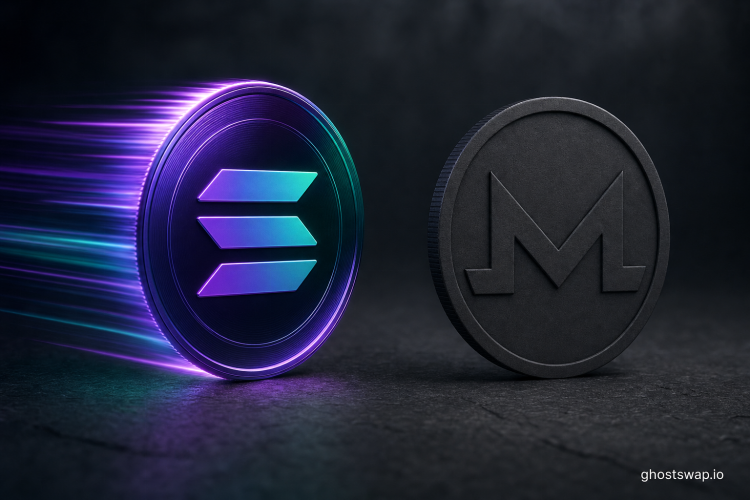
That is why a certain kind of holder rotates a slice of SOL into Monero. Not the whole stack. A slice.
Transparency on Solana is unusually complete
Low fees encourage people to do everything on-chain: mint, tip, vote, farm, rotate positions twice a day. More transactions mean more data, and indexers have had years to map it. Hand someone a single address and they can usually work out which other addresses you control, roughly when you started, and what you were doing through the last cycle. That takes no legal process. It takes a browser tab.
This is harmless right up until it is not: when a client who pays you in SOL can see your net worth, when a small treasury is legible to competitors, or when a pseudonymous account is one donation away from being tied to your main wallet.
What Monero changes
Monero starts from the opposite default. Amounts are hidden, the real sender is obscured among decoys, and each payment goes to a one-time stealth address derived from the address you shared, so the address itself never appears on-chain. In practice that means a Monero address has no public balance and no public history to scroll through.
That same design explains the pressure Monero is under. It has been delisted by a growing number of centralised exchanges over the past two years, and EU anti-money-laundering rules are expected to restrict anonymity-enhancing coins at regulated venues by 2027. The asset is not disappearing, but the regulated routes into it are narrowing, which matters if your plan depends on a venue that may not list XMR next year.
Two chains, two clocks
Coming from Solana, Monero feels slow, so set expectations before you start. Solana confirms about as fast as you can watch it happen. Monero blocks arrive on a much slower cadence, and most wallets wait for several confirmations before funds are spendable. Then there is sync time. A Monero wallet scans the chain to find the outputs that belong to you, because there is no address lookup to query, and on an old laptop that first pass takes a while.
None of this is a defect. It is the cost of a chain where nobody, your own wallet included, gets a shortcut.
What a SOL to XMR swap actually does
The mechanics are plain. You provide a Monero address you control. The service quotes a rate and gives you a Solana deposit address. You send SOL from your own wallet. It converts through licensed liquidity providers, and XMR goes straight to the address you gave. Instant-swap services such as GhostSwap run this without an account, without email, and without KYC by default, and they are non-custodial, so nothing is held on your behalf.
Two settings matter more than the headline rate. Set a refund address, always. If the swap cannot complete, that is where your SOL goes back to, and leaving it blank turns a small problem into a support ticket. Then decide between a fixed quote and a floating one. Fixed protects you from movement while your deposit confirms and costs a little in the rate. Floating tracks the market and can land better or worse. Checking the SOL to XMR pair for the current rate and the minimum takes a few seconds and saves the awkward case where your deposit lands under the minimum.
One thing to know up front: deposits flagged by the licensed partner’s automated AML screening can be held pending review. It is not common, but it happens, and any service that claims it never could is not being straight with you.
Where these swaps go wrong
- Sending from a venue that batches withdrawals, so the deposit lands after the quote window has closed
- Pasting a Monero address from a wallet you no longer hold the seed for
- Checking only the first characters of a long Monero address and not the ending
- Treating the swap as a privacy reset while funding it from an address already tied to your name
- Skipping the refund address and then needing it
Deciding what belongs on the private side
Be clear about what this does and does not do. It moves value from a transparent chain to an opaque one. It does not erase the Solana side: your deposit stays on-chain forever, its amount and timing visible to anyone watching that address. Any service that suggests otherwise is misleading you.
What you get is an asset whose balance and future movements are not published by default. That is a narrower claim than most privacy marketing makes, and it is the one that holds up.
Most people who do this keep the working wallet transparent and move only the portion they would rather not have indexed. Trading capital stays where the liquidity and the speed are. Decide that split while it is still a calm decision, not after someone sends you a screenshot of your own address.