Algorithmic trading is becoming increasingly popular among Indian traders looking to automate their strategies and improve execution efficiency.
In this article, I will discuss the Best Algo Trading Platforms in India Supporting Free API Integration, comparing their features
API capabilities, automation tools, pricing, and suitability for different trading styles. This guide will help you choose the right platform for your trading needs.
Key Points & Best Algo Trading Platforms In India Supporting Free API Integration
1. Dhan
Dhan has become one of India’s most developer-centric algo trading platforms. DhanHQ APIs are free of subscription costs and facilitate trading strategy automation.
Users can access REST APIs, WebSockets, and TradingView. Dhan offers advanced order types such as Forever Orders and Iceberg Orders.
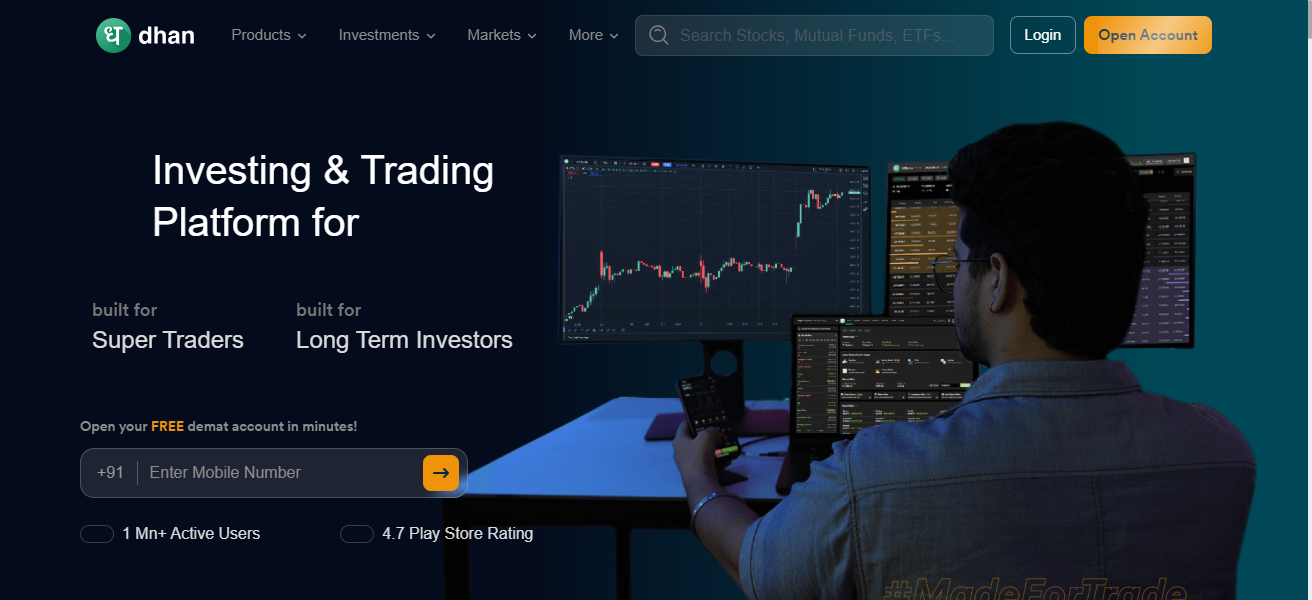
Dhan’s high level of API rate limits, combined with low latency and fast execution, is perfect for intraday trading, as well as options strategies and quantitative trading.
Developers can utilize Dhan’s extensive API documentation to create trading bots and automated execution systems quickly.
Dhan – Pros & Cons
| Pros | Cons |
|---|---|
| Completely free DhanHQ API access for traders | Limited international market access |
| High API rate limits suitable for active algorithms | Advanced features may require technical knowledge |
| Supports REST APIs and WebSocket streaming | Smaller third-party ecosystem than Zerodha |
| Seamless TradingView webhook integration | Primarily focused on Indian markets |
| Advanced order types, including Iceberg and Forever Orders | Some advanced analytics tools are still evolving |
2. FYERS
FYERS offers a completely free API ecosystem, making it the most popular platform for algo traders. FYERS offers real-time, historical, and WebSocket market data APIs.
FYERS APIs now support Python, JavaScript, Java, and Go. Recent upgrades for FYERS APIs have improved execution times and system scalability, providing algo traders the ability to implement more complex automated trading strategies.

Integrated support for TradingView also streamlines the automation process by letting traders create execution flows based on technical signals directly in TradingView, eliminating the need for costly third-party services.
FYERS – Pros & Cons
| Pros | Cons |
| Free API access without monthly charges | Customer support response times can vary |
| Supports Python, JavaScript, Java, and Go | Complex API setup for complete beginners |
| Reliable WebSocket market data feeds | Fewer ready-made algo templates compared to no-code platforms |
| Strong TradingView integration | Historical data limitations on certain segments |
| Growing developer community and documentation | Requires coding knowledge for custom automation |
3. Angel One SmartAPI
For low-cost trading automation, Angel One’s SmartAPI offers a robust free automated trading API. SmartAPI offers real-time market data, historical data, order streams, and WebSocket integration.

SmartAPI is a popular choice for retail traders since there are no monthly API costs, and the execution speed is excellent.
SmartAPI enables algorithm trading for equities, commodities, currencies, and derivatives. SmartAPI is an excellent choice for algo traders, new or experienced, since Angel One is continually improving its trading technology.
Angel One SmartAPI – Pros & Cons
| Pros | Cons |
| No API subscription fees | Documentation can occasionally lag behind updates |
| Access to equities, F&O, commodities, and currencies | Platform stability may fluctuate during extreme market volatility |
| Real-time market data and order execution | Learning curve for advanced API functions |
| Large retail trader community | Limited advanced quantitative research tools |
| Multiple SDKs and integration options | User interface may feel crowded to new users |
4. Upstox
Upstox provides free API access that helps traders build custom algorithms with Python, Excel, and other automation tools.
Upstox has implemented API infrastructure upgrades that have enhanced user experience through increased stability, execution speed, and integration.
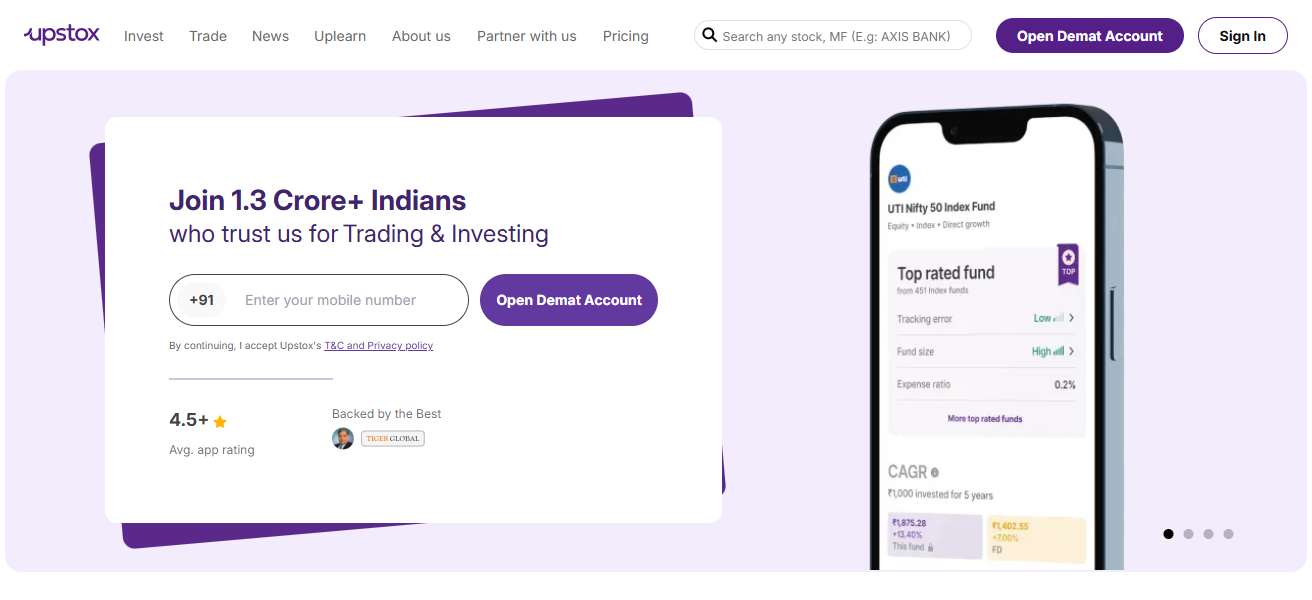
Upstox also has real-time execution, as well as a backtesting feature. Because of this, Upstox is favored by systematic traders.
Upstox is also friendly to beginners, and has an education system and a developing community of programmers, which supports new users of algorithmic trading.
Upstox – Pros & Cons
| Pros | Cons |
| Free API integration for developers | Fewer institutional-grade tools than premium platforms |
| Easy onboarding for beginners | API ecosystem still growing compared to older competitors |
| Supports Excel, Python, and custom applications | Advanced backtesting capabilities are limited |
| Improved execution speed and stability | Some advanced features require third-party integrations |
| Active developer support and documentation | Smaller algo trading community than Zerodha |
5. Zerodha Kite Connect
Zerodha’s Kite Connect API is a tribute to a great algorithmic trading system, as its reliability and sheer quality of documentation and developer community stand alone, even though it’s paid.
A huge volume of traders and fintech firms use Kite Connect to automate their businesses and trade.

Kite Connect’s architecture supports REST APIs, WebSockets, and integrations with most of the leading algorithmic trading platforms.
Its sophisticated, institutional-grade infrastructure and a huge ecosystem of third-party services justify the price of the subscription, and it sets the bar high for algorithmic traders in India.
Zerodha Kite Connect – Pros & Cons
| Pros | Cons |
| Industry-leading API documentation | API is not completely free |
| Highly reliable infrastructure and uptime | Monthly API subscription cost |
| Massive third-party developer ecosystem | Beginners may find setup challenging |
| Supports advanced automation and analytics tools | No free API tier for serious automation |
| Widely trusted by professional traders | Requires programming knowledge |
6. Tradetron
Tradetron is a no-code, cloud-based algorithmic trading platform that lets users design, automate, and manage trading strategies from the comfort of a personal computer.
Tradetron has integrated a number of Indian brokers from multiple asset classes and uses API systems for automatic trade execution.
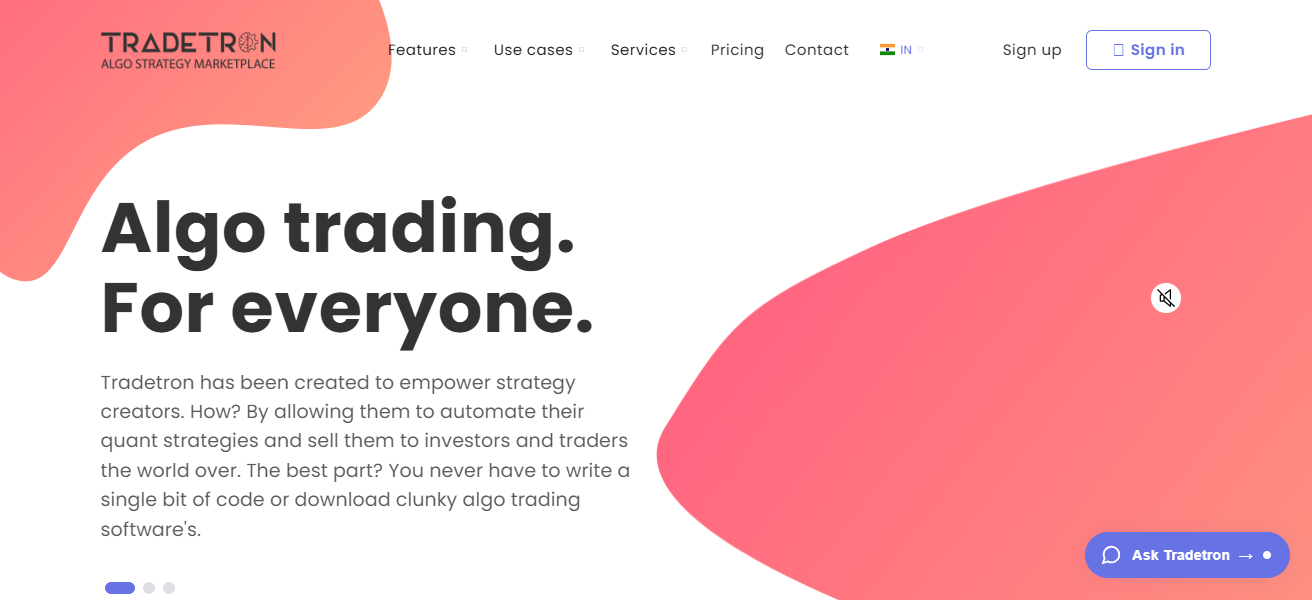
Tradetron’s customers value its visual strategy builder, risk management options, and ready-to-trade strategies.
Tradetorn is dedicated to a growing marketplace for automated trading solutions and easy-to-use technology.
Tradetron – Pros & Cons
| Pros | Cons |
| No-code strategy builder | Monthly subscription plans can become expensive |
| Cloud-based execution without local setup | Limited flexibility compared to custom-coded algorithms |
| Strategy marketplace with ready-made systems | Dependence on platform uptime |
| Multi-broker integration support | Advanced customization options are restricted |
| Built-in risk management tools | Premium features require higher-tier plans |
7. AlgoTest
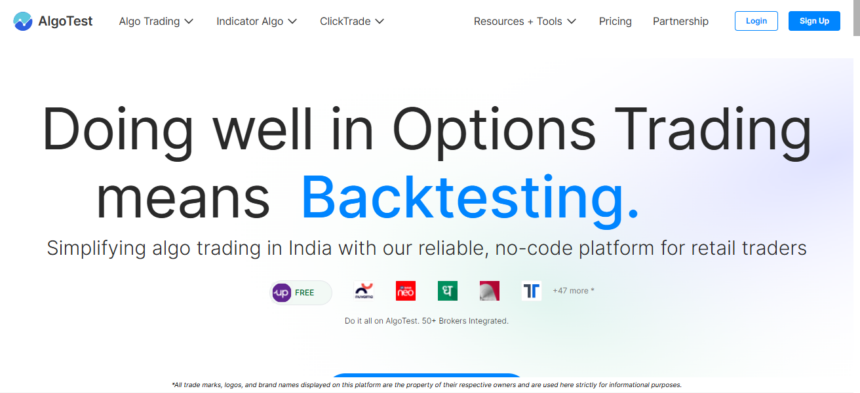
AlgoTest continues to emerge as one of the most popular options strategy automation tools for derivatives traders. Its broker API’s, strategy analysis tools, and backtest tools are powerful.
With AlgoTest, traders can test their options strategies on historical data before they execute them in the real world.
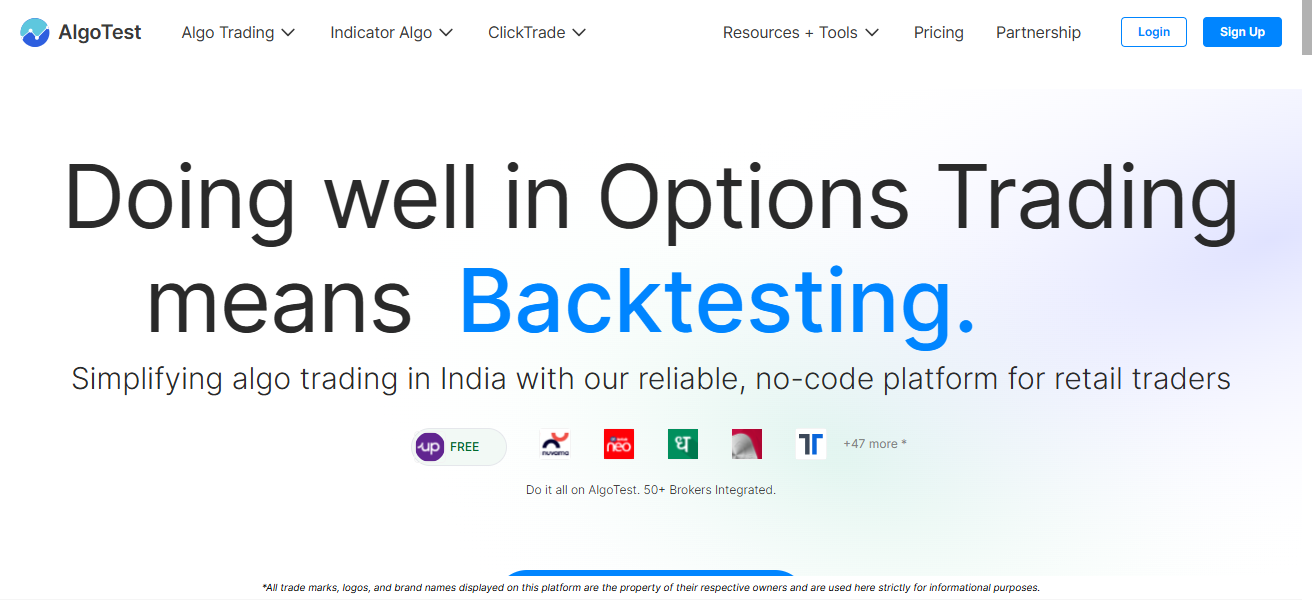
AlgoTest is popular among Nifty and Bank Nifty options traders due to its dashboard and risk management tools. AlgoTest is continually improving its analytics and automation.
AlgoTest – Pros & Cons
| Pros | Cons |
| Excellent options strategy backtesting | Primarily focused on options trading |
| Detailed performance analytics | Less suitable for equity-focused traders |
| Easy strategy deployment through broker integrations | Limited support for non-derivative assets |
| User-friendly interface for options traders | Some advanced features require paid plans |
| Strong risk analysis tools | Smaller community compared to major brokers |
8. Streak
Gone are the days when coding skills were the primary requirement for designing an algorithm in the financial market.
Trading strategies can now be designed without coding using Streak. The aim for Streak is to make algorithmic trading services accessible to retail traders and to achieve that
They have created a highly visual service offering for strategy design, backtesting, and automated execution.
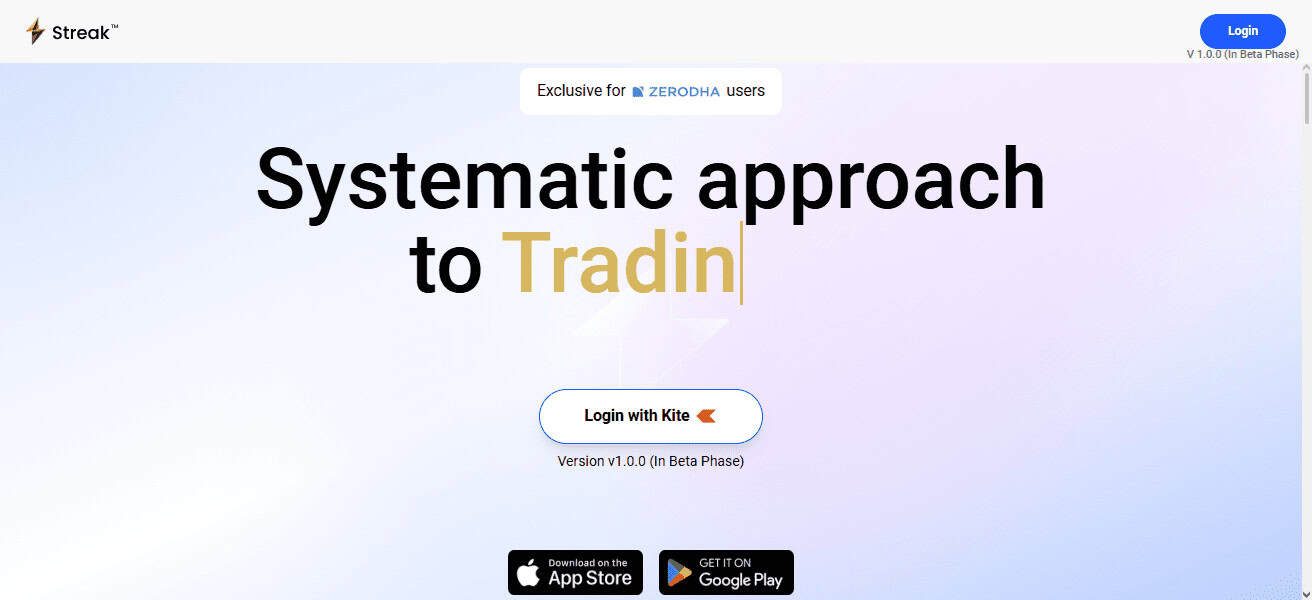
Streak makes use of a rules-based strategy design framework that can include technical indicators. Once created, the strategies can be seamlessly deployed.
Streak’s design, integration with broker services, and variety of strategies have made Streak the algorithmic software service of choice for thousands of traders in India.
Streak – Pros & Cons
| Pros | Cons |
| Completely no-code strategy creation | Limited flexibility for highly complex strategies |
| Easy-to-use visual strategy builder | Fewer customization options than APIs |
| Fast backtesting engine | Strategy conditions can be restrictive |
| Suitable for beginners entering algo trading | Advanced quantitative traders may outgrow the platform |
| Large library of technical indicators | Limited support for custom coding |
9. AalsiTrader
AalsiTrader is a new AI-based algorithmic trading platform in India. Automated trading, backtesting, and paper trading are all seamlessly integrated with broker services and are standard offerings for most algorithmic trading platforms.

What differentiates AalsiTrader from its competitors is the AI agents that have been used to automate the analysis of different market conditions and the identification and execution of trading opportunities.
A diverse and exciting feature set has been added to AalsiTrader, such as risk control and strategies optimization, and it has integrated several popular brokers, including Zerodha, Dhan, Angel One, and Upstox.
AalsiTrader – Pros & Cons
| Pros | Cons |
| AI-powered strategy automation features | Newer platform with a smaller user base |
| Supports multiple leading brokers | Limited long-term track record |
| Includes paper trading and backtesting | Some AI features may require premium plans |
| Automated risk management tools | Community resources are still developing |
| Continuous feature innovation | Advanced customization may be limited |
10. Anadi Algo
Anadi Algo is a new advanced strategy automation platform emerging in the Indian markets. With broker API integrations, webhook connections from TradingView, backtesting, and automated trading, Anadi Algo has a lot to offer.
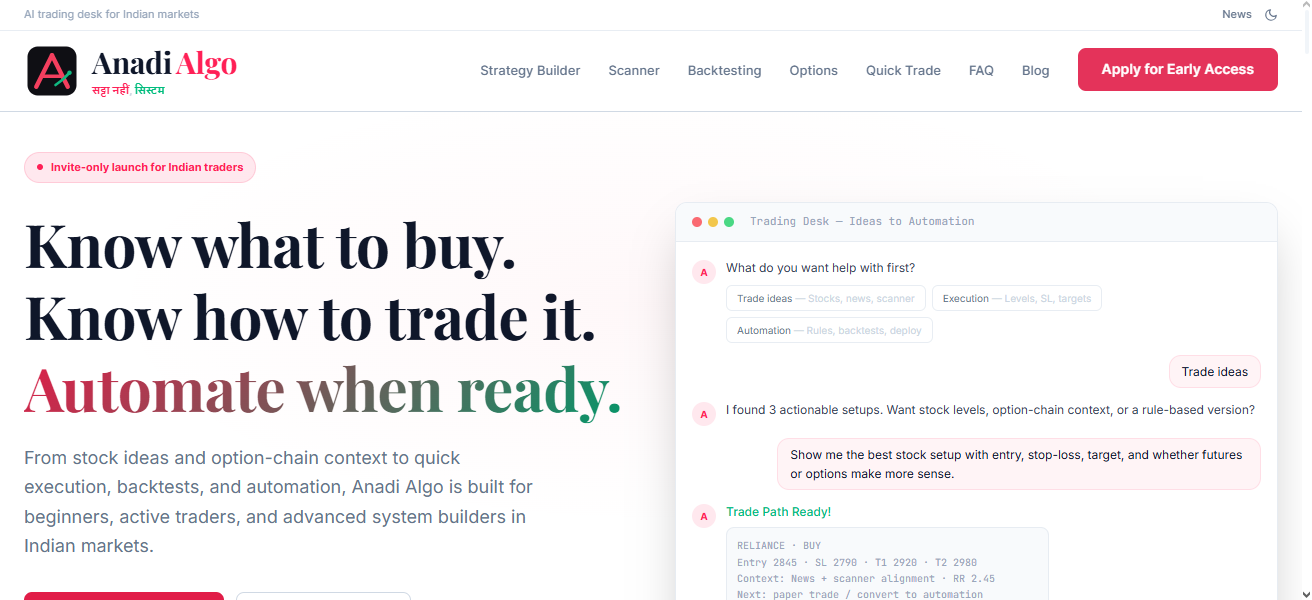
Integrating with multiple brokers, users can create, test, and deploy strategies all on one platform.
With an emphasis on the use of AI for the generation of strategies, real-time market scanning, and automation of work and processes, Anadi Algo is one of the best options for traders who want to automate their trading processes.
Anadi Algo – Pros & Cons
| Pros | Cons |
| Supports TradingView webhook automation | Smaller brand recognition in the market |
| Multi-broker API connectivity | Learning resources are relatively limited |
| Strategy creation and deployment from one dashboard | Fewer third-party integrations than larger competitors |
| Focus on AI-assisted trading workflows | Community support remains modest |
| Real-time market scanning capabilities | Advanced features may require additional configuration |
Conclusion
In summary, some of the best algorithm trading platforms in India that offer free APIs enable traders to automate their strategies, have access to real-time market data, and increase the efficiency of their trade executions, all at no extra cost.
Dhan, FYERS, Angel One, and Upstox have strong API infrastructures and ecosystems. Selecting the most appropriate platform for you will depend on your trading goals and automation level, as well as your technical skills and broker preference.
FAQ
Which algo trading platform offers free API integration in India?
Dhan, FYERS, Angel One SmartAPI, and Upstox are among the leading platforms that provide free API access for eligible traders.
Do I need coding knowledge for algorithmic trading?
Not necessarily. Platforms like Tradetron and Streak offer no-code strategy builders, while API-based platforms typically require programming skills.
Which programming languages are commonly supported by trading APIs?
Most Indian trading APIs support Python, JavaScript, Java, and REST-based integrations for building automated trading systems.
Is algo trading legal in India?
Yes, algorithmic trading is legal in India when conducted through SEBI-compliant brokers and approved trading platforms.