This article reviews top tier trading systems for institutional traders that provide financial services businesses the ability to enhance trading productivity, analyze markets, increase automation, and manage risk.
The leading edge solutions provide users real-time data, algorithmic trade execution, effective control of one’s investment portfolio, and access to all world markets.
Technology for institutional traders is the foundation for banks, hedge funds, and other financial services businesses to make timely and judicious investment decisions.
Key Points & Best Institutional Trading Technology
| Institutional Trading Technology | Explanation |
|---|---|
| Bloomberg Terminal | Provides real-time market data, analytics, trading tools, and financial insights globally. |
| Refinitiv Eikon | Delivers advanced trading intelligence, news, analytics, and investment research solutions. |
| Trading Technologies (TT) | Offers professional futures trading infrastructure with powerful execution capabilities worldwide. |
| FlexTrade Systems | Enables algorithmic trading, order management, and institutional execution workflows efficiently. |
| Charles River IMS | Supports investment management, portfolio operations, and institutional trading processes. |
| Bloomberg AIM | Provides asset management technology for portfolio, compliance, and trading operations. |
| Fidessa | Delivers multi-asset trading solutions for brokers and financial institutions globally. |
| Portware | Offers algorithmic trading tools, customization, and execution management technology. |
| Itiviti | Provides advanced trading platforms for global brokers and financial institutions. |
| AlgoTrader | Enables automated trading strategies with institutional-grade algorithmic execution systems. |
10 Best Institutional Trading Technology
1. Bloomberg Terminal
Bloomberg Terminal is one of the top-ranked systems for Institutional Trading Technology and is used globally by banks, hedge funds, and professional traders. It combines real-time data and news with analytics and portfolio management and trading tools.
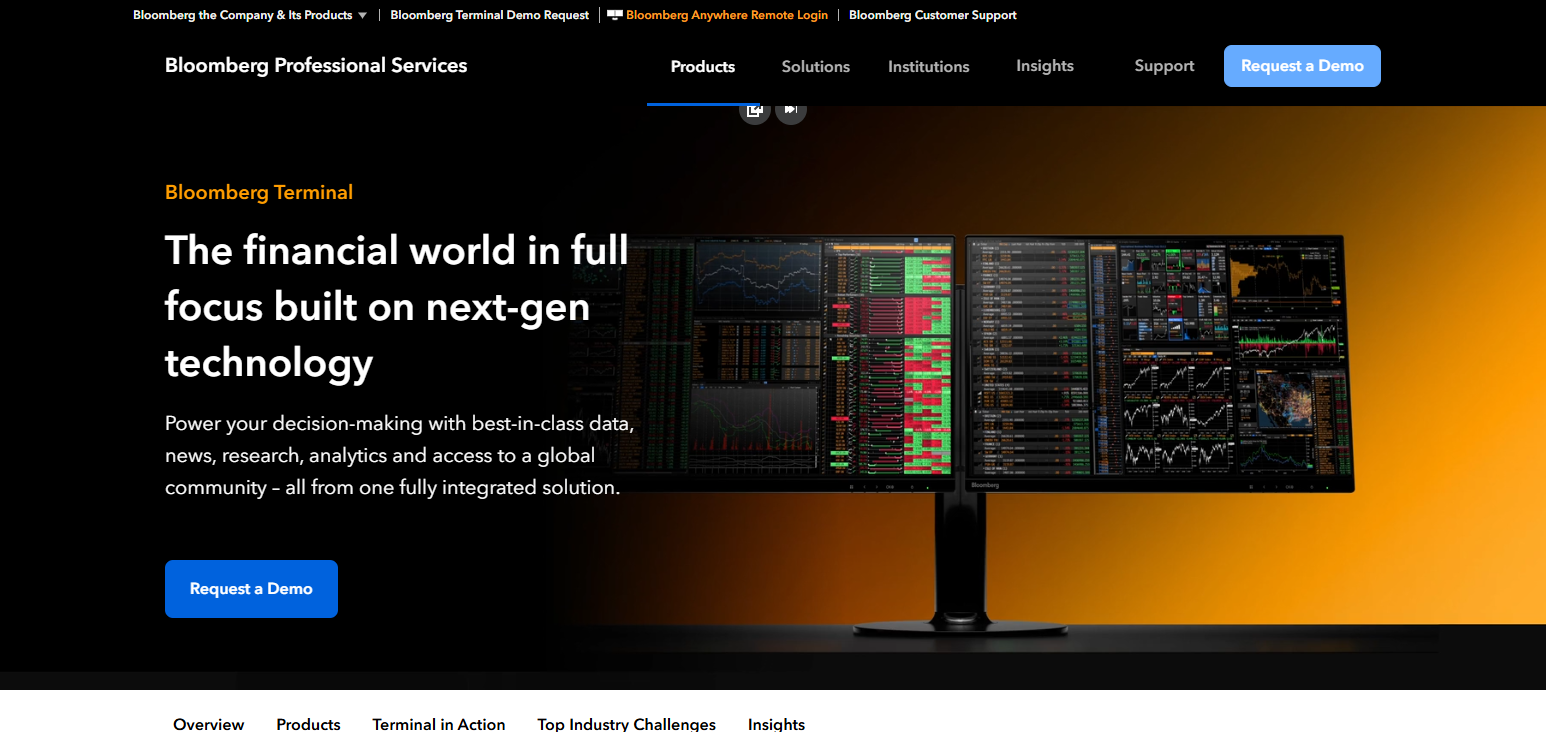
Bloomberg Terminal is used by institutions to scan the world’s markets, identify and analyze investment opportunities, and manage risk which helps them to make informed trading decisions.
Its integrated communications, powerful real-time database, and customizable dashboards give Bloomberg Terminal the competitive advantage to be the leading platform for institutional clients.
Bloomberg Terminal – Key Features
- Real-Time Market Data – Global data on financial markets at the click of a button.
- Advanced Financial Analytics – Analytical capabilities for assessments of markets, investments, and portfolios.
- Professional Trading Tools – Tools for the execution of trades and management of positions for institutional investors.
- Breaking News Integration – Financial news, economic updates, and announcements sourced globally and delivered as they happen.
- Portfolio Management – Tools for the assessment of portfolio risk and the optimization of portfolio construction.
| Pros | Cons |
|---|---|
| Provides highly accurate real-time financial data across global markets. | Extremely expensive subscription costs make it difficult for small firms. |
| Offers powerful analytics and research tools for professionals. | Requires training due to complex interface and features. |
| Supports advanced trading, portfolio management, and risk analysis. | Some features may be unnecessary for smaller investors. |
| Delivers reliable financial news and market intelligence. | Limited customization compared with newer cloud-based platforms. |
| Used widely by banks and institutional investors globally. | High dependency on Bloomberg ecosystem and services. |
2. LSEG Workspace
LSEG Workspace (previously as Refinitiv Eikon) is one of the top-rated systems of Institutional Trading Technology. It is a system used to do financial studies, analyses of markets, and the management of investments.
It offers real-time pricing, economic data, corporate data, and professional trading intelligence. This system is used by institutional investors to analyze their portfolios and assess the risks as well as identify trends in the markets.

The combination of news and analytics along with fully developed trading systems and styles enables financial professionals to make investment decisions quickly and accurately.
LSEG Workspace – Key Features
- Comprehensive Market Intelligence – Financial data and economic insights for institutional investors.
- Advanced Research Tools – Analysis of companies, industries, markets, and investment opportunities.
- Real-Time Trading Information – Market data, updates, and trading information at the ready.
- Customizable Workspaces – Personal dashboards for alerts, reports, and financial monitoring.
- Risk Analysis Capabilities – Assessment of portfolio and market risk and optimization of investment strategies.
| Pros | Cons |
|---|---|
| Provides extensive market intelligence and financial research data. | Premium pricing may not suit smaller investment companies. |
| Offers advanced analytics for investment decisions and portfolio analysis. | Platform complexity requires professional training. |
| Delivers real-time market updates and financial news. | Some advanced features have additional costs. |
| Supports customizable dashboards and workflows. | Data coverage may vary across different regions. |
| Helps institutions improve research and risk management processes. | Interface can feel overwhelming for new users. |
3. Trading Technologies (TT)
Trading Technologies (TT) is one of the top-rated systems of Institutional Trading Technology. It specializes in the professional domains of trading for futures and the derivatives markets. Trading Technologies offers a cloud-based trading system, advanced tools for the execution of orders, and algorithm-based trading and risk management.
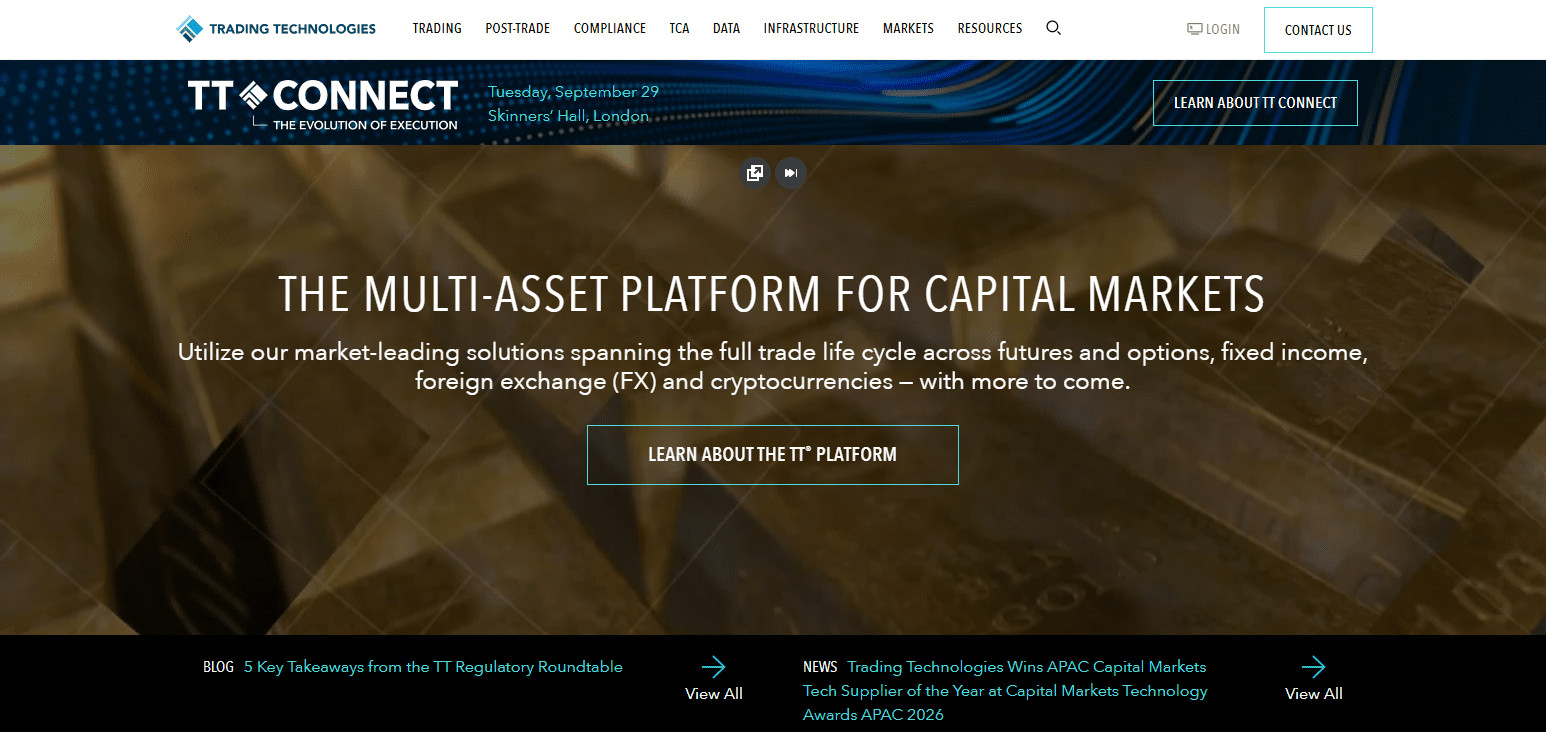
Hedge funds and proprietary trading firms as well as financial institutions use TT to trade on any of the world’s markets and execute their trades at high velocity. Its trade architecture is safe and reliable, with the necessary scalability to support advanced trading systems.
Trading Technologies (TT) – Key Features
- Cloud-Based Trading Infrastructure – Reliable, scalable trading technology for access to all markets.
- Algorithmic Trading Support – Institutions can develop automated strategies for trade execution.
- Global Exchange Connectivity – Trade access to all futures, options, and derivatives exchanges.
| Pros | Cons |
|---|---|
| Provides fast and reliable cloud-based trading infrastructure. | Mainly focused on futures and derivatives markets. |
| Supports advanced algorithmic trading strategies. | Can be expensive for smaller trading organizations. |
| Offers connectivity with multiple global exchanges. | Requires technical knowledge for advanced features. |
| Includes strong risk management capabilities. | Limited usefulness outside professional trading environments. |
| Enables high-speed order execution and automation. | Implementation may require professional support. |
4. FlexTrade Systems
FlexTrade Systems is a winner of the Best Institutional Trading Technology award and a provider of algorithmic trading, execution, and multi-asset trading solutions. The Systems division of FlexTrade Systems offers advanced algorithms, automation, and analytics in real-time.
Banks, brokers and asset managers use FlexTrade to optimize the execution of large orders, automate volume workflows, and minimize the efficiency loss to the market. FlexTrade offers coverage of equity, fixed income, foreign exchange, and derivatives products across all the world’s major trading venues.
FlexTrade Systems – Key Features
- Advanced Algorithms: Supplies sophisticated algorithms to optimize the execution of trades, minimizing the impact of trades on the market.
- Cross-Asset Trading: Facilitates trading in equities, fixed income, foreign exchange, and derivatives.
- Execution Management: Assists firms in the management of orders and analyzes the performance and efficiency of trading.
- Market Analysis Tools: Offers insights on liquidity, pricing, and execution in the market.
- Modular Trading Systems: Grants firms the ability to tailor various parts of their trading solution.
| Pros | Cons |
|---|---|
| Provides powerful algorithmic trading and execution tools. | High implementation costs for smaller institutions. |
| Supports multiple asset classes and global markets. | Requires specialized knowledge to configure systems. |
| Helps reduce market impact through smart execution. | Setup and customization can be time-consuming. |
| Offers advanced analytics for trade performance improvement. | Maintenance may require dedicated technical resources. |
| Provides flexible solutions for institutional trading needs. | Less suitable for individual retail traders. |
5. Charles River Development (Charles River IMS)
Charles River IMS is a leading Best Institutional Trading Technology winner and trading solution provider for investment managers, asset owners, and financial institutions. Charles River IMS offers portfolio, order, and trade management alongside workflow automation and compliance monitoring.
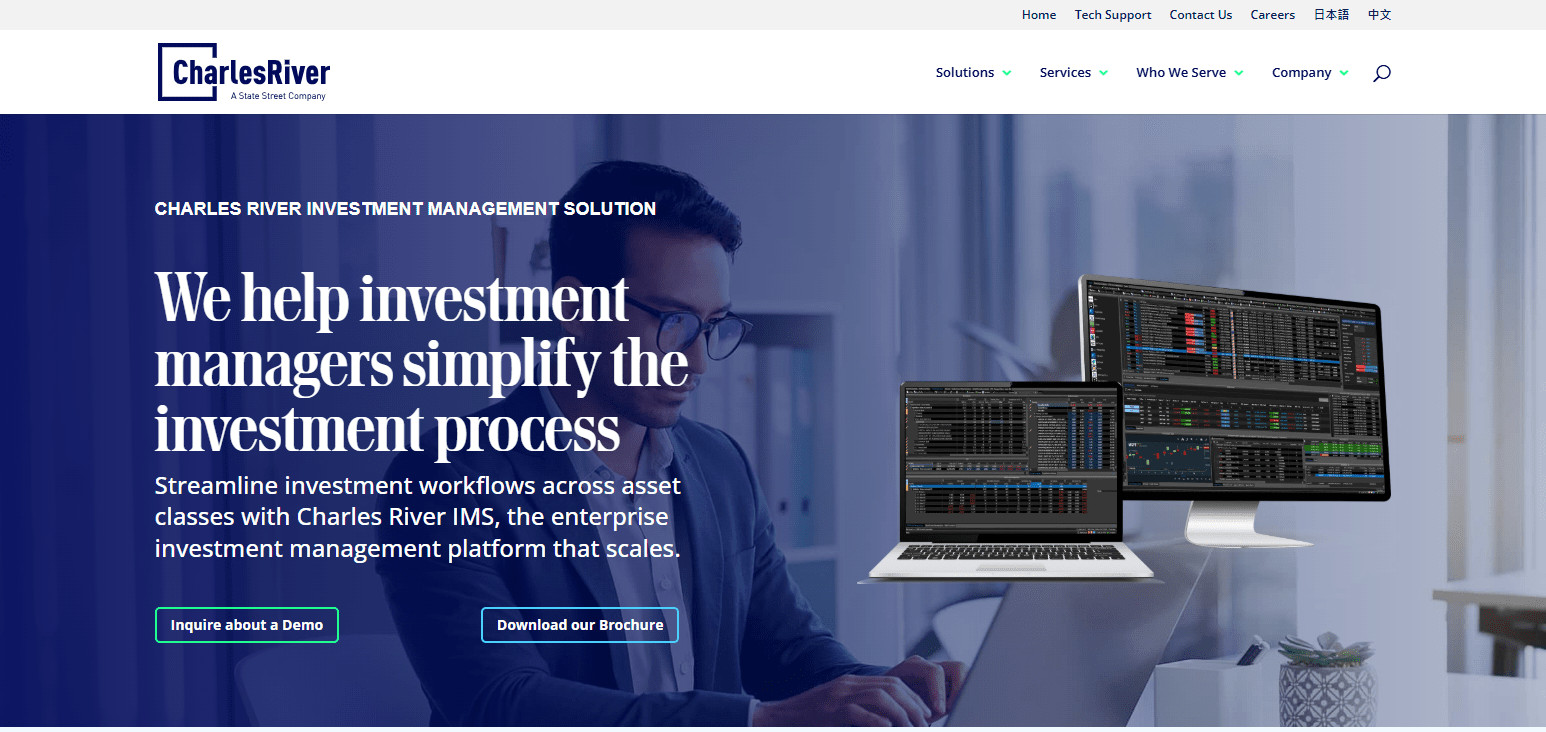
Charles River IMS is used by institutions to manage multiple asset classes and to enhance the efficiency of operations. The integrated nature of its solutions offers financial institutions the ability to perform regulatory mandates, analyze and appraise their portfolios, and improve their investment decision processes.
Charles River IMS – Key Features
- Investment Management Software: Allows managers to construct, oversee, and manage various types of investment portfolios.
- Order Management: Provides solutions for efficient trade processing and order execution.
- Automated Compliance: Instantly checks compliance in relation to regulations and investment restrictions.
- Cross-Asset Capabilities: Supports equities, fixed income, alternative investments, and other asset classes.
- Automated Investment Processes: Enhances productivity and reduces the amount of manual tasks.
| Pros | Cons |
|---|---|
| Provides comprehensive portfolio and investment management solutions. | Expensive licensing costs for smaller firms. |
| Supports multiple asset classes and investment strategies. | Implementation process can be complex. |
| Includes strong compliance and regulatory management tools. | Requires employee training for efficient usage. |
| Improves operational efficiency through workflow automation. | May need integration with existing financial systems. |
| Trusted by large asset managers worldwide. | Overly advanced for simple investment operations. |
6. Bloomberg Asset and Investment Manager (Bloomberg AIM)
Bloomberg AIM is a leading Best Institutional Trading Technology solution and system for asset managers and investment firms. Bloomberg AIM combines trading and portfolio management with compliance and risk controls in a single integrated system.

Bloomberg AIM is used by financial institutions to rationalize their investment strategies and automate workflow tasks to improve transparency. Bloomberg AIM is used by financial firms to cope with regulatory mandates and improve the efficiency of their investment operations while managing complex portfolio investments.
Bloomberg AIM – Key Features
- Investment Management Software: Offers complete investment management solutions for institutional asset managers.
- Portfolio Risk Control: Assists firms in the analysis of portfolio risk and loss of control of investments.
- Automated Compliance: Simplifies the reporting of compliance issues through automation.
- Trade Workflow Automation: Streamlines the entire investment process from the construction of a portfolio to the execution of trades.
| Pros | Cons |
|---|---|
| Provides integrated asset management and trading workflows. | High subscription costs limit accessibility. |
| Offers strong portfolio risk management features. | Requires expertise to operate effectively. |
| Supports compliance monitoring and regulatory requirements. | Smaller firms may not use all features. |
| Improves transparency across investment operations. | Customization options can be limited compared with competitors. |
| Connects easily with Bloomberg financial ecosystem. | Depends heavily on Bloomberg infrastructure. |
7. Fidessa
Fidessa is a versatile Best Institutional Trading Technology platform with a multi-asset trading infrastructure system for brokers, banks, and trading institutions. Its infrastructure supports the trading and processing of equities and derivatives and facilitates the workings of the global marketplace.

Fidessa’s clients appreciate the automated market workflows and efficient processing of Fidessa’s Order Management and Execution systems. With Fidessa, banks, and other financial institutions enhance their trading capabilities and market offerings to clients with the utmost reliability.
Fidessa – Key Features
- Multi-Asset Trading Infrastructure: Systems and structures pertaining to equities, derivatives, and institutional trading.
- Order Management System: Useful for traders who want to streamline the order process.
- Global Market Connectivity: Systems used to connect with all global exchanges, liquidity, and trade networks.
- Automated Trading Workflows: Complex systems made simple by automation.
- Brokerage Support Solutions: Systems to help brokerages service their clients.
| Pros | Cons |
|---|---|
| Provides reliable multi-asset trading infrastructure. | Primarily designed for institutional users. |
| Offers strong global exchange connectivity. | High operational costs for smaller businesses. |
| Supports efficient order management and execution. | Requires technical expertise for customization. |
| Helps brokers improve trading service quality. | Platform upgrades may require additional resources. |
| Provides proven technology for financial institutions. | Less flexible compared with modern cloud platforms. |
8. Portware
Portware is a sophisticated Best Institutional Trading Technology platform, with an emphasis on automated trading and execution systems. Portware is used by Hedge Funds, Brokers, and Asset Managers to automate trading and enhance the efficiencies of the investment and trading operations by reducing the costs of order execution.
The Portware platform is equipped with advanced systems for analytics, and networks, with a high degree of personalization to address the complexities of institutional trading.
Portware – Key Features
- Algorithmic Trading Platform: Institutions can create and place bespoke algorithms.
- Execution Management System: System to streamline trades and assist in managing workflows.
- Advanced Analytics: Offers metrics on trades, including costs and execution.
- Custom Strategy Development: Protections to build bespoke trading strategies.
- Multi-Market Connectivity: Systems to connect and trade all global markets.
| Pros | Cons |
|---|---|
| Enables advanced algorithmic trading strategy development. | Expensive solution for smaller investment firms. |
| Provides efficient execution management capabilities. | Requires experienced users for optimal performance. |
| Supports multiple markets and asset classes. | Complex setup process for customized strategies. |
| Offers analytics for improving trade execution quality. | Not suitable for basic trading requirements. |
| Helps institutions automate complex trading operations. | Requires continuous monitoring and maintenance. |
9. Itiviti
Itiviti is a full-service Best Institutional Trading Technology platform catering to the needs of brokerages, banks, and other financial institutions. Its modular systems for trading and order management, execution, connectivity, and access to markets, cover all the world’s exchanges.

Financial Institutions use Itiviti to facilitate their trading operations and improve both their systems’ scalability, and their clients’ trading experience. Its modular systems are flexible and offer support for all the different asset classes. Itiviti’s systems also offer support for the evolving dynamics of global financial markets.
Itiviti – Key Features
- Global Trading Platform: Systems used to trade globally; designed for banks and brokers.
- Market Access Technology: Direct connects to all global liquidity and exchanges.
- Order Execution Management: Systems to facilitate trade filling with automation.
- Flexible Infrastructure: Systems designed to fit and to be flexible for trading.
- Multi-Asset Trading Support: Systems used to trade all the financial instruments.
| Pros | Cons |
|---|---|
| Provides flexible institutional trading infrastructure. | Implementation can be complex and lengthy. |
| Supports global market access and connectivity. | High costs associated with enterprise solutions. |
| Handles multiple asset classes efficiently. | Requires technical expertise for customization. |
| Helps automate trading and operational workflows. | Smaller firms may find features excessive. |
| Provides scalable solutions for financial institutions. | Integration with existing systems may require effort. |
10. AlgoTrader
AlgoTrader is a tool that can help users develop automated trading strategies. AlgoTrader has a lot of tools that assist users in backtesting their strategies and deploying them.
Institutions such as banks and trading firms use AlgoTrader to develop and trade advanced tools to trade assets like cryptocurrencies, stocks, and other financial derivatives.
AlgoTrader adds speed to trading operations, takes away the need for hand-operated trading strategies, and helps institutions manage the different strategies they want to deploy.
AlgoTrader – Key Features
- Automated Trading Strategies: AlgoTrader systems allow institutions complete automation to build and run their very own algorithmic trading systems.
- Backtesting Technology: Traders can use historical market data to test their strategies prior to implementation.
- Exchange Connectivity: Multiple integrations to different exchanges and trading platforms across the globe.
- Digital Asset Trading Support: Supports trading activities in institutional grade cryptocurrency and blockchain trading.
- Portfolio Management Tools: Firms can assess their investments, review their performance and improve trading techniques.
| Pros | Cons |
|---|---|
| Enables automated algorithmic trading strategy development. | Requires programming knowledge for advanced customization. |
| Supports backtesting before deploying trading strategies. | May have a learning curve for beginners. |
| Provides connectivity with multiple exchanges and markets. | Advanced features can be costly. |
| Supports institutional digital asset trading operations. | Limited adoption compared with larger platforms. |
| Helps improve trading speed and efficiency. | Requires technical maintenance and monitoring. |
Conclusion
In conclusion, the best Institutional Trading Technology solutions give financial institutions automation and trading technology, analytics, and risk management. Financial institutions can have better decision insights, and operational effectiveness through platforms like the Bloomberg Terminal, LSEG Workspace, Trading Technologies, and FlexTrade.
The right technology is determined by the customer need, the business drawn by the customer, security, and the infrastructure needs. These technologies are the forefront of the future of global institutional investing.
FAQ
Why do financial institutions use trading technology?
Financial institutions use trading technology to improve execution speed, automate trading strategies, manage risks, access market data, and increase operational efficiency.
Which is the Best Institutional Trading Technology platform?
Bloomberg Terminal, LSEG Workspace, Trading Technologies (TT), FlexTrade Systems, and Charles River IMS are among the leading institutional trading technology platforms.
What features should institutions look for in trading technology?
Important features include real-time market data, algorithmic trading, order management, risk analysis, portfolio management, automation, and global exchange connectivity.
Is Bloomberg Terminal suitable for institutional investors?
Yes, Bloomberg Terminal is widely used by institutional investors for market intelligence, financial research, trading tools, portfolio analysis, and investment decision-making.