This article explains how Fraud Detection APIs Securing Real-Time Payment Gateways use new technologies to protect payment security from the dangers of new cyber-attacks.
Fraud detection APIs can identify and minimize risky transactions and charged-back transactions while building optimal fraud-free and optimal payment-gate APIs to improve business transactions using newer payment technologies.
What Are Fraud Detection APIs?
APIs for fraud detection interface payment software and sophisticated security systems to recognize and block fraud in real time. They employ artificial intelligence and machine learning to analyze risk signals, transaction data, user behavior, and device data.
These APIs protect digital transactions and prevent identity theft and chargebacks by detecting suspicious payments. These APIs prevent identity theft. Fraud detection APIs are integrated with payment gateways to strike a balance between security and user convenience for customer transactions.
How To Choose the Best Fraud Detection API?
- Ensure Detection Precision: Prioritize services with minimal false positives and greater likelihoods of fraud detection.
- Consider Scalability & Performance: Take into account the time necessary to process requests, and ensure APIs can support rising transactional numbers.
- Evaluate Cost Vs. Features: Choose services that offer the most pertinent security tools and advanced features for the best cost.
- Assess Ease of Integration: Evaluate APIs that combine easily with established business systems and payment gateways.
- Focus on Fraud Risks of Your Sector: Choose services that account for the fraud perpetrator challenge of your area of business.
Key Points & Fraud Detection APIs Securing Real-Time Payment Gateways
| Fraud Detection API | Explanation |
|---|---|
| Sift API | Uses machine learning models detecting fraud patterns across real-time payment transactions securely. |
| SEON API | Analyzes digital footprints and prevents fraudulent activities using advanced risk intelligence. |
| Stripe Radar API | Protects online payments with automated fraud detection and adaptive machine learning systems. |
| Riskified API | Provides eCommerce fraud prevention through behavioral analysis and accurate transaction decisions. |
| Forter API | Delivers real-time identity-based fraud prevention using network intelligence and automation. |
| Signifyd API | Offers guaranteed fraud protection with AI-powered transaction verification and analysis. |
| Kount API | Detects suspicious payments using AI risk scoring and comprehensive fraud analytics. |
| ClearSale API | Combines artificial intelligence and experts for effective payment fraud prevention solutions. |
| Arkose Labs API | Blocks automated fraud attacks through advanced bot detection and authentication technology. |
| ThreatMetrix API | Identifies fraudulent transactions using global digital identity intelligence and behavioral analytics. |
10 Fraud Detection APIs Securing Real-Time Payment Gateways
1. Sift API
Sift API is a sophisticated system for securing payments by detecting fraud in real-time. Using machine learning, Sift studies billions of digital activities looking for patterns of suspicious transactions, account takeovers, payment abuse, and various fraudulent activities.
Sift API is used by many modern businesses to design unique and adaptive fraud prevention solutions, increasing precision and decreasing complaints due to false declines.
Real-time risk scoring by Sift API allows payment gateways to approve legitimate users while blocking fraud in an attempt to limit future economic losses.
Sift API – Key Features
- Machine Learning Based Fraud Detection: Uses payment data and AI to spot suspicious payment behaviors and the risk of fraud.
- Instant Risk Evaluations: Provides near instantaneous evaluations of payment data to make faster payment approvals and decide on fraud.
- Account Takeover Defenses: Identifies attempts to illegally log into accounts and assist in taking over customer accounts.
- Digital Trust Intelligence: Evaluates customer behavior in order to determine fraud through multiple digital channels.
- Dynamic Fraud Defenses: Uses data from previous payment transactions to evolve the system on a continual basis to detect more fraud.
| Pros | Cons |
|---|---|
| Advanced machine learning detects complex fraud patterns accurately. | Pricing may be expensive for small businesses. |
| Real-time risk scoring improves payment approval decisions. | Requires technical expertise for complete API integration. |
| Reduces chargebacks and fraudulent payment activities effectively. | Large data dependency may require continuous monitoring. |
| Supports account takeover and payment abuse prevention. | Initial configuration can take time for optimization. |
| Provides scalable fraud protection for growing enterprises. | May generate occasional false-positive transaction alerts. |
2. Seon API
SEON API uses intelligent fraud detection by analyzing digital footprints, behavior, and real-time risk assessments. Fraud detection with SEON API is achieved by analyzing email addresses, phone numbers, IP and device data, and even social digital footprints.
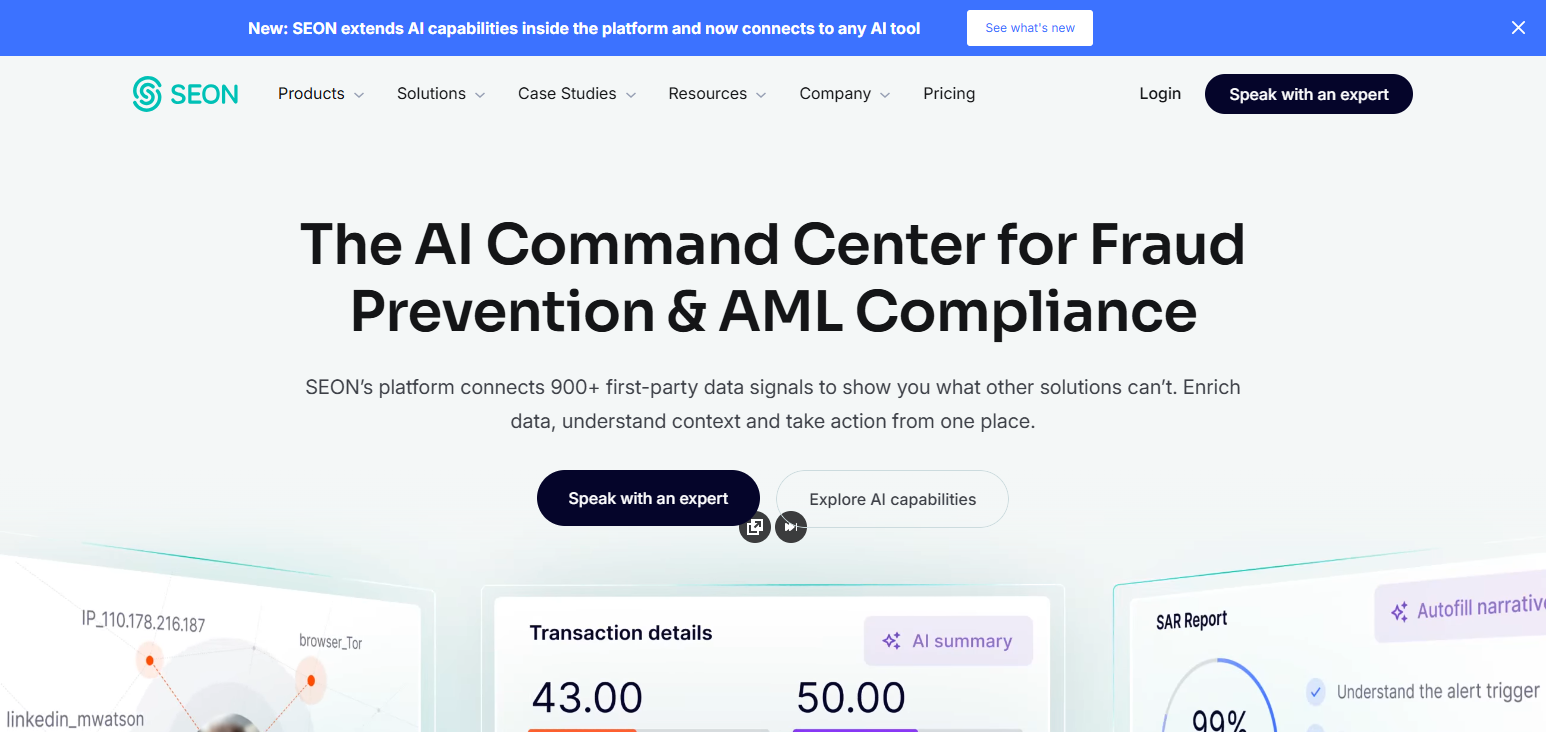
SEON is used by payment gateways to eliminate identity fraud, account fraud, and transaction fraud while maintaining an excellent customer experience. The most recent AI-driven fraud intelligence models of SEON allow businesses to fully automate decisions and approve payments faster with an improved cybercriminal defense.
SEON API – Key Features
- Digital Footprint Evaluation: Assesses a user’s online identity through clues given via email, devices, IP data, and social data.
- Fraud Detection through Behavior Tracking: Monitors customer behavior to detect significant risk and irregular transactions.
- Instant Risk Evaluation: Provides a fraud score before the payment authorization is completed.
- Identity Verification/Validation Tools: Aids in the prevention of fake identity accounts, identity theft, and manipulation of payment fraud.
- Fraud Automation with AI: Aids and automates decisions for fraud with less reliance on an investigation.
| Pros | Cons |
|---|---|
| Analyzes multiple digital signals for accurate fraud detection. | Advanced features may increase subscription costs. |
| Provides quick API integration with payment platforms. | Requires proper data handling and privacy management. |
| Detects identity fraud using digital footprint intelligence. | Effectiveness depends on available customer information. |
| Helps reduce manual fraud investigation processes. | Complex fraud rules require regular adjustments. |
| Offers flexible solutions for online businesses. | Smaller companies may find enterprise features unnecessary. |
3. Stripe Radar API
Stripe Radar API incorporates fraud detection into payment gateways by utilizing machine learning models and a global transaction dataset. Stripe Radar’s built-in defense against fraudulent transactions automatically analyzes behavioral payment patterns, customer histories, and assessments of device risk.
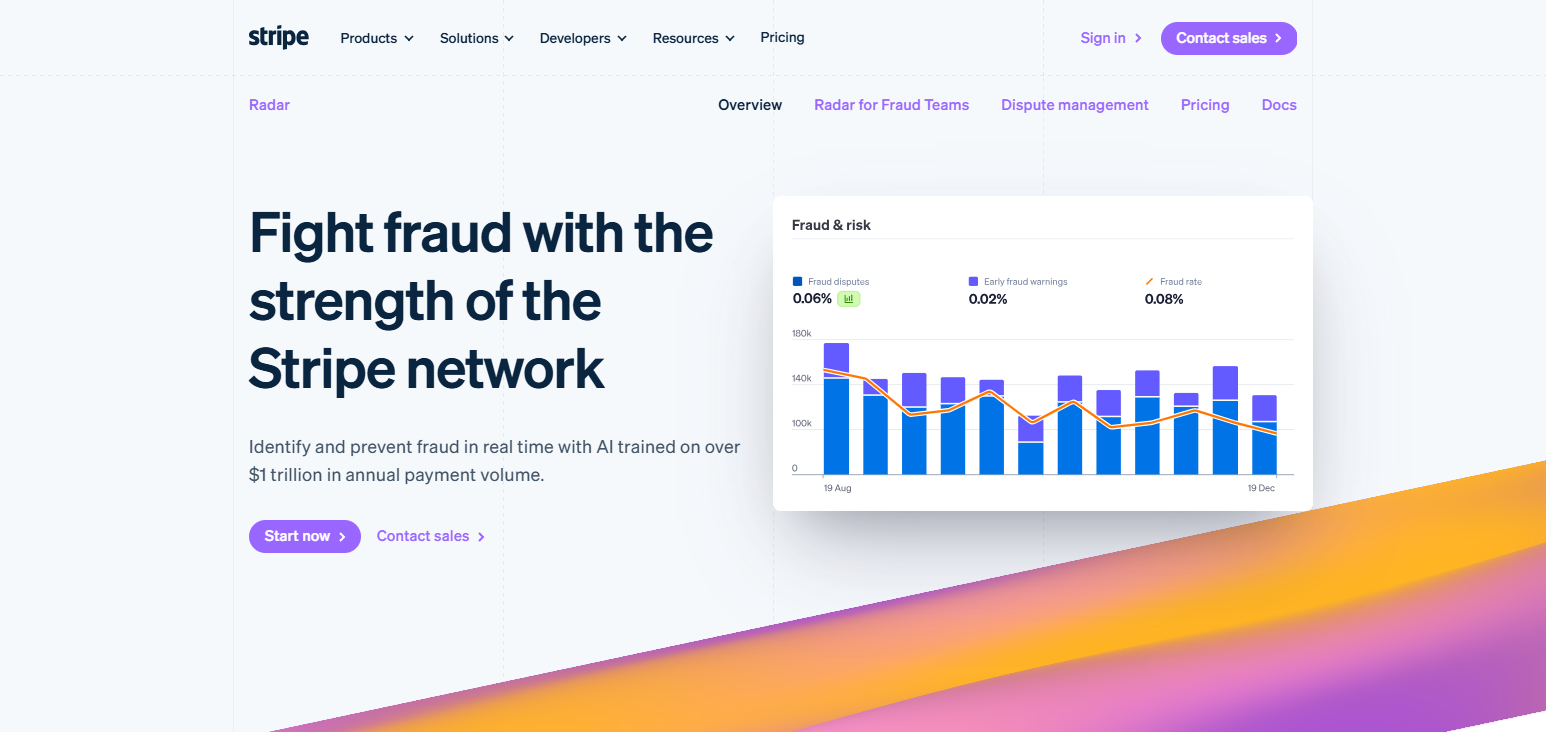
Stripe Radar allows businesses to lower chargebacks while maintaining customer satisfaction. Adaptive AI of Stripe Radar trains with millions of transactions allowing payment gateways to discover new fraudulent behavior and enhance payment security without employee efforts.
Stripe Radar API – Key Features
- Fraud Prevention through AI: Uses machine learning and other AI-based systems trained on payment transactions globally to enhance fraud prevention.
- Instant Risk Evaluation: Automatically analyzes payment data and customer data to determine fraud risk.
- Chargeback Protection: Helps merchants avoid losses from transactions that result in chargebacks.
- Personal Fraud Protection Rules: Businesses may create personalized rules for payment fraud protection.
- Integrated with Stripe: Works seamlessly with all other tools and payment infrastructure provided by Stripe.
| Pros | Cons |
|---|---|
| Built directly into Stripe payment infrastructure. | Mainly suitable for Stripe-based payment systems. |
| Uses machine learning from global payment data. | Customization options can be limited compared with dedicated tools. |
| Reduces chargebacks through automated fraud prevention. | Additional costs apply for advanced fraud features. |
| Easy setup for online merchants and developers. | Less suitable for non-Stripe payment environments. |
| Provides real-time transaction risk evaluation. | Complex fraud cases may require manual review. |
4. Riskified API
Riskified’s API targets online businesses to help them reach more accurate decisions around approvals. It helps customers lower the costs of fraud losses and payment declines. Riskified assesses the risk of transactions using AI and ML.

The API integrates easily with the more modern payment gateways and helps businesses recognize and reduce fraudulent activity, safely engage in more transactions around the world, and helps improve the level of confidence customers have in doing business with them.
Riskified API – Key Features
- Behavioral Transaction Analysis: Studies purchasing behavior to uncover patterns related to fraudulent behavior.
- AI Approval Decisions: Employs machine learning to accurately approve legitimate transactions.
- Global Fraud Intelligence: Utilizes international transaction data to create better security decisions.
- Chargeback Protection: Assists companies in lessening impacts from chargebacks.
- Customer Experience Optimization: Balances strong payment security with an increase in transaction approvals.
| Pros | Cons |
|---|---|
| Improves payment approval rates using AI analysis. | Higher pricing targets enterprise-level businesses. |
| Reduces fraud losses and unnecessary declines. | Integration requires technical implementation support. |
| Provides accurate behavioral fraud detection models. | Best results require sufficient transaction data. |
| Helps global businesses manage payment risks. | May not fit small transaction volumes. |
| Offers strong chargeback protection capabilities. | Custom workflows may need additional setup. |
5. Forter API
Forter’s API helps payment gateways to manage the prevention of payment fraud, account takeovers, and the making of unauthorized transactions. Forter’s API does an assessment of behavioral activity, transactional activity, device information, and insights of the global network.

Forter enables businesses to facilitate the burden of fraud with more operational efficiency and reduced costs, while maintaining a faster process of approving secure payment transactions.
Forter API – Key Features
- Identity-Based Fraud Detection: Integrates digital identity data to distinguish true customers.
- Real-Time Automated Decisions: Approves or declines a transaction based on an automated assessment of its risk in real time.
- Account Protection System: Safeguards accounts from takeovers.
- Global Intelligence Network: Empowers collaborative fraud detection through networked insights.
- Behavioral Analytics: Focuses on customer actions to find fraud.
| Pros | Cons |
|---|---|
| Uses identity intelligence for accurate fraud decisions. | Enterprise pricing may be costly for startups. |
| Provides real-time automated fraud prevention. | Requires integration with customer data systems. |
| Reduces account takeover and payment fraud risks. | Advanced features may need technical knowledge. |
| Improves customer approval experiences. | Setup process can require operational adjustments. |
| Uses global network intelligence for better detection. | Less effective with limited transaction history. |
6. Signifyd API
The use of Signifyd’s API helps businesses keep secure payment transactions while eliminating the payment fraud threat. Signifyd’s API employs an analysis of transactional data, customer identification, and behavioral assessments to rapid detection of payment fraud.

Signifyd enables merchants to increase sales and maintain their level of confidence with protection from payment fraud and automated payment assessments.
Signifyd latest products utilize advanced machine learning and real-time fraud to enable safe global trade to minimize the occurrence of payment fraud and enhance the approval of secure payment transactions.
Signifyd API – Key Features
- AI Fraud Detection Engine: Quickly identifies fraud through sophisticated algorithms.
- Chargeback Guarantee Protection: Covers losses from chargebacks when transactions are approved.
- Automated Transaction Reviews: Creates automated systems for transaction review that lessen time spent on fraud detection.
- Identity Risk Analysis: Reviews customer identities and behavior to enhance security.
- Global Commerce Security: Assists in fraud prevention for digital payments worldwide.
| Pros | Cons |
|---|---|
| Provides AI-based fraud protection and chargeback coverage. | Premium plans may be expensive for smaller merchants. |
| Automates transaction approval and rejection decisions. | Requires integration with commerce platforms. |
| Reduces financial losses from fraudulent orders. | Limited customization compared with open platforms. |
| Improves customer trust during online payments. | Some complex fraud cases need reviews. |
| Supports global digital commerce security needs. | Service costs may increase with transaction growth. |
7. Kount API
Kount defends payment systems from fraud using AI, risk scoring, and identity verification. The API interrogates a mix of hundreds of risk factors – from device info to location and user behavior, and even transaction patterns. Kount allows companies to identify and mitigate potential fraud before payment is even processed.

This significantly reduces chargeback exposure and loss to fraud. Kount’s sophisticated digital identity solution empowers companies to deliver safer payment solutions, and enhance payment approval ratios for legitimate customers across the globe.
Kount API – Key Features
- AI Risk Scoring Technology: Evaluates risk of a transaction based on thousands of fraud assessment indicators.
- Digital Identity Verification: Uses advanced behavioral analysis to confirm user identity.
- Device Intelligence Detection: Reviews information pertaining to a device to identify potentially suspicious behavior.
| Pros | Cons |
|---|---|
| Uses AI risk scoring for payment protection. | Requires technical resources for advanced configuration. |
| Analyzes hundreds of fraud risk indicators. | Pricing information is not always publicly available. |
| Prevents identity fraud and unauthorized transactions. | Large businesses benefit more than small users. |
| Provides strong digital identity verification. | Continuous rule management may be required. |
| Helps reduce chargebacks and transaction losses. | Integration complexity can delay deployment. |
8. ClearSale API
ClearSale protects the payment transaction process in real-time by combining the use of AI and a skilled fraud analysis team. The API interrogates the customer, their purchasing behavior, and transaction patterns to assess developing fraud.

ClearSale presents companies the advantage of automated fraud operations while incorporating human skills to assess cases requiring deeper investigation. With a contemporary fraud prevention model, ClearSale allows online retailers to minimize chargebacks while offering safe and secure payment experiences across multiple payment channels.
ClearSale API – Key Features
- AI Fraud Screening: Automatically determines the risk of fraud for transactions.
- Human Expert Review: Merges technology and human specialists for high fraud case complexity.
- Transaction Monitoring: Reviews payment transactions for potentially suspicious activity.
- Chargeback Reduction Tools: Aids organizations in minimizing their chargeback-related fraud loss.
- Retail Fraud Protection: Provides online retailers industry-specific security solutions.
| Pros | Cons |
|---|---|
| Combines AI technology with human fraud experts. | Manual review processes may slow decisions. |
| Helps retailers reduce fraudulent transactions. | Mainly focused on eCommerce fraud prevention. |
| Provides effective chargeback reduction solutions. | Costs may increase with transaction volume. |
| Improves payment confidence for online businesses. | Integration requires business-specific customization. |
| Supports automated fraud screening processes. | Smaller merchants may not need full capabilities. |
9. Arkose Labs API
Arkose Labs aims to prevent automated fraud attacks using bot detection and risk-based authentication. Their API protects payment systems from automated attacks and the creation of fake user accounts. To identify genuine users, Arkose Labs employs behavioral intelligence and dynamic risk assessment.

The platform aids companies in securing online payments while protecting customer experience from interruptions. The advanced fraud prevention systems employed by Arkose Labs are designed to prevent sophisticated attacks targeted at online payment and financial systems.
Arkose Labs API – Key Features
- Advanced Bot Detection: Prevents automated fraudulent attacks against payment systems.
- Adaptive Authentication: Implements varied user risk-level adaptive confirmation.
- Account Abuse Prevention: Enables prevention of fake and fraudulent accounts.
- Behavioral Intelligence: Assists in framing user behavior for malicious intent.
- Cyber Threat Protection: Safeguards companies from automated fraudulent cyber activity.
| Pros | Cons |
|---|---|
| Strong protection against bots and automated attacks. | Advanced security challenges may affect user experience. |
| Prevents fake accounts and credential stuffing attacks. | Implementation may require technical expertise. |
| Uses adaptive authentication for better security. | Not focused only on payment fraud detection. |
| Protects digital platforms from cyber threats. | Higher costs for advanced enterprise solutions. |
| Reduces automated abuse across online services. | Some users may dislike additional verification steps. |
10. ThreatMetrix API
ThreatMetrix offers a worldwide digital identity intelligence solution that recognizes fraudulent payments as they occur. The API examines data regarding the device, user, behavior patterns, geography, and the networks involved to establish risk for the transaction.

ThreatMetrix enables banks and payment companies to thwart the theft of identity, the fraudulent use of accounts, and unauthorized payments.
Its analytics platform utilizes advanced technologies and extensive intelligence networks to increase the precision of fraudulent payment detection while permitting good customers to transact swiftly and safely.
ThreatMetrix API – Key Features
- Digital Identity Intelligence: Detects fraudulent identities using worldwide identity networks.
- Device Fingerprinting: Evaluates device characteristics to recognize suspicious transactions.
- Behavioral Analytics: Assists in evaluating fraud risk based on user behavior.
- Real-Time Transaction Monitoring: Assesses payment threats while processing transactions.
- Identity Theft Prevention: Assists financial organizations in safeguarding users against unauthorized activity.
| Pros | Cons |
|---|---|
| Provides powerful global identity intelligence network. | Enterprise pricing can be expensive. |
| Detects suspicious activities using behavioral analytics. | Requires large datasets for maximum accuracy. |
| Helps prevent identity theft and payment fraud. | Integration can be complex for beginners. |
| Supports financial institutions with advanced security. | May require ongoing system maintenance. |
| Improves transaction security without slowing customers. | Smaller businesses may find features excessive. |
Conclusion
In Conclusion Fraud Detection APIs Securing Real-Time Payment Gateways The use of Fraud Detection APIs is becoming essential to safeguard current payment gateways from evolving cyber threats.
APIs built with advanced technology and risk analysis provide real-time protection against fraud; chargebacks are reduced and the security of transactions is improved.
Investing in the proper fraud detection solution serves to protect payment processing, improve the digital payment experience for users, and improve the trust users have in the payment system.
FAQ
How do Fraud Detection APIs secure payment gateways?
They use AI, machine learning, and real-time monitoring to identify and block suspicious transactions.
Which Fraud Detection API is best for online payments?
Sift, Stripe Radar, SEON, and Forter are popular solutions for secure digital payments.
Can Fraud Detection APIs prevent account takeover attacks?
Yes, they detect unusual login behavior, device changes, and suspicious account activities.
How do Fraud Detection APIs reduce chargebacks?
They identify risky transactions before processing, helping businesses prevent unauthorized payments and disputes.