In this article, I will discuss the Best On-Chain Reputation Platforms for Web3 Users, highlighting their key features, benefits, reputation scoring methods, data analysis capabilities, and supported blockchains.
You will discover how these platforms help users build digital credibility, establish trust, verify blockchain activity, and improve participation across decentralized applications and Web3 ecosystems in 2026.
What Are On-Chain Reputation Platforms?
Blockchain-based systems known as “on-chain reputation platforms” assess users’ reliability based on their wallet activity, transaction history, digital identification, and involvement in the community. To create reputation scores, confirm user contributions, and find reliable participants, they examine both on-chain and off-chain data.
These platforms facilitate transparent interactions across decentralized ecosystems, enhance security, stop fraudulent activity, and assist Web3 applications evaluate user dependability. Additionally, they allow users to create digital reputations that can be verified across several blockchain networks.
Key Points & Best On-Chain Reputation Platforms for Web3 Users
- Nomis Protocol: Calculates wallet reputation scores from on-chain activity to help protocols assess users.
- ChainAware.ai: AI-powered wallet analytics predicting user behavior, fraud risk, and creditworthiness across blockchains.
- Orange Protocol: Issues verifiable credentials and reputation scores using customizable data models across Web3.
- OpenRank: Decentralized graph-based ranking engine scoring users and content using community interaction data.
- Ethos Network: Credibility platform where users vouch for, review, and stake reputation on peers.
- RubyScore: Wallet scoring tool rating on-chain activity across Linea, zkSync, and other networks.
- Cred Protocol: Provides on-chain credit scores for wallets, supporting lending decisions and risk assessment.
- UTU Trust: Trust infrastructure using social endorsements and blockchain data to verify reliable participants.
- SourceCred: Open-source tool measuring and rewarding community contributions through transparent, configurable reputation scores.
- KGeN Engage: Gaming-focused platform rewarding players’ verified activity and building portable reputation across communities.
10 Best On-Chain Reputation Platforms for Web3 Users In 2026
1. Nomis Protocol
Nomis Protocol is an on-chain identity and reputation technology that creates individualized reputation scores for Web3 users based on wallet activity. More than thirty factors, including as wallet balance, transaction volume, wallet age, and blockchain interactions, are examined in its data analysis. Applications can leverage these information to find active users, assess wallet credibility, and offer individualized chances and rewards based on reputation.
Because of its multichain functionality, users can use activity from several blockchain ecosystems to establish a reputation. Ethereum, Polygon, BNB Smart Chain, Base, Arbitrum, Optimism, Gnosis, TONNE, and a number of other networks are supported. Additionally, Nomis uses score minting to provide verified reputation credentials.
Nomis Protocol Feature
| Feature | Benefit |
|---|---|
| Multi-chain wallet scoring | Your reputation is recognized across many blockchains. |
| Tokenized, portable scores | You own and carry your score between Web3 apps. |
| Age, volume, and diversity-based scoring | Long-term, genuine activity earns you a higher score. |
| API and SDK access | Protocols verify you faster with less friction. |
| Sybil and bot detection | Real users get fairer access to rewards and airdrops. |
2. ChainAware.ai
ChainAware.ai offers behavioral analytics driven by AI to assist Web3 users and decentralized applications in assessing the reliability and potential hazards of wallets. To produce predictive risk evaluations, its data analysis looks at transaction histories, wallet interactions, behavioral patterns, counterparty relationships, and suspicious activity.
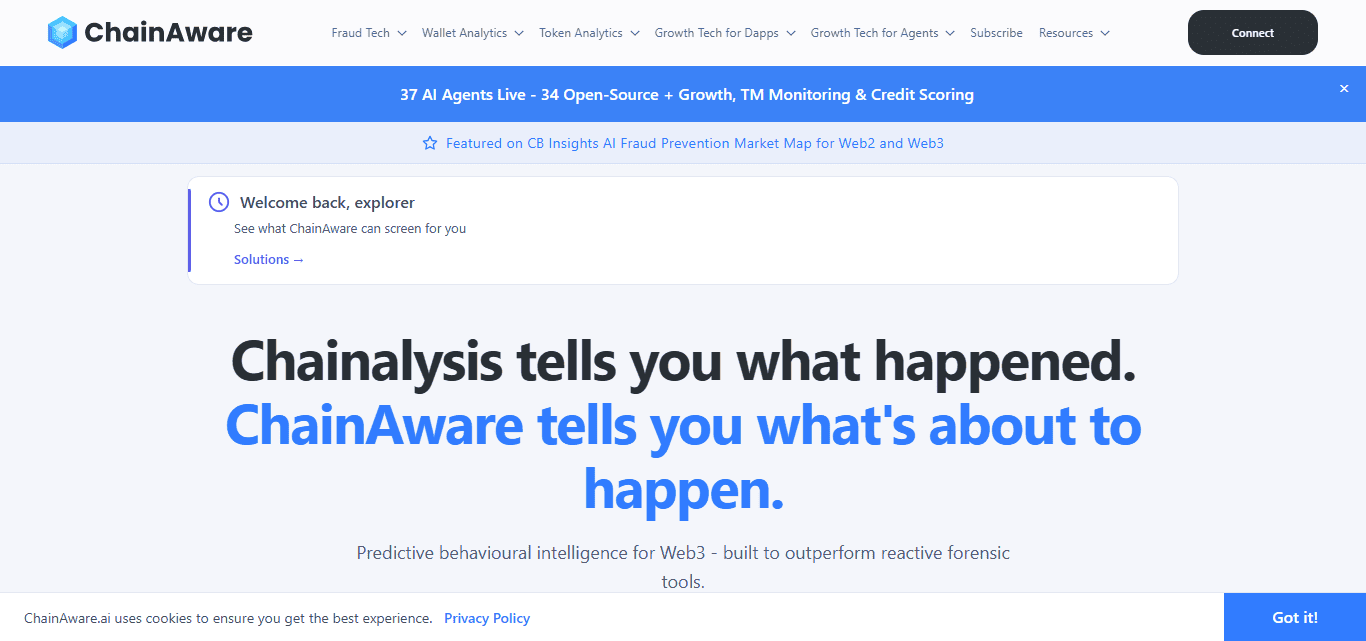
These features facilitate token safety checks, wallet profiling, fraud detection, and Sybil protection. With distinct tools covering various network combinations, its multichain compatibility allows behavioral assessment across Ethereum, BNB Smart Chain, Polygon, Base, Solana, TON, TRON, and HAQQ. ChainAware assists protocols in making better judgments regarding user engagement, security, and onboarding by examining past blockchain activity.
ChainAware.ai Feature
| Feature | Benefit |
|---|---|
| AI-powered behavior prediction | You receive personalized offers matching your wallet habits. |
| Real-time fraud and rug-pull detection | You avoid scams and risky projects. |
| Wallet credit scoring | Your financial behavior can unlock better opportunities. |
| Multi-chain unified reports | You see all your wallet insights in one place. |
| Developer-friendly APIs | Apps can tailor safer, smarter experiences for you. |
3. Orange Protocol
Users can build verified digital identities and reputation credentials with the aid of Orange system, a decentralized reputation and trust system. On-chain transactions, token balances, NFT ownership, smart contract interactions, and certain off-chain data, such as application activity and community evaluations, are all included in its data analysis.

This data is used to create reputation NFTs, verifiable credentials, and individualized reputation scores. Connecting identification and reputation data between decentralized apps and blockchain ecosystems is the main goal of its multichain compatibility.
Orange enables developers to customize data sources and reputation models in accordance with their applications, as opposed to presenting a single, fixed list of supported blockchains.
Orange Protocol Feature
| Feature | Benefit |
|---|---|
| Verifiable credentials | You hold provable achievements that others can trust. |
| Customizable data models | Communities can score you in ways that fit them. |
| On-chain and off-chain data aggregation | Your full activity builds one complete profile. |
| Privacy-preserving proofs | You prove credentials without exposing personal details. |
| Open developer infrastructure | You can use your reputation across many new apps. |
4. OpenRank
OpenRank is a decentralized reputation and ranking mechanism that uses transparent, verifiable trust signals to assist apps in assessing individuals. Reputation graphs, peer-to-peer connections, community interactions, attestations, and application-specific datasets are all used in its data analysis to determine rankings. It measures relationships and finds influential or reliable people using algorithms like EigenTrust.

Because of its data-source agnostic multichain architecture, developers can integrate data from external datasets and many blockchain ecosystems. OpenRank offers decentralized ranking infrastructure that applications can leverage for recommendations, Sybil resistance, user discovery, and community reputation systems rather than relying on a single blockchain for all reputation computations.
OpenRank Feature
| Feature | Benefit |
|---|---|
| Graph-based ranking algorithms | Quality users and content rise above spam. |
| Personalized trust-network rankings | Your feed reflects people and content you trust. |
| Verifiable decentralized computation | Rankings stay transparent and tamper-resistant. |
| Farcaster and social platform support | Your engagement earns recognition in social Web3. |
| Open APIs for developers | You get better ranked feeds across multiple apps. |
5. Ethos Network
Ethos Network is a Web3 credibility platform that uses community-backed reputation rankings, reviews, and endorsements to assist users in building public trust. Positive and negative evaluations, cash obligations through vouching, slashing incidents, human verification, and publicly accessible account information are all taken into account in its data analysis.

Rather than ensuring someone is genuinely trustworthy, these signals add to a dynamic credibility score that represents community sentiment. Currently, the main component of its multichain compatibility is a portable reputation identity that links wallets and user accounts.
Base is the main blockchain used to document transactions pertaining to reputation, reviews, and vouchers. Through its API, applications can obtain public reputation data, assisting users in maintaining trust across many Web3 services.
Ethos Network Feature
| Feature | Benefit |
|---|---|
| Peer reviews and vouches | You build credibility directly from people who know you. |
| Staking behind vouches | Backers have real stake, so trust signals are stronger. |
| Portable credibility score | Your reputation follows you across Web3. |
| Social and wallet account linking | All your identities combine into one trusted profile. |
| Transparent profile pages | You can check anyone’s trust history before transacting. |
6. RubyScore
RubyScore is a decentralized reputation and multichain analytics platform that analyzes wallet behavior to determine authentic Web3 players. Transaction history, wallet balances, gas spending, active days, smart contract interactions, and participation across DeFi, NFTs, bridges, and DAOs are all examined via its data analysis.

Its Proof-of-Human ID, Multichain Reputation Score, and ecosystem-specific achievement levels are all influenced by these metrics. Many Layer 1 networks, Layer 2 solutions, and appchains are covered by its multichain capabilities. Ethereum
Arbitrum, Optimism, Base, Polygon, Avalanche, BNB Chain, zkSync, Linea, Scroll, and numerous other blockchains are supported. Applications can utilize this to evaluate user behavior in various blockchain ecosystems.
RubyScore Feature
| Feature | Benefit |
|---|---|
| Wallet activity scoring | You quickly understand your on-chain standing. |
| Linea, zkSync, and multi-network support | Your activity is tracked across popular ecosystems. |
| Simple score dashboard | You see rankings and activity breakdowns easily. |
| Airdrop eligibility tracking | You know whether you qualify for ecosystem rewards. |
| Quests and campaigns | You learn exactly how to improve your score. |
7. Cred Protocol
DeFi applications use Cred Protocol, an on-chain credit reputation platform, to assess borrower creditworthiness and wallet financial dependability. Lending history, borrowing activity, repayment records, liquidations, wallet balances, transaction behavior, and DeFi positions are all examined in its data analysis.
These metrics produce credit ratings and comprehensive financial reports that aid lenders in identifying any hazards associated with borrowers. Financial and behavioral data from ten blockchain networks are combined by its multichain capability.

Ethereum, Base, Arbitrum, Optimism, Polygon, Avalanche, BNB Chain, Celo, Linea, and Robinhood are among the supported blockchains. In order to facilitate better informed decentralized lending decisions, Cred also monitors lending activity across protocols including Aave, Compound, and Morpho.
Cred Protocol Feature
| Feature | Benefit |
|---|---|
| On-chain credit scoring | Your lending history builds a real financial reputation. |
| Traditional-style score ranges | Scores are familiar and easy to interpret. |
| APIs for DeFi underwriting | Lenders can offer you better terms quickly. |
| Transparent score factors | You learn what affects and improves your creditworthiness. |
| Under-collateralized lending support | Strong borrowers may lock up less collateral. |
8. UTU Trust
UTU Trust is a decentralized trust infrastructure created to increase dependability and reputation in online communities and digital platforms. In order to produce individualized trust signals and suggestions, its data analysis gathers user comments, reviews, endorsements, social connections, and prior encounters.
Its Trust Engine assesses information based on the network and affiliations of the asking person rather than depending on a single, universal reputation score. Its multichain strategy facilitates integrations with blockchain-based trust services and decentralized apps.

Ethereum is essential to its initial trust architecture, and the interoperability of UTU tokens between Ethereum and BNB Smart Chain has also been documented. Additionally, its technology has investigated interfaces with the Harmony, Oasis, and Polygon ecosystems.
UTU Trust Feature
| Feature | Benefit |
|---|---|
| Social and blockchain trust engine | You get balanced trust insights from multiple sources. |
| Network-based recommendations | You see which connections trust a project or person. |
| Embeddable trust widgets | Trust signals appear directly inside the apps you use. |
| User endorsement system | Your reliable behavior earns endorsements from others. |
| Cross-platform trust data | Your reputation works across many Web3 applications. |
9. SourceCred
An open-source community reputation system called SourceCred evaluates individual contributions and honors significant involvement in decentralized projects. Contributions including conversations, development activities, forum postings, community support, and cooperative effort are all examined by its data analysis.
It determines Cred scores based on the significance and connections of individual contributions using a contribution graph and a modified PageRank algorithm. Because SourceCred primarily functions as a community contribution measurement infrastructure rather than a blockchain-native reputation protocol, its multichain support is not a fundamental feature.
Platforms like GitHub, Discourse, and Discord can be integrated with it. To identify important participants, communities might individually set up contribution guidelines and award Grain prizes.
SourceCred Feature
| Feature | Benefit |
|---|---|
| Open-source reputation system | You can verify exactly how contributions are measured. |
| Contribution graph | Your posts, code, and activities are all recognized. |
| Configurable weights | Communities reward the work they value most. |
| Automated reward distribution | You receive tokens fairly based on earned Cred. |
| GitHub, Discord, and Discourse integrations | Your work across platforms counts toward your reputation. |
10. KGeN Engage
Through community involvement and gameplay, KGeN Engage, a Web3 gaming engagement and reputation platform, assists gamers in creating verified digital identities. Proof of Human, Proof of Engagement, Proof of Skill, Proof of Commerce, and Proof of Social are the five main reputation criteria that its data analysis assesses.
These metrics assess social ties, economic transactions, accomplishments, gaming engagement, and player authenticity. Its multichain infrastructure integrates blockchain-based reputation records with gaming and platform engagement data.

Aptos serves as the primary blockchain of KGeN’s ecosystem, which also supports smart contracts across several EVM networks. Its Proof of Gamer methodology facilitates the identification of real gamers and rewards significant engagement in gaming ventures.
KGeN Engage Feature
| Feature | Benefit |
|---|---|
| Gaming quests and campaigns | You earn rewards just by playing and participating. |
| Verified player identity | Your gaming reputation is trusted across communities. |
| Token and perk rewards | Active play translates into real, tangible value. |
| Anti-bot protection | Genuine gamers receive fairer rewards. |
| Community tools for studios | You connect with games seeking engaged, authentic players. |
How To Pick 2026’s Top On-Chain Reputation Platform
- Assess Reputation Scoring Methodology: Recognize how platforms use behavioral patterns and wallet activity to determine scores.
- Verify Supported Blockchain Networks: Select blockchain-compatible platforms where you actively participate and carry out transactions.
- Compare Wallet Analytics and Data Transparency: Look at data accuracy, transparent reporting, transaction tracking, and wallet insights.
- Examine Security Features and Identity Verification: Give top priority to fraud detection, Sybil attack protection, and trustworthy identity verification.
- Take into Account API Accessibility and Integrations: Choose platforms that provide easy decentralized application integrations and accessible APIs.
- Examine Privacy and Data Management Procedures: Examine how platforms handle sensitive data and safeguard user information.
- Align Platform Features with Specific Web3 Needs: Select options that meet your demands for participation, security, identification, and reputation.
Conclusion
In conclusion Blockchain-based systems known as “on-chain reputation platforms” use wallet activity, transaction history, digital identification, and community involvement to assess users’ reliability. To create reputation scores, validate user contributions, and pinpoint reliable players, they examine both on-chain and off-chain data.
These platforms assist Web3 apps in evaluating user dependability, enhancing security, stopping fraud, and facilitating open communication amongst decentralized ecosystems. Additionally, they let users create digital reputations that can be verified across several blockchain networks.
FAQ
How do on-chain reputation platforms work?
They analyze wallet activity, transaction history, behavioral patterns, and community contributions to evaluate digital credibility.
Why is on-chain reputation important for Web3 users?
It helps establish trust, demonstrate genuine participation, improve transparency, and support safer decentralized interactions.
Do on-chain reputation platforms support multiple blockchains?
Some platforms analyze activity across multiple networks, while others focus on specific ecosystems or data sources.
How are on-chain reputation scores calculated?
Scores typically use wallet history, transaction behavior, financial activity, community engagement, and other reputation indicators.