In this article I will discuss the Best AI Model Hosting Platforms that assist developers, businesses and researchers in deploying, administering and expanding the power of artificial intelligence models easily.
These platforms deliver advanced infrastructure, GPU support, secure hosting, API linking, and other advanced deployment tools. We will investigate their features,benefitsandlimitations so that you are able to find the best AI hosting option.
Key Points
| AI Model Hosting Platform | Explanation |
|---|---|
| Hugging Face Inference Endpoints | Hosts machine learning models with scalable, secure, production-ready deployment infrastructure. |
| Amazon SageMaker | Provides managed AI model hosting with automation, monitoring, and scaling capabilities. |
| Google Vertex AI | Enables enterprise model deployment with powerful cloud-based AI hosting services. |
| Microsoft Azure Machine Learning | Offers secure model hosting, deployment pipelines, and enterprise AI management. |
| OpenAI API Platform | Hosts advanced AI models through reliable APIs for application integration. |
| Replicate | Allows easy AI model deployment and execution through simple APIs. |
| Together AI | Provides high-performance hosting for open-source large language models efficiently. |
| RunPod | Delivers affordable GPU-powered AI model hosting for developers worldwide. |
| Modal | Enables serverless AI model hosting with flexible computing resources. |
| Lambda Cloud | Provides GPU infrastructure for hosting and running AI models. |
1. Hugging Face Inference Endpoints
Hugging Face Inference Endpoints is a service used to host and manage cloud-based AI applications in production environments. It helps developers and businesses to deploy their AI models with scalable, optimized, and secured infrastructures.
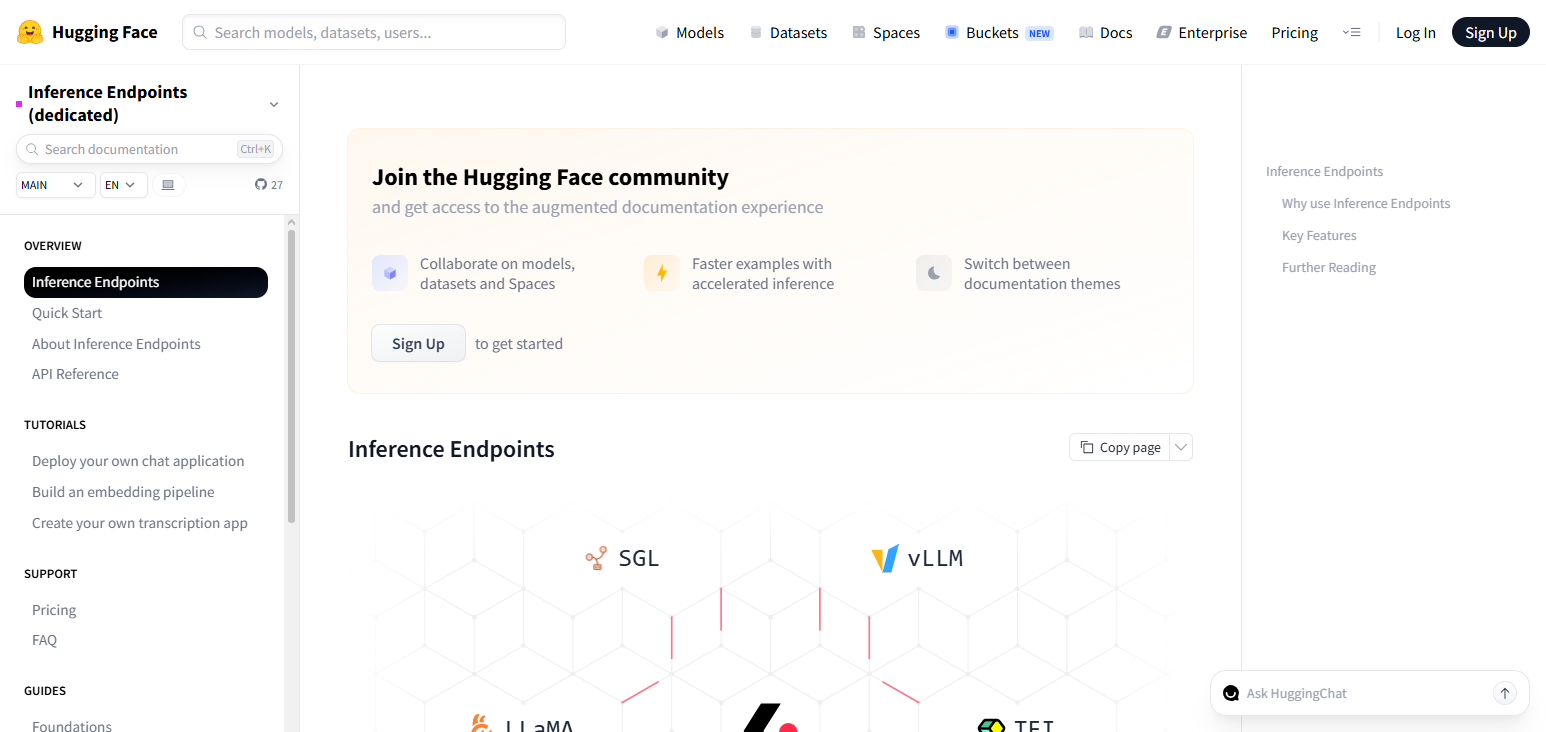
The platform is combined with a large number of available open-source models from the Hugging Face ecosystem, which makes integrations for Natural Language Processing (NLP) and Generative AI applications easier.
Hugging Face Inference Endpoints is, with the highest potential in terms of enterprise and business scalability, inference, and ease of use in terms of endpoints, the best AI model hosting platform there is.
Features of Hugging Face Inference Endpoints
- Scalable Model Deployment: Enables rapid deployment of ML models with automatic scaling.
- Open-Source Model Support: Provides access to thousands of pre-trained AI models across various applications.
- Secure Infrastructure: Offers enterprise-grade security features for protection of AI models and data.
- Hardware Optimization: Offers optimized computing resources for faster model inference.
- Easy API Integration: Allows developers to easily connect their models hosted in applications through simple APIs.
| Pros | Cons |
|---|---|
| Supports thousands of open-source AI models easily. | Advanced features may require higher pricing plans. |
| Provides scalable deployment with automatic resource management. | Custom model optimization can require technical expertise. |
| Offers secure enterprise-grade hosting infrastructure. | Limited control compared with self-managed infrastructure. |
| Simplifies API integration for developers. | Large models may have higher inference costs. |
| Reduces complexity of AI model deployment. | Performance depends on selected hardware configuration. |
2. Amazon SageMaker
Amazon SageMaker provides a robust service for the building, training, and hosting of artificial intelligence apps at scale. It includes automatic deployment of trained models, scaling algorithms, monitoring tools, as well as integrated development environments for scientists and developers.
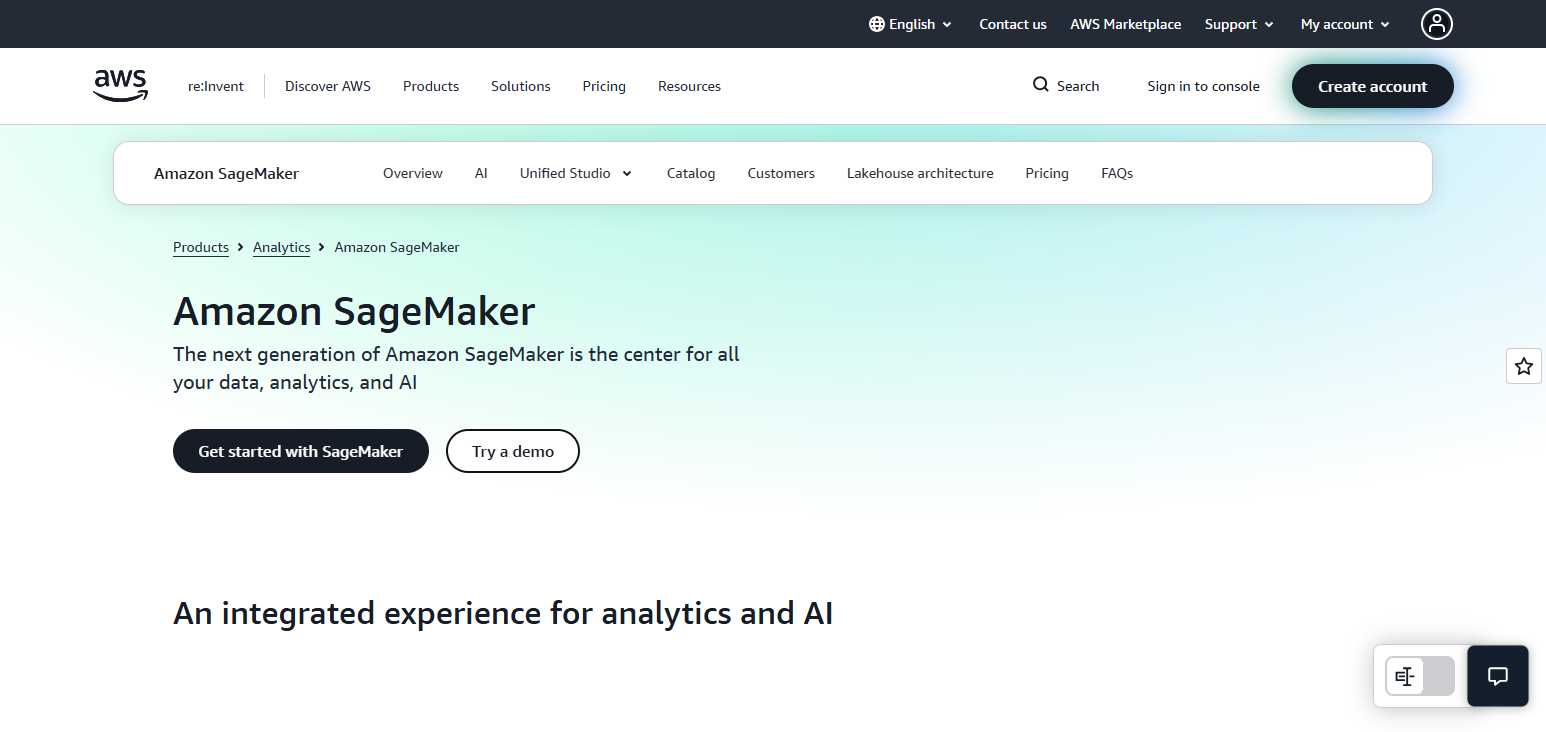
Companies can implement custom machine learning models and foundation models on flexible computing resources from AWS. From the perspective of the best AI model hosting platforms, Amazon SageMaker is one of the top-quality options available.
Features of Amazon SageMaker
- Managed AI Hosting: Provides a fully managed solution for building, training, deploying, and hosting ML models and applications.
- Automated Machine Learning: Fully automates the data processing, modeling, and training workflows from start to finish.
- Model Monitoring: Automatically tracks the performance of models in production.
- Enterprise Security: Offers enterprise grade security features including encryption, access management, and protection of compliance.
- AWS Integration: Integrates easily with other AWS services for AI workflows.
| Pros | Cons |
|---|---|
| Provides complete machine learning development and hosting solutions. | Can become expensive for large-scale AI workloads. |
| Offers automatic scaling for changing application demands. | Requires AWS knowledge for effective management. |
| Includes powerful monitoring and management tools. | Complex interface for beginners and small teams. |
| Provides strong security and compliance features. | Additional AWS services may increase overall costs. |
| Integrates well with the AWS ecosystem. | Setup and configuration can be time-consuming. |
3. Google Vertex AI
Google Vertex AI offers customers a cutting edge platform for developing, deploying, and managing artificial intelligence models on Google Cloud.
It supports machine learning models, generative AI solutions, and large language models. It provides automated machine learning, tools to track models, deployment pipeline tools, and turnkey distributed inference endpoints.

Best AI Model Hosting Platforms, such as Google Vertex AI, give businesses the opportunity to reduce the complexity of infrastructure
While also allowing businesses the ability to create more reliable AI applications. It integrates with Google Cloud data services and provides enterprise-grade security for AI deployments.
Features of Google Vertex AI
- Generative AI Support: Provides a fully managed service for AI hosting and management of advanced generative AI and language models.
- Machine Learning Operations: Provides fully automated end-to-end ML data processing, modeling, and training workflows.
- Scalable Predictions: Supports scalable and reliable AI predictions through flexible and scalable cloud infrastructures.
- AutoML Capabilities: Simplifies manual efforts for coding and enables developers to create machine learning models with minimal coding effort.
- Google Cloud Integration: Seamlessly integrates with Google Cloud data and computing services with AI workflows.
| Pros | Cons |
|---|---|
| Supports advanced generative AI and machine learning models. | Pricing structure can be difficult to understand. |
| Provides powerful AutoML and AI development tools. | Requires Google Cloud expertise for optimization. |
| Offers scalable prediction and deployment capabilities. | Some features have steep learning curves. |
| Integrates smoothly with Google Cloud services. | Enterprise usage can become costly over time. |
| Provides reliable AI infrastructure for businesses. | Limited flexibility outside Google Cloud environment. |
4. Microsoft Azure Machine Learning
Microsoft Azure Machine Learning is a cloud-based AI development and deployment platform that lets businesses build and host efficient machine learning models. It offers automated machine learning, model tracking, deployment pipelines, and turnkey distributed inference endpoints.
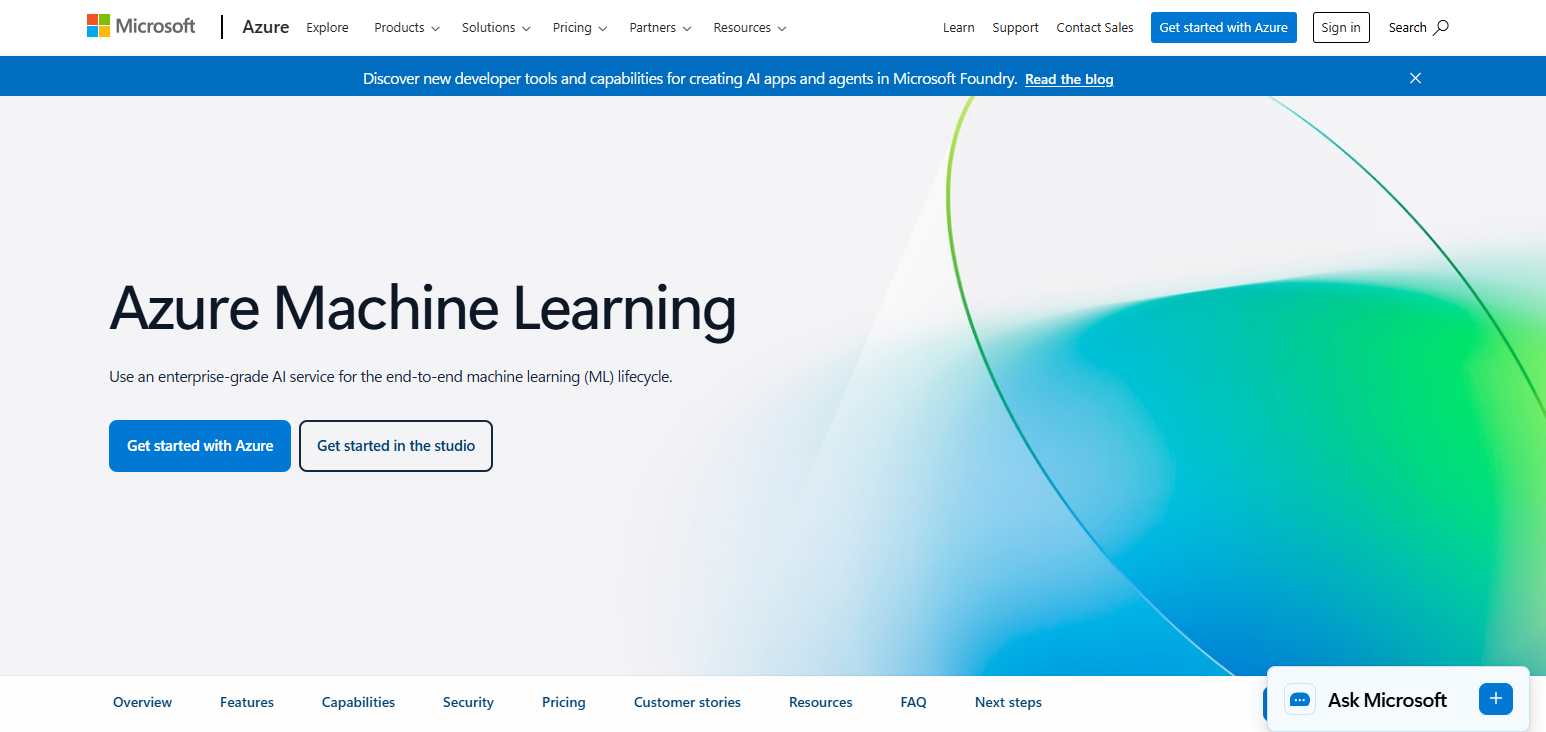
Organizations deploy AI solutions securely while maintaining control over data, models, and applications. Best AI Model Hosting Platforms, such as Microsoft Azure Machine Learning, aid businesses to simplify the intricacies of infrastructure
While offering businesses the ability to design more reliable AI applications. It integrates with other Microsoft cloud services and predictive analytics, automation, and large-scale AI applications.
Features of Microsoft Azure Machine Learning
- AI Model Deployment: Supports secure deployment of machine learning models across cloud environments.
- Automated Machine Learning: Helps developers build models automatically with reduced manual effort.
- Model Lifecycle Management: Tracks, manages, and improves models throughout development stages.
- Enterprise Compliance: Provides strong security and regulatory compliance features.
- Azure Ecosystem Support: Integrates with Microsoft services for complete AI solutions.
| Pros | Cons |
|---|---|
| Enables secure AI model deployment and management. | Can be complex for new AI developers. |
| Provides automated machine learning capabilities. | Requires understanding of Azure services. |
| Offers strong enterprise security and compliance. | Pricing can increase with heavy usage. |
| Integrates with Microsoft business applications. | Deployment setup may require technical skills. |
| Supports complete model lifecycle management. | Some advanced tools need additional configurations. |
5. OpenAI API Platform
OpenAI API Platform is an AI model hosting service that gives developers the ability to integrate high-quality AI models within their applications with reliable cloud-based APIs. It provides developers access to powerful language models without the hassle of managing servers, GPUs, or model infrastructures.

Developers can create chatbots, AI assistants, content generation tools, and more with AI services. Best AI Model Hosting Platforms like OpenAI API Platform simplify AI deployment by providing ready-to-use models with consistent performance, security, and availability.
Features of OpenAI API Platform
- Advanced AI Models: Provides access to powerful language models through cloud-based APIs.
- Developer-Friendly APIs: Enables easy integration of AI capabilities into applications.
- High Availability: Delivers reliable infrastructure for continuous AI-powered services.
- Scalable Performance: Handles applications ranging from small projects to enterprise workloads.
- No Infrastructure Management: Removes the need for hosting servers or managing GPUs.
| Pros | Cons |
|---|---|
| Provides access to advanced AI language models. | Users have limited control over underlying models. |
| Easy API integration for developers and businesses. | Usage costs increase with higher API demand. |
| Requires no server or GPU management. | Depends on external API availability. |
| Delivers reliable performance and scalability. | Custom model hosting options are limited. |
| Supports many AI-powered application use cases. | Less suitable for highly customized private models. |
6. Replicate
Replicate is an AI model hosting service that enables developers to run AI models through their applications using simple APIs. It supports thousands of open-source AI models for image generation, text processing, audio applications and other AI tasks.
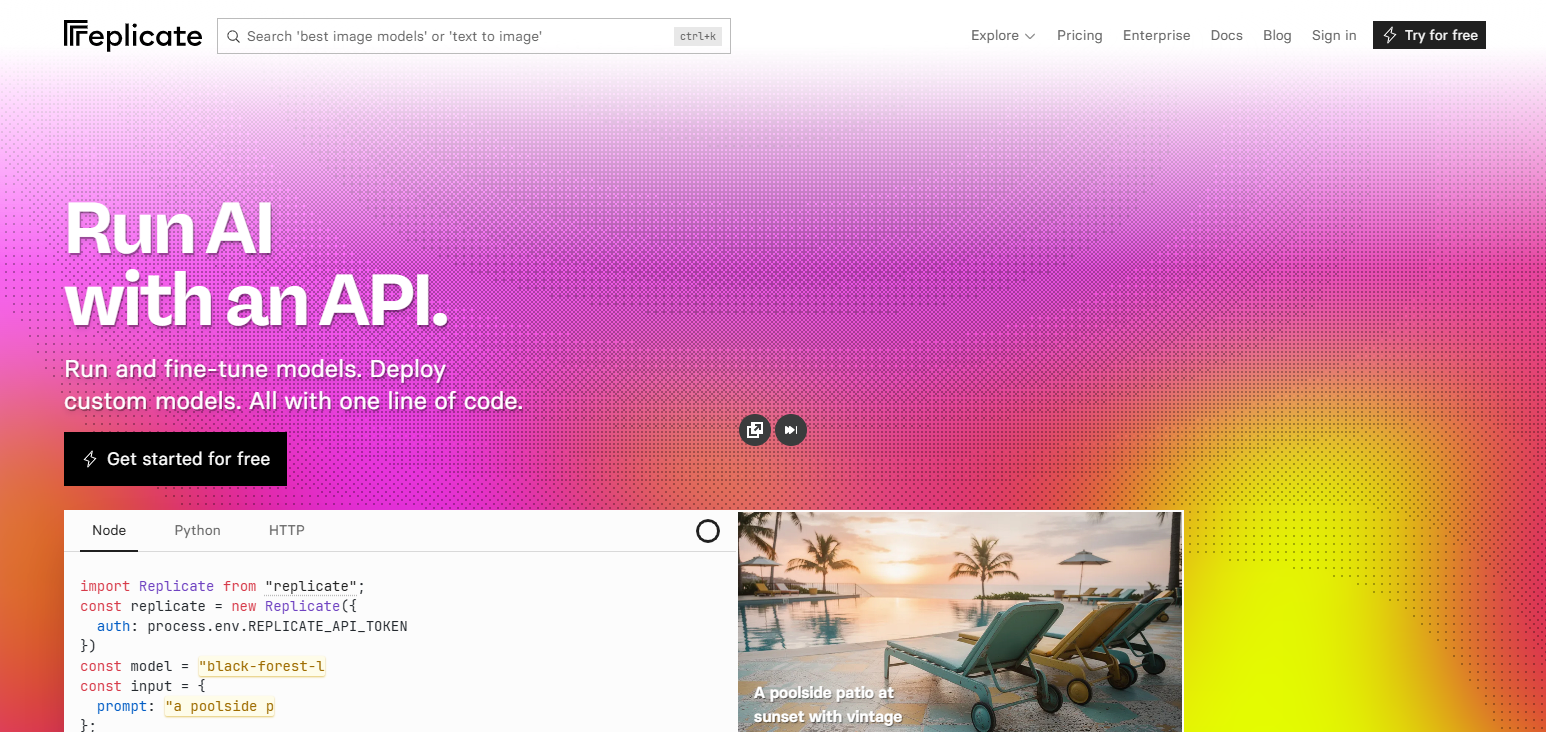
Developers can deploy models without the hassle of managing complex infrastructures or GPU environments. As part of the Best AI Model Hosting Platforms
Replicate provides easy access to advanced AI capabilities with flexible prices and fast model execution. It is especially useful to startups and developers building AI-powered applications quickly.
Features of Replicate
- High Throughput Model APIs: Facilitates the integration of AI models with high throughput APIs.
- Large Model Library: Offers a large sampling of community-built AI models focused on various image, speech, and natural language understanding and processing applications.
- GPU Inference: Deploys GPU processing resources for AI model deployment and execution.
- Model Fine-Tuning: Delivers the capability to enhance and improve existing AI models.
- Developer APIs: Includes developer APIs for integrating AI models within application programming interfaces.
| Pros | Cons |
|---|---|
| Makes AI model execution simple through APIs. | Large-scale enterprise workloads may need alternatives. |
| Provides access to many community AI models. | Model availability depends on contributors. |
| Requires minimal infrastructure management. | Advanced customization options are limited. |
| Supports fast deployment for AI applications. | Costs may increase with frequent usage. |
| Useful for startups and rapid prototyping. | Performance varies across different hosted models. |
7. Together AI
Together AI offers high quality infrastructure for hosting, fine-tuning, and running open-source artificial intelligence models. The platform targets large language models and generative AI applications to provide users with optimized GPU computing and inference services.
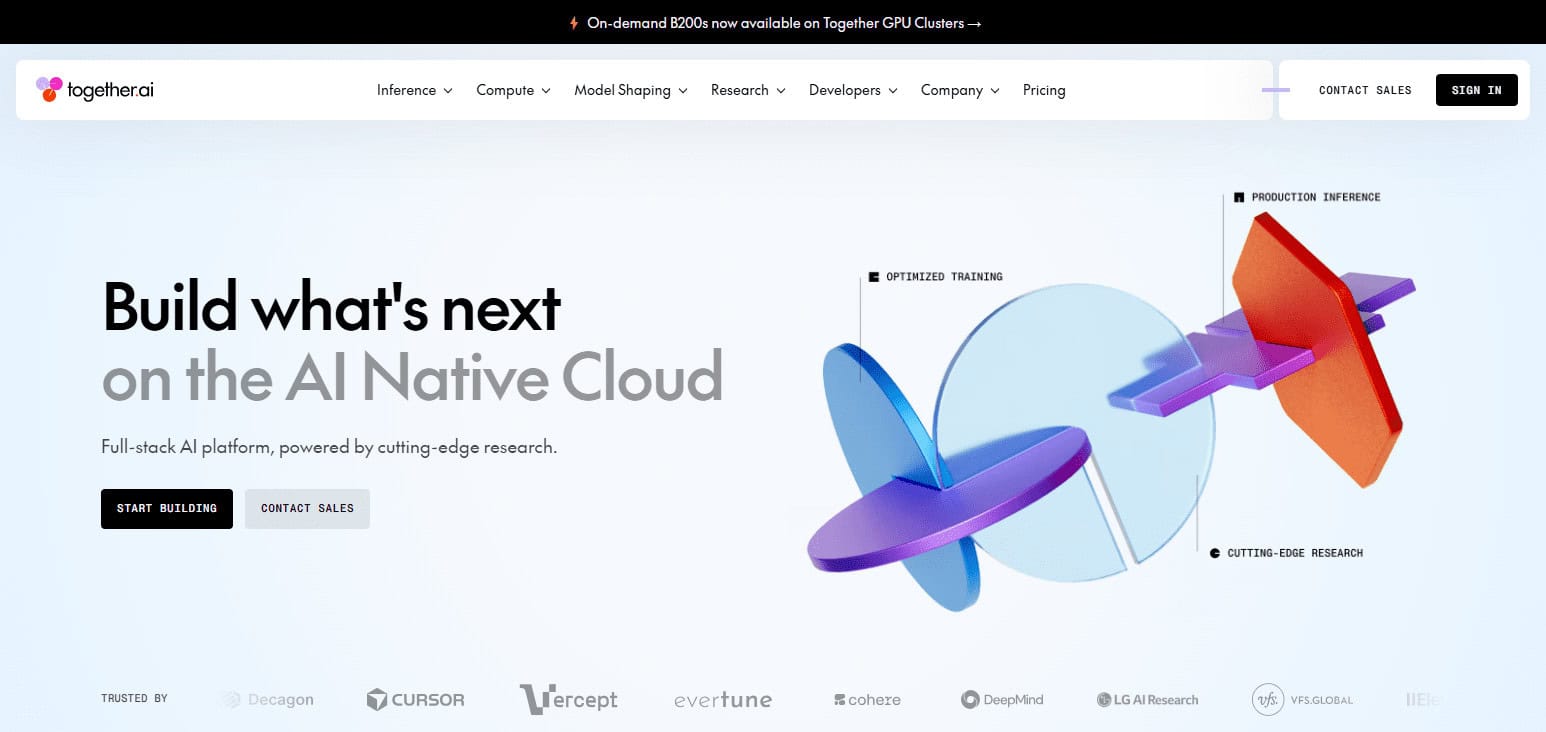
Developers can run popular open-source models and benefit from enterprise-level performance and scalability. Best AI Model Hosting Platforms like Together AI help organizations deploy advanced AI solutions without building expensive infrastructures. It supports model customizations, API access, and efficient AI application development.
Features of Together AI
- Open-Source Model Hosting: Provides infrastructure for hosting popular open-source AI models.
- High-Speed Inference: Delivers optimized performance for faster model responses.
- GPU Infrastructure: Uses powerful computing resources for advanced AI workloads.
- Model Fine-Tuning: Allows customization and improvement of AI models.
- Developer APIs: Provides simple interfaces for integrating AI models into applications.
| Pros | Cons |
|---|---|
| Provides efficient hosting for open-source AI models. | Smaller ecosystem compared with major cloud providers. |
| Offers fast inference performance for LLM applications. | Limited enterprise tools compared with AWS or Azure. |
| Supports model fine-tuning and customization. | Requires technical knowledge for advanced features. |
| Provides powerful GPU-based AI infrastructure. | Pricing may vary depending on computing requirements. |
| Simplifies deployment of generative AI applications. | Availability depends on supported models. |
8. RunPod
RunPod provides GPU-centric AI hosting at a lower cost than competitors, making it an attractive resource to developers, researchers, and businesses. Users can utilize RunPod’s resources to deploy AI models in a rely GPU-based ML training and inference processing environments.
RunPod supports container-based deployments and flexible pricing in addition to providing high-performance computing environments. RunPod is one of the Best AI Model Hosting Platforms, and it is popular for providing affordable
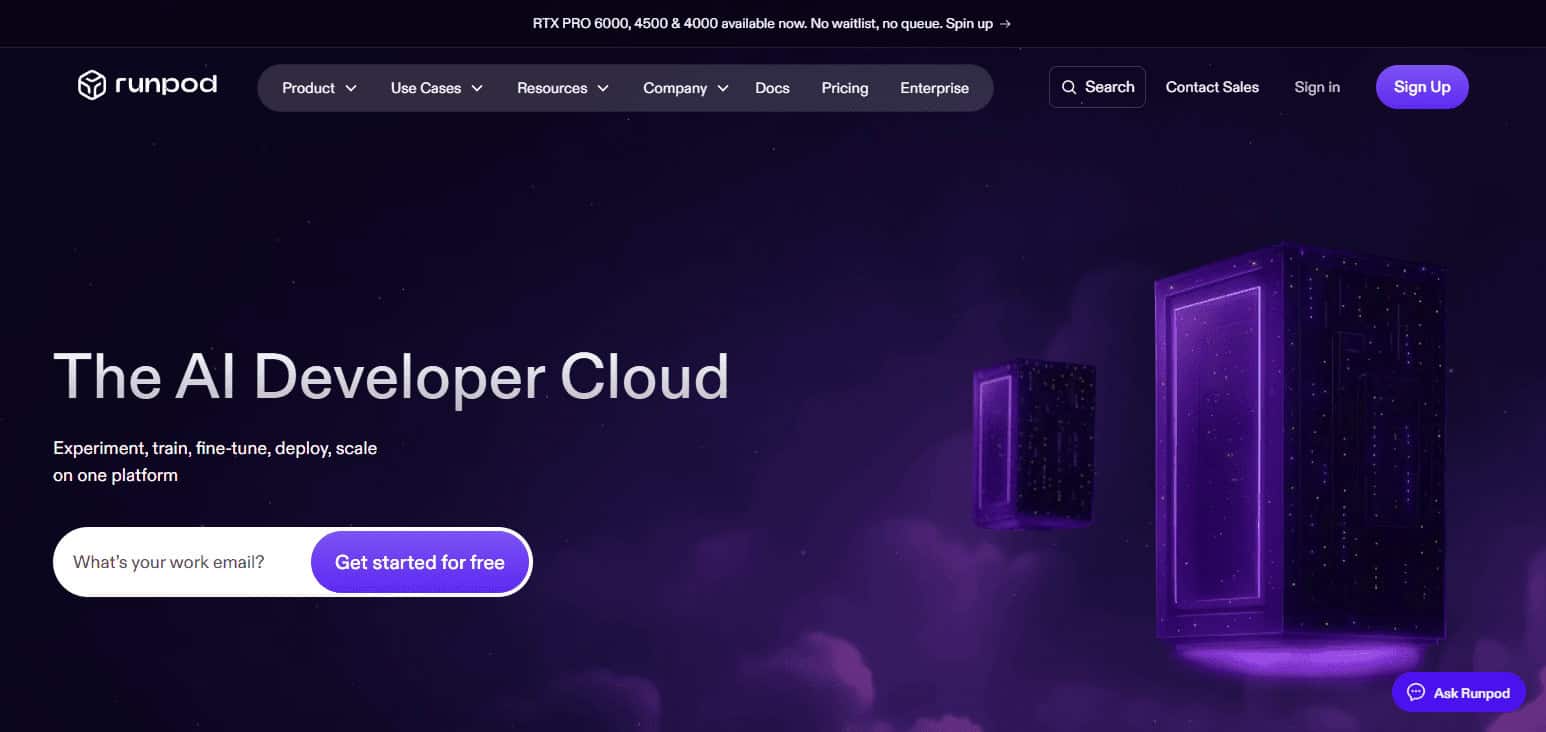
GPU access for users who want to conduct experimental AI projects and difficult generative AI tasks. RunPod enables users to scale their AI workloads without having to purchase expensive hardware.
Features of RUN
- Fast AI Sandbox: Simplifies the AI model testing process with an easily accessible sandbox environment.
- Model Library: Offers an extensive collection of developed AI models for use in a variety of applications ranging from image recognition to natural language processing.
- GPU Banked Time: Delivers GPU resources as an offset to the time requested for model training and inference.
- Serverless Environment: Removes the responsibility of managing the infrastructure for deployment, hosting, and running AI models.
- Custom APIs: Includes tailor-made APIs for integrating AI models within applications.
- Cohort Model Development: Provides a framework for developing AI models within a defined cohort.
| Pros | Cons |
|---|---|
| Provides affordable GPU resources for AI workloads. | Requires more technical setup knowledge. |
| Offers flexible computing environments for developers. | Less managed compared with enterprise platforms. |
| Supports powerful GPUs for AI training. | Monitoring tools are more limited. |
| Enables cost-effective AI experimentation. | Users manage more infrastructure responsibilities. |
| Suitable for researchers and independent developers. | Not ideal for beginners without cloud experience. |
9. Modal
Modal Labs provides serverless infrastructure for deploying and running AI models with minimal operational management. Modal enables developers to implement deep learning workloads in the cloud while automatically managing compute requirements.

Modal’s platform supports GPU acceleration and rapid deployment of AI applications. Best AI Model Hosting Platforms such as Modal are popular for offering cost-effective GPU access for users
Who want to conduct experimental AI projects and difficult generative AI tasks. Modal Labs helps users scale their AI workloads without having to purchase expensive hardware.
Features of Modal
- Serverless AI Infrastructure: Is a computing platform that enables developers to run AI workloads without having to manage servers.
- Automatic Scaling: Is a system in which resources are automatically adjusted as needed, based on application demand.
- GPU Acceleration: Offers GPU to accelerate machine learning workloads.
- Custom Environments: Offers developers the ability to construct personalized AI execution environments.
- Fast Deployment: Is a deployment method that is characterized by extreme speed in completing AI application deployments, with little configuration required.
| Pros | Cons |
|---|---|
| Provides serverless infrastructure for AI applications. | Smaller platform ecosystem compared with cloud giants. |
| Automatically scales computing resources efficiently. | Requires learning Modal-specific development methods. |
| Supports GPU acceleration for machine learning. | Advanced workloads may require customization. |
| Reduces server management responsibilities. | Limited enterprise integrations available. |
| Enables fast AI application deployment. | Pricing depends heavily on resource consumption. |
10. Lambda Cloud
Lambda Cloud provides GPU-focused cloud infrastructure designed for artificial intelligence development, training, and model hosting. Lambda Cloud allows users access to high-performance GPUs to assist researchers and companies to conduct intensive AI workloads efficiently.
Lambda Cloud’s platform supports frameworks for deep learning, model training environments, and scalable AI deployments.

Best AI Model Hosting Platforms such as Lambda Cloud are popular for providing cost-effective GPU access for users who want to conduct experimental AI projects and difficult generative AI tasks. It helps users scale their AI workloads without purchasing expensive hardware.
Features of Lambda Cloud
- GPU-Powered Infrastructure: Is an infrastructure system that provides high-performance GPUs for both AI training and hosting.
- Deep Learning Support: Includes a range of popular machine learning toolkits and AI libraries.
- Scalable Resources: Allows businesses to increase computing capacity as needed.
- Research-Friendly Platform: Is a platform designed for researchers
| Pros | Cons |
|---|---|
| Provides powerful GPU infrastructure for AI workloads. | Focuses mainly on GPU computing services. |
| Offers affordable alternatives to private hardware. | Requires technical knowledge for deployment. |
| Supports popular deep learning frameworks. | Fewer managed AI tools than major clouds. |
| Useful for AI research and model training. | Limited business-focused features available. |
| Provides scalable computing resources for developers. | Infrastructure management responsibility remains with users. |
Conclusion
To Conclude The Best AI Model Hosting Platforms are designed to simplify the tasks of deploying, administering, and optimizing the usage of AI models.
Hugging Face, Amazon SageMaker, Google Vertex AI, and OpenAI API Platform are all great choices for developers and businesses to easily construct quality AI applications.
The best hosting platform will totally depend on certain preferences like scalability, price, safety, model availability, processing power, as well as overall platform functionality.
FAQ
Why are AI Model Hosting Platforms important?
AI Model Hosting Platforms simplify model deployment by providing scalable infrastructure, GPU resources, automatic updates, and reliable performance
Which are the Best AI Model Hosting Platforms?
Some of the Best AI Model Hosting Platforms include Hugging Face Inference Endpoints, Amazon SageMaker, Google Vertex AI, Microsoft Azure Machine Learning, OpenAI API Platform, Replicate, Together AI, RunPod, Modal, and Lambda Cloud.
Can AI Model Hosting Platforms support large language models?
Yes, many AI Model Hosting Platforms support large language models (LLMs) by providing powerful GPUs, optimized inference systems, and scalable cloud infrastructure for running advanced generative AI applications.
Are AI Model Hosting Platforms suitable for businesses
Yes, businesses use AI Model Hosting Platforms to deploy customer support bots, automation tools, recommendation systems, analytics solutions, and other AI-powered applications with secure and scalable environments.