This article will discuss the best surety bond companies for contractors, highlighting companies that provide reliable bonding services to construction companies. Subjects include bond types, contractor eligibility, bonding capacity, underwriting requirements, application procedures, financial strength, and key features.
This guide is to help contractors understand the key differences between the major surety providers and, in turn, to help them identify options that fit their particular project needs.”
Key Points & Best Surety Bond Companies for Contractors
- Travelers — Provides comprehensive surety solutions for contractors across various construction project sizes.
- Liberty Mutual Surety — Offers flexible bonding programs, strong underwriting, and specialized contractor support.
- The Hartford — Delivers contractor surety bonds with experienced underwriting and personalized service.
- CNA Surety — Provides contract and commercial bonds designed for diverse contractor requirements.
- Zurich Surety — Supports contractors with customized bonding solutions and extensive construction industry expertise.
- Old Republic Surety — Offers reliable bonding services with specialized programs for construction professionals.
- Acuity Surety — Provides responsive surety solutions focused on contractors and construction business needs.
- RLI Surety — Delivers contract and commercial surety bonds with streamlined application processes.
- Great American Surety — Provides tailored bonding programs and experienced support for contractors nationwide.
- Chubb Surety — Offers comprehensive surety products backed by strong underwriting and financial resources.
10 Best Surety Bond Companies for Contractors
1. Liberty Mutual Surety
Liberty Mutual Surety offers contract and commercial surety solutions to contractors of all sizes, including programs for complex construction needs. Its contract-bond offering includes construction obligations, and its published materials emphasize support for everyone from smaller contractors to multinational companies.
Liberty Mutual says it can provide up to $750 million for its programs and has additional capacity for qualified clients. Underwriting will look at financial strength, liquidity, experience with construction and project requirements. Its surety operations feature worldwide capabilities, agent resources and claims support. Liberty Mutual has an A rating from A.M. Best and a Treasury listing of $3.1 billion.
Liberty Mutual Surety Features
- Contract & Commercial Surety: Contract and commercial surety options for contractors.
- Construction Bonds: Provides bid, performance and payment bonds.
- High Capacity Meets the high bonding needs of qualified contractors.
- Contractor Support: Provides underwriting expertise and dedicated surety resources
| Pros | Cons |
|---|---|
| Broad range of contract and commercial surety solutions | Underwriting can be detailed for larger accounts |
| Supports substantial bonding requirements | Smaller contractors may have more documentation requirements |
| Strong contractor and construction expertise | Availability and terms can vary by jurisdiction |
| Extensive agent and service network | Approval depends on individual financial qualifications |
2. Travelers Surety
Travelers Surety provides contract bonding for general contractors, construction managers, specialty trades, road and bridge builders, paving contractors and utility contractors. Its primary construction bonds are bid, performance and payment bonds, but it also offers maintenance and other surety products. Travelers says its financial resources support bonding programs for projects ranging from small construction to large work programs.

Underwriting typically reviews the contractor’s financial condition, experience, capacity and project obligations before setting up a bonding program. Usually contractors contact travelers through an insurance agent. Other considerations in comparisons of providers include the long-standing surety operation and documented financial-strength position.
Travelers Surety
- Contract Surety: Offers bonding solutions to construction contractors and businesses.
- Bond Types Required: Includes bid, performance, and payment bonds.
- Flexible Programs: Works for contractors of any business size and project size.
| Pros | Cons |
|---|---|
| Wide selection of construction surety products | Underwriting requirements vary by contractor |
| Supports contractors across multiple construction sectors | Strong financial documentation may be required |
| Programs available for different project sizes | Terms depend on project-specific risk |
| Established surety and agent network | Not every contractor qualifies for the same capacity |
3. The Hartford
The Hartford offers construction surety bonds for general, highway/heavy, trade and specialty contractors. Its surety offering is designed to support businesses from smaller contractors to large construction operations and its Bond Division caters for both large single bonds and smaller requirements.
Construction surety can support contractual obligations through the appropriate bond products, with underwriting done through regional offices throughout the United States.
The Hartford also has 1StepSurety, an online platform that enables users to quote, view bond details, issue bonds and manage documentation. A+ by A.M. Hartford Fire Insurance Company currently has. Best, A1 from Moody’s, and A+ from S&P.
Hartford Features
- Construction Focus: Offers surety solutions tailored to contractors.
- Multiple Bond Types Bid, Performance, Payment and Related Bonds.
Digital Management: Online tools for managing and issuing bonds.
Contractor Support: Provides underwriting resources through its regional surety operation
| Pros | Cons |
|---|---|
| Strong focus on construction contractors | Eligibility depends on underwriting review |
| Supports general and specialty contractors | Bond limits vary according to qualifications |
| Online tools simplify bond management | Digital features may depend on the account |
| Regional underwriting and contractor support | Larger projects may require extensive financial information |
4. Chubb Surety
Chubb Surety offers construction bonding for general contractors, heavy highway and civil contractors, trade contractors, engineering firms and supply or service contractors. Its construction portfolio includes bid, performance, payment, maintenance, supply-and-install and service bonds.
Chubb underlines the importance of experienced underwriting and strong surety capacity for contractors on large projects. Its published information reports an aggregate Treasury listing of $2.289 billion as of August 2026 and surety capabilities in more than 45 countries and territories.
Contractors should consider financial requirements, complexity of project, other commitments, experience and bonding limits required in underwriting. The international capabilities and contractor-focused resources that Chubb offers can also matter for businesses operating across multiple markets.
Chubb Surety Features
- Comprehensive Surety: Provides contract bonding solutions for the construction industry.
- Construction Coverage: Includes bid, performance, payment and maintenance bonds.
Complex Projects: Helping contractors out with bigger or specialized projects. - Global Reach: Provides surety solutions in many international markets
| Pros | Cons |
|---|---|
| Broad range of construction surety products | Primarily suited to qualified accounts |
| Supports complex construction projects | Underwriting can be rigorous |
| Significant domestic and international capabilities | Requirements vary by project and jurisdiction |
| Strong specialty insurance infrastructure | Smaller contractors may have fewer suitable programs |
5. CNA Surety (Western Surety)
CNA Surety offers contract surety products through Western Surety Company and other companies, providing contractors bid, performance, payment, maintenance, supply and related bonds. Its FAST-Track programs demonstrate a particular emphasis on smaller contractors with published limits up to $750,000 for some single and aggregate contracts and higher limits through FAST-Track Pro.
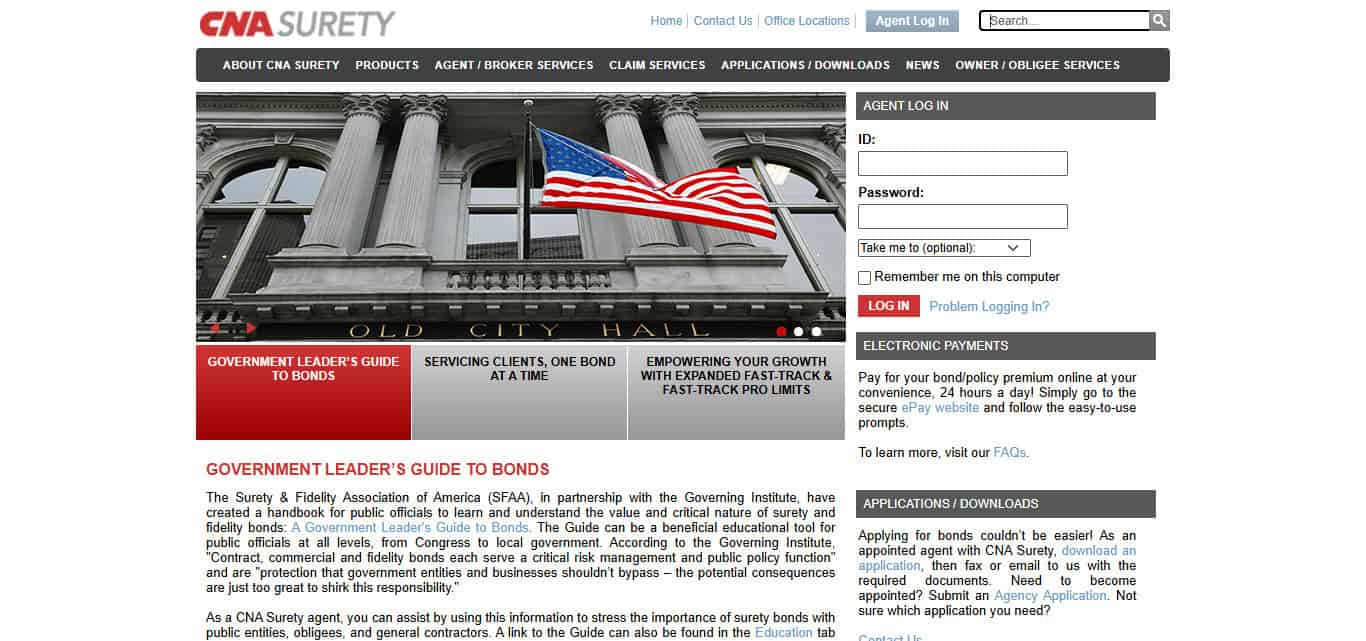
CNA offers bONdLINE, a web-based system that helps agents issue and manage smaller transactional bonds. Underwriting may include contractor financial information, prequalification details, indemnity agreements, and project information. Because requirements vary by account and underwriting situation, contractors should verify current program limits and eligibility.
CNA Surety (Western Surety) Features
- Contract Bonds: Provides bonds for construction contract obligations.
Small Contractor Programs: Offers programs for eligible smaller contractors. - Digital instruments: Offers digital services for issuing and administering bonds.
- Underwriting Support: Assesses contractor financials, experience, and project requirements.
| Pros | Cons |
|---|---|
| Offers contract and commercial surety products | Program eligibility varies by contractor |
| Dedicated options for smaller contractors | Certain programs have specific limits |
| Online tools support bond management | Higher bonding needs may require full underwriting |
| Extensive agent distribution network | Documentation requirements vary by account |
6. Zurich
Zurich offers contract surety bonds to contractors of all sizes from small to large ENR 400 firms working on public and private construction projects. Its portfolio of bonds includes bid, performance, labor and material payment, subcontract performance, subdivision, maintenance, supply, license and permit and environmental bonds.

Zurich says its surety operations can issue bonds in all 50 U.S. states and about 25 countries. Its Surety Express platform allows users to book new bonds, access renewal information, and change existing bonds. Contractors should provide financial, operational, project and contract data for under writing. Zurich also has a Surety Bond Validator to validate bonds.
Zürich Features
- Construction and Commercial Surety: Provides broad bond coverage options.
Core Construction Bonds: bid, performance, and payment bonds - Broad Reach: Enables contractors to work in various U.S. jurisdictions and markets.
- Digital Services: Tools to administer and verify surety bonds
| Pros | Cons |
|---|---|
| Extensive construction surety portfolio | Detailed underwriting may be required |
| Offers multiple contract and commercial bonds | Eligibility varies by financial profile |
| Broad geographic capabilities | Requirements differ across jurisdictions |
| Digital tools support bond management | Larger programs can require substantial documentation |
7. American Contractors Indemnity Company (ACIC)
American Contractors Indemnity Company is a specialty surety insurer. The company specializes in surety bonding including court, specialty contract, license and permit and miscellaneous bonds. ACIC was licensed in 46 states, the District of Columbia, Guam and the Northern Mariana Islands and listed with the U.S.
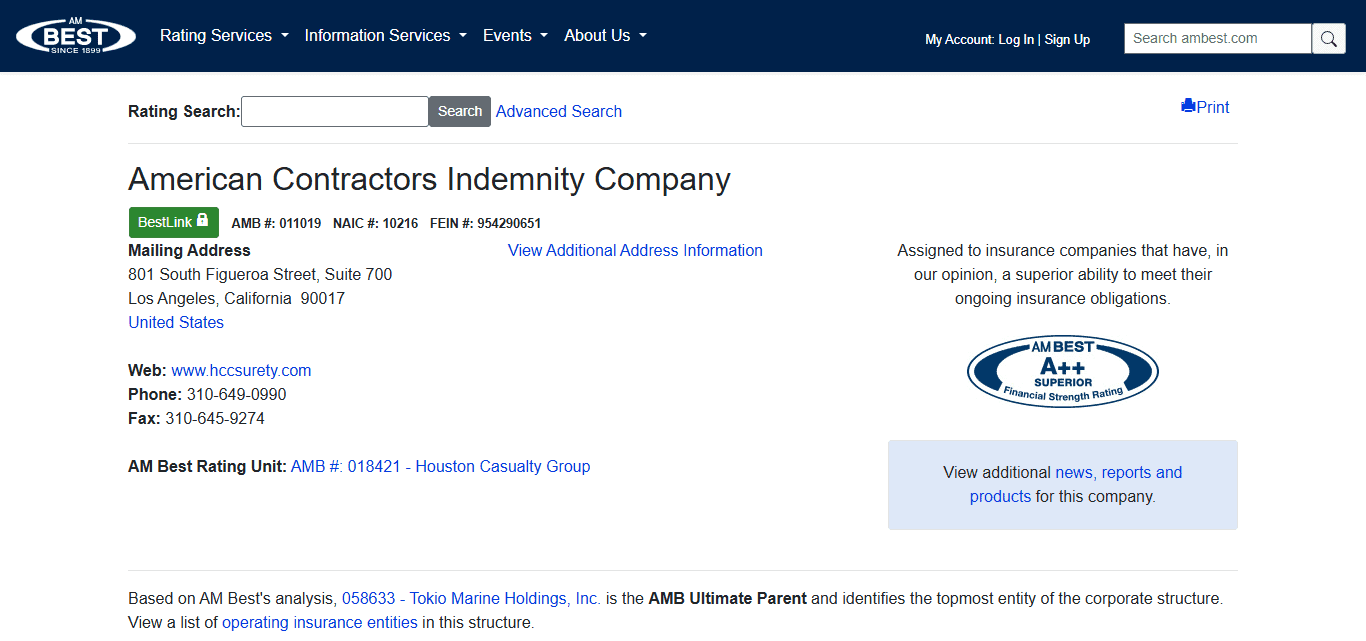
Treasury for federal surety business as of Dec. 31, 2023, according to the California Department of Insurance. Much of its business is generated by independent agents. Before applying, contractors should review the bond type, availability in their state, financial and credit requirements, bond amount, indemnity requirements, and underwriting process. Approval and actual capacity depend on the individual account and applicable underwriting standards.
American Contractors Indemnity Co. (ACIC) Features
- License Bonds: Provides license, permit and other licensing bonds.
Agent Distribution: Mostly does business through independent insurance agents with contractors - Specialty Surety: Addresses diverse specialty and commercial surety needs.
- Contract Bonds: Offers suitable bonding choices for contractors and businesses.
| Pros | Cons |
|---|---|
| Offers various specialty surety products | Product availability varies by jurisdiction |
| Provides contract-related bonding solutions | Underwriting requirements depend on risk |
| Broad licensing footprint | May not suit every large construction account |
| Access through independent agents | Application requirements can vary by bond type |
8. Merchants Bonding Company
Merchants Bonding Company specializes in contract and commercial surety, with construction products including bid, performance, payment, maintenance, subdivision, and other contract bonds. It serves general contractors, subcontractors, and developers working on federal, public, and private projects. Its underwriting process evaluates factors such as financial strength, experience, capacity, credit history, project details, and work history.

Contractors normally work through an insurance agent, who submits the required documentation to the surety. Merchants also provides online tools for agents and emphasizes personalized underwriting rather than relying solely on strict formulas. The company states that it can handle bonds from smaller requirements through multimillion-dollar accounts.
Merchants Bonding Company Features
- Types of Bonds: Bid, performance, payment and maintenance bonds.
Flexible Programs: Serves contractors with different bonding needs.
Agent Support: Uses insurance agents to help with applications and underwriting - Contract Surety: Offers construction bonding solutions for contractors and developers.
| Pros | Cons |
|---|---|
| Strong focus on contract and commercial surety | Underwriting requirements vary by contractor |
| Provides several construction bond types | Financial documentation may be required |
| Supports different contractor sizes | Bond capacity depends on qualifications |
| Agent-supported application process | Availability can vary by state and project |
9. Berkshire Hathaway Specialty Insurance
Berkshire Hathaway Specialty Insurance (BHSI) offers surety products for regional, national and global contractors, including heavy civil, highway and major trade contractors. Its published product range includes performance, payment, advance payment, maintenance, supply and warranty bonds BHSI also references experience with public-private partnerships and alternative project delivery methods.

Contractors should consider the company’s target market, the required bonding capacity, the complexity of the project, and the financial and underwriting requirements when determining eligibility. The surety operation is specifically designed for larger and complex construction related risks. BHSI also provides international surety, making geographic requirements an important factor for contractors working on projects across borders.
Berkshire Hathaway Specialty Insurance Features
- Large-Account Focus: Provides surety solutions for larger and complex contractors.
- Construction Bonds: Offers performance, payment, maintenance, and supply bonds.
- Complex Projects: Supports major infrastructure and specialized construction work.
- Global Capabilities: Provides surety solutions across regional and international markets.
| Pros | Cons |
|---|---|
| Strong focus on large and complex construction risks | May be less suitable for very small contractors |
| Offers multiple contract surety products | Underwriting can be highly detailed |
| Supports major infrastructure projects | Higher documentation expectations for complex accounts |
| Regional and international capabilities | Eligibility depends on project and contractor profile |
10. Arch Insurance Group
Arch Insurance Group provides surety solutions through its specialty insurance operations, which means that its construction and contractual bonding capabilities are relevant to contractors looking for contract surety support.
For this company, the paragraph should address bid, performance and payment bonds, maintenance and other applicable contract bonds, contractor eligibility, underwriting requirements, bonding capacity and project size.

These details can vary by jurisdiction and product so it is also prudent to verify financial strength, geographic availability and the broker or agent distribution model prior to publication. Contractors should check the financial statements, indemnity agreements, project details and underwriting standards needed against their own bonding requirements before applying for a bond.
Arch Insurance Group Features
- Specialty Surety: Provides surety solutions within its specialty insurance portfolio.
- Contract Bonds: Supports applicable construction contract bonding requirements.
- Risk-Based Underwriting: Considers contractor and project-specific risk factors.
- Broker Distribution: Provides access through insurance brokers and agents.
| Pros | Cons |
|---|---|
| Provides specialty surety and contract solutions | Product availability varies by market |
| Supports construction-related bonding requirements | Underwriting depends on individual risk |
| Broker and agent distribution provides market access | Financial documentation may be required |
| Specialty insurance expertise | Bond capacity varies by contractor qualifications |
Conclusion
To summarize : When choosing the best surety bond companies for contractors, it will depend on bonding capacity, eligibility requirements, project size, financial qualifications, under-writing standards and geographic availability.
Companies like Liberty Mutual, Travelers, The Hartford, Chubb, CNA Surety, Zurich and others provide various bonding solutions. Contractors should consider bond types, application requirements, costs, support and financial strength before choosing a bond provider that best fits their unique business needs.
FAQ
What is a surety bond for contractors?
A surety bond protects project owners by guaranteeing a contractor fulfills specific contractual obligations.
What types of bonds do contractors need?
Common types include bid, performance, payment, maintenance, license, and permit bonds.
How do contractors qualify for surety bonds?
Sureties typically review financial statements, credit history, construction experience, project details, and business capacity.
How much does a contractor surety bond cost?
Premiums vary based on bond amount, contractor qualifications, financial strength, project risk, and bond type.