In this article, I will cover the Top Reverse Factoring and Supply Chain Platforms, their main features, financing models, supplier payment options, funding structures, integrations, and working capital capabilities.
You’ll also discover how these platforms benefit buyers and suppliers, simplify invoice financing, improve liquidity management, and offer technology-enabled solutions for today’s supply chain finance programs.
Key Points & Top Reverse Factoring and Supply Chain Platforms
| Platform | Explanation |
|---|---|
| PrimeRevenue | Provides supply chain finance solutions helping businesses optimize liquidity and supplier payment terms. |
| C2FO | Connects buyers and suppliers through dynamic discounting and working capital optimization opportunities. |
| Tradeshift / SemFi | Combines digital trade infrastructure with financing solutions to improve business liquidity and payments. |
| FIS / Demica | Provides supply chain finance infrastructure supporting receivables funding and global working capital programs. |
| Kyriba Working Capital | Helps enterprises optimize cash, liquidity, working capital, and financial risk management processes. |
| Orbian | Delivers supply chain finance programs enabling suppliers to access early payments from buyers. |
| CredAble | Offers working capital solutions helping businesses finance receivables and strengthen supply-chain liquidity. |
| CRX Markets | Provides digital marketplace infrastructure connecting institutional investors with supply chain finance opportunities globally. |
| Lendscape | Provides lending technology supporting receivables finance, asset-based lending, and supply-chain finance. |
| Finverity | Connects businesses and investors through digital trade finance and receivables funding solutions. |
| Taulia | Helps businesses optimize working capital through supplier financing, dynamic discounting, and payment solutions. |
| CashFlo | Provides digital supply chain finance enabling suppliers to unlock cash from invoices. |
| FinDynamic | Enables businesses to improve liquidity through dynamic discounting and automated working capital solutions. |
| TASConnect | Provides treasury and working capital technology supporting cash visibility, forecasting, and financial management. |
| Traxpay | Delivers digital supply chain finance solutions connecting buyers, suppliers, banks, and financing partners. |
15 Top Reverse Factoring and Supply Chain Platforms
1. Prime Revenue
PrimeRevenue specializes in supply chain finance and working-capital optimization, enabling buyers to pay suppliers early and maybe even extend payment terms. Its model matches approved supplier invoices to financing arrangements so suppliers can get liquidity based on the buyer’s financial strength.
The platform supports global programs, with PrimeRevenue claiming its solutions support greater than 30,000 clients in more than 90 countries Before implementing, buyers need to consider funding partner options, currencies, jurisdictions, supplier eligibility, onboarding requirements and transaction economics.

Integration and automation are important because invoice approval, financing requests, payment information and reporting must be integrated with existing accounts-payable and treasury workflows. The price depends on the program structure, funding agreements and the parties involved.
| Feature | Explanation |
|---|---|
| Supply Chain Finance | Supports buyer-led financing that enables suppliers to receive approved invoices early. |
| Global Funding Network | Connects supply-chain finance programs with participating banks and funding institutions. |
| Working Capital Optimization | Helps buyers manage payment terms while improving supplier access to liquidity. |
| Digital Platform | Automates financing workflows, transaction management, supplier onboarding, and reporting. |
2. C2FO
C2FO offers multiple options for early payment to suppliers using a combination of dynamic discounting and supply chain finance. Its dynamic discounting model can tap buyer cash, while its Dynamic Supplier Finance taps outside funding when buyers want to conserve liquidity.
C2FO’s market-driven approach allows suppliers to offer discount rates and buyers to segment suppliers by geography, industry, relationship, materiality or other criteria.

The platform also integrates businesses with banking and funding partners through a single integration. Key evaluation areas include supplier participation, discount economics, funding costs, onboarding, ERP connectivity, settlement processes and eligibility. Actual pricing depends on supplier demand, timing of payments, financing structure & program design.
| Feature | Explanation |
|---|---|
| Dynamic Discounting | Allows suppliers to request early payment by offering discounts on approved invoices. |
| Supplier Finance | Provides externally funded early-payment options while helping buyers preserve cash. |
| Market-Based Pricing | Suppliers can participate in pricing decisions through C2FO’s marketplace approach. |
| Digital Integration | Supports connectivity with enterprise systems and automated payment workflows. |
3. Tradeshift / SemFi
Tradeshift’s supply chain finance infrastructure gives businesses flexibility in how they pay suppliers and finance. The model is bank-neutral, allowing companies to work with their existing lenders or Tradeshift’s banking partners.
Buyers can switch between self-funded and bank-financed options depending on their liquidity needs. The platform also features supplier segmentation, onboarding, early-payment programs and digital supply-chain workflows.

When evaluating, businesses should consider who the participating funding partners are, what financing products are available today, geographic availability, supplier eligibility, integration requirements, settlement workflow and financing costs. Availability of products may vary by market and program structure; purchasers should confirm applicable terms prior to implementation.
| Feature | Explanation |
|---|---|
| Supply Chain Finance | Supports financing programs designed around supplier payments and working capital. |
| Digital Invoicing | Connects invoicing and financial workflows through its digital trade network. |
| Flexible Funding | Can support buyer-funded and externally funded financing structures. |
| Supplier Connectivity | Helps buyers onboard and engage suppliers through digital supply-chain infrastructure. |
4. FIS / Demica
FIS Supply Chain Finance Suite (formerly Demica) is a technology provider to the supply chain finance, receivables finance and working-capital programs market. The platform connects corporates with a network of global funders via cloud-based infrastructure, while banks may utilize its platform to offer supply-chain finance solutions to corporate customers.
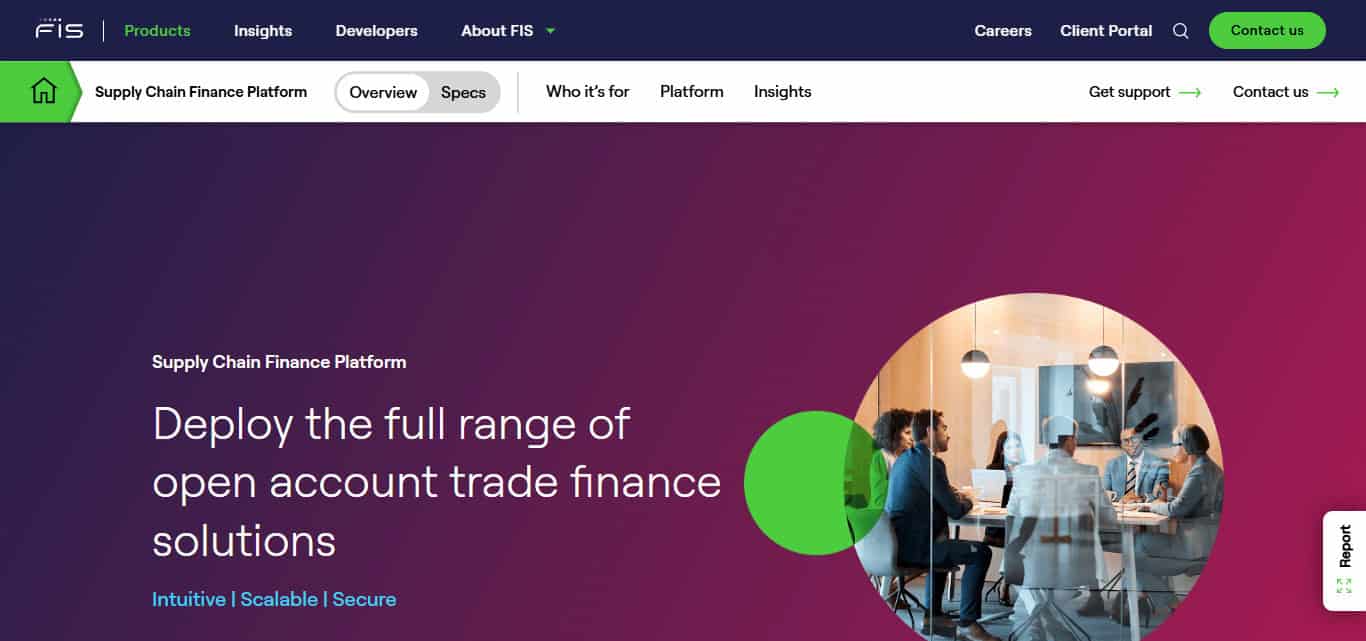
It can be used for flexible deal structuring, transaction automation, reporting, portfolio monitoring and receivables financing. Businesses should consider funding availability, multi-funder structures, credit requirements,
jurisdictional support, integration with corporate finance systems and program eligibility. FIS also said its platform supported a $2.55 billion Glencore trade-receivables securitization in 2026, a sign of its use in large structured transactions.
| Feature | Explanation |
|---|---|
| Receivables Finance | Supports financing structures based on corporate receivables and invoices. |
| Multi-Funder Access | Connects financing programs with banks and institutional funding sources. |
| Program Automation | Automates transaction processing, reporting, and supply-chain finance workflows. |
| Global Infrastructure | Supports large-scale corporate and financial-institution financing programs. |
5. Kyriba Working Capital
Kyriba Working Capital helps you manage working capital through supply chain finance, reverse factoring, dynamic discounting and receivables finance. Its supply-chain finance model enables suppliers to receive earlier payment, while buyers can extend payment terms, with financing based on the buyer’s credit profile.
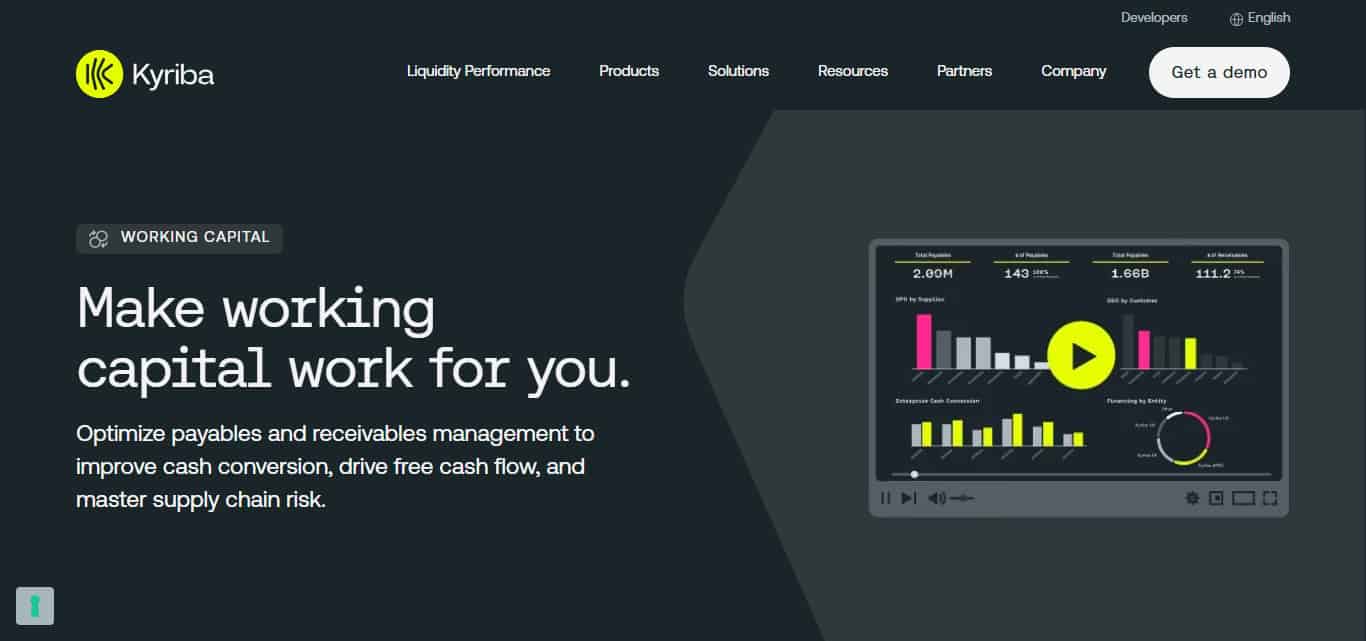
The platform ingests approved invoices from ERP systems and provides dashboards for funding availability, payment history and analytics. Buyers need to think about treasury integration, ERP connectivity, supplier onboarding, funding partners, financing fees and implementation requirements. Kyriba also provides receivables finance, allowing companies to address both payable and receivable liquidity needs through its working capital technology.
| Feature | Explanation |
|---|---|
| Working Capital Optimization | Helps organizations manage payables, receivables, liquidity, and payment strategies. |
| Supply Chain Finance | Supports supplier financing and early-payment programs within working-capital operations. |
| Treasury Integration | Connects working-capital activities with broader treasury and cash-management processes. |
| Analytics & Visibility | Provides reporting and visibility into cash, liquidity, and working-capital performance. |
6. Orbian
Orbian offers supply chain finance and payment-with-terms solutions, with a focus on buyer-led working-capital programs. Its supply chain finance model enables suppliers to receive early payment, while buyers can negotiate longer payment terms, improving buyer DPO and supplier liquidity simultaneously.

Orbian states its proprietary Bank Pool funding structure works with leading global banks to provide global financing reach. The company also said that suppliers are not necessarily required to sell or assign receivables or open new bank accounts in its supply chain finance structure.
Buyers should still consider country availability, supplier eligibility, funding capacity, onboarding processes, contractual requirements and transaction economics as program terms may vary by jurisdiction and structure.
| Feature | Explanation |
|---|---|
| Reverse Factoring | Enables suppliers to receive early payment against approved buyer invoices. |
| Buyer-Led Financing | Structures financing around the buyer’s payment obligations and credit profile. |
| Bank Funding | Uses participating financial institutions to provide liquidity for supplier payments. |
| Global Programs | Supports international supply-chain finance programs across multiple markets. |
7. CredAble
CredAble offers working capital and structured trade finance solutions including sales invoice financing, purchase invoice discounting, purchase order financing, receivables securitization and supply chain financing. Its solutions enable suppliers and businesses who want early access to working capital and its technology also powers banks and financial institutions.

Some supply chain applications integrate with bank systems, corporate ERPs, invoice-data sources and third party platforms that CredAble provides through APIs. The businesses should consider the evaluation of buyer and supplier eligibility, credit underwriting, financing limits, onboarding requirements, applicable interest or financing costs and market coverage. Today, it’s operations are strongly associated with India, with corporate offices and financing solutions serving that market.
| Feature | Explanation |
|---|---|
| Supply Chain Finance | Provides financing solutions supporting suppliers and businesses across supply chains. |
| Invoice Financing | Enables businesses to access working capital against eligible receivables or invoices. |
| Digital Onboarding | Uses technology to streamline supplier registration and financing processes. |
| API Connectivity | Supports integrations with corporate systems, banks, and financial technology platforms. |
8. CRX Markets
CRX Markets is a digital marketplace for working-capital financing which connects corporates with banks and institutional investors. It provides a platform for payables and receivables solutions such as reverse factoring, payment-term extension, dynamic discounting and receivables financing.
CRX says its marketplace connects corporates with over 50 banks and investors and is active across multiple currencies, jurisdictions and markets. Its infrastructure automates processes from invoice selection to funding and settlement.

Program design, financing partner availability, supplier eligibility, credit requirements, jurisdiction coverage, integration requirements and pricing should be considered by businesses. The platform offers investors and banks standardized access to corporate receivables and payables programs through its marketplace.
| Feature | Explanation |
|---|---|
| Financing Marketplace | Connects corporates seeking working capital with banks and institutional investors. |
| Reverse Factoring | Supports buyer-led supplier financing through its digital marketplace infrastructure. |
| Receivables Finance | Provides access to financing structures backed by corporate receivables. |
| Multi-Investor Access | Enables financing programs to connect with multiple potential funding institutions. |
9. Lendscape
Lendscape is not a lender or a source of financing, but it is a provider of lending technology. It has a platform that supports receivables finance, factoring, invoice discounting, asset-based lending and supply chain finance products. The technology automates lending workflows, offers risk management capabilities, supports multiple currencies and languages and has open APIs for integration with existing systems and third-party tools.
Lendscape claims to be trusted by over 130 banks and lenders and manages technology behind major client turnover. Buyers should be aware that when considering it, the financing will need to be from a funding provider and not Lendscape. Therefore, implementation, customization, integration, lender requirements and deployment structure are important considerations.
| Feature | Explanation |
|---|---|
| Receivables Finance | Provides technology for invoice discounting, factoring, and receivables-based lending. |
| Supply Chain Finance | Supports lenders offering supply-chain and working-capital financing products. |
| Lending Automation | Automates lending workflows, transaction processing, monitoring, and administration. |
| API Integration | Provides connectivity options for integrating lending systems with external applications. |
10. Finverity
Finverity offers technology and working capital solutions for payables finance, reverse factoring, invoice discounting, distributor finance and payables extension. Its FinverityOS platform is built to digitize and automate supply chain finance operations for banks and non-bank financial institutions. In reverse factoring, a third party funder can purchase approved supplier invoices, with the buyer acting as the credit-risk anchor.

The platform supports configurable products, limits, pricing, workflows and onboarding processes. Businesses should consider the availability of funding, geographic reach, supplier eligibility, transaction costs, integration needs, credit standards and legal structure. Its solutions can also support dynamic discounting using buyer liquidity instead of external funding.
| Feature | Explanation |
|---|---|
| Reverse Factoring | Supports buyer-led financing where suppliers can access early invoice payments. |
| Trade Finance | Provides digital infrastructure for various trade and working-capital financing products. |
| Funding Marketplace | Connects financing opportunities with banks, funds, and other capital providers. |
| Configurable Workflows | Allows financing providers to configure products, pricing, limits, and approval processes. |
11. Taulia
Taulia, a SAP company, offers supplier financing, dynamic discounting, and working capital solutions embedded in business payment processes. Its dynamic discounting model lets buyers use their own cash to pay suppliers earlier in return for discounts
while supply chain finance can tap third-party liquidity. Taulia also lets firms switch between self-funded dynamic discounting and externally funded supply chain finance as liquidity needs shift.
Its platform is designed to integrate with existing enterprise systems, and Taulia boasts plug-and-play implementation capabilities. Evaluation criteria should include SAP/ERP integration, supplier onboarding, funding model, geographic availability, financing or discount costs, eligibility, payment terms and program configuration.
| Feature | Explanation |
|---|---|
| Supplier Financing | Gives suppliers opportunities to receive early payment against approved invoices. |
| Dynamic Discounting | Enables buyers to use available cash for early supplier payments at negotiated discounts. |
| SAP Integration | Provides integration with SAP and enterprise financial systems for payment workflows. |
| Working Capital | Helps buyers optimize payment terms while providing suppliers with liquidity options. |
12. CashFlo
CashFlo offers supply-chain finance and reverse factoring solutions, enabling suppliers to get paid early and buyers to extend their payment terms. Its model uses the buyer’s credit strength and external financing to provide liquidity to suppliers against approved invoices.

CashFlo also allows for multiple sources of funding including treasury liquidity, banking relationships and partner financial institutions depending on the program. Services include: onboarding vendors, training, financing and integrations with ERP and WMS systems.
They should check lender availability, supplier eligibility, financing costs, onboarding needs, payment flow, and market coverage. CashFlo also mentions partnerships with more than 20 lenders for some financing programs.
| Feature | Explanation |
|---|---|
| Reverse Factoring | Enables suppliers to obtain early payment against approved buyer invoices. |
| Multiple Funding Sources | Supports financing through banks, lenders, and other participating funding partners. |
| Supplier Onboarding | Provides digital processes for registering and activating suppliers for financing programs. |
| ERP Integration | Connects financing workflows with enterprise resource planning and business systems. |
13. FinDynamic
FinDynamic offers supply-chain finance solutions, such as dynamic discounting, confirming, reverse factoring and early-payment. Its dynamic discounting model allows buyers to pay suppliers early with surplus liquidity in exchange for discounts based on the requested payment acceleration.
Its confirming model operates on the lines of reverse factoring where a financial institution takes care of buyer payables, suppliers can choose for early payment and buyers can have longer payment terms.

FinDynamic says its technology works with ERP and treasury systems and can connect with multiple banking partners. Buyers should consider bank coverage, supplier onboarding, integration requirements, discount economics, financing costs, geographic availability and eligibility.
| Feature | Explanation |
|---|---|
| Dynamic Discounting | Allows buyers to offer early invoice payments in exchange for supplier discounts. |
| Reverse Factoring | Enables third-party financial institutions to fund supplier early payments. |
| Supplier Financing | Provides suppliers with liquidity options based on approved invoices and payment timing. |
| ERP Connectivity | Integrates financing workflows with enterprise resource planning and treasury systems. |
14. TAS Connect.
TASConnect is a platform for working capital and trade finance that improves cash flow visibility and optimizes payables and receivables. Its bank-agnostic architecture offers end-to-end working capital and supply chain finance capabilities, including payables financing, receivables and distributor financing, and dynamic discounting.

The platform is built on modular technology, so you can have different financing workflows integrated into one environment. For business, key evaluation factors include: treasury connectivity, ERP integration, cash visibility, liquidity forecasting, payment workflows, automation, reporting and analytics. Buyers should also consider onboarding requirements, implementation effort, supported financial institutions, geographic availability, and product-specific financing costs when choosing a program.
| Feature | Explanation |
|---|---|
| Working Capital | Supports payables, receivables, liquidity, and broader working-capital management. |
| Supply Chain Finance | Provides technology for financing and optimizing supplier-related payment workflows. |
| Cash Visibility | Helps organizations monitor cash positions, liquidity, and working-capital movements. |
| Reporting & Analytics | Provides financial reporting and analytics for working-capital decision-making. |
15. Traxpay
Traxpay provides dynamic supplier financing that combines dynamic discounting and reverse factoring. Buyers can select to pay supplier invoices early using their own liquidity or a third-party source of funds. The discounts on suppliers are set by the buyer and the discount is based on how soon payment is made.

A business should evaluate: supplier onboarding, availability of funding partners, ERP/API integration, transaction workflows, geographical reach, financing costs and eligibility. A key characteristic is the ability to blend dynamic supplier financing with post-maturity financing to allow companies to meet their early-payment and extended-payment-term requirements.
| Feature | Explanation |
|---|---|
| Dynamic Supplier Finance | Combines early-payment financing with flexible supplier discounting mechanisms. |
| Reverse Factoring | Allows suppliers to receive earlier payments while buyers manage extended payment terms. |
| Flexible Funding | Supports buyer-funded liquidity and third-party financing structures. |
| Digital Integration | Connects supply-chain financing workflows with corporate systems and payment processes. |
Conclusion
Conclusion Top reverse factoring and supply chain platforms support businesses in managing supplier payments, improving liquidity, and optimizing working capital with digital financing solutions. Platforms like PrimeRevenue, C2FO, Taulia, Traxpay and others offer supplier finance, dynamic discounting, receivables funding and payment automation.
Companies should look at funding options, integration, supplier onboarding, geographic reach, pricing, eligibility and specific working-capital needs when evaluating these platforms.
FAQ
What is reverse factoring?
Reverse factoring allows suppliers to receive early payment for approved invoices while buyers maintain agreed payment terms.
What are supply chain finance platforms?
They provide digital tools for supplier financing, invoice management, payment optimization, and working-capital management.
How does reverse factoring benefit suppliers?
It can provide faster access to cash without requiring suppliers to wait until the buyer’s original payment date.
How does it benefit buyers?
Buyers can potentially extend payment terms while supporting supplier liquidity and strengthening working-capital management.