Here I will talk about the Best Cross Chain Liquidity Routing Protocols that help users transfer assets and swap tokens across different blockchain networks. These protocols link liquidity sources, compare transaction routes and improve cross-chain trading efficiency.
We’ll look at their main features, supported networks, security features, transaction fees and unique benefits to help readers understand which solutions are best for them.
Key Points & Best Cross-Chain Liquidity Routing Protocols
| Protocol | Key Features |
|---|---|
| LI.FI | Aggregates bridges and decentralized exchanges to optimize cross-chain swaps, routes, and execution. |
| Across Protocol | Uses intent-based bridging to deliver fast transfers with competitive fees across supported chains. |
| Stargate Finance | Enables cross-chain asset transfers through unified liquidity pools and instant guaranteed finality. |
| deBridge | Facilitates secure cross-chain transfers and swaps with efficient liquidity routing across networks. |
| Wormhole | Connects blockchain ecosystems through messaging infrastructure and cross-chain token transfer capabilities. |
| Axelar | Provides cross-chain communication and programmable token transfers between interconnected blockchain networks. |
| Symbiosis Finance | Aggregates cross-chain liquidity to simplify token swaps across multiple supported blockchain networks. |
| Socket Protocol | Routes cross-chain transactions through integrated bridges and exchanges to improve execution efficiency. |
| FastBridge by Avail | Supports cross-chain asset movement designed to improve transaction speed and interoperability across networks. |
| Circle CCTP V2 | Enables native USDC transfers across supported blockchains using Circle’s burn-and-mint mechanism. |
10 Best Cross-Chain Liquidity Routing Protocols
1. LI.FI
LI.FI is a cross-chain aggregator that compares bridges and DEXs and picks the best route for you. It supports over 60 blockchains including Ethereum, Solana, Arbitrum, Base, BNB Chain, Polygon and Avalanche. It connects 20+ bridges (Across, Stargate, Hop, etc.) and 30+ DEXs so you can route almost any liquid token.

The fees are the base bridge fee, gas and optionally the integrator fee, which is typically ~0.25% or less. Default slippage is usually 0.5%, adjustable on a per swap basis. Exchange rates are live quotes on all routes so you get the market rate plus the cost of the route. It powers wallets and apps like Jumper.
LI.FI Feature Feature
| Feature | Explanation |
|---|---|
| Liquidity Aggregation | Aggregates liquidity from multiple bridges and decentralized exchanges. |
| Cross-Chain Swaps | Enables token swaps between supported blockchain networks. |
| Route Optimization | Compares available routes to help optimize transaction costs and execution. |
| Developer Integration | Provides APIs and SDKs for integrating cross-chain swaps into applications. |
2. Across Protocol
Across is an intent based bridge secured by UMA’s optimistic oracle and relayers complete transfers in seconds. It supports Ethereum, Arbitrum, Optimism, Base, Polygon, zkSync, Linea, Scroll, Blast and Solana. We support ETH/WETH, USDC, USDT, DAI, WBTC and ACX tokens.
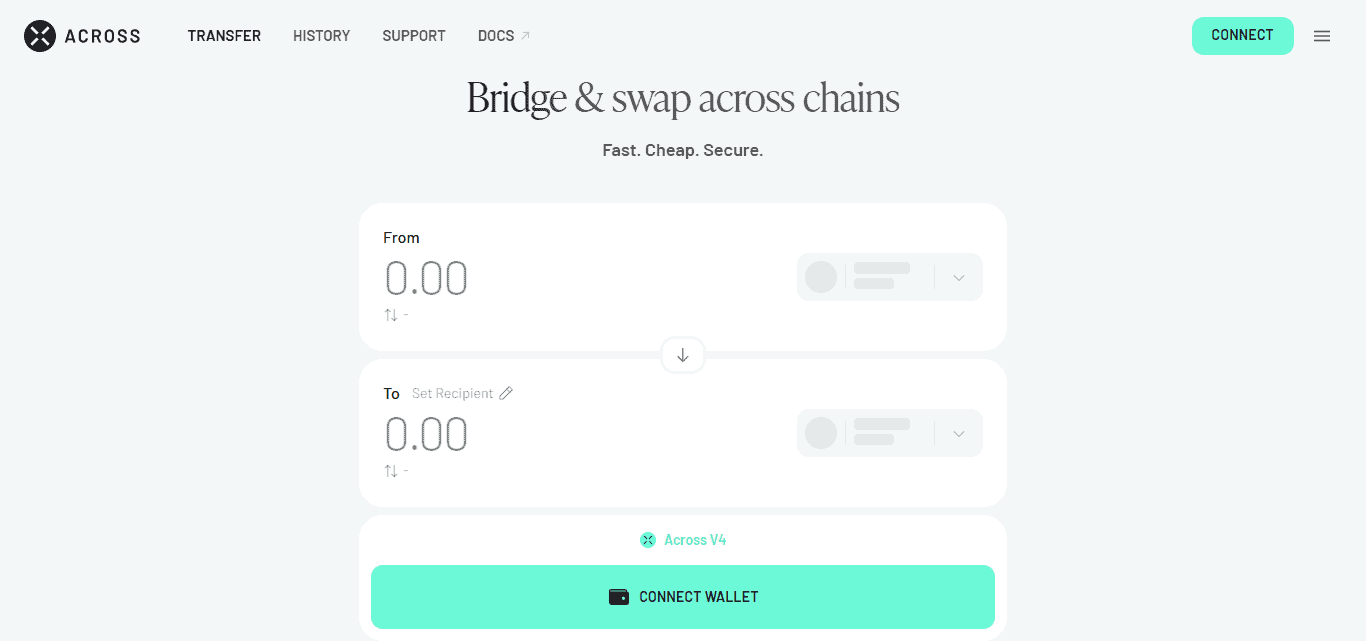
Fees consist of a relayer fee, LP fee and destination gas and are typically around 0.05%-0.2% on major assets. Since the quote is fixed before you sign, bridge slippage is effectively zero. The ratio is close to 1:1 for the same asset, net of fees. Across is known for fast, low cost transfers that are usually less than a minute.
Across Protocol Feature
| Feature | Explanation |
|---|---|
| Intent-Based Bridging | Uses intents to connect users seeking cross-chain asset transfers with relayers. |
| Fast Transfers | Supports rapid transfers across supported blockchain networks. |
| Competitive Fees | Uses a capital-efficient design to help reduce bridging costs. |
| Security Model | Uses optimistic verification and a dispute mechanism to secure transfers. |
3. Stargate Finance
Stargate is built on LayerZero and uses unified liquidity pools to transfer native assets. Stargate V2 supports 15-20+ chains including Ethereum, Arbitrum, Optimism, Base, BNB Chain, Avalanche, Polygon and more.

Tokens are USDC, USDT, ETH and a select few others. Fees are comprised of two components: a small protocol fee (about 0.04%-0.06% in “Taxi” mode, cheaper in “Bus” batched mode) and a LayerZero messaging fee paid in gas. Swaps 1:1 vs pool liquidity with default slippage tolerance of ~0.5%. Instant delivery and guaranteed, no wrapped tokens.
Stargate Finance Feature
| Feature | Explanation |
|---|---|
| Unified Liquidity | Uses shared liquidity pools to facilitate cross-chain asset transfers. |
| Native Asset Transfers | Supports transfers of native assets across supported blockchain networks. |
| Instant Guaranteed Finality | Provides instant transaction confirmation under its defined transfer model. |
| DeFi Integration | Enables applications to integrate cross-chain transfers into decentralized finance workflows. |
4. deBridge
deBridge utilizes its DLN (deSwap Liquidity Network) which is an intent based system where market makers fill orders. It supports 20+ chains like Ethereum, Solana, BNB Chain, Arbitrum, Base, Polygon, Avalanche, Hyperliquid and more. Cross-chain swaps of thousands of tokens.

The fee is around 0.04% (4 bps) of the amount. And a small fixed fee (e.g. ~0.001 ETH on EVM chains or ~0.015 SOL on Solana). With DLN, there is no bridge slippage as the rate is locked at the time of order creation. Rates are market based with small spreads and transfers typically settle in seconds to a few minutes.
deBridge Feature
| Feature | Explanation |
|---|---|
| Cross-Chain Transfers | Facilitates asset transfers between supported blockchain networks. |
| Liquidity Routing | Connects cross-chain liquidity and swap opportunities through its infrastructure. |
| Fast Execution | Designed to support efficient transaction execution across connected networks. |
| Developer Tools | Offers APIs and integration tools for cross-chain applications. |
5. Wormhole
Wormhole is a generalized messaging layer secured by a 19 of guardian network. It bridges 30+ chains such as Ethereum, Solana, Sui, Aptos, Arbitrum, Base, and Cosmos-based chains. Portal moves wrapped assets, NTT supports native multichain tokens, and Mayan or Connect add swap routing.

Wormhole doesn’t charge a fixed protocol fee on the core transfers, so users are mostly paying source gas, destination gas and relayer fees. Slippage applies only when swapping via routers, typically 0.5%–1%. Rates are 1:1 for a token in its wrapped or native version.
Wormhole Feature
| Feature | Explanation |
|---|---|
| Cross-Chain Messaging | Enables applications to exchange messages across connected blockchains. |
| Token Transfers | Supports cross-chain token transfers through its interoperability infrastructure. |
| Broad Connectivity | Connects numerous blockchain ecosystems through supported integrations. |
| Developer Infrastructure | Provides tools for building cross-chain decentralized applications. |
6. Axelar
Axelar is a proof-of-stake interoperability network that provides General Message Passing (GMP) and the Interchain Token Service (ITS). It connects to 60+ chains including EVM chains, Cosmos, etc. Its main user-facing swap layer is Squid Router. Supported assets are axlUSDC, wrapped BTC and ETH, AXL and custom interchain tokens.

Gas-based fees depend on the destination chain. Typically, it’s a few cents to a few dollars, plus small DEX fees on swaps. Slippage is determined by the swap route, typically at 0.5%-1%. Bridged assets are 1:1 rates. Swaps are market rates.
Axelar Feature
| Feature | Explanation |
|---|---|
| Cross-Chain Communication | Enables secure communication between interconnected blockchain networks. |
| General Message Passing | Allows smart contracts to trigger actions across supported chains. |
| Interoperability | Connects different blockchain ecosystems through a unified communication layer. |
| Programmable Transfers | Supports cross-chain token transfers and application-specific workflows. |
7. Symbiosis Finance
Symbiosis is a synthetic asset and shared liquidity layer based cross-chain liquidity protocol. It supports 40-50+ networks, including Ethereum, BNB Chain, Polygon, Avalanche, Arbitrum, TON, Tron and Bitcoin. Users can exchange native assets between EVM and non-EVM chains without the need for manual wrapping.

The quote displays the fees — a protocol fee (typically a fraction of a percent), liquidity-pool fees, and gas. “Slippage” depends on the depth of the pool and defaults to roughly 0.5%, adjustable by the user. Rates are taken from the live pool, so large trades on thin routes may get a worse rate. Usually, the settlement takes a few minutes.
Symbiosis Finance Feature
| Feature | Explanation |
|---|---|
| Cross-Chain Swaps | Enables token swaps between supported blockchain networks. |
| Liquidity Aggregation | Connects liquidity sources to facilitate cross-chain trading. |
| Single-Interface Experience | Simplifies multi-chain swaps through an integrated user interface. |
| Token Compatibility | Supports various tokens across its connected blockchain ecosystems. |
8. Socket Protocol
Socket is a chain abstraction and interoperability protocol, and its consumer app is now operating as Bungee. It brings in 15+ bridges and many DEXs across 30+ chains like Ethereum, Arbitrum, Optimism, Base, Polygon, BNB Chain, and Solana adjacent routes.

It supports the major tokens like ETH, USDC, USDT, DAI, WBTC and long-tail assets. The fare depends on the route. Users pay the underlying bridge or solver fee, destination gas, and sometimes a small integrator fee. Users can usually set slippage at 0.5%–1%. It’s auction-style “Bungee Auto” picks the cheapest route, so rates tend to follow the market.
Socket Protocol Feature
| Feature | Explanation |
|---|---|
| Bridge Aggregation | Integrates multiple bridges to expand cross-chain transfer options. |
| Route Selection | Helps applications select suitable routes for cross-chain transactions. |
| Developer APIs | Provides infrastructure for integrating cross-chain functionality into applications. |
| Transaction Efficiency | Helps streamline cross-chain execution through aggregated routing options. |
9. FastBridge by Avail
Avail’s FastBridge, now part of Avail Nexus, connects Ethereum with the Avail network and growing rollup ecosystems. It supports ETH, USDC, AVAIL, and other assets as Nexus grows. Coverage is narrower than the above aggregators, focusing on Ethereum, Avail and major L2s like Arbitrum, Base and Optimism.

There is no fee on the asset itself, users pay mostly source and destination gas + a small relayer fee. It moves tokens 1:1 so slippage is minimal and it aims for fast transfers, often in minutes, vs the long waits of older optimistic bridges.
FastBridge by Avail Feature
| Feature | Explanation |
|---|---|
| Cross-Chain Connectivity | Supports asset movement between compatible blockchain networks. |
| Transfer Efficiency | Focuses on simplifying cross-chain transfers through its bridging infrastructure. |
| Avail Ecosystem | Aligns with Avail’s broader goal of improving blockchain interoperability. |
| Multi-Chain Access | Helps users access supported networks through cross-chain transfer functionality. |
10. Circle CCTP V2
Circle’s Cross-Chain Transfer Protocol (CCTP) V2 burns native USDC on the source chain and mints new native USDC on the destination chain, without any wrapped tokens involved. It supports 15+ chains including Ethereum, Avalanche, Arbitrum, Optimism, Base, Polygon, Solana and Linea. Main asset is USDC, with growing support for EURC.

Standard transfers have no protocol fee, only gas. Fast Transfer cost a small fee, anywhere between 1-14 basis points depending on the chain. The transfer is burn-and-mint, so slippage is zero and the rate is 1 USDC to 1 USDC exactly. Standard finality can take minutes. The Fast Transfer is measured in seconds.
Circle CCTP V2 Feature
| Feature | Explanation |
|---|---|
| Native USDC Transfers | Transfers USDC between supported chains using a burn-and-mint mechanism. |
| Native Asset Representation | Avoids relying on conventional third-party wrapped USDC representations. |
| Fast Transfer Support | Introduces faster transfer capabilities through supported Fast Transfer functionality. |
| Developer Integration | Provides infrastructure for applications requiring native cross-chain USDC movement. |
Conclusion
To summarize, the best cross-chain liquidity routing protocols for you depend on your needs like transaction speed, fees, supported blockchains, liquidity, and security. There are different cross-chain capabilities that platforms like LI.FI, Across Protocol, Stargate Finance, deBridge
Wormhole offer. Before choosing a protocol to find a suitable solution for efficient, reliable and cost-effective blockchain transactions, compare its features, compatibility of the network and risks.
FAQ
Which are the best cross-chain liquidity routing protocols?
Popular options include LI.FI, Across, Stargate, deBridge, Wormhole, and Axelar.
How does LI.FI support cross-chain swaps?
LI.FI aggregates bridges and decentralized exchanges to find suitable transaction routes.
Is Across Protocol suitable for fast transfers?
Across uses intent-based bridging to facilitate fast, efficient cross-chain asset transfers.
What makes Stargate Finance different from other protocols?
Stargate uses unified liquidity pools to facilitate cross-chain asset transfers.