In this article, we will go over the best cross-chain liquidity routing protocols that enable users to transfer digital resources and exchange tokens across different blockchain networks.
We will examine the major platforms, including LI.FI / Jumper, Across Protocol, deBridge, Stargate Finance, Symbiosis Finance and others, focusing on their key features, benefits, and capabilities to help users understand cross-chain liquidity routing solutions.
Key Points & Best Cross-Chain Liquidity Routing Protocols
| Protocol | Explanation |
|---|---|
| LI.FI / Jumper | Aggregates bridges and decentralized exchanges, finding efficient routes for cross-chain asset transfers. |
| Across Protocol | Uses optimistic bridging to deliver fast, capital-efficient transfers between supported blockchain networks. |
| deBridge | Enables secure cross-chain transfers and messaging with liquidity-efficient execution across multiple blockchains. |
| Stargate Finance | Provides unified cross-chain liquidity, enabling native asset transfers with deep liquidity pools. |
| Symbiosis Finance | Aggregates cross-chain swaps, helping users exchange tokens across supported blockchain networks seamlessly. |
| Rango Exchange | Aggregates bridges and exchanges to discover competitive routes for cross-chain cryptocurrency swaps. |
| Wormhole Portal | Connects blockchain ecosystems through cross-chain token transfers powered by Wormhole messaging infrastructure. |
| Socket Protocol | Aggregates bridges and routes transactions across chains, optimizing costs, speed, and execution. |
| Chainflip | Enables native cross-chain swaps between major blockchains without requiring wrapped tokens or intermediaries. |
| Hop Protocol | Facilitates fast token transfers between Ethereum layer-two networks using specialized liquidity providers. |
10 Best Cross-Chain Liquidity Routing Protocols In 2026
1. LI.FI / Jumper
LI.FI is a cross-chain aggregation infrastructure, connecting multiple bridges and DEXs and swap providers through a unified routing system. Jumper, its user-facing swap application, enables users to swap tokens across supported blockchain networks without having to manually compare every bridge or decentralized exchange. The platform analyzes the available routes based on estimated output, transaction fees, execution time, and route availability.

Depending on the assets and networks selected, a transaction may involve multiple providers to complete the swap. LI.FI is especially useful for apps and wallets who want to embed cross-chain swaps into their UI. Before confirming transfers, users should still check quoted fees, slippage, network support and transaction risks.
LI.FI / Jumper Feature
| Feature | Explanation |
|---|---|
| Cross-Chain Aggregation | Connects multiple bridges and decentralized exchanges for token transfers. |
| Smart Route Optimization | Compares available routes based on costs, speed, and expected output. |
| Multi-Chain Support | Enables swaps across numerous supported blockchain networks and ecosystems. |
| Developer Integration | Provides APIs and SDKs for wallets and decentralized applications. |
2. Across Protocol
Across Protocol is an intent-based cross-chain bridge that facilitates fast and efficient transfer of digital resources between supported blockchain networks. This enables independent relayers to deliver destination-chain funds the moment they observe a valid deposit, rather than forcing users to wait for each step in a traditional bridging process.
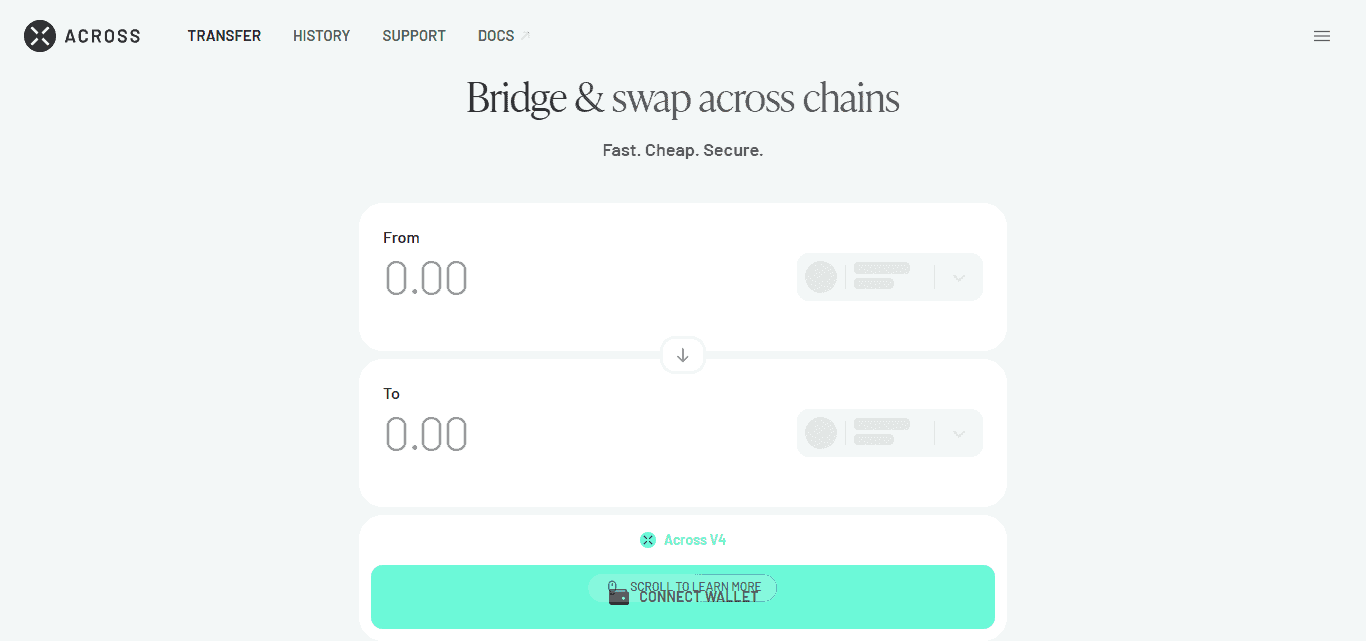
Later, the protocol verifies transactions and compensates relayers through its settlement system. It can enhance transfer speed and capital efficiency, especially when moving assets between Ethereum and the supported Layer 2s.
Across also provides the infrastructure for developers building cross-chain swaps and applications. Users should compare available routes, fees, destination tokens and network support before transferring assets as actual execution depends on current liquidity and transaction conditions.
Across Protocol Feature
| Feature | Explanation |
|---|---|
| Intent-Based Bridging | Uses user intents and relayers to facilitate cross-chain transfers. |
| Fast Transfers | Relayers can provide destination funds before final settlement completes. |
| Capital Efficiency | Uses a pooled settlement model to improve liquidity utilization. |
| Layer 2 Connectivity | Supports transfers between Ethereum and compatible scaling networks. |
3. deBridge
deBridge is a cross-chain interoperability protocol that allows digital resources and information to be transferred between supported blockchain networks. Its infrastructure is designed to enable cross-chain swaps and transfers and to orchestrate execution across different ecosystems.
One of its key offerings, deBridge DLN, uses a cross-chain trading model, connecting users to independent solvers that can fulfilll orders on destination chains. This approach is designed to minimize traditional wrapped-asset bridging requirements and can facilitate efficient transfers across compatible networks.

Developers are able to integrate deBridge functionality into decentralized applications and trading interfaces. Routes may change including availability and performance, therefore users should check for supported tokens, networks, quoted amounts, fees and security assumptions before executing any transactions.
deBridge Feature
| Feature | Explanation |
|---|---|
| Cross-Chain Swaps | Facilitates token exchanges between supported blockchain networks. |
| DLN Technology | Uses a solver-based model for cross-chain order fulfillment. |
| Native Asset Transfers | Supports routes designed to reduce reliance on wrapped assets. |
| Developer Tools | Offers integration infrastructure for decentralized applications and services. |
4. Stargate Finance
Stargate Finance is a cross-chain liquidity transport protocol, which allows assets to be transferred between different blockchain networks that are supported. With its infrastructure, users can bridge supported assets between chains and still tap into destination-chain liquidity via unified liquidity mechanisms.
Stargate is especially useful for decentralized finance users who want to move stablecoins and other supported tokens between different blockchain ecosystems. Developers are able to plug Stargate’s infrastructure into applications that need cross-chain transfers, liquidity access or interoperability features.

It has routing options that depend on the available networks, assets and liquidity pools. Users should check transaction requirements, transfer fees, destination assets, and estimated delivery times before using Stargate.
Stargate Finance Feature
| Feature | Explanation |
|---|---|
| Unified Liquidity | Connects liquidity pools to facilitate supported cross-chain transfers. |
| Native Asset Transfers | Enables transfers of supported assets between connected networks. |
| Stablecoin Connectivity | Supports cross-chain movement of selected stablecoins and tokens. |
| DeFi Integration | Provides infrastructure for applications requiring cross-chain liquidity access. |
5. Symbiosis Finance
Symbiosis Finance is a cross-chain decentralized exchange and liquidity protocol that enables users to swap tokens across supported blockchain networks. It includes cross-chain transfer capabilities combined with automated market-making and routing mechanisms, allowing users to access assets from different ecosystems through one interface.
Symbiosis can find available routes and display estimated results for comparison, instead of requiring users to manually execute separate transactions on different platforms. Its ecosystem is capable of connecting different Layer 1 and Layer 2 networks, including EVM and non-EVM environments.

That makes it a great tool for users who want to trade tokens across different blockchains easily. However, the routes, liquidity, slippage and transaction cost available will vary depending on the assets and networks you choose.
Symbiosis Finance Feature
| Feature | Explanation |
|---|---|
| Cross-Chain Swaps | Enables token exchanges across supported blockchain ecosystems. |
| Route Aggregation | Identifies available routes through integrated liquidity sources and bridges. |
| Multi-Chain Connectivity | Supports selected EVM and non-EVM blockchain networks. |
| Unified Interface | Simplifies cross-chain exchanges through a single user experience. |
6. Rango Exchange
Rango Exchange is a cross-chain aggregator that connects decentralized exchanges, bridges and other swap services, allowing users to exchange cryptocurrency across different blockchain ecosystems. It’s supposed to make it easier to do things that would otherwise require you to go to several platforms on your own.
Rango looks at all the possible routes and helps users to find possible ways to move from one token to another token in a different network. Multi-chain is especially useful for transactions between different blockchain architectures like EVM-compatible networks, Cosmos ecosystems, Solana and certain UTXO-based chains.

Routes available based on current integrations and supported assets. Users should compare estimated output, network fees, slippage and transaction steps before approving a swap.
Rango Exchange Feature
| Feature | Explanation |
|---|---|
| Route Aggregation | Combines routes from integrated bridges and decentralized exchanges. |
| Broad Chain Coverage | Connects supported networks across different blockchain architectures. |
| Swap Optimization | Helps users compare estimated output across available transaction routes. |
| Multi-Step Swaps | Can coordinate complex routes involving multiple providers and networks. |
7. Wormhole Portal
Wormhole Portal is a user-facing interface built on the top of Wormhole’s cross-chain infrastructure that enables users to transfer supported tokens between connected blockchain networks. Wormhole brings interoperability messaging, allowing compatible applications and networks to talk to each other across chains.
Depending on the route and asset supported, users can transfer tokens between ecosystems without having to use a separate centralized exchange for each transfer. Wormhole is especially useful in a multichain world, where assets and decentralized applications are built on different blockchain architectures.

It also enables wider infrastructure to develop cross-chain applications and messaging use cases. Before any cross-chain transaction, users should check token representations, destination network compatibility, transfer fees and security considerations.
Wormhole Portal Feature
| Feature | Explanation |
|---|---|
| Cross-Chain Transfers | Facilitates supported token transfers between connected blockchain networks. |
| Interoperability Messaging | Wormhole infrastructure enables compatible chains and applications to communicate. |
| Multichain Connectivity | Connects diverse blockchain ecosystems through supported integrations. |
| Application Support | Enables developers to build cross-chain applications using Wormhole infrastructure |
8. Socket Protocol
Socket Protocol is cross-chain infrastructure designed to connect bridges, decentralized exchanges, and transaction routes through a unified routing layer. Its ecosystem includes Bungee, a user-facing bridging and swapping interface that helps users discover routes across supported blockchain networks.

By aggregating different providers, Socket aims to simplify cross-chain transactions and help users compare available execution options. Its infrastructure is also useful for developers who want to incorporate bridging and cross-chain functionality into decentralized applications without integrating every provider individually. Routes can vary in cost, speed and complexity depending on the transaction.
Socket Protocol Feature
| Feature | Explanation |
|---|---|
| Bridge Aggregation | Connects multiple bridge providers through unified infrastructure. |
| Route Discovery | Identifies available transaction paths across supported blockchain networks. |
| Transaction Optimization | Helps compare costs, speed, and execution options across routes. |
| Developer Infrastructure | Provides tools for integrating cross-chain functionality into applications. |
9. Chainflip
Chainflip is a decentralized cross-chain swapping protocol that facilitates cryptocurrency exchanges across blockchain networks. Chainflip differs from the traditional wrapped-token model and instead aims to enable swaps of native assets via its own cross-chain liquidity network.
It does this with an architecture that combines a dedicated State Chain, validator infrastructure and cryptographic signing mechanisms to coordinate transactions across supported networks. This design aims to provide a more simple swapping experience to users swapping assets like Bitcoin and Ether, where it is supported.

Chainflip is especially useful for traders seeking native asset liquidity across various blockchain ecosystems. However, the trading pairs available, fees, liquidity and execution prices differ, so users should look closely at transaction quotes.
Chainflip Feature
| Feature | Explanation |
|---|---|
| Native Cross-Chain Swaps | Enables swaps between supported assets across different blockchains. |
| Decentralized Liquidity | Uses a specialized liquidity network for cross-chain trading. |
| Validator Infrastructure | Uses validators and cryptographic mechanisms to coordinate transactions. |
| Wrapped-Token Reduction | Focuses on native-asset swaps without requiring conventional wrapped tokens for every route. |
10. Hop Protocol
Hop Protocol is a cross-chain bridge protocol originally created to facilitate the movement of tokens between Ethereum and Layer 2 scaling networks that it supports. It uses dedicated liquidity providers, known as Bonders, to assist users in getting assets to destination networks without having to wait for the full traditional bridging process to complete.
This mechanism can facilitate the movement of funds between supported rollups, particularly for users who are using decentralized finance applications on different Ethereum scaling ecosystems. Hop’s architecture focuses on supported token routes and liquidity availability, rather than attempting to support all blockchains.
Users should check which networks and assets are supported by the protocol before initiating transfers. “Also consider fees, liquidity, transfer times, and security assumptions.
Hop Protocol Feature
| Feature | Explanation |
|---|---|
| Layer 2 Bridging | Facilitates token transfers between Ethereum and supported Layer 2 networks. |
| Bonder Mechanism | Bonders provide destination liquidity to accelerate eligible transfers. |
| Liquidity-Based Transfers | Uses liquidity mechanisms to facilitate supported cross-chain token movement. |
| Rollup Connectivity | Helps users move supported assets between compatible Ethereum scaling networks. |
Conclusion
To summarize, the Best Cross-Chain Liquidity Routing Protocols facilitate the movement of digital currencies and token swaps across different blockchain networks. Platforms like LI.FI / Jumper, Across Protocol, deBridge, Stargate Finance, and Rango Exchange offer various routing, liquidity, and interoperability options.
The protocol that is suitable is determined by the networks it supports, the fees it charges for transactions, the speed of execution, the availability of liquidity and the security it provides. Always check the routes available before confirming cross-chain transactions.
FAQ
Which are the best cross-chain liquidity routing protocols?
Leading options include LI.FI, Across, deBridge, Stargate, Symbiosis, Rango, and Chainflip.
What is LI.FI / Jumper used for?
It aggregates bridges and decentralized exchanges to find efficient cross-chain swap routes.
How does Across Protocol work?
It uses relayers to facilitate fast transfers between supported blockchain networks.
What makes deBridge different from other protocols?
Its DLN infrastructure enables solver-based cross-chain swaps and order fulfillment.