
This article covers the various AI tools that offer auditing services for crypto portfolios, ensuring investors and businesses accurate, compliant, and transparent portfolios.
These tools utilize advanced AI and machine learning technologies to track crypto transactions, identify and explain anomalies, reconcile multiple wallets, and produce reports that are prepped for audits.
With these tools, crypto holders can avoid errors and simplify the management and reporting of their crypto portfolios.
Key Points & AI Tools That Audit Your Crypto Portfolio For Errors
- TRES Finance Automates portfolio reconciliation, ensuring accurate crypto accounting, compliance, and error-free financial reporting.
- Cryptio Provides institutional-grade crypto bookkeeping, detecting discrepancies and simplifying audits for accountants and enterprises.
- Bitwave Integrates crypto transactions into accounting systems, identifying errors while streamlining tax and compliance processes.
- TaxBit Specializes in crypto tax reporting, auditing portfolios for inaccuracies and ensuring IRS-compliant documentation.
- Koinly Tracks crypto trades, flags portfolio inconsistencies, and generates accurate tax reports across jurisdictions.
- Lukka Offers enterprise-grade crypto data solutions, auditing portfolios for valuation errors and regulatory compliance.
- CoinTracking Analyzes trading history, highlights portfolio mistakes, and prepares detailed tax and performance reports.
- Powerdrill Bloom Uses AI-driven analytics to audit crypto portfolios, uncovering hidden errors and optimizing reporting accuracy.
- Zapper Simplifies DeFi portfolio tracking, detecting inconsistencies across wallets and protocols for accurate financial insights.
- ChatFin AI-powered assistant auditing crypto portfolios, identifying transaction errors and providing real-time compliance guidance.
10 AI Tools That Audit Your Crypto Portfolio For Errors
1. TRES Finance
TRES Finance is a sophisticated enterprise-grade platform that audits, reconciles, and validates crypto financial data across multiple networks and exchanges.
It leverages automation and AI-driven insights to obtain transaction histories and cross-check them against blockchains to identify anomalies that are not easily identified through manual processes.
TRES Finance integrates with more than 200 blockchains, wallets, exchanges, and even legacy financial systems to create unified
Audit-ready bookkeeping and transaction trails that allow finance teams to detect errors early and comply with external audit reporting requirements.
TRES Finance Features
Multi‑Platform Connectivity – Consolidates several crypto actions from hundreds of wallets, exchanges, and blockchains for centralized crypto tracking.
Automated Transaction Ingestion – Completes and automatically obtains transaction histories to assist with data gaps or omissions that can lead to mistakes.
AI‑Powered Error Detection – Machine learning is employed to identify anomalies, inconsistencies, and unusual patterns that are misrecorded or have duplicate entries.
Audit‑Ready Reporting – Exportable audit trails and detailed books that can assist internal auditors and external regulators.
| Pros | Cons |
|---|---|
| Enterprise-grade solution with audit-ready books across 200+ blockchains, wallets, and exchanges. | Complex platform that may require training for smaller teams. |
| AI-driven insights automatically flag anomalies and inconsistencies. | Higher cost compared to simpler portfolio trackers. |
| Detailed transaction trails simplify external audits and regulatory compliance. | May be overkill for casual investors or low-volume portfolios. |
| Integrates with traditional financial systems for seamless bookkeeping. | Implementation can be time-consuming for organizations with diverse systems. |
2. Cryptio
Cryptio is an accounting and audit-readiness platform built specifically for digital asset businesses and their institutional users.
It integrates with exchanges, wallets, and custodians to provide transaction data and uses reconciliation logic to reconcile internal books and blockchain records.
With its audit trail creation and action history logging capabilities, Cryptio allows teams to identify discrepancies and missing entries that may result in reporting mistakes.

The platform prioritizes financial integrity and provides alignment with the world’s generally accepted accounting standards
Aiding firms in creating clear, supportable documentation and confidently navigating external regulatory and internal audit processes.
Cryptio Features
Reconciling Engine – Ensures that there are no mismatches and that your records are accurate by reconciling on chain transactions with your business’s internal records.
Unified Data Dashboard – Displays all activities in one view to identify discrepancies in various wallets and exchanges.
Audit Trail – Step by step transaction actions are recorded for auditors to track histories of changes.
Compliance – Lessens the potential for mistakes in tax and regulatory filings by aiding businesses in adhering to recognized accounting practices.
| Pros | Cons |
|---|---|
| Connects to exchanges, wallets, and custodians for automated reconciliation. | Primarily geared toward institutions, not casual users. |
| Generates traceable audit trails to spot mismatches and missing entries. | Limited advanced analytics beyond accounting and compliance. |
| Supports widely-accepted accounting standards for regulatory compliance. | May require integration support for complex setups. |
| Enhances financial integrity and transparency for crypto operations. | Less focus on tax optimization features. |
3. Bitwave
Bitwave was created specifically for enterprise-level reconciliation, compliance, and audit prep in crypto finance.
It automates the ingestion of blockchain transactions and ERP systems, increasing accuracy by automatically cross-referencing on-chain transactions with financial ledgers.

Bitwave’s audit functionality is unique in that it provides clients with customizable, downloadable audit trails for each and every transaction, helping users identify reporting discrepancies and missing records.
Bitwave is GAAP, IFRS, and SOC 1/SOC 2 certified, ensuring that clients’ portfolio data is regulatory reporting and external audit ready.
Bitwave Features
ERP System Integration – Enables your business to integrate its blockchain data with its existing financial systems through an ERP system.
Lifecycle Transaction Logs – Logs every transaction from start to finish to identify the specific steps in which something went wrong.
Standards Compliance – Complies with global accounting and reporting standards such as IFRS and GAAP.
Automated Error Alerts – Alerts users of unusual patterns and missing entries to help prevent erroneous data from being recorded in your books.
| Pros | Cons |
|---|---|
| Enterprise-level reconciliation with ERP integration reduces manual errors. | Best suited for medium to large enterprises, not individuals. |
| Creates detailed audit trails for every transaction. | Subscription cost can be high. |
| Supports IFRS and GAAP accounting standards. | Learning curve for non-finance professionals. |
| SOC 1/SOC 2 certified, ensuring secure and compliant data handling. | Limited DeFi-native analytics compared to some newer tools. |
4. TaxBit
TaxBit automates the calculation of tax and compliance obligations for crypto holders and businesses by pulling transaction histories from exchanges and wallets.
While the platform was initially known for supporting users with their tax reporting obligations, TaxBit also identifies atypical transactions
Absent cost basis records, and erroneous classifications that overstate or understate gains or losses.
The platform produces tax reports that are ready for audits and can help users identify potential inaccuracies in their portfolio activity prior to submission to tax authorities.
TaxBit uses automation to enhance the detection of errors and to mitigate the risk of costly errors by simplifying the interpretation of complex processes.
TaxBit Features
Automated Tax Calculation – Automates the process of calculating taxes for complex crypto trades and movements.
Error Flagging – Flags significant changes to a user’s tax situation and alerts users of missing cost basis, misclassified assets, and unusual transactions.
Audit Ready Tax Reports – Tax reports can be exported and shared with tax authorities or auditors.
Multi-Account Aggregation – Aggregates a user’s entire portfolio via transaction data obtained from numerous sites.
| Pros | Cons |
|---|---|
| Automates tax calculations and compliance for crypto holders. | Mainly focused on tax reporting, less on general portfolio auditing. |
| Flags unusual transactions, missing cost basis, and misclassifications. | Complex portfolios may require manual verification for edge cases. |
| Generates audit-ready reports for authorities and businesses. | Limited advanced portfolio insights or investment analysis. |
| Reduces human error through automated detection. | Subscription tiers can be expensive for high-volume traders. |
5. Koinly
Koinly applies machine learning and artificial intelligence to crypto transactions, wallet-to-wallet transfers, and anomaly detection for missing cost basis data or duplicate records.
Its automated functionality supports users in reconciling numerous crypto transactions across disparate chains and platforms.
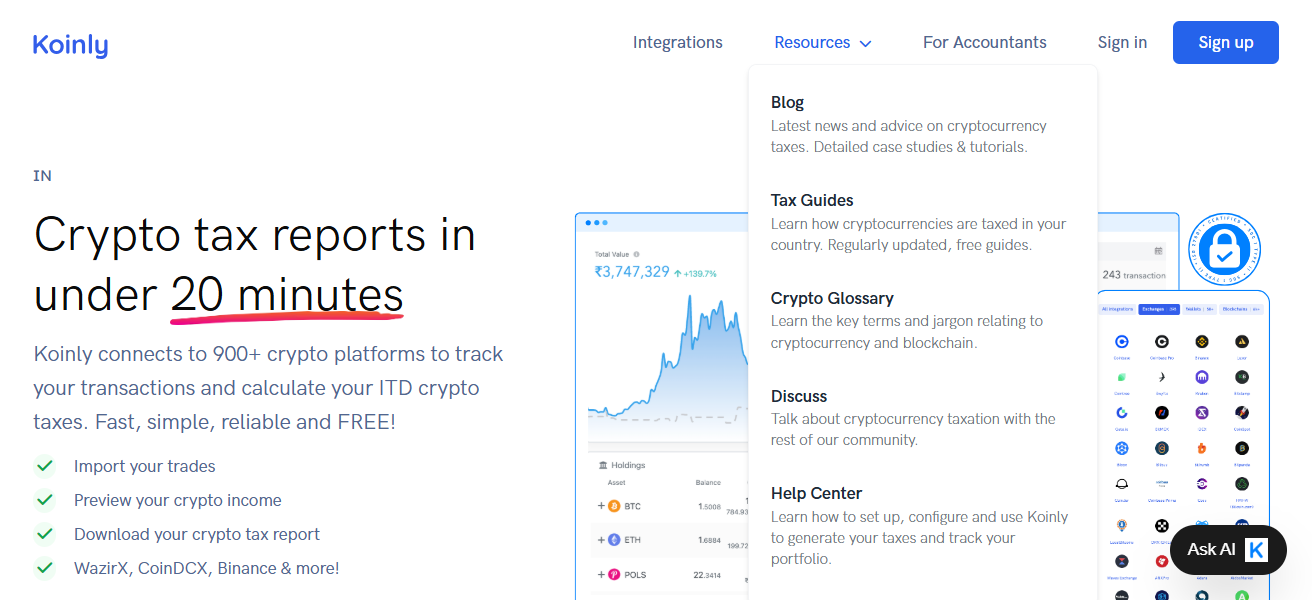
It streamlines users’ internal transfers while recognizing and categorizing income from staking and DeFi, and identifies potential error that may alter misleadingly portfolio and tax reports.
Users can save time from manual data and report audits for tax filing to Koinly’s correct data services and records.
Koinly Features
AI-Based Transaction Classification – Categorization of trades, income, transfers, and rewards utilizes artificial intelligence.
Duplicate & Missing Entry Detection – Detects unrecorded movements and duplicate entries that can impact portfolio approximations.
Internal Transfer Matching – Automatically counts transfers between wallets so that you do not double count possessions.
Unified Portfolio Syncing – Integrates and consolidates data from different wallets, chains, and exchanges.
| Pros | Cons |
|---|---|
| AI-powered transaction classification and error detection. | Some advanced features require paid plans. |
| Automatically matches transfers across wallets and exchanges. | May misclassify complex DeFi transactions occasionally. |
| Detects duplicates and missing cost basis entries for accurate reporting. | Customer support response time can vary. |
| Provides audit-friendly datasets, reducing manual work. | Less enterprise-grade; more suited for individuals or SMEs. |
6. Lukka
Lukka provides institutional-level support in crypto accounting and audit assistance, centered on reliability and compliance.
Its system takes in complicated transaction data and utilizes memory of elaborate transactional reconciliation processes to yield verifiable results with audit support.

Specifically, Lukka’s system prepares reports in accordance with international financial reporting standards and is built to support high transaction volume, cross-entity portfolios.
Furthermore, Lukka’s system provides the wallet-level traceability and audit logs to help enterprises with regulatory compliance concerns identify and resolve discrepancies in their financial records.
Lukka Features
Enterprise-Grade Data Ingestion – Processes heavy data loads, and to support complex portfolios.
Detailed Asset Traceability – Provides comprehensive auditing and compliance tracking, at the wallet level.
Structured Reconciliation Logic – Uses rules-based structures to harmonize blockchain and accounting records.
Standard Reporting Frameworks – Enhances compliance through the mitigation of reporting errors and the integration of standard frameworks for regulatory and financial reporting.
| Pros | Cons |
|---|---|
| Institutional-level accounting and reconciliation. | Primarily targets large organizations; may be overkill for small investors. |
| Produces verifiable results with granular wallet-level traceability. | Implementation requires dedicated resources. |
| Supports global accounting standards and high-volume portfolios. | Limited focus on tax filing for individual users. |
| Reliable audit trails help maintain compliance in strict regulatory environments. | Cost may be prohibitive for smaller businesses. |
7. CoinTracking
CoinTracking has been around for a long time and aggregates crypto transactions across multiple exchanges, wallets, and blockchains, presenting everything in a single dashboard.
It auto-imports your trade history and creates customizable reports, including tax reports and reports based on realized/unrealized gains and losses.
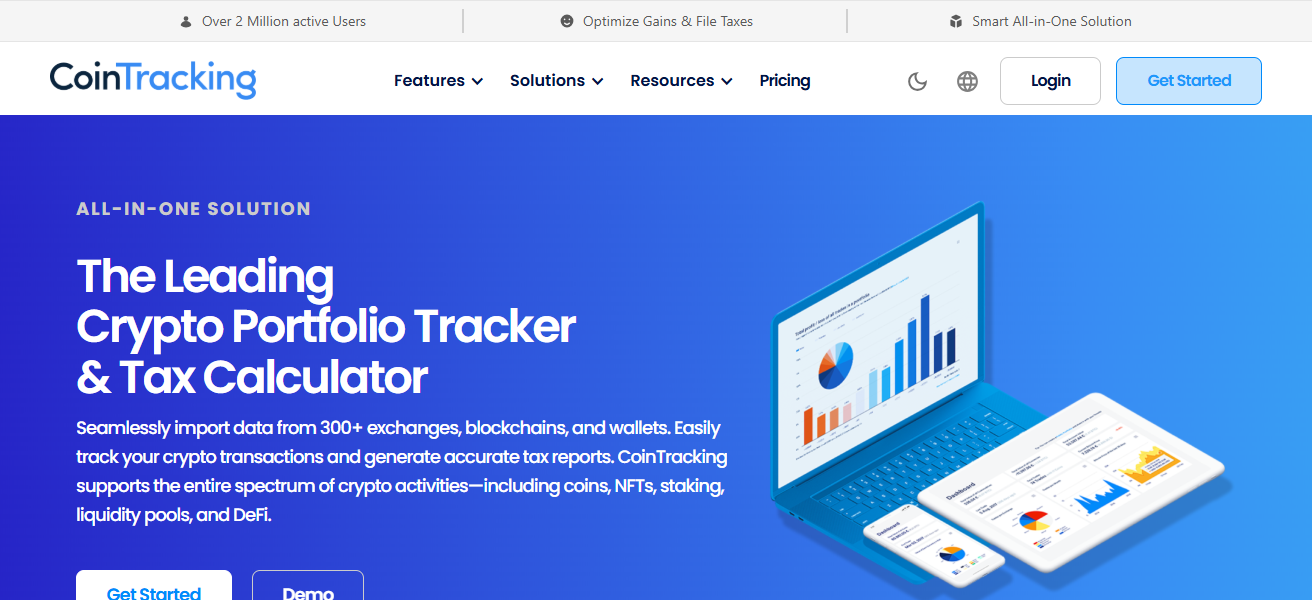
CoinTracking automates the tax filing classification and reporting documents. This could help missing transfers or mismatched transactions to be found, which could affect your portfolio or tax outcomes.
Users can adjust and edit their accounts to avoid problems related to compliance or audits, as CoinTracking provides the reporting functionality to perform thorough breakdowns and advanced analytics.
CoinTracking Features
Wide Exchange & Wallet Support – Imports data from thousands of wallets and exchanges.
Trade Classification Automation – Trades, purchases, sales, and incomes are classified and separated to ensure proper reporting.
Mismatch Detection Tools – Identifies problems regarding missing transfers and unlinked wallets.
Customizable Reports – Users are allowed to customize reports to increase focus on particular taxing areas, lost capital, gained capital, or errors.
| Pros | Cons |
|---|---|
| Aggregates data from hundreds of exchanges and wallets automatically. | Interface can be overwhelming for beginners. |
| Generates customizable reports highlighting gains, losses, and taxes. | Free version is limited; advanced analytics require subscription. |
| Detects missing transfers or mismatched entries. | DeFi support is improving but may not cover all chains. |
| Long-standing, widely used platform with extensive features. | Reporting for complex portfolios can be tedious to set up. |
8. Powerdrill Bloom
Powerdrill Bloom is not your standard tax or accounting software but rather AI-powered crypto analytics software that identifies patterns, opportunities, trends, and problems with investors’ portfolios.
Bloom utilizes machine intelligence and combines analytics of market signals, on-chain data, and portfolio activities to provide real-time insights and alerts on risks.

Although NOT built primarily for auditing, AI predictive analytics and risk management recommendations
Enables users to examine and evaluate portfolios to discover the existence of unusual performance metrics, irregular patterns, and suspicious metrics that may indicate data issues or incorrect reports.
Powerdrill Bloom Features
AI-Driven Pattern Recognition – Studies the patterns involved in the movement of stakes made by clientele, to recognize trends and deviations from the norm which may reveal data problems.
Real-Time Alerts – Provides alerts when data – for example, key parameters – differ from previous records in real time.
Risk & Performance Scoring – Identifies deviations from the norm (volatility) of a portfolio to provide control over the performance, and to avert data problems.
Integrated Data Views: Merges on-chain indicators with pricing and activity data to aid in error spotting.
| Pros | Cons |
|---|---|
| AI-driven insights help detect unusual patterns or risk signals. | Not designed specifically for audit or tax compliance. |
| Provides real-time portfolio monitoring and trend analysis. | Lacks full accounting or reporting functionalities. |
| Synthesizes on-chain data for smarter investment decisions. | May require manual reconciliation for precise error detection. |
| Alerts users to suspicious metrics or irregular performance. | Geared toward investors, not accountants or regulators. |
9. Zapper
Zapper is a portfolio tracking and visualization tool within Web3 that shows users their DeFi positions, tokens, and NFTs by accessing on-chain data.
Zapper is not an audit or tax compliance tool, but Zapper shows users on-chain discrepancies in wallets and discrepancies within the real-time activity across networks.

Zapper’s on-chain tracking provides investors the ability to find transactions, movements, or positions that are missed or not accounted for to assist in manual reconciliation or to aid in deep investigations.
Zapper Features
On-Chain Aggregation Dashboard: Aggregates DeFi positions, tokens, and NFTs to identify visualized movements that may be overlooked.
Real-Time Wallet Syncing: Merges account balances across all networks to eliminate staleness and gaps in data.
Discrepancy Identification: Assists users in assessing missing transactions and unexpected changes in their assets.
Interactive Visual Tools: Error spotting is simplified due to user-friendly charts and precise visualizations.
| Pros | Cons |
|---|---|
| Aggregates DeFi positions, tokens, and NFTs in one dashboard. | Not a full accounting or tax reporting solution. |
| Detects discrepancies between wallets and on-chain activity. | Manual reconciliation still required for audit purposes. |
| Real-time portfolio visualization improves oversight. | Focused mainly on Ethereum-based assets; other chains may have limited coverage. |
| Helps spot missing transactions or unexpected movements. | Limited support for historical reporting or official compliance. |
10. ChatFin
“ChatFin” seems to be an AI assistant focused on finance and acts like an AI agent. It interprets crypto portfolios and answers queries related to transactions, performance, and mistakes.
Although no specific documentation was found, class tools of this type use natural language and AI to analyze queries of their users’ portfolios, identify inconsistencies and explain them in a straightforward manner.

ChatFin-like tools permit users to easily identify mistakes: “why did my portfolio value change?” or “which transactions look inconsistent?”
Instead of sifting through the data manually, users can easily conduct audits on their portfolios. (General description based on typical AI chat finance tools.)
ChatFin (Assumed) Features
AI Conversational Interface: Users can ask questions in natural language, e.g., “why is this balance off?” and get feedback.
Quick Anomaly Summaries: Offers simplified explanations for inconsistencies and questionable data entries.
Data Interpretation Assistance: Offers instructions on how to analyze raw transaction records.
Portfolio Querying Tools: Search instructions (e.g., “find all classified gains”) can be executed without using spreadsheets.
| Pros | Cons |
|---|---|
| AI-powered chat interface makes portfolio insights easy to query. | Specific product details and capabilities are not publicly documented. |
| Highlights mismatches, anomalies, and unexpected holdings. | May not replace traditional auditing software for compliance purposes. |
| Simplifies error detection without manual searches. | Reliant on quality of integrated portfolio data. |
| Intuitive for investors who prefer conversational interfaces. | Not ideal for enterprise-level reconciliation or regulatory reporting. |
Conclsuion
Lastly, AI tools that automatically audit your crypto portfolios for errors are important for safe, precise, and clear management of crypto assets.
The tools are able to identify errors, balance your books, and create reports for auditing which are beneficial for compliance and reducing errors.
These tools give assurance to businesses and investors to confidently manage complex portfolios, help with the reporting process, and help them remain compliant in the fast-evolving world of crypto.
FAQ
AI tools that automatically track, analyze, and reconcile crypto transactions to detect errors and anomalies.
They reduce manual mistakes, save time, and provide accurate, audit-ready reports.
Yes, AI tools flag unrecorded, duplicate, or misclassified transactions.
Most support numerous wallets, exchanges, and blockchain networks.