
This article will cover AI tools that help users save on time for doing market analyses. The fast development of artificial intelligence enables businesses to pinpoint insights, monitor competitors, and analyze industry trends with great rapidity.
- Key Points & AI Tools That Reduce Time Spent on Market Analysis
- 10 AI Tools That Reduce Time Spent on Market Analysis
- 1. Crimson Hexagon
- 2. Tableau
- 3. Clearbit
- 4. AlphaSense
- 5. Crayon
- 6. Owler
- 7. GrowthBar
- 8. MonkeyLearn
- 9. Brandwatch
- 10. Zyte
- How To Choose AI Tools That Reduce Time Spent on Market Analysis?
- Conclusion
- FAQ
Automation of data collection, pattern recognition, and decision-making simplification are the hallmarks of these tools. With these tools, businesses save on hours of research whilst remainining competitive.
Key Points & AI Tools That Reduce Time Spent on Market Analysis
Crimson Hexagon – Analyzes social media trends rapidly, delivering real-time consumer sentiment and behavior insights efficiently.
Tableau – Uses AI to visualize market data quickly, highlighting patterns and trends for faster decisions.
Clearbit – Provides enriched company and market data instantly, streamlining competitor analysis and lead generation efforts.
AlphaSense – Scans global financial documents, delivering key insights and trends in seconds, saving hours manually.
Crayon – Tracks competitors’ digital activity automatically, providing actionable insights without manually monitoring websites or campaigns.
Owler – Offers AI-driven company profiles, competitor alerts, and market updates for faster strategic analysis.
GrowthBar – Generates competitive keyword insights and market trends rapidly, cutting down SEO research time significantly.
MonkeyLearn – Analyzes customer reviews and survey data automatically, revealing market insights and sentiment trends efficiently.
Brandwatch – Monitors social mentions and brand trends continuously, converting raw data into actionable market intelligence.
Zyte – Extracts competitor pricing, product, and market data automatically, saving hours of manual data collection.
10 AI Tools That Reduce Time Spent on Market Analysis
1. Crimson Hexagon
Crimson Hexagon was an AI platform that analyzed social media and customer insights. It assisted analysts in discovering patterns, sentiment, and brand perception quicker than the traditional method.
It distinguished itself by processing billions of public social media interactions and visualizing trends in marketplaces close to real-time, decreasing hours of manual analysis to minutes.
Users often compared it to social listening tools to the depth of historical data and analytical detail.
Even though it has been discontinued, Crimson Hexagon was one of the first to set the speed and volume benchmarks for early social competitive analytics, giving teams the ability to identify changes before their rivals acted.
Crimson Hexagon Features
- Identifies and analyzes trends and sentiment on billions of social media posts in real time.
- Shows consumers behavior and brand perception on all platforms.
- Gives data for long term market shifts.
- Gives more insights faster than other social media analysis.
| Pros | Cons |
|---|---|
| Processes billions of social media interactions in near real-time. | Platform is now discontinued; replaced by newer solutions. |
| Provides deep historical data for trend analysis. | Can be expensive for small teams. |
| Visualizes consumer sentiment and brand perception effectively. | Less flexible for internal company data integration compared to Tableau. |
| Speeds up analysis that previously took hours manually. | Focused mainly on social media; limited financial data insights. |
2. Tableau
Tableau is a top business intelligence and visual analytics platform that helps users create interactive dashboards from raw data in minutes.
Unlike simple spreadsheet tools, Tableau employs AI-assisted features like Explain Data and smart recommendations to detect and explain patterns, anomalies, and trends, providing users with a coding-free experience.
Tableau’s visual storytelling capabilities are unique in the industry. Analysts can filter underperforming segments in multiple datasets, compare them, and immediately share insights with decision-makers.
While other specialized market research solutions struggle to integrate internal data, Tableau’s ability to merge internal company data with external market data results in a superior analytical view and helps users make decisions faster and with better accuracy.
Tableau Features
- Provides interactive dashboards and visualizations from data sets.
- Features Explain Data which is AI-assisted to provide insights on patterns.
- Easily integrates new data and existing data from different sources.
- Dashboards are shareable for collaborative decision-making.
| Pros | Cons |
|---|---|
| Converts raw data into interactive dashboards in minutes. | Requires some technical knowledge for advanced customization. |
| AI-assisted features uncover patterns automatically. | Not specialized for competitive intelligence like Crayon or Owler. |
| Integrates internal and external datasets effectively. | Data prep can still be time-consuming for unstructured data. |
| Excellent for visual storytelling and executive presentation. | May require extra connectors for social media or web data. |
3. Clearbit
Clearbit is an AI-driven solution for B2B data intelligence and enrichment. It appends over 100 firmographics and contact attributes to each lead in a CRM system, and improves data quality with no manual lookup or data entry.
With Clearbit, sales and marketing teams integrate firmographics, technographics, and intent data, which means analysts spend less time collecting data from various sources.
Clearbit uses real-time data enrichment to reduce customer profile verification and identify high value customer segments and buying patterns.
Unlike other market data services, Clearbit automates the creation of data context throughout the customer lifecycle, and simplifies the processes for launching targeted marketing campaigns.
Clearbit Features
- Enhances CRM records with new, firmographic, technographic data, and intent data.
- Provides lead and company insights in real time.
- Manual research is eliminated for marketing and sales teams.
- Identifies potential customers for targeted marketing.
| Pros | Cons |
|---|---|
| Real-time enrichment of CRM and lead data. | Mostly B2B focused; limited for consumer market analysis. |
| Provides rich firmographic, technographic, and intent signals. | Dependent on subscription tiers for full feature access. |
| Reduces manual data collection and verification. | Limited analytics visualization compared to Tableau. |
| Helps identify high-value segments quickly. | Primarily used for marketing and sales, not trend forecasting. |
4. AlphaSense
AlphaSense uses gen AI to search SEC filings, analyst reports, news, expert call transcripts, and 500 million+ other business documents
To streamline research workflows and accelerate developing research workflows to next-gen standards.
Rather than manually seeking and assimilating data, AlphaSense uses AI, synthesizing insights and highlighting major trends across industries.
Gen AI search and understand complex business questions providing summary answers and citations — streamlining research to a matter of minutes, research that previously took days. AlphaSense also allows rapid analysis improvement with its automated data depth compared to legacy systems.
AlphaSense Features
- Searches more than 500 million company documents, business reports and filings.
- Actionable insights are provided by AI in a simpler form for complex questions.
- Research workflows are expedited from several days to a few minutes.
- Emerging trends and risks in the market are highlighted.
| Pros | Cons |
|---|---|
| Aggregates 500M+ business documents instantly. | Enterprise pricing may be high for small companies. |
| Uses AI and GenAI search to summarize insights. | Focuses mainly on financial and regulatory documents. |
| Speeds up workflows that previously took days. | Not optimized for social media sentiment or customer reviews. |
| Provides actionable insights with full citations. | Requires training to use advanced search effectively. |
5. Crayon
Crayon is a competitive intelligence tool that streamlines the manual research process by continuously tracking millions of online sources, such as websites, social media, changes in pricing pages, and changes in products, to track competitor movements.
For example, “battlecards” use AI to summarize the competitive moves, shifts in messaging, or changes pricing that would take hours of research to summarize.
While basic analytics dashboards focus on facilitating decision-making within a company, Crayon helps teams identify opportunities and threatsby providing benchmark analyses of competitors.
Its automated data monitoring frees analysts from conducting data collection in order to increase actionable insight from data.
Crayon Features
- AI battlecards are provided to make informed decisions strategically.
- Monitors competitors in real time for: websites, products, and digital campaigns.
- Changes in pricing, messaging, and products are tracked in real time.
- Provides insights for decision-making by comparing competitors.
| Pros | Cons |
|---|---|
| Continuously monitors competitor websites, pricing, and messaging. | Primarily competitor-focused; less useful for internal analytics. |
| Generates AI-driven battlecards automatically. | Can be overwhelming with too many alerts for large markets. |
| Helps spot opportunities and threats in real-time. | Integration with other BI tools may require configuration. |
| Reduces manual monitoring hours significantly. | Limited sentiment analysis compared to Brandwatch. |
6. Owler
Owler provides company profiles and crowdsourced competitive intelligence and company profiles, giving brief, easy-to-understand summaries of funding, leadership, acquisitions, and news changes.
Owler streamlines competitor tracking by summarizing millions of user submissions and curated sources, eliminating the need for manual research and newsletters.
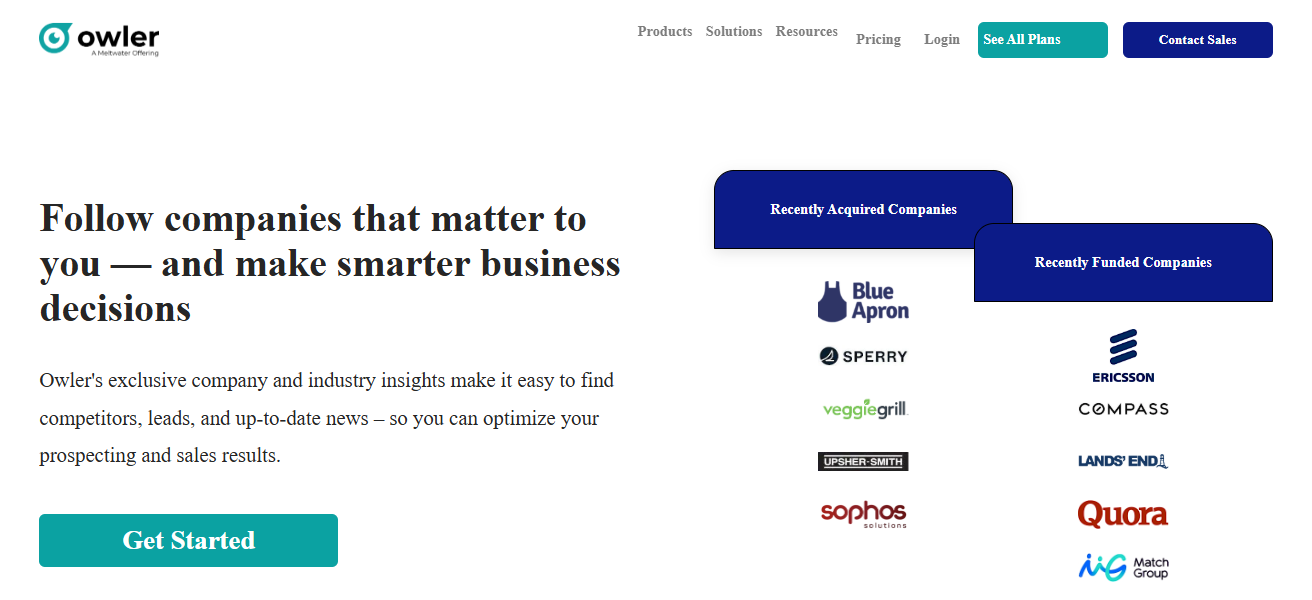
The Competitive Graph and real-time alerts enhance industry changes that would normally require multiple news and analytics searches.
In contrast to enterprise intelligence suites, Owler emphasizes speed and accessibility for small teams and startups, making early competitive signals easier to identify.
Owler Features
- Offers company profiles and competitor insights gained from the public.
- Notifies users on acquisitions, leadership alterations, and funding activities.
- Uses Competitive Graphs to depict industry connections.
- Provides a snapshot view for small teams and startups.
| Pros | Cons |
|---|---|
| Crowdsourced competitive intelligence with frequent updates. | Less granular than enterprise intelligence suites. |
| Delivers digestible summaries of funding, leadership, and acquisitions. | Reliance on user contributions may introduce bias or gaps. |
| Provides real-time alerts and visual Competitive Graphs. | Limited AI analysis compared to AlphaSense or Brandwatch. |
| Accessible for small teams and startups. | Not as robust for large-scale financial datasets. |
7. GrowthBar
GrowthBar is an AI-powered SEO tool that integrates natural language generation with SEO analytics in order to simplify keyword research, competition research, and content planning.
Though the product is mainly utilized for content strategy, its keyword demand, search trends, and domain authority metrics provide a quick glance at the topics that the audience would engage with.
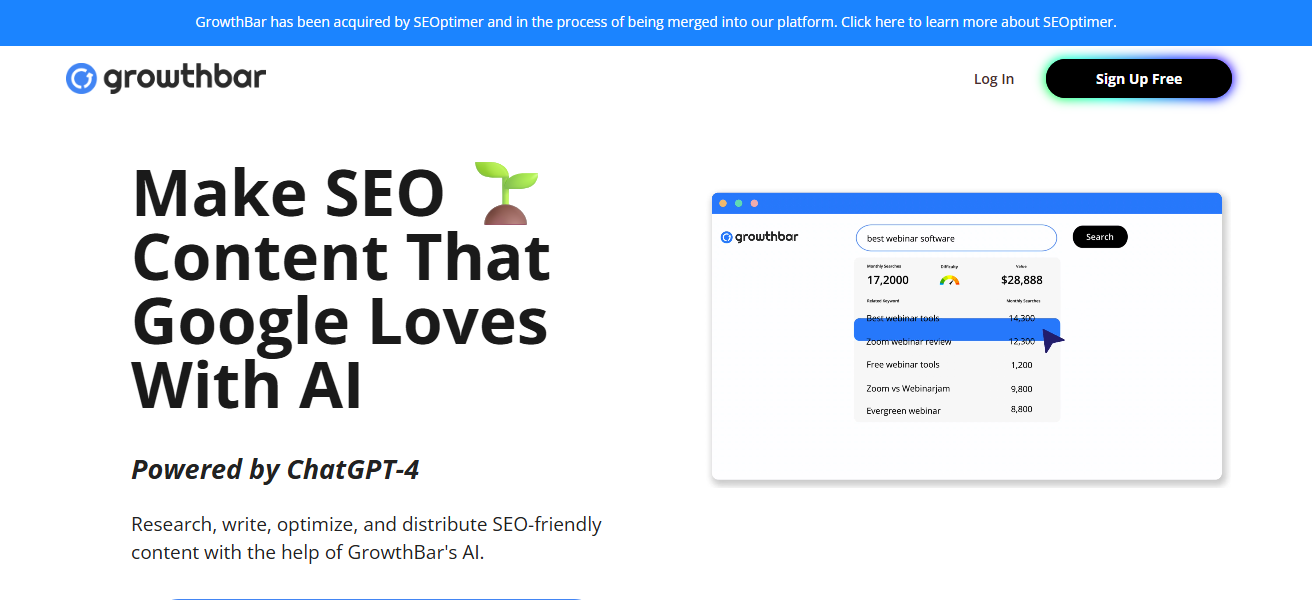
Traditional market research tools require users to upload data for analysis, whereas GrowthBar AI instantly provides users with a list of long-tail keywords, content suggestions, and competitor gaps.
This SEO and AI combination is especially useful for teams who are focusing on organic growth, as it streamlines the work that would otherwise be done on disparate analytics tools.
GrowthBar Features
- Provides top converting keywords, and content ideas via AI.
- Offers competitive analysis by merging SEO insights and market data.
- Simplifies content research and competitor assessments.
- Saves time on manual keyword and topic discovery.
| Pros | Cons |
|---|---|
| AI-driven SEO and content research automation. | Focused on online content; limited broader market analysis. |
| Suggests keywords, content ideas, and competitor insights instantly. | Lacks deep financial or social media analytics. |
| Reduces hours of manual SEO and market research. | Smaller dataset coverage compared to Clearbit or AlphaSense. |
| Combines trend analysis with organic growth metrics. | Not suitable for enterprise-level BI reporting. |
8. MonkeyLearn
MonkeyLearn is a machine learning based tool for text analyses. Some of its feats include sentiment analysis, keyword extraction, and taxonomy modeling.
Analysts are aided by ML in automating the analysis of big, unstructured text data, such as reviews, survey responses, or social media comments, which could take days to tag someone manually.
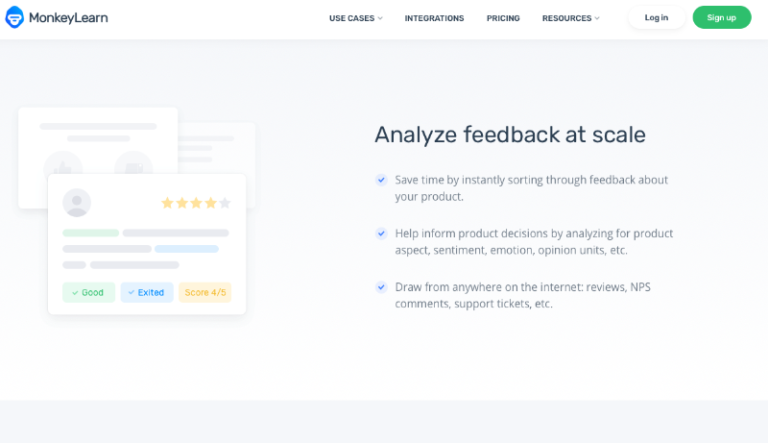
With the use of customized classifiers, teams can identify recurring patterns and sentiment trends in large data sets, which accelerates trend spotting and customer feedback analysis.
Compared to standard manual coding or spreadsheet categorization, the automation provided by MonkeyLearn saves an enormous amount of time.
MonkeyLearn Features
- Automate processes for text classification, sentiment detection, and keyword identification.
- Can quickly handle and process large amounts of unstructured data.
- Identifies patterns and trends found in reviews, surveys, and social media.
- Enables the creation of unique machine learning models for advanced text analytics.
| Pros | Cons |
|---|---|
| Automates text analysis, sentiment classification, and keyword extraction. | Less effective for real-time market trend monitoring. |
| Reduces manual processing of unstructured data. | Requires setup of custom classifiers for best results. |
| Detects patterns and trends quickly across large datasets. | Limited visualization capabilities compared to Tableau. |
| Speeds up customer feedback and review analysis. | Focused on text data; not ideal for financial or pricing analysis. |
9. Brandwatch
Brandwatch uses Artificial Intelligence to analyze social media mentions and extract insights using natural language processing to identify changes in sentiment, emerging trends, and audience profiles on various social media platforms and social media forums.
Brandwatch makes predictions about the life cycle and momentum of trends, helping marketers and strategists know where to focus their efforts before their competitors.
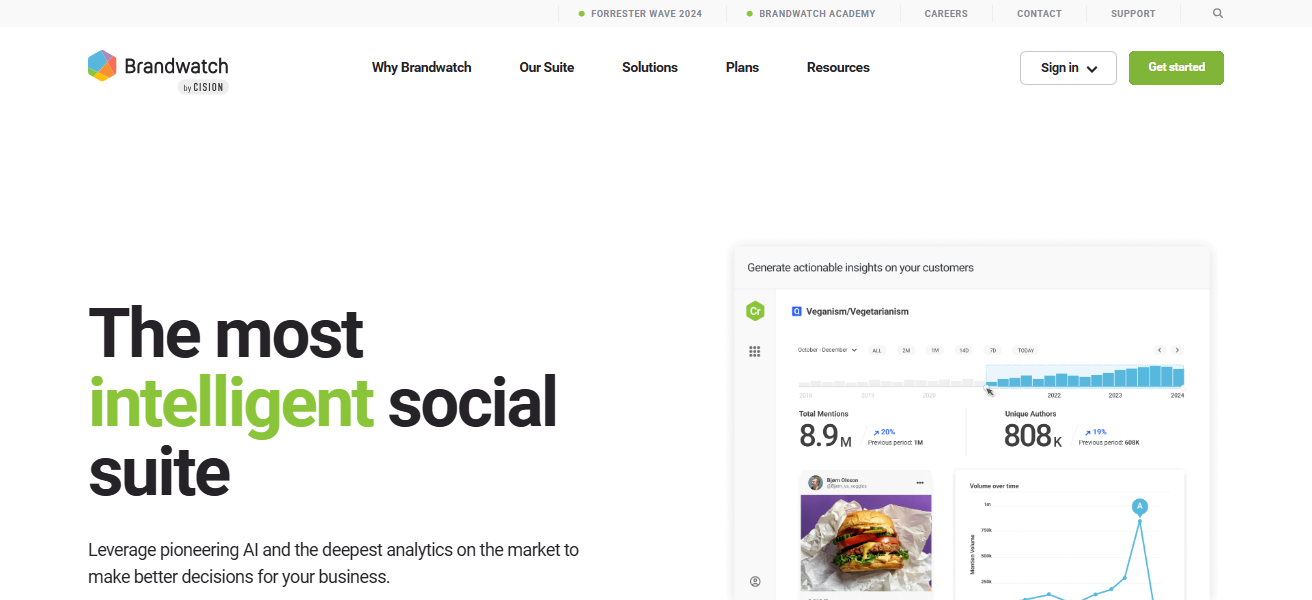
Brandwatch’s predictive modeling assists teams in understanding the reasons for the changes in the data and helps them to provide the data in the context of the consumer’s behavioral changes in real time.
This minimizes the amount of manual data analysis, and provides data to the decision-makers in a more detailed format, and in a more rapid format, also.
Brandwatch Features
- Analyzes and provides reports on social media trends, sentiment, and engagement.
- Uses NLP to understand audience behavior and forecast trends.
- Provides insights into competitors and brand mentions in real time.
- Offers social insights dashboards and campaign planning.
| Pros | Cons |
|---|---|
| Predicts social trends and sentiment shifts using NLP. | Can be expensive for smaller organizations. |
| Provides insights into audience demographics and engagement. | Mainly focused on social media; less useful for internal data. |
| Helps decide where to invest attention before competitors. | Data can be overwhelming without proper filters. |
| Reduces manual interpretation and delivers actionable insights. | Less suitable for financial or product data analysis. |
10. Zyte
Zyte utilizes AI and browser automation to convert web pages into structured datasets. Instead of having to collect market data from hundreds of websites manually
Analysts can use the Zyte APIs to automate collection of data, from pricing data and inventory data to news articles and customer reviews.
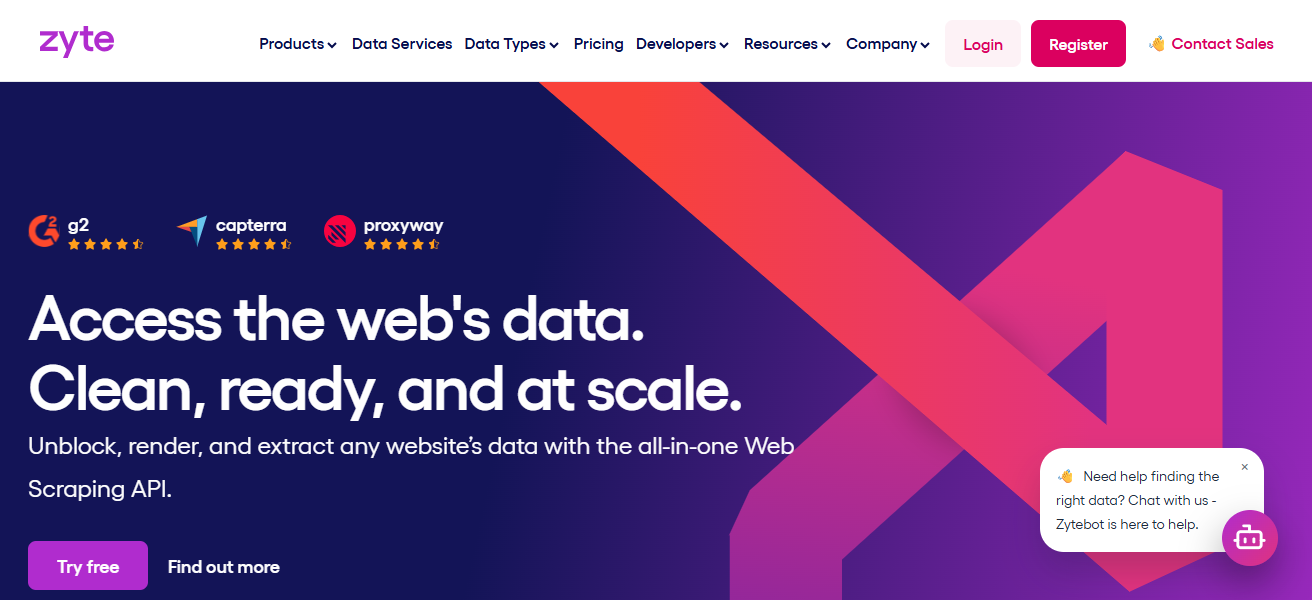
This process streamlines the data collection process and enables quick testing and modeling. Zyte’s scraping tools simplify data collection from complex websites
Sites that use headless rendering, and sites that use anti-bot mechanisms, providing efficient data collection at large scales without the need for custom engineering.
Zyte Features
- Streamlines the process of web data extraction from complex websites, including competitor analysis.
- Offers structured sets for competitor pricing, products, and news.
- Offers automated solutions for bot detection and headless browsing.
- Saves time on manual data collection for market research.
| Pros | Cons |
|---|---|
| Automates large-scale web data extraction efficiently. | Requires understanding of APIs and scraping rules. |
| Handles complex sites, headless rendering, and anti-bot protections. | Focused on raw data; lacks visualization and interpretation. |
| Reduces hours spent collecting competitor, pricing, and product data. | Needs integration with BI tools for analysis. |
| Provides structured datasets ready for modeling and insights. | Less suitable for real-time social sentiment compared to Brandwatch. |
How To Choose AI Tools That Reduce Time Spent on Market Analysis?
- Define Your Goal – Identify whether you need social listening, competitive intelligence, SEO insights, or text analysis.
- Data Coverage – Ensure the tool covers relevant sources: websites, social media, financial reports, or CRM data.
- Automation Level – Look for AI that automates data collection, enrichment, and analysis to save maximum time.
- Integration – Check if it integrates with existing tools like BI platforms, CRMs, or dashboards.
- Ease of Use – Prefer intuitive interfaces that require minimal technical expertise.
- Real-Time Insights – Tools that deliver updates quickly help you react faster than competitors.
- Scalability – Make sure the tool can handle growing datasets as your business expands.
- Cost vs Benefit – Compare subscription costs to time saved and decision-making efficiency.
Conclusion
To conclude, AI tools that accelerate market analysis enable businesses to collect insights more quickly, monitor rivals, and streamline data-driven decision-making.
These tools enhance precision, help organizations remain competitive in the marketplace, and automate research, trend analysis, and reporting. AI tools are vital for contemporary market analysis and competitive advantage.
FAQ
Software that automates data collection, competitor tracking, and trend insights.
Brandwatch and Crimson Hexagon are top choices.
Crayon and Owler provide real-time competitor insights.
Yes, MonkeyLearn and AlphaSense handle text and document analysis.