This article will cover the Best AI Agent Payment Protocols for secure, automated and efficient digital payments by AI agents.
We’ll dive deep into popular protocols such as ACP, AP2, x402, MPP, UCP, and ERC-8004, discussing their core features, benefits, and use cases to help you understand how these technologies are transforming automated payments.
Key Points & Best AI Agent Payment Protocols In
| Protocol | Explanation |
|---|---|
| ACP (Agentic Commerce Protocol) | Enables AI agents to discover products, manage checkout, and complete purchases seamlessly. |
| AP2 (Agent Payments Protocol) | Provides secure payment authorization, verifiable mandates, and accountability for AI-driven transactions. |
| x402 | Enables internet-native payments through HTTP 402 responses for automated agent transactions. |
| MPP | Supports machine-to-machine payments, enabling AI agents to pay for digital services automatically. |
| UCP | Standardizes commerce interactions, helping AI agents connect shoppers, merchants, and payment providers. |
| VIC | Supports verifiable identity and credentials, helping establish trust between autonomous AI agents. |
| MAP | Facilitates machine-agent payments through standardized communication and interoperable transaction workflows. |
| ERC-8004 | Establishes on-chain agent identity, reputation, and validation for trusted autonomous interactions. |
| AXTP | Aims to standardize agent transactions, enabling interoperable communication across AI-powered payment systems. |
| APP | Enables agent payment processing through defined workflows for secure, automated digital transactions. |
10 Best AI Agent Payment Protocols In 2026
1. ACP (Agentic Commerce Protocol)
ACP is an open standard co-created by OpenAI and Stripe. It enables checkout within the chat, allowing an agent to complete a purchase while the merchant remains the seller of record. Its Payment Method is mostly traditional rails: cards and wallets through Stripe, with a time-limited, single-use Shared Payment Token that has the buyer’s permission but doesn’t reveal the card details.

It is built for conversational shopping agents that browse, select and buy on behalf of a user, for AI Agent Support. Blockchain Support As a fiat-first protocol, rather than an on-chain protocol, blockchain support is limited.
Integration: Merchants implement a set of REST endpoints and webhooks. Teams already on Stripe have the easiest path. It’s good for retailers and companies that push sales through AI assistants.
ACP (Agentic Commerce Protocol) Feature
| Feature | Explanation |
|---|---|
| Automated Checkout | Enables AI agents to create carts and complete structured checkout workflows. |
| Secure Payment Credentials | Supports secure transfer of payment credentials through compatible payment providers. |
| Order Management | Helps coordinate checkout confirmation and order fulfillment with merchants. |
| Merchant Integration | Allows merchants to use existing backend systems and payment processors. |
2. AP2 (Agent Payments Protocol)
AP2 is an open, payment-agnostic protocol from Google, which focuses on trust and authorization. The core concept is “mandates,” which are cryptographically signed records (intent, cart, and payment mandates) that show what the user authorized, and provide an audit trail in the event of a dispute.
Its Payment Method is flexible and accepts cards, bank transfers and stablecoins, with crypto processed via its x402 extension. It is designed for AI Agent Support, built for agents operating with delegated authority, from real-time purchases to tasks the user pre-approves with limits.

Partial and optional blockchain support, mostly through the stablecoin extension. For Integration, it’s built to work with Google’s Agent2Agent (A2A) protocol and the Model Context Protocol (MCP), so it can slot into agent frameworks without replacing them.
AP2 (Agent Payments Protocol) Feature
| Feature | Explanation |
|---|---|
| Payment Authorization | Uses verifiable mandates to record permission for agent-led purchases. |
| Checkout Mandates | Records the items and purchase conditions authorized by the user. |
| Payment Verification | Links payment mandates and receipts to help verify transactions. |
| Flexible Payment Methods | Designed to support different payment instruments, including cards and digital currencies. |
3. x402
x402 Built by Coinbase, x402 resurrects the long-dormant HTTP 402 “Payment Required” status code to allow any API or web resource to charge per request. If an agent hits a paid endpoint, the server responds with 402 and payment instructions and the agent pays and retries.
Payment method is stablecoin micropayments, mostly USDC . AI Agent Support is one of the most developer-friendly options for machine-to-machine use, as agents can pay for data, APIs and compute with no accounts or API keys.
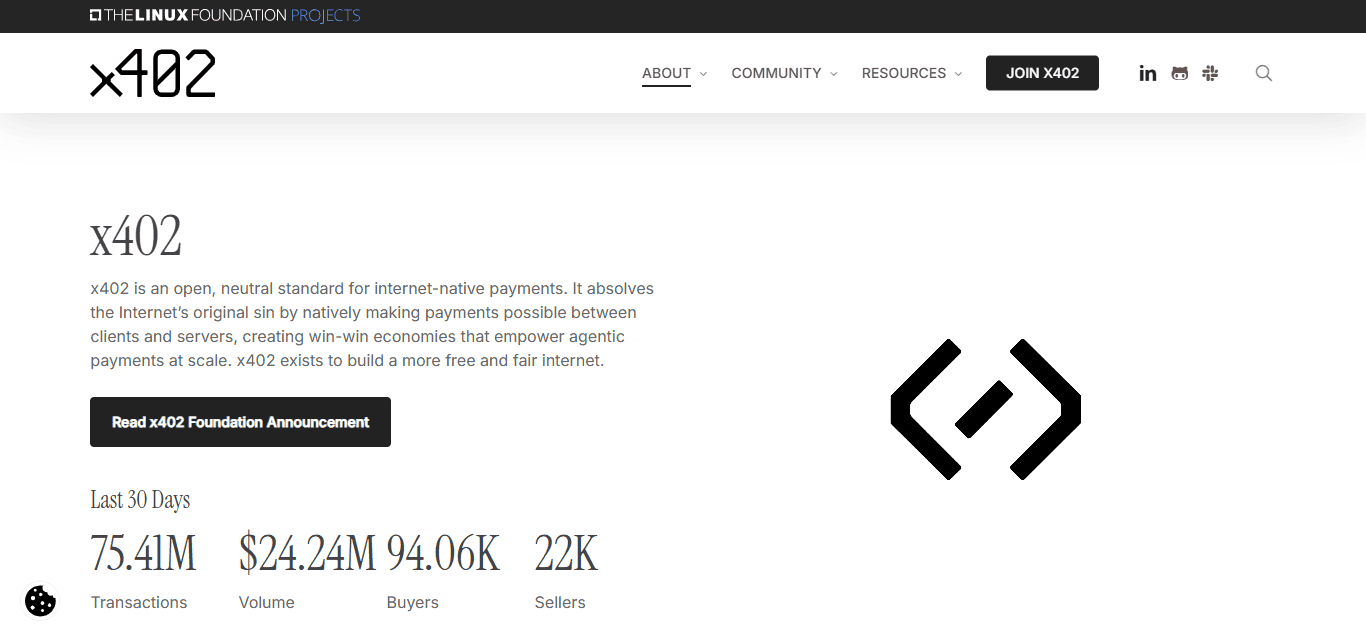
Its signature strength is Blockchain Support with settlement on networks like Base and Solana. Integration only needs a small middleware layer on the server and a client library on the agent. It has a growing ecosystem behind it. Best for pay-per-call APIs and micropayments.
x402 Feature
| Feature | Explanation |
|---|---|
| HTTP 402 Payments | Uses HTTP 402 Payment Required to request payment for digital resources. |
| Pay-per-Request | Enables automated payments for individual API calls and online services. |
| Cryptocurrency Support | Supports blockchain-based payments, including stablecoins on compatible networks. |
| Automated Settlement | Helps verify payment authorization and settle transactions through compatible infrastructure. |
4. MPP
MPP is a machine-payments standard that is linked to Stripe and the Tempo blockchain. The idea is to provide agents with a standard way to pay for services programmatically. Hybrid Payment Method: Unlike crypto-only options, it accepts card and debit payments, along with stablecoins and other crypto.

AI Agent Support is for agents who need to make many small or streaming payments, e.g. sessions in which many charges are made over a single connection. Blockchain support is via Tempo and other supported chains, with fiat as an alternative. It’s built on Stripe’s payment infrastructure and developer tools for Integration, so existing Stripe users can take it with relatively little friction.
MPP (Machine Payments Protocol) Feature
| Feature | Explanation |
|---|---|
| Machine-to-Machine Payments | Enables software agents to pay for digital services programmatically. |
| HTTP Payment Flow | Uses payment challenges to communicate the requirements for accessing paid resources. |
| Metered Payments | Supports session-based payments for usage-based services on compatible payment rails. |
| Multiple Payment Rails | Designed to accommodate different payment methods through compatible payment integrations. |
5. UCP
UCP is Google’s open standard for the entire commerce journey for AI agents: discovery, search, checkout and fulfillment. It was built with major retailers and commerce platforms. It is designed to work with a number of payment providers and pairs with AP2 for payment trust and authorizations, so it supports a wide range of Payment Methods.
AI Agent Support It enables agents that assist with shopping, such as Google’s AI surfaces, to interact with merchants in a standard way. AP2 doesn’t focus on Blockchain Support, but can include stablecoin options.
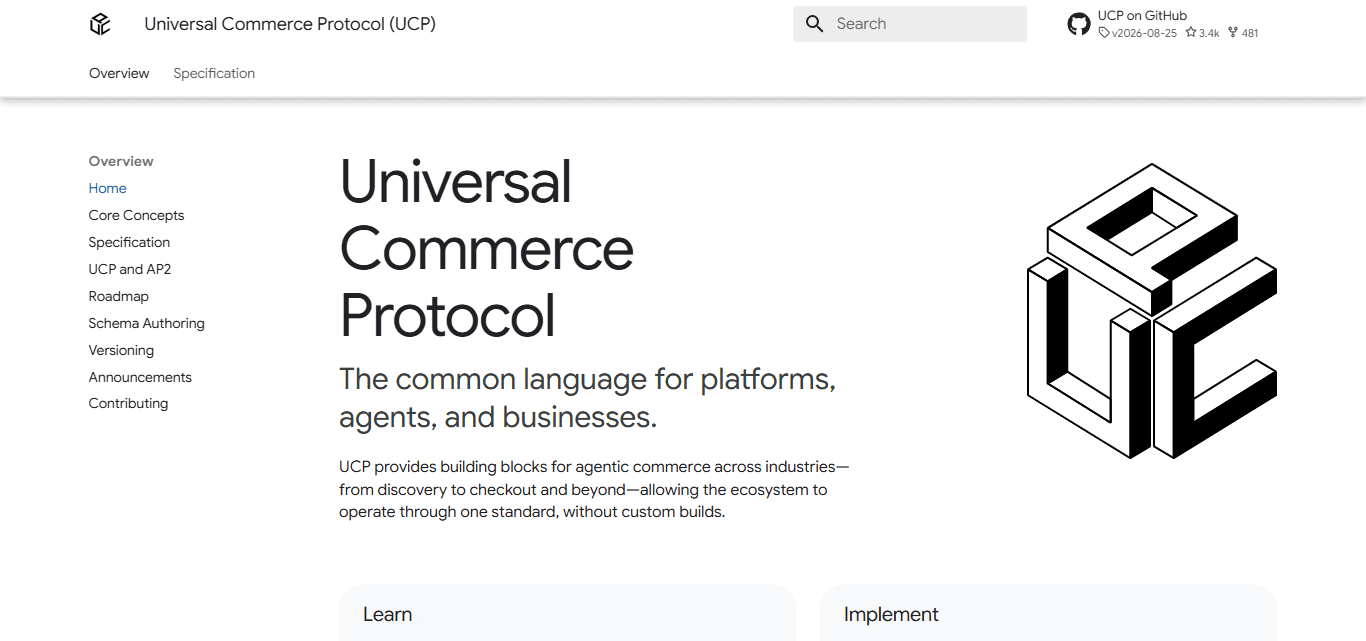
For Integration, merchants publish capabilities in a common format. UCP is designed to co-exist with A2A and MCP. This is good for retailers who want to be discoverable and buyable by AI shopping agents.
UCP (Universal Commerce Protocol) Feature
| Feature | Explanation |
|---|---|
| Commerce Standardization | Defines common ways for agents and businesses to interact during purchases. |
| Checkout Management | Supports structured checkout sessions and purchase updates. |
| Order Management | Provides standardized interactions for managing orders and their status. |
| Payment Integration | Supports payment-handler integrations and can work alongside AP2 authorization mandates. |
6. VIC
VIC is Visa’s platform for agent-initiated purchases on the existing card network. Its Payment Method is tokenized Visa credentials, so the agent never sees the actual card number, and spending controls, limits and consent are associated with the token. It gives agents authenticated, permissioned payment ability for AI Agent Support, and Visa paired it with trusted-agent verification so merchants can tell legitimate agents from bots.

Blockchain Support Not Core VIC operates on Visa’s existing rails, but Visa is investigating stablecoin settlement elsewhere. The integration is handled through Visa’s network, issuers, acquirers and partner platforms, meaning merchants and banks can plug it in without having to rewire their payment stack. It is good for enterprises which needs card grade security and dispute handling.
VIC Feature
| Feature | Explanation |
|---|---|
| Protocol Identification | Confirm the official full name before describing its capabilities. |
| Payment Authorization | Include only authorization features documented by its developers. |
| Agent Compatibility | Verify which AI agents and payment systems it supports. |
| Transaction Security | Check its official documentation for authentication and verification mechanisms. |
7. MAP
MAP (Mastercard Agent Pay) brings agent-driven payments to the Mastercard network. It pays using “agentic tokens”, tokenized credentials that are bound to a specific agent and user, encoding rules for spending and revocable, just as tokenization already secures card payments.
For AI Agent Support, it’s about registering and verifying Agents so Merchants and Issuers can trust an Agent has real user authority. Support for blockchain is limited, as it is mostly running on the legacy card infrastructure.

For Integration, Mastercard partners with issuers, acquirers and AI platforms so that existing merchant bases can accept agent payments with minimal disruption. Note that “MAP” is sometimes used for other things so be sure to check the context when you see it.
MAP Feature
| Feature | Explanation |
|---|---|
| Protocol Identification | Verify the project’s full name and official specification first. |
| Payment Processing | Describe supported transaction workflows only when officially documented. |
| System Integration | Confirm compatibility with wallets, merchants, or payment providers. |
| Interoperability | Identify supported standards and networks from reliable project documentation. |
8. ERC-8004
ERC-8004 is an Ethereum standard for trust in AI agents. It is not a payment protocol in itself, but a trust layer that makes payments between unknown agents safer. It creates on-chain registries for agent identity, reputation and validation so one agent can check another’s track record before dealing with it.
Payment Method is payment agnostic, and typically paired with crypto payment protocols like x402. For AI Agent Support, it provides agents with portable, verifiable identities and feedback histories. Native Blockchain Support.
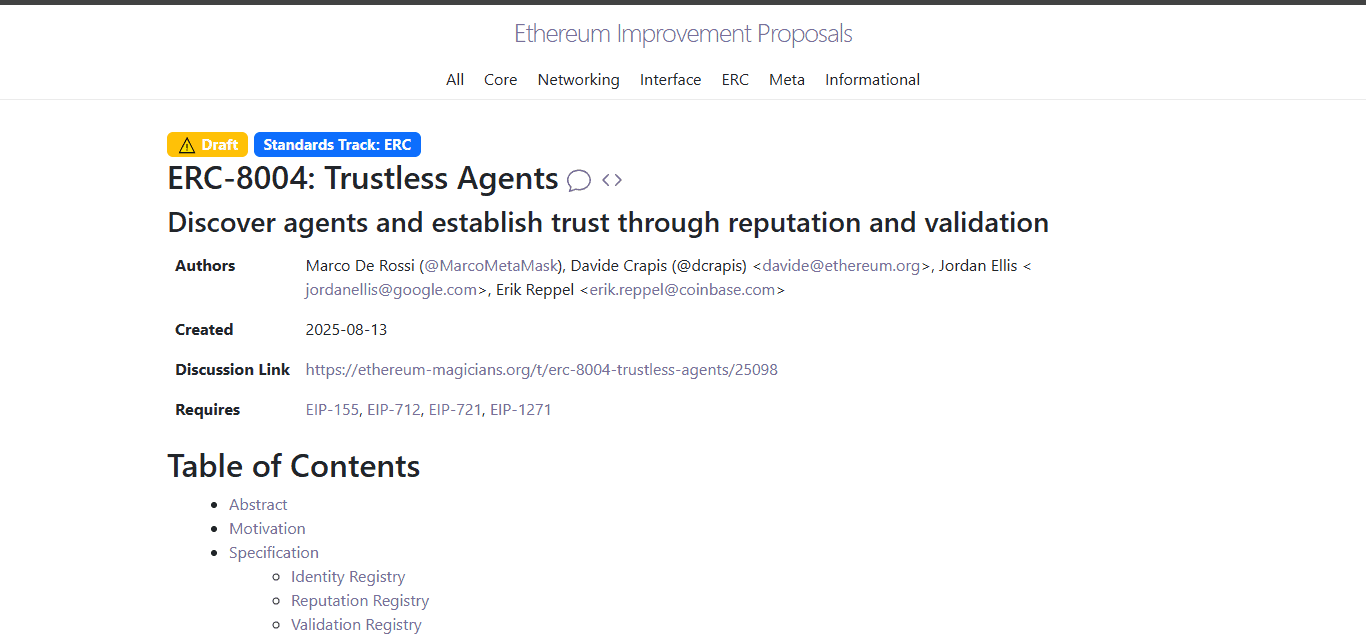
Blockchain Support is an Ethereum standard, native to EVM-compatible blockchains. For Integration, developers register agents in the on-chain registries , and read from other agents or services . This works best for open agent marketplaces, where participants are unknown to each other.
ERC-8004 (Trustless Agents) Feature
| Feature | Explanation |
|---|---|
| On-Chain Identity | Provides blockchain-based identifiers for discovering and identifying AI agents. |
| Reputation Registry | Enables users and systems to publish and retrieve agent feedback. |
| Validation Registry | Supports recording independent checks of agent behavior or task execution. |
| Cross-Organization Trust | Helps agents interact across organizational boundaries without requiring pre-existing trust. |
9. AXTP
AXTP has the least standardized name on this list so handle with care. One directory calls it the Agent Experience Transfer Protocol, an open protocol that allows AI agents to share structured learnings to learn over time, with some agentic payment flows.
The name is easily confused with similar projects like ATXP (Agent Transaction Protocol), and AGTP that have different goals. Its Payment Method is not well documented yet, and seems to focus more on coordination and value exchange between agents than a fixed rail. AI Agent Support – For developers building autonomous agents that share knowledge and transact.
Blockchain Support Unknown, not confirmed as a core feature. It is described as sitting above existing agent communication and orchestration protocols for Integration. Check with the real project and spec before relying on this.
AXTP (Agent Experience Transfer Protocol) Feature
| Feature | Explanation |
|---|---|
| Experience Sharing | Enables AI agents to share structured information about previous experiences. |
| Knowledge Retrieval | Allows agents to retrieve relevant shared experiences before executing tasks. |
| Structured Data | Defines formats and operations for exchanging agent experiences. |
| Governance and Trust | Provides mechanisms intended to support controlled and trustworthy experience sharing. |
10. APP
APP is not a single product. More likely to be used as a generic tag for the category. One industry guide says agent payment protocols are API-driven ways for AI agents to send, receive and authorize payments without needing constant human intervention.
Some individual projects may use the acronym for their own names, so check which is meant. The Payment Method will depend on the protocol, which can be cards, bank transfers or stablecoins. AI Agent Support is meant to allow agents to trade under limits set by the user.

Blockchain Support ranges from fully on-chain (x402) to none (ACP and VIC). Most for Integration work with REST/JSON APIs, and more and more with MCP and A2A. If you saw “APP” in a specific source let me know which one and I can give an exact breakdown
APP Feature
| Feature | Explanation |
|---|---|
| Official Identification | Confirm the exact protocol name and developer before describing its features. |
| Payment Authorization | Include documented authorization capabilities if payment processing is supported. |
| Transaction Processing | Verify whether the protocol handles payments or connects to external payment systems. |
| Integration Support | Identify officially supported agents, payment providers, and technical standards. |
Conclusion
Overall, the Best AI Agent Payment Protocols are changing the way digital transactions are made by enabling safe, automated, and fast payments between AI agents, businesses, and users.
Protocols like ACP, AP2, x402, MPP, UCP, and ERC-8004 offer different roles for commerce, payment authorization, and agent trust. The correct protocol is determined by your needs, available payment methods, security functionality, and integration needs.
FAQ
What are AI agent payment protocols?
They enable AI agents to initiate, authorize, and process automated digital payments securely.
Which AI payment protocols are popular?
ACP, AP2, x402, MPP, UCP, and related standards support different payment workflows.
What is ACP?
ACP supports agent-driven commerce and structured checkout interactions.
Are these protocols secure?
Security depends on authorization, implementation, and payment-provider safeguards.