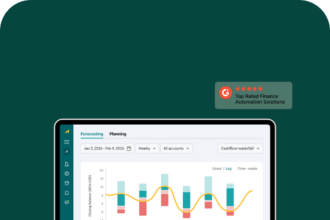
In the following sections, I will discuss the Best AI Tools for Financial Risk Modeling, which assist financial institutions in handling credit, market, and operational risk more effectively.
- Key Points & Best AI Tools For Financial Risk Modeling
- 10 Best AI Tools For Financial Risk Modeling
- 1. IBM Watson
- 2. SAS Risk Solutions
- 3. Microsoft Azure AI
- 4. Google Cloud AI
- 5. DataRobot
- 6. Alteryx
- 7. Kensho Technologies
- 8. Ayasdi
- 9. FICO AI
- 10. SuperAGI Risk Assessment
- How To Choose Best AI Tools for Financial Risk Modeling
- Conclusion
- FAQ
These tools apply sophisticated machine learning, automation, and predictive analytics to large datasets to improve and automate regulatory compliant decision making
Which enables organizations to recognize and respond to various risks effectively and efficiently. Businesses are able to respond to risks in a timely manner and with a greater degree of precision.
Key Points & Best AI Tools For Financial Risk Modeling
| Tool | Key Point |
|---|---|
| IBM Watson | Advanced predictive analytics for credit risk and fraud detection |
| SAS Risk Solutions | Robust statistical modeling for enterprise-level risk management |
| Microsoft Azure AI | Cloud-based machine learning for scalable financial simulations |
| Google Cloud AI | Big data integration for real-time risk assessment |
| DataRobot | Automated machine learning for faster risk model deployment |
| Alteryx | Data blending and analytics to streamline financial risk workflows |
| Kensho Technologies | AI-driven market intelligence for portfolio and risk analysis |
| Ayasdi | Topological data analysis for complex risk pattern detection |
| FICO AI | Credit scoring and decisioning with explainable AI models |
| SuperAGI Risk Assessment | Comprehensive AI risk planning for financial institutions |
10 Best AI Tools For Financial Risk Modeling
1. IBM Watson
IBM Watson employs cutting-edge AI tech and other types of machine learning in assisting finance companies improve their patterns of risk modeling and decision-making.
Watson’s AI systems possess the ability to process and analyze large quantities of unstructured data such as news feeds and other market documents, as well as regulatory texts to recognize and analyze patterns, trends, and threats.
This helps in the evaluation of the data against likely predictions. Watson’s ability to integrate with other data systems within the company provides risk managers with the tools to explain their AI’s data-driven results, automate numerous analytics tasks, and improve their operational efficiency.
Features IBM Watson
Natural Language Processing (NLP): Watson can process large amounts of unstructured data (such as news articles and reports) and extract relevant information related to risk from them which other models may not be able to accomplish.
Predictive Analytics: Uses machine learning algorithms to predict risk metrics is regardless of the default volatility through historical and current data.
Cognitive Reasoning: Provides an explanation as to why outcomes are produced by interrelating and reasoning over complex data feature sets.
Explainable AI: Allows compliance teams to explain how the models work and what results they are producing for auditors and regulators.
| Pros | Cons |
|---|---|
| Advanced natural language processing for unstructured financial data analysis. | Can be expensive for smaller firms due to enterprise pricing. |
| Strong cognitive insights and predictive analytics capabilities. | Steep learning curve for teams without prior AI expertise. |
| Integrates well with existing enterprise systems and workflows. | Customization and deployment may require specialist support. |
| Supports explainable AI for compliance and transparency. | Model performance can depend heavily on high-quality input data. |
2. SAS Risk Solutions
As a result of the foundational statistical modeling for SAS over the years, modules for credit, operational, market, and stress testing risk came into formation.
These frameworks are capable of predicting losses and simulating negative scenarios. They SAS Scorecard Automation and advanced machine learning capabilities are risk management leaders.
Their holistic data center integration, and risk data multipoint data center risk integration SAS tool visualization and interpretation
SAS risk analytics reporting that integrate regulatory requirements. SAS Analytics Risk retired SAS and SAS risk analytics SAS risk analytics SAS risk analytics SAS risk analytics SAS risk analytics SAS risk analytics.
Features SAS Risk Solutions
Credit Risk Module: Uses advanced statistical modeling to score and rank borrowers to aid in making lending risk decisions.
Market Risk Analytics: Uses Value at Risk (VaR), stress tests, and scenario analysis to assess the impact of volatility on the business.
Operational Risk Framework: Quantifies operational risk by capturing loss events and risk indicators.
Regulatory Reporting Support: Built-in templates and audit trails help meet requirements for Basel, IFRS, and other national regulations.
| Pros | Cons |
|---|---|
| Industry-proven analytics with strong statistical rigor. | High licensing and maintenance costs. |
| Comprehensive modules for credit, market, and operational risk. | Interface can feel dated compared to newer platforms. |
| Excellent regulatory reporting support. | Requires trained SAS specialists to maximize value. |
| Scalable for large financial institutions. | Model deployment can be complex for non-technical users. |
3. Microsoft Azure AI
Microsoft Azure AI offers financial services businesses the ability to quickly and easily create, train, and deploy machine learning models for risk services in the Azure platform.
Services within Azure provide the ability for organizations to create risk models for predictive risk scoring, anomaly detection, and scenario analysis.
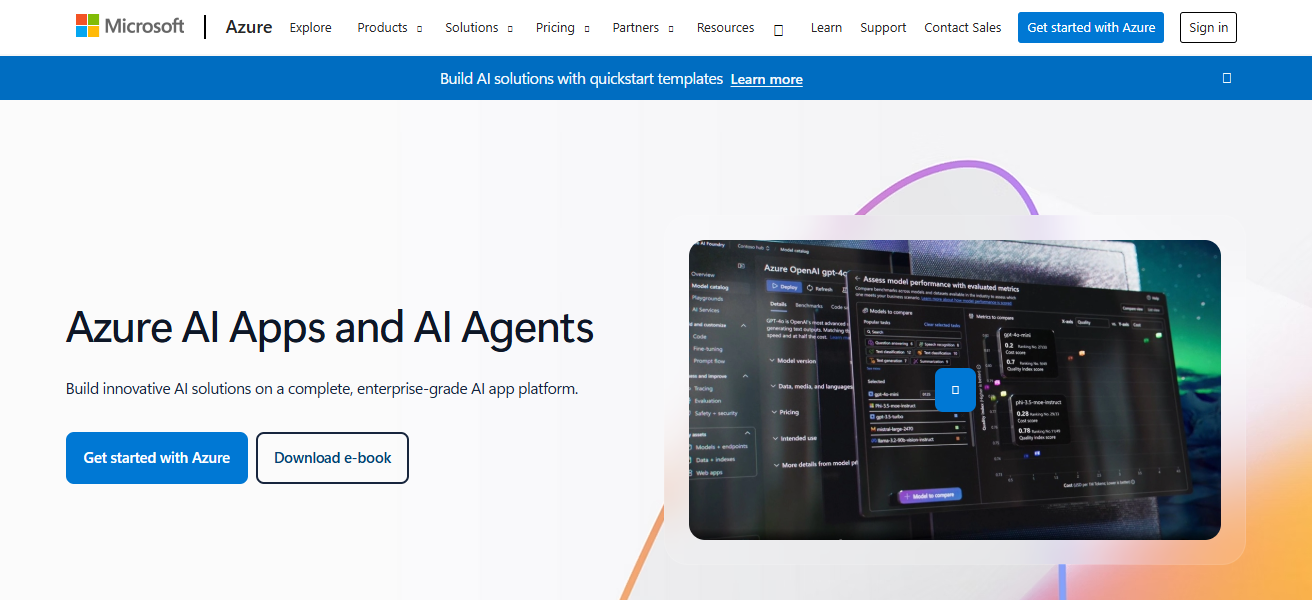
Azure Synapse and Azure data lakes provide risk analysis models the ability to perform real-time ingestion of market and transaction data to provide risk data insights.
Microsoft provides responsible AI services to ensure access to required financial models using AI that adjusts to the complexity of the models. Azure provides the ability for organizations to scale their use of the AI platform with their needs.
Features Microsoft Azure AI
Cognitive Services: APIs used for sentiment and language detection as well as anomaly detection to enhance risk data.
Real-Time Scoring: Real-time risk scoring through integration with streaming services (i.e. payments, trading, etc.).
Responsible AI Tools: Fairness and interpretability dashboards keep models within ethical and compliance boundaries.
| Pros | Cons |
|---|---|
| Highly scalable cloud infrastructure. | Pricing complexity (usage + compute costs) can be confusing. |
| Wide range of AI services (ML, cognitive, real-time analytics). | Custom models need data science expertise. |
| Strong integration with data platforms (Synapse, Data Lake). | Compliance configurations require careful setup for finance. |
| Emphasizes responsible and explainable AI. | Can be overwhelming due to many services/options. |
4. Google Cloud AI
Google’s cutting-edge machine learning technology and scalable cloud infrastructure have Eased Financial Model Risk with Google Cloud AI.
Financial institutions are now able to construct and customize models to assess credit risk, forecast market changes, and identify fraudulent transactions using tools like BigQuery ML, Vertex AI, and AutoML.
Google’s advancements in deep learning and real-time data analytics facilitate the quick processing of large data volumes.

The result is the increased accuracy of models that have been optimized using Google’s data ecosystem.
Google Cloud’s commitment to explainable AI and ethical practices in predictive modeling helps financial institutions create operational risk models that are transparent and meet regulations.
Features Google Cloud AI
Vertex AI: Single platform for developing, deploying, and monitoring custom models.
AutoML Capability: For users with no expertise in risk modeling, model tuning and feature engineering are automated.
BigQuery ML: Provides capability to train ML directly on big datasets using SQL for risk insights to be available faster.
Scalable Infrastructure: Computational power in the cloud scales to provide high-volume data analytics.
| Pros | Cons |
|---|---|
| Excellent ML capabilities and deep learning support. | Cost management can be challenging without governance. |
| AutoML simplifies model creation for non-experts. | Integration may require cloud engineering resources. |
| Real-time data analytics (BigQuery & ML). | Interpretability tools are less mature than some competitors. |
| Strong support for data scientists with Vertex AI. | Some features may still be evolving. |
5. DataRobot
DataRobot is the only AutoML software tool that can streamline the model building process to meet the financial risk modeling needs of entities lacking in-house data science resources.
It employs automation to facilitate the construction of models prepared for risks in areas such as credit risk evaluation, default prediction, and liquidity forecasting.
With the software, an organization’s risk assessment team can quickly, effectively, and efficiently deploy predictive models.
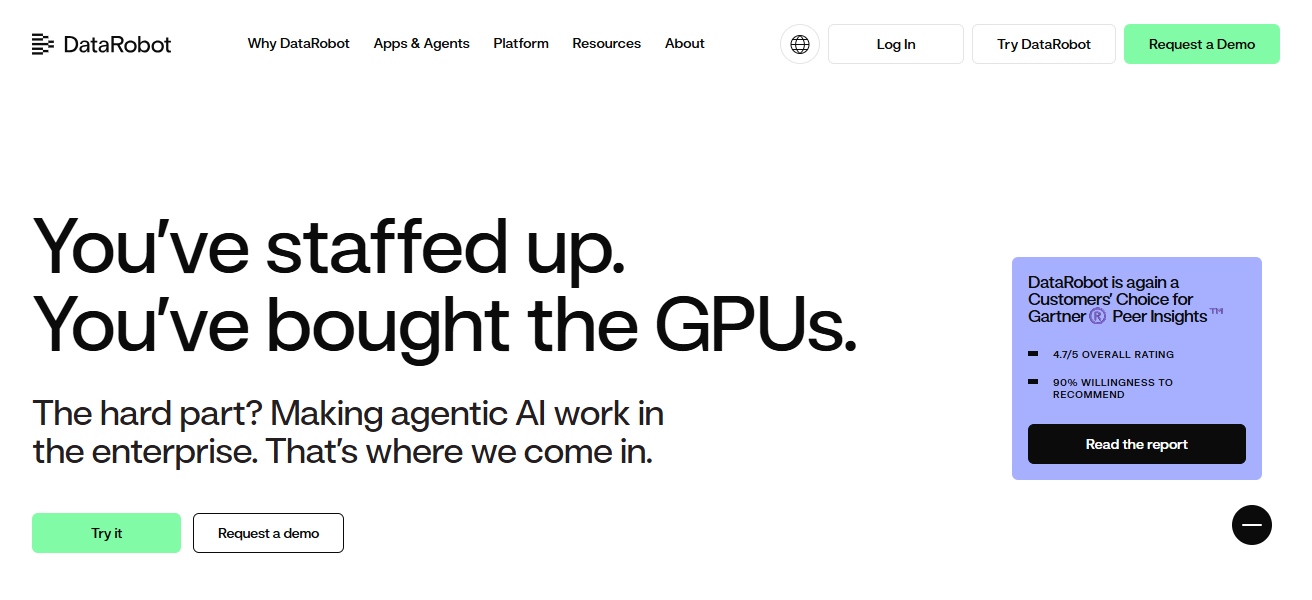
DataRobot interpretable AI assists in explaining the compliance and model drivers as needed to meet regulatory requirements.
Its structured/unstructured data use, model governance, and operational risk mitigation enhance trust in AI model outcomes. The tool provides dynamic risk assessments via real-time scoring as well.
Features DataRobot
Automated Machine Learning (AutoML): Tests a myriad of algorithms autonomously to provide optimal risk prediction.
Model Governance: For compliance and reproducibility, tracks model versions, performance and lineage.
Explainability Tools: Risk professionals see the reasoning behind model decisions due to the visualizations and feature impact scores.
Multiple Deployment Options: Each model can be deployed on-cloud or on-premises as per enterprise requisites.
| Pros | Cons |
|---|---|
| Automates most of the machine learning lifecycle. | Subscription costs can be high for small teams. |
| Great for rapid prototyping of risk models. | AutoML can hide model internals (less transparent). |
| Built-in model governance and explainability. | May need manual tuning for niche use cases. |
| Can work with various data types. | Model accuracy depends on data preparation quality. |
6. Alteryx
Alteryx is an analytics platform that helps finance and risk modeling professionals prepare, blend, and analyze data.
With a simple drag-and-drop function, employees can seamlessly build risk portfolios and connect to a variety of machine-learning applications.
Alteryx enables teams to automate data retrieval from different sources, improve market datasets, and utilize predictive data analytics to review credit, operational and market risk.
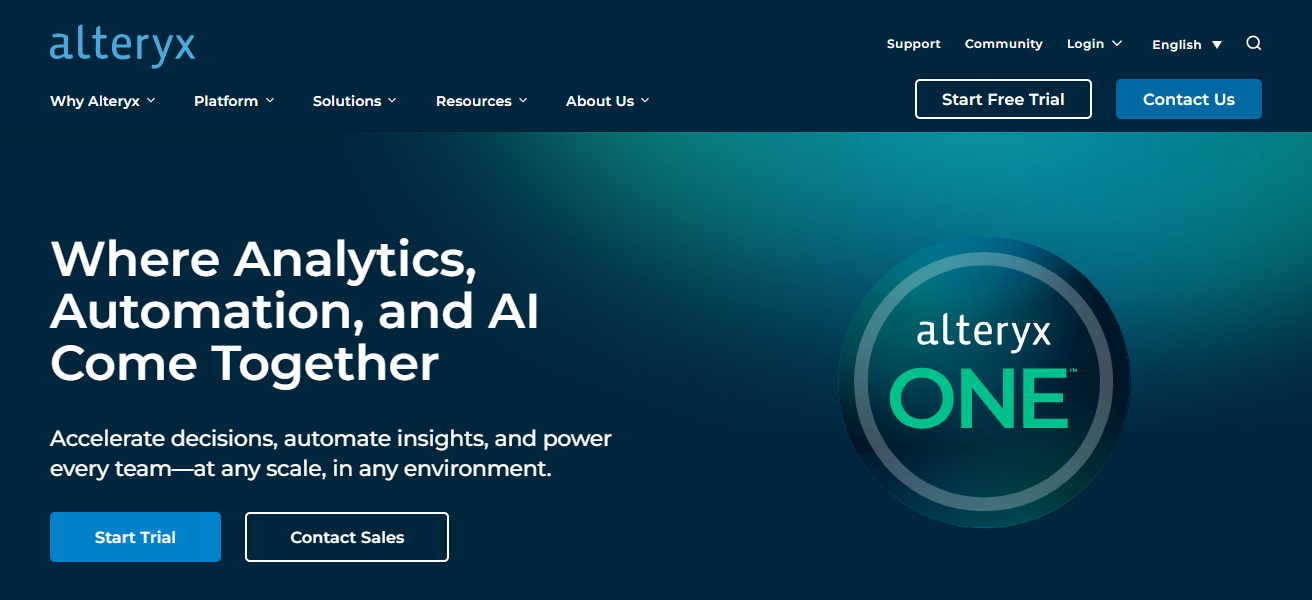
Moreover, employees can develop an operational model framework, which will help improve the efficiency of operational risk review portfolios, thus improving the risk and credit review cycles.
Alteryx allows institutions to complete building the final model and overlapping advanced analytics like clustering and decision trees, thus improving the building and operational efficiency, from unifying different teams like finance and it.
Features Alteryx
Drag-and-Drop Workflow: Non-technical users can visually build data prep and analytical pipelines.
Data Integration: Combines data from various sources – legacy systems, databases, spreadsheets, etc. – to manage risk as a whole.
Predictive Analytics: With built-in tools (and Python/R integration), risk exploration can be performed through regression, classification, and clustering.
Repeatable Processes: Saves workflow templates to provide the same risk analysis to all teams.
| Pros | Cons |
|---|---|
| User-friendly visual workflow builder. | Limited advanced ML compared to full AutoML platforms. |
| Strong data prep and blending capabilities. | Licensing costs scale with larger deployments. |
| Integrates with Python/R for customization. | Less suitable for highly complex risk models out-of-the-box. |
| Enables repeatable, shareable workflows. | Performance may lag with very large datasets. |
7. Kensho Technologies
Kensho Technologies, a subsidiary of S\&P Global, provides AI driven analytics to simplify financial risk modeling and decision analytics.
Kennsho uses machine learning to estimate risk exposures from complex financial data, news, and external money flow and macroeconomic data.

Its algorithm NLP can quantify unstructured data in the form of market comments and regulatory filings, which can be used to update traditional risk models.
Kensho can predict market movements and provide insights to answer “what if” to questions. Financials use Kensho for risk assessment of stress testing
Portfolio risk assessment, and risk assessment from economic events to improve strategic risk decision making.
Features Kensho Technologies
Event-Driven Analytics: Links real-world events (changes in policy, geopolitical events) with the outputs of the risk model.
NLP for Market Signals: Automated structured extraction of free text data from news, research, etc.
Scenario Simulation: Provides risk teams with an opportunity to conduct “what if” tests in a variety of economic settings.
API-Driven Data Access: Seamless incorporation of data feeds into a risk platform and dashboards.
| Pros | Cons |
|---|---|
| Excellent real-time analytics and scenario simulation. | Primarily tailored to large enterprises. |
| Strong NLP for extracting insights from text. | Less widely adopted, so fewer community resources. |
| Designed for event-driven risk forecasting. | May require training for effective use. |
| Backed by S&P Global data strength. | Costs can be premium based on data usage. |
8. Ayasdi
Ayasdi’s AI products would notice sophisticated structures in financial datasets that conventional models would overlook using topological data analysis and machine learning.
For risk modeling, Ayasdi uncovers the nonlinearities and hidden clusters that exist in credit portfolios, operational logs, and market data.
This allows for more granular and sophisticated risk predictions. Emerging risk factors exposed through metrics that standard unsupervised learning techniques miss.
In finance’s highly regulated environments, the tools for model interpretability and regulatory compliance are also invaluable.
Having identified systemic risks early, Ayasdi is able to construct a number of models for credit risk, market risk, and overall enterprise risk. This is what sets Ayasdi apart.
Features Ayasdi
Topological Data Analysis: Finds nonlinear patterns in financial data sets that other traditional models may fail to see.
Unsupervised Learning: Finds clusters of data and the interrelationships between data, all without a predetermined outcome.
Interpretability Layer: Helps users understand the key factors and the relationships between the simpler and more complex features of the model.
Risk Segmentation: Facilitates the more granular identification of a portfolio’s at-risk segments.
| Pros | Cons |
|---|---|
| Uses topological data analysis for deeper insights. | Specialized technology requires expert understanding. |
| Reveals hidden structures and nonlinear risk patterns. | Smaller ecosystem than general ML platforms. |
| Strong for credit and portfolio segmentation. | Adoption may require change in traditional modeling workflows. |
| Offers interpretability and regulatory support. | Deployment and scaling can be complex. |
9. FICO AI
FICO AI leverages the deep analytic proficiency and legacy of the FICO score to provide sophisticated risk modeling solutions for the financial industry. FICO integrates machine learning and industry-centric models for credit risk, fraud, and anti-money laundering activities.
Predictive scores are created, risk populations are segmented, and automated decisioning is provided by FICO AI systems which are capable of analyzing massive amounts of transactional and behavioral data.
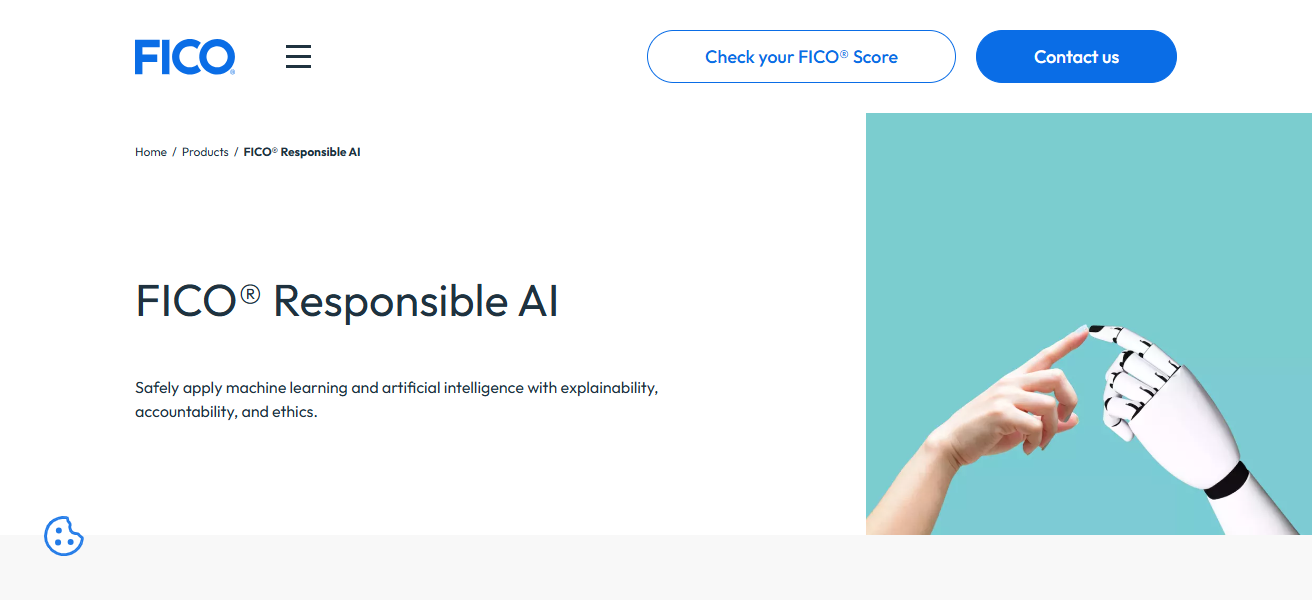
The explainable AI of the systems is an essential asset for institutions to defend the models to regulators and other members of the board.
FICO’s AI solutions are favored by both legacy and contemporary lenders due to the telltale balanced approach of the systems, as they score traditionally or protect the innovation of a model.
Features FICO AI
Credit Scoring Models: Reliable models for estimating a borrower’s risk based on historical performance data.
Fraud Detection Engines.” Monitoring systems powered by machine learning to detect abnormal or suspicious activity in real time.
Explainability and Transparency.” Because output information is crafted to be comprehensible to risk officers and regulators.
Decision Optimization.” Automation of risk decisions is possible as rules and models are combined eliminating the need for manual intervention.
| Pros | Cons |
|---|---|
| Trusted scoring models with strong domain expertise. | Focused heavily on credit risk (niche use). |
| Excellent fraud and AML capabilities. | Custom model flexibility may be limited. |
| Explainable decisions for regulators. | Licensing can be costly for full suite. |
| Integrates well with existing risk systems. | May require professional services to customize. |
10. SuperAGI Risk Assessment
SuperAGI is beginning to develop a system for autonomous AI, centered around modular, multi-agent risk analysis capabilities.
In financial risks, it can coordinate a proprietary AI agent in parallel to accomplish functions in data preparation, anomaly detection, scenario simulation, modeling, and other tasks in the risk modeling process.
This approach to distributed intelligence improves the speed and accuracy while reducing the need for human resources.
SuperAGI’s architecture enables adaptive learning, allowing models to learn and evolve in accordance with the financial markets and risk signals at play.
By merging automation with predictive analysis, SuperAGI can enhance the capabilities for monitoring and managing risks in real time.
This gives financial institutions the capacity to design scalable and seamless risk systems that are able to vary in response to the controlling factors of the economic system and the regulations governing that economy.
Features SuperAGI Risk Assessment
Multi-Agent Framework.” Autonomous agents perform parallel processes such as data collection, scoring, and running simulations.
Adaptive Learning.” A model’s new data is assimilated to continuously update, enabling improved responsiveness to changing market conditions.
Task Orchestration.” Agents work in collaboration to automate complex end-to-end risk processes.
Modular Architecture.’‘ Organizations can install dedicated agents for credit, market, or operational risk functions
| Pros | Cons |
|---|---|
| Modular multi-agent approach enhances automation. | Relatively newer, with evolving ecosystem. |
| Supports adaptive, real-time risk modeling. | Potentially complex architecture to implement. |
| Agents can handle parallel tasks efficiently. | Fewer off-the-shelf risk templates compared to legacy tools. |
| Can scale with dynamic market conditions. | Requires development expertise for custom use cases. |
How To Choose Best AI Tools for Financial Risk Modeling
Clearly Defined Risk Use Case: Consider whether you will need the tool for credit risk, market risk, operational risk, fraud detection, or stress testing.
Data Compatibility: Make sure the tool addresses your type data to assess whether structured, unstructured, real-time, or historical datasets are needed.
Performance & Model Accuracy: Look to the available machine learning technologies, predictive power, and if the tool can solve difficult problems successfully.
Explainability & Compliance: As there are regulations regarding audits, select AI tools that have Explainable Artificial Intelligence (XAI) that are placed in such a way that they are visible to the user, depicting to the user the steps taken in generating a respectful output.
Scalability: Ensure the rapid expansion of the tool in terms of data and the complexity of the model.
Integration Capabilities: Ensure interoperability with existing risk management systems, other technologies, databases, and management software.
Automation Level: Identify systems that can automate processes such as data preparation, model training, model monitoring, and reporting where human manual activities will be less.
Security & Data Privacy: Make sure there are advanced features for systems protected through encryption to control entry and that they are compliant to regulations governing use of financial data.
Cost & Licensing: Assess available pricing models and compare with your organizational budget and expected ROI.
Vendor Support & Ecosystem: Consider vendor documentation availability, community ecosystem, and strategic direction to see if it is trustworthy. Some tools are designed for community use.
Conclusion
To wrap up, the most effective AI technologies for financial risk modeling allow companies to foresee, evaluate, and lessen threats with better precision, and quantify risks, and do so more quickly than ever before.
These technologies integrate better decision-making. With better risk and market uncertainty, regulatory compliance, and order resilience, financial institutions can remain competitive. This is done in a more analytical, automated, and AI-explainable world.
FAQ
It is the process of using statistical and AI tools to predict and manage risks like credit, market, operational, and liquidity risks.
AI improves prediction accuracy, processes large datasets faster, automates workflows, and uncovers hidden patterns traditional methods may miss.
IBM Watson, SAS Risk Solutions, Microsoft Azure AI, Google Cloud AI, DataRobot, Alteryx, Kensho, Ayasdi, FICO AI, SuperAGI.
Yes, cloud-based platforms like Azure, Google Cloud AI, and DataRobot offer scalable solutions for smaller institutions.
Structured, unstructured, real-time, historical, transactional, and textual data like news or regulatory reports.