
This article describes the current Best Autonomous AI Agent Crypto Trading Desks and how they are shaping the market. These trading desks harness the power of autonomous AI agents to explore markets, assess scenarios, generate trading frameworks, and help make trading decisions.
We will examine the main features, pros and cons, and how far the technology can be pushed for some of the most advanced AI crypto automation tools. We hope this will assist the reader in evaluating available options to automate their cryptocurrency trading.
Key Points & Best Autonomous AI Agent Crypto Trading Desks
| Mention | Explanation |
|---|---|
| TradingAgents | Simulates an institutional trading floor using specialized LLM agents for analysis. |
| AiHedgeFund | Uses investor personas and analytical agents to debate strategies and execute trades. |
| ElizaOS | Open-source framework supporting autonomous DeFi and high-frequency trading agents on Solana. |
| Autonolas | Coordinates decentralized autonomous services and multiple agents for complex crypto workflows. |
| ZyFAI | Automatically searches, reallocates, and compounds funds across high-yield DeFi vaults. |
| OKX Agent Trade Kit | MCP toolkit enabling AI agents to trade across centralized and decentralized exchanges. |
| TradeSanta | Beginner-friendly cloud platform providing automated trading signals, grid, and DCA strategies. |
| Pionex | Provides built-in cloud trading bots operating continuously without coding or API setup. |
| QuickNode Infrastructure | Supplies blockchain connectivity infrastructure for fast MEV and custom onchain agent execution. |
| CoinGecko Agent Skills | Lets AI agents access live cryptocurrency prices, market depth, and token metrics |
10 Best Autonomous AI Agent Crypto Trading Desks
1. TradingAgents
There are many trading specialists that coordinate and analyze the market to make an informed investment decision. This approach is similar to how large segments of institutional trading are organized.
The TradingAgents framework is a large language multi-agent system. This framework identifies trading specialists and assigns roles to fundamental and technical analysts, sentiment researchers and traders.

The specializing agents have the ability to analyze data, communicate, argue and have the ability to ultimately reach a decision for a trade. The framework shows the trading workflow involving coordination of multiple specialized agents as a substitute to a single large model.
TradingAgents Features
- Multi-Agent Architecture: AI specialization for differentiated trading analysis.
- Institutional Simulation: Re-creates flows of institutional level trading.
- Collaborative Analysis: Research analysis, perspective, and arguments for decisions.
- Trading Decisions: Converging probability of support for investment and trading.
| Pros | Cons |
|---|---|
| Uses multiple specialized agents for deeper market analysis. | Multi-agent systems can be complex to configure and maintain. |
| Simulates institutional-style research and decision-making workflows. | Simulated institutional behavior may not match real trading desks. |
| Agents can debate and challenge different trading perspectives. | Conflicting agent opinions can make decisions slower or inconsistent. |
| Supports structured, systematic trading decision processes. | AI-generated decisions can still contain analytical errors and biases. |
2. AiHedgeFund
Different investment decisions are made on the basis of different philosophies, attitudes towards risk and different ways of perceiving and interpreting information. AiHedgeFund adopts a multi-agent approach where different investment personas with different styles and attitudes represent different investment perspectives.
The framework incorporates well-known investor-inspired personas including Warren Buffett and Charlie Munger and analytical sub-agents who scrutinize financial information and evaluate investment opportunities.
These agents are able to evaluate and argue different investment strategies and assumptions, evaluate different companies and ultimately make trade execution decisions. The main idea involves integrating different styles of investment approach into an automated decision-making system.
AiHedgeFund Features
- Investor Personas: Mimicking the personalities and creating characters of multiple investors and their respective philosophies.
- Analytical Agents: With specialized agents devoted to the examination of companies, and markets as well as the identification of investment opportunities.
- Strategy Debate: Argumentation and challenge to investment ideas prior to decisions.
- Trade Execution: Translation of the selected investment ideas into trading actions.
| Pros | Cons |
|---|---|
| Provides multiple investor perspectives for investment analysis. | Investor personas are simulations rather than actual investment professionals. |
| Combines fundamental and specialized analytical agents. | More agents can increase computational and operational complexity. |
| Encourages debate before selecting an investment strategy. | Debates may produce conflicting or unreliable conclusions. |
| Can connect analysis with automated trade execution. | Automated execution can increase losses when strategies fail. |
3. ElizaOS
Decentralized Finance (DeFi) needs software that can work with blockchains, protocols, wallets, and market infrastructures without the need for constant human inputs. ElizaOS is an open-source agent framework for building agent-based autonomous AI for blockchain and DeFi.
ElizaOS is associated with building autonomous agents for trading and financial applications on the Solana blockchain.

With ElizaOS, developers have the ability to create agents that can interact with decentralized applications, monitor markets, and carry out automated tasks, making ElizaOS useful for the research of autonomous blockchain-based financial applications and agent-based DeFi.
ElizaOS Features
- Open-Source Framework: An agent construction framework for developers.
- DeFi Integration: Equips agents capable of engaging the decentralized finance market.
- Blockchain Operations: Agents equipped to examine markets and system interface with the blockchain.
- Solana Focus: High utilization and application focus in the Solana ecosystem
| Pros | Cons |
|---|---|
| Open-source framework allows extensive customization. | Requires technical knowledge to develop and configure effectively. |
| Supports autonomous agents for DeFi applications. | DeFi applications involve smart-contract and protocol risks. |
| Enables blockchain interaction and automated operations. | Blockchain transactions may experience delays, failures, or fees. |
| Strong ecosystem presence, particularly around Solana. | Strong ecosystem focus may limit suitability for some networks. |
4. Autonolas
Complex decentralized applications need many autonomous services that can communicate and collaborate in order to complete a task. Autonolas aim is to build services that can operate through networks of agents and nodes that work together.
Autonolas is built for scenarios where many agents need to collaborate to achieve to a goal, but each agent needs to perform a specialized task. In cryptocurrency environments, this can support decentralized automation
Data processing, and trading services and other off-chain activities connected to blockchain. This is built on the foundation of providing cooperating autonomous services so that users do not need to control every action of the service.
Autonolas Features
- Autonomous Services: Capable of construction of services with a high degree of autonomy.
- Multi-Agent Coordination: Cooperation of multiple agents and nodes on advanced operations.
- Decentralized Architecture: Arrangement of distributed agents over a centralized one.
- Crypto Workflows: Coordination of automation, data processing, and decentralized services.
| Pros | Cons |
|---|---|
| Enables autonomous services with reduced human intervention. | Autonomous systems can be difficult to monitor and control. |
| Supports coordination between multiple agents and nodes. | Multi-agent coordination can introduce additional technical complexity. |
| Decentralized architecture can reduce dependence on centralized systems. | Decentralized infrastructure may be harder to manage and troubleshoot. |
| Useful for complex crypto and automation workflows. | Performance depends on participating services, agents, and infrastructure. |
5. ZyFAI
Capital arbitrage in DeFi is extremely time consuming due to the increased number of DeFi protocols and the need for constant checks for the best opportunity. ZyFAI aims to create a yield farming automation system across the supported chain networks such as Base and Arbitrum.
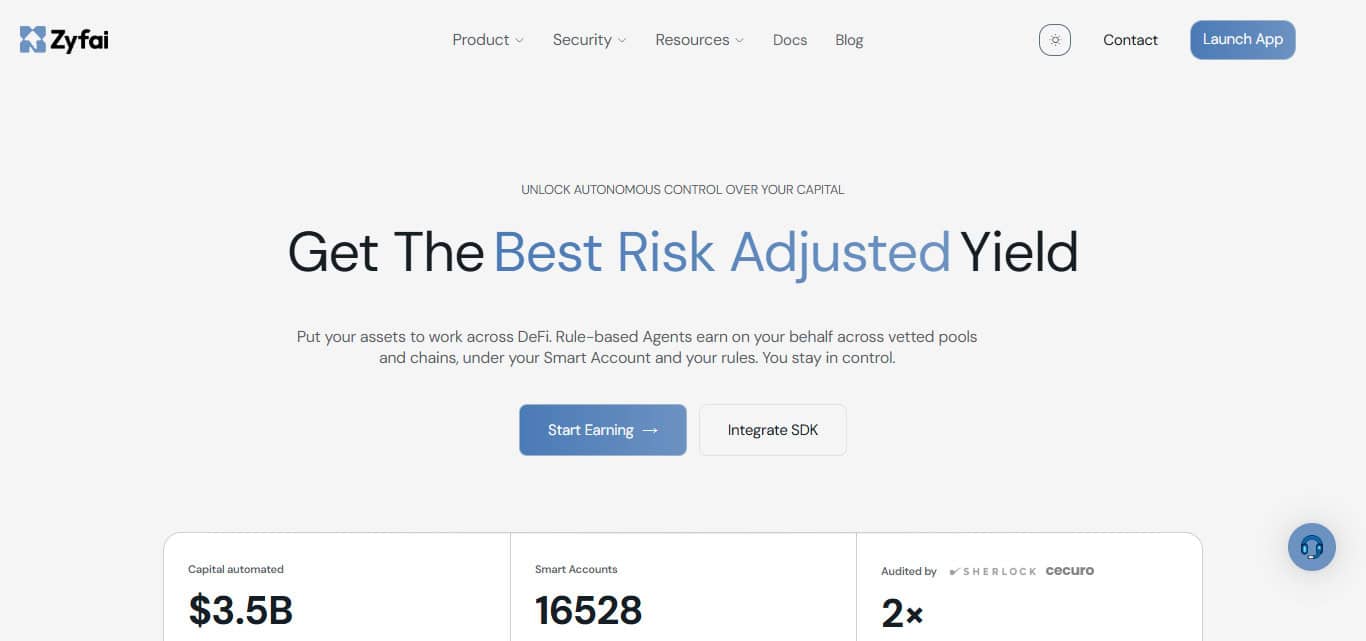
The system is capable of performing yield opportunity analysis and capital rebalancing. The system is able to generate returns and reinvest those returns to increase capital. The automation of yield farming strategies attempts to decrease labor to a minimum; however, risks such as smart contract, market, and liquidity risks are still prevalent.
ZyFAI Features
- Yield Optimization: Detects potential high yield opportunities in supported protocols.
- Automatic Rebalancing: Can shift capital between strategies depending on the optimization algorithm.
- Compounding: Automatically reinvest returned capital to assist yield strategies.
- Multi-Chain Operations: Opportunity assessment across multiple blockchains and DeFi.
| Pros | Cons |
|---|---|
| Searches across multiple blockchain networks for yield opportunities. | Cross-chain strategies can introduce additional technical and bridge risks. |
| Automates yield strategy selection and capital management. | Automated strategies may choose opportunities that later become unprofitable. |
| Automatic rebalancing reduces manual portfolio management. | Frequent rebalancing can create transaction costs and execution risks. |
| Compounding can automate reinvestment of generated returns. | High advertised yields can involve significant protocol or market risks. |
6. OKX Agent Trade Kit
As the AI trading agents evolve, so must the tools. Smart tools such as OKX Agent Trade Kit are capable of being used in trading environments to provide AI Agents with the needed tools to communicate with exchanges, obtain market data, and provide tools needed to effect market orders.
The Model Context Protocol (MCP) is a standardized communication interface for AI-driven systems. The nature of AI systems is to enable decision making and if the required tools are available, cryptocurrency trading can become a reality.
OKX Agent Trade Kit Features
- MCP-Based Toolkit: Employs the Model Context Protocol to build AI agent based trading tools.
- CEX Integration: AI Agents are able to interact with centralized crypto exchange environments.
- DEX Integration: Supports interaction with decentralized exchange infrastructure and workflows.
- Agent Automation: Integrates AI-based analysis with cryptocurrency trading.
| Pros | Cons |
|---|---|
| MCP integration helps AI agents access trading tools. | MCP-based integrations require suitable technical implementation. |
| Supports interaction with centralized exchange environments. | Centralized exchanges introduce custody and platform-related risks. |
| Can connect agents with decentralized exchange workflows. | DEX transactions may involve slippage, gas costs, and smart-contract risks. |
| Helps bridge AI analysis with trading execution. | Incorrect AI instructions could potentially trigger unwanted trades. |
7. TradeSanta
Automated trading can be complicated for complete beginners because most bots are difficult to set up and often require some level of programming, API keys, and nether-understandable configuration. TradeSanta is a cloud-based platform focused on simplicity.
Like most cryptocurrency trading automation programs, TradeSanta offers features such as grid trading, dollar-cost averaging, and cryptocurrency trading signals.
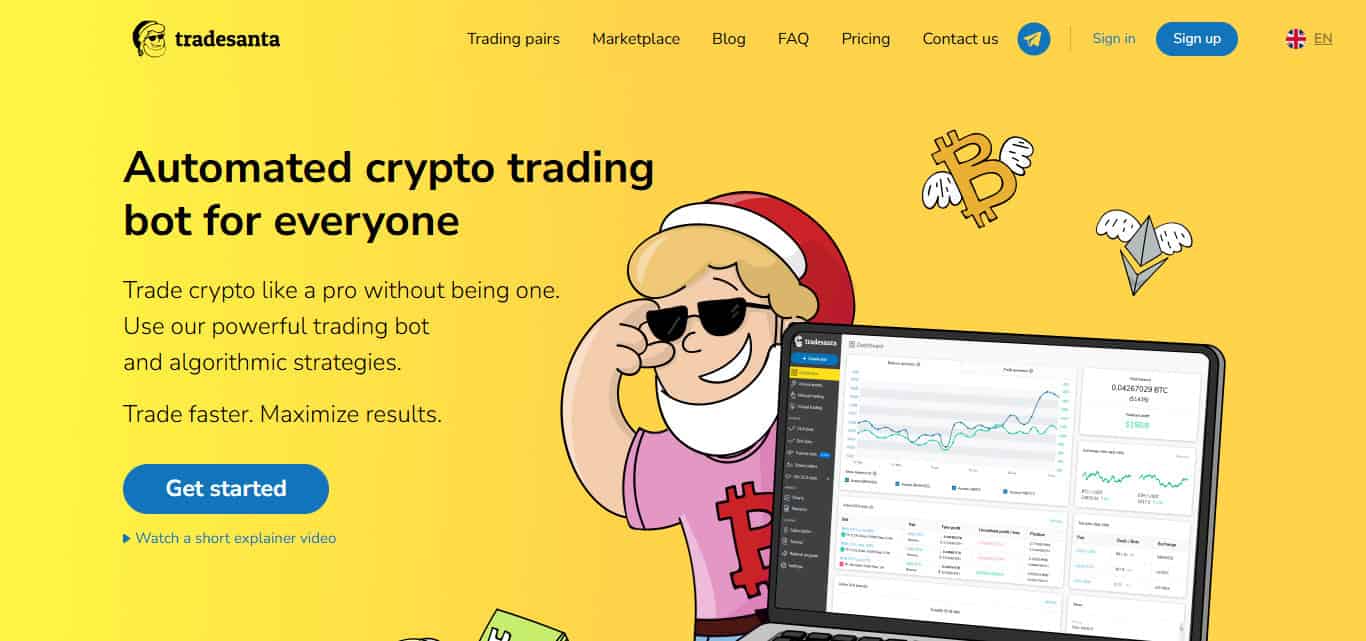
There are a number of strategies that require a combination of sophisticated market analysis and professional trading logic in order to be successful. For TradeSanta and all automated trading systems, it is important to keep in mind that losing money is as easy as pushing a button.
TradeSanta Features Features
- Cloud-Based Automation: Offers users tools to execute trading strategies with no locally installed software.
- Grid Trading: Offers grid strategies to users for trading under specific market conditions.
- DCA Strategies: Offers DCA (dollar cost averaging) strategies for automated crypto purchases.
- Beginner Friendly: Offers trading tools and automation to users with little to no coding experience.
| Pros | Cons |
|---|---|
| Cloud-based system reduces the need for local infrastructure. | Users depend on the platform’s availability and services. |
| Grid strategies can automate trading within defined price ranges. | Grid strategies can perform poorly during strong directional markets. |
| DCA automation supports systematic purchasing strategies. | DCA does not guarantee profits during prolonged market declines. |
| Designed to be accessible for less technical users. | Advanced traders may find customization and controls limiting. |
8. Pionex
Most trading automation platforms require some level of configuration and maintenance, as trading bots must be regularly updated with new trading strategies and managed effectively. Pionex offers an incredibly easy implementation of automated trading strategies within their cryptocurrency trading platform.
Because the bots operate in the Pionex infrastructure trading cloud, there is no need for external trading software, and API management is not required.
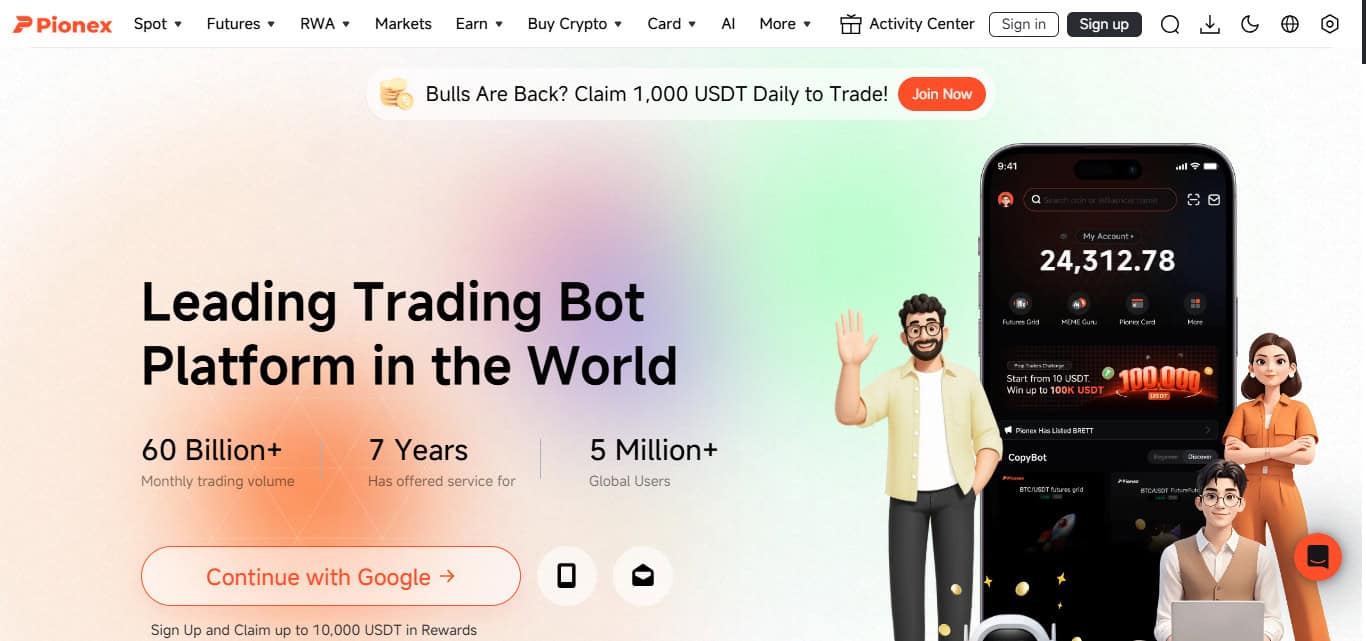
Grid-type automation and trading strategies are more accessible to the average user as ready made automation is the focus of the Pionex trading platform.
Pionex Features
- Built-In Trading Bots: Offers built-in trading automation on its crypto exchange.
- 24/7 Automation: Automated trading bots require no oversight as they run continuously.
- No External API Setup: Users are not required to set up trading exchange APIs.
- Multiple Strategies: Offers automated trading techniques such as grid trading strategies.
| Pros | Cons |
|---|---|
| Trading bots are integrated directly into the exchange platform. | Users remain exposed to exchange-specific operational and custody risks. |
| Bots can operate continuously without constant monitoring. | Continuous automation can amplify losses during unfavorable conditions. |
| No separate external API configuration is generally required. | Users have less infrastructure flexibility than custom-built systems. |
| Offers multiple automated trading strategies. | Pre-built strategies may not suit every market condition or trader. |
9. QuickNode Infrastructure
To operate trading services within the blockchain economy, low latency and predictable access to blockchain networks is essential. QuickNode Infrastructure is an RPC service and API infrastructure to access several blockchain networks.
This backend infrastructure can support DeFi applications, blockchain agents, trading systems and applications that use MEV. Providing developers with network access eliminates the need to operate and maintain blockchain nodes, especially for trading systems and agents.
Reliable infrastructure is critical for autonomous agents or trading systems since failed or slow blockchain requests can affect order execution and trading.
QuickNode Infrastructure Features Features
- Blockchain RPC: Infrastructure for access and communication with blockchain networks.
- Multi-Chain Support: Supports connectivity to numerous blockchain ecosystems and networks.
- Developer Infrastructure: Offers solutions for accessing blockchain data and transactions.
- Onchain Applications: May serve back end solutions for DeFi, MEV, and autonomous blockchain agents
| Pros | Cons |
|---|---|
| Provides reliable blockchain connectivity for applications and agents. | Infrastructure services can create dependency on an external provider. |
| Supports connectivity across many blockchain networks. | Different blockchains can have different technical requirements and limitations. |
| Reduces the need to operate blockchain nodes independently. | Service costs can increase with high-volume application usage. |
| Useful for DeFi, MEV, and onchain agent applications. | Infrastructure quality alone cannot eliminate blockchain execution risks. |
10. CoinGecko Agent Skills
Trading systems have to use prior information to analyze assets and make decisions. The purpose of CoinGecko Agent Skills is to give access to AI agents and development systems to information about cryptocurrency markets.
There are multiple layers of integration where agents can request information about cryptocurrency pricing, market statistics, token statistics, and various metrics.
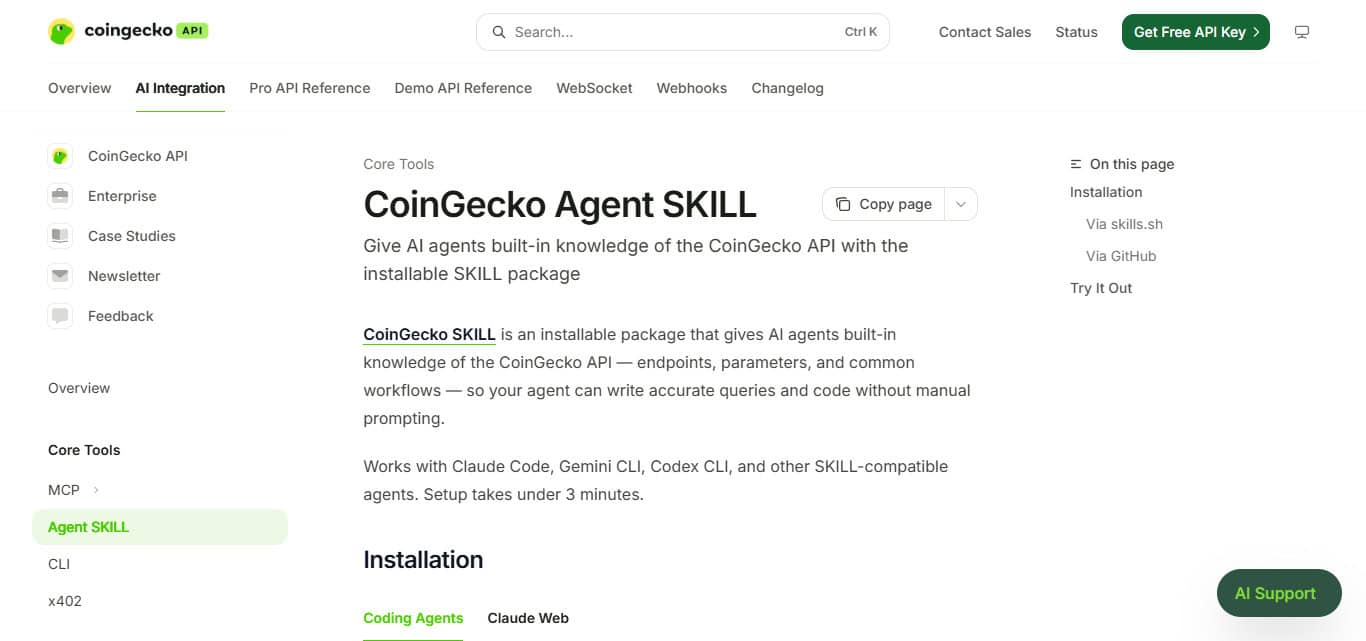
This access eliminates the dependency on training data. Real-time access to data can decrease the cost of analysis and requires trained interpretation, but the quality of decisions is determined by the chosen strategy and information interpretation.
CoinGecko Agent Skills
- Live Market Data: This skill provides the AI agent with access to the latest information for the global cryptocurrency market.
- Price Information: Cryptocurrency pricing data is provided for research and smarter decisions.
- Token Metrics: This skill provides agents with additional data for token pricing and other statistics related to the market for tokens.
- AI Integration: This skill connects data on cryptocurrencies to AI programming tools and automation.
| Pros | Cons |
|---|---|
| Gives AI agents access to cryptocurrency market information. | Data quality depends on available sources and integrations. |
| Provides pricing information for automated market analysis. | Cryptocurrency prices can change extremely quickly. |
| Offers token metrics useful for research and comparison. | Metrics alone cannot provide reliable investment conclusions. |
| Connects market data with AI agent workflows. | AI agents may misinterpret data or generate incorrect recommendations. |
Conclusion
In conclusion, the best autonomous AI Crypto trading desks have the ability to automate all the steps involved in analyzing the market, creating trading strategies, monitoring markets, and placing trades.
Each platform has its own advantages, such as multi-agent research, automation of DeFi, and real-time market data.
That said, investing involves a high degree of risk and users should take into consideration security, costs, volatility, and other limitations of the trading platform before deciding on the use of AI-based trading services.
FAQ
How do autonomous AI trading agents work?
They collect market data, analyze signals, develop strategies, and execute trades automatically.
Are autonomous AI crypto trading desks profitable?
Profitability varies depending on strategies, market conditions, risks, and execution quality.
What features should the best AI trading desks provide?
Look for automation, real-time data, risk controls, analytics, and multi-agent capabilities.
Can AI agents trade cryptocurrencies without human intervention?
Yes, configured agents can monitor markets and execute predefined trading strategies automatically.