This article will outline the Best Chargeback Management Tools for High-Risk Merchants. Due to fraud, friendly fraud, or errors in processing, high-risk merchants often experience a high volume of chargebacks.
- key Points & Best Chargeback Management Tools for High-Risk Merchants
- 10 Best Chargeback Management Tools for High-Risk Merchants
- 1. Chargeback Gurus
- 2. Midigator
- 3. Ethoca
- 4. Verifi (Visa)
- 5. Chargebacks911
- 6. SEON
- 7. Kount
- 8. Signifyd
- 9. Sift
- 10. Accertify
- Key Reasons To Choose The Best Chargeback Management Tools For High-Risk Merchants
- Conclusion
- FAQ
Selecting the right chargeback management solution can mitigate the risk of losing money, automate the handling of disputes, and improve overall efficiency of the organization. In this case, we will review the most effective tools for shielding care risk companies.
key Points & Best Chargeback Management Tools for High-Risk Merchants
| Tool | Key Point |
|---|---|
| Chargeback Gurus | Comprehensive dispute resolution with analytics and fraud prevention tailored for high-risk industries. |
| Midigator | Real-time reporting and automation to reduce chargeback ratios and improve compliance. |
| Ethoca | Collaboration network that alerts merchants of disputes early to prevent chargebacks. |
| Verifi (Visa) | Rapid dispute resolution through Visa’s Order Insight and collaboration tools. |
| Chargebacks911 | End-to-end management including prevention, representment, and analytics for high-risk merchants. |
| SEON | Fraud detection powered by AI to stop suspicious transactions before they become chargebacks. |
| Kount | AI-driven fraud prevention with strong identity trust features for risky verticals. |
| Signifyd | Guaranteed fraud protection that covers chargeback losses for merchants. |
| Sift | Machine learning fraud prevention with dispute management workflows. |
| Accertify | Enterprise-grade fraud and dispute management trusted by airlines and global merchants. |
10 Best Chargeback Management Tools for High-Risk Merchants
1. Chargeback Gurus
Chargeback Gurus deals with high-risk merchant chargeback mitigation and dispute management with customized automation and expert services for high-risk industries such as travel, telecom, and education.
The company utilizes Enhanced Smart Prevention Alerts™ with rules-based data and tailor notifications that help keep chargeback ratios under the card networks’ threshold.

Alerts can be managed entirely by Gurus’ team, lessening the burden on merchants while improving response accuracy.
Chargeback Gurus helps mitigate chargeback issues for complicated eCommerce businesses with customized rules and strategies that identify and act on trends for each MID.
Chargeback Gurus Features
Pre Chargeback Alerts – Merchants are notified by customizable rules prior to action before it turns to chargeback servicing disputes.
Expert Rep management – Combines software and humans to assist and optimize responses to disputes.
Root Cause Dispute Analytics – Patterns and reason are tracked to help businesses resolve and improve.
Custom Industry Strategy – Plans for prevention and better ratio control are tailored for high-risk travel and education.
| Pros | Cons |
|---|---|
| Offers expert‑led support alongside automation — great for high‑risk verticals like travel, education, and subscription services. | Can be more expensive than purely automated solutions due to human review and customization. |
| Custom pre‑chargeback alerts help merchants take action before disputes turn into chargebacks. | Implementation and tuning may take longer initially for complex business models. |
| Focus on proactive prevention and compliance support helps keep chargeback ratios under network thresholds. | Best value usually realized with a dedicated team handling disputes — may not suit small merchants. |
| Detailed reporting & root‑cause insights make trend analysis easier. | Heavy customization might require more onboarding time. |
2. Midigator
Midigator has the capability to assist companies in chargeback management through market analytics.
The platform enhances automation in obtaining data from Ethoca and Verifi and keeps automation of alter monitoring and data retrieval from both platforms in real time.
The platform gives companies the automation to monitor the analytics of chargeback data for root cause analysis in a dispute and factors in dispute VAMP ratios.
Midigator also customizes automation for companies in responding to disputes and considers the portfoli of chargeback data to understand deeply the analytics from dispute data.
Midigator Features
Centralized Alerts Dashboard – Ethoca and Verifi network alerts from various sources are consolidated into one.
Real-Time Dispute Analytics – Patterns, causes, and trends of disputes are deeply analyzed and insights are provided.
Workflow Dispute Automation – Internal workflows and processes are automated to reply to disputes.
Custom Reporting – Strategies can be refined by merchants with detailed performance reports that are generated.
| Pros | Cons |
|---|---|
| Real‑time alerts and centralized dashboard pull dispute signals together (including Ethoca & Verifi). | Analytics depth may be overwhelming if you lack chargeback expertise. |
| Strong data‑driven insights to identify root causes and reduce overall chargebacks. | Fewer built‑in fraud screening features than some competitors. |
| Helps automate dispute replies and workflow, saving time on manual tasks. | Some merchants report that advanced features need configuration support. |
| Integrates with multiple payment and processing platforms. | Pricing scales with volume — not ideal for very low‑volume merchants. |
3. Ethoca
Ethoca, which is now part of the Mastercard family, provides alert services that notify merchants immediately upon their card issuer lodging a dispute with a merchant.
These alerts allow merchants to take preventive measures to avoid a chargeback, refund a disrupted shipment, or get in communication with the customer to avoid administrative chargeback fees.
Ethoca also assists merchants and cardholders in claim dispute confusion through the Consumer Clarity™ data that provides merchants and cardholders transactional data in real time through their banking apps.
Ethoca’s global reach that includes partners such as Mastercard and other major international banking institutions makes the services attractive for merchants with a global customer base.
Ethoca Features
Real-Time Dispute Alerts – Businesses are notified of chargebacks posting with no time to act.
Consumer Clarity Provides detailed purchase information to cardholders to eliminate ambiguity.
Global Issuer Network – Timely alerts are provided by collaboration with issuers around the globe.
Reduced False Chargebacks – Eliminates possible disputes of chargebacks through lack of accurate and precise information
| Pros | Cons |
|---|---|
| Real‑time issuer alerts allow merchants to stop disputes before chargebacks are created. | Doesn’t include a full standalone dispute management platform; usually paired with other tools. |
| Can reduce unnecessary chargebacks when used proactively. | Limited to the issuer connections in its network. |
| Consumer Clarity data increases transparency for cardholders, reducing misunderstandings. | Less hands‑on support compared with full service providers. |
| Broad support with many global banks. | Not a complete chargeback representment solution alone. |
4. Verifi (Visa)
Visa’s Verifi handles chargeback management with services such as Order Insight, Rapid Dispute Resolution (RDR), and the Cardholder Dispute Resolution Network (CDRN).
This chargeback management allows merchants to share non-fraud chargeback detailed orders and CRM data with issuers to deflect inquiries and reduce chargeback losses.
When payment disputes arise, merchants can automate refunds with RDR and resolve certain disputes in a matter of seconds, eliminating manual effort and lowering operating expenses in RDR.
A big Contribution of Verifi is the interconnection provided with Visa, allowing merchants to spot transaction problems early and resolve issues efficiently to avoid disputes and chargeback losses.
Verifi (Visa) Features
Order Insight™ Integration – Anticipates inquiries from cardholders by sharing order information directly with issuers.
Rapid Dispute Resolution (RDR) – Responds to disputes by partially refunding automatically and resolving the issue immediately.
Pre‑Dispute Tools – Available to merchants so they can attempt to resolve issues before they escalate to chargebacks.
Visa Network Leverage – Complete integration with Visa’s network for first sight.
| Pros | Cons |
|---|---|
| Order Insight & Rapid Dispute Resolution (RDR) help resolve disputes before they become chargebacks. | Best results when integrated with merchant backend and CRM — needs technical setup. |
| Early visibility directly via Visa network improves prevention effectiveness. | Primarily focused on Visa transactions (though other networks are supported through integrations). |
| Automated partial refunds/dispute responses reduce manual work. | Some advanced features are only available via gateway/processor partnerships. |
| Reduces operational overhead with automated workflows. | Learning curve for rules configuration. |
5. Chargebacks911
The company most utilized by high-risk and enterprise merchants, Chargebacks911, offers complete spectrum prevention, detection and representment platform.
Chargebacks911 imports data, identifies and reviews patterns, and uses insights to improve prevention and detection strategies.
Chargebacks911’s representment services and case building, and submission to issuers, increases winnings by high rates.
Supporting over 85 currencies, the platform further aids global sellers by providing analytics on the causes of disputes.
Chargebacks911 offers proactive alerting and post dispute recovery making it the best choice for complicated chargeback scenarios.
Chargebacks911 Features
AI‑Driven Source Classification – Automatically attributes the cause of the disputes (fraud, error, friendly chargebacks).
Managed Representment Services – Professionals put together the case, and submit the disputes to increase win probability.
Global Chargeback Analytics – Monitors disputes’ patterns and trends per region and card.
Custom Prevention Rules – Customized rules and thresholds for merchants that have elevated risk.
| Pros | Cons |
|---|---|
| Combines AI classification with human‑assisted representment for higher win rates. | Can become costly for high dispute volumes, especially with managed services. |
| Supports global merchants and multisite chargeback strategies. | Setup requires time to tailor AI and workflows. |
| In‑depth analytics help pinpoint dispute trends and adjust prevention strategies. | Best suited for mid‑large merchants. |
| Offers end‑to‑end dispute remediation. | Smaller merchants may not need full suite. |
6. SEON
SEON is a fraud prevention and chargeback management tool powered by machine learning and alternative data (device fingerprints, IP signals, and email verifications) to assess risk in real-time.
By analyzing every transaction in real-time, SEON empowers merchants to potentially stop chargeback fraud by denying fraudulently attempting orders.
SEON is rule‑writing engine is very configurable and allows teams to customize logic to new risks with minimal developer effort.
SEON is unique in the market in combining fraud screening and transactional behavioral indicators to provide warning fraud merchants the ability to mitigate fraud prior to incurring the costs and disputes of chargeback fraud.
SEON Features
Behavioral & Device Fingerprinting – Scoring the risk of a transaction by tracking mouse movement and the device used and the IP.
Flexible Rule Engine – Empowers merchants to develop their own risk logic and tailor their rules to their business.
Alternative Data Signals – For better verification, it supplements existing data with data from emails, phones, and social platforms.
Fraud Screening – Monitors for suspicious activity to stop orders from being charged back.
| Pros | Cons |
|---|---|
| Strong fraud prevention engine helps reduce fraud‑related disputes before they occur. | Not a full chargeback representment solution on its own. |
| Uses behavioral and device data for better risk scoring. | Some merchants find rules configuration complex without support. |
| Flexible rule builder to tailor risk logic for different products/locations. | Advanced features may require additional fees. |
| Reduces manual review through automation. | Chargeback reporting insights are less robust than full dispute suites. |
7. Kount
Kount and Equifax provide a comprehensive fraud and chargeback management solution that helps online merchants safeguard their businesses throughout the entire transaction lifecycle.
Kount’s Global Network of Identity Trust classifies patrons as fraudsters and launderers based on the analysis of transactional, device, and behavioral data, eliminating false positives and lowering chargeback risks.
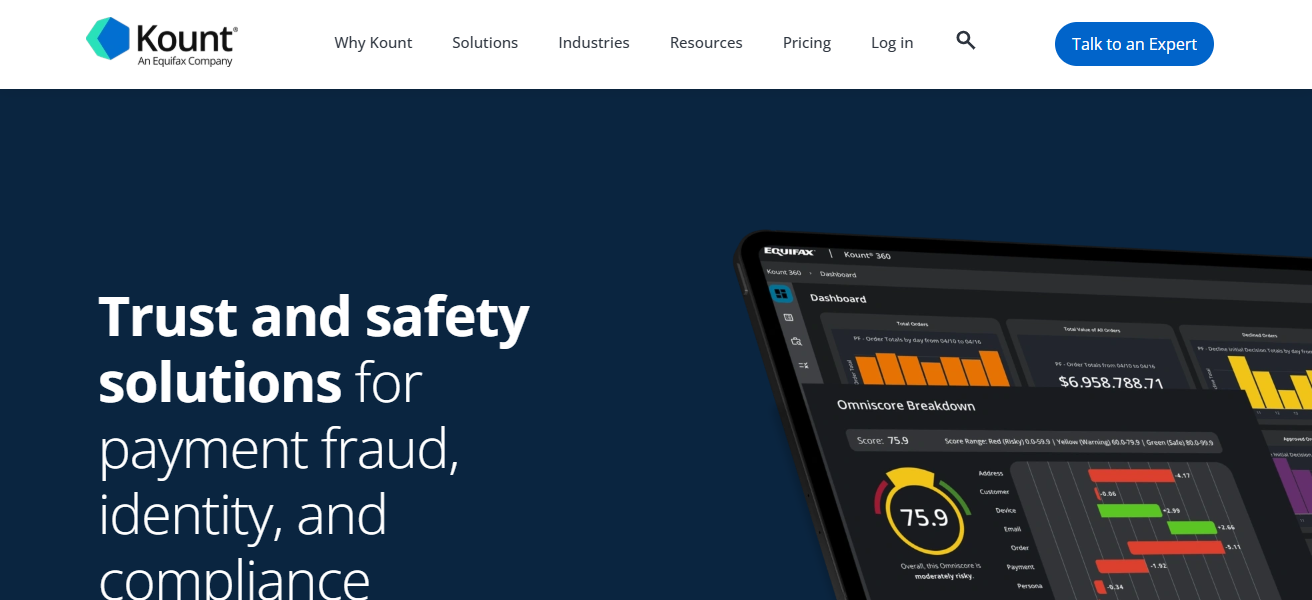
Kount incorporates response alerts (Verifi and Ethoca) with order authentication, identity confirmation, and automated rapid dispute resolution.
Kount’s real-time data and customizable automation allow merchants with higher risk profiles to refine their loss mitigation and customer services, all while meeting industry compliance standards.
Kount Features
Identity Trust Global Network – Assesses billions of data points for precise risk scoring.
Real-Time Decisioning – Automatically accepts or rejects transactions depending on the risk.
Integration with Alerts – Merges early alerts with the tools for preventing fraud.
Adaptive Machine Learning – Adjusts rules automatically according to the feedback from data
| Pros | Cons |
|---|---|
| Unified fraud + chargeback prevention platform with real‑time decisions. | Fraud and dispute features can be costly at high volume. |
| Strong identity signals (global network) reduce false positives. | Complexity may require dedicated risk team. |
| Integrates early alerts with order validation and mitigation workflows. | Some advanced customization needs technical resources. |
| Flexible for different merchant sizes and industries. | Interface may be complex for beginners. |
8. Signifyd
Signifyd’s commerce protection platform gives chargeback protection at no cost to the merchant when fraud is suspected. signfyd automates the back-and-forth of chargeback disputes.
Signfyd leverages a variety of commercial and fraud-related data points to optimize real-time performance on orders. Fraud and chargeback dispute trends provide insights to optimize automation strategies.
For high-risk merchants with revenue volatility and the financial burden associated with chargeback fraud, Signifyd’s guarantee is a beneficial addition.
Signifyd Features
Guaranteed Chargeback Protection – Takes the losses from fraud chargebacks on approved orders.
Real‑Time Commerce Intelligence – Scores risk using pumped network signals.
Automated Evidence Bundles – Collects all the required documents for a dispute automatically.
Decision Automation – Minimal manual intervention for approving or declining transactions.
| Pros | Cons |
|---|---|
| Offers guaranteed chargeback reimbursement for approved orders, shifting liability. | Guarantee comes with requirements — declining guaranteed orders won’t be covered. |
| Very strong fraud detection based on commerce network intelligence. | Can be expensive for smaller merchants without high fraud risk. |
| Automates evidence collection and dispute responses. | Not strictly a chargeback management tool — more focused on fraud + guarantee model. |
| Improves approval rates without taking on excess risk. | Some merchants feel tied to Signifyd’s decision model. |
9. Sift
Sift’s platform examines global interactions through AI-based fraud decisioning, risk assessment, and chargeback management.
Sift provides merchants the automation and categorization of chargeback responses that saves them time, and helps them understand the cause of their disputes.
Sift’s systems work to improve the identification of patterns that lead to disputes, and streamline chargeback management to aid analytics.
The balance of chargeback automation and fraud detection systems provides aiding analytics to support Sift’s platform reputation.
Sift Features
AI Powered Risk Scoring – Scans for suspicious activity using advanced machine learning.
Dispute Categorization Tools – Assists merchants in sorting chargebacks by the reason.
Integrated Fraud + Chargeback Insights – Merges visibility on fraud with dispute coordinates.
Automated Workflows – Eases the manual effort involved in working on a dispute.
| Pros | Cons |
|---|---|
| AI‑powered fraud detection + dispute insight in one platform. | Chargeback features are more analytics‑centric than full‑service representment. |
| Large global signal network improves risk scoring accuracy. | Requires configuration and tuning for best results. |
| Automates workflows to reduce manual overhead. | Best suited for mid‑large merchants. |
| Helps categorize dispute causes to prevent repeat patterns. | Less focus on automated refunds vs. some competitors. |
10. Accertify
Accertify is an enterprise risk and management platform that has built automated solutions for chargeback dispute resolution, fraud management, and multi-channel decisioning.
In chargeback management, it offers continuous engagement, advanced automation, and partnerships with over 60 payment service providers to alleviate operational complexity.

Accertify analyzes loss dispute patterns and applies predictive modeling to streamline dispute resolution approaches, lowering chargeback losses by significant percentages
often by ~50%. The platform is particularly well suited to larger merchants with advanced fraud and dispute management needs.
Accertify Features
Enterprise Chargeback Automation – Addresses large workloads with scalable chargeback automation.
AI Fraud Decisioning – Merges fraud prevention and dispute resolution.
Multi-Partner Integrations – Collaborates with 60+ payment and risk partners.
| Pros | Cons |
|---|---|
| Enterprise‑grade chargeback automation + fraud prevention capabilities. | Designed for high volume — may be too large and complex for small businesses. |
| Scalable workflows with AI‑based decisioning reduce manual work. | Setup and integration require technical resources and time. |
| Integrates with dozens of payment networks and partners. | More expensive than smaller solutions. |
| Detailed analytics and reporting help optimize dispute strategies. | Licensing complexity varies by feature set. |
Key Reasons To Choose The Best Chargeback Management Tools For High-Risk Merchants
- Reducing Financial Losses – Stop chargebacks and fees from falling out of your control.
- Proactive Fraud Prevention – Defend revenue by stopping and identifying fraud.
- Automated Dispute Management – Balance out gaps from human error in representment processes and save time.
- Real-Time Alerts & Analytics – Get an instant overview of disputes, their trends and root causes.
- Compliance with Card Networks – Keep your chargeback ratios in balance with Visa/Mastercard.
- Improved Customer Experience – Dispute resolution can be supercharged to minimize unnecessary friction.
- Designed for High Risk – Travel, subscription, digital goods, etc all have their own specialty tools.
Conclusion
In conclusion, choosing the Best Chargeback Management Tools for High Risk Merchants is critical to reducing loss, stopping fraud, and improving automation of the chargeback process.
These tools provide automated workflows, fraud identification, and industry-specific alerts for high-risk industries.
The right solution helps merchants protect revenue loss while being compliant, and improves operational efficiency to the payment ecosystem.
FAQ
They are software solutions designed to help merchants prevent, monitor, and respond to chargebacks efficiently.
High-risk merchants face more frequent disputes; these tools reduce financial losses and maintain compliance.
Yes, many integrate fraud detection to stop risky transactions before chargebacks occur.
Most top tools automate evidence collection, submissions, and workflow management.
Yes, platforms like Chargebacks911 and Ethoca support multiple currencies and international transactions.