In this article, I will explain the Best Compliance Automation Tools for Fintechs which help automate compliance tasks, decrease labor intensity, and assist companies in adhering to changing financial legislation.
- Key Points & Best Compliance Automation Tools for Fintechs
- 10 Best Compliance Automation Tools for Fintechs
- 1. ComplyAdvantage
- 2. Chainalysis
- 3. Ascent RegTech
- 4. Scytale
- 5. Hyperproof
- 6. Drata
- 7. Vanta
- 8. LogicGate Risk Cloud
- 9. Secureframe
- 10. Tugboat Logic
- How To Choose Best Compliance Automation Tools for Fintechs
- FAQ
Fintechs face strict AML, KYC, and data protection regulations, so selecting effective automation tools for seamless operation and efficient risk mitigation, to retain customer and regulator confidence, is important.
Key Points & Best Compliance Automation Tools for Fintechs
| Tool | Key Point |
|---|---|
| ComplyAdvantage | AI-driven AML screening that reduces false positives in fraud detection. |
| Chainalysis | Blockchain transaction monitoring for crypto compliance and risk management. |
| Ascent RegTech | Automated regulatory updates to keep fintechs aligned with changing laws. |
| Scytale | SOC 2 & ISO 27001 automation with streamlined audit readiness. |
| Hyperproof | Centralized compliance workflows with integrations for risk tracking. |
| Drata | Continuous monitoring of security controls for fintech compliance. |
| Vanta | Fast compliance readiness for startups aiming at SOC 2 certification. |
| LogicGate Risk Cloud | Customizable GRC platform for managing enterprise risk and compliance. |
| Secureframe | Automated evidence collection to simplify audits and reporting. |
| Tugboat Logic | Policy automation engine that generates compliance documentation instantly. |
10 Best Compliance Automation Tools for Fintechs
1. ComplyAdvantage
ComplyAdvantage is the industry-leading fintech compliance automation solution that helps manage the detection and prevention of financial crime.
ComplyAdvantage’s AI solution screens customers, transactions, and other third-party entities for risk associated with financial crimes like money laundering, sanctions, and terrorist financing.
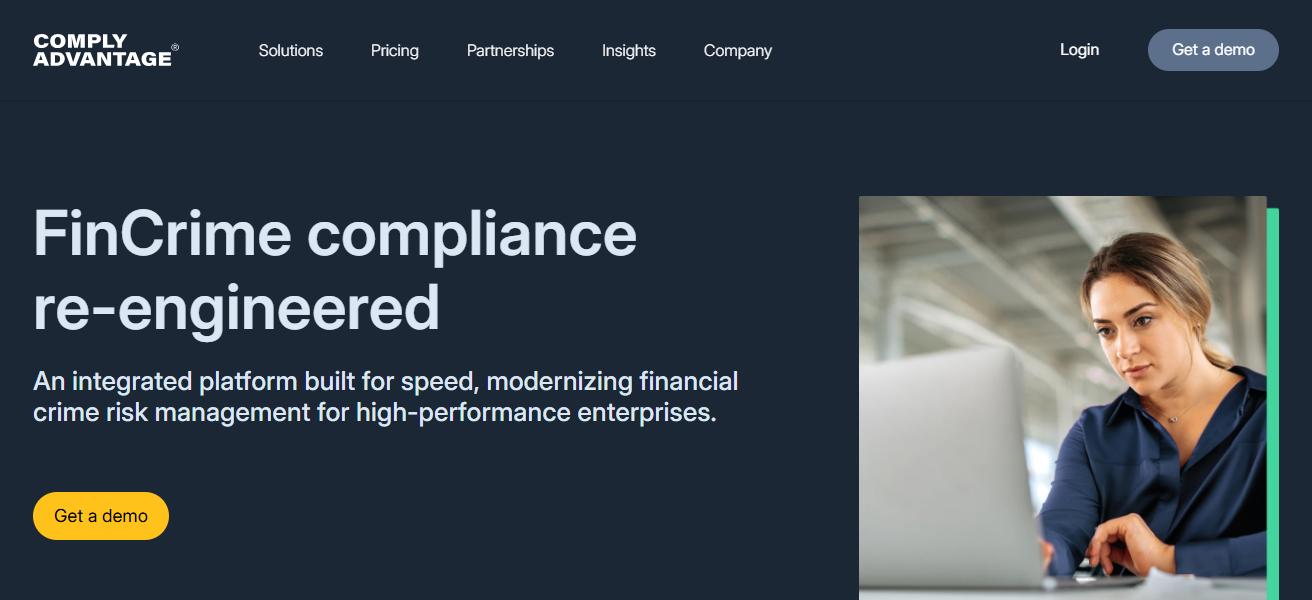
Fintechs are able to automate the onboarding, monitoring, and reporting processes with less manual effort and reduced error problems with the use of real-time risk data and ever-changing watchlists.
ComplyAdvantage’s solution integrates with virtually any system and provides alerts for real-time analytics to aid in faster decision-making.
ComplyAdvantage helps less mature and growing fintechs automate compliance to avoid the problem of growing a compliance department to manage compliance.
Features ComplyAdvantage
Real-Time AML Screening – Instantly captures risk and scans customers and transaction data in real-time against (PEP) and negative adversarial sanctions, and media lists.
Risk Scoring & Alerts – Assigns risk levels and scores to entities and sends alerts so suspicious activities can be quickly prioritized and investigated.
Dynamic Watchlists – Automatically refreshes and updates global watchlists so fintechs can always screen against the most recent sanctions and enforcement data.
Integration Capabilities – Offers functionalities with onboarding tools, CRM systems, and transaction systems for smooth compliance workflows with zero manual data entry.
| Pros | Cons |
|---|---|
| Uses real‑time AI‑driven risk data to detect financial crime. | Can be expensive for early‑stage fintechs with limited budgets. |
| Dynamic watchlists that update automatically. | Implementation can require external support for complex workflows. |
| Strong AML/KYC monitoring and alerting. | Some advanced features may have a steep learning curve. |
| Reduces manual screening effort significantly. | Customization beyond default use cases may need professional services. |
| Integrates with many fintech and banking systems. | May generate false positives without tuning initially. |
2. Chainalysis
Blockchain analysis and cryptocurrency compliance via Chainalysis is crucial to digitally integrated fintechs. The platform allows for seamless real-time tracking of dubious transactions and examines instances of fraud, money laundering, and ransomware.
Chainalysis facilitate automation for compliance verification on crypto transactions and wallets within the regulator frameworks. The platform effectively aids compliance teams in tracking and tracing funds across blockchain networks.
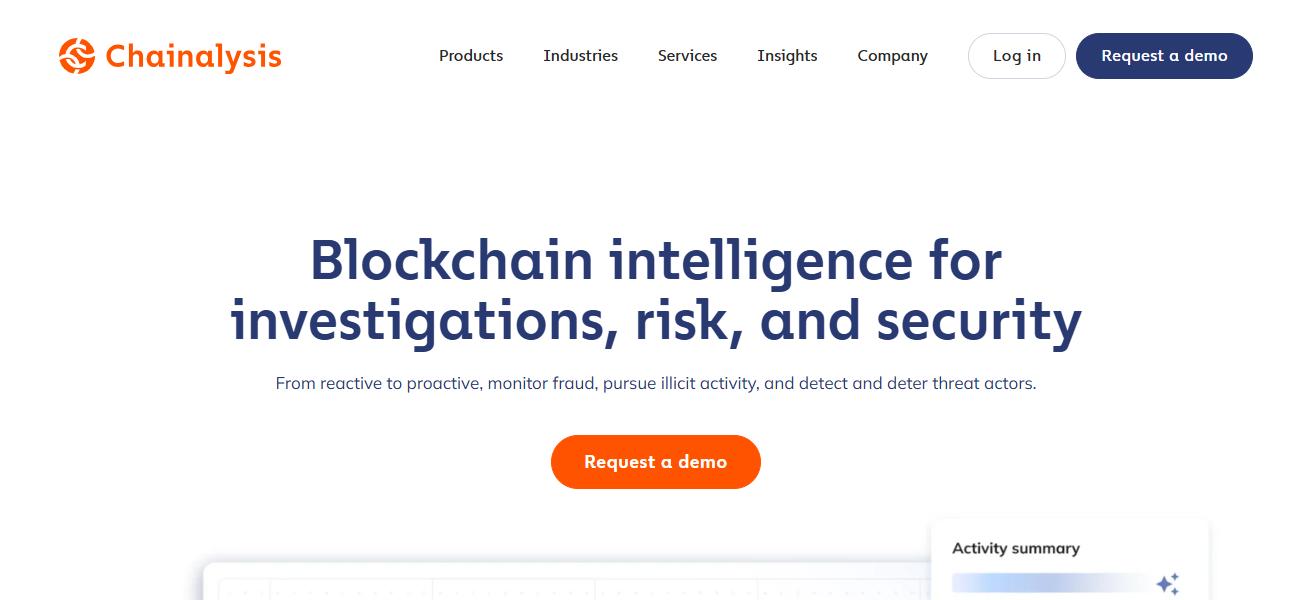
Integrating Chainalysis allows fintechs to cultivate transparency and trust from regulatory agencies while protecting operational layers within the rapidly evolving cryptocurrency ecosystem.
Features Chainalysis
Blockchain Transaction Monitoring – Monitors crypto movements within and across various blockchains to detect bad behaviors.
Risk Scoring Engine – Improves the quality of automated decision-making by assigning risk scores to wallets and addresses based on their activity and transaction history.
Investigative Tools & Dashboards – Offers specialized tools for compliance teams to visualize, and search to untangle complex crypto movements.
| Pros | Cons |
|---|---|
| Best‑in‑class blockchain transaction monitoring. | Primarily focused on crypto, not traditional finance. |
| Provides detailed investigation and risk scoring tools. | Cost can be high for real‑time, full‑coverage plans. |
| Helps meet AML requirements in digital assets. | Learning curve for teams new to blockchain analysis. |
| Widely trusted by regulators and exchanges. | Large volume alerts may need manual triage. |
| Supports tracing illicit funds on multiple blockchains. | Integration complexity with legacy systems. |
3. Ascent RegTech
Ascent Regtech provides fintech companies with a compliance knowledge platform that digitally interprets and manages compliance obligations.
Ascent uses AI and natural processing language to extract pertinent rules and regulations from around the globe, crossing and matching specific regulations to a company’s policies and procedures.
This compliance knowledge platform significantly mitigates the time-consuming challenge of monitoring regulators, and ensures simultaneous compliance across several jurisdictions.
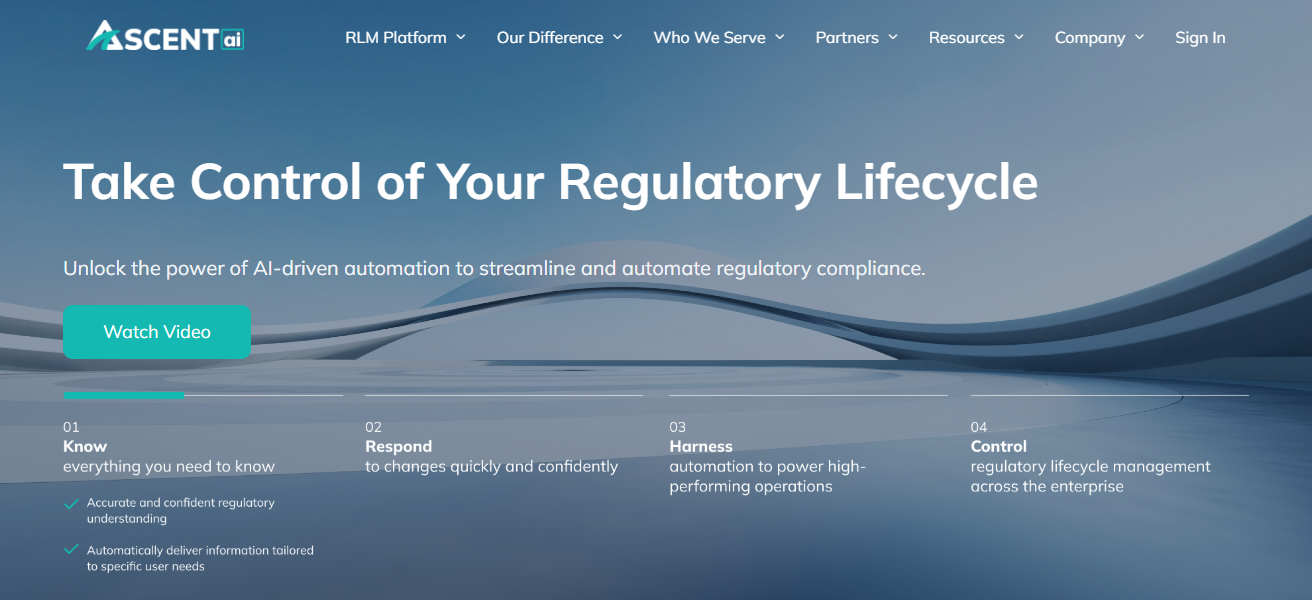
Once users receive assignments, they are able to create a to-do list and get settled tasks along with notifications for upcoming tasks.
Ascent Regtech provides an invaluable service to the international fintech industry by eliminating the painstaking task of compliance monitoring and enabling compliance teams to devote their time and resources to more critical decision-making.
Features Ascent RegTech
Regulatory Rule Extraction – AI interprets the regulatory texts and automatically extracts relevant compliance obligations.
Policy Mapping – Cross-references regulatory obligations with internal policies and processes to clarify the required actions for implementation.
Change Alerts & Updates – Automatically provides alerts for updates, changes, or introductions of regulations concerning your fintech.
Task & Assignment Automation – Transforms obligations concerning regulations into compliance activities with deadlines assigned to teams.
| Pros | Cons |
|---|---|
| Automates regulatory interpretation for multiple jurisdictions. | May require additional systems for end‑to‑end compliance workflows. |
| Reduces manual regulatory research work. | Dependent on quality and currency of regulatory data sources. |
| Alerts for regulatory changes relevant to your business. | Initial setup to map your policies can take time. |
| Helps with cross‑border compliance complexity. | Best suited for regulated enterprises (not micro start‑ups). |
| Excellent for firms with heavy regulatory tracking needs. | UI/UX may feel complex for non‑compliance users. |
4. Scytale
Scytale is the only compliance automation tool that focuses on digital identity verification and document security at the same time. Created for fintech companies, it automates KYC and AML processes, quickly and securely verifying the identities of customers.
The platform’s document capture and verification, along with storage, alleviate operational bottlenecks and reduce the likelihood of fraud.
Scytale also prepares compliance reports and interfaces with other fintech tools for workflow efficiency.
With Scytale, fintechs improve the customer onboarding experience and maintain compliance without hampering the speed of business, meeting all regulations, and lightening the load on the compliance department.
Features Scytale
Digital Identity Automation – Captures and securely validates customer identity documentation through automated verification workflows.
Secure Document Storage – Offers KYC and other compliance records in auditable encrypted vaults for safekeeping.
Fraud Detection Checks – Implements document loss and identity fraud prevention verification to enhance the security of the onboarding process.
API Integration – Works with fintech onboarding and CRM systems to enhance the verification process with no operational interruptions.
| Pros | Cons |
|---|---|
| Strong digital identity and document verification automation. | Narrow focus compared to full GRC platforms. |
| Speeds up KYC onboarding securely. | May require plug‑ins for other compliance modules. |
| Reduces fraud via verified documentation. | Some advanced anti‑fraud features cost extra. |
| Centralized secure storage for compliance evidence. | Not ideal if broad risk management automation is needed. |
| Integrates with onboarding flows easily. | Scalability features may be limited for large enterprises. |
5. Hyperproof
Hyperproof specializes in compliance management by providing centralized modules for control management, evidence collection, and audit management.
Fintech customers get the ability to automate repetitive compliance tasks, keep track of risk assessments, and manage compliance frameworks (e.g. SOC 2, ISO 27001, and GDPR).
It enables compliance teams and auditors to work together in real time and reduces the burden of manual documentation and reporting.
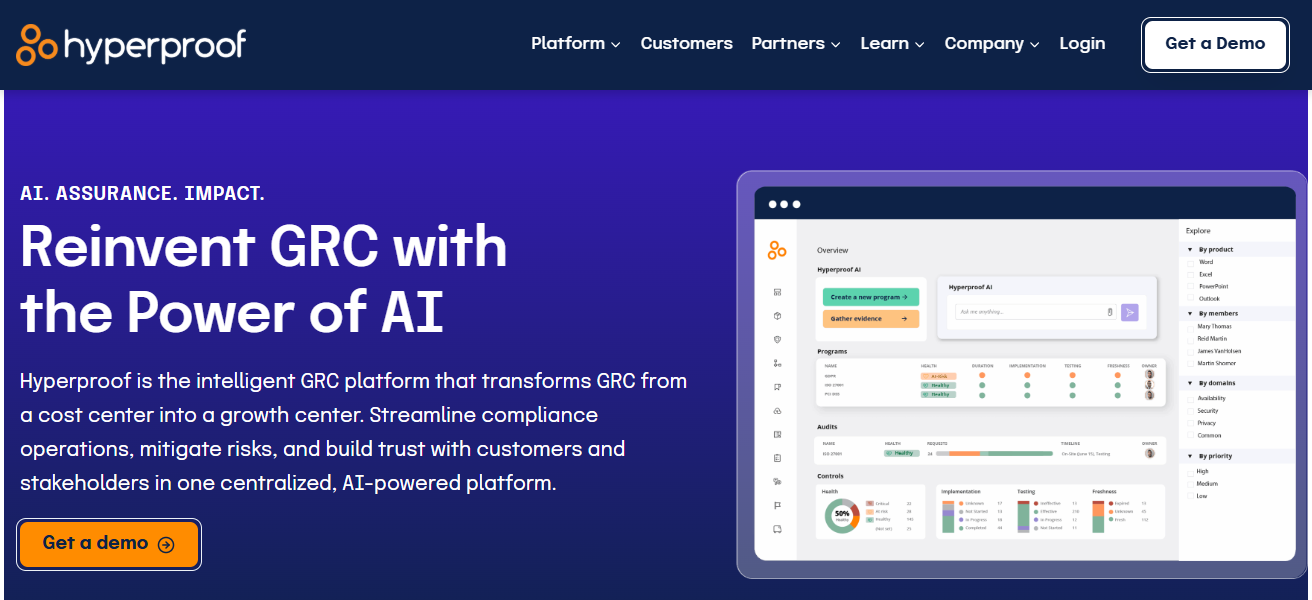
Its dashboards facilitate compliance visibility and help teams detect compliance posture improvements by addressing regulatory changes in real time.
Hyperproof also helps fintechs streamline audit processes while eliminating ubiquitous manual process errors.
Its automation capabilities also help smaller teams achieve the compliance efficiency of large enterprises without the resource and technical complexity.
Features Hyperproof
Compliance Workflow Automation — Automates tasks that are repetitive in nature such as control testing, collection of evidence, and sending reminders for compliance.
Centralized Evidence Repository – This feature consolidates audit trails, evidence, and documentation in one easily accessible and searchable location.
Multi-Framework Support – This feature allows customers to manage multiple frameworks, including SOC 2, ISO 27001, GDPR, PCI, and custom ones.
Audit Readiness Dashboards – This feature provides a series of visual dashboards that indicates compliance position, outstanding gaps, and other tasks that need focus.
| Pros | Cons |
|---|---|
| Centralizes controls, evidence collection, and audit trails. | Can be expensive for small fintech teams. |
| Supports multiple frameworks (SOC 2, ISO, GDPR). | Some advanced customization needs professional services. |
| Enables collaboration between compliance and audit teams. | Initial setup and configuration time can be significant. |
| Easy dashboard visibility of compliance posture. | Smaller teams may not use full functionality. |
| Reduces manual reporting and audit preparation. | Dependent on integrations to pull evidence automatically. |
6. Drata
Drata is another compliance automation service provider in the market focusing on providing pivot services. Drata provides automation services in maintaining compliance monitoring standards like SOC 2, ISO 27001, and HIPAA.
Drata offers automation in compliance monitoring, collection of evidence, and maintaining audit-ready reports. The services Drata provides improve the inefficiencies associated with compliance management.
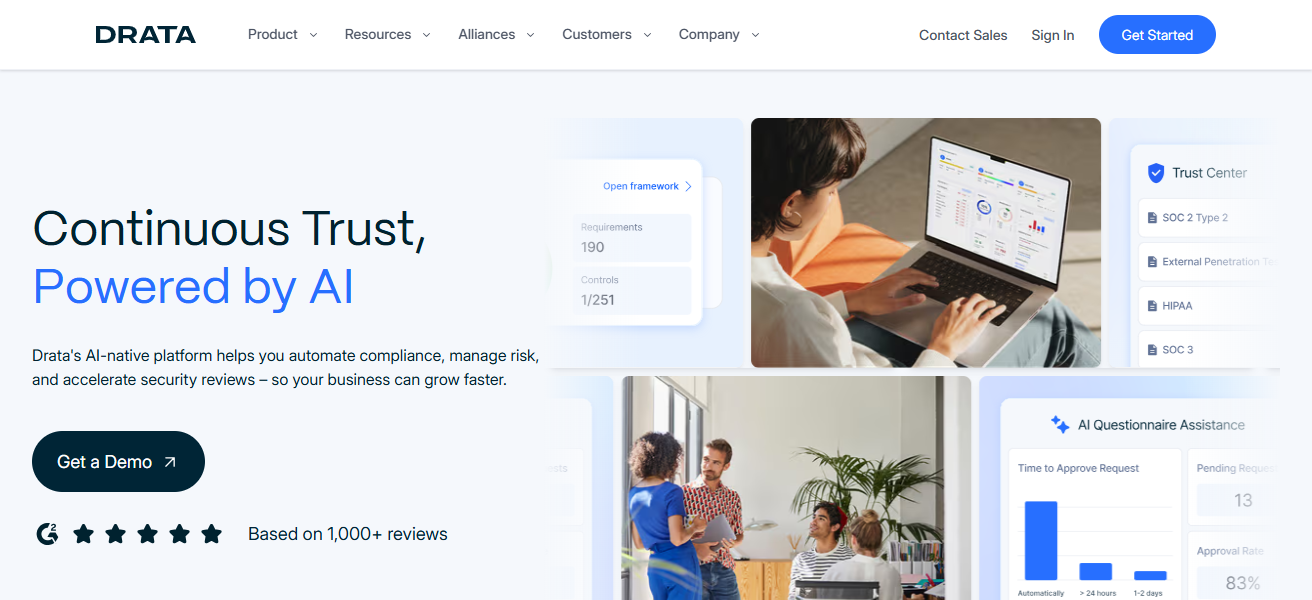
Drata provides immediate notifications and monitoring services in real time. Drata is providing pci services. Drata provides pci services for startups and growing companies. Drata provides the services without heavy monitoring.
Features Drata
Continuous Control Monitoring – This feature provides monitoring of security settings, access patterns, and other system attributes to determine if compliance is being maintained.
Automated Evidence Collection – This feature secures audit evidence from cloud and productivity applications without requiring upload from users.
Real-Time Alerts – This feature provides an immediate warning to users if a control is not working, and a risk is present.
Integrated Compliance Scoring – This feature provides a mechanism to visually present compliance posture through a scoring system based on various frameworks including SOC 2, ISO 27001, and a few others.
| Pros | Cons |
|---|---|
| Continuous monitoring of security controls and config. | Best focused on security compliance—needs integrations for broader risk. |
| Automates evidence collection and reporting. | Pricing scales with integrations and use cases. |
| Helps maintain SOC 2, ISO 27001, HIPAA. | Smaller fintechs might not need all features. |
| Real‑time alerts for potential compliance drift. | Some users report support wait times. |
| Easy integration with productivity and cloud tools. | Initial onboarding can be time‑intensive. |
7. Vanta
Vanta helps automate SOC 2, ISO 27001, HIPAA, and GDPR compliance for fintechs and manages evidence collection, oversight of security controls, employee policy automated enforcement, and audits without all manual efforts, much of the work braches low hanging fruit out of audits.
Supported integrations that cover major cloud productivity suites provide continuous compliance and adaptive security fintech’s must have. Their monitors provide compliance visibility helping teams close identify and address gaps.
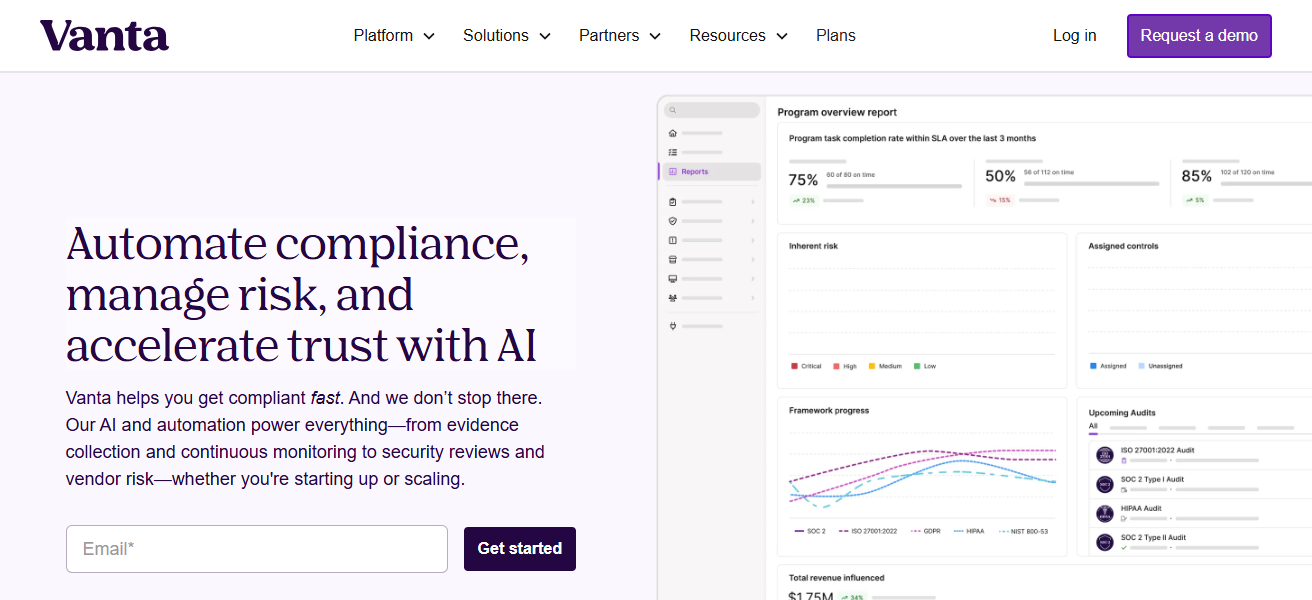
Rather than having to grind through manual compliance tasks, fintechs focusing on growth will have the ability to get audits done, security practices will have been enhanced, and investors, customers, and regulators will have more confidence.
Features Vanta
Auto Evidence Generation – This feature retrieves evidence of controls without user involvement through system integrations to facilitate audit readiness.
Continuous Monitoring – This feature ensures monitoring of user accounts, settings, and other system components is continuous so that compliance is not disrupted.
Framework Guidance – This feature is intended to help users stay on course by providing custom checklists and requirements for SOC 2, ISO 27001, HIPAA, and others.
{Company X}’s Risk & Gap Reporting – Reporting providing risk areas and missing controls on a near real-time basis.
| Pros | Cons |
|---|---|
| Simplifies automation of SOC 2, ISO, HIPAA compliance. | Some advanced policy customization is limited. |
| Continuous monitoring and automatic evidence generation. | Costs add up with team members/users. |
| Fast audit readiness and certification cycles. | Requires steady integration upkeep. |
| Supports scalable compliance as company grows. | Not deeply focused on AML/KYC. |
| Solid dashboards with actionable compliance insights. | Support for niche regional standards may lag. |
8. LogicGate Risk Cloud
LogicGate Risk Cloud is a versatile suite created to automatically manage risk and compliance for a variety of fintechs. Businesses can perform risk assessments, automate workflows, and manage incident tracking on a single platform.
Compliance team members can customize workflows, automate control testing, and produce reports for audits to keep compliance streamlined.
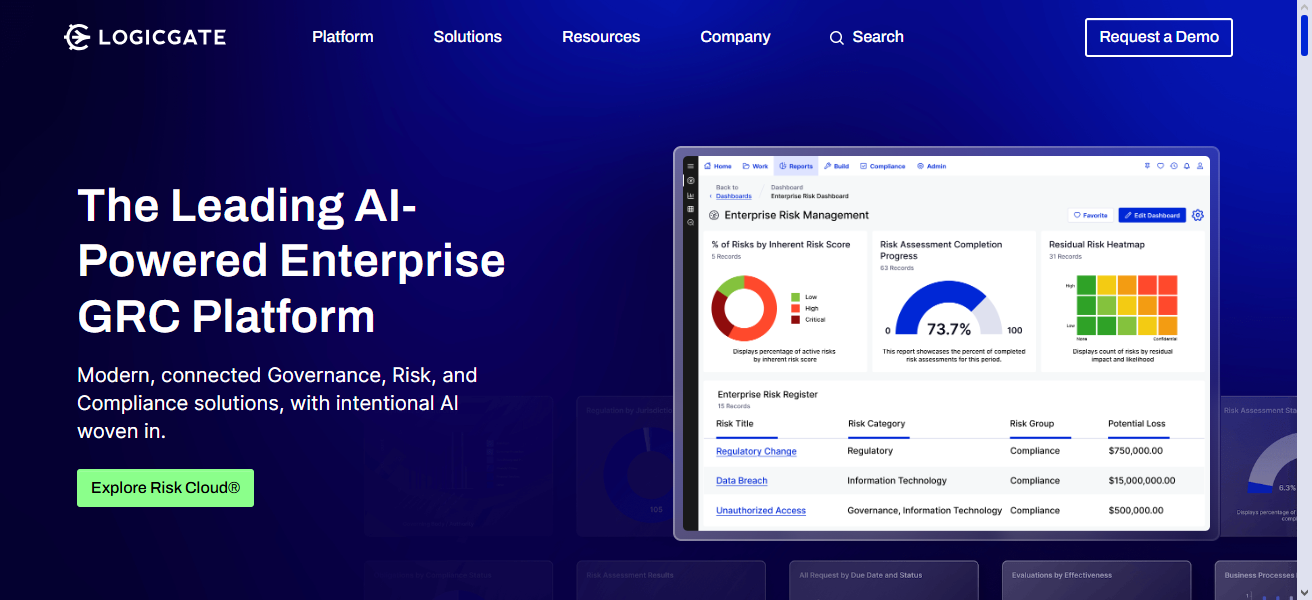
LogicGate’s no-code platform enables fintechs to rapidly adjust to new regulations and plug into their current systems to ease the operational burden.
Organizations can use LogicGate to improve visibility and manage risk more effectively to optimize their decision-making. LogicGate’s automation features address the need for manual oversight and scaled support for rapidly growing fintechs.
Features LogicGate Risk Cloud
No-Code Workflow Builder – Empowers teams to build and automate compliance and risk workflows through drag-and-drop functionalities.
Centralized Risk & Control Library – Consolidates all risks, controls, audits, and assessments.
Incident & Issue Management – Manages risk events, investigation and resolution, and remediation activities from detection to closure.
Custom Reporting & Dashboards – Provides specialized reporting that presents a visual view of compliance status, changes, and health.
| Pros | Cons |
|---|---|
| Flexible, no‑code workflow automation. | Steeper learning curve for new users. |
| Centralizes risk, incident, and compliance data. | Can require professional services for advanced configuration. |
| Easy adaptation to new or changing regulations. | Cost can be high for very small teams. |
| Allows custom mapping and reporting. | May feel overwhelming without dedicated compliance staff. |
| Integrates with existing tools and databases. | Some analytics features need upgrades. |
9. Secureframe
Secureframe is a compliance automation platform to help fintechs get and sustain effortlessly SOC 2 and ISO 27001 and HIPAA certifications.
Allows organizations to be audit-ready at every moment by automating all facets of compliance processes (evidence collection, employee training, and monitoring).
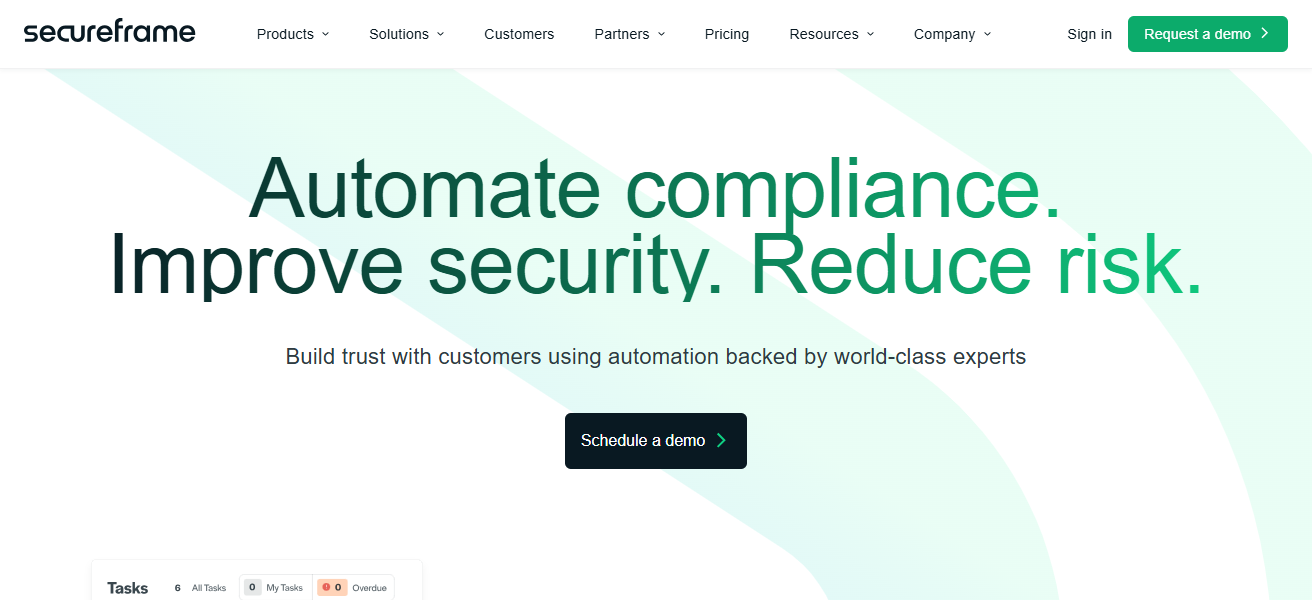
Secureframe streamlines the compliance process to over 70 integrated cloud and software solutions.
Dashboards and alerts help companies understand the compliance gaps and resolve them. Secureframe helps small compliance teams, companies, and regulators maintain and automate operational processes effortlessly.
Features Secureframe
Automated Compliance Workflows – Provides continuous monitoring and collection of evidence against compliance standards such as SOC 2 and ISO 27001.
Training & Policy Tracking – Offers modules for employee compliance training along with tracking for policy acknowledgment.
Integration Ecosystem – Provides multiple connectors to automate compliance data collection from cloud, productivity, and identity providers.
Audit Preparation Tools – Compiles all documents and conducts readiness assessments to streamline the audit submission process and review.
| Pros | Cons |
|---|---|
| Automates evidence collection and compliance monitoring. | Pricing scales significantly with number of standards. |
| Helps with SOC 2, ISO 27001, HIPAA, and more. | Premium features reserved for higher tiers. |
| Continuous monitoring keeps audit‑ready posture. | Advanced integrations require technical setup. |
| Provides employee training tracking. | Some customers experience feature gaps for unique workflows. |
| Dashboards simplify gap identification. | Smaller fintech teams might underutilize capabilities. |
10. Tugboat Logic
Tugboat Logic serves fintech companies with a comprehensive solution for automating compliance processes, including achieving standards such as SOC 2, ISO 27001, and HIPAA, seamlessly.
The platform features template policies, automated evidence collection, and continuous monitoring to facilitate audit preparation.
Ongoing automation workflows, employee training, and real-time reporting ensure sustained compliance.
Teams can simultaneously manage several certifications on the platform, minimizing time wasted and manual mistakes.
For fintech companies, Tugboat Logic is extremely helpful for accelerating compliance readiness and trust-building with customers and regulators
As well as allowing small teams to maintain enterprise compliance standards without overspending on resources and expertise.
Features Tugboat Logic
Pre‐Built Policy Library – Supports compliance acceleration joiners with out-of-the-box policy templates covering major frameworks.
Evidence Automation – Streamlines audit preparedness by automatically sourcing and retaining evidence from interconnected systems.
Ongoing Track – Monitors control effectiveness and identifies discrepancies in real time.
Training and Awareness – Offers on-the-job training for compliance and framework practice requirements.
| Pros | Cons |
|---|---|
| End‑to‑end compliance automation (SOC 2, ISO, HIPAA). | Full‑suite price makes it less accessible for early startups. |
| Includes pre‑built policy templates and training. | May require consulting help for complex frameworks. |
| Automated evidence gathering and reporting. | Dashboard customization is more limited. |
| Supports multiple certifications at once. | Not as strong for AML/KYC as specialist tools. |
| Reduces audit prep time significantly. | Integrations sometimes need development work. |
How To Choose Best Compliance Automation Tools for Fintechs
Understand Your Compliance Requirements Recognize the required frameworks (AML, KYC, SOC 2, ISO, GDPR). Define the must-haves versus the nice-to-haves.
Verify Integration Capability: Tools must incorporate existing systems (CRM, onboarding, cloud). It is better to use tools that have strong APIs and native connectors.
Assess the Level of Automation: Automatic monitoring, warning and reporting look for. Artificial intelligence must be evaluated for risk scoring and the automation of rules.
Examine Sustainability: The tool must accompany the business. Support for compliance in multiple jurisdictions.
Weigh Cost Against Value: ROI benefits and pricing tiers must be reviewed. Costs must be weighed against the extent of automation and risk mitigation.
Cocnlsuion
In conclusion Even if there are numerous compliance automation technology solutions on the market, the balance of compliance automation technology solutions must be accomplished.
Keeping ahead in the fast-evolving regulated financial environment. ComplyAdvantage, Chainalysis, Vanta, and Hyperproof have the potential to automate
KYC, AML, and audits while improving efficiencies, minimizing touch, and enhancing risk management. With the solutions, there is operational efficiency within the fintech ecosystem, compliance, and trust customers, and regulators.
FAQ
Tools that automate regulatory processes, like KYC, AML, and audits, reducing manual effort and errors.
Fintechs face strict regulations; automation ensures compliance, reduces risk, and saves time.
ComplyAdvantage and Chainalysis are top choices for transaction monitoring and identity verification.
Yes, platforms like Vanta, Hyperproof, and Drata support SOC 2, ISO 27001, GDPR, and HIPAA.
Many tools, such as Drata and Vanta, scale with growing fintechs and smaller teams.