
This article will cover D2C Brand Enablement Platforms that assist companies in selling directly to customers.
Depending on the platform chosen, a business can have more or less control in the management of products, payments, marketing, and overall customer experience.
These platforms help manage customer experience and the overall scale of online operations, and they help optimize sales across multiple channels, whether the business is a startup or an enterprise.
Key Points & Best D2C Brand Enablement Platforms
| Platform | Key Point |
|---|---|
| Shopify | Scalable all-in-one solution with strong app ecosystem and omnichannel support |
| BigCommerce | Robust enterprise-level features including advanced SEO and multi-store management |
| Magento (Adobe Commerce) | Highly customizable open-source platform ideal for complex D2C operations |
| WooCommerce | Flexible WordPress integration with extensive plugins for small to mid-sized brands |
| OpenCart | Best for small retailers offering lightweight, easy-to-use eCommerce tools |
| Webflow eCommerce | Superior design flexibility for visually-driven D2C brands |
| Squarespace Commerce | User-friendly design templates with integrated marketing tools |
| Wix eCommerce | Affordable and beginner-friendly platform with drag-and-drop customization |
| Salesforce Commerce Cloud | Enterprise-grade scalability with AI-driven personalization |
| QPe | India-focused D2C enablement with strong payment and logistics integration |
10 Best D2C Brand Enablement Platforms
1. Shopify
Simplified and highly scalable, Shopify is among the most recognized D2C Brand Enablement Platforms. It’s a highly recognized platform with high flexibility and notoriety.
It’s a platform with a lot of versatility. Shopify supports a lot of customization and offers many themes, inventory management, and payment management.

Shopify integrates payment management. Brands can help customize and optimize growth with the apps Shopify integrates for marketing, growth, and shipping.
Shopify also offers a variety of analytics. Starting with beginners, to advanced, giving flexibility across social media and marketplaces, Shopify is recognized and highly valued for D2C Brands.
Shopify Features
- Simple Store Setup: The smooth interface with drag-and-drop functionality enabling the user to quickly set up the store.
- Ecosystem of Applications: Shop marketing, payment, shipping, analytics, and automations.
- Sell on All Platforms: Effortlessly sell through websites, social media, marketplaces, and POS systems.
- Safe & Secure for Growth: Reliable hosting, SSL, and automatic updates to grow businesses.
| Pros | Cons |
|---|---|
| Extremely user-friendly and quick to set up online stores. | Monthly subscription can be costly for larger stores with many apps. |
| Scalable for startups to large businesses. | Limited flexibility for highly customized backend operations. |
| Wide variety of themes and apps for marketing, shipping, and analytics. | Transaction fees if not using Shopify Payments. |
| Strong omnichannel support across web, social media, and marketplaces. | Advanced customizations may require developer assistance. |
2. BigCommerce
BigCommerce is an ideal platform for businesses needing flexibility and growth in D2C operations. It handles complex product catalogs and supports multi-channel selling and advanced SEO.
Unlike some other platforms, BigCommerce provides marketing, analytics, and payment processing tools, minimizing reliance on third-party applications.
Its scalable architecture is designed for both small startups and big enterprises. Brands enjoy robust customization
B2B capabilities, and secure hosting, enabling them to concentrate on customer experience and online sales optimization.
BigCommerce Features
- Advanced Search Engine Optimization Tools: In platform SEO optimization to result in greater search visibility and user traffic.
- Multi-Channel Selling: Selling on marketplaces and social sites, along with B2B.
- Built-In Native Features: analytics, payment, and marketing tools are all included to eliminate the need for additional third-party applications.
- Flexible Control of Product Management: Complex catalogs, variations, and pricing rule customs.
| Pros | Cons |
|---|---|
| Supports complex product catalogs and B2B/B2C selling. | Learning curve is higher than Shopify for beginners. |
| Advanced SEO and marketing tools built-in. | Some themes are less flexible compared to competitors. |
| Scalable architecture for growing businesses. | Costs can increase with sales volume due to pricing tiers. |
| Native analytics, payment gateways, and automation tools reduce third-party dependency. | Design customization may require coding knowledge. |
3. Magento (Adobe Commerce)
Magento (now Adobe Commerce) is a highly flexible and feature-rich platform for D2C brands requiring customization.
Advanced product management, multi-store functionality, and personalized shopping experiences are just a few of its features.
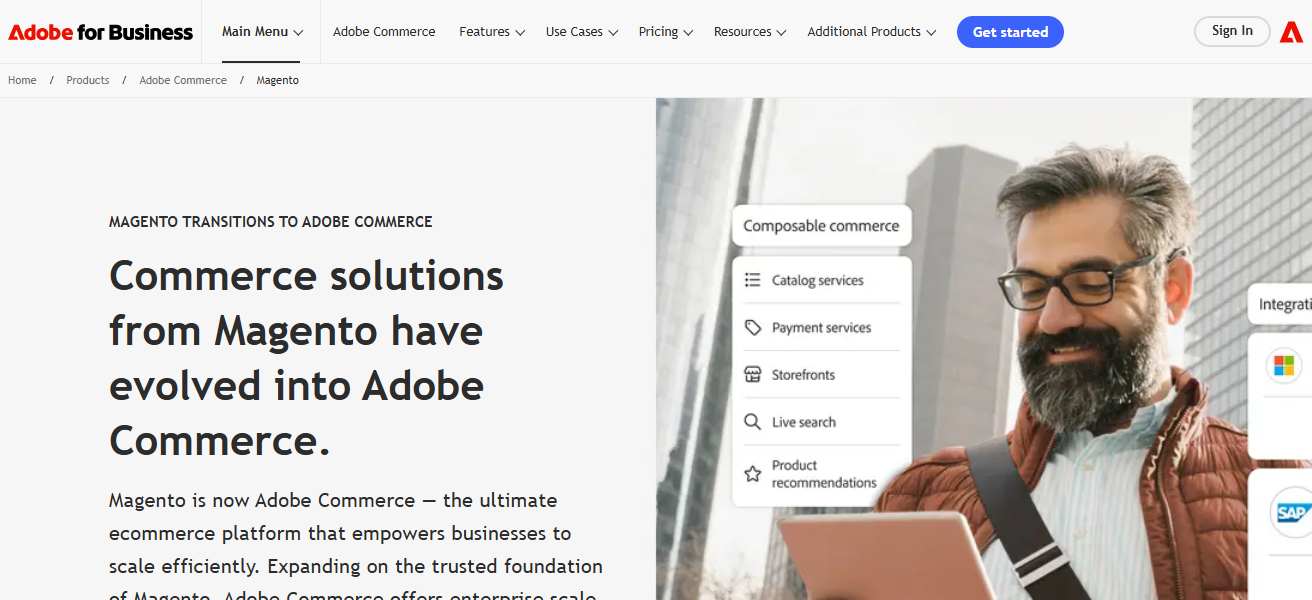
Magento’s robust API’s allow for seamless integration with ERP, CRM, and other third party applications. Proprietary customization offers businesses control over design, checkout, and backend.
Magento is ideal for brands with in-house technical resources and offers top tier scalability, security, and marketing tools. It’s especially suited for medium to large businesses looking to develop a global online presence.
Magento (Adobe Commerce) Features
- Robust Customization: Open-source flexibility for tailored design and enhanced workflows.
- Support for Multiple Stores: Control of numerous branded stores with just a single administrative panel.
- Integrations: Works with a CRM, ERP, PIM, payment gateways, and third-party systems.
- Architecture That Scales: Designed for catalogs, and traffic on an enterprise level
| Pros | Cons |
|---|---|
| Highly flexible and fully customizable. | Requires technical expertise and developer support. |
| Advanced multi-store and product management features. | Higher hosting and maintenance costs. |
| Seamless integrations with ERP, CRM, and third-party apps. | Not ideal for small businesses with limited budgets. |
| Scalable and secure, ideal for global brands. | Setup and deployment can be time-consuming. |
4. WooCommerce
WooCommerce is an excellent option for small and medium D2C brands offering great flexibility and control without enormous costs.
Integrating directly into WordPress, WooCommerce is a free plugin that turns websites into customizable eCommerce stores, and allows integration with a variety of payment, shipping, and marketing plugins.
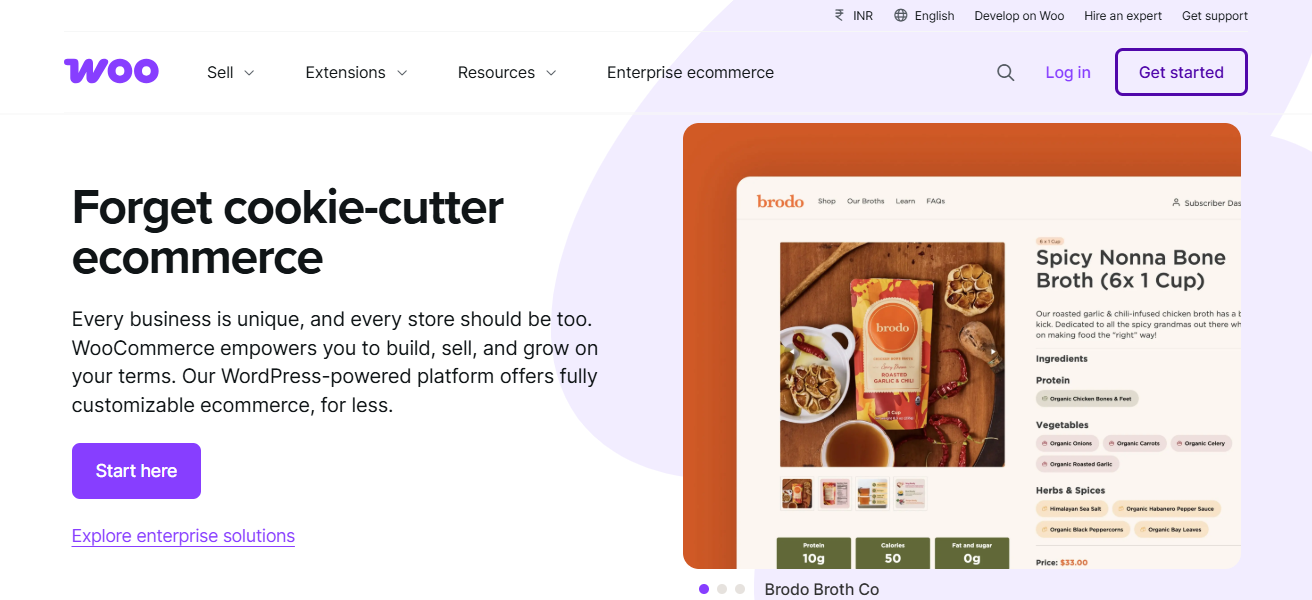
Users can take advantage of an easy to use dashboard with inventory control, and with full ownership of their online store’s data, WooCommerce creates thousands of extensions that help brands grow, optimize, and customize their data.
WooCommerce Features
- Integration with WordPress: You can turn a WordPress website into a fully functional eCommerce Store.
- Plugin Ecosystem: Plugins for payment, shipping, SEO, and marketing enhance store functionality.
- Data Ownership: Customer data, store content, and hosting environment are completely yours.
- Flexible Product Options: Offers simple, variable, and downloadable products.
| Pros | Cons |
|---|---|
| Free plugin for WordPress with vast customization options. | Requires WordPress knowledge and hosting setup. |
| Large ecosystem of plugins for payments, shipping, and marketing. | High customization can complicate site management. |
| Full control over data and store ownership. | Performance can degrade with large product catalogs if not optimized. |
| Ideal for small to medium businesses with flexible budgets. | Security depends on proper maintenance and plugin updates. |
5. OpenCart
D2C brands can use OpenCart as it is an open source eCommerce platform that is flexible and lightweight. Since it is sime and modular, businesses can easily handle and organize their products, orders, and customers.
They can manage their global sales with its multilingual, multiple currency and payment functions. There are also marketing, SEO, and analytics solutions on their marketplace.
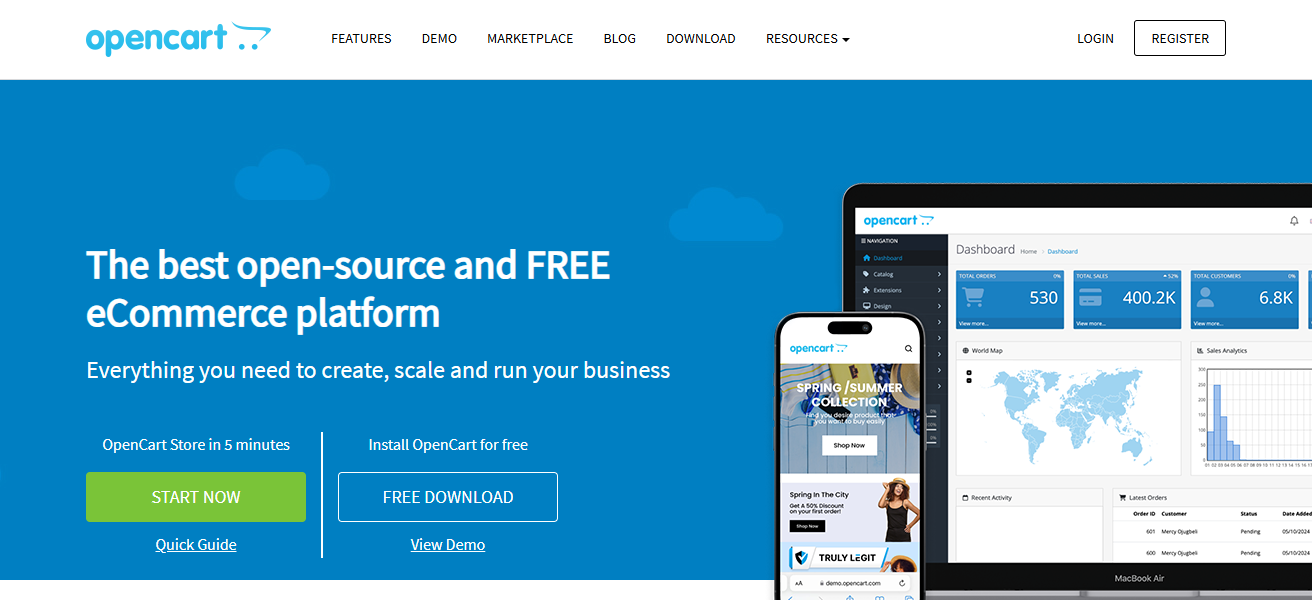
Businesses with the technical skill can fully modify OpenCart. Small businesses and start ups can also benefit from its low cost and control over their hosting and design without a reliance on 3rd parties.
OpenCart Features
- Lightweight Platform: Modular design facilitates fast performance.
- Multi‑Store & Multi‑Currency: Manage numerous stores and currencies from a single dashboard.
- Extension Marketplace: Add‑ons and themes for payment, shipping, SEO, and analytics.
- Simple Inventory Management: Streamlined control over products, orders, and customer groups.
| Pros | Cons |
|---|---|
| Lightweight, modular, and open-source. | Limited support and smaller community compared to Shopify or WooCommerce. |
| Multi-language, multi-currency support for global selling. | Design and feature customization require technical skills. |
| Cost-effective with full control over hosting. | Extensions may have varying quality and compatibility issues. |
| Easy inventory and order management for startups and small businesses. | Not as advanced for large-scale enterprises. |
6. Webflow eCommerce
Webflow eCommerce offers design flexibility and powerful eCommerce capabilities to D2C brands. Webflow isn’t like other platforms.
Users can design websites down to the pixel with no coding limitations. It comes with a built-in CMS, inventory system, and even SEO tools.
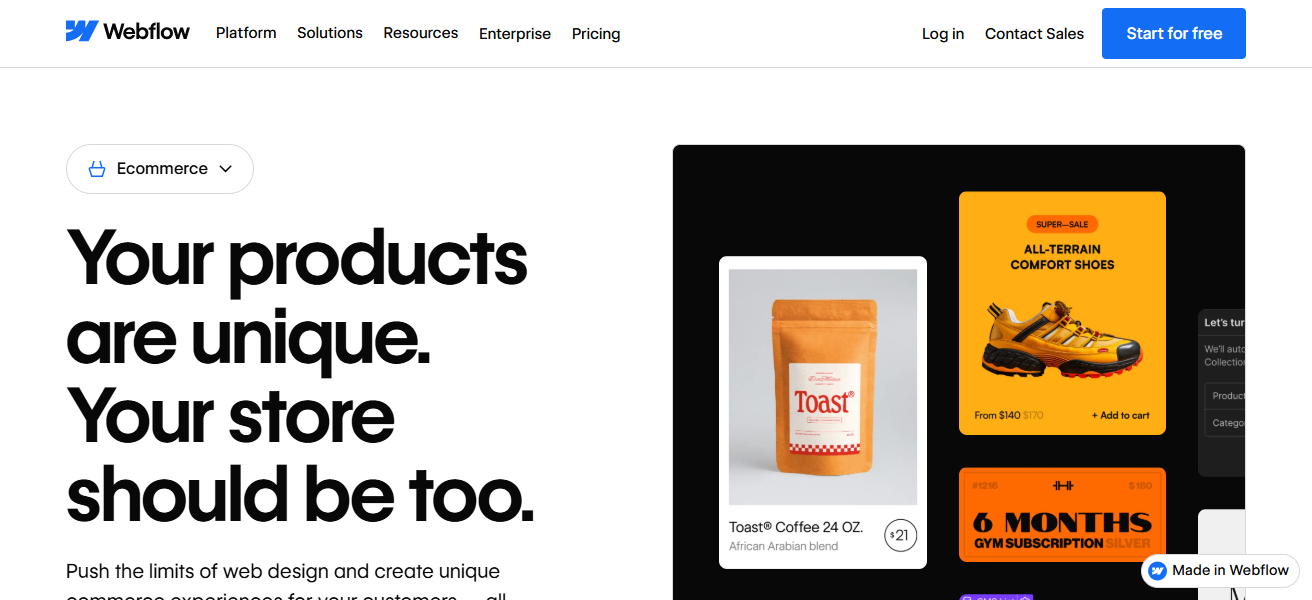
Brands can design responsive storefronts, set up payment integrations, and add marketing tools. Webflow is best suited for businesses that prioritize design and want to build an online store that looks amazing.
It offers scalability to support growth in the number of products, and its hosting means even fast growing brands and mid-sized D2C businesses can rely on its performance.
Webflow eCommerce Features
- Design Freedom: Unfettered coding allows for pixel-perfect layout control.
- Built‑in CMS: For pages, blogs, and product collections.
- SEO & Performance Tools: Visibility and speed are provided by optimized structure and hosting.
- Responsive Framework: Mobile adaptability across all devices is automatic.
| Pros | Cons |
|---|---|
| Pixel-perfect design flexibility without coding. | Steeper learning curve for non-designers. |
| Built-in CMS, inventory management, and SEO tools. | Limited app marketplace compared to Shopify. |
| Scalable and fast hosting infrastructure. | E-commerce features may not be as advanced for very large stores. |
| Ideal for design-focused brands wanting a unique online presence. | Custom integrations can require developer support. |
7. Squarespace Commerce
Squarespace Commerce provides a visually attractive and user-friendly platform well equipped for D2C brands.
Numerous small businesses and creators praise the website for its drag-and-drop builder and beautiful original templates.
Apart from website design, Squarespace Commerce also offers its users payment processing, shipping integrations, and even inventory management.
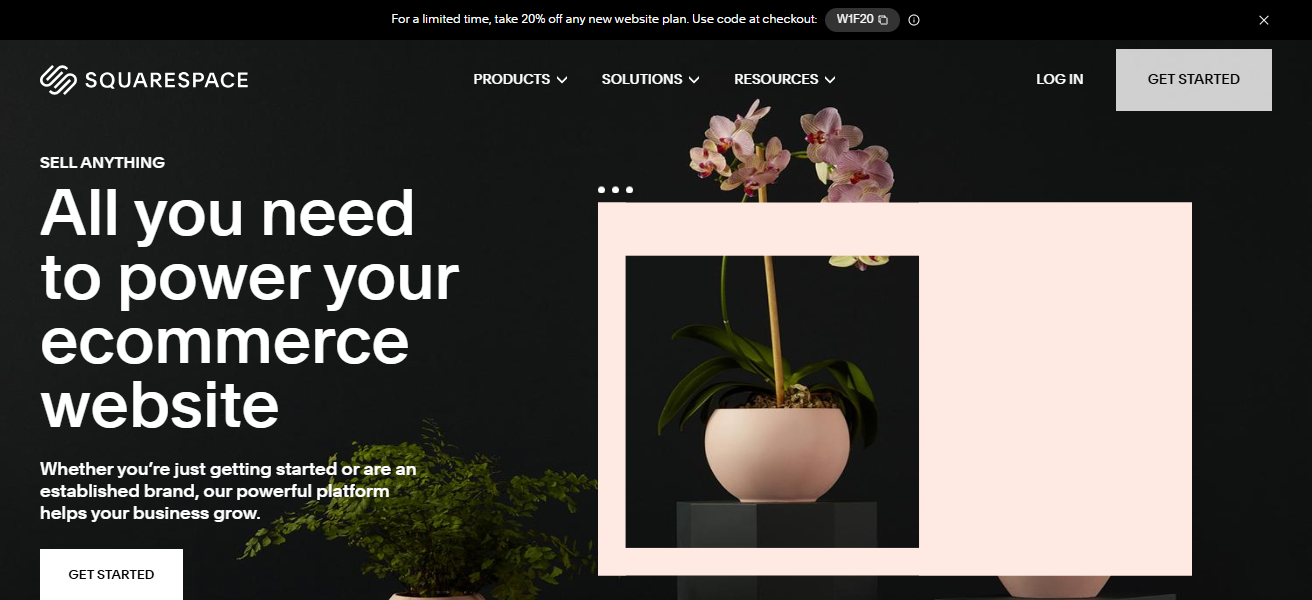
On top of the inventory and payment processing, marketing becomes simple with the email integrations, SEO tools, and analytics.
Furthermore, for brands looking for a site that works quickly and is visually appealing, as well as providing the customer with a simple and reliable experience, Squarespace Commerce is the best choice.
Squarespace Commerce Features
- Visual Templates: Themes that are aesthetically pleasing and professionally crafted.
- All‑in‑One Platform: Integrated tools for email marketing, analytics, shipping, and payment.
- Customer Management: An intuitive dashboard for customer profiles, orders, and stock management.
- SEO & Marketing Tools: Campaign builders and SEO simplification.
| Pros | Cons |
|---|---|
| Stylish templates and drag-and-drop interface. | Limited backend customization compared to open-source platforms. |
| Built-in inventory, payments, shipping, and marketing tools. | Advanced features require workarounds or third-party tools. |
| Quick setup for small businesses and creatives. | Pricing can increase with more advanced features. |
| Reliable and fast platform with mobile-friendly designs. | Not ideal for complex product catalogs or enterprise needs. |
8. Wix eCommerce
Wix eCommerce offers D2C brands an easy to use platform which prioritizes simplicity and design. Using the drag-and-drop builder, businesses can build and design an online store without writing any code.
Wix offers several built-in tools to streamline product management, support multiple payment methods, and integrate shipping and marketing tools. Wix’s App Market adds additional functions such as analytics, email marketing, and SEO.
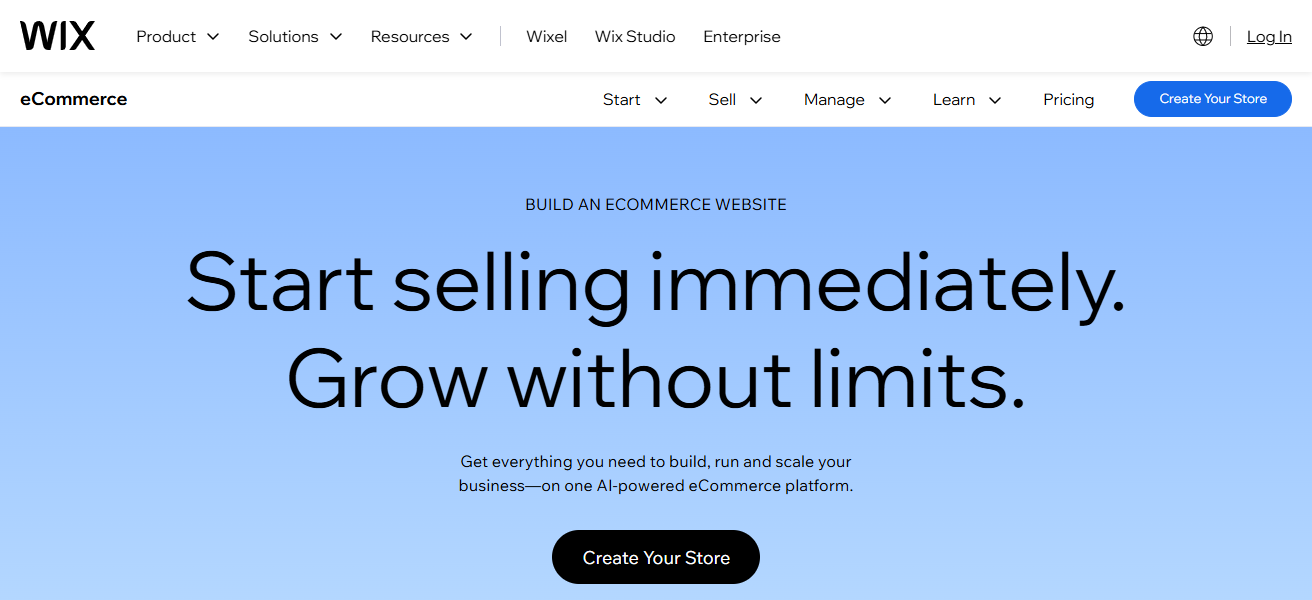
Emerging D2C brands with little technical resources will benefit from Wix’s responsive designs, mobile optimization, and smooth check out experience.
Wix eCommerce Features
- Beginner‑Friendly Editor: Online store creation tools are beautifully developed and are drag and drop.
- App Market: Incorporate additional apps for analytics, marketing, loyalty, etc.
- Multi-Channel Sales: Sell on Instagram, Facebook, marketplaces, and web store.
- Payment Flexibility: Integrations with multiple payment processors.
| Pros | Cons |
|---|---|
| Very intuitive drag-and-drop builder. | Limited scalability for large stores. |
| Supports payments, shipping, and marketing tools. | Some advanced e-commerce features require premium plans. |
| App Market for extra functionality like SEO and analytics. | Customization is less flexible than open-source platforms. |
| Quick setup for startups and small businesses. | May not support complex product or inventory management needs. |
9. Salesforce Commerce Cloud
Salesforce Commerce Cloud is designed for D2C businesses that need complex systems. It features AI-assisted personalization, advanced omnichannel capabilities, and comprehensive analytics.
Thanks to its integration with Salesforce CRM, D2C businesses can optimize and streamline customer data, marketing, and sales. The Commerce Cloud can manage extensive product catalogs and support global trade, as well as sell B2C and B2B.
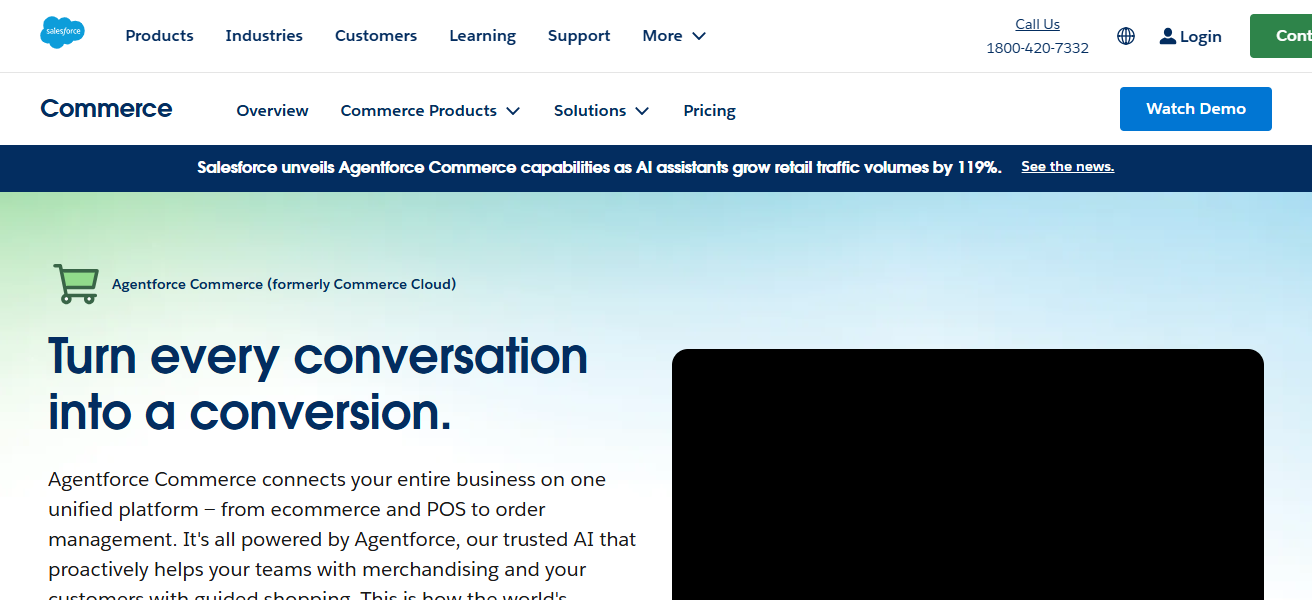
The platform is cloud-based which allows for scalability, speed, and security. For established D2C brands, Salesforce Commerce Cloud is a platform that allows for tailored shopping experiences and seamless customer journeys across all channels.
Salesforce Commerce Cloud Features
- AI-Driven Personalization: Smarter recommendations and tailored shopping experiences.
- Omnichannel Capabilities: Integrated commerce across web, mobile, store, and social.
- CRM Integration: Direct access to Salesforce platform for automated, data-driven marketing.
- Enterprise-Grade Scalability: Supports high user traffic, big catalogs, and international business.
| Pros | Cons |
|---|---|
| Enterprise-grade platform with AI-powered personalization. | Expensive and often out of reach for small businesses. |
| Seamless integration with Salesforce CRM and marketing tools. | Complex setup requires technical and IT resources. |
| Supports omnichannel commerce and large-scale catalogs. | High learning curve for teams without experience. |
| Cloud-based, scalable, secure, and reliable for global operations. | Customization may need specialized developers. |
10. QPe
QPe, a relatively new D2C brand enablement platform, aims to make eCommerce simpler for small and medium sized enterprises.
Through storefront creation and integrated payment and order management systems, they provide an array of services.

Built in marketing features and easy set up require little to no technical effort. Discounting, loyalty programs, and analytics are marketing options offered.
The platform is designed to help eCommerce ready startups and brands scale. Cost management for D2C businesses enables greater focus on customer engagement, product proliferation, and operational efficiency.
QPe Features
- Quick Setup: Straightforward store setups without technical hassles.
- Built-In Marketing Tools: Marketing features like discounts, loyalty programs, and engagement tools.
- Order & Payment Management: Simple payment methods and order tracking.
- Analytics Dashboard: Reports on sales, customer behavior, and key performance metrics.
| Pros | Cons |
|---|---|
| Easy-to-use platform with minimal technical setup. | Newer platform, smaller community, and fewer integrations. |
| Built-in marketing features like discounts and loyalty programs. | Limited advanced features for large-scale brands. |
| Affordable and scalable for small to medium businesses. | Less brand recognition compared to Shopify or Magento. |
| Focused on efficient operations and quick eCommerce launch. | May require additional tools for complex analytics or marketing automation. |
How To Choose Best D2C Brand Enablement Platforms
Business Size and Budget– Align budget and growth plans with pricing and scale of the platform.
Ease of Use– Use simple tools that require less technical know-how and set-up time.
Customization Needs– Choose platforms with customizable design and features that reflect your brand.
Integrated Marketing Tools– Select platforms that have built-in email, SEO, and ads for growth.
Multi-Channel Selling– Allow selling through websites, social media, marketplaces, and offline channels.
Payment and Checkout Options– Global payment options and fast, secure checkout must be available.
Inventory and Order Management– Tracked and controlled workflow of stock and orders should be efficient.
Analytics and Reporting– Access of real-time data of sales, customers, and traffic should be available.
Third-Party Integrations– Integrate with your shipping, ERP, CRM, and marketing systems without hassle.
Security and Compliance– Apply data protection, SSL, and compliance with PCI for customers.
Cocnlsuion
In conclusion Building a successful online business requires a strong commitment, starting with choosing the right D2C brand enablement platform.
Shopify, Magento, and Salesforce Commerce Cloud are great options and offer sales, marketing, and customer management tools for various business sizes.
By selecting the right platform, they are able to optimize operational workflows, improve customer experience, and scale effectively in the competitive eCommerce environment.
FAQ
What is a D2C brand enablement platform?
It’s software that helps brands sell directly to consumers online, managing sales, inventory, and marketing.
Why should I use a D2C platform?
They simplify eCommerce operations, improve customer experience, and help scale sales efficiently.
Which platform is best for startups?
Shopify, WooCommerce, Wix, and QPe are beginner-friendly and cost-effective for small businesses.
Are these platforms suitable for large enterprises?
Yes, Magento, BigCommerce, and Salesforce Commerce Cloud handle large catalogs and high traffic.