I am going to talk about Data Sovereignty Compliance Platforms that assist establishments in safeguarding their sensitive data, fulfilling international regulatory norms, and exercising control over where data is stored and processed.
- Key Points & Best Data Sovereignty Compliance Platforms
- 10 Best Data Sovereignty Compliance Platforms
- 1. Microsoft Purview
- 2. BigID
- 3. OneTrust
- 4. Informatica Data Governance
- 5. Collibra
- 6. Varonis
- 7. Privitar
- 8. Immuta
- 9. Securiti
- 10. Talend Data Fabric
- How We Choose Best Data Sovereignty Compliance Platforms
- Cocnlsuion
- FAQ
These platforms assist companies in overseeing data residency, privacy, and governance in cloud, hybrid, and on-premise environments while lowering compliance risks.
Key Points & Best Data Sovereignty Compliance Platforms
| Platform | Key Point |
|---|---|
| Microsoft Purview | Unified governance across hybrid and multi-cloud environments with compliance automation |
| BigID | Data discovery and classification for sensitive data across jurisdictions |
| OneTrust | Privacy compliance with GDPR, CCPA, and global sovereignty laws |
| Informatica Data Governance | Metadata-driven governance ensuring data residency and lineage tracking |
| Collibra | Enterprise-wide governance with strong policy enforcement and auditability |
| Varonis | Data security and sovereignty controls for unstructured data |
| Privitar | Data privacy engineering with anonymization and residency compliance |
| Immuta | Dynamic access control for sensitive data across cloud platforms |
| Securiti | AI-powered compliance for data mapping, residency, and sovereignty |
| Talend Data Fabric | Integrated governance with sovereignty-aware data pipelines |
10 Best Data Sovereignty Compliance Platforms
1. Microsoft Purview
Microsoft Purview offers enterprises a unified data governance and compliance solution that helps discover, classify, and manage data across both on-premise and multicloud settings.
It serves enterprise needs through automated functions including data discovery, metadata management, data lineage tracking, and sensitivity classification for regulatory compliance, such as GDPR and CCPA.
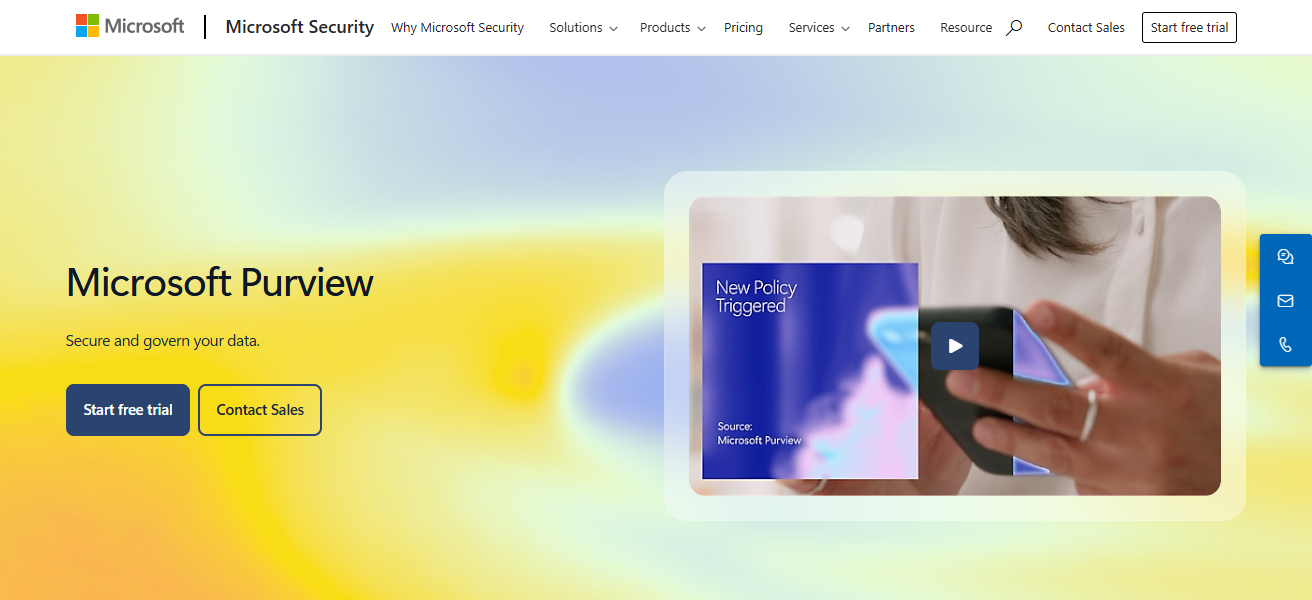
Purview’s deep integrations with Microsoft Azure and Microsoft 365 streamline the operationalization of governance and privacy controls
While providing data visibility across usage, risk, and compliance within a given data estate and enhancing safe and compliant access to data, as well as risk mitigation.
Features Microsoft Purview
Unified Data Catalog – Instantly reviews, catalogs, and classifies data gained through data assets across cloud/on-prem sources to develop a centralized governance catalog.
Data Lineage & Traceability – Illustrates data movement and transformations so that teams appreciate how data shifts and evolves through systems.
Risk & Compliance Management – Compliance manager and policy design tools automate regulatory control mapping
Integration with Microsoft Ecosystem – Superb integration with Azure, Microsoft 365, and Power BI for governed services in Microsoft’s ecosystem.
2. BigID
BigID’s platform is focused on discovering, classifying, and protecting sensitive and confidential information across structured and unstructured data targeting privacy, data discovery, and governance.
Regulatory compliance and personal/regulated data classification and discovery automation are supported through machine learning.
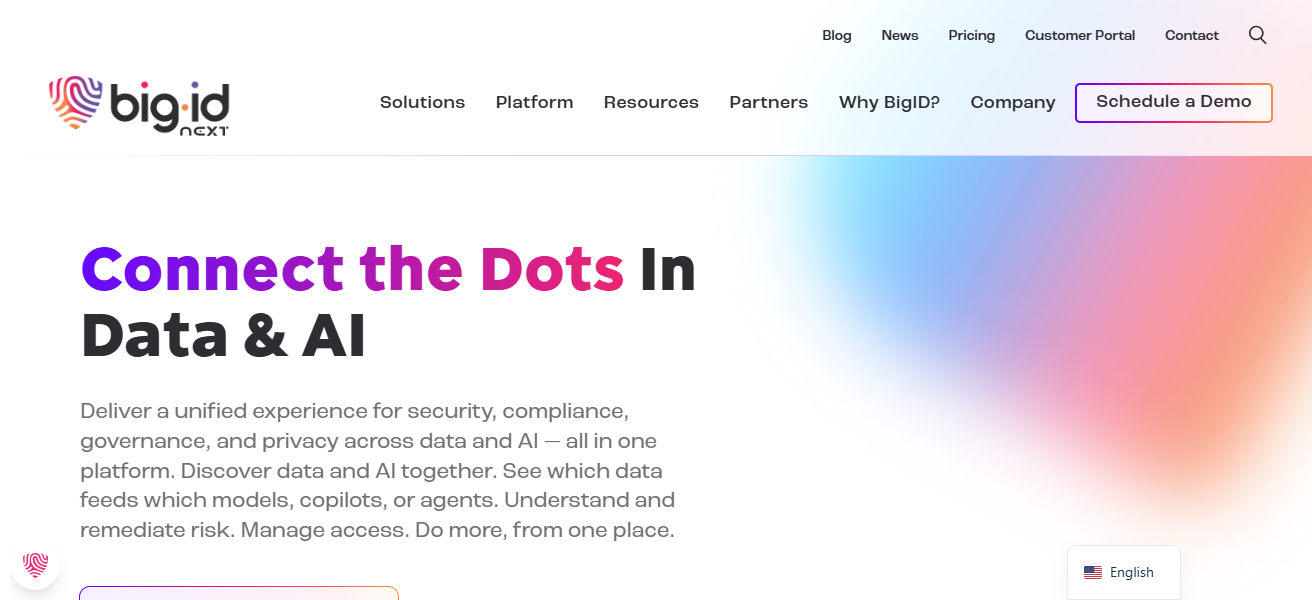
Compliance with CCPA and GDPR legislation is simplified. Organizations are able to balance compliance and risk with data inventory
Data subject rights management, and policy-driven data protections. For privacy-focused governance programs, BigID has proven to be an excellent option.
Features BigID
Automated Data Discovery – Machine learning identifies sensitive data (PII/PHI) in both structured and unstructured sources.
Advanced Classification – Data is classified by sensitivity, risk, and regulatory relevance.
Policy Enforcement Support – Provides support to implement privacy policies and governance controls based on data context.
Compliance Dashboards & Reporting – Risk metrics and compliance status are integrated into executive dashboards.
| Pros | Cons |
|---|---|
| Excellent at automated discovery and classification of sensitive data (PII, PHI, etc.) using AI/ML — ideal for compliance and privacy teams. ( | Setup can be resource-intensive and complex, requiring strong governance expertise. |
| Strong risk scoring, dashboards, and integration support for multi-cloud/hybrid environments. | Learning curve and integration efforts may be high for organizations without dedicated compliance resources. |
| Scalable for large, regulated data ecosystems with automated rights management tools. | Pricing transparency is limited and can be expensive for smaller users. |
3. OneTrust
OneTrust is an industry champion when it comes to privacy, security, and governance. With OneTrust, organizations are able to streamline policy management, automate workflows, and manage and monitor privacy obligations across jurisdictions.
OneTrust serves GDPR, CCPA, and numerous other regulatory frameworks through its diversified systems for consent and preference management, policy automation, risk management, third-party data, and more.
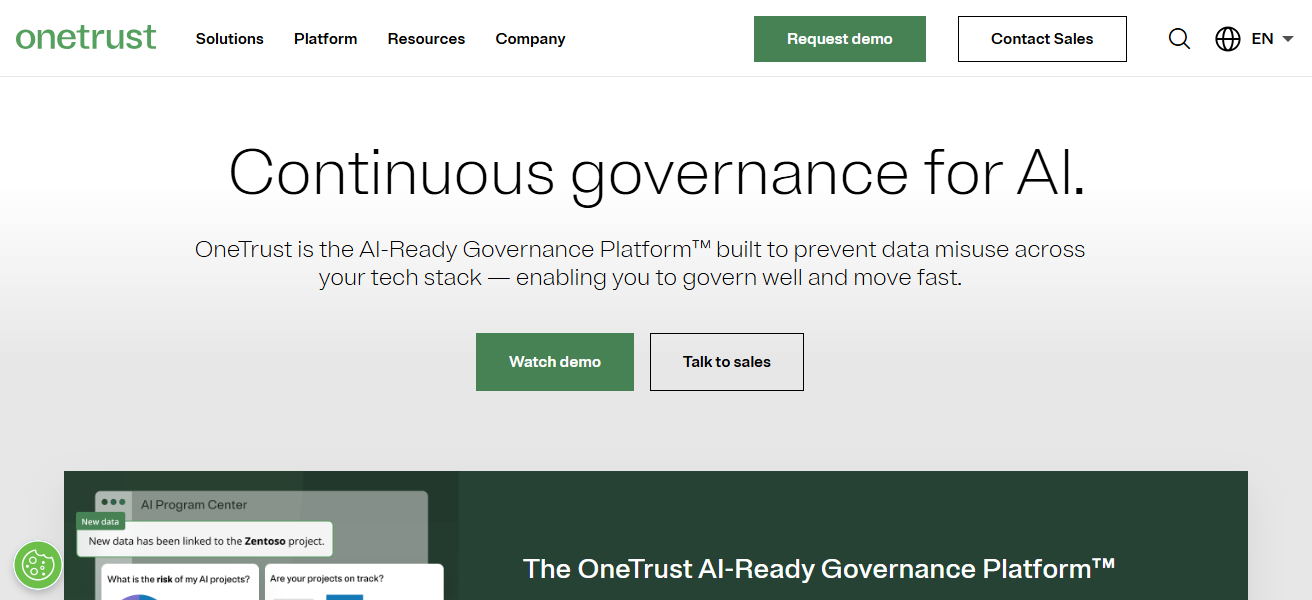
OneTrust provides its clients with unified dashboards with real-time data to help monitor and manage risk, execute on data subject requests, and efficiently maintain governance controls.
Features OneTrust
Privacy & Consent Management – Decentralized control for user consent, preferences, and privacy decisions.
Data Use Governance – Links governance policies with real-time enforcement control in data and AI systems.
| Pros | Cons |
|---|---|
| Broadest privacy and compliance feature set with integrated consent, policy automation, and regulatory libraries. | Configuration and customisation can be complex and resource heavy. |
| Strong automation of privacy workflows (DSARs, mapping, risk tracking) and scalable for global compliance | Costs can scale quickly as modules or users expand |
| Well-suited for enterprise governance teams and cross-jurisdiction regulation coverage. | Not always real-time enforcement focused; core engineering integrations may be heavy. |
4. Informatica Data Governance
Informatica includes strong metadata management, data lineage, data quality, and compliance capabilities within its Intelligent Data Management Cloud features.
Through Informatica, companies can understand their data assets, implement governance, and ensure data accuracy and completeness.
Informatica provides automated cataloging, classification, and policy enforcement so teams can achieve compliance, maintain policy enforcement, and support trusted analytics.
Informatica has enhanced capabilities to support complex data governance, due to its integration with data quality and master data management features, making it an ideal fit for large enterprises.
Features Informatica Data Governance
Metadata Management: Integration and centralization of metadata from separate systems.
Data Quality & Data Lineage: After compliance is enforced, data quality is ensured and lineage is tracked.
AI-Assisted Insights: Automation of classification, recommendation, and cataloging, via AI
Policy Management & Stewardship: Governance policies and their enforcement are defined, along with stewardship workflows.
| Pros | Cons |
|---|---|
| Robust metadata, lineage, quality, and compliance features in a mature enterprise platform. | Can be complex, resource-intensive and may require consultants for full value. |
| Comprehensive suite for large regulatory environments with integrated quality controls. | Integration requires internal expertise; cost and learning curve are significant. |
| Strong ecosystem connectivity for hybrid/multi-cloud platforms. | May feel heavyweight compared to lighter governance alternatives. |
5. Collibra
Collibra is a complete data intelligence and governance resource offering data cataloging, governance, policy management, automation of compliance, and workflow automation.
Collibra centralizes metadata, data definitions, and governance policies, enabling teams to set, implement, and monitor their standard control access, and data lineage tracking.
Collibra helps teams reduce compliance risk and improve data quality through its collaborative platform.
The platform also facilitates organizations’ regulatory requirements through audit trails, helping organizations build trust in their data and comply with international data protection legislation.
Features Collibra
Enterprise Data Catalog: Build a data asset catalog that is searchable and understandable by business users.
Metadata & Glossary Management: Customers store their business terms and their definitions to standardize the governance language.
Policy & Standards Enforcement: Governance policies and controls applied to data sets, supporting compliance and control.
Data Lineage & Impact Analysis: Compliance risk can be assessed through relationships and dependencies visualization.
| Pros | Cons |
|---|---|
| Best-in-class governance and metadata management with strong stewardship workflows. | Implementation complexity and ongoing management needs can be high. |
| Flexible integration and active metadata usage improves compliance transparency. | Pricing may be high for smaller businesses or early stage teams |
| Collaborative features bolster cross-team governance and policy standardisation. | Some documentation and manual lineage capture are weaker. |
6. Varonis
Varonis is a data security and governance platform that aims to protect sensitive data and track user activity to mitigate insider threats and assist with compliance.
It automatically identifies, classifies, and maps permissions to both structured and unstructured data repositories, discovers anomalies, and enforces least-privilege access.
Varonis gives audit logs, analytical insights into risk, and threat data so that entities can manage security and compliance activities in a timely manner.
The company’s data security intelligence and continuous monitoring capabilities are invaluable for data security in highly regulated environments.
Features Varonis
Data Classification – Detects and categorizes sensitive information located on various file systems and repositories.
Threat Detection \& Response – Detects abnormal behavior and monitors for insider threat activities.
Access Governance – Applies the principle of least-privilege and reviews entitlements.
Compliance Reporting – Provides audit logs and compliance documentation necessary for GDPR/HIPAA.
| Pros | Cons |
|---|---|
| Strong data security analytics and classification focused on protecting sensitive data. | Deployment across hybrid environments can require significant setup and effort. |
| Real-time monitoring and threat detection aids compliance reporting and breach response. | Not as tailored for full data governance as other platforms; security focus is more prominent. |
| Integrates deeply with file systems and permissions analytics. | Can be overwhelming or too powerful for small businesses. |
7. Privitar
Privitar data privacy solutions allow enterprises to use sensitive data safely and securely share sensitive data through privacy-enhancing data masking and de-identification techniques.
Privitar automates applying privacy policies to data and data provisioning to help organizations manage privacy risk and data utility.
Privitar excels at organizational scalable governance through the embedded and built-in configurable workflow policies to data governance.
This allows for data to be analyzed by machine learning and other compliance driven data science techniques.
Privitar allows organizations to safely reduce the risk of re-identification and secure territories of collaborative the compliance workflows.
This enables organizations to fully unlock the commercial value of their data without being uncompliant.
Features Privitar
Data De-Identification & Masking – Safeguards sensitive data by anonymizing or tokenizing it.
Privacy-Driven Data Provisioning – Provides governed, secure data for analysis without exposing PII.
Policy-Based Controls – Implements uniform privacy policies within and across data environments.
Secure Data Sharing – Enables compliant data access for analytics and development. Industry standard knowledge
| Pros | Cons |
|---|---|
| Strong data de-identification and privacy-enhancing technology, ideal for safe sharing. | Focused more on anonymisation/privacy rather than full compliance workflow features. |
| Helps balance analytics with regulatory risk reduction. | Integration of real-time APIs and consent automation may be limited. |
| Well positioned for regulated industries (e.g., finance). | Requires specialist integration work for some environments. |
8. Immuta
Immuta empowers software assets with the governance infrastructure based on the policy-as-code concept, automating the governance of data access policies with real-time enforcement across a variety of contemporary cloud data platforms, including Snowflake, Databricks, and BigQuery.
Real-time row and column access, auditing capabilities, and centralized policy management allow organizations to administer privacy management requirements and facilitate compliance reporting.
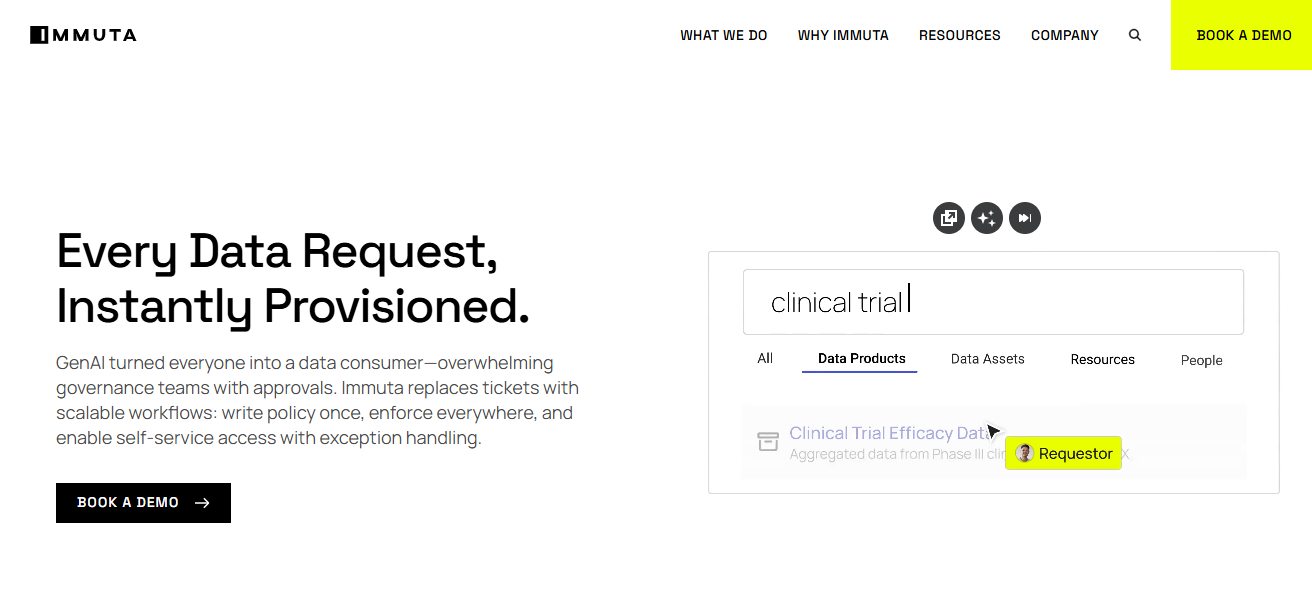
Immuta’s automated governance technology diminishes the need for manual processes, and increases the speed with which analytics teams can obtain data access.
Immuta is the best suited and most effective solution for specialized markets that need consistent governance, audit-ready data, and the ability to control access to sensitive information.
Features Immuta
Unified Policy Enforcement – Consolidates the creation of access policies and their uniform application across different systems.
Cross-Platform Data Access Control – Integrates with Snowflake, Databricks, BigQuery, AWS, Azure, etc.
Discovery & Tagging – Automatically discovers and tags data assets with governance context.
Auditing & Compliance Reporting – Monitors access and usage flows data for audits
| Pros | Cons |
|---|---|
| Fine-grained access control and policy-as-code strongly support compliance and analytics governance. | Primarily focused on dynamic access policies; full privacy program features are less central. |
| Real-time row/column level enforcement is ideal for cloud analytics stacks. | Discovery capabilities are limited compared to dedicated classification tools |
| Good for regulated analytics use-cases (Snowflake, Databricks, etc.) | Smaller ecosystem focus — may need complementary tooling. |
9. Securiti
Securiti has built a unified governance and compliance technology platform covering data discovery, data classification, access governance, compliance management, and AI governance.
Its Data Command Center integrates controls and metadata across hybrid multicloud configurations, allowing firms to apply policies, analyze access, and manage risk.
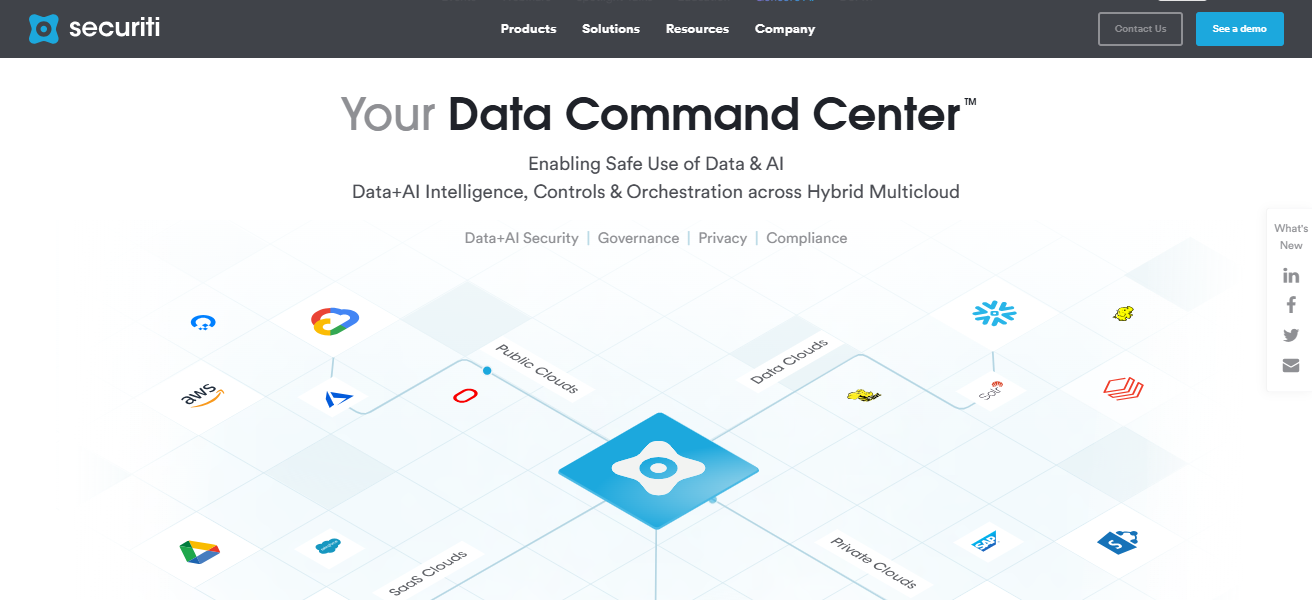
Securiti provides automation needed to comply with worldwide regulations and offers governance and lineage tracking, breach impact analysis, and modern data and AI case governance.
The platform’s features foster the secure use of data within the constraints of compliance with data protection and organizational requirements.
Features Securiti
Data Discovery & Classification – Automatically discovers and tags data across structured and unstructured environments.
Data Access Governance – Monitors and manages access, mapping permissions to data stores.
Data Quality & Lineage – Monitors the movement and quality of the data as it is used for analytics and/or artificial intelligence.
AI-Aware Governance – Unstructured data and AI lifecycle governance has additional tailored functionality.
| Pros | Cons |
|---|---|
| Unified privacy + security + governance with automated compliance workflows. | Younger platform than some incumbents — integrations can be less extensive in legacy environments. |
| Strong PrivacyOps automation and risk analytics. | May require fine-tuning for custom legacy system integrations. |
| AI-driven discovery and policy enforcement across multi-cloud sources. | Pricing details vary widely; smaller org adoption may need proof-of-value. |
10. Talend Data Fabric
Talend Data Fabric is a consolidated data platform that provides data integration along with functionality for data governance and quality and compliance.
It helps companies address the complete data lifecycle: ingestion, cleansing, governance, and privacy reporting.
With Talend’s real-time governance features, data quality is monitored for accuracy, consistency, and compliance.
Talend embedded governance into data workflows, allowing teams to monitor, and report compliance, and enforce compliance with high data quality, and without losing control in complex environments.
Features Talend Data Fabric
End-to-End Data Integration – Offers data ingestion, transformation, and governance on a single platform.
Data Quality Tools – Supports analytics created provisioned data consumer trust through validation, profiling, and remediation.
Compliance & Policy Controls – Designed for automated governance and regulatory compliance enforcement.
Metadata & Lineage Support – Monitors data movement and alteration across systems, making the organization ready for audits.
| Pros | Cons |
|---|---|
| Unified platform for data integration, quality, governance, and compliance in one low-code interface. | Deployment and integration complexity are common, requiring technical skill and ongoing management. |
| Strong connection capabilities to SAP, cloud sources and multi-cloud orchestration. | Frequent updates and configuration obstacles can slow adoption. |
| Stable performance, good pipeline design tools, and anonymisation support. | Needs better integration with some external tools and detailed configuration guidance. |
How We Choose Best Data Sovereignty Compliance Platforms
- Regulatory Coverage. Compliance software needs to empower an organization to comply with a variety of global and local data privacy and protection mandates and a data obligation residency. (e.g. GDPR, CCPA, HIPAA, etc.)
- Data Discovery & Classification. The ability of compliance software to automatically identify, classify and tag data that is sensitive, and/or regulated across all environments.
- Data Residency & Sovereignty. Strong compliance controls to govern where data is geo located, processed and accessible from, especially where there are geo limitations.
- Policy Enforcement & Automation. Automation of the creation and regulation of compliance policies in order to reduce the manual administrative effort, as well as the risk of human error.
- Access Governance & Security. Fine grained controls, and audit of access to systems containing sensitive data to ensure only authorized individuals are able to access the data.
- Scalability & Integration. The software must be able to integrate with on premise, or cloud and hybrid systems and grow with the enterprise data.
- Reporting & Audit Readiness. The ability to maintain up to date dashboards and logs to prepare reports to demonstrate compliance during regulatory audits.
- Ease of Use & Support. The compliance software should provide user friendly dashboards, well mapped processes and reasonable assistance from the vendor.
Cocnlsuion
In conclusion, The Best Data Sovereignty Compliance Platforms enable organizations to control their data’s location, access, and compliance with various regulations.
The multifaceted approach of data discovery, policy enforcement, access governance, audit readiness, and other tools to minimize legal risk and help build trust.
The best platforms enable organizations to conduct data operations securely without hindering their international growth potential nor their compliance with changing data privacy regulations.
FAQ
A platform that helps organizations manage data according to local/regional laws, ensuring data storage, processing, and access comply with legal requirements.
It ensures data stays within required geographic boundaries and complies with privacy laws like GDPR, CCPA, and other regional regulations.
Enterprises, regulated industries, cloud-native businesses, and any organization handling sensitive or cross-border data.
Data discovery, classification, policy automation, access control, reporting, and audit readiness.
Yes — top platforms support hybrid and multi-cloud environments (Azure, AWS, GCP).