In this article, I will discuss the Best Decentralized GPU Compute Networks that are revolutionizing the AI and Cloud Computing industries.
We will cover 10 top projects: Render, Bittensor, Akash Network, Aethir and io.net. You will learn about their key features, GPU computing services, pricing advantages, network adoption and native token utility so you can understand their unique capabilities and potential applications.
What Are Decentralized GPU Compute Networks?
Decentralized GPU compute networks are platforms that match users in need of computing power with distributed GPU providers globally. These networks facilitate AI training, machine learning, data processing and graphics rendering without a complete reliance on centralized cloud providers.
They can enhance hardware availability, offer flexible pricing and allow developers, enterprises and researchers to scale up computing workloads efficiently using idle GPU resources, while also contributing to a more distributed digital infrastructure.
How to Choose the Best Decentralized GPU Network
- Identify your workload requirements: Determine whether you need GPUs for AI training, inference, rendering, or machine learning applications.
- Compare GPU models and memory: Evaluate GPU performance, VRAM capacity, processing power, and compatibility with your computing workloads.
- Evaluate pricing and reliability: Compare rental costs, uptime, performance consistency, provider reputation, and potential unexpected computing expenses.
- Check adoption and available computing capacity: Review active providers, available GPUs, network usage, customer adoption, and infrastructure scalability.
- Understand token requirements and payment options: Check supported payment methods, native token utility, transaction fees, staking requirements, and payment flexibility.
Key Points & Best Decentralized GPU Compute Networks
| Decentralized GPU Compute Network | Explanation |
|---|---|
| Render (RENDER) | Provides decentralized GPU power for rendering, AI workloads, and demanding computational tasks. |
| Bittensor (TAO) | Incentivizes decentralized machine learning networks through token rewards and competitive intelligence markets. |
| Akash Network (AKT) | Offers decentralized cloud computing, enabling affordable GPU rentals for AI and applications. |
| Aethir (ATH) | Supplies distributed GPU infrastructure for enterprise AI, cloud gaming, and rendering workloads. |
| io.net (IO) | Aggregates distributed GPUs to provide scalable, cost-effective computing resources for AI developers. |
| Flux (FLUX) | Operates decentralized cloud infrastructure supporting applications, computing workloads, and distributed hosting services. |
| AIOZ Network (AIOZ) | Combines decentralized infrastructure for AI computing, content delivery, and distributed digital storage. |
| Gensyn (GSYN) | Develops decentralized machine learning infrastructure designed to coordinate and verify distributed AI training. |
| CUDOS (CUDOS) | Connects distributed computing resources to support scalable cloud services and AI workloads. |
| Vast.ai | Marketplace connecting users with affordable GPU rentals for AI training and inference. |
10 Best Decentralized GPU Compute Networks In 2026
1. Render (RENDER)
Render Network (RENDER) Core Purpose Render Network links creators with distributed GPU providers for graphics rendering and select AI workloads. GPU Computing Services: Supports 3D rendering, visual effects, animation and the supported GPU-accelerated workloads. Pricing & Cost Benefit: The decentralized model offers on demand access to GPU capacity without the need for creators to purchase expensive hardware.

Pricing depending on workload and service tier. Network Adoption: A lot of artists, studios and developers are using its ecosystem but you should check current activity through official network statistics. Native Token Utility: RENDER enables payments on the network and incentives within the ecosystem. Its distributed infrastructure enables creators to scale rendering capacity and reduce dependence on centralized rendering resources
Render (RENDER)
| Feature | Explanation |
|---|---|
| Decentralized GPU Rendering | Connects creators with distributed GPUs for 3D rendering and visual effects. |
| Creative Workflows | Supports animation, motion graphics, and compatible generative AI imaging workflows. |
| Flexible Computing | Offers on-demand GPU rendering without requiring users to own powerful hardware. |
| Distributed Network | Coordinates GPU providers and creators through a decentralized rendering ecosystem. |
2. Bittensor (TAO)
Bittensor is building decentralized markets where participants can supply machine intelligence and other digital services through specialized subnets. GPU Computing Services: Some subnets offer AI inference, model development and compute related services Bittensor is more than a GPU rental marketplace.
Pricing & Cost Advantage Incentives and costs differ on the design, demand for services and the resources of each subnet. Network Adoption: The ecosystem consists of miners, validators, subnet developers and token holders; adoption differs across subnets.
Native Token Utility: TAO is used to incentivize the network, stake and participate in the economic model of the ecosystem. Its competitive model rewards useful contributions, not just listing available GPUs.
Bittensor (TAO)
| Feature | Explanation |
|---|---|
| AI Subnet Ecosystem | Organizes specialized subnets providing machine intelligence and digital services. |
| Decentralized Intelligence | Connects independent participants contributing AI models, computation, and other useful outputs. |
| Incentive Mechanism | Rewards contributions according to network-specific evaluation and incentive mechanisms. |
| Open Participation | Enables developers, miners, validators, and subnet operators to participate in its ecosystem. |
3. Akash Network (AKT)
Core Purpose: Akash Network is an open marketplace for customers to buy compute resources from independent infrastructure providers. GPU Computing Services: Allows you to rent GPUs, run AI model inference, machine learning workloads and containerized applications.
Pricing & Cost Advantage – Providers participate in a market-based process that can result in lower costs than traditional cloud offerings. Actual savings will vary depending on GPU model, availability, region and workload.
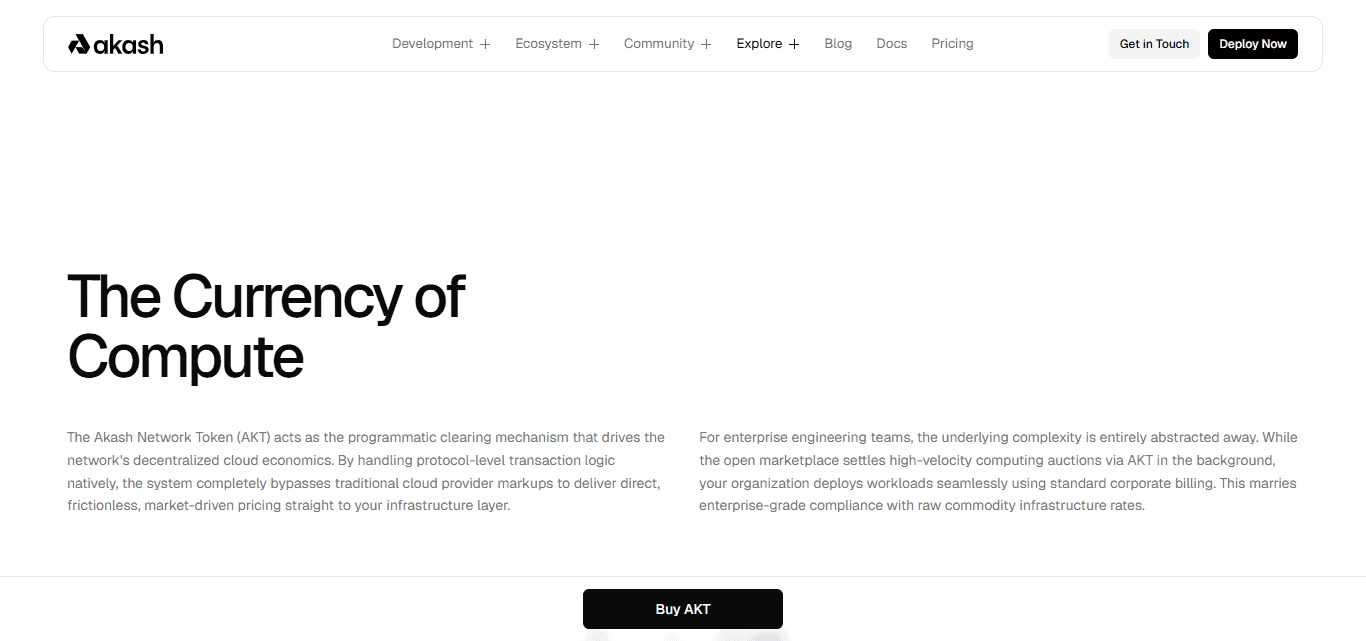
Network Adoption: Developers, businesses and infrastructure providers can join its decentralized cloud ecosystem, current usage to be checked against network data. AKT’s native token utility is staking, network security, governance, and ecosystem economics. Akash is especially relevant to users who want flexible cloud infrastructure and competitively priced GPU capacity.
Akash Network (AKT)
| Feature | Explanation |
|---|---|
| Open Compute Marketplace | Matches customers with independent providers offering computing resources. |
| GPU Rentals | Supports GPU workloads for AI inference, machine learning, and applications. |
| Competitive Pricing | Providers bid for deployments, allowing customers to compare available offers. |
| Flexible Deployment | Supports containerized applications with configurable CPU, memory, storage, and GPU resources. |
4. Aethir (ATH)
Aethir brings together distributed enterprise-grade GPU resources into cloud infrastructure built for AI, gaming and other compute intensive applications. GPU Computing Services: Provides AI training and inference, real-time rendering, and cloud gaming.
Pricing & Cost Advantage: Distributed supply can help to increase the access to GPU resources and improve affordability, but actual costs depend on hardware, service requirements and availability. Network Adoption Infrastructure ecosystem of GPU providers and customers Published network capacity and active utilization should be evaluated separately.
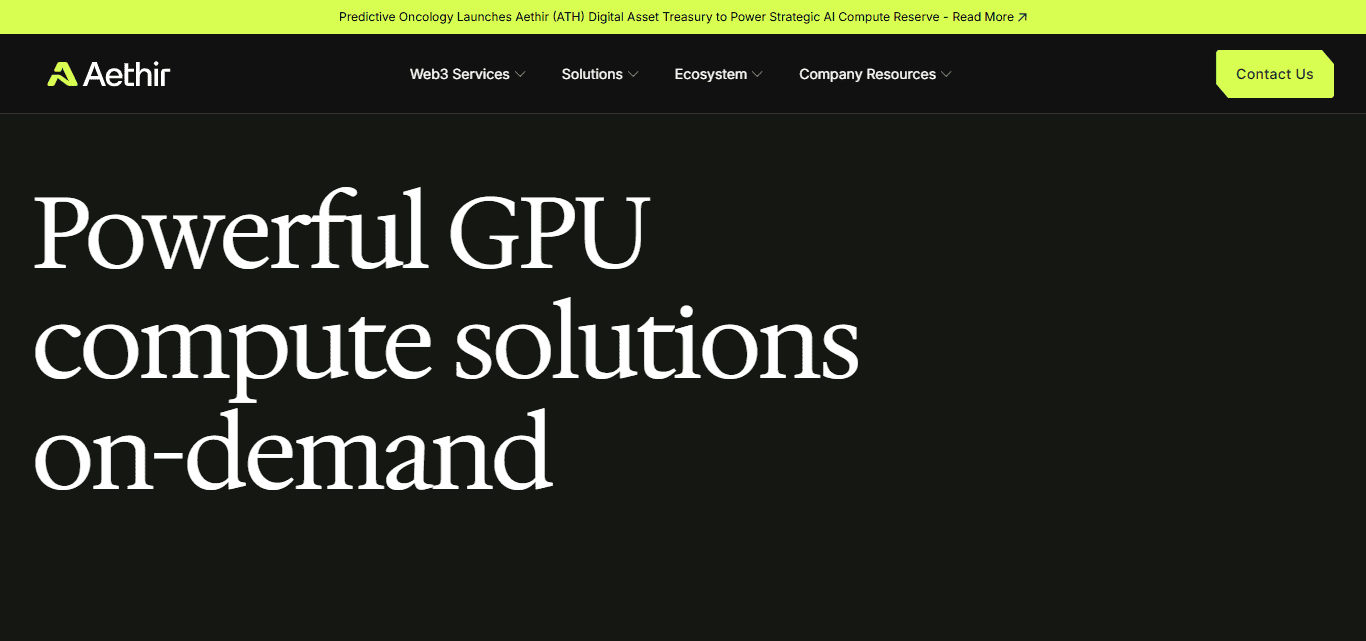
Native Token Utility: ATH supports payments, staking, governance and incentives for participating providers. Aethir is more than just consumer GPU rentals. It’s about enterprise-grade infrastructure.
Aethir (ATH)
| Feature | Explanation |
|---|---|
| Enterprise-Grade GPUs | Aggregates high-performance GPU resources for demanding computing workloads. |
| AI Computing | Supports AI model training, inference, and other GPU-intensive workloads. |
| Cloud Gaming | Provides distributed infrastructure designed for responsive, real-time gaming experiences. |
| Distributed Infrastructure | Connects resource owners, quality-checking systems, and customers across its network. |
5. io.net
io.net aggregates distributed GPU resources into scalable computing clusters for AI developers and companies. GPU Computing Services: The infrastructure supports machine learning, model training, inference and GPU-intensive workloads that require multiple processors.
Pricing & Cost Advantage Flexible GPU selection and distributed supply may reduce computing costs over major cloud providers. Real savings depend on configuration and demand. Network Adoption The project claims to have thousands of GPUs connected in more than 130 countries, according to the official website.

Native Token Utility IO enables network incentives and tokenomics that align supplier rewards with computing demand. The main advantage is that it facilitates access to distributed GPU clusters.
io.net (IO)
| Feature | Explanation |
|---|---|
| Distributed GPU Clusters | Aggregates GPUs from distributed providers into computing clusters. |
| AI Model Training | Supports machine learning workloads requiring scalable GPU processing power. |
| Flexible Hardware Selection | Enables users to select GPU configurations suited to specific workloads. |
| On-Demand Compute | Provides access to distributed computing resources without building dedicated infrastructure. |
6. Flux (FLUX)
Flux offers decentralized cloud infrastructure with independent node operators, distributed across a worldwide network. GPU Computing Services: Its ecosystem includes cloud deployments, application hosting and GPU rental via services such as FluxEdge for AI workloads. Pricing & Cost
Advantage Customers have a selection of hardware options and can pay for what they use, with pricing that varies based on the GPU and provider. Network Adoption: The official documentation states that there are more than 10,000 nodes run by the community in 66 countries.

The number of nodes is not indicative of the availability or utilization of GPUs. Native Token Utility: FLUX enables network economics, collateral requirements and infrastructure operator rewards. Its broader cloud focus makes it useful for more than just GPU-only computing
Flux (FLUX)
| Feature | Explanation |
|---|---|
| Decentralized Cloud | Provides distributed infrastructure for hosting applications and computing workloads. |
| Global Node Network | Uses independently operated nodes to support decentralized cloud services. |
| Application Hosting | Enables deployment of applications and services across its infrastructure ecosystem. |
| GPU Compute Access | FluxEdge offers access to GPU computing for suitable AI workloads. |
7. AIOZ Network (AIOZ)
AIOZ Network builds decentralized infrastructure for AI computing, digital storage and video delivery. GPU Computing Services: AIOZ AI supports distributed AI execution, model training capabilities, AI services and a marketplace for models and datasets.
Pricing & Cost Advantage: The pay-as-you-go model can enable users to pay for services consumed rather than having to maintain all the infrastructure themselves. Actual compute pricing will depend on the service. Network Adoption Developers, node operators, content providers and AI projects can join its broader ecosystem .

Adoption statistics should be benchmarked against existing network data. Native Token Utility: AIOZ is used for payments in the ecosystem and to incentivize participants. Its unique feature is the combination of AI computing with storage and media infrastructure.
AIOZ Network (AIOZ)
| Feature | Explanation |
|---|---|
| Decentralized AI | Develops distributed infrastructure for AI-related computing services. |
| Distributed Storage | Supports decentralized storage for digital data and applications. |
| Content Delivery | Provides distributed infrastructure for video streaming and media delivery. |
| Multi-Purpose Network | Combines AI, storage, and media infrastructure within one ecosystem |
8. Gensyn (GSYN)
Gensyn aims to coordinate computing resources around the world to enable decentralized machine learning and verifiable AI development. GPU Computing Services: It’s protocol is targeting distributed training, inference, evaluation and verification of work of machine learning across heterogeneous devices.
Pricing & Cost Advantage Sharing computing resources could make AI development more accessible, but actual savings depends on workload efficiency, coordination overhead, and hardware availability.

Network Adoption: Live network activity should be the measure of adoption, not just announcements, and the ecosystem will be populated by researchers, developers and compute contributors.
Use of the Native Token: Watch out for token details Gensyn’s published protocol documentation describes $AI for payments, staking and governance so verify the official token and ticker before identifying GSYN as its native asset.
Gensyn (GSYN)
| Feature | Explanation |
|---|---|
| Distributed AI Training | Coordinates machine learning work across geographically distributed computing resources. |
| Verifiable Computation | Uses verification mechanisms to check the correctness of distributed training operations. |
| Machine Learning Markets | Supports infrastructure for AI training, inference, evaluation, and related services. |
| Decentralized Coordination | Connects computing contributors and developers through an open protocol. |
9. CUDOS (CUDOS)
CUDOS built decentralized cloud infrastructure to connect computing resources to blockchain and Web3 applications. GPU Computing Services: Its original ecosystem was focused on cloud computing, and offering access to distributed hardware for workloads such as AI and rendering-related tasks.
Pricing & Cost Advantage: Distributed infrastructure can be an alternative to traditional cloud providers but costs depend on the current service, hardware, and provider arrangements. Network Adoption: Before estimating adoption, assess the existing provider availability, integrations and active workloads, especially as the project’s ecosystem and token arrangements have changed.

Native Token Utility: CUDOS was used for payments, staking and ecosystem incentives. Prior to detailing utility, check its current token status and migration arrangements. It is important to distinguish between historical branding and currently available services.
CUDOS (CUDOS)
| Feature | Explanation |
|---|---|
| Decentralized Computing | Developed infrastructure connecting distributed computing resources with cloud workloads. |
| Cloud Infrastructure | Focused on providing computing resources for applications and developers. |
| AI Workload Potential | Distributed computing infrastructure can support suitable AI and GPU-intensive workloads. |
| Blockchain Integration | Its ecosystem connected computing services with blockchain-based applications and token mechanisms. |
10. Vast.ai
Vast.ai is a marketplace for GPUs where customers can compare and rent compute hardware from individual hosts. GPU Computing Services It supports a range of hardware configurations and can be used for AI training, inference, machine learning, and other GPU-intensive workloads.
Price & Cost Advantage: Hosts set competitive rates, covering on-demand, interruptible and reserved. Interruptible instances are potentially much cheaper but can be reclaimed, so better suited to workloads that can accept disruption.

Network Adoption: There is a wide selection of GPUs available on the marketplace; inventory and availability are subject to supply and demand. Native Token Utility: Vast.ai doesn’t need a native cryptocurrency token for its core marketplace. Its platform allows customers to pay for computing services.
Vast.ai
| Feature | Explanation |
|---|---|
| GPU Rental Marketplace | Connects customers with independent hosts offering GPU computing resources. |
| AI Model Training | Provides GPU instances suitable for machine learning and AI training. |
| Flexible Pricing | Allows customers to compare GPU rental prices and hardware configurations. |
| Multiple GPU Options | Offers different hardware specifications for inference, experimentation, and compute-intensive workloads. |
Conclusion
To summarize, the Best Decentralized GPU Compute Networks present disruptive alternatives to traditional cloud computing for AI, machine learning, and rendering workloads. Projects like Render, Akash Network,
Aethir and io.net provide different computing solutions with different performance, pricing and access. So, before you go ahead and pick a network, compare GPU availability, reliability, costs, adoption, and token utility. This will help you find the best platform for your computing needs in 2026.
FAQ
Are decentralized GPU networks cheaper than traditional cloud providers?
They can offer competitive pricing, depending on GPU availability, hardware specifications, workload requirements, and provider rates.
Which decentralized GPU network is best for AI?
Akash, Aethir, and io.net support AI computing, while Bittensor focuses on decentralized machine intelligence.
Do decentralized GPU networks have native tokens?
Many use tokens for payments, staking, rewards, or governance, but token utility varies by project.
Can businesses use decentralized GPU computing?
Yes, businesses can access distributed GPU resources for AI training, inference, rendering, and other demanding workloads.