In this article, I’ll break down the Best Ground Lease Capital Providers for CRE, highlighting top companies that help commercial real estate owners and developers get access to capital, unlock land value and enhance financing flexibility.
You will learn about their core services, financing structures, financial terms, key features, and track records so that you can compare providers and select the right ground lease solutions for your commercial property investment needs.
Key Points & Best Ground Lease Capital Providers for CRE
| Company | Explanation |
|---|---|
| Safehold Inc. | Specializes in ground leases, providing long-term real estate financing solutions for property owners. |
| Mesirow Financial | Offers investment management and financial services, including real estate investment strategies for institutional clients. |
| Haven Capital Ground Lease | Focuses on ground lease financing solutions designed to support commercial real estate ownership and development. |
| Ground Lease REIT | Provides real estate investment opportunities centered on ground leases and long-term rental income. |
| Kawa Capital Management | Manages alternative investments, including real estate strategies targeting income generation and long-term value. |
| Mohr Capital Ground Lease | Supports commercial real estate investments through ground lease structures and tailored property financing solutions. |
| Grace Capital Group | Provides real estate investment and financing solutions for property owners, developers, and investors. |
| CTL Capital LLC | Specializes in commercial real estate financing, including credit tenant lease transactions and investment solutions. |
| The Shidler Group | Invests in commercial real estate, emphasizing long-term ownership, property development, and strategic asset management. |
| Terra Funding Trust | Focuses on real estate funding opportunities, potentially supporting property acquisitions and development financing strategies. |
| Eyzenberg & Company | Provides real estate investment banking, capital advisory, and financing services for commercial property transactions. |
10 Best Ground Lease Capital Providers for CRE
1. Safehold Inc
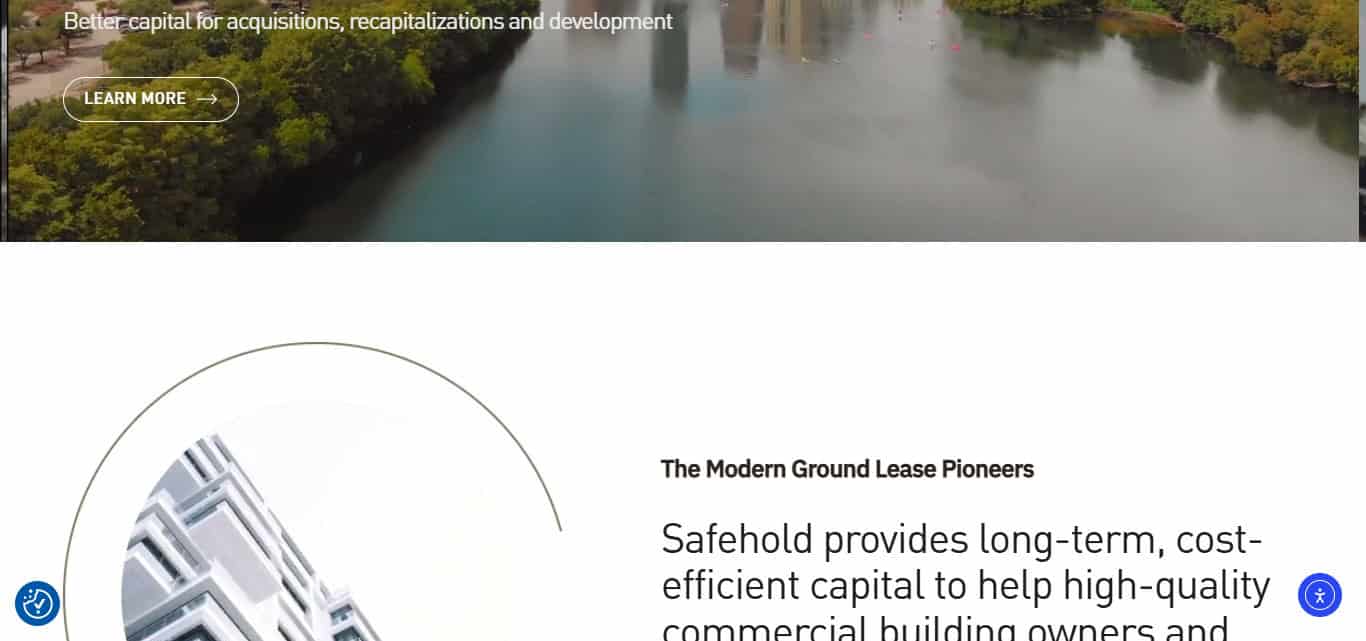
Safehold Inc. provides long-term ground leases that enable owners and developers of commercial real estate to unlock the value of a property while still owning and operating their buildings. It can offer capital solutions for property acquisitions, recapitalizations and new development projects.
Structure of the financing Safehold acquires the land interest and leases it to the building owner who pays ground rent on a long-term basis. The building owner can pair this arrangement with leasehold mortgage financing to reduce upfront equity requirements.
Financial terminology: Safehold says it generally does deals from $15 million to $500 million in public filings, with ground-lease terms that can stretch to 99 years and initial cap rates in the range of 4.25% to 5%. These are real terms, based on underwriting and the transaction.
Proven track record: The company says its core ground lease portfolio is valued at about $7 billion and it operates in major U.S. markets. Its public investor materials and regulatory filings provide useful information in evaluating its portfolio and its financing model.
Safehold, Inc. Features
- Long-Term Ground Leases: Offers long-term land leases that enable commercial property owners to capture land value while maintaining ownership of the building.
- Capital Efficiency: Reduces upfront equity requirements and allows for acquisitions, recapitalizations and development projects.
Versatile Property Coverage: Provides coverage for multifamily, office, hotel, retail, industrial, life sciences and other commercial property classes
Proven Market Position: Maintains a dedicated ground lease investment platform with a diversified portfolio throughout major U.S. markets.It’s a small story.
2. Mesirow Financial
Mesirow provides ground lease financing and structured capital solutions for commercial real estate owners and developers looking to increase leverage, protect equity or maximize investment returns. Its services are applicable to acquisitions, recapitalizations and existing income producing properties.
Financing structure: The firm can structure a ground lease transaction that separates land ownership from building ownership, making a direct loan to the ground lessor and providing additional leasehold debt as needed.

This method can increase the joint financing capacity over the separate property interests. Financial terms: Mesirow says a typical minimum transaction size is $10 million, ground lease structures can vary from 5 to 50 years, and ground lease financing leverage is typically 40%–55% of the property’s fee-simple cost before considering leasehold financing.
The price is a function of cash flow of the deal, quality of the assets and the structure of the deal.” Proven track record: Mesirow has completed more than 80 ground lease financing transactions totaling approximately $4.2 billion in issuance, making its published transaction data especially useful for CRE sponsors looking at specialist capital providers.
Mesirow Financial Features
- Ground Lease Financing: Financing structures that enable CRE owners to maximize leverage and improve their overall capital structure.
- Bifurcation expertise: Separates ownership of land from ownership of buildings, permitting financing of each interest independent of the other.
- Property Types: Commercial income-producing properties across asset classes subject to cash flow and underwriting requirements.
- Track Record of Transaction Success: Over 80 ground lease transactions completed and approximately $4.2 billion issued.
3. Haven Capital
Haven Capital offers ground lease financing to commercial real estate owners and developers seeking to unlock land value, improve capital efficiency or raise capital for acquisitions, development and recapitalizations. Its programs cover a range of property types including multifamily, student housing, office, hotels, retail and logistics.
Financing structure: Haven acquires the underlying land interest and leases it back to the property owner, who typically retains the building and operational control. Its programs feature repurchase options, which allow sponsors the potential flexibility to purchase the land back under agreed contractual terms.

Finance lingo: Haven’s published prepayable ground lease program has transaction sizes of $35 million to $500 million or more, an initial yield of 4.80% to 5.50%, loan-to-value ratios of 35% to 45%, and fixed annual rent increases of 2%, with periodic CPI increases subject to program terms.
These are program-specific and not guarantyd offers. TRACK RECORD VERIFIED: Haven has posted its financing framework, transaction rules and sample capital structures on its official website. CRE sponsors should get completed-deal references and current pricing before believing advertized capacity or terms.
Haven Capital Ground Lease Features
- Specialized Ground Lease Programs: Provides ground lease structures for property owners looking for capital without selling their buildings.
- Broad CRE Focus: Focuses on multifamily, student housing, office, hotel, grocery-anchored retail and logistics assets.
- Repurchase Options: Some programs contain contractual repurchase provisions, which could provide owners with the opportunity to repurchase the land.
- Published Financing Parameters: Offers indicative yields, leverage ranges, rent increases and transaction size guidelines to assist in assessing potential deals.
4. Ground Lease REIT
Leasehold REIT should be a category of real estate investment trust, not a verified individual provider, unless a specific legal entity and official website can be identified. Ground lease REITs typically acquire land interests and receive contractual rent from property owners or operators.
Financing structure: A ground lease-centric REIT typically buys the land under a commercial property and leases it to the owner of the building on the property for a long period. The lease grants the tenant rights for land-use and property operation, while the REIT receives ground rent and the contractual rights of the land owner.

Financial terms: Key items to evaluate include the lease term, initial rent, annual rent escalations, tenant credit quality, rent coverage, renewal provisions, and the disposition of the buildings at lease termination or default. Terms vary by investment and are not representative of an unnamed REIT.
Track record: Before adding a named REIT to a provider ranking, check the registered name, public filings, ground lease portfolio, completed acquisitions and reported rental income. Without that identification, specific transaction totals or terms of financing cannot be reliably verified.
Ground Lease REITs Features
- Ground Lease Investment Model: Ground lease REITs generally acquire land from owners of commercial properties under long-term lease agreements.
- Recurring Rental Income: Generates contractual rental income from tenants occupying land to operate commercial property.
- Longer Lease Terms: May include longer lease periods, periodic rent hikes, and specific tenant maintenance duties.
- Portfolio Diversification Potential: Investors can determine exposure by property sector, location, tenants and lease structure. Note: Specific legal entity is needed for the term “Ground Lease REIT” before company-specific features can be verified
5. Kawa Capital Management
Kawa Capital Management provides ground lease capital solutions to commercial real estate owners to fund development, acquisitions, recapitalizations, repositioning and renovations. Sponsors looking for an alternative to traditional mortgage debt or direct equity investment may be interested in its ground lease program.
Financing structure: Kawa structures transactions based on the separation of land ownership and building ownership, allowing property owners to monetize their land interest and yet retain the ability to operate or develop the improvements under a lease.

The firm’s published materials also speak to flexibility to invest across different positions in the capital stack. Financial terms: Sponsors should evaluate the proposed ground rent, term of lease, rent escalation schedule, repurchase provisions, transaction size and compatibility with existing or planned mortgage financing.
Kawa’s publicly available overview of ground leases does not provide a universal pricing schedule for all transactions, so current terms must be underwritten directly. Proven track record: Kawa says it has a 14-year history of ground leases, and says it has closed more than 20 transactions with a cumulative ground lease value of more than $1 billion over the five-year period discussed in its published materials. These numbers are a good reference point to evaluate its experience.
Kawa Capital Management Features
- Real Estate Capital Solutions: Review the services it reports on for investment and financing to assess its ability to serve the needs of commercial property transactions.
- Ground Lease Applicability: Determine if the firm has ground lease capital set aside for your property and transaction.
- Structured Financing Evaluation of potential capital structures, ownership arrangements and relationship of land to building interests.
- Track Record Verification: Request similar completed ground lease transactions, financing terms and references before considering it as a specialist provider.
6. Mohr Capital
Mohr Capital is a commercial real estate investment and development firm, recommended when researching property investment, acquisitions, development and capital structuring. However, it would be wise to verify whether there is a specific ground lease financing program before you call the company a specialist ground lease capital provider.
Financial arrangements: For any proposed ground lease transaction, sponsors should determine whether Mohr Capital would take ownership of the land interest, invest through another ownership structure, provide debt or participate in a larger property investment. These arrangements have different implications for ownership, control and future refinancing.

Financial language: Key points to confirm include minimum transaction size, target property types, lease length, escalation provisions for ground rent, repurchase rights, sponsor equity requirements and any debt or preferred equity components.
No ground lease pricing or standard financing terms should be assumed without a published program or written proposal. Track Record: Examine the firm’s history of documented property acquisitions, development projects, investment portfolios, and any direct ground lease transactions. To be credible as a CRE comparison, distinguish its broader real estate experience from verified ground lease financing experience.
Mohr Capital Ground Lease Features
- Commercial Real Estate Focus : Review the firm’s property investment and development activities for potential CRE capital investment opportunities.
- Ground Lease Availability: Don’t assume general investment activity includes direct ground lease financing, verify it.
- Structuring of the Deal: Determine if the transaction you are considering involves land purchase, leasehold ownership, debt or equity participation.
- Due Diligence Criteria: Confirm completed ground lease deals, approved property types, deal size minimums, and contract terms.
7. Grace Capital Group
Grace Capital Group provides ground lease financing that is designed to help developers and property owners improve capital efficiency, finance construction, stabilize assets or recapitalize existing properties. Its published program includes property types such as multifamily, hotels, senior housing, student housing, office, retail, industrial, self-storage and certain special-use projects.
Financing structure: The investor acquires the underlying land interest and leases it to the sponsor who holds the building and manages the property under the ground lease. Per Grace Capital, sponsors may be able to purchase the land back at a fixed price after a set period of time under optional repurchase arrangements.

Financial terms: Its published materials refer to repurchase options that may begin in year four, but actual pricing, rent escalation terms, lease length, transaction size and repurchase prices vary by transaction. Developers should consider the total cost of ground rent and repurchase obligations, compared to traditional debt and equity.
Grace Capital has a dedicated ground lease financing page and a closed transaction example of construction financing for Chase Tower in Los Angeles. Proven track record: Sponsors should ask for other similar transactions and written terms to see if the provider is a good fit for a particular CRE project.
Grace Capital Group Features
- Ground Lease Financing: A financing solution that helps eligible CRE owners unlock land value and improve capital efficiency.
- Multifamily, Office, Retail, Industrial, Hotel and Other Property Types: The published materials describe opportunities in multifamily, office, retail, industrial, hotel and other property types.
- Repurchase arrangements: Certain structures allow sponsors to repurchase the underlying land under agreed terms.
- Transaction Assessment: Before proceeding, review contracts, ground rent commitments, duration of leases, buyback price and sponsor’s eligibilit
8. CTL Capital LLC
“CTL Capital’s focus is on credit tenant lease financing, net lease financing and structured debt solutions for commercial properties with strong tenant credit and contractual rental income. It also provides bifurcated ground lease financing for qualifying existing ground leases or properties where a ground lease can be created.
Financing Structure: Credit tenant lease loans are used to support long-term financing based on the tenant’s creditworthiness and lease payment obligations. In the case of ground lease transactions, CTL Capital is able to split the land interest from the leasehold interest such that the two interests can be owned and financed separately under the terms of the ground lease.

Financials: Typical credit tenant loan structures include minimum loan sizes generally in the $5 million – $10 million range, long-term fixed-rate financing, and potential leverage up to 100% of loan-to-value for qualifying transactions.
Actual proceeds depend on tenant credit, lease structure, cash flow, underwriting. Its ground lease financing could involve long leases and debt sized separately for the land interest. Track record of success CTL Capital has more than $23 billion in net lease financing with over 500 leases and more than 75 million square feet of properties. Its official documents cite completed financings, including university and workforce housing projects.
CTL Capital LLC Features
- Credit Tenant Lease Financing: Long-term financing secured by leases or guaranties from creditworthy corporate and institutional tenants.
- Ground Lease Bifurcation: Allows separate ownership and financing of land and building interests.
- Long Term Fixed Rate Debt: Provides financing solutions to match debt with contractual lease revenue.
- Deep Financing Background: Closed over $23 billion in net lease financing on a portfolio of more than 500 leases.
9. The Shidler Group
Terra Funding Trust Investment vehicle of The Shidler Group, investing in and lending against leased fee interests in land underlying multifamily communities and multi-tenant commercial buildings under long-term ground leases. This makes it directly relevant to CRE sponsors seeking land-based investment dollars.
Capital structure Terra Funding can either invest in the leased-fee interest (i.e., the landowner’s ownership interest subject to the ground lease) or make loans secured by such interest. The building owner or operator remains the holder of the leasehold interest and is bound by the lease’s rent and other obligations under the contract.

Financial terms: Sponsors should review the amount of the investment or loan, coverage of ground rent, lease term, rent escalation provisions, collateral requirements and repayment or exit structure. Specific pricing, leverage limits and minimum transaction sizes should be confirmed with Terra Funding and should not be assumed from the general activities of the Shidler Group.
Proven track record: Terra Funding is listed in The Shidler Group’s official company information Trust as a dedicated investment vehicle and its focus on leased-fee interests. Get deal-level references or supporting documentation directly from the firm before publishing any transaction totals.
Terra Funding Trust – The Shidler Group Features
- Leased-Fee Investments: The Terra Funding Trust focuses on land interests that are subject to long-term ground leases under commercial buildings.
- Ground Lease Lending: The stated strategy is to invest in or lend against qualifying leased fee interests.
- Commercial Property Exposure – Looks at ground lease structures for multifamily communities and multi-tenant commercial buildings.
- Specialty Investment Structure: Collateral, ground rent cover, lease obligations, repayment terms, deal specific underwriting.
10. Eyzenberg & Company
The firm offers commercial real estate capital advisory services, including specialized ground lease capital solutions. Its published capabilities are centered on assisting sponsors to structure transactions that unlock the value of land, improve capital efficiency and optimize the combined financing of land and buildings.
Financing structure: The firm’s ground lease experience includes bifurcation transactions that separate a property’s leased-fee interest from its leasehold interest.

Depending on the transaction, Eyzenberg can act as principal or intermediary and help structure the relevant land and building financing. Financial terms: They should consider ground rent, length of lease, rent escalations, repurchase or exit provisions, availability of leasehold debt and the all-in cost of capital.
Also, since advisory and principal deals may be structured differently, borrowers should seek a deal-specific proposal spelling out fees, funding commitments and the responsibilities of each capital provider.
Proven track record: Eyzenberg’s official ground lease capital materials highlight its experience advising in bifurcation transactions and its role as both principal and intermediary. Ask about comparable transactions done, references, and whether the firm will put up the capital or find third party financing. Do your due diligence.
Eyzenberg & Company Features
- Ground Lease Capital Advisory: Helps CRE sponsors evaluate ground lease structures and potential capital optimization opportunities.
- Bifurcation Transactions: Supports arrangements that separate land interests from leasehold interests for financing purposes.
- Capital Structuring Expertise: Can assist with evaluating how ground leases interact with debt, equity, and property ownership.
- Transaction Due Diligence: Request completed ground lease examples and confirm whether the firm will invest directly or arrange third-party capita
Conclusion
Conclusion Choosing the Best Ground Lease Capital Providers for CRE requires thoughtful evaluation of financing structures, lease terms, capital availability, and proven transaction experience.
Companies like Safehold, Mesirow Financial, Haven Capital and CTL Capital provide alternative commercial real estate financing. Before you commit, consider ground rent, escalation clauses, repurchase options and long-term commitments so you choose a provider that’s right for your investment strategy and financial objectives.
FAQ
Who are the best ground lease capital providers for CRE?
Leading providers and firms to evaluate include Safehold Inc., Mesirow Financial, Haven Capital, Kawa Capital Management, Grace Capital Group, CTL Capital LLC, Terra Funding Trust, and Eyzenberg & Company. Their services and ground lease expertise vary.
How does ground lease financing work?
In a typical ground lease transaction, an investor purchases the land and leases it to a property owner for an extended period. The property owner retains the building and pays contractual ground rent while following the lease terms.
What are the main benefits of ground lease financing?
Ground lease financing can help property owners unlock land value, reduce upfront equity requirements, preserve capital for development, and potentially improve financing flexibility. However, ground rent and long-term contractual obligations must be carefully evaluated.
Which properties qualify for ground lease financing?
Eligible properties may include office buildings, multifamily communities, hotels, retail centers, industrial facilities, logistics properties, and other commercial assets. Eligibility depends on the provider’s investment criteria, location, property value, and income stability.